

Measuring implementation in global mental health: validation of a pragmatic implementation science measure in eastern Ukraine using an experimental vignette design
Open accessThe DOI matches its Crossref record; 33 of the 33 references it cites were found in a registry or an index.
Abstract
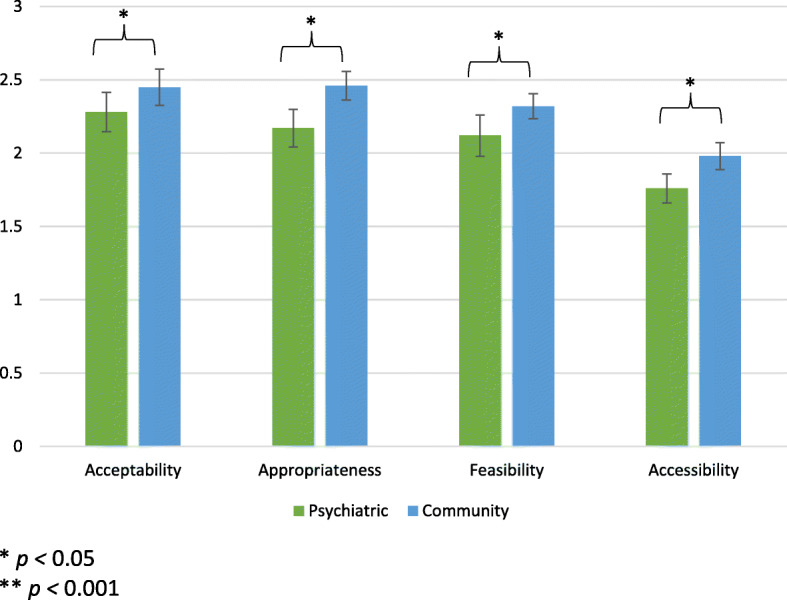
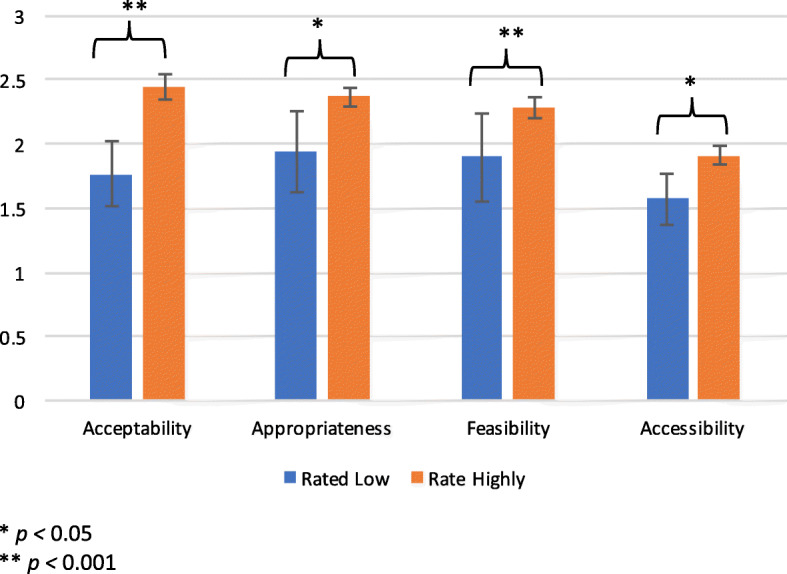
BACKGROUND: There is mounting evidence supporting the effectiveness of task-shifted mental health interventions in low- and middle-income countries (LMIC). However, there has been limited systematic scale-up or sustainability of these programs, indicating a need to study implementation. One barrier to progress is a lack of locally relevant and valid implementation measures. We adapted an existing brief dissemination and implementation (D&I) measure which includes scales for acceptability, appropriateness, feasibility and accessibility for local use and studied its validity and reliability among a sample of consumers in Ukraine. METHODS: Local qualitative data informed adaptation of the measure and development of vignettes to test the reliability and validity. Participants were veterans and internally displaced persons (IDPs) recruited as part of a separate validity study of adapted mental health instruments. We examined internal consistency reliability, test-retest reliability, and construct and criterion validity for each scale on the measure. We randomly assigned half the participants to respond to a vignette depicting existing local psychiatric services which we knew were not well regarded, while the other half was randomized to a vignette describing a potentially more well-implemented mental health service. Criterion validity was assessed by comparing scores on each scale by vignette and by overall summary ratings of the programs described in the vignettes. RESULTS: N = 169 participated in the qualitative study and N = 153 participated in the validity study. Qualitative findings suggested the addition of several items to the measure and indicated the importance of addressing professionalism/competency of providers in both the scales and the vignettes. Internal consistency reliabilities ranged from α = 0.85 for feasibility to α = 0.91 for appropriateness. Test-rest reliabilities were acceptable to good for all scales (rho: 0.61-0.79). All scales demonstrated substantial and significant differences in average scores by vignette assignment (ORs: 2.21-5.6) and overall ratings (ORs: 5.1-14.47), supporting criterion validity. CONCLUSIONS: This study represents an innovative mixed-methods approach to testing an implementation science measure in contexts outside the United States. Results support the reliability and validity of most scales for consumers in Ukraine. Challenges included large amounts of missing data due to participants' difficulties responding to questions about a hypothetical program.
Overview
The claims and statistics of this paper haven’t been checked yet.
Free: it reads the open-access text and checks the first 5 claims that cite a source we can check. Create a free account to check every claim.
Integrity signals
Registry
Cites
Statistics
Figures

Verification
Claims the paper makes
The claims and statistics of this paper haven’t been checked yet.
Free: it reads the open-access text and checks the first 5 claims that cite a source we can check. Create a free account to check every claim.
Claims other papers make about this one
Each is checked against this paper’s own text: does it say what the citing paper says it does?
The cited source says what the claim attributes to it.
In the citing paper
“Acceptability, appropriateness, and feasibility subscales adapted from a validated measure of Dissemination and Implementation (Haroz et al., 2019) were completed at the three- and six-month assessments.”
From Siyakhana: A Hybrid Type 2 Effectiveness-Implementation Stepped-Wedge Trial to Reduce Stigma Towards Substance Use and Depression Among Community Health Workers in HIV/TB Care in South Africa (2025) · cites this paper as Haroz et al., 2019
Self-check
Percentages, sums and reported differences re-computed from the paper’s own numbers.
The self-check needs the paper’s full text.
Citations
Cites
Damschroder, L. J., Aron, D. C., Keith, R. E., Kirsh, S. R., Alexander, J. A., & Lowery, J. C. (2009) · Implementation Science · doi:10.1186/1748-5908-4-50 · Cited by 14,496 · cited 2×
“Briefly, these measures were developed using a logical framework approach, and populated with items based on several leading implementation science frameworks (CFIR; [14], RE-AIM [15], EPIS [16] as well as our own experience and consultations with experts.”
BackgroundMethodProctor, E., Silmere, H., Raghavan, R., Hovmand, P., Aarons, G., Bunger, A., Griffey, R., & Hensley, M. (2011) · Administration and Policy in Mental Health and Mental Health Services Research · doi:10.1007/s10488-010-0319-7 · Cited by 8,721 · cited 4×
“Consumers are often included in the major theoretical frameworks that guide current D&I research [1, 14, 16], and are considered key stakeholders in the implementation process [36, 37].”
BackgroundMethodInfluentialEvaluating the public health impact of health promotion interventions: the RE-AIM framework.
Glasgow, R. E., Vogt, T. M., & Boles, S. M. (1999) · American Journal of Public Health · doi:10.2105/ajph.89.9.1322 · Cited by 7,217 · cited 3×
“Briefly, these measures were developed using a logical framework approach, and populated with items based on several leading implementation science frameworks (CFIR; [14], RE-AIM [15], EPIS [16] as well as our own experience and consultations with experts.”
MethodAdvancing a Conceptual Model of Evidence-Based Practice Implementation in Public Service Sectors
Aarons, G. A., Hurlburt, M., & Horwitz, S. M. (2011) · Administration and Policy in Mental Health and Mental Health Services Research · doi:10.1007/s10488-010-0327-7 · Cited by 3,240 · cited 3×
“Briefly, these measures were developed using a logical framework approach, and populated with items based on several leading implementation science frameworks (CFIR; [14], RE-AIM [15], EPIS [16] as well as our own experience and consultations with experts.”
BackgroundMethodProctor, E. K., Landsverk, J., Aarons, G., Chambers, D., Glisson, C., & Mittman, B. (2009) · Administration and Policy in Mental Health and Mental Health Services Research · doi:10.1007/s10488-008-0197-4 · Cited by 1,894
Bridging Research and Practice
Tabak, R. G., Khoong, E. C., Chambers, D. A., & Brownson, R. C. (2012) · American Journal of Preventive Medicine · doi:10.1016/j.amepre.2012.05.024 · Cited by 1,386 · cited 1×
“Based on conceptual frameworks [23] that show these constructs are important to implementation we would expect them to be correlated, but not perfectly [1].”
BackgroundMixed method designs in implementation research
Palinkas, L. A., Aarons, G. A., Horwitz, S., Chamberlain, P., Hurlburt, M., & Landsverk, J. (2011) · Administration and Policy in Mental Health and Mental Health Services Research · doi:10.1007/s10488-010-0314-z · Cited by 1,187 · cited 1×
“Use of mixed-methods research to develop and validate measures is not new in global mental health [21, 30–34] yet has rarely been done with implementation science measures, even in the US [11, 35].”
MethodExperimental Vignette Studies in Survey Research
Atzmüller, C., & Steiner, P. M. (2010) · Methodology · doi:10.1027/1614-2241/a000014 · Cited by 997 · cited 2×
“We employed an experimental vignette study design [19], one that has been used in other studies to test implementation measures in the United States [17].”
MethodHuman resources for mental health care: current situation and strategies for action
Kakuma, R., Minas, H., van Ginneken, N., Dal Poz, M. R., Desiraju, K., Morris, J. E., Saxena, S., & Scheffler, R. M. (2011) · The Lancet · doi:10.1016/s0140-6736(11)61093-3 · Cited by 979 · cited 1×
“Rarely, if ever, are services integrated into the general health system [5, 6].”
BackgroundAssessing organizational readiness for change
Lehman, W. E. K., Greener, J. M., & Simpson, D. D. (2002) · Journal of Substance Abuse Treatment · doi:10.1016/s0740-5472(02)00233-7 · Cited by 863 · cited 1×
“leadership, [27] organizational readiness for change [28], and compendiums of implementation measures [24, 25].”
BackgroundSignificance Testing of the Spearman Rank Correlation Coefficient
Zar, J. H. (1972) · Journal of the American Statistical Association · doi:10.1080/01621459.1972.10481251 · Cited by 689 · cited 1×
“Internal consistency reliability, using Cronbach’s Alpha, was also calculated [22].”
MethodGrimshaw, J., Eccles, M., Thomas, R., MacLennan, G., Ramsay, C., Fraser, C., & Vale, L. (2006) · Journal of General Internal Medicine · doi:10.1007/s11606-006-0269-7 · Cited by 631
Aarons, G. A., Ehrhart, M. G., & Farahnak, L. R. (2014) · Implementation Science · doi:10.1186/1748-5908-9-45 · Cited by 559 · cited 1×
“leadership, [27] organizational readiness for change [28], and compendiums of implementation measures [24, 25].”
BackgroundLewis, C. C., Fischer, S., Weiner, B. J., Stanick, C., Kim, M., & Martinez, R. G. (2015) · Implementation Science · doi:10.1186/s13012-015-0342-x · Cited by 430 · cited 1×
“information on reliability, 26% on structural validity, 18% on predictive validity and 4% on responsiveness [3].”
BackgroundSignificance Testing of the Spearman Rank Correlation Coefficient
Zar, J. H. (1972) · Journal of the American Statistical Association · doi:10.2307/2284441 · Cited by 396
Glasgow, R. E., & Riley, W. T. (2013) · American Journal of Preventive Medicine · doi:10.1016/j.amepre.2013.03.010 · Cited by 318 · cited 1×
“implementation science measures that are both relevant and feasible is a major priority [4].”
BackgroundInstrumentation issues in implementation science
Martinez, R. G., Lewis, C. C., & Weiner, B. J. (2014) · Implementation Science · doi:10.1186/s13012-014-0118-8 · Cited by 243 · cited 3×
“Use of mixed-methods research to develop and validate measures is not new in global mental health [21, 30–34] yet has rarely been done with implementation science measures, even in the US [11, 35].”
BackgroundMethodBOLTON, P. (2001) · The Journal of Nervous and Mental Disease · doi:10.1097/00005053-200104000-00005 · Cited by 239
Self-citationKohrt, B. A., Jordans, M. J., Tol, W. A., Luitel, N. P., Maharjan, S. M., & Upadhaya, N. (2011) · BMC Psychiatry · doi:10.1186/1471-244x-11-127 · Cited by 213
Multiple Segment Factorial Vignette Designs
Ganong, L. H., & Coleman, M. (2006) · Journal of Marriage and Family · doi:10.1111/j.1741-3737.2006.00264.x · Cited by 160 · cited 1×
“Using an experimental vignette study design [19, 20], we randomly assigned half the participants to read and respond to the “poorly”-implemented program, while the other half read and responded to the “well”-implemented program vignette.”
MethodLewis, C. C., Stanick, C. F., Martinez, R. G., Weiner, B. J., Kim, M., Barwick, M., & Comtois, K. A. (2016) · Implementation Science · doi:10.1186/s13012-014-0193-x · Cited by 155 · cited 1×
“leadership, [27] organizational readiness for change [28], and compendiums of implementation measures [24, 25].”
BackgroundAssessing local instrument reliability and validity: a field-based example from northern Uganda
Betancourt, T. S., Bass, J., Borisova, I., Neugebauer, R., Speelman, L., Onyango, G., & Bolton, P. (2009) · Social Psychiatry and Psychiatric Epidemiology · doi:10.1007/s00127-008-0475-1 · Cited by 124
Self-citationKaiser, B. N., Kohrt, B. A., Keys, H. M., Khoury, N. M., & Brewster, A.-R. T. (2013) · Transcultural Psychiatry · doi:10.1177/1363461513502697 · Cited by 123
Murray, L. K., Tol, W., Jordans, M., Sabir, G., Amin, A. M., Bolton, P., Bass, J., Bonilla-Escobar, F. J., & Thornicroft, G. (2014) · Intervention · doi:10.1097/wtf.0000000000000070 · Cited by 118 · cited 1×
“With the growing call for implementation research in global mental health [7, 8] it is critical to develop accurate measurement procedures and instruments in order to advance implementation science [3, 9–11].”
MethodSelf-citationClinton-McHarg, T., Yoong, S. L., Tzelepis, F., Regan, T., Fielding, A., Skelton, E., Kingsland, M., Ooi, J. Y., & Wolfenden, L. (2016) · Implementation Science · doi:10.1186/s13012-016-0512-5 · Cited by 116
Advancing implementation science through measure development and evaluation: a study protocol
Lewis, C. C., Weiner, B. J., Stanick, C., & Fischer, S. M. (2015) · Implementation Science · doi:10.1186/s13012-015-0287-0 · Cited by 115 · cited 9×
“As part of a three-year project sponsored by the United States Agency for International Development Victims of Torture Fund (VOT) JHU has partnered with NaUKMA to train mental health providers and peer veteran counselors in the Common Elements Treatment Approach (CETA) and test the intervention in a randomized control…”
MethodInfluentialOptimizing an Era of Global Mental Health Implementation Science
Betancourt, T. S., & Chambers, D. (2015) · JAMA Psychiatry · doi:10.1001/jamapsychiatry.2015.2705 · Cited by 111 · cited 1×
“With the growing call for implementation research in global mental health [7, 8] it is critical to develop accurate measurement procedures and instruments in order to advance implementation science [3, 9–11].”
MethodAdvancing the application, quality and harmonization of implementation science measures
Rabin, B. A., Purcell, P., Naveed, S., Moser, R. P., Henton, M. D., Proctor, E. K., Brownson, R. C., & Glasgow, R. E. (2012) · Implementation Science · doi:10.1186/1748-5908-7-119 · Cited by 106
Stirman, S. W., Gutner, C. A., Langdon, K., & Graham, J. R. (2016) · Behavior Therapy · doi:10.1016/j.beth.2015.12.001 · Cited by 103 · cited 1×
“Consumers are often included in the major theoretical frameworks that guide current D&I research [1, 14, 16], and are considered key stakeholders in the implementation process [36, 37].”
BackgroundMeasurement resources for dissemination and implementation research in health
Rabin, B. A., Lewis, C. C., Norton, W. E., Neta, G., Chambers, D., Tobin, J. N., Brownson, R. C., & Glasgow, R. E. (2015) · Implementation Science · doi:10.1186/s13012-016-0401-y · Cited by 92 · cited 1×
“leadership, [27] organizational readiness for change [28], and compendiums of implementation measures [24, 25].”
BackgroundHaroz, E. E., Bass, J. K., Lee, C., Murray, L. K., Robinson, C., & Bolton, P. (2014) · BMC Psychology · doi:10.1186/s40359-014-0031-6 · Cited by 71 · cited 1×
“outcomes for implementation research [1] which we had previously operationalized for use in non-Western settings [13, 21].”
MethodSelf-citationDevelopment and validation of the child psychosocial distress screener in Burundi.
Jordans, M. J. D., Komproe, I. H., Ventevogel, P., Tol, W. A., & de Jong, J. T. V. M. (2008) · American Journal of Orthopsychiatry · doi:10.1037/a0014216 · Cited by 45
Advancing Implementation Research and Practice in Behavioral Health Systems
Powell, B. J., & Beidas, R. S. (2016) · Administration and Policy in Mental Health and Mental Health Services Research · doi:10.1007/s10488-016-0762-1 · Cited by 34 · cited 1×
“Consumers are often included in the major theoretical frameworks that guide current D&I research [1, 14, 16], and are considered key stakeholders in the implementation process [36, 37].”
Background
Research works printed but not linked: 1
- Rogers EM. Elements of diffusion. Diffusion of innovations 2003, vol. 5. p. 1–38.
Cited by
Magidson, J. F., Joska, J. A., Belus, J. M., Andersen, L. S., Regenauer, K. S., Rose, A. L., Myers, B., Majokweni, S., O’Cleirigh, C., & Safren, S. A. (2021) · Journal of the International AIDS Society · doi:10.1002/jia2.25720 · Cited by 82
“Feasibility and acceptability were assessed based on uptake (percentage who initiated the intervention and session attendance respectively) and a validated quantitative measure was used for assessing implementation outcomes in Low-andmiddle-income countries (LMICs) [41], including feasibility, acceptability and approp…”
MethodDorsey, S., Gray, C. L., Wasonga, A. I., Amanya, C., Weiner, B. J., Belden, C. M., Martin, P., Meza, R. D., Weinhold, A., Soi, C., et al. (2020) · BMC Psychiatry · doi:10.1186/s12888-019-2364-4 · Cited by 76
“When possible, we also assess other implementation constructs using existing measures developed for use in low-resource contexts [51] and/or standardized measures reviewed and translated for appropriateness to assess intervention acceptability, feasibility [52], and perceived intervention effectiveness [51].”
MethodSelf-citationSingh, N. S., Bogdanov, S., Doty, B., Haroz, E. E., Girnyk, A., Чернобровкіна, В., Murray, L. K., Bass, J., & Bolton, P. A. (2021) · American Journal of Orthopsychiatry · doi:10.1037/ort0000537 · Cited by 71
Self-citationLovero, K. L., Kemp, C. G., Wagenaar, B. H., Giusto, A., Greene, M. C., Powell, B. J., & Proctor, E. K. (2023) · Implementation Science · doi:10.1186/s13012-023-01310-2 · Cited by 52
“There is now a growing evidence base for using implementation frameworks [34, 35] and measures [36, 37], and specific determinants to implementation [38] in LMICs have been identified.”
BackgroundAldridge, L. R., Kemp, C. G., Bass, J., Danforth, K., Kane, J. C., Hamdani, S. U., Marsch, L. A., Uribe-Restrepo, J. M., Nguyen, A. J., Bolton, P. A., et al. (2022) · Implementation Science Communications · doi:10.1186/s43058-022-00301-6 · Cited by 51
“[18], and greater than internal consistency estimates from most measures identified in a review of implementation science measures by ClintonMcHarg et al.”
BackgroundMethodResultSelf-citation
Metadata
- Authors
- Haroz, E. E., Bolton, P., Nguyen, A. J., Lee, C., Bogdanov, S., Bass, J., Singh, N. S., Doty, B., & Murray, L.
- Affiliations
- Johns Hopkins University (US)
- University of Virginia (US)
- National University of Kyiv-Mohyla Academy (UA)
- Corresponding author
- Haroz, E. E.
- Venue
- BMC Health Services Research
- Published
- 2019-04-29
- Volume
- 19
- Issue
- 1
- Pages
- 262-262
- ISSN
- 1472-6963 (ISSN-L)
- PMC
- PMC6489318
- OpenAlex
- W2947217834
- Cited by
- 70
- References
- 33
- Citations by year
- 2026: 6 · 2025: 15 · 2024: 14 · 2023: 8 · 2022: 14 · 2021: 6 · 2020: 5 · 2019: 1
- FWCI
- 8.85
- Type
- journal article
- Language
- en
- Open access
- gold
- doi.org
- Licence
- cc-by
- creativecommons.org/licenses/by/4.0 (tdm)
- creativecommons.org/licenses/by/4.0 (vor)
- Locations
- BMC Health Services Research (publishedVersion, cc-by)
- PubMed Central (publishedVersion, cc-by)
- PubMed (publishedVersion)
- Electronic Kyiv-Mohyla Academy Institutional Repository (National University of Kyiv-Mohyla Academy) (submittedVersion)
- DOAJ (DOAJ: Directory of Open Access Journals) (submittedVersion, cc-by-sa)
- Funders
- United States Agency for International Development (AID-OAA-LA-15-00003)
- National Institute of Mental Health (K01MH116335)
- Topics
- Health Sciences › Health Professions › General Health Professions › Health Policy Implementation Science
- Health Sciences › Medicine › Psychiatry and Mental health › Mental Health Treatment and Access
- Health Sciences › Nursing › Research and Theory › Health Education and Validation
- Keywords
- implementation measurement, dissemination and implementation research, scale adaptation, vignette design, construct validity, criterion validity, reliability statistics, veterans, internally displaced persons, Eastern Ukraine
- MeSH terms
- Implementation Science, Humans, Mental Health Services, Psychometrics, Research Design, Ukraine, Global Health, Reproducibility of Results, Qualitative Research
About these checks
Registry, retraction, Cites and statistics results are computed, not judged, with one exception: a printed reference that no index lists is read once by a model before it counts as a citation error. Claims are extracted by a model and kept only when their quote appears verbatim in the text; each cited source is then checked, with a model’s help, for whether it says what the claim relies on. Those verdicts can be wrong — read the claim’s quote and the cited source before relying on one.
Statistics and arithmetic are recomputed, not judged.
Confidence bands are shown only for fields calibrated on our annotated test set. None is calibrated yet, so no band is shown.
What counts as a claim ›How we measure confidence ›How we check this ›
Are you an author, or do you see a problem with this page? Request a review
Data sources
Bibliographic data: Semantic Scholar, OpenAlex, Crossref.
Contains information from the Semantic Scholar Academic Graph Datasets, made available under the ODC Attribution License (ODC-BY 1.0).
Semantic Scholar’s data is described in: Kinney, R., et al. (2023). The Semantic Scholar Open Data Platform. arXiv:2301.10140.
