

Unaddressed privacy risks in accredited health and wellness apps: a cross-sectional systematic assessment
Open accessThe DOI matches its Crossref record; 24 of the 24 references it cites were found in a registry or an index.
Abstract
BACKGROUND: Poor information privacy practices have been identified in health apps. Medical app accreditation programs offer a mechanism for assuring the quality of apps; however, little is known about their ability to control information privacy risks. We aimed to assess the extent to which already-certified apps complied with data protection principles mandated by the largest national accreditation program. METHODS: Cross-sectional, systematic, 6-month assessment of 79 apps certified as clinically safe and trustworthy by the UK NHS Health Apps Library. Protocol-based testing was used to characterize personal information collection, local-device storage and information transmission. Observed information handling practices were compared against privacy policy commitments. RESULTS: The study revealed that 89% (n = 70/79) of apps transmitted information to online services. No app encrypted personal information stored locally. Furthermore, 66% (23/35) of apps sending identifying information over the Internet did not use encryption and 20% (7/35) did not have a privacy policy. Overall, 67% (53/79) of apps had some form of privacy policy. No app collected or transmitted information that a policy explicitly stated it would not; however, 78% (38/49) of information-transmitting apps with a policy did not describe the nature of personal information included in transmissions. Four apps sent both identifying and health information without encryption. Although the study was not designed to examine data handling after transmission to online services, security problems appeared to place users at risk of data theft in two cases. CONCLUSIONS: Systematic gaps in compliance with data protection principles in accredited health apps question whether certification programs relying substantially on developer disclosures can provide a trusted resource for patients and clinicians. Accreditation programs should, as a minimum, provide consistent and reliable warnings about possible threats and, ideally, require publishers to rectify vulnerabilities before apps are released.
Overview
The claims and statistics of this paper haven’t been checked yet.
Free: it reads the open-access text and checks the first 5 claims that cite a source we can check. Create a free account to check every claim.
Integrity signals
Registry
Cites
Statistics
Figures
Verification
Claims the paper makes
The claims and statistics of this paper haven’t been checked yet.
Free: it reads the open-access text and checks the first 5 claims that cite a source we can check. Create a free account to check every claim.
Claims other papers make about this one
Each is checked against this paper’s own text: does it say what the citing paper says it does?
The source backs part of the claim, not all of it — or backs it for a different population, condition or comparison.
In the citing paper
“Clinical endorsement of digital health products and services including systems for regulation and accreditation of technology and data enabled services is required and has been suggested previously [42], and a recent systematic review of the international literature on barriers and facilitators to patient and public involvement with digital health has suggested this is a key issue [43].”
From Readiness for Delivering Digital Health at Scale: Lessons From a Longitudinal Qualitative Evaluation of a National Digital Health Innovation Program in the United Kingdom (2017) · cites this paper as [42]
Experimental — accuracy not yet measuredThe source backs part of the claim, not all of it — or backs it for a different population, condition or comparison.
In the citing paper
“The current situation is alarming, as recent studies report on privacy violations being a common occurrence with health and wellbeing (HWB) applications [26], [27].”
From Security and Privacy of mHealth Applications: A Scoping Review (2020) · cites this paper as [26]
Experimental — accuracy not yet measuredThe source backs part of the claim, not all of it — or backs it for a different population, condition or comparison.
In the citing paper
“Only one-third of the apps available had a confidentiality policy, which, in most cases, was incomplete (e.g., no specification on the use of data by a third party or incomplete explanations of the process for requesting changes to registered data as allowed by law).”
From Mobile intervention for individuals with psychosis, dual disorders, and their common comorbidities: A literature review (2019) · cites this paper as [122]
Experimental — accuracy not yet measuredThe cited source says what the claim attributes to it.
In the citing paper
“The study also reports that a large number of applications stored and transmitted unencrypted personal information.”
From Mobile intervention for individuals with psychosis, dual disorders, and their common comorbidities: A literature review (2019) · cites this paper as [122]
The cited source says what the claim attributes to it.
In the citing paper
“Applications were evaluated based on their compliance with data collection/transmission/storage guidelines, confidentiality, privacy policy content, and the adequacy of these policies for the application’s actual behavior.”
From Mobile intervention for individuals with psychosis, dual disorders, and their common comorbidities: A literature review (2019) · cites this paper as [122]
3 more claims about this paper
Create a free account to see every claim other papers make about this one.
Self-check
Percentages, sums and reported differences re-computed from the paper’s own numbers.
The self-check needs the paper’s full text.
Citations
Cites
Information Privacy Research: an Interdisciplinary Review1
Smith, H. J., Dinev, T., & Xu, H. (2011) · MIS Quarterly · doi:10.2307/41409970 · Cited by 2,013 · cited 1×
“Health apps may put patient privacy, defined here as the right of individuals to con-trol how their information is collected and used [7] (other definitions are possible [8]), at risk in a number of ways [9].”
BackgroundInternet of Things – New security and privacy challenges
Weber, R. H. (2010) · Computer Law & Security Review · doi:10.1016/j.clsr.2009.11.008 · Cited by 1,454 · cited 1×
“Privacy issues are likely to only become more complex with the advent of wearable medical technologies, devices connected via the Internet of Things [45] and large-scale ‘ big data ’ analyses that combine information about individuals from multiple sources.”
BackgroundSecurity and Privacy Challenges in Cloud Computing Environments
Takabi, H., Joshi, J. B. D., & Ahn, G.-J. (2010) · IEEE Security & Privacy Magazine · doi:10.1109/msp.2010.186 · Cited by 1,319 · cited 1×
“These may arise as a result of technical and organizational challenges in ensuring the appropriate storage, handling and transfer of information held in online storage [55].”
BackgroundHealthcare in the pocket: Mapping the space of mobile-phone health interventions
Klasnja, P., & Pratt, W. (2012) · Journal of Biomedical Informatics · doi:10.1016/j.jbi.2011.08.017 · Cited by 970 · cited 1×
“Mobile apps – software programs running on devices like smartphones – offer a wide range of potential medical and health-related uses [1].”
BackgroundCan Mobile Health Technologies Transform Health Care?
Steinhubl, S. R., Muse, E. D., & Topol, E. J. (2013) · JAMA · doi:10.1001/jama.2013.281078 · Cited by 496
Availability and quality of mobile health app privacy policies
Sunyaev, A., Dehling, T., Taylor, P. L., & Mandl, K. D. (2015) · Journal of the American Medical Informatics Association · doi:10.1136/amiajnl-2013-002605 · Cited by 360 · cited 2×
“Recent Recent privacy-focused reviews of health and wellness apps available through generic app stores have consistently identified gaps in the extent to which data uses are fully documented and appropriate security mechanisms implemented [10 – 13].”
BackgroundMan-in-the-Middle Attack to the HTTPS Protocol
Callegati, F., Cerroni, W., & Ramilli, M. (2009) · IEEE Security & Privacy Magazine · doi:10.1109/msp.2009.12 · Cited by 347 · cited 1×
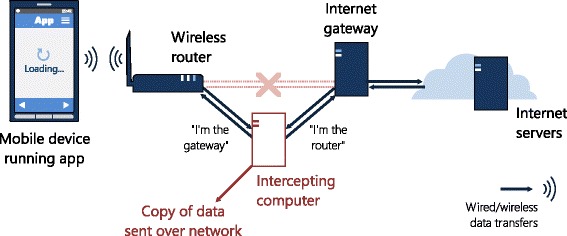
“By making a simple configuration change to the operating systems on each test device, we were able to intercept encrypted communications in addition to unsecured traffic (principles explained in Additional file 1: Figure AF2) [28].”
BackgroundPrivacy and Security in Mobile Health Apps: A Review and Recommendations
Martínez-Pérez, B., de la Torre-Díez, I., & López-Coronado, M. (2015) · Journal of Medical Systems · doi:10.1007/s10916-014-0181-3 · Cited by 342 · cited 3×
“and infrastructure designed to secure the online processing of clinical data [31, 44].”
BackgroundA Review on the State-of-the-Art Privacy-Preserving Approaches in the e-Health Clouds
Abbas, A., & Khan, S. U. (2014) · IEEE Journal of Biomedical and Health Informatics · doi:10.1109/jbhi.2014.2300846 · Cited by 331 · cited 1×
“Recent work has illustrated the scope for threats arising from online storage of health information and identified privacy-preserving strategies that could inform future studies that assess compliance more directly [56].”
BackgroundFor Telehealth To Succeed, Privacy And Security Risks Must Be Identified And Addressed
Hall, J. L., & McGraw, D. (2014) · Health Affairs · doi:10.1377/hlthaff.2013.0997 · Cited by 297 · cited 1×
“Because health and, in particular, wellness apps are often provided by organizations that are not traditional medical providers, they can sit outside the scope of existing legal and professional safeguards [50].”
Background
Research works printed but not linked: 4
- Cohn SP Privacy and confidentiality in the nationwide health information network 2006 Washington National Committee on Vital and Health Statistics
- England NHS Five year forward view 2014 London HM Government
- Information Commissioner’s Office Privacy notices code of practice 2010 Wilmslow Information Commissioner’s Office
- Federal Trade Commission Mobile privacy disclosures – building trust through transparency 2013 USA Federal Trade Commission
Cited by
Items 201–300 of 410
Technology Matters: Mental health apps – separating the wheat from the chaff
Bergin, A., & Davies, E. B. (2020) · Child and Adolescent Mental Health · doi:10.1111/camh.12363 · Cited by 11
Jones, C., O'Toole, K., Jones, K., & Brémault-Phillips, S. (2020) · JMIR mHealth and uHealth · doi:10.2196/19807 · Cited by 11
“Although no regulations or standards exist regarding the frequency with which a developer should update an app, these apps should ideally be updated regularly enough to reflect the rapidly changing evidence base and recommendations regarding psychoeducation and mTBI management [28].”
BackgroundIrawan, A. S., Alristina, A. D., Laili, R. D., Amalia, N., Muharram, A. P., Miranda, A. V., Döbrössy, B., & Girasek, E. (2025) · Frontiers in Digital Health · doi:10.3389/fdgth.2025.1621293 · Cited by 13
Patient-generated data in the management of HIV: a scoping review
Hewitt, C., Lloyd, K. C., Tariq, S., Durrant, A. C., Claisse, C., Kasadha, B., & Gibbs, J. (2021) · BMJ Open · doi:10.1136/bmjopen-2020-046393 · Cited by 11
Zhang, H., Wang, T., Zhang, Z., Lin, B., Mei, Y., Zhang, Y., & Chen, G. (2020) · Medicine · doi:10.1097/md.0000000000020656 · Cited by 11
“These changes bring potential clinical advantages, but also expose new risks.([10]) On one hand, the widespread development and usage for apps offer new pathways tomanage chronic diseases, especially stroke.”
BackgroundInfluentialAdopting wearables to customize health insurance contributions: a ranking-type Delphi
Neumann, D., Tiberius, V., & Biendarra, F. (2022) · BMC Medical Informatics and Decision Making · doi:10.1186/s12911-022-01851-4 · Cited by 10
What Clinicians Should Tell Patients About Wearable Devices and Data Privacy: A Narrative Review
Pergolizzi, J. V., LeQuang, J. A., El-Tallawy, S. N., & Varrassi, G. (2025) · Cureus · doi:10.7759/cureus.81167 · Cited by 11
“A key concern with data storage is the ability of data to cross state and even country lines, in which case the laws of the destination locality govern how the data are to be handled [21].”
On Mobile Health, Empowerment, and the Limits of Task Shifting in Healthcare
Gray, J. (2025) · The American Journal of Bioethics · doi:10.1080/15265161.2025.2554771 · Cited by 10
“Similar optimism surrounded the National Health Service England’s (NHS) digital health library, which was decommissioned shortly after inception when it was revealed that several listed apps were inconsistent with the NHS’s own criteria (Huckvale et al. 2015; Tsekleves 2015).”
An Iterative and Collaborative End-to-End Methodology Applied to Digital Mental Health
Boulos, L., Mendes, A., Delmas, A., & Kaadoud, I. C. (2021) · Frontiers in Psychiatry · doi:10.3389/fpsyt.2021.574440 · Cited by 12
Privacy and Trust in eHealth: A Fuzzy Linguistic Solution for Calculating the Merit of Service
Ruotsalainen, P. S., Blobel, B. G. M. E., & Pohjolainen, S. A. (2022) · Journal of Personalized Medicine · doi:10.3390/jpm12050657 · Cited by 12
“…privacy and trust information, such as: to which unknown partners and purposes PHI is disclosed; data ownership; whether the SerP and other stakeholders will behave as expected and purposes; and the legitimacy and presence of the vendor, and the quality of the health services offered [58,68–70].”
BackgroundTorous, J. B., Powell, A. C., & Knable, M. B. (2016) · Psychiatric Annals · doi:10.3928/00485713-20160908-02 · Cited by 10
Iglesias-Posadilla, D., Gómez-Marcos, V., & Hernández-Tejedor, A. (2017) · Medicina Intensiva · doi:10.1016/j.medin.2017.01.003 · Cited by 12
Health Lifestyle Data-Driven Applications Using Pervasive Computing
Fernández-Luque, L., Aupetit, M. J. M., Palotti, J., Singh, M., FADLELBARI, A. M., Baggag, A., Khowaja, K., & Al‐Thani, D. (2019) · Lecture notes in bioengineering · doi:10.1007/978-3-030-06109-8_10 · Cited by 10
Jakob, L., Steeb, T., Fiocco, Z., Pumnea, T., Jakob, S. N., Wessely, A., Rothenberger, C., Brinker, T. J., French, L. E., Berking, C., et al. (2020) · JMIR mhealth and uhealth · doi:10.2196/16517 · Cited by 10
“Furthermore, privacy, moral, and ethical concerns have been raised [3,4].”
Privacy in Mobile Health Applications for Breast Cancer Patients
Benjumea, J., Dorronzoro, E., Ropero, J., Rivera-Romero, O., & Carrasco, A. (2019) · Proceedings - IEEE Symposium on Computer-Based Medical Systems · doi:10.1109/cbms.2019.00131 · Cited by 19
“On the other hand, [24] assess privacy risks on 79 applications certified as safe by the UK National Health System.”
BackgroundShareDNA: a smartphone app to facilitate family communication of genetic results
Jujjavarapu, C., Anandasakaran, J., Amendola, L. M., Haas, C. B., Zampino, E., Henrikson, N. B., Jarvik, G. P., & Mooney, S. D. (2021) · BMC Medical Genomics · doi:10.1186/s12920-020-00864-0 · Cited by 12
Application and Challenges of Machine Learning in Healthcare
Yadav, K. K., & Gaurav, A. (2023) · International Journal for Research in Applied Science and Engineering Technology · doi:10.22214/ijraset.2023.55678 · Cited by 10
Digital therapeutics as an emerging new therapy for diabetes mellitus: potentials and concerns
Li, S., Tao, J., Tang, J., Chu, Y., & Wu, H. (2024) · Endocrine Connections · doi:10.1530/ec-24-0219 · Cited by 11
“The study found that most apps do not widely use data transmission encryption and often share information with third-party servers, or even lack specific privacy protocols, leading to health issues such as reduced data security and serious threats to user data privacy and security ( 46 , 47 , 48).”
BackgroundJoung, K.-I., An, S. H., Bang, J. S., & Kim, K. J. (2025) · JMIR mhealth and uhealth · doi:10.2196/64527 · Cited by 10
“These technologies offer advantages such as real-time data collection, personalized feedback, and continuous monitoring, potentially enhancing user engagement and promoting sustainable behavior change to reduce metabolic syndrome risks [5,6].”
Non-pharmacological interventions for breathlessness in people with cancer
Booth, S., Chin, C. A., Spathis, A., Maddocks, M. M., Yorke, J., Burkin, J., Moffat, C., Farquhar, M. C., & Bausewein, C. (2018) · Expert Review of Quality of Life in Cancer Care · doi:10.1080/23809000.2018.1524708 · Cited by 12
Digital health evaluation workshop for interprofessional healthcare students
Aungst, T. D., Lahoz, M. R., & Evans, P. (2017) · Digital Health · doi:10.1177/2055207617740089 · Cited by 9
Research on the application of mobile payment security system based on the Internet of Things
Xu, B., Huang, D., & Mi, B. (2020) · Concurrency and Computation Practice and Experience · doi:10.1002/cpe.5779 · Cited by 9
Lewczuk, K., Górowska, M. P., Li, Y., & Gola, M. K. (2020) · Frontiers in Psychiatry · doi:10.3389/fpsyt.2020.00807 · Cited by 8
“Although tracking objective indicators of online behavior and offering tailored interventions are possible with mobile devices, it raises ethical issues connected to gathering, managing, and storing sensitive, personal data (56).”
BackgroundReal-Time Assessment of Stress and Stress Response Using Digital Phenotyping: A Study Protocol
Egger, S., Knorr, M. S., Bobes, J., Bernstein, A., Seifritz, E., & Vetter, S. (2020) · Frontiers in Digital Health · doi:10.3389/fdgth.2020.544418 · Cited by 8
Perera, A. G., Sancha, P., & Jiménez, M. D. A. J. (2021) · Journal of Medical Systems · doi:10.1007/s10916-021-01748-1 · Cited by 8
Self-tests for influenza: an empirical ethics investigation
Rumbold, B. E., Wenham, C., & Wilson, J. (2017) · BMC Medical Ethics · doi:10.1186/s12910-017-0192-y · Cited by 9
“Moreover, earlier work showed that even apps that had undergone a process of appraisal to enter the curated NHS Health Apps Library raised very serious concerns of privacy and data protection [53].”
BackgroundGabel, A., Schiering, I., Müller, S., & Ertas, F. (2018) · IFIP advances in information and communication technology · doi:10.1007/978-3-319-92925-5_22 · Cited by 9
“Evaluations of health apps [26] reveal several deficits concerning privacy and information security.”
Measuring privacy policy compliance in the Alexa ecosystem: In-depth analysis
Shafei, H. A., Gao, H., & Tan, C. C. (2024) · Computers & Security · doi:10.1016/j.cose.2024.103963 · Cited by 7
Lin, Y., Lemos, M., & Neuschaefer‐Rube, C. (2022) · JMIR Medical Education · doi:10.2196/34042 · Cited by 10
“Given that many health apps are free and paid for, often using personal data for personalized advertisement and marketing, such fears are understandable [51]; however, it was”
BackgroundMorley, J., Laitila, J., Ross, J. S., Schamroth, J., Zhang, J., & Floridi, L. (2025) · Minds and Machines · doi:10.1007/s11023-025-09710-7 · Cited by 8
“Evidently, none of these strategies have proven to be particularly successful (Huckvale et al., 2015), at least not at scale.”
Daniels, K., Vonck, S., Robijns, J., Spooren, A. I. F., Hansen, D., & Bonnechère, B. (2025) · BMJ Open · doi:10.1136/bmjopen-2024-095769 · Cited by 8
Roberts, L. W., & Torous, J. B. (2016) · Academic Psychiatry · doi:10.1007/s40596-016-0594-z · Cited by 7
Hughes, C., & Moxham-Hall, V. L. (2017) · Substance Abuse Research and Treatment · doi:10.1177/1178221817711419 · Cited by 10
Is the future of leadership development wearable? Exploring self-tracking in leadership programs
Ruderman, M. N., & Clerkin, C. (2020) · Industrial and Organizational Psychology · doi:10.1017/iop.2020.18 · Cited by 9
Mobile Health App Privacy Policies: What Patients Want vs. Understand
Siberry, V. G. R., Ratwani, R. M., & Wesley, D. B. (2022) · Proceedings of the International Symposium on Human Factors and Ergonomics in Health Care · doi:10.1177/2327857922111031 · Cited by 10
“Many health apps gain permission to read and share patient data, yet do not have a privacy policy, have a privacy policy only available in English, omit data sharing practices or data encryption information from the policy, or present the policy at a reading level inaccessible to most of the population.(6-8,10-15) Thi…”
BackgroundProliferation of private online healthcare companies
Watson, J., Salisbury, C., Atherton, H., Campbell, J., McKinstry, B., & Ziébland, S. (2016) · BMJ · doi:10.1136/bmj.i1076 · Cited by 7
Simulation environment for testing security and privacy of mobile health apps
(2016) · Modeling and Simulation in Medicine Symposium (MSM 2016) · doi:10.22360/springsim.2016.msm.008 · Cited by 6
Enhancing security in patient medical information exchange: A qualitative study
Manns, A., Pezziardi, T., Kadlub, N., Burgun, A., Destrez, A., & Tsopra, R. (2025) · International Journal of Medical Informatics · doi:10.1016/j.ijmedinf.2025.105841 · Cited by 6
Guo, Y., Zou, K., Yang, M., & Liu, C. (2022) · IEEE Access · doi:10.1109/access.2022.3198705 · Cited by 7
“To analyze the impact of R p on app distribution platform strategy choice, we set R p ∈ [0 , 36] with a step size of 6.”
BackgroundMethodFuture pHealth Ecosystem-Holistic View on Privacy and Trust
Ruotsalainen, P. S., & Blobel, B. G. M. E. (2023) · Journal of Personalized Medicine · doi:10.3390/jpm13071048 · Cited by 6
“Unfortunately, commercial service providers often have low incentives to enforce strong privacy policies, and they often do not keep the privacy promises expressed in their policy documents [73,74].”
BackgroundDanger vs Fear: An Empirical Study on Wearable Users' Privacy Coping
Baskaran, K., & Mathew, S. K. (2020) · ACM SIGCPR Conference on Computer Personnel Research (SIGCPR) · doi:10.1145/3378539.3393856 · Cited by 11
“Health information disclosure concerns have also been highlighted in previous studies indicating this to be a major issue in the adoption of digital health technology [10,26,42].”
BackgroundStakeholders' views and opinions on existing guidelines on “How to Choose Mental Health Apps”
Khan, W., Jebanesan, B., Ahmed, S., Trimmer, C., Agic, B., Safa, F., Ashraf, A., Tuck, A. C., Kavic, K., Wadhawan, S., et al. (2023) · Frontiers in Public Health · doi:10.3389/fpubh.2023.1251050 · Cited by 6
“For example, the NHS Apps Library, which assessed Apps against a defined set of criteria, was released but quickly rolled back due to public outcry following news that highlighted privacy and security gaps in many of the Apps (23).”
BackgroundInfluentialAre PETs (Privacy Enhancing Technologies) Giving Protection for Smartphones? -- A Case StudyPreprint
Sharma, T., & Bashir, M. (2020) · arXiv (Cornell University) · doi:10.13140/rg.2.2.31719.06568 · Cited by 6
Bene, B. A., Ibeneme, S., Fadahunsi, K. P., Harri, B. I., Ukor, N., Mastellos, N., Majeed, A., & Car, J. (2022) · BMJ Open · doi:10.1136/bmjopen-2021-058067 · Cited by 6
Self-citationNavigating the frontier: Integrating emerging biomedical technologies into modern healthcare
Alla, S., Mohanty, J., Sriraman, H., & Chattu, V. K. (2024) · Elsevier eBooks · doi:10.1016/b978-0-443-22038-8.00015-5 · Cited by 5
Mager, A., & Mayer, K. (2019) · Momentum Quarterly - Zeitschrift für sozialen Fortschritt · doi:10.15203/momentumquarterly.vol8.no2.p95-108 · Cited by 10
Mobile Healthcare in an Increasingly Connected Developing World
Yadav, N., Aliasgari, M., & Poellabauer, C. (2016) · International Journal of Privacy and Health Information Management · doi:10.4018/ijphim.2016070106 · Cited by 5
Mantovani, E., & Bocos, P. C. (2017) · Human-computer interaction series · doi:10.1007/978-3-319-60672-9_12 · Cited by 8
Development and Presentation of an Ethical Framework for Health and Medical Apps
Tokgöz, P., Eger, H., Funke, S. S., Gutjar, A., Nguyen-Thi, T., & Dockweiler, C. (2019) · Journal of the International Society for Telemedicine and eHealth · doi:10.29086/jisfteh.7.e15 · Cited by 5
“Five publications deal with ethical concerns regarding the regulation and approval of health and medical apps.(6,11,18,33,34) Only one publication addresses developers of health and medical apps and”
BackgroundUser-Centred Design-Based Privacy and Security Framework for Developing Mobile Health Applications
Hasan, U., Islam, M. N., Anuva, S. T., & Tahmid, A. R. (2021) · Algorithms for intelligent systems · doi:10.1007/978-981-16-0586-4_17 · Cited by 5
Involving Users in the Evaluation of Apps for Specific Health Conditions
Powell, L., Joddrell, P., & Parker, J. C. (2017) · Studies in health technology and informatics · doi:10.3233/978-1-61499-798-6-646 · Cited by 5
“accredited apps in the NHS Health Apps Library [9] and the challenge and subsequent Federal Trade Commission charges against the creators and marketers of the ‘braintraining’ app ‘Lumosity’ for deceiving customers with unfounded claims [10, 11].”
BackgroundDigital Psychiatry: Ethical Risks and Opportunities for Public Health and Well-BeingPreprint
Burr, C., Morley, J., Taddeo, M., & Floridi, L. (2019) · SSRN Electronic Journal · doi:10.13140/rg.2.2.32805.45289 · Cited by 5
Standards for mobile health-related apps (Preprint)Preprint
Miró, J., & Llorens-Vernet, P. (2018) · doi:10.2196/preprints.13057 · Cited by 5
Limited validity of an AI-powered app for dietary assessment in females with obesity
Serra, M., Alceste, D., Jucker, N., Haupt, L., Elben, S., Müller, S., Hulshof, P. J. M., Meijer, H. A. J., Thalheimer, A., Steinert, R. E., et al. (2026) · npj Digital Medicine · doi:10.1038/s41746-026-02536-2 · Cited by 4
Silver Surfers on the Tech Wave: Privacy Analysis of Android Apps for the Elderly
Kapoor, P., Pagey, R., Mannan, M., & Youssef, A. (2023) · Lecture notes of the Institute for Computer Sciences, Social Informatics and Telecommunications Engineering · doi:10.1007/978-3-031-25538-0_35 · Cited by 4
“Huckvale et al. [13] assessed 79 clinically safe medical/health apps used by chronic and unwell persons, and found that 23/79 of apps sent unencrypted PII over the Internet, 63/79 apps communicated directly with third-party services and 53/79 of apps had some form of privacy policy.”
BackgroundMobile health apps: Current state, barriers, and future directions
Kao, C., Moawad, A., & Bhargava, A. (2025) · Elsevier eBooks · doi:10.1016/b978-0-443-15728-8.00019-7 · Cited by 5
Smartphone und Depression: Ursache oder Therapie?
Spitzer, M. (2018) · Nervenheilkunde · doi:10.1055/s-0038-1631165 · Cited by 5
Błachnio, A., Przepiórka, A., Gorbaniuk, O., McNeill, M., Bendayan, R., Durak, M., Şenol-Durak, E., Ben‐Ezra, M., Benvenuti, M., Angeluci, A. C. B., et al. (2022) · Frontiers research topics · doi:10.3389/978-2-88974-249-3 · Cited by 4
Apps and intensive care medicine
Iglesias-Posadilla, D., Gómez-Marcos, V., & Hernández-Tejedor, A. (2017) · Medicina Intensiva (English Edition) · doi:10.1016/j.medine.2017.01.003 · Cited by 5
Analyzing Privacy Policies of Zero Knowledge Cloud Storage Applications on Mobile Devices
Baalous, R., Poet, R., & Storer, T. (2018) · IEEE International Conference on Cloud Engineering · doi:10.1109/ic2e.2018.00047 · Cited by 6
“[19] examined 79 NHS health applications' privacy policies.”
BackgroundProtección de Datos Personales en el Marco de la COVID-19: el Caso de CoronApp en Colombia
Peña, K. I. C., & Montenegro, Y. A. (2022) · Law State and Telecommunications Review · doi:10.26512/lstr.v14i1.39063 · Cited by 5
Navigating the Ethical Maze in Digital Health Research
Nebeker, C. (2024) · The American Journal of Bioethics · doi:10.1080/15265161.2024.2298145 · Cited by 4
“Ensuring that prospective participant can fully understand the potential risks associated with the collection, storage, and sharing, including RRI, of sensitive health data is challenging (Huckvale et al. 2015).”
BackgroundRisk Management Governance in Applications
Alolayan, R. M. (2020) · doi:10.7176/ikm/10-2-07 · Cited by 3
Garfield, S., Furniss, D. J., Husson, F., Turley, M., & Franklin, B. D. (2018) · BMJ Open · doi:10.1136/bmjopen-2018-021764 · Cited by 3
“Such features might include the ability to record current and recent medication (including over the counter and complementary medication, oxygen and vaccinations where relevant), allergies and sensitivities, compliance aids, problems with taking medication (eg, swallowing difficulties), ability to record comments abou…”
MethodDigital Sensory Phenotyping for Psychiatric Disorders
Dai, R., Yu, C., Xia, C., Zhou, J., Liu, C., & Chen, C. (2020) · Journal of Psychiatry and Brain Science · doi:10.20900/jpbs.20200015 · Cited by 5
“Unfortunately, inadequate privacy protection has already infested digital health care collections, including estimations of mental health and behavior, as discovered by a 6-month systematic assessment [152].”
BackgroundEthical, Legal, and Social Issues (ELSI) in Mental Health Informatics
Subbian, V., Galvin, H. K., Petersen, C. C., & Solomonides, A. E. (2021) · Health informatics · doi:10.1007/978-3-030-70558-9_18 · Cited by 4
Privacy and Trust in pHealth – Past, Present and Future
Ruotsalainen, P. S., & Blobel, B. G. M. E. (2022) · Studies in health technology and informatics · doi:10.3233/shti220968 · Cited by 3
Thematic analysis of google play reviews of lifestyle apps
Keller, V., & Ercsey, I. (2023) · Human Technology · doi:10.14254/1795-6889.2023.19-1.6 · Cited by 3
“They highlighted the risks of advertising within apps due to its association with compromising privacy by allowing personal data to be sent to advertisers (Huckvale et al., 2015).”
BackgroundResultBabbage, C. M., Wagner, H., Dowthwaite, L., Portillo, V., Vallejos, E. P., & Fischer, J. E. (2024) · Internet Interventions · doi:10.1016/j.invent.2024.100740 · Cited by 4
“…public were held on the NHS Health Apps Library from 2013 to 2021 (Digital National Health Service, 2022) found two thirds did not have a privacy policy, half the apps were sending personal data without encryption and 10 % of apps sent unencrypted usernames and passwords (Huckvale et al., 2015).”
Lupton, D. A., & Pedersen, S. (2015) · Analysis & Policy Observatory · doi:10.4225/50/56257a98736ed · Cited by 4
“Many of the most popular health and medical apps send data unencrypted, thus rendering personal data open to hacking (Adhikari et al., 2014; Huckvale et al., 2015).”
BackgroundApps in der digitalen Prävention und Gesundheitsförderung
Albrecht, U., & von Jan, U. (2019) · Springer Reference Pflege, Therapie, Gesundheit · doi:10.1007/978-3-662-58314-2_40 · Cited by 3
Hitcham, L., Bergin, A., Ito‐Jaeger, S., Reeves, S., & Vallejos, E. P. (2026) · JMIR Mental Health · doi:10.2196/92187 · Cited by 2
“However, after concerns were raised about data security [22] and about the lack of an evidence base for the recommended apps [23], the library was suspended.”
ACSIMA: A Cyber Security Index for Mobile Health Apps
Sellak, H., Chhetri, M. B., Grobler, M. M., & Moore, K. (2021) · IEEE/ACM International Conference on Automated Software Engineering Workshops (ASEW) · doi:10.1109/asew52652.2021.00039 · Cited by 3
Apps in der digitalen Prävention und Gesundheitsförderung
Albrecht, U., & von Jan, U. (2018) · Springer Reference Pflege, Therapie, Gesundheit · doi:10.1007/978-3-662-54179-1_40-1 · Cited by 2
Introduction to wearable technology in arrhythmia management
Pérez-Guerrero, E. J., Mehrotra, I., Jain, S. S., & Perez, M. V. (2024) · Heart Rhythm · doi:10.1016/j.hrthm.2024.07.098 · Cited by 2
Sakka, S., Pavlidis, N., Liagkou, V., Panges, I., Filippidou, D. E., Stylios, C. D., & Manos, A. (2025) · Journal of Cybersecurity and Privacy · doi:10.3390/jcp5030045 · Cited by 2
Beyond Health Apps, Utilize Patient-Generated Data
Akram, A., Dunleavy, G., Soljak, M., & Car, J. (2017) · Communications in computer and information science · doi:10.1007/978-3-319-67642-5_6 · Cited by 3
Self-citationLearn from the mistakes of care.data
Mann, N. (2016) · BMJ · doi:10.1136/bmj.i4289 · Cited by 2
Role of Emerging Technologies in Geriatric Pain Management
Docking, R. (2016) · Clinics in Geriatric Medicine · doi:10.1016/j.cger.2016.06.011 · Cited by 2
Brüggemann, T., Dehling, T., & Sunyaev, A. (2019) · Hawaii International Conference on System Sciences (HICSS) · doi:10.24251/hicss.2019.515 · Cited by 3
“Second, manual assessment conducted on technical aspects of apps, such as analyzing the source code or monitoring data connections [18, 19, 1, 9, 20, 21, 22, 23].”
MethodPrivacy by Design for Neuropsychological Studies Based on an mHealth App
Gabel, A., Ertas, F., Pleger, M., Schiering, I., & Müller, S. (2021) · Communications in computer and information science · doi:10.1007/978-3-030-72379-8_22 · Cited by 2
Risk and Trust in Self-Tracking via Fitness Apps
Busch, L., Schücker, L., Utesch, T., & Strauß, B. (2021) · Springer eBooks · doi:10.1007/978-3-030-72945-5_13 · Cited by 2
Remote monitoring of cognition in cirrhosis and encephalopathy: future opportunity and challenge
Buckholz, A. P., & Rosenblatt, R. E. (2022) · Metabolic Brain Disease · doi:10.1007/s11011-022-01134-x · Cited by 4
“In one study by the United Kingdom’s Health service, 66% of apps that were categorized as “trusted” for clinical use were transmitting data that was not properly encrypted, while 20% did not have any privacy policy at all (Huckvale et al. 2015).”
BackgroundApps in der digitalen Prävention und Gesundheitsförderung
Albrecht, U., & von Jan, U. (2022) · Springer Reference Pflege, Therapie, Gesundheit · doi:10.1007/978-3-662-65219-0_40 · Cited by 2
A long adolescence: when will medical apps come of age?
Steene, A. J. (2016) · Journal of Comparative Effectiveness Research · doi:10.2217/cer-2016-0031 · Cited by 2
Three Essays on Information Privacy of Mobile Users in the Context of Mobile Apps
Koohikamali, M. (2016) · University of North Texas Digital Library (University of North Texas) · doi:10.12794/metadc862727 · Cited by 3
“High sensitive data such as personal health information should be protected better if collected by mobile apps (Huckvale et al., 2015).”
BackgroundGabizon, I., Bhagirath, V. C., Lokker, C., Bhavnani, S. P., & Lonn, E. (2019) · Personalized Medicine · doi:10.2217/pme-2019-0015 · Cited by 2
Reassessing Low RiskPreprint
Fowler, L. R. (2021) · SSRN Electronic Journal · doi:10.2139/ssrn.3920424 · Cited by 2
From Dr. Google to CE-marked medical devices: need for ethical and legal safeguards
Marisei, M., Sicignano, E., Barone, B., Crocetto, F., & Napolitano, L. (2024) · Journal of Basic and Clinical Physiology and Pharmacology · doi:10.1515/jbcpp-2024-0020 · Cited by 2
Choices on selective clinical data sharing by people with Parkinson’s disease
Mursaleen, L., Stamford, J., Schmidt, P. N., Dean, J. M., Windle, R., Jones, D., & Matthews, H. F. (2017) · Journal of Parkinsonism and Restless Legs Syndrome · doi:10.2147/jprls.s133922 · Cited by 1
“That said, many medical apps and devices which perform organized collection of personal data are not subject to government regulation and fall short of data protection standards.(7,8) It is, therefore, immensely important that PwP define how they want their data to be used.”
BackgroundBowman, N. D., & Condis, M. (2020) · Advances in information security, privacy, and ethics book series · doi:10.4018/978-1-7998-3487-8.ch008 · Cited by 1
Privacy Respecting Data Sharing and Communication in mHealth: A Case Study
Pleger, M., & Schiering, I. (2021) · IFIP advances in information and communication technology · doi:10.1007/978-3-030-72465-8_12 · Cited by 1
Digital health innovation to support sensitive enquiry about female genital mutilation
McEwan, J., & Bedford, H. (2021) · British Journal of Midwifery · doi:10.12968/bjom.2021.29.5.252 · Cited by 1
Mobile phone applications used to monitor age-related macular degeneration
Rogalska, A., & Kurzak, E. (2025) · Annales Academiae Medicae Silesiensis · doi:10.18794/aams/195983 · Cited by 1
The Intersection of Generative AI and Wearable Health Devices: A Privacy-Focused Analysis
Thaker, H., & Thaker, B. (2024) · International Conference on Data, Computation and Communication (ICDCC) · doi:10.1109/icdcc62744.2024.10961527 · Cited by 2
“…advance, striking a balance between deriving valuable health insights and safeguarding users' privacy becomes increasingly imperative as stated by [20]. b) Risk of re-identification : When a Gen AI model is fed with such sensitive data, it signals back this data to its database to store this data…”
Falaah, F. (2024) · Jurnal Riset Kualitatif dan Promosi Kesehatan · doi:10.61194/jrkpk.v3i2.674 · Cited by 2
“Huckvale et al. (2020) highlight that many health applications lack robust privacy protections, increasing the risk of data breaches and unauthorized access(Huckvale et al., 2015).”
Femi‐Lawal, V. O., & Aderemi, T. V. (2025) · PLOS Digital Health · doi:10.1371/journal.pdig.0000872 · Cited by 2
“The evidence, therefore, strongly hints that Africa faces unique challenges in consumer protection and privacy, including weak regulatory frameworks, low digital literacy, increased vulnerability to cybersecurity risks, and low levels of youth inclusion in policy development [2].”
InfluentialCassim, E., Prewitt, M. H., & Walsh, D. S. (2025) · Medical Clinics of North America · doi:10.1016/j.mcna.2025.07.007 · Cited by 1
Li, F., Peng, J., Cao, L., & Zhou, D. (2026) · Frontiers in Public Health · doi:10.3389/fpubh.2025.1687208 · Cited by 1
Joo, E., Kononova, A. G., Yang, J., & Kanthawala, S. (2026) · International Journal of Strategic Communication · doi:10.1080/1553118x.2026.2640138 · Cited by 1
Metadata
- Authors
- Huckvale, K., Prieto, J. T., Tilney, M., Benghozi, P.-J., & Car, J.
- Affiliations
- Imperial College London (GB)
- Centre National de la Recherche Scientifique (FR)
- Nanyang Technological University (SG)
- Corresponding author
- Huckvale, Kit
- Prieto, José Tomás
- Venue
- BMC Medicine
- Published
- 2015-09-25
- Volume
- 13
- Issue
- 1
- Pages
- 214-214
- ISSN
- 1741-7015 (ISSN-L)
- PMC
- PMC4582624
- OpenAlex
- W2120522957
- Semantic Scholar
- 02749722c8bdfec410ef318feebd27c14cdd5e23
- Cited by
- 376
- References
- 24
- Citations by year
- 2026: 15 · 2025: 23 · 2024: 21 · 2023: 21 · 2022: 21 · 2021: 41 · 2020: 61 · 2019: 46 · 2018: 38 · 2017: 45 · 2016: 39 · 2015: 4
- FWCI
- 139.34
- Type
- journal article
- Language
- en
- Open access
- gold
- doi.org
- Licence
- Locations
- BMC Medicine (publishedVersion, cc-by)
- Europe PMC (PubMed Central) (publishedVersion, cc-by)
- PubMed Central (publishedVersion, cc-by)
- PubMed (publishedVersion)
- OAR@UM (University of Malta) (submittedVersion, other-oa)
- DR-NTU (Nanyang Technological University) (submittedVersion, cc-by)
- Minerva Access (University of Melbourne) (submittedVersion, cc-by)
- Spiral (Imperial College London) (submittedVersion, cc-by)
- Topics
- Social Sciences › Sociology and Political Science › Privacy, Security, and Data Protection
- Health Sciences › Health Professions › General Health Professions › Mobile Health and mHealth Applications
- Health Sciences › Health Professions › Health Information Management › Thoreau and American Literature
- Keywords
- health apps, wellness apps, data privacy, data protection, encryption, privacy policies, data transmission, personal health data, data theft, mobile application security
- MeSH terms
- Confidentiality, Cross-Sectional Studies, United Kingdom, Humans, National Health Programs, Software, Computer Security, Risk Assessment, Internet
About these checks
Registry, retraction, Cites and statistics results are computed, not judged, with one exception: a printed reference that no index lists is read once by a model before it counts as a citation error. Claims are extracted by a model and kept only when their quote appears verbatim in the text; each cited source is then checked, with a model’s help, for whether it says what the claim relies on. Those verdicts can be wrong — read the claim’s quote and the cited source before relying on one.
Statistics and arithmetic are recomputed, not judged.
Confidence bands are shown only for fields calibrated on our annotated test set. None is calibrated yet, so no band is shown.
What counts as a claim ›How we measure confidence ›How we check this ›
Are you an author, or do you see a problem with this page? Request a review
Data sources
Bibliographic data: Semantic Scholar, OpenAlex, Crossref.
Contains information from the Semantic Scholar Academic Graph Datasets, made available under the ODC Attribution License (ODC-BY 1.0).
Semantic Scholar’s data is described in: Kinney, R., et al. (2023). The Semantic Scholar Open Data Platform. arXiv:2301.10140.
