

Unaddressed privacy risks in accredited health and wellness apps: a cross-sectional systematic assessment
Open accessThe DOI matches its Crossref record; 24 of the 24 references it cites were found in a registry or an index.
Abstract
BACKGROUND: Poor information privacy practices have been identified in health apps. Medical app accreditation programs offer a mechanism for assuring the quality of apps; however, little is known about their ability to control information privacy risks. We aimed to assess the extent to which already-certified apps complied with data protection principles mandated by the largest national accreditation program. METHODS: Cross-sectional, systematic, 6-month assessment of 79 apps certified as clinically safe and trustworthy by the UK NHS Health Apps Library. Protocol-based testing was used to characterize personal information collection, local-device storage and information transmission. Observed information handling practices were compared against privacy policy commitments. RESULTS: The study revealed that 89% (n = 70/79) of apps transmitted information to online services. No app encrypted personal information stored locally. Furthermore, 66% (23/35) of apps sending identifying information over the Internet did not use encryption and 20% (7/35) did not have a privacy policy. Overall, 67% (53/79) of apps had some form of privacy policy. No app collected or transmitted information that a policy explicitly stated it would not; however, 78% (38/49) of information-transmitting apps with a policy did not describe the nature of personal information included in transmissions. Four apps sent both identifying and health information without encryption. Although the study was not designed to examine data handling after transmission to online services, security problems appeared to place users at risk of data theft in two cases. CONCLUSIONS: Systematic gaps in compliance with data protection principles in accredited health apps question whether certification programs relying substantially on developer disclosures can provide a trusted resource for patients and clinicians. Accreditation programs should, as a minimum, provide consistent and reliable warnings about possible threats and, ideally, require publishers to rectify vulnerabilities before apps are released.
Overview
The claims and statistics of this paper haven’t been checked yet.
Free: it reads the open-access text and checks the first 5 claims that cite a source we can check. Create a free account to check every claim.
Integrity signals
Registry
Cites
Statistics
Figures
Verification
Claims the paper makes
The claims and statistics of this paper haven’t been checked yet.
Free: it reads the open-access text and checks the first 5 claims that cite a source we can check. Create a free account to check every claim.
Claims other papers make about this one
Each is checked against this paper’s own text: does it say what the citing paper says it does?
The source backs part of the claim, not all of it — or backs it for a different population, condition or comparison.
In the citing paper
“Clinical endorsement of digital health products and services including systems for regulation and accreditation of technology and data enabled services is required and has been suggested previously [42], and a recent systematic review of the international literature on barriers and facilitators to patient and public involvement with digital health has suggested this is a key issue [43].”
From Readiness for Delivering Digital Health at Scale: Lessons From a Longitudinal Qualitative Evaluation of a National Digital Health Innovation Program in the United Kingdom (2017) · cites this paper as [42]
Experimental — accuracy not yet measuredThe source backs part of the claim, not all of it — or backs it for a different population, condition or comparison.
In the citing paper
“The current situation is alarming, as recent studies report on privacy violations being a common occurrence with health and wellbeing (HWB) applications [26], [27].”
From Security and Privacy of mHealth Applications: A Scoping Review (2020) · cites this paper as [26]
Experimental — accuracy not yet measuredThe source backs part of the claim, not all of it — or backs it for a different population, condition or comparison.
In the citing paper
“Only one-third of the apps available had a confidentiality policy, which, in most cases, was incomplete (e.g., no specification on the use of data by a third party or incomplete explanations of the process for requesting changes to registered data as allowed by law).”
From Mobile intervention for individuals with psychosis, dual disorders, and their common comorbidities: A literature review (2019) · cites this paper as [122]
Experimental — accuracy not yet measuredThe cited source says what the claim attributes to it.
In the citing paper
“The study also reports that a large number of applications stored and transmitted unencrypted personal information.”
From Mobile intervention for individuals with psychosis, dual disorders, and their common comorbidities: A literature review (2019) · cites this paper as [122]
The cited source says what the claim attributes to it.
In the citing paper
“Applications were evaluated based on their compliance with data collection/transmission/storage guidelines, confidentiality, privacy policy content, and the adequacy of these policies for the application’s actual behavior.”
From Mobile intervention for individuals with psychosis, dual disorders, and their common comorbidities: A literature review (2019) · cites this paper as [122]
3 more claims about this paper
Create a free account to see every claim other papers make about this one.
Self-check
Percentages, sums and reported differences re-computed from the paper’s own numbers.
The self-check needs the paper’s full text.
Citations
Cites
Information Privacy Research: an Interdisciplinary Review1
Smith, H. J., Dinev, T., & Xu, H. (2011) · MIS Quarterly · doi:10.2307/41409970 · Cited by 2,013 · cited 1×
“Health apps may put patient privacy, defined here as the right of individuals to con-trol how their information is collected and used [7] (other definitions are possible [8]), at risk in a number of ways [9].”
BackgroundInternet of Things – New security and privacy challenges
Weber, R. H. (2010) · Computer Law & Security Review · doi:10.1016/j.clsr.2009.11.008 · Cited by 1,454 · cited 1×
“Privacy issues are likely to only become more complex with the advent of wearable medical technologies, devices connected via the Internet of Things [45] and large-scale ‘ big data ’ analyses that combine information about individuals from multiple sources.”
BackgroundSecurity and Privacy Challenges in Cloud Computing Environments
Takabi, H., Joshi, J. B. D., & Ahn, G.-J. (2010) · IEEE Security & Privacy Magazine · doi:10.1109/msp.2010.186 · Cited by 1,319 · cited 1×
“These may arise as a result of technical and organizational challenges in ensuring the appropriate storage, handling and transfer of information held in online storage [55].”
BackgroundHealthcare in the pocket: Mapping the space of mobile-phone health interventions
Klasnja, P., & Pratt, W. (2012) · Journal of Biomedical Informatics · doi:10.1016/j.jbi.2011.08.017 · Cited by 970 · cited 1×
“Mobile apps – software programs running on devices like smartphones – offer a wide range of potential medical and health-related uses [1].”
BackgroundCan Mobile Health Technologies Transform Health Care?
Steinhubl, S. R., Muse, E. D., & Topol, E. J. (2013) · JAMA · doi:10.1001/jama.2013.281078 · Cited by 496
Availability and quality of mobile health app privacy policies
Sunyaev, A., Dehling, T., Taylor, P. L., & Mandl, K. D. (2015) · Journal of the American Medical Informatics Association · doi:10.1136/amiajnl-2013-002605 · Cited by 360 · cited 2×
“Recent Recent privacy-focused reviews of health and wellness apps available through generic app stores have consistently identified gaps in the extent to which data uses are fully documented and appropriate security mechanisms implemented [10 – 13].”
BackgroundMan-in-the-Middle Attack to the HTTPS Protocol
Callegati, F., Cerroni, W., & Ramilli, M. (2009) · IEEE Security & Privacy Magazine · doi:10.1109/msp.2009.12 · Cited by 347 · cited 1×
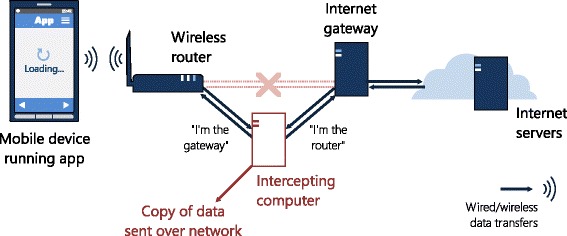
“By making a simple configuration change to the operating systems on each test device, we were able to intercept encrypted communications in addition to unsecured traffic (principles explained in Additional file 1: Figure AF2) [28].”
BackgroundPrivacy and Security in Mobile Health Apps: A Review and Recommendations
Martínez-Pérez, B., de la Torre-Díez, I., & López-Coronado, M. (2015) · Journal of Medical Systems · doi:10.1007/s10916-014-0181-3 · Cited by 342 · cited 3×
“and infrastructure designed to secure the online processing of clinical data [31, 44].”
BackgroundA Review on the State-of-the-Art Privacy-Preserving Approaches in the e-Health Clouds
Abbas, A., & Khan, S. U. (2014) · IEEE Journal of Biomedical and Health Informatics · doi:10.1109/jbhi.2014.2300846 · Cited by 331 · cited 1×
“Recent work has illustrated the scope for threats arising from online storage of health information and identified privacy-preserving strategies that could inform future studies that assess compliance more directly [56].”
BackgroundFor Telehealth To Succeed, Privacy And Security Risks Must Be Identified And Addressed
Hall, J. L., & McGraw, D. (2014) · Health Affairs · doi:10.1377/hlthaff.2013.0997 · Cited by 297 · cited 1×
“Because health and, in particular, wellness apps are often provided by organizations that are not traditional medical providers, they can sit outside the scope of existing legal and professional safeguards [50].”
Background
Research works printed but not linked: 4
- Cohn SP Privacy and confidentiality in the nationwide health information network 2006 Washington National Committee on Vital and Health Statistics
- England NHS Five year forward view 2014 London HM Government
- Information Commissioner’s Office Privacy notices code of practice 2010 Wilmslow Information Commissioner’s Office
- Federal Trade Commission Mobile privacy disclosures – building trust through transparency 2013 USA Federal Trade Commission
Cited by
Items 301–400 of 410
Cyber security for virtual clinics
Roy, B. (2012) · Engineering & Technology Reference · doi:10.1049/etr.2015.0125 · Cited by 1
Open Source Based Privacy-Proxy to Restrain Connectivity of Mobile Apps
Mense, A., Steger, S., Jukic-Sunaric, D., Mészáros, A., & Sulek, M. (2016) · International Conference on Advances in Mobile Computing and Multimedia (MoMM) · doi:10.1145/3007120.3007163 · Cited by 1
“A study from Huckvale et al [4] about the analysis of apps included in NHS England's Health Apps Library shows the lack of security and privacy of many mHealth apps and reports that most apps do not handle data according to their privacy policy, and that some apps do not even have any privacy…”
BackgroundMethodCan a reset of digital literacy standards improve nursing practice?
Hamilton, D. (2018) · British Journal of Nursing · doi:10.12968/bjon.2018.27.13.768 · Cited by 1
Mobile Health: Studien zur Bedeutung mobiler Medien im Gesundheitskontext
Rossmann, C., & Jöckel, S. (2019) · Springer eBooks · doi:10.1007/978-3-658-27902-8_13 · Cited by 1
AN EXPLORATORY EMPIRICAL ANALYSIS OF THE QUALITY OF MOBILE HEALTH APPS
Cabrera, A., Ranasinghe, M., Frossard, C., Postel‐Vinay, N., & Boyer, C. (2019) · Proceedings of the 18th International Conference on WWW/Internet 2019 · doi:10.33965/icwi2019_201913l013 · Cited by 2
“Huckvale 2015 b, in another paper, demonstrates that 67% of the insulin dose calculator apps assessed provided inappropriate dosage recommendation.”
BackgroundUsing Readability to Explore Data Privacy Statements Within Mobile Health Applications
Pownell, J. M., Larson, L., Neago, D. H., Pesch, M. S., Ayres, S. J., & Austin, R. R. (2020) · CIN Computers Informatics Nursing · doi:10.1097/cin.0000000000000647 · Cited by 2
Navigating E-Mental Health: How to Choose an Effective and Trustable App?
Song, M. J., Tabi, K., & Krausz, M. R. (2020) · Springer eBooks · doi:10.1007/978-3-319-70134-9_106-1 · Cited by 1
Pálsdóttir, Á. (2020) · Communications in computer and information science · doi:10.1007/978-3-030-57847-3_16 · Cited by 1
The software will see you now: The promise and peril of digital therapy
Quill, L. (2021) · Counselling and Psychotherapy Research · doi:10.1002/capr.12404 · Cited by 1
Developing an app to support sensitive enquiry and discussion about female genital mutilation
McEwan, J., & Bedford, H. (2021) · Journal of Health Visiting · doi:10.12968/johv.2021.9.4.164 · Cited by 1
Comparing the Perception of Privacy for Medical Devices and Devices With Medical Functionality
Kaiser, F. K., Wiens, M., & Schultmann, F. (2020) · International Journal of Privacy and Health Information Management · doi:10.4018/ijphim.2020010103 · Cited by 2
Analyzing Security and Privacy Concerns of Contact Tracing Applications
Migiro, L., Shahriar, H., & Sneha, S. (2021) · IEEE International Conference on Digital Health (ICDH) · doi:10.1109/icdh52753.2021.00052 · Cited by 1
Bregenzer, A., & Jiménez, P. (2018) · Springer Reference Wirtschaft · doi:10.1007/978-3-658-17975-5_30-1 · Cited by 2
Bregenzer, A., & Jiménez, P. (2021) · Springer eBooks · doi:10.1007/978-3-658-17782-9_30 · Cited by 1
Apps in der digitalen Prävention und Gesundheitsförderung
Albrecht, U., & von Jan, U. (2022) · Springer Reference Pflege, Therapie, Gesundheit · doi:10.1007/978-3-662-54179-1_40-2 · Cited by 1
Mobile Healthcare in an Increasingly Connected Developing World
Yadav, N., Aliasgari, M., & Poellabauer, C. (2019) · IGI Global eBooks · doi:10.4018/978-1-5225-9863-3.ch042 · Cited by 1
Quality and Safety of Health Mobile Applications: Are They an Issue?
Boyer, C. (2022) · Health informatics · doi:10.1007/978-3-030-91237-6_27 · Cited by 2
How to Evaluate a Mobile App and Advise Your Patient About It?
Aungst, T. D. (2022) · Springer eBooks · doi:10.1007/978-3-031-10698-9_9 · Cited by 1
Pyne, Y., McMillan, B., & Stewart, S. (2023) · Elsevier eBooks · doi:10.1016/b978-0-323-99271-8.00003-6 · Cited by 1
Malinka, C., Dittrich, F., Back, D. A., Ansorg, J., von Jan, U., & Albrecht, U. (2023) · BMC Musculoskeletal Disorders · doi:10.1186/s12891-023-06226-y · Cited by 1
Mobile Applications in Childhood Immunization: A Systematic Review
Mejia, C. T., & Necochea-Chamorro, J. I. (2023) · TEM Journal · doi:10.18421/tem122-08 · Cited by 1
Mobile Health Literacy Interventions and Health Disparities Reduction
Ownby, R. L., Purcell, D. J., Thomas-Purcell, K. B., & Simonson, M. R. (2024) · Springer eBooks · doi:10.1007/978-981-92-1290-3_75 · Cited by 2
CARMA 2020 - 3rd International Conference on Advanced Research Methods and Analytics
Domènech, J., & Vicente, M. R. (2020) · doi:10.4995/carma2020.2020.11920
Online structured education for people newly diagnosed with type 2 diabetes
Poduval, S. (2019) · UCL Discovery (University College London) · Cited by 1
Psychiatry and law in the digital age: untangling the hype, risk and promise
Gooding, P., & Resnick, K. (2020) · International Journal of Law and Psychiatry · doi:10.1016/j.ijlp.2020.101553 · Cited by 2
Smartphone apps for type 2 diabetes self-management and medication adherence : a multi-method study
Huang, Z. (2020) · DR-NTU (Nanyang Technological University) · doi:10.32657/10356/137883 · Cited by 2
Xu, X. (2019) · DR-NTU (Nanyang Technological University) · doi:10.32657/10356/137738 · Cited by 1
Shirzad, M., Hajimiri, K., Shakibazadeh, E., & Abedini, M. (2021) · SSRN Electronic Journal · doi:10.2139/ssrn.3897965 · Cited by 1
Harmer, W. (2022) · University of Huddersfield Repository (University of Huddersfield) · Cited by 1
Mobile health technologies that enable patient-physician interactions: public policy perspectives
Ramsay, C. A. (2016) · Summit (Simon Fraser University)
Informal Learning Using Tablet Computers and Apps: A Multi-Method Study of Older Adults
Diabetes, S.-M., & Seabrook, H. J. (2016)
E-health and the performativity of the "health democracy"
Dumez, H., & Minvielle, É. (2017) · Systèmes d information & management · doi:10.9876/sim.v22i1.783
Consumer Healthcare: Current Trends
Gopikrishna, G., Balakrishna, C., & Soumya, K. D. (2017) · Edge Hill University
Acceptance of a Neuropaediatric Exergame Rehabilitation System with Severe Cerebral Palsy
Farr, W. J., Poole, M., Thursfield, C., & Male, I. (2017) · Annual Symposium on Computer-Human Interaction in Play · doi:10.1145/3130859.3131317
Denman, S. (2017) · UVic’s Research and Learning Repository (University of Victoria)
Digital Mental Health in the Wild: An Adapted Grounded Theory Study
Bergin, A. (2017) · ChesterRep (University of Chester)
Mobile Telephones and Mobile Health: a Societal Question Under Debate in the Public Domain
Juanals, B. (2018) · Wiley eBooks · doi:10.1002/9781119549765.ch9
Electronic Communication, Telehealth, and Social Media
Khanna, M. S., & Chou, T. (2018) · Oxford University Press eBooks · doi:10.1093/oxfordhb/9780190634841.013.46
Governance Through Mobile Apps:The Construction of Public Health Problems
Lamothe, C. (2018) · Spectrum Research Repository (Concordia University)
Gutta, R. (2019) · ScholarWorks (Walden University) · Cited by 1
Developing Ethical Web- and Mobile-Based Technologies for Dementia: Challenges and Opportunities
Robillard, J. M., & Feng, T. L. (2019) · Oxford University Press eBooks · doi:10.1093/med/9780190459802.003.0014
A Game of Phones: Capitalizing on Health Applications, Gamification, and Improving Patient Outcomes
Hazel, K. (2020) · Digital Commons @ Butler University (Butler University)
Analysis of Physiotherapists Perceptions for Improvement of Digital Innovation
Eriksson, P. G. (2020) · KTH Publication Database DiVA (KTH Royal Institute of Technology)
LUGN - En prototyp närmare ett stressfritt studentliv
Lundblad, C., & Ahlstedt, J. (2020) · DiVA (Digitala Vetenskapliga Arkivet)
Evaluating accredited mHealth applications. An exploratory study
Sancha, P., Perera, A. G., & Jiménez, M. D. A. J. (2020) · International Conference on Advanced Research Methods and Analytics (CARMA) · doi:10.4995/carma2020.2020.11609
“…security; data protection and reuse of data; possible risks related to misuse; poor regulation; and lack of standards for validation, efficiency and quality (BinDhim, Hawkey & Trevena, 2015; Huckvale, Prieto, Tilney, Benghozi & Car, 2015; Martínez-Pérez, De La Torre-Díez & López-Coronado, 2014).”
BackgroundAmbiguities in the Privacy Policies of Common Health and Fitness Apps
Sen, D., & Ahmed, R. (2020) · Advances in information quality and management · doi:10.4018/978-1-7998-3479-3.ch127
Khan, Z. M., Ahmed, R., & Sen, D. (2020) · Advances in information security, privacy, and ethics book series · doi:10.4018/978-1-7998-3487-8.ch005
The Quantified Leader: Wearables & Self-Tracking Technology for Development
Ruderman, M. N., & Clerkin, C. (2019) · doi:10.35613/ccl.2019.2052
Do Pregnant Women Using Smartphones Care About Their Privacy?
Jacob, R., & Rani, D. (2020) · International Journal of Information Communication Technologies and Human Development · doi:10.4018/ijicthd.2020100102
Quantification label for mobile apps
Habib, S. J., & Marimuthu, P. N. (2021) · Journal of Engineering Research · doi:10.36909/jer.v9i2.9479
“RELATED WORK Our literature survey on labeling on software App reveals that there are no common standards developed yet and we would like to take this opportunity to provide the readers about the importance of uniform labeling, as there are many low-quality, unsafe and even potentially harmful Apps causing more risks…”
BackgroundKhan, Z. M., Ahmed, R., & Sen, D. (2021) · IGI Global eBooks · doi:10.4018/978-1-7998-8954-0.ch094
Contribution to Software Quality Control Techniques for Assessing Privacy and Data Protection
Guamán, D. S. (2021) · UPM Digital Archive (Technical University of Madrid) · doi:10.20868/upm.thesis.69641
Bregenzer, A., & Jiménez, P. (2020) · Springer Reference Wirtschaft · doi:10.1007/978-3-658-17975-5_30-2
Navigating E-Mental Health: How to Choose an Effective and Trustable App?
Song, M. J., Tabi, K., & Krausz, M. R. (2021) · Springer eBooks · doi:10.1007/978-3-030-57296-9_106
Barth, S. (2021) · doi:10.3990/1.9789036551410 · Cited by 1
Edbrooke-Childs, J. H., Smith, J., Rees, J., Edridge, C., Calderón, A., Saunders, F., Wolpert, M., & Deighton, J. (2018) · JMIR Research Protocols · doi:10.2196/10018
Ambiguities in the Privacy Policies of Common Health and Fitness Apps
Sen, D., & Ahmed, R. (2021) · IGI Global eBooks · doi:10.4018/978-1-7998-8954-0.ch075
Khan, Z. M., Ahmed, R., & Sen, D. (2021) · IGI Global eBooks · doi:10.4018/978-1-7998-8545-0.ch037
Exploring the role of health apps in supporting young people with depression: a mixed methods study
Martinengo, L. (2021) · DR-NTU (Nanyang Technological University) · doi:10.32657/10356/157124
Grinblat, R., & Baskal, E.-B. (2022) · Springer eBooks · doi:10.1007/978-3-658-36940-8_5
9 The Clinical Relevance of Apps for Tinnitus
(2022) · Thieme Publishers New York eBooks · doi:10.1055/b-0042-189040
Exploring Users’ Responses to mHealth Service Failure—The Moderating Role of Service Failure Type
向, 宇. (2023) · Modern Management · doi:10.12677/mm.2023.134043
Assessing Implications of Telehealth Apps’ Privacy Policies and Terms of service for Users
Saxena, A. (2022) · Deep Blue (University of Michigan) · doi:10.7302/7893
The Security of Wireless Communication Protocols Used in Mobile Health Systems
Losiouk, E. (2023) · Women in engineering and science · doi:10.1007/978-3-031-21975-7_15
Ahmed, S., Trimmer, C., Khan, W., Tuck, A. C., Rodak, T., Agic, B., Kavic, K., Wadhawan, S., Abbott, M., Husain, M. O., et al. (2024) · Frontiers in Public Health · doi:10.3389/fpubh.2024.1196491
“For example, the NHS Apps Library , with Apps assessed against a defined set of criteria, was released but quickly rolled back due to public outcry following research that showed privacy and security gaps in a large proportion of the included Apps (49).”
BackgroundMental Health, Social Media, and the Meta
(2024) · Frontiers research topics · doi:10.3389/978-2-8325-5631-3
Chan, H. Y., & Toh, H. J. (2025) · International Review of Law Computers & Technology · doi:10.1080/13600869.2025.2510440 · Cited by 1
“…practices, data security and user safety, systems vulnerabilities, and potential data misuse (Canali, Schiaffonati, and Aliverti 2022; Chang et al. 2019; Huckvale et al. 2015; Huckvale, Torous, and Larsen 2019; Ioanni-dou and Sklavos 2021; Jie 2022; Kapoor et al. 2020; Loncar-Turukalo et al. 2019).”
Oberwinster, L. (2025) · Prävention und Gesundheitsförderung · doi:10.1007/s11553-025-01226-3
Mobile health apps for QT interval measurement: A systematic review
Chavez-Ecos, F. A., Uribe-Cavero, L. J., Chavez-Ecos, R., Arias-Arias, S., Chavez-Gutarra, M. A., Montesinos‐Segura, R., & Camacho-Caballero, K. (2025) · Journal of Electrocardiology · doi:10.1016/j.jelectrocard.2025.154041
Monitoring Patient Apps Security Vulnerabilities
Hussein, K. (2025) · Lecture notes of the Institute for Computer Sciences, Social Informatics and Telecommunications Engineering · doi:10.1007/978-3-031-92517-7_15
Smartphone apps for cancer care
Alhuwail, D., Abd-Alrazaq, A. A., & Alsahli, M. A. (2025) · Elsevier eBooks · doi:10.1016/b978-0-443-33984-4.00015-8 · Cited by 1
Privacidade em aplicativos de saúde reprodutiva feminina: um estudo sobre a opinião das usuárias
Lima, I., Silva, C., Vilela, J., & Peixoto, M. (2025) · Revista dos Mestrados Profissionais · doi:10.51359/2317-0115.2025.265686
Ahmalia, R., Aljaberi, M. A. A., Said, M. S. M., Ayuni, D. Q., & Yolanda, M. (2025) · Malaysian Journal of Medicine and Health Sciences · doi:10.47836/mjmhs.21.s3.28
Ethical considerations in digital mental healthcare
Reddy, K. J. (2025) · Elsevier eBooks · doi:10.1016/b978-0-443-43908-7.00019-7
Harnessing Language Models to Analyze Android App Permission Fidelity
Tamrakar, Y., Banerjee, R., Myers, E., Carli, L. D., & Ray, I. (2025) · Conference on Privacy, Security and Trust · doi:10.1109/pst65910.2025.11268849 · Cited by 1
“This risk escalates in domains like mobile health (mHealth), where applications frequently handle additional sensitive PII categories including medical histories, real-time physiological metrics ( e.g. , heart rate, blood glucose), and demographic attributes [5], [6].”
What’s in a number? A multimethod study of self-quantification’s role in shaping selfhood
Smirnova, S. (2023) · London School of Economics and Political Science Theses Online (London School of Economics and Political Science) · doi:10.21953/lse.00004403
Malinka, C., Dittrich, F., Back, D. A., Ansorg, J., von Jan, U., & Albrecht, U.-V. (2024) · Figshare · doi:10.6084/m9.figshare.26570953
A transdisciplinary framework for ethical mobile mental health
Bowie-DaBreo, D. (2024) · Lancaster EPrints (Lancaster University) · doi:10.17635/lancaster/thesis/2433
Malinka, C., Dittrich, F., Back, D. A., Ansorg, J., von Jan, U., & Albrecht, U.-V. (2024) · Figshare · doi:10.6084/m9.figshare.26570947
Winter, J. (2020) · Elektronische Hochschulschriften der LMU München (Ludwig-Maximilians-Universität München) · doi:10.5282/edoc.27153
Malinka, C., Dittrich, F., Back, D. A., Ansorg, J., von Jan, U., & Albrecht, U.-V. (2024) · Figshare · doi:10.6084/m9.figshare.26570950
Digital Mental Health Initiatives in Nigeria – a Qualitative Interview Study
Chen, T. (2023) · MacSphere (McMaster University) · doi:10.71548/16688
Implementation of a Coach-Client System in a Mobile Fitness Application
Viltrakis, K. (2025) · Theseus (Ammattikorkeakoulujen)
Benjumea, J. (2023) · Deposito de Investigacion Universidad de Sevilla (University of Seville)
Agarwal, P. (2021) · TSpace (University of Toronto) · Cited by 1
Cos, C. A. (2023) · Dipòsit Digital de la Universitat de Barcelona (Universitat de Barcelona)
Manning, J. B. (2023) · UCL Discovery (University College London) · Cited by 1
Alhammad, N. J. (2026) · Warwick Research Archive Portal (University of Warwick) · doi:10.82444/warw.33899458
Göçhan, D. (2023) · Istanbul Technical University Academic Open Archive (Istanbul Technical University)
Kamssu, A. J., Siekpe, J. S., & Durai, J. (2026) · International Journal of Healthcare Management · doi:10.1080/20479700.2026.2619116
Machinya, J. (2026) · Law Technology and Humans · doi:10.5204/lthj.3984
Wearable technology in health care: a privacy-centric perspective
Kanojia, S. (2026) · Elsevier eBooks · doi:10.1016/b978-0-443-38299-4.00005-9
Sources of Data Used in Pharmacoepidemiology and Pharmacovigilance
Chinzowu, T., & Nishtala, P. S. (2026) · Elsevier eBooks · doi:10.1016/b978-0-443-26472-6.00082-6
L'assurance santé privée à l'épreuve des objets connectés
Redon, M. (2021) · theses.fr (ABES) · doi:10.70675/d60c57d9zcc43z4e6czaa85z043d945b9217
Sutarwala, J. H. (2026) · Journal of International Crisis and Risk Communication Research · doi:10.63278/jicrcr.vi.3747
“The absence of clear, understandable privacy frameworks erodes trust between healthcare organizations and the communities they serve (Huckvale et al., 2015).”
Madigan, A., Fabian, H., Jilka, S., Arroya, B., Larkin, D., Lewin, C. D. C., Zahid, U., Kilcoyne, I., & Wykes, T. (2026) · BMJ Connections Mental Health · doi:10.1136/bmjcment-2025-000033
Hoang, V. L., Nguyen, N. T., Bui, H. T., Hoang, T. H., & Liamputtong, P. (2025) · Springer eBooks · doi:10.1007/978-981-97-0821-5_133-1
Anticipating the Impact of AI on Diet and Exercise Apps: Foresight Study Applying the Futures Wheel
Tadeo, X., Seres, G., Lin, S., Sapanel, Y., Chew, H. S. J., & Ho, D. (2026) · Journal of Medical Internet Research · doi:10.2196/96285
Metadata
- Authors
- Huckvale, K., Prieto, J. T., Tilney, M., Benghozi, P.-J., & Car, J.
- Affiliations
- Imperial College London (GB)
- Centre National de la Recherche Scientifique (FR)
- Nanyang Technological University (SG)
- Corresponding author
- Huckvale, Kit
- Prieto, José Tomás
- Venue
- BMC Medicine
- Published
- 2015-09-25
- Volume
- 13
- Issue
- 1
- Pages
- 214-214
- ISSN
- 1741-7015 (ISSN-L)
- PMC
- PMC4582624
- OpenAlex
- W2120522957
- Semantic Scholar
- 02749722c8bdfec410ef318feebd27c14cdd5e23
- Cited by
- 376
- References
- 24
- Citations by year
- 2026: 15 · 2025: 23 · 2024: 21 · 2023: 21 · 2022: 21 · 2021: 41 · 2020: 61 · 2019: 46 · 2018: 38 · 2017: 45 · 2016: 39 · 2015: 4
- FWCI
- 139.34
- Type
- journal article
- Language
- en
- Open access
- gold
- doi.org
- Licence
- Locations
- BMC Medicine (publishedVersion, cc-by)
- Europe PMC (PubMed Central) (publishedVersion, cc-by)
- PubMed Central (publishedVersion, cc-by)
- PubMed (publishedVersion)
- OAR@UM (University of Malta) (submittedVersion, other-oa)
- DR-NTU (Nanyang Technological University) (submittedVersion, cc-by)
- Minerva Access (University of Melbourne) (submittedVersion, cc-by)
- Spiral (Imperial College London) (submittedVersion, cc-by)
- Topics
- Social Sciences › Sociology and Political Science › Privacy, Security, and Data Protection
- Health Sciences › Health Professions › General Health Professions › Mobile Health and mHealth Applications
- Health Sciences › Health Professions › Health Information Management › Thoreau and American Literature
- Keywords
- health apps, wellness apps, data privacy, data protection, encryption, privacy policies, data transmission, personal health data, data theft, mobile application security
- MeSH terms
- Confidentiality, Cross-Sectional Studies, United Kingdom, Humans, National Health Programs, Software, Computer Security, Risk Assessment, Internet
About these checks
Registry, retraction, Cites and statistics results are computed, not judged, with one exception: a printed reference that no index lists is read once by a model before it counts as a citation error. Claims are extracted by a model and kept only when their quote appears verbatim in the text; each cited source is then checked, with a model’s help, for whether it says what the claim relies on. Those verdicts can be wrong — read the claim’s quote and the cited source before relying on one.
Statistics and arithmetic are recomputed, not judged.
Confidence bands are shown only for fields calibrated on our annotated test set. None is calibrated yet, so no band is shown.
What counts as a claim ›How we measure confidence ›How we check this ›
Are you an author, or do you see a problem with this page? Request a review
Data sources
Bibliographic data: Semantic Scholar, OpenAlex, Crossref.
Contains information from the Semantic Scholar Academic Graph Datasets, made available under the ODC Attribution License (ODC-BY 1.0).
Semantic Scholar’s data is described in: Kinney, R., et al. (2023). The Semantic Scholar Open Data Platform. arXiv:2301.10140.
