

Interventions to improve team effectiveness within health care: a systematic review of the past decade
Open accessThe DOI matches its Crossref record; 332 of the 336 references it cites were found in a registry or an index.
Abstract
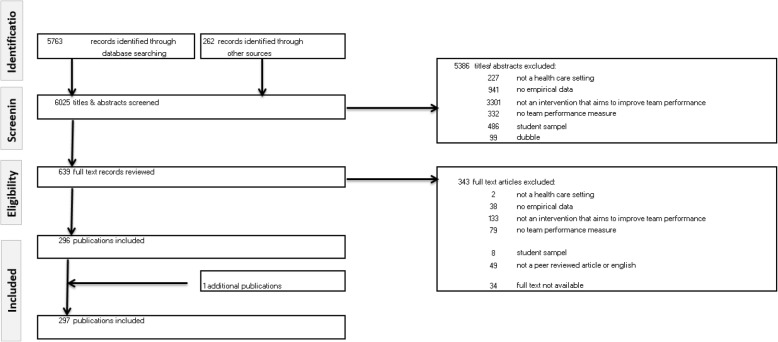
Background: A high variety of team interventions aims to improve team performance outcomes. In 2008, we conducted a systematic review to provide an overview of the scientific studies focused on these interventions. However, over the past decade, the literature on team interventions has rapidly evolved. An updated overview is therefore required, and it will focus on all possible team interventions without restrictions to a type of intervention, setting, or research design. Objectives: To review the literature from the past decade on interventions with the goal of improving team effectiveness within healthcare organizations and identify the “evidence base” levels of the research. Methods: Seven major databases were systematically searched for relevant articles published between 2008 and July 2018. Of the original search yield of 6025 studies, 297 studies met the inclusion criteria according to three independent authors and were subsequently included for analysis. The Grading of Recommendations, Assessment, Development, and Evaluation Scale was used to assess the level of empirical evidence. Results: Three types of interventions were distinguished: (1) Training , which is sub-divided into training that is based on predefined principles (i.e. CRM: crew resource management and TeamSTEPPS: Team Strategies and Tools to Enhance Performance and Patient Safety), on a specific method (i.e. simulation), or on general team training. (2) Tools covers tools that structure (i.e. SBAR: Situation, Background, Assessment, and Recommendation, (de)briefing checklists, and rounds), facilitate (through communication technology), or trigger (through monitoring and feedback) teamwork. (3) Organizational (re)design is about (re)designing structures to stimulate team processes and team functioning . (4) A programme is a combination of the previous types. The majority of studies evaluated a training focused on the (acute) hospital care setting. Most of the evaluated interventions focused on improving non-technical skills and provided evidence of improvements. Conclusion: Over the last decade, the number of studies on team interventions has increased exponentially. At the same time, research tends to focus on certain interventions, settings, and/or outcomes. Principle-based training (i.e. CRM and TeamSTEPPS) and simulation-based training seem to provide the greatest opportunities for reaching the improvement goals in team functioning.
Overview
The claims and statistics of this paper haven’t been checked yet.
Free: it reads the open-access text and checks the first 5 claims that cite a source we can check. Create a free account to check every claim.
Integrity signals
Registry
Cites
Statistics
Figures
Verification
Claims the paper makes
The claims and statistics of this paper haven’t been checked yet.
Free: it reads the open-access text and checks the first 5 claims that cite a source we can check. Create a free account to check every claim.
Self-check
Percentages, sums and reported differences re-computed from the paper’s own numbers.
The self-check needs the paper’s full text.
Citations
Cites
Audit and feedback: effects on professional practice and healthcare outcomes
Ivers, N., Jamtvedt, G., Flottorp, S., Young, J. M., Odgaard-Jensen, J., French, S. D., O'Brien, M. A., Johansen, M., Grimshaw, J., & Oxman, A. D. (2012) · Cochrane Database of Systematic Reviews · doi:10.1002/14651858.cd000259.pub3 · Cited by 5,485
Interprofessional education: effects on professional practice and healthcare outcomes
Reeves, S., Perrier, L., Goldman, J., Freeth, D., & Zwarenstein, M. (2013) · Cochrane Database of Systematic Reviews · doi:10.1002/14651858.cd002213.pub3 · Cited by 1,946
Teamwork and patient safety in dynamic domains of healthcare: A review of the literature
MANSER, T. (2009) · Acta Anaesthesiologica Scandinavica · doi:10.1111/j.1399-6576.2008.01717.x · Cited by 1,322 · cited 1×
“A lack of teamwork is often identified as a primary point of vulnerability for quality and safety of care [1, 2].”
BackgroundThe Evolution of Crew Resource Management Training in Commercial Aviation
Helmreich, R. L., Merritt, A. C., & Wilhelm, J. A. (1999) · The International Journal of Aviation Psychology · doi:10.1207/s15327108ijap0901_2 · Cited by 1,111 · cited 1×
“CRM aims to prevent and manage errors through avoiding errors, trapping errors before they are committed, and mitigating the consequences of errors that are not trapped [325].”
BackgroundAssociation Between Implementation of a Medical Team Training Program and Surgical Mortality
Neily, J., Mills, P. D., Young-Xu, Y., Carney, B. T., West, P., Berger, D. H., Mazzia, L. M., Paull, D. E., & Bagian, J. P. (2010) · JAMA · doi:10.1001/jama.2010.1506 · Cited by 1,040 · cited 4×
“MTT combines training, implementation of tools (briefings, debriefing, and other projects), and follow-up coaching [5, 304, 305, 316].”
BackgroundMethodInfluentialWhat Do We Know about Health Care Team Effectiveness? A Review of the Literature
Lemieux-Charles, L., & McGuire, W. L. (2006) · Medical Care Research and Review · doi:10.1177/1077558706287003 · Cited by 844 · cited 1×
“healthcare settings vary significantly, which challenges the generalizability [327].”
BackgroundTraining and simulation for patient safety
Aggarwal, R., Mytton, O. T., Derbrew, M., Hananel, D., Heydenburg, M., Issenberg, B., MacAulay, C., Mancini, M. E., Morimoto, T., Soper, N., et al. (2010) · Quality and Safety in Health Care · doi:10.1136/qshc.2009.038562 · Cited by 739 · cited 1×
“Simulation-based training uses a specific method as its core, namely, simulation, which refers to “a technique to replace or amplify real-patient experiences with guided experiences, artificially contrived, that evokes or replicates substantial aspects of the real world in a fully interactive manner” [326].”
Introduction of surgical safety checklists in Ontario, Canada
Urbach, D. R., Govindarajan, A., Saskin, R., Wilton, A. S., & Baxter, N. N. (2014) · New England Journal of Medicine · doi:10.1056/nejmsa1308261 · Cited by 627 · cited 1×
“…Anaesthesiology Improvement in information exchange, knowledge of critical information, perception of safety in anaesthesia teams, perceived teamwork A Urbach et al. 2014 [242] Surgical safety checklist Operating room Implementation is not associated with significant reductions in operative…”
Lingard, L. (2008) · Archives of Surgery · doi:10.1001/archsurg.2007.21 · Cited by 596 · cited 2×
“Improvement in unplanned admission rates and number of wound complications D Lingard et al. 2008 [251] Team briefing structured by a checklist General surgery Improvement in number of communication failures and proactive and collaborative team communication C Low et al. 2013 [232] “Flow checklists”…”
BackgroundMethodTeam-training in healthcare: a narrative synthesis of the literature
Weaver, S. J., Dy, S. M., & Rosen, M. A. (2014) · BMJ Quality & Safety · doi:10.1136/bmjqs-2013-001848 · Cited by 535
Research works printed but not linked: 2
- Donaldson MS, Corrigan JM, Kohn LT. To err is human: building a safer health system: National Academies Press; 2000.
- Fernandez R, Pearce M, Grand JA, Rench TA, Jones KA, Chao GT, et al. A randomized comparison study to evaluate the effectiveness of a computer-based teamwork training intervention on medical teamwork and patient care performance. Acad Emerg Med. 2013;20:S125.
Cited by
Items 101–200 of 515
Pucer, P., Martinović, K., Karnjuš, I., & Renko, J. (2025) · Clinical Simulation in Nursing · doi:10.1016/j.ecns.2025.101726 · Cited by 15
Imbrìaco, G., Monesi, A., Giugni, A., Ferrari, P., Bigi, E., & Menarini, M. (2021) · Air Medical Journal · doi:10.1016/j.amj.2021.03.002 · Cited by 10
Vifladt, A., Ballangrud, R., Myhr, K., Grusd, E., Porthun, J., Mæhlum, P. A., Aase, K., Sollid, S. J. M., & Odberg, K. R. (2023) · BMJ Open · doi:10.1136/bmjopen-2022-067006 · Cited by 12
van Peppen, L. M., Faber, T. J. E., Erasmus, V., & Dankbaar, M. E. W. (2022) · JMIR Serious Games · doi:10.2196/38009 · Cited by 21
“Therefore, training medical students in teamwork has received increased attention in the past decade, and teamwork principles are being introduced into several medical school curricula [6,13-17].”
BackgroundIstrate, M. I., Forray, A. I., Ungureanu, M., Mira, J. J., Constantinescu, S.-A., & Cherecheș, R. M. (2025) · BMC Nursing · doi:10.1186/s12912-025-02745-2 · Cited by 13
“Implementing tailored safety training programs that incorporate simulation interdepartmental collaboration and address the specific needs of each department is crucial [72, 80].”
Autonomy and independence: a critical imperative for midwifery
Zarbiv, G., & Ellen, M. (2025) · BMJ Global Health · doi:10.1136/bmjgh-2025-019184 · Cited by 12
“23 Evidence shows that when midwives are educated to international standards, such as those outlined in the ICM Essential Competen-cies for Midwifery Practice 24 and the ICM Global Standards for Midwifery Education, 25 they are fully equipped to function as autonomous, independent practitioners…”
Navigating complexity: a conceptual framework for simulation interventions
Schram, A., Henriksen, T. B., Maindal, H. T., & Brazil, V. A. (2025) · Advances in Simulation · doi:10.1186/s41077-025-00366-y · Cited by 12
“Supportive conditions, such as institutional investment in infrastructure or prioritization of digital integration, can help enable the successful implementation of new EMR systems [21].”
Muñoz, P. M., Cardinal‐Fernández, P., Rodríguez, Á. M., Ruiz‐Zaldibar, C., & López, A. D. L. C. (2025) · Nursing Reports · doi:10.3390/nursrep15110398 · Cited by 14
What Do We Know About Teamwork in Chinese Hospitals? A Systematic Review
Wang, H., Buljac‐Samardžić, M., Wang, W., van Wijngaarden, J. D. H., Yuan, S., & van de Klundert, J. J. (2021) · Frontiers in Public Health · doi:10.3389/fpubh.2021.735754 · Cited by 12
“” In step four, the two categories were further divided into several subcategories according to the theoretical frameworks and reviews mentioned above (12, 13, 22, 23).”
BackgroundInfluentialTeam Dynamics in the Operating Room
Watkins, S. C., & Hensley, N. B. (2023) · Anesthesiology Clinics · doi:10.1016/j.anclin.2023.05.004 · Cited by 17
A cross-sectional analysis of preterm birth incidence and survival in Al Kharj, Saudi Arabia
Alghadier, M., Alasraj, M., Elnaggar, R. K., Alazmi, M., AlDawsari, A., Alnadah, S., Alqahtani, F., & Zaghamir, D. E. F. (2024) · Saudi Medical Journal · doi:10.15537/smj.2024.45.7.20240194 · Cited by 9
“This thorough comparison makes it easier to Preterm birth in Al Kharj, Saudi Arabia... Alghadier et al 43-45 The survival rate of ELBW neonates in Saudi Arabia was 59%, and it was linked with BW and GA. 46 Abolfotouh et al 46 have reported that RDS, IVH, PDA, ROP, BPD, and NEC to be the most common complications in th…”
BackgroundSudeshika, T., Naunton, M., Peterson, G. M., Deeks, L. S., Thomas, J., & Kosari, S. (2021) · International Journal of Environmental Research and Public Health · doi:10.3390/ijerph18030966 · Cited by 10
Ballangrud, R., Aase, K., & Vifladt, A. (2021) · BMC Health Services Research · doi:10.1186/s12913-021-06732-6 · Cited by 16
“Interventions to improve team effectiveness within healthcare are widely used [1].”
BackgroundBryant, A. L., Eynde, M. V. D., Grewe, M. E., Alderman, J. T., Zomorodi, M. G., & Durham, C. F. (2022) · Journal of Interprofessional Care · doi:10.1080/13561820.2021.2000374 · Cited by 9
“Strategies to promote team communication such as Team Strategies and Tools to Enhance Performance and Patient Safety (TeamSTEPPS®), standardized communication tools such as Situation, Background, Assessment, and Recommendation (SBAR), and restructuring of team rounds to stimulate team processes and function can be hel…”
BackgroundMethodAusserhofer, D., Bragadóttir, H., Dhaini, S., Harvey, C. L., Lehocki, F., & Schubert, M. (2021) · Springer eBooks · doi:10.1007/978-3-030-71073-6_7 · Cited by 10
Scaffolding safety in nursing simulation: A grounded theory
Hussein, M. T. E., & Harvey, G. (2023) · Journal of Professional Nursing · doi:10.1016/j.profnurs.2023.01.003 · Cited by 11
Madisa, M., Filmalter, C. J., & Heyns, T. (2023) · Midwifery · doi:10.1016/j.midw.2023.103768 · Cited by 11
Nazir, A., Baletic, N., Dumas, R. P., Fitzgerald, C. A., Xu, K., McGowan, M., & Nolan, B. (2023) · European Journal of Trauma and Emergency Surgery · doi:10.1007/s00068-023-02381-y · Cited by 8
“Training with constructive feedback may enhance team dynamics and improve patient safety outcomes [32].”
Staff-Family Communication Methods in Long-Term Care Homes: An Integrative Review
Stephen, A. J., Connelly, D. M., Hung, L., & Unger, J. (2024) · Journal of Long-Term Care · doi:10.31389/jltc.282 · Cited by 8
Instruments for Patient Safety Assessment: A Scoping Review
Nunes, E., Vantil, F. C. S., Lima, E. D. F. A., Minarini, G. P. S. S., Gaspar, F., Lucas, P. R. M. B., & Primo, C. Ç. (2024) · Healthcare · doi:10.3390/healthcare12202075 · Cited by 8
The expository phase of debriefing in clinical simulation: a qualitative study
Fenzi, G., Alemán-Jiménez, C., Fuentes, P., López, G. S., Leal‐Costa, C., & Agea, J. L. D. (2025) · BMC Nursing · doi:10.1186/s12912-025-03067-z · Cited by 15
“These aspects add to the variety of different possibilities to expose their knowledge during the debriefing, make the expository phase of MAES© a fundamental opportunity to train effective teamwork which is fundamental in clinical settings [45, 46].”
Ber, R., London, D., Senan, S., Youssefi, Y., Harter, D. H., Golfinos, J. G., & Pacione, D. R. (2021) · Journal of neurosurgery · doi:10.3171/2021.4.jns21485 · Cited by 8
Management of critical care emergencies in children with autism spectrum disorder
Al‐Beltagi, M., Saeed, N. K., Bediwy, A. S., Alhawamdeh, R., & Elbeltagi, R. M. (2025) · World Journal of Critical Care Medicine · doi:10.5492/wjccm.v14.i2.99975 · Cited by 18
Memarbashi, E., Akhuleh, O. Z., Imani, F., & Nasiri, E. (2020) · Journal of Client-centered Nursing Care · doi:10.32598/jccnc.6.1.307.1 · Cited by 8
“Achieving patient safety depends on teamwork (Buljac-Samardzic et al., 2020).”
Gawronski, O., Briassoulis, G. C., Ghannudi, Z. E., Ilia, S., Sánchez‐Martín, M., Chiusolo, F., Jensen, C. S., Manning, J. C., Valla, F. V., Pavelescu, C., et al. (2024) · Nursing in Critical Care · doi:10.1111/nicc.13096 · Cited by 8
Wittig, J., Krogh, K., Blanchard, E. E., Xing, K., Kushner, J., Bichmann, A., Flin, R. H., Brazil, V. A., Goldhaber-Fiebert, S. N., Paige, J. T., et al. (2024) · Simulation in Healthcare The Journal of the Society for Simulation in Healthcare · doi:10.1097/sih.0000000000000809 · Cited by 7
Bauer, T. M., Janda, A. M., Wu, X., Ling, C., Shook, D. C., Roca, G. Q., Shann, K. G., Smith, T., Mathis, M. R., Kaneko, T., et al. (2024) · Circulation Cardiovascular Quality and Outcomes · doi:10.1161/circoutcomes.124.011065 · Cited by 7
The burnout: a silent saboteur in in vitro fertilization laboratories
Başar, M., & Düzcü, T. (2025) · Journal of Assisted Reproduction and Genetics · doi:10.1007/s10815-025-03537-y · Cited by 12
“…in parallel healthcare settings demonstrates that rotation systems are most effective when they provide adequate recovery periods between demanding assignments, distribute high-intensity responsibilities equitably, and incorporate individual preferences while maintaining system fairness [88].”
Wang, W., Shen, J., Greene, W. B., Ren, D., & Sherwood, P. R. (2021) · Nurse Education Today · doi:10.1016/j.nedt.2021.105207 · Cited by 11
Weenink, J.-W., Tresfon, J., van de Voort, I., van Muijden, T., Hamming, J. F., & Bal, R. A. (2023) · BMC Health Services Research · doi:10.1186/s12913-023-10035-3 · Cited by 12
Dodge, L. E., Nippita, S., Hacker, M. R., Intondi, E. M., Ozcelik, G., & Paul, M. E. (2020) · Journal of Healthcare Risk Management · doi:10.1002/jhrm.21440 · Cited by 8
Improving Teamwork and Communication in Schools of Nursing
Cooke, M., & Valentine, N. M. (2020) · Journal of Nursing Care Quality · doi:10.1097/ncq.0000000000000513 · Cited by 7
“Utilizing creative approaches to build capacity for teamwork can benefit new and existing teams.(17,18) This initial QI project has demonstrated improvements in teamwork, collaboration, communication, and”
BackgroundMethodWilliams, S. A., Fitzpatrick, K., Chandler, N. M., Arnold, J. L., & Snyder, C. W. (2022) · Pediatric Quality and Safety · doi:10.1097/pq9.0000000000000578 · Cited by 7
Kim, S. Y., & Ko, Y. (2023) · Healthcare · doi:10.3390/healthcare11101380 · Cited by 14
“[27], which analyzed interventions aimed at enhancing team effectiveness in healthcare, it was reported that crew resource management (CRM) and TeamSTEPPS training were mainly applied to improve teamwork and patient safety in hospitals, but these interventions improved only non-technical skills such as teamwork, commu…”
BackgroundWang, H., van Wijngaarden, J. D. H., Buljac‐Samardžić, M., & van de Klundert, J. J. (2023) · Frontiers in Public Health · doi:10.3389/fpubh.2023.1082070 · Cited by 10
Wiedermann, C. J., Barbieri, V., Engl, A., & Piccoliori, G. (2024) · International Journal of Environmental Research and Public Health · doi:10.3390/ijerph21040425 · Cited by 13
“First , training programs are considered a cornerstone for fostering better communication and teamwork skills [33].”
BackgroundExploring the governance practices of nurse managers in the Greater Accra Region of Ghana
Ofei, A. M. A., & Paarima, Y. (2021) · Journal of Nursing Management · doi:10.1111/jonm.13288 · Cited by 13
The neonatal transfer process through the lens of neonatologists at public hospitals in South Africa
Ashokcoomar, P., & Bhagwan, R. (2022) · Health SA Gesondheid · doi:10.4102/hsag.v27i0.1617 · Cited by 12
Martínez, R., Wiggins, H., Webb, J., Claudson, R., & Barfield, P. A. (2023) · Teaching and learning in nursing · doi:10.1016/j.teln.2023.06.003 · Cited by 6
Ethical Considerations in the Use of the da Vinci Surgical System in Modern Surgery
Hemmatyar, A., Soleymani, S., Khosravi-Mashizi, M., Saberi, A., Shirinzadeh-Dastgiri, A., Naseri, A., Vakili-Ojarood, M., HaghighiKian, S. M., Rahmani, A., Jayervand, F., et al. (2025) · Indian Journal of Surgical Oncology · doi:10.1007/s13193-025-02296-7 · Cited by 8
“Open surgery, laparoscopic surgery, and robot-assisted laparoscopic surgery each offer unique advantages and should be viewed as complementary [30, 32, 34].”
A Cross-Sectional Study on the Impact of Nurse-Led Health Coaching on Oncology Patient Outcomes
Almutairi, M., Almutairi, A. A., & Alodhialah, A. M. (2025) · Journal of Multidisciplinary Healthcare · doi:10.2147/jmdh.s513597 · Cited by 11
“42 Adherence was highest among patients receiving oral chemotherapy, possibly due to its convenience compared to infusion-based treatments or radiation therapy, which require frequent clinic visits.”
Ylönen, M., Heinänen, M. T., Lauritsalo, S., Paloneva, J., & Rosqvist, E. (2025) · BMC Medical Education · doi:10.1186/s12909-025-07715-5 · Cited by 6
Lapierre, A., Berube, M., Giroux, M., Tardif, P., Turcotte, V., Mercier, É., Richard‐Denis, A., Williamson, D. R., & Moore, L. (2024) · Injury · doi:10.1016/j.injury.2024.111873 · Cited by 10
Kacholi, G., Kalolo, A., & Mahomed, O. H. (2021) · Pan African Medical Journal · doi:10.11604/pamj.2021.38.223.23767 · Cited by 7
“This result is supported by the results of a systematic review of articles published between 2008 and 2018 that found clarity of roles and functions of the team offered an impetus to the overall team ́s effectiveness [32].”
ResultImpact of simulation training on decision to delivery interval in cord prolapse
Gallagher, G., Griffin, A., Clipperton, S., & Janssens, S. (2021) · BMJ Simulation & Technology Enhanced Learning · doi:10.1136/bmjstel-2021-000860 · Cited by 6
Concept analysis of patient safety in home care: a hybrid model
Shahrestanaki, S. K., Rafii, F., Ghezeljeh, T. N., Farahani, M. A., & Kohne, Z. A. M. (2022) · BMJ Open Quality · doi:10.1136/bmjoq-2022-002077 · Cited by 8
Handoffs and the challenges to implementing teamwork training in the perioperative environment
Paquette, S. L., Kilcullen, M., Hoffman, O. L., Hernandez, J., Mehta, A., Salas, E., & Greilich, P. E. (2023) · Frontiers in Psychology · doi:10.3389/fpsyg.2023.1187262 · Cited by 9
Hilt, A. D., Kaptein, A. A., Schalij, M. J., & van Schaik, J. (2020) · JMIR Human Factors · doi:10.2196/17131 · Cited by 6
“With the knowledge of what needs attention during daily teamwork, a next step could be HF trainings, such as Crew Resource Management (CRM) or Team Strategies and Tools to Enhance Performance and Patient Safety (TeamSTEPPS) [25].”
BackgroundKarlsson, J., Eriksson, T., Lindahl, B., Schildmeijer, K. G. I., & Fridh, I. (2020) · Intensive and Critical Care Nursing · doi:10.1016/j.iccn.2020.102923 · Cited by 17
Teamwork in Healthcare Management
Mach, M., Abrantes, A. C. M., & Soler, C. (2021) · IntechOpen eBooks · doi:10.5772/intechopen.96826 · Cited by 9
Effects of using a cognitive aid on content and feasibility of debriefings of simulated emergencies
Freytag, J., Stroben, F., Hautz, W. E., Penders, D., & Kämmer, J. E. (2021) · GMS journal for medical education · doi:10.3205/zma001491 · Cited by 9
Moghadam, M. P., Nasiri, A., & Mahmoudirad, G. (2021) · Modern Care Journal · doi:10.5812/modernc.118425 · Cited by 6
Lessons from COVID-19 for future disasters: an opinion paper
del Castillo, J. M. G., Delgado, M. C. M., Martín‐Sánchez, F. J., Martínez‐Sellés, M., Molero, J., Guillén, S. M., Rodríguez‐Artalejo, F., Ruiz‐Galiana, J., Cantón, R., Ramos, P. D. L., et al. (2022) · Revista Española de Quimioterapia · doi:10.37201/req/058.2022 · Cited by 5
Paul, M. M., Westphale, S., Huflage, H., Helf, D., Hofmann, C., Koenig, S., Meffert, R., Bley, T. A., Germer, C., Meybohm, P., et al. (2023) · Notfall + Rettungsmedizin · doi:10.1007/s10049-023-01181-6 · Cited by 5
Dempster, P., Hutchinson, A. F., Oldland, E., & Bouchoucha, S. (2023) · International Emergency Nursing · doi:10.1016/j.ienj.2023.101378 · Cited by 5
Finstad, A. S., Bjørshol, C. A., Aase, I., Røislien, J., & Ballangrud, R. (2024) · Anesthesiology Research and Practice · doi:10.1155/2024/2021671 · Cited by 13
Hijazi, H. H. A., Alyahya, M. S. I., Alolayyan, M. N., Ajayneh, F. J., Abdi, R. M. A., Hossain, A., AlMarzooqi, A., & Alameddine, M. S. (2025) · BMC Medical Education · doi:10.1186/s12909-025-07082-1 · Cited by 6
“Additionally, unclear instructions or incomplete exchanges of patient histories, treatment plans, or procedural protocols can lead to misunderstandings among healthcare providers, further increasing the likelihood of errors during task execution [65, 66].”
Communication handover barriers among nurses and paramedics in emergency care settings
Haliq, S. A. A., & Alshammari, T. (2025) · BMC Nursing · doi:10.1186/s12912-025-03286-4 · Cited by 18
Improving patient safety culture in hospitals: A scoping review
Aires‐Moreno, G. T., Marques, L. G., Ramos, S. F., Araújo-Neto, F. D. C., Silva, R. D. O. S., Fernandes, B. D., Alcântara, T. D. S., Mesquita, A. R., Chemello, C., & Lyra, D. (2025) · Research in Social and Administrative Pharmacy · doi:10.1016/j.sapharm.2025.05.010 · Cited by 13
Gonçalves, A. S., Pestana‐Santos, M., McCourt, C., & Prata, A. P. (2025) · Midwifery · doi:10.1016/j.midw.2025.104514 · Cited by 7
Botes, M., King, L. L., Holliman, R., de Lange, S., Tumusiime, S. I., Kutoane, M., Quiroga, D., & Brysiewicz, P. (2025) · African Journal of Emergency Medicine · doi:10.1016/j.afjem.2025.100890 · Cited by 6
“This shift from fragmented to integrated care was seen as a critical learning outcome and reflects one of the BEC course ’ s core strengths; its emphasis on a unified approach to managing acutely ill or injured patients [39].”
Normalization of Deviance in the Perioperative Setting: A Systematic Literature Review
Wilbanks, B. A., & Gardenier, C. (2025) · AORN Journal · doi:10.1002/aorn.14396 · Cited by 7
Crew Resource Management — Navigating AI’s Automation Paradox
Abdulnour, R.-E. E., Akbarialiabad, H., Haghighi, A., & Leachman, S. A. (2026) · New England Journal of Medicine · doi:10.1056/nejmp2600938 · Cited by 5
Patient safety as a global health priority
Kim, O. T. (2022) · CARDIOVASCULAR THERAPY AND PREVENTION · doi:10.15829/1728-8800-2022-3427 · Cited by 7
Zoubi, F. A., Beaulé, P. E., & Fallavollita, P. (2024) · Frontiers in Surgery · doi:10.3389/fsurg.2023.1242287 · Cited by 6
Interprofessional Social Work Practice: A Call for a New Specialization
Callahan, A. M., & Higgins, D. M. (2023) · Journal of Social Work Education · doi:10.1080/10437797.2023.2213276 · Cited by 5
“It is important to measure how social workers contribute to interprofessional team effectiveness (Buljac-Samardzic et al., 2020; White-Williams & Shirey, 2022) and how inter-professional teamwork affects the quality of social work practice.”
BackgroundNøst, T. H., Dahl‐Michelsen, T., Aandahl, H., & Steinsbekk, A. (2024) · Scandinavian Journal of Pain · doi:10.1515/sjpain-2023-0132 · Cited by 7
Benz, J. G., Stancanelli, G., Zambruni, M., Manjary, P. R., Hantavololona, H., Andrianarisoa, V. R., Rakotondrazanany, H., Weber, B. M. D. T., Rosa-Mangeret, F., Reich, M. R., et al. (2024) · Advances in Simulation · doi:10.1186/s41077-024-00289-0 · Cited by 9
Interprofessional collaboration in palliative dementia care
Khemai, C., Leao, D. L. L., Janssen, D. J. A., Schols, J. M. G. A., & Meijers, J. M. M. (2024) · Journal of Interprofessional Care · doi:10.1080/13561820.2024.2345828 · Cited by 6
“Collaborative processes of our scoping review is also described by several other studies (Buljac-Samardzic et al., 2020; Lindqvist, 2016; Sargeant et al., 2008; Scotten et al., 2015) and is relevant for team efficacy (O’Daniel & Rosenstein, 2008) and patient safety (Foronda et al., 2016).”
BackgroundMethodEnhancing data practices for Whole Health: Strategies for a transformative future
Guo, L., Reddy, K. P., Iseghem, T. V., & Pierce, W. (2024) · Learning Health Systems · doi:10.1002/lrh2.10426 · Cited by 7
Kettlewell, J., Radford, K., Timmons, S., Jones, T. M., Fallon, S., Westley, R., White, S. B., & Kendrick, D. (2024) · Injury · doi:10.1016/j.injury.2024.111722 · Cited by 5
Nabelsi, V., & Plouffe, V. (2024) · JMIR Formative Research · doi:10.2196/60222 · Cited by 5
Rahama, E. E. S., Elmadani, M., Mohammed, M. M., & Eqrer, Z. A. O. (2025) · BMC Nursing · doi:10.1186/s12912-025-02870-y · Cited by 8
Mohamed, E. H., & Harvey, G. (2022) · Nurse Education in Practice · doi:10.1016/j.nepr.2022.103408 · Cited by 7
Sen, A., & Selvaratnam, L. (2022) · Springer eBooks · doi:10.1007/978-981-19-4383-6_8 · Cited by 5
Kapiki, S. (., & Pappa, A. (2025) · Journal of Health Organization and Management · doi:10.1108/jhom-03-2025-0134 · Cited by 4
Kester‐Greene, N., Brydges, R., Niepage, M., Goulding, A., Squires, A., & Kalocsai, C. (2025) · Journal of Neonatal Nursing · doi:10.1016/j.jnn.2024.12.010 · Cited by 4
Ramadan, O. M. E., Hafiz, A. H., Katooa, N. E., Alghamdi, N. M., Elsharkawy, N. B., Abdelaziz, E. M., Mohamed, N. A., & Baraka, N. I. M. (2025) · BMC Nursing · doi:10.1186/s12912-025-03104-x · Cited by 16
“Institutional interventions, such as formal debriefing programs, structured support groups, and workload redistribution, are critical in supporting nurses’ emotional resilience [53, 104].”
Aras, Y., Avcı, K., & Goktas, M. (2025) · Journal of Health Organization and Management · doi:10.1108/jhom-04-2025-0190 · Cited by 8
Resuscitative cesarean delivery: when every second counts
Shields, A. D., Vidosh, J., & Zelop, C. M. (2026) · American Journal of Obstetrics and Gynecology · doi:10.1016/j.ajog.2025.07.038 · Cited by 4
Beltrán, V., Gil, A. C., Morales, C., Campos‐Bijit, V., Contador, R., Díaz, L., Bustos, J., & Fernández, E. (2026) · JMIR Aging · doi:10.2196/78913 · Cited by 7
“Interventions led by nurses or care coordinators demonstrated high satisfaction and adherence, suggesting that a team-based, hybrid care model may offer the most sustainable pathway [46].”
Αντωνιάδου, Μ., & Antoniadis, R. (2024) · Applied Sciences · doi:10.3390/app14114918 · Cited by 12
Ryan, C. L., Johnson, P., Mainey, L., Clare, D., Galea, G., Kurup, C., Shipton, M., & Wirihana, L. (2024) · Clinical Simulation in Nursing · doi:10.1016/j.ecns.2024.101658 · Cited by 4
Ozdoba, P., Jurek, K., & Dobrowolska, B. B. (2025) · Medical Science Monitor · doi:10.12659/msm.945639 · Cited by 5
Patientensicherheit in der Kindernotfallversorgung
Daub, J., Mileder, L. P., Jung, P., Hoffmann, F., & Heimberg, E. (2022) · Monatsschrift Kinderheilkunde · doi:10.1007/s00112-022-01572-y · Cited by 4
A MIXED-METHODS STUDY ON THE ROLE OF FEEDBACK IN AN INTERPROFESSIONAL HEALTHCARE TEAM
Dalo, S., & Sibbald, S. L. (2023) · Performance Improvement Quarterly · doi:10.56811/piq-22-0032 · Cited by 6
O’Malley, R., O'Connor, P. E., & Lydon, S. (2024) · BMC Family Practice · doi:10.1186/s12875-024-02352-1 · Cited by 7
“While cultural strategies are typically more abstract and challenging to target, culture can be effectively improved [97] and many strategies bolstering culture are relatively feasible (e.g., having a coffee together [98]).”
BackgroundSantesson, I., Schell, C. O., & Bjurling‐Sjöberg, P. (2024) · BMC Medical Education · doi:10.1186/s12909-024-05567-z · Cited by 4
“Interprofessional simulation-based training also seems to provide the greatest opportunities for improved team functioning [29].”
BackgroundFactors Related to Effective Teamwork Performance in Nursing: Narrative Literature Review
Husarek, K., Loborec, V., Čunović, M., Ilić, P., Krajačić, J., & Smrekar, M. (2024) · Croatian Nursing Journal · doi:10.24141/2/8/1/6 · Cited by 6
Stop the Line: Interventions to Prevent Retained Surgical Items
Angelilli, S. (2024) · AORN Journal · doi:10.1002/aorn.14190 · Cited by 7
Juliá‐Sanchis, R., Escribano, S., Sánchez‐Marco, M., García‐Aracil, N., Perpiñá‐Galvañ, J., & Cabañero‐Martínez, M. J. (2025) · Nursing Open · doi:10.1002/nop2.70002 · Cited by 6
“(Buljac-Samardzic et al., 2020 ; Gutiérrez-Puertas et al., 2020; Tan et al., 2021 ) However, there are multiple barriers to overcome, such as the hegemony of the biomedical paradigm (Ruiz Moral et al., 2020 ), which reduces exposure to patient-centered models of care, or students' difficulties in…”
Carstensen, K., Jensen, E. K., Madsen, M. L., Thomsen, A. M. L., Løvschall, C., Dehbarez, N. T., & Risør, B. W. (2020) · BMJ Open · doi:10.1136/bmjopen-2019-034459 · Cited by 4
“This would result in selection bias and could lead to an underestimation of time differences between the ORs, as complicated procedures are expected to be more time consuming than simple procedures.”
Kang, M. J., Gibbs, H. H., Selzer, R., Hudaib, A., Aung, A. K., & Gibbs, J. (2022) · Internal Medicine Journal · doi:10.1111/imj.15351 · Cited by 5
Вачиковна, П. Н., Исакова, С. С., Sokolova, O. Y., Ausheva, A. K., Zhetisheva, R., & Arutyunov, A. А. (2022) · Kardiologiia · doi:10.18087/cardio.2022.5.n1945 · Cited by 4
Hassan, Y., Kushwaha, A., & Sharma, V. (2022) · International Journal of Law and Management · doi:10.1108/ijlma-03-2022-0049 · Cited by 9
Ferri, P., Rovesti, S., Barbieri, A., Giuliani, E., Vivarelli, C., Panzera, N., Volpi, P., & Lorenzo, R. D. (2020) · Advances in intelligent systems and computing · doi:10.1007/978-3-030-52287-2_10 · Cited by 4
Getting Better Together: The Two-Team Training Approach in Simulation-Based Education
Clapper, T. C. (2021) · The Journal of Continuing Education in Nursing · doi:10.3928/00220124-20210804-07 · Cited by 4
A Multisensory Platform for Maximizing Collective Intelligence in the Operating Room
Presti, D. L., Gravina, R., Massaroni, C., Formica, D., Schena, E., & Fortino, G. (2021) · IEEE/ACM Conference on Connected Health: Applications, Systems and Engineering Technologies · doi:10.1109/chase52844.2021.00039 · Cited by 4
de Miranda, F. M., dos Santos, B. V., Kristman, V. L., & Mininel, V. A. (2025) · Revista Latino-Americana de Enfermagem · doi:10.1590/1518-8345.7250.4430 · Cited by 3
Sahar, J., Akbar, M. A., Rekawati, E., Rachmawati, U., & Sartika, R. A. D. (2026) · Pacific Rim International Journal of Nursing Research · doi:10.60099/prijnr.2026.277032 · Cited by 3
Metadata
- Authors
- Buljac-Samardzic, M., Doekhie, K. D., & van Wijngaarden, J. D. H.
- Affiliations
- Erasmus University Rotterdam (NL)
- ORCID
- Doekhie, Kirti D.
- Venue
- Human Resources for Health
- Published
- 2020-01-08
- Volume
- 18
- Issue
- 1
- Pages
- 2-2
- ISSN
- 1478-4491 (ISSN-L)
- PMC
- PMC6950792
- OpenAlex
- W2999221681
- Cited by
- 515
- References
- 336
- Citations by year
- 2026: 84 · 2025: 103 · 2024: 108 · 2023: 67 · 2022: 68 · 2021: 61 · 2020: 23
- FWCI
- 8.80
- Type
- journal article
- Language
- en
- Open access
- gold
- doi.org
- Licence
- cc-by
- creativecommons.org/licenses/by/4.0/ (tdm)
- creativecommons.org/licenses/by/4.0/ (vor)
- Locations
- Human Resources for Health (publishedVersion, cc-by)
- PubMed Central (publishedVersion, cc-by)
- PubMed (publishedVersion)
- EUR Research Repository (Erasmus University Rotterdam) (publishedVersion, other-oa)
- EUR Research Repository (Erasmus University Rotterdam) (submittedVersion, other-oa)
- RePub (Erasmus University Rotterdam) (submittedVersion, other-oa)
- DOAJ (DOAJ: Directory of Open Access Journals) (submittedVersion, cc-by-sa)
- EUR Research Repository (Erasmus University Rotterdam) (submittedVersion, cc-by)
- Funders
- Erasmus Medisch Centrum
- Topics
- Social Sciences › Psychology › Social Psychology › Team Dynamics and Performance
- Health Sciences › Medicine › Public Health, Environmental and Occupational Health › Patient Safety and Medication Errors
- Health Sciences › Health Professions › General Health Professions › Interprofessional Education and Collaboration
- Keywords
- team-based intervention, team effectiveness, healthcare teamwork, team training, crew resource management, TeamSTEPPS, simulation-based training, SBAR, organizational redesign, non-technical skills, patient safety, communication technology, monitoring and feedback, acute hospital care
- MeSH terms
- Delivery of Health Care, Humans, Patient Care Team, Quality Improvement
About these checks
Registry, retraction, Cites and statistics results are computed, not judged, with one exception: a printed reference that no index lists is read once by a model before it counts as a citation error. Claims are extracted by a model and kept only when their quote appears verbatim in the text; each cited source is then checked, with a model’s help, for whether it says what the claim relies on. Those verdicts can be wrong — read the claim’s quote and the cited source before relying on one.
Statistics and arithmetic are recomputed, not judged.
Confidence bands are shown only for fields calibrated on our annotated test set. None is calibrated yet, so no band is shown.
What counts as a claim ›How we measure confidence ›How we check this ›
Are you an author, or do you see a problem with this page? Request a review
Data sources
Bibliographic data: Semantic Scholar, OpenAlex, Crossref.
Contains information from the Semantic Scholar Academic Graph Datasets, made available under the ODC Attribution License (ODC-BY 1.0).
Semantic Scholar’s data is described in: Kinney, R., et al. (2023). The Semantic Scholar Open Data Platform. arXiv:2301.10140.
