

Interventions to improve team effectiveness within health care: a systematic review of the past decade
Open accessThe DOI matches its Crossref record; 332 of the 336 references it cites were found in a registry or an index.
Abstract
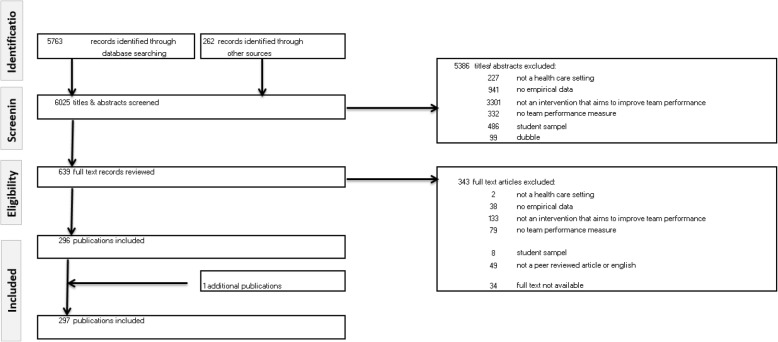
Background: A high variety of team interventions aims to improve team performance outcomes. In 2008, we conducted a systematic review to provide an overview of the scientific studies focused on these interventions. However, over the past decade, the literature on team interventions has rapidly evolved. An updated overview is therefore required, and it will focus on all possible team interventions without restrictions to a type of intervention, setting, or research design. Objectives: To review the literature from the past decade on interventions with the goal of improving team effectiveness within healthcare organizations and identify the “evidence base” levels of the research. Methods: Seven major databases were systematically searched for relevant articles published between 2008 and July 2018. Of the original search yield of 6025 studies, 297 studies met the inclusion criteria according to three independent authors and were subsequently included for analysis. The Grading of Recommendations, Assessment, Development, and Evaluation Scale was used to assess the level of empirical evidence. Results: Three types of interventions were distinguished: (1) Training , which is sub-divided into training that is based on predefined principles (i.e. CRM: crew resource management and TeamSTEPPS: Team Strategies and Tools to Enhance Performance and Patient Safety), on a specific method (i.e. simulation), or on general team training. (2) Tools covers tools that structure (i.e. SBAR: Situation, Background, Assessment, and Recommendation, (de)briefing checklists, and rounds), facilitate (through communication technology), or trigger (through monitoring and feedback) teamwork. (3) Organizational (re)design is about (re)designing structures to stimulate team processes and team functioning . (4) A programme is a combination of the previous types. The majority of studies evaluated a training focused on the (acute) hospital care setting. Most of the evaluated interventions focused on improving non-technical skills and provided evidence of improvements. Conclusion: Over the last decade, the number of studies on team interventions has increased exponentially. At the same time, research tends to focus on certain interventions, settings, and/or outcomes. Principle-based training (i.e. CRM and TeamSTEPPS) and simulation-based training seem to provide the greatest opportunities for reaching the improvement goals in team functioning.
Overview
The claims and statistics of this paper haven’t been checked yet.
Free: it reads the open-access text and checks the first 5 claims that cite a source we can check. Create a free account to check every claim.
Integrity signals
Registry
Cites
Statistics
Figures
Verification
Claims the paper makes
The claims and statistics of this paper haven’t been checked yet.
Free: it reads the open-access text and checks the first 5 claims that cite a source we can check. Create a free account to check every claim.
Self-check
Percentages, sums and reported differences re-computed from the paper’s own numbers.
The self-check needs the paper’s full text.
Citations
Cites
Audit and feedback: effects on professional practice and healthcare outcomes
Ivers, N., Jamtvedt, G., Flottorp, S., Young, J. M., Odgaard-Jensen, J., French, S. D., O'Brien, M. A., Johansen, M., Grimshaw, J., & Oxman, A. D. (2012) · Cochrane Database of Systematic Reviews · doi:10.1002/14651858.cd000259.pub3 · Cited by 5,485
Interprofessional education: effects on professional practice and healthcare outcomes
Reeves, S., Perrier, L., Goldman, J., Freeth, D., & Zwarenstein, M. (2013) · Cochrane Database of Systematic Reviews · doi:10.1002/14651858.cd002213.pub3 · Cited by 1,946
Teamwork and patient safety in dynamic domains of healthcare: A review of the literature
MANSER, T. (2009) · Acta Anaesthesiologica Scandinavica · doi:10.1111/j.1399-6576.2008.01717.x · Cited by 1,322 · cited 1×
“A lack of teamwork is often identified as a primary point of vulnerability for quality and safety of care [1, 2].”
BackgroundThe Evolution of Crew Resource Management Training in Commercial Aviation
Helmreich, R. L., Merritt, A. C., & Wilhelm, J. A. (1999) · The International Journal of Aviation Psychology · doi:10.1207/s15327108ijap0901_2 · Cited by 1,111 · cited 1×
“CRM aims to prevent and manage errors through avoiding errors, trapping errors before they are committed, and mitigating the consequences of errors that are not trapped [325].”
BackgroundAssociation Between Implementation of a Medical Team Training Program and Surgical Mortality
Neily, J., Mills, P. D., Young-Xu, Y., Carney, B. T., West, P., Berger, D. H., Mazzia, L. M., Paull, D. E., & Bagian, J. P. (2010) · JAMA · doi:10.1001/jama.2010.1506 · Cited by 1,040 · cited 4×
“MTT combines training, implementation of tools (briefings, debriefing, and other projects), and follow-up coaching [5, 304, 305, 316].”
BackgroundMethodInfluentialWhat Do We Know about Health Care Team Effectiveness? A Review of the Literature
Lemieux-Charles, L., & McGuire, W. L. (2006) · Medical Care Research and Review · doi:10.1177/1077558706287003 · Cited by 844 · cited 1×
“healthcare settings vary significantly, which challenges the generalizability [327].”
BackgroundTraining and simulation for patient safety
Aggarwal, R., Mytton, O. T., Derbrew, M., Hananel, D., Heydenburg, M., Issenberg, B., MacAulay, C., Mancini, M. E., Morimoto, T., Soper, N., et al. (2010) · Quality and Safety in Health Care · doi:10.1136/qshc.2009.038562 · Cited by 739 · cited 1×
“Simulation-based training uses a specific method as its core, namely, simulation, which refers to “a technique to replace or amplify real-patient experiences with guided experiences, artificially contrived, that evokes or replicates substantial aspects of the real world in a fully interactive manner” [326].”
Introduction of surgical safety checklists in Ontario, Canada
Urbach, D. R., Govindarajan, A., Saskin, R., Wilton, A. S., & Baxter, N. N. (2014) · New England Journal of Medicine · doi:10.1056/nejmsa1308261 · Cited by 627 · cited 1×
“…Anaesthesiology Improvement in information exchange, knowledge of critical information, perception of safety in anaesthesia teams, perceived teamwork A Urbach et al. 2014 [242] Surgical safety checklist Operating room Implementation is not associated with significant reductions in operative…”
Lingard, L. (2008) · Archives of Surgery · doi:10.1001/archsurg.2007.21 · Cited by 596 · cited 2×
“Improvement in unplanned admission rates and number of wound complications D Lingard et al. 2008 [251] Team briefing structured by a checklist General surgery Improvement in number of communication failures and proactive and collaborative team communication C Low et al. 2013 [232] “Flow checklists”…”
BackgroundMethodTeam-training in healthcare: a narrative synthesis of the literature
Weaver, S. J., Dy, S. M., & Rosen, M. A. (2014) · BMJ Quality & Safety · doi:10.1136/bmjqs-2013-001848 · Cited by 535
Research works printed but not linked: 2
- Donaldson MS, Corrigan JM, Kohn LT. To err is human: building a safer health system: National Academies Press; 2000.
- Fernandez R, Pearce M, Grand JA, Rench TA, Jones KA, Chao GT, et al. A randomized comparison study to evaluate the effectiveness of a computer-based teamwork training intervention on medical teamwork and patient care performance. Acad Emerg Med. 2013;20:S125.
Cited by
Items 401–500 of 515
Samaran, E., Mustamu, A. C., & Mamo, Y. (2025) · Journal of Health Sciences · doi:10.33086/jhs.v18i01.6795 · Cited by 5
Ανακοίνωση δυσάρεστων ειδήσεων στη Μονάδα Εντατικής Νοσηλείας Νεογνών: Μια αφηγηματική ανασκόπηση
Τρίκα, Π., Metallinou, D., Karampas, G., Τίγκα, Μ., & Nanou, C. (2025) · Eleutho · doi:10.18332/eleutho/201473
Expanding the Characterization of Collaborative Workflow and Health IT
Wong, N., Kuziemsky, C. E., Abraham, J., Nambiar, K., & Reddy, M. C. (2025) · Cognitive informatics in biomedicine and healthcare · doi:10.1007/978-3-031-82971-0_8
Butler, S. (2025) · Primary Health Care · doi:10.7748/phc.2025.e1854 · Cited by 2
Improving team dynamics in an acute older people care unit to improve quality and safety of care
Akrour, R., Pattschull, A., Stamenkovic, S., Courret-Gilgen, C., Manjon, A. G., Bourgeois, Y., & Rapin, J. (2025) · SAGE Open Medicine · doi:10.1177/20503121251333314
“Although the risk assessment in the 24 h following admission has decreased annually since 2020, the average annual rate of pressure ulcers in categories 2, 3, and 4 and above remained relatively stable and lower than what is described in the literature for the same population.”
Preventing Harassment to Improve Team Well-Being and Patient Safety in Healthcare
Aspide, R., Piazza, O., Vizcaychipi, M. P., Agostinelli, A., Geogy, N., & Sharma, D. (2025) · Springer eBooks · doi:10.1007/978-3-031-86286-1_14
Algarni, A. S., Alshehri, S. A., Alzahrani, A. F., Almuabdi, A., Alshiakh, S. M., & Samargandi, R. (2025) · Saudi Journal of Health Systems Research · doi:10.1159/000546632 · Cited by 1
Jin, R., Deng, Y., & Yang, J. H. (2025) · Frontiers in Public Health · doi:10.3389/fpubh.2025.1612625 · Cited by 2
Morrow, D. F., Thurman, H., Martin, M. C., Weirich, M. R., & Moore, A. B. (2025) · Journal of Applied Gerontology · doi:10.1177/07334648251353262
“Other studies have af fi rmed the linkage between worker training and improved worker performance outcomes in areas such as mental health worker effectiveness (Frank et al., 2020) and health worker performance (Buljac-Samardzic et al., 2020).”
Beltrán, V., Gil, A. M. C., Morales, C., Campos‐Bijit, V., Contador, R., Díaz, L., Bustos, J., & Fernández, E. (2025) · doi:10.2196/preprints.78913
Glowinski, D., Buchheit, F., Badier, E., Celi, J., Boloré, S., & Fassier, T. (2025) · Simulation in Healthcare The Journal of the Society for Simulation in Healthcare · doi:10.1097/sih.0000000000000855
Petrosoniak, A., Panici, F., & Hicks, C. M. (2025) · Springer eBooks · doi:10.1007/978-3-031-86312-7_24 · Cited by 1
Napolitano, C., Buzalko, R. J., Dallaghan, G. L. B., Mason, K., & Simonsen, K. A. (2025) · Cureus · doi:10.7759/cureus.90801
“By having a clear understanding of each team member’s roles, interprofessional teams establish a shared mental model that improves teamwork and enhances patient care [37].”
Perceived level of teamwork as reported by registered nurses: a cross-sectional study
Kohanová, D., Solgajová, A., Kolarczyk, E. B., & Bartoníčková, D. (2025) · Contemporary Nurse · doi:10.1080/10376178.2025.2547790 · Cited by 1
“A comprehensive understanding of team dynamics, fundamental principles, and the identification of potential areas for improvement within teams can only be achieved through regular evaluations of teamwork (Buljac-Samardzic et al., 2020).”
InfluentialOpto-electronically derived PPG-based non-invasive sensor for multiparameter detection
Amrutha, T. A., Nair, B., Sirdeshmukh, V. V., & Kale, S. N. (2025) · IEEE Applied Sensing Conference (APSCON) · doi:10.1109/apscon63569.2025.11144036
“The hemoglobin level is essential for numerous blood tests [2].”
Designing Interprofessional Education in Mechanical Ventilation: A Study of Learning Needs and GapsPreprint
Tajima, H., Kasai, H., Takeda, K., Utsumi, T., Furukawa, Y., Usui, I., Suzuki, T., Sakai, I., & Ito, S. (2025) · medRxiv · doi:10.1101/2025.09.14.25335731
“Our qualitative findings support these principles: participants emphasised the importance of workplace conditions, organisational support, and structured educational opportunities, factors known to enhance interprofessional team performance [30] [31].”
Cruz, L., Stuhlman, M. W., Bencken, C., Waddell, M., Scarboro, C., Cunningham, K. B., Ross, S. W., & Bullard, M. J. (2025) · Surgery · doi:10.1016/j.surg.2025.109674
Gunturi, A., Maheta, B. J., Bodd, M. H., Bergman, J., Leppert, J. T., Lorenz, K., Raspi, I. G., Singh, N. K., & Giannitrapani, K. F. (2025) · Journal of Surgical Research · doi:10.1016/j.jss.2025.09.013
Firdaus, R., Wulansari, O. D. E., Angraini, D. I., & Pratiwi, W. O. (2025) · Salud Ciencia y Tecnología · doi:10.56294/saludcyt20252013
“(26) The lack of contextualized and locally tailored approaches is also an obstacle to preventing and tackling CED.”
Izobraževanje kot steber razvoja managementa v zdravstvu
Lukhanin, O., Šprajc, P., & Lukhanina, Y. (2025) · doi:10.18690/um.fov.7.2025.6
Doka, B. K., Negeri, K. G., Worku, A. G., & Kassa, D. H. (2025) · Health Services Insights · doi:10.1177/11786329251381429
“12 In the current health system, different actions are practiced to enhance data quality and information utilization.”
Robillard, N., Vincelette, C., Robitaille, A., Varshney, T., Andrews, M., Waldolf, R., Thivierge-Southidara, M., Lineberry, M. C., Yudkowsky, R., LeBlanc, V. R., et al. (2025) · Simulation in Healthcare The Journal of the Society for Simulation in Healthcare · doi:10.1097/sih.0000000000000893
Teamtrening gjør sykepleierstudenter bedre rustet for en kompleks helsetjeneste
Karlsen, T., Storlien, M. H. S., Stomlien, T., & Ballangrud, R. (2025) · Sykepleien Forskning · doi:10.4220/sykepleiens.2025.102955
Keller, H. D. M., de Oliveira, P. C., Mendes, A. D. S., Fernandes, L. C., Oliveira, R. A., Vattimo, M. D. F. F., & Coelho, F. U. D. A. (2025) · Australian Critical Care · doi:10.1016/j.aucc.2025.101469
Development of digital learning tools for medical education with agile scrum methodology
Puncher, J., Karunananthan, S., Amrani, S., Archibald, D., Brunet, N., Forgues-Martel, S., Hajjar, A. E. J., Helmer‐Smith, M., Jolin‐Dahel, K., McCutcheon, T., et al. (2025) · BMC Medical Education · doi:10.1186/s12909-025-08270-9
“Effective teamwork is paramount in all healthcare organizations, yet research of interventions and approaches to increase teamwork in these organizations has been narrow in scope, concentrated in hospital settings and on tools, programs, and organizational structures [23].”
Santesson, I., Schell, C. O., & Bjurling‐Sjöberg, P. (2024) · Figshare · doi:10.6084/m9.figshare.25918893
Jepkosgei, J., English, M., Adam, M. B., & Nzinga, J. (2022) · Figshare · doi:10.6084/m9.figshare.19766148
Weenink, J.-W., Tresfon, J., van de Voort, I., van Muijden, T., Hamming, J., & Bal, R. A. (2024) · Figshare · doi:10.6084/m9.figshare.26621359
Dijkstra, F. S., Renden, P. G., Meeter, M., Schoonmade, L. J., Krage, R., van Schuppen, H., & de la Croix, A. (2021) · Figshare · doi:10.6084/m9.figshare.14314153
O’Malley, R., O’Connor, P., & Lydon, S. (2024) · Figshare · doi:10.6084/m9.figshare.26713550
Chen, H.-W., O’Donnell, J. M., Chiu, Y.-J., Chen, Y.-C., Kang, Y.-N., Tuan, Y.-T., 郭淑瑜, & Wu, J. ". (2022) · Figshare · doi:10.6084/m9.figshare.20745240
Dijkstra, F. S., Renden, P. G., Meeter, M., Schoonmade, L. J., Krage, R., van Schuppen, H., & de la Croix, A. (2021) · Figshare · doi:10.6084/m9.figshare.14314165
Myhr, K., Ballangrud, R., Aase, K., & Vifladt, A. (2024) · Figshare · doi:10.6084/m9.figshare.26157095
Weenink, J.-W., Tresfon, J., van de Voort, I., van Muijden, T., Hamming, J., & Bal, R. A. (2024) · Figshare · doi:10.6084/m9.figshare.26621356
Jepkosgei, J., English, M., Adam, M. B., & Nzinga, J. (2022) · Figshare · doi:10.6084/m9.figshare.19766151
Santesson, I., Schell, C. O., & Bjurling‐Sjöberg, P. (2024) · Figshare · doi:10.6084/m9.figshare.26726708
Dijkstra, F. S., Renden, P. G., Meeter, M., Schoonmade, L. J., Krage, R., van Schuppen, H., & de la Croix, A. (2021) · Figshare · doi:10.6084/m9.figshare.14314159
Santesson, I., Schell, C. O., & Bjurling‐Sjöberg, P. (2024) · Figshare · doi:10.6084/m9.figshare.25919097
O’Malley, R., O’Connor, P., & Lydon, S. (2024) · Figshare · doi:10.6084/m9.figshare.26713544
Additional file 1 of TEAMs go VR—validating the TEAM in a virtual reality (VR) medical team training
Wespi, R., Schwendimann, L., Neher, A. N., Birrenbach, T., Schauber, S. K., Manser, T., Sauter, T. C., & Kämmer, J. E. (2024) · Figshare · doi:10.6084/m9.figshare.27000802
Chen, H.-W., O’Donnell, J. M., Chiu, Y.-J., Chen, Y.-C., Kang, Y.-N., Tuan, Y.-T., Kuo, S.-Y., & Wu, J. ". (2022) · Figshare · doi:10.6084/m9.figshare.20745237
Myhr, K., Ballangrud, R., Aase, K., & Vifladt, A. (2024) · Figshare · doi:10.6084/m9.figshare.26157350
Guérin Benz, J., Stancanelli, G., Zambruni, M., Manjary, P. R., Hantavololona, H., Andrianarisoa, V. R., Rakotondrazanany, H., de Tejada Weber, B. M., Mangeret, F. R., Reich, M. R., et al. (2024) · Figshare · doi:10.6084/m9.figshare.26719848
O’Malley, R., O’Connor, P., & Lydon, S. (2024) · Figshare · doi:10.6084/m9.figshare.26713547
Aremu, S. O., Adamu, A. I., Ngwai, Y. B., & Barkhadle, A. A. (2025) · Tropical Medicine and Health · doi:10.1186/s41182-025-00893-4 · Cited by 6
“This suggests that risk perception grounded in lived experience may serve as a more immediate and powerful behavioral driver than abstract knowledge or generalized attitudes [40–42].”
Altoolm, M. M. D., Alkorbi Ahmad Saleh, T., Alshami, M. Q., Alharthi Mohammed Owaidh, A., Alzaghafi, T. S. B., Alshomrani, S. S., Alzaghafi, H. S. B., Al-Sufyani, S. K. A., Alanazi, M. K., Aldhuwayhi Abdulkarim Hameed, A., et al. (2024) · International Journal of Computational and Experimental Science and Engineering · doi:10.22399/ijcesen.4668
“The toll is quantifiable: studies consistently link high administrative burden to clinician burnout, a syndrome of emotional exhaustion, depersonalization, and reduced personal accomplishment, which has reached epidemic proportions within the healthcare workforce [2].”
WIP: Fostering Effective Teamwork in Undergraduate Research Based Course
Kumar, P., Lim, P., Movahed, S. V., & Beg, O. A. (2025) · IEEE Frontiers in Education Conference (FIE) · doi:10.1109/fie63693.2025.11328682 · Cited by 1
“Key components of successful teamwork include clear communication, constructive conflict resolution, and mutual alignment [1], [2].”
Conway, A., Bradley, R., Ryan, A. A., McCauley, C. O., Lynch, B., Harkin, D., & Penney, S. (2026) · Healthcare · doi:10.3390/healthcare14020276
“Embedding reminiscence into workforce development frameworks may strengthen sustainability and ensure greater consistency across care homes [30].”
Self-assessment of professional behaviours: a preregistration nurse development initiative
Hill, R., & Sankey, L. (2026) · British Journal of Nursing · doi:10.12968/bjon.2025.0106
Towards Building of First-class Scientific Research Group: A Case Study of Four Groups (in China)
Hou, S., Ji, X., Wang, J., Horsey, E. M., Hongyu, C., & Peng, X. (2026) · Science Technology and Society · doi:10.1177/09717218251406999
“The government and universities should consider constructing a more perfect system from the top-level design to create a more ideal academic atmosphere for research groups to ensure their effectiveness in scientific research (Buljac-Samardzic et al., 2020).”
Governance and Reform in the Healthcare System: Key Challenges and Perspectives
Сергіївна, В. Н., Lavrentii, D., Monastyrskyi, G., Demchyshyn, Y., & Levytska, Y. (2026) · Premier journal of science. · doi:10.70389/pjs.100231
Team creativity as a catalyst for care effectiveness and well-being in primary care teams
Lee, Y. S. H., LaVine, N., Rathert, C., Kogan, Y., & Poghosyan, L. (2026) · Health Care Management Review · doi:10.1097/hmr.0000000000000465 · Cited by 1
Delphi study to explore indicators of high functioning pain management teams
Rogers, D. G., Snow, J. L., Teufert, C., Higgins, D. M., Noh, M. Y., Becker, W. C., Murphy, J. L., Sandbrink, F., & Edmond, S. N. (2026) · Journal of Pain · doi:10.1016/j.jpain.2026.106216
Dotson, N., Kordzikowski, M., & Jacob, A. (2026) · Archives of Psychiatric Nursing · doi:10.1016/j.apnu.2026.152086
Garza, F. P., García-Fernández, M. L., Gutiérrez-García, E., & Santoyo-Jimenez, E. (2026) · Enfermería Intensiva · doi:10.1016/j.enfi.2026.500592
Reclaiming the systems identity of human factors and ergonomics in healthcare
Chadwick, L. M., & O’Dea, A. (2026) · Human Factors in Healthcare · doi:10.1016/j.hfh.2026.100130
Project CREATE: Improving nurse-physician teamwork through problem-based learning sessions
Hegde, A. A., Tran, T., Patel, V., Manges, C. A., Taylor, T. L., Nair, P., Golla, V., Mehta, H. N., Michalopulos, M., Somasundaravelayudham, S., et al. (2026) · Journal of Interprofessional Education & Practice · doi:10.1016/j.xjep.2026.100811
Barmparas, G., Marselian, A., Kanji, F. F., Ravi, H., Gewertz, B. L., & Cohen, T. (2026) · Surgery · doi:10.1016/j.surg.2026.110149
Assessing teamwork perceptions and challenges in a South African district hospital
Tonder, W. V., Benedict, M. A., & van Rooyen, C. (2026) · South African Family Practice · doi:10.4102/safp.v68i1.6290
Invited Commentary: Quality Over Quantity Can Help Advance Team Science
Paige, J. T. (2026) · Journal of the American College of Surgeons · doi:10.1097/xcs.0000000000001945
Ferdous, J. (2025) · Emerald Group Publishing Limited eBooks · doi:10.1108/978-1-83662-314-420251006
Pedersen, L. T., Ipsen, J. A., Egebæk, H. K., Andersen, P. T., Viberg, B., & Bruun, I. H. (2026) · Geriatric Nursing · doi:10.1016/j.gerinurse.2026.104044
Integrating Nursing Care in Cardiovascular Emergency Protocols: A Mixed-Method Study
Jarelnape, A. A., & El-Aziz, W. W. A. (2026) · Sudan Journal of Medical Sciences · doi:10.18502/sjms.v21i1.18932
Evaluation et optimisation des performances cliniques en situations de soins critiques simulées
Evain, J. (2022) · theses.fr (ABES) · doi:10.70675/707dfef1za05ez49ddzb567zd7a2835591d7
Nurses’ perceptions of team huddle in an Intensive Care Unit: An exploratory qualitative study
Garza, F. P., García-Fernández, M. L., Gutiérrez-García, E., & Santoyo-Jimenez, E. (2026) · Enfermería Intensiva (English ed ) · doi:10.1016/j.enfie.2026.500592
Phillipson, J. C., Menson, E., Barclay, S. F., & Lyons, O. (2026) · Archives of Disease in Childhood · doi:10.1136/archdischild-2025-329335
“31 32 In contrast, this evaluation incorporates mixed-methods, longitudinal qualitative data and captures Kirkpatrick Level 3 and 4 outcomes, strengthening the validity of the findings and demonstrating a more methodologically sound approach than is typical in the conflict management training…”
Nazar, A. A., Panakaje, N., Lasrado, B. S., & Parvin, S. M. R. (2026) · Journal of Health Organization and Management · doi:10.1108/jhom-01-2026-0002
Poves‐Álvarez, R., Gómez‐Sánchez, E., Martínez‐Rafael, B., Lorenzo‐López, M., Rodríguez-Cerón, G., Gómez‐Pesquera, E., López-Herrero, R., Arranz-Molinero, E., Vaquerizo-Villar, F., Hornero, R., et al. (2026) · Journal of Healthcare Leadership · doi:10.2147/jhl.s592815 · Cited by 1
“28 Regular interaction reduces information asymmetry, allowing the leader to address concerns before they escalate into conflicts.”
Meals That Matter: Nourishing Healthy Work Environments Through Commensality
Horner, J., & King, S. (2026) · JONA The Journal of Nursing Administration · doi:10.1097/nna.0000000000001729
Disruptive behaviors in the operating room: The paradox of surgical excellence
Cohen, T., Gewertz, B. L., Rosengart, T. K., & Salas, E. (2026) · Human Factors in Healthcare · doi:10.1016/j.hfh.2026.100140
Digital Transformation in Healthcare: The Critical Role of Clinical Staff InteractionsPreprint
Stead, S., Hartwich, N. J., Antons, D., & Salge, T. O. (2026) · Research Square · doi:10.21203/rs.3.rs-9365928/v1
Impacto de una intervención educativa en seguridad del paciente en atención primaria amazónica
Varela, Y. M. C., Salinas, A. F. E., & Guachamín, J. A. B. (2026) · Religación · doi:10.46652/rgn.v11i50.1652
McMahon, C. J., & Rossano, J. W. (2026) · Pediatric Cardiology · doi:10.1007/s00246-026-04314-z · Cited by 1
Interprofessionelle Zusammenarbeit. Potenziale für die Qualität der Heilmittelversorgung
Grafe, M., Adolphs, S., & Kohmäscher, A. (2026) · Springer eBooks · doi:10.1007/978-3-662-73466-7_13
Madhavan, M., & Jithesh, V. (2026) · International Journal of Community Medicine and Public Health · doi:10.18203/2394-6040.ijcmph20261760
Levchyk, O. I., Лазарчук, Т. Б., Yarema, N. I., Mykulyak, V. R., & Kotsyuba, O. I. (2026) · Academic Visions · doi:10.66556/2786-586x.55.levchyk-o
Actitudes hacia el trabajo en equipo en emergencia de un hospital general público en Ecuador
Merchán, E. J. R., Arévalo-Carrera, M. L., Abad, J. S. P., Vega, A. C., Villegas, L. F. O., & Carvajal, J. A. (2026) · Universitas Médica · doi:10.11144/javeriana.umed67.atte
Fani, F., Mahmoudi, G., YAZDANI-CHARATI, J., Hashemi, S. N., Gharayagh-Zandi, M., Soltani, S. A., Yaminfirooz, M., & Jahani, M.-A. (2026) · Primary Health Care Research & Development · doi:10.1017/s1463423626101194
“Several models and tools have been introduced to evaluate primary health care (Buljac-Samardzic et al ., 2020).”
Kunju, S. A., Mohammed, C. A., Ramanathan, H. P., Prabhu, M. M., Vimal Krishnan, S., Anand, R., Jain, A., & Unnikrishnan, B. (2026) · Research Square · doi:10.21203/rs.3.rs-9693027/v1
Surgical safety culture and postoperative endophthalmitis: A real-world study
Zhan, B., Yang, Z., Wu, Y., Huang, T., Wang, J., Gui, C., Xi, S., Chen, Z., & Zhou, X. (2026) · Eye Discovery · doi:10.1016/j.edisc.2026.100051
Khadiga, A.-E. G. G. H., & Manal, M. A. A. (2021) · International Journal of Health Sciences · doi:10.53730/ijhs.v5ns2.15967
“This variability can affect communication between nursing staff, surgical teams, and oncology clinicians, potentially delaying recognition and management of early wound changes (Buljac-Samardzic et al., 2020).”
Zchout, A., Barak, H., Yermiyah, O., Rachaminov, O., Manor, U., Zimlichman, E., & Segal, G. (2026) · Research Square · doi:10.21203/rs.3.rs-9671292/v1
Burlacu, C. L., Sinai, Y. B., Norte, G., Buléon, C., Štourač, P., Savoldelli, G. L., Berger‐Estilita, J., Podesta, A. M. C., & Østergaard, D. (2026) · European Journal of Anaesthesiology · doi:10.1097/eja.0000000000002448 · Cited by 1
Nunes, N. M., & Martins, D. (2026) · Cureus · doi:10.7759/cureus.111417
“Interventions to improve healthcare team effectiveness include team training, tools, organizational redesign, and structured programs [16], while evidence-based frameworks emphasize accountability, conflict management, decision-making, reflection, and coaching as common targets for improving…”
Ansari, A., & Singh, R. (2026) · The Journal of Social Psychology · doi:10.1080/00224545.2026.2686262
SARTIKA, D., Ardyansyah, B. D., Idris, I., Afandi, I. N., WAHYU, S., Fajriah, S. N., Hasfat, H., & Budu (2026) · American Journal of Pharmaceutical Education · doi:10.1016/j.ajpe.2026.102035
Reframing Patient Safety: Relationships as the Core Infrastructure of Safe Care
Weller, J. M. (2026) · Anesthesia & Analgesia · doi:10.1213/ane.0000000000008189 · Cited by 1
How to Bridge Interprofessional and Simulation-Based Education? The State of the Art in IP-Sim
Törnqvist, T., Tidén, S. W., Picchiottino, P., & Fassier, T. (2026) · Springer eBooks · doi:10.1007/978-3-032-23222-9_10
Rarani, S. A. (2026) · British Journal of Healthcare Management · doi:10.12968/bjhc.2025.0124
Gürkan, D. Y., & Çakmak, R. (2026) · BMC Nursing · doi:10.1186/s12912-026-05004-0
“For example, nurse managers may administer the scale before and after team-based training programs to evaluate whether collective coping, coordination, and mutual support improve over time [14, 15, 30].”
InfluentialAmiri, M., Khani, A., Adelmanesh, Y., & Bagheri, M. (2026) · Perioperative Care and Operating Room Management · doi:10.1016/j.pcorm.2026.100697
Dzierba, A. L., & Barletta, J. F. (2026) · Springer eBooks · doi:10.1007/978-3-032-22660-0_52
Identifying competencies of primary health care teams in Bhavnagar district, Gujarat
Mehta, A., Misra, M., Dyson, J., Puwar, T. I., & Rao, K. D. (2026) · PLOS Global Public Health · doi:10.1371/journal.pgph.0006861
“Evidence shows that training team members together facilitates better teamwork [34,35].”
Lau, F. M., Ma, T. S. K., Lau, K. Y., Leung, A. M. S., Tai, P. W. H., Chan, M. H., Lai, P. C. K., Chan, W. K., Ngai, C. W., Sin, W. C., et al. (2026) · Dimensions of Critical Care Nursing · doi:10.1097/dcc.0000000000000777
Díaz-Piedra, C., & Stasi, L. L. D. (2026) · Springer series in design and innovation · doi:10.1007/978-3-032-23073-7_21
Communiquer en anesthésie-réanimation et médecine péri-opératoire
Cros, J. (2022) · Arnette eBooks · doi:10.3917/arne.brune.2022.01.0122
Communiquer en anesthésie-réanimation et médecine péri-opératoire
Cros, J. (2022) · Arnette eBooks · doi:10.3917/arne.brune.2022.01.0660
Purnamasari, N., Adliah, F., Rapley, T., Pennington, L., & Basu, A. P. (2026) · Developmental Medicine & Child Neurology · doi:10.1111/dmcn.70436
Evaluation of the Critical Care Team Training and Clinical Excellence (TTrACE) Academy
Carhart, K., Weiser, N., Brydges, R., Davies, R., Romano, D., Salamon, S. D., Deangelis, K.-C., Gerard, N. B., Canzian, S., & Topolovec‐Vranic, J. (2026) · Healthcare · doi:10.3390/healthcare14152421
Team Behavior and Patient Outcome Changes After Human Factors Program in a Pediatric Airway Setting
Cadre, B., Luscan, R., Chen, X., Garcelon, N., Simon, F., & Thierry, B. (2026) · JAMA Otolaryngology–Head & Neck Surgery · doi:10.1001/jamaoto.2026.2049
Metadata
- Authors
- Buljac-Samardzic, M., Doekhie, K. D., & van Wijngaarden, J. D. H.
- Affiliations
- Erasmus University Rotterdam (NL)
- ORCID
- Doekhie, Kirti D.
- Venue
- Human Resources for Health
- Published
- 2020-01-08
- Volume
- 18
- Issue
- 1
- Pages
- 2-2
- ISSN
- 1478-4491 (ISSN-L)
- PMC
- PMC6950792
- OpenAlex
- W2999221681
- Cited by
- 515
- References
- 336
- Citations by year
- 2026: 84 · 2025: 103 · 2024: 108 · 2023: 67 · 2022: 68 · 2021: 61 · 2020: 23
- FWCI
- 8.80
- Type
- journal article
- Language
- en
- Open access
- gold
- doi.org
- Licence
- cc-by
- creativecommons.org/licenses/by/4.0/ (tdm)
- creativecommons.org/licenses/by/4.0/ (vor)
- Locations
- Human Resources for Health (publishedVersion, cc-by)
- PubMed Central (publishedVersion, cc-by)
- PubMed (publishedVersion)
- EUR Research Repository (Erasmus University Rotterdam) (publishedVersion, other-oa)
- EUR Research Repository (Erasmus University Rotterdam) (submittedVersion, other-oa)
- RePub (Erasmus University Rotterdam) (submittedVersion, other-oa)
- DOAJ (DOAJ: Directory of Open Access Journals) (submittedVersion, cc-by-sa)
- EUR Research Repository (Erasmus University Rotterdam) (submittedVersion, cc-by)
- Funders
- Erasmus Medisch Centrum
- Topics
- Social Sciences › Psychology › Social Psychology › Team Dynamics and Performance
- Health Sciences › Medicine › Public Health, Environmental and Occupational Health › Patient Safety and Medication Errors
- Health Sciences › Health Professions › General Health Professions › Interprofessional Education and Collaboration
- Keywords
- team-based intervention, team effectiveness, healthcare teamwork, team training, crew resource management, TeamSTEPPS, simulation-based training, SBAR, organizational redesign, non-technical skills, patient safety, communication technology, monitoring and feedback, acute hospital care
- MeSH terms
- Delivery of Health Care, Humans, Patient Care Team, Quality Improvement
About these checks
Registry, retraction, Cites and statistics results are computed, not judged, with one exception: a printed reference that no index lists is read once by a model before it counts as a citation error. Claims are extracted by a model and kept only when their quote appears verbatim in the text; each cited source is then checked, with a model’s help, for whether it says what the claim relies on. Those verdicts can be wrong — read the claim’s quote and the cited source before relying on one.
Statistics and arithmetic are recomputed, not judged.
Confidence bands are shown only for fields calibrated on our annotated test set. None is calibrated yet, so no band is shown.
What counts as a claim ›How we measure confidence ›How we check this ›
Are you an author, or do you see a problem with this page? Request a review
Data sources
Bibliographic data: Semantic Scholar, OpenAlex, Crossref.
Contains information from the Semantic Scholar Academic Graph Datasets, made available under the ODC Attribution License (ODC-BY 1.0).
Semantic Scholar’s data is described in: Kinney, R., et al. (2023). The Semantic Scholar Open Data Platform. arXiv:2301.10140.
