

The DOI matches its Crossref record; 146 of the 146 references it cites were found in a registry or an index.
Regulation of efferocytosis as a novel cancer therapy
Open accessAbstract
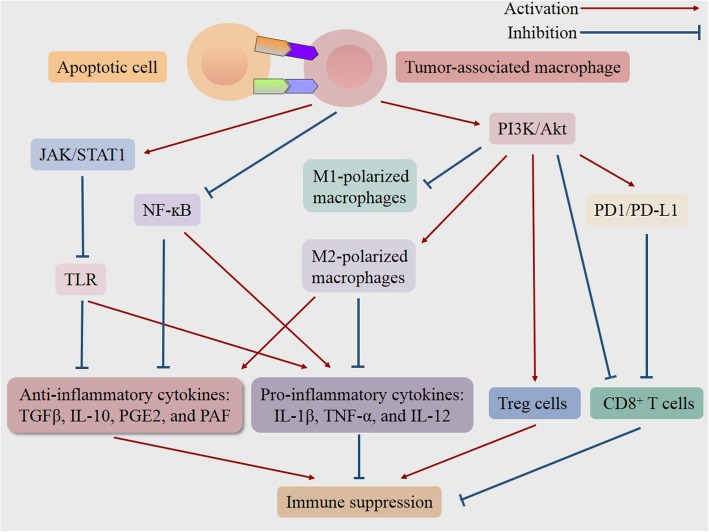
Efferocytosis is a physiologic phagocytic clearance of apoptotic cells, which modulates inflammatory responses and the immune environment and subsequently facilitates immune escape of cancer cells, thus promoting tumor development and progression. Efferocytosis is an equilibrium formed by perfect coordination among “find-me”, “eat-me” and “don’t-eat-me” signals. These signaling pathways not only affect the proliferation, invasion, metastasis, and angiogenesis of tumor cells but also regulate adaptive responses and drug resistance to antitumor therapies. Therefore, efferocytosis-related molecules and pathways are potential targets for antitumor therapy. Besides, supplementing conventional chemotherapy, radiotherapy and other immunotherapies with efferocytosis-targeted therapy could enhance the therapeutic efficacy, reduce off-target toxicity, and promote patient outcome.
Overview
The claims and statistics of this paper haven’t been checked yet.
Run the check — free, no account needed. It reads the open-access text and checks the sources it cites.
Integrity signals
Registry
Cites
Statistics
Figures
Verification
Claims the paper makes
The claims and statistics of this paper haven’t been checked yet.
Run the check — free, no account needed. It reads the open-access text and checks the sources it cites.
Claims other papers make about this one
Each is checked against this paper’s own text: does it say what the citing paper says it does?
The source backs part of the claim, not all of it — or backs it for a different population, condition or comparison.
In the citing paper
“It is seen as a major hurdle to using antigen presenting cells in cell-based therapies (61–64).”
From Cholesterol efflux protein, ABCA1, supports anticancer functions of myeloid immune cells (2026) · cites this paper as [63]
Experimental — accuracy not yet measured
Self-check
Percentages, sums and reported differences re-computed from the paper’s own numbers.
The self-check needs the paper’s full text.
Citations
Cites
1 retracted
Tan, X., Zhang, Z., Yao, H., & Shen, L. (2018) · Cancer Letters · doi:10.1016/j.canlet.2018.08.012 · Cited by 76
RetractedTumour-educated macrophages promote tumour progression and metastasis
Pollard, J. W. (2004) · Nature reviews. Cancer · doi:10.1038/nrc1256 · Cited by 3,413
Fadok, V. A., Voelker, D. R., Campbell, P. A., Cohen, J., Bratton, D. L., & Henson, P. M. (1992) · The Journal of Immunology · doi:10.4049/jimmunol.148.7.2207 · Cited by 3,321
Calreticulin exposure dictates the immunogenicity of cancer cell death
Obeid, M., Tesniere, A., Ghiringhelli, F., Fimia, G. M., Apetoh, L., Perfettini, J.-L., Castedo, M., Mignot, G., Panaretakis, T., Casares, N., et al. (2007) · Nature Medicine · doi:10.1038/nm1523 · Cited by 3,216
Fadok, V. A., Bratton, D. L., Konowal, A., Freed, P. W., Westcott, J. Y., & Henson, P. M. (1998) · Journal of Clinical Investigation · doi:10.1172/jci1112 · Cited by 3,166
Martin, S. J., Reutelingsperger, C. P., McGahon, A. J., Rader, J. A., van Schie, R. C., LaFace, D. M., & Green, D. R. (1995) · The Journal of experimental medicine · doi:10.1084/jem.182.5.1545 · Cited by 2,824
Inhibitory Fc receptors modulate in vivo cytoxicity against tumor targets
Clynes, R. A., Towers, T. L., Presta, L. G., & Ravetch, J. V. (2000) · Nature Medicine · doi:10.1038/74704 · Cited by 2,768
Distinct role of macrophages in different tumor microenvironments
Lewis, C. E., & Pollard, J. W. (2006) · Cancer Research · doi:10.1158/0008-5472.can-05-4005 · Cited by 2,225
Bingle, L., Brown, N. J., & Lewis, C. E. (2002) · The Journal of Pathology · doi:10.1002/path.1027 · Cited by 2,022
Immunosuppressive effects of apoptotic cells
Voll, R. E., Herrmann, M., Roth, E. A., Stach, C., Kalden, J. R., & Girkontaite, I. (1997) · Nature · doi:10.1038/37022 · Cited by 1,787
Cited by
Sorted by citations
Items 101–101 of 101
Haile, S. A., Gatta, A., Colon, N., Philpott, D. J., Kufer, T. A., Ying, L., Tong, D., & Ferrero, R. L. (2026) · The FASEB Journal · doi:10.1096/fj.202504879r
Metadata
- Authors
- Zhou, Y., Yao, Y., Deng, Y., & Shao, A.
- Affiliations
- Second Affiliated Hospital of Zhejiang University (CN)
- Corresponding author
- Deng, Yongchuan
- Shao, Anwen
- Venue
- Cell Communication and Signaling
- Published
- 2020-05-05
- Volume
- 18
- Issue
- 1
- Pages
- 71-71
- ISSN
- 1478-811X (ISSN-L)
- PMC
- PMC7199874
- OpenAlex
- W3023079876
- Cited by
- 100
- References
- 146
- Citations by year
- 2026: 8 · 2025: 23 · 2024: 29 · 2023: 17 · 2022: 11 · 2021: 8 · 2020: 4
- FWCI
- 0.98
- Type
- journal article
- Language
- en
- Open access
- gold
- doi.org
- Locations
- Cell Communication and Signaling (publishedVersion, cc-by)
- PubMed Central (publishedVersion, cc-by)
- PubMed (publishedVersion)
- DOAJ (DOAJ: Directory of Open Access Journals) (submittedVersion, cc-by-sa)
- Funders
- Postdoctoral Research Foundation of China (2017M612010)
- National Natural Science Foundation of China (81701144)
- Topics
- Life Sciences › Immunology and Microbiology › Immunology › Phagocytosis and Immune Regulation
- Life Sciences › Biochemistry, Genetics and Molecular Biology › Molecular Biology › Cell death mechanisms and regulation
- Life Sciences › Biochemistry, Genetics and Molecular Biology › Cell Biology › Autophagy in Disease and Therapy
- Keywords
- efferocytosis, cancer immunotherapy, tumor immune evasion, find-me signals, eat-me signals, don't eat me signal, tumor microenvironment, drug resistance, combination therapy, cancer therapy targets
- MeSH terms
- Regulated Cell Death, Animals, Humans, Immunosuppression Therapy, Inflammation, Neoplasms, Phagocytosis, Apoptosis, Disease Progression, Tumor Escape
About these checks
Registry, retraction, Cites and statistics results are computed, not judged, with one exception: a printed reference that no index lists is read once by a model before it counts as a citation error. Claims are extracted by a model and kept only when their quote appears verbatim in the text; each cited source is then checked, with a model’s help, for whether it says what the claim relies on. Those verdicts can be wrong — read the claim’s quote and the cited source before relying on one.
Statistics and arithmetic are recomputed, not judged.
Confidence bands are shown only for fields calibrated on our annotated test set. None is calibrated yet, so no band is shown.
What counts as a claim ›How we measure confidence ›How we check this ›
Are you an author, or do you see a problem with this page? Request a review
