

The DOI matches its Crossref record; 37 of the 39 references it cites were found in a registry or an index; none of the 6 sources its claims cite is checked for support yet.
Objectively measured physical activity and sedentary time in youth: the International Children's Accelerometry Database (ICAD)
Open accessAbstract
BACKGROUND: Physical activity and sedentary behaviour in youth have been reported to vary by sex, age, weight status and country. However, supporting data are often self-reported and/or do not encompass a wide range of ages or geographical locations. This study aimed to describe objectively-measured physical activity and sedentary time patterns in youth. METHODS: The International Children's Accelerometry Database (ICAD) consists of ActiGraph accelerometer data from 20 studies in ten countries, processed using common data reduction procedures. Analyses were conducted on 27,637 participants (2.8-18.4 years) who provided at least three days of valid accelerometer data. Linear regression was used to examine associations between age, sex, weight status, country and physical activity outcomes. RESULTS: Boys were less sedentary and more active than girls at all ages. After 5 years of age there was an average cross-sectional decrease of 4.2% in total physical activity with each additional year of age, due mainly to lower levels of light-intensity physical activity and greater time spent sedentary. Physical activity did not differ by weight status in the youngest children, but from age seven onwards, overweight/obese participants were less active than their normal weight counterparts. Physical activity varied between samples from different countries, with a 15-20% difference between the highest and lowest countries at age 9-10 and a 26-28% difference at age 12-13. CONCLUSIONS: Physical activity differed between samples from different countries, but the associations between demographic characteristics and physical activity were consistently observed. Further research is needed to explore environmental and sociocultural explanations for these differences.
Overview
AI snapshot
Written from the paper’s full text.
TL;DR
This pooled analysis of ActiGraph accelerometer data from 20 studies in ten countries described physical activity and sedentary time in 27,637 youth aged 2.8–18.4 years. It found consistent sex, age, and weight-status differences, plus substantial between-country variation, despite use of common data-reduction procedures.
Key findings
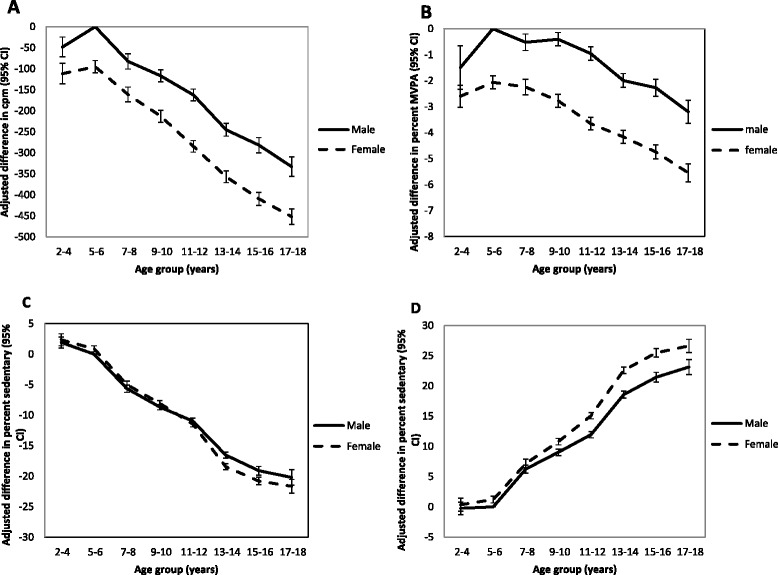
- Boys were less sedentary and more active than girls at all ages. After age 5, total physical activity decreased cross-sectionally by an average of 4.2% per additional year (3.7% in boys, 4.6% in girls), mainly through lower light-intensity activity and greater sedentary time.
- Physical activity did not differ by weight status in the youngest children, but from age seven onwards overweight/obese participants were less active than normal-weight peers; this showed a dose–response relationship in both sexes and was particularly large in boys.
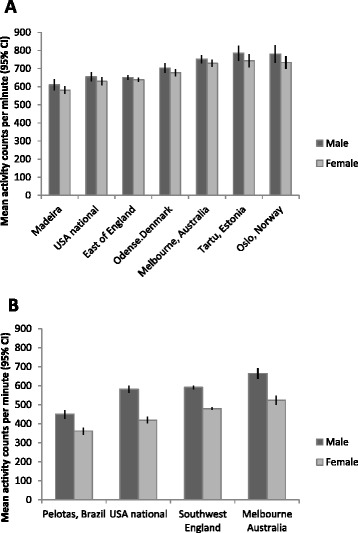
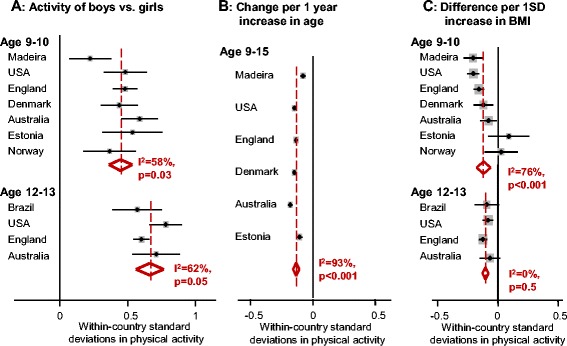
- Between-country differences were substantial: at age 9–10 the difference between the least active population (Madeira) and most active (Oslo, Norway) was 15–20% (156 cpm in boys, 613 vs. 769; 99 cpm in girls, 561 vs. 660), and at age 12–13 it was 26–28%.
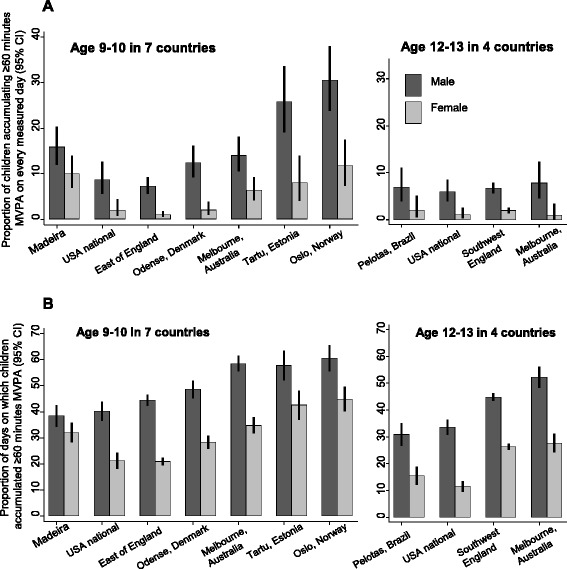
- Among 5–17 year olds in ICAD, only 9.0% of boys and 1.9% of girls achieved ≥60 min MVPA every valid day; ≥60 min MVPA was accumulated on 46% of valid days for boys and 22% for girls, with Norwegian boys aged 9–10 recording the highest values (60.5% of measured days).
Methods
- ICAD pooled ActiGraph accelerometer data from 20 studies in ten countries using a standard data-reduction procedure. Analyses included 27,637 participants (92% of 29,967 potential participants) aged 2.8–18.4 years with at least 3 valid days (mean 5.3, range 3–7), providing 188,416 valid days across 35,360 time points.
- Linear regression examined cross-sectional associations between age, sex, weight status, and physical activity outcomes, adjusted for study and season; robust standard errors accounted for repeated measures within participants. Country comparisons were restricted to ages 9–15 and ten studies from eight countries, using standardized within-country outcomes and random-effects meta-analysis.
- Physical activity outcomes included average accelerometer counts per minute (cpm) and percentage time sedentary (≤100 cpm), light (101–2295 cpm), and moderate-to-vigorous (≥2296 cpm). Guideline achievement was presented as ≥60 min MVPA on every valid day and as the percentage of valid days with ≥60 min MVPA.
Limitations
- The paper states that the sample was skewed toward ages 9–15 (82% of measurement time points) and the UK and USA (73% of measurement time points); some countries had too few participants for country-level analysis, countries were not globally representative, and low- and middle-income countries were underrepresented. Most samples were not nationally representative, though generally at least regionally representative.
- The paper states accelerometer limitations: waist-worn accelerometers poorly record upper-body activity and cycling, potentially underestimating activity in high-cycling countries such as Denmark; they misclassify motionless-standing as sedentary, potentially overestimating sedentary time; and the MVPA thresholds perform poorly for ages 4–6 and are not validated under age 4.
- The paper notes that direction of causation between weight status and physical activity was not investigated and may be bidirectional, and that individual, social, and environmental explanations for between-country differences were not explored. Evident from the text: girls were over-represented (59%, falling to 52% after excluding one large study of adolescent girls), which may affect descriptive proportions.
Model-written summary. Check it against the paper before relying on it.
Integrity signals
Registry
Cites
Statistics
Figures
Verification
Claims the paper makes
19 Own result · 12 Own method · 5 Not checked yet · 4 Own interpretation
A result the paper reports from its own data — it cites no other source for it, so there is none to check. The quote shows it is in the paper.
In the paper
“At age 9–10, the difference between the least active population (Madeira) and the most active (Oslo, Norway) was 15–20 % (156 cpm in boys (613 vs. 769) and 99 cpm in girls (561 vs. 660)).”
§ Objectively measured physical activity and sedentary time in youth: the International children’s accelerometry database (ICAD) > Results > Cross-country comparisons of physical activity
plain- Asserted: passes — The authors put it forward as true.
- Checkable: passes — It can be checked against evidence.
- Load-bearing: unclear — It is unclear whether the paper’s conclusions depend on it.
- Based: passes — The paper gives a reason why it holds.
A result the paper reports from its own data — it cites no other source for it, so there is none to check. The quote shows it is in the paper.
In the paper
“At age 12–13, even larger differences were seen (26–28 % between the highest and lowest countries).”
§ Objectively measured physical activity and sedentary time in youth: the International children’s accelerometry database (ICAD) > Results > Cross-country comparisons of physical activity
plain- Asserted: passes — The authors put it forward as true.
- Checkable: passes — It can be checked against evidence.
- Load-bearing: unclear — It is unclear whether the paper’s conclusions depend on it.
- Based: passes — The paper gives a reason why it holds.
A result the paper reports from its own data — it cites no other source for it, so there is none to check. The quote shows it is in the paper.
In the paper
“due mainly to lower levels of light-intensity physical activity and greater time spent sedentary”
- Also stated in: § Physical activity by sex, age and weight status · plain
“Simultaneous with the reduction in total physical activity and percentage time in MVPA between increasing age groups, light physical activity (Fig. 1c) declined and sedentary time increased (Fig. 1d).”
- Also stated in: § Discussion · plain
“the lower levels of overall physical activity with increasing age were reflected by a progressive increase in the volume of sedentary time and an almost equivalent ‘displacement’ of light-intensity physical activity.”
§ Objectively measured physical activity and sedentary time in youth: the International children’s accelerometry database (ICAD) > Abstract > Results
plaindirect- Asserted: passes — The authors put it forward as true.
- Checkable: passes — It can be checked against evidence.
- Load-bearing: passes — The paper’s conclusions depend on it.
- Based: passes — The paper gives a reason why it holds.
- Also stated in: § Physical activity by sex, age and weight status · plain
A result the paper reports from its own data — it cites no other source for it, so there is none to check. The quote shows it is in the paper.
In the paper
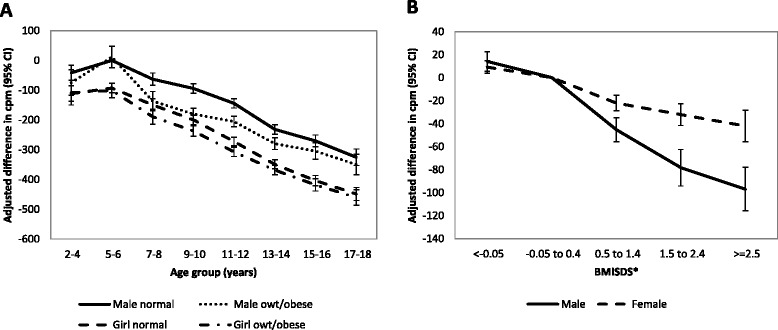
“Overweight/obesity was not associated with total physical activity in the youngest age groups (age 2–6)”
- Also stated in: § Results · plain
“Physical activity did not differ by weight status in the youngest children”
§ Objectively measured physical activity and sedentary time in youth: the International children’s accelerometry database (ICAD) > Results > Physical activity by sex, age and weight status
plain- Asserted: passes — The authors put it forward as true.
- Checkable: passes — It can be checked against evidence.
- Load-bearing: passes — The paper’s conclusions depend on it.
- Based: passes — The paper gives a reason why it holds.
- Also stated in: § Results · plain
A result the paper reports from its own data — it cites no other source for it, so there is none to check. The quote shows it is in the paper.
In the paper
“but from age seven onwards, overweight/obese participants were less active than their normal weight counterparts.”
- Also stated in: § Physical activity by sex, age and weight status · plain
“but was consistently associated with lower total physical activity in older age groups (Fig. 2a).”
§ Objectively measured physical activity and sedentary time in youth: the International children’s accelerometry database (ICAD) > Abstract > Results
plaincorrelational- Asserted: passes — The authors put it forward as true.
- Checkable: passes — It can be checked against evidence.
- Load-bearing: passes — The paper’s conclusions depend on it.
- Based: passes — The paper gives a reason why it holds.
- Also stated in: § Physical activity by sex, age and weight status · plain
A result the paper reports from its own data — it cites no other source for it, so there is none to check. The quote shows it is in the paper.
In the paper
“When calculated relative to the average activity level at age 12, the annual difference was 5.8 % (4.7 % in boys, 6.8 % in girls; data not shown).”
§ Objectively measured physical activity and sedentary time in youth: the International children’s accelerometry database (ICAD) > Discussion
plaincorrelational- Asserted: passes — The authors put it forward as true.
- Checkable: passes — It can be checked against evidence.
- Load-bearing: passes — The paper’s conclusions depend on it.
- Based: passes — The paper gives a reason why it holds.
A result the paper reports from its own data — it cites no other source for it, so there is none to check. The quote shows it is in the paper.
In the paper
“After 5 years of age there was an average cross-sectional decrease of 4.2 % in total physical activity with each additional year of age”
- Also stated in: § Physical activity by sex, age and weight status · plain
“Overall, this is equivalent to an average annual reduction in total physical activity of 4.2 % relative to age five (3.7 % decrease in boys, 4.6 % decrease in girls).”
- Also stated in: § Discussion · plain
“The present study found a difference of 4.2 % per annum in overall physical activity when calculated with reference to the activity level at age five.”
§ Objectively measured physical activity and sedentary time in youth: the International children’s accelerometry database (ICAD) > Abstract > Results
plaincorrelationaln = 27,637- Asserted: passes — The authors put it forward as true.
- Checkable: passes — It can be checked against evidence.
- Load-bearing: passes — The paper’s conclusions depend on it.
- Based: passes — The paper gives a reason why it holds.
- Also stated in: § Physical activity by sex, age and weight status · plain
A result the paper reports from its own data — it cites no other source for it, so there is none to check. The quote shows it is in the paper.
In the paper
“comparison of data from Norway and the US shows that Norwegian 9–10 year old girls were, on average, as active as American boys (658 vs. 655 cpm).”
§ Objectively measured physical activity and sedentary time in youth: the International children’s accelerometry database (ICAD) > Discussion
plain- Asserted: passes — The authors put it forward as true.
- Checkable: passes — It can be checked against evidence.
- Load-bearing: passes — The paper’s conclusions depend on it.
- Based: passes — The paper gives a reason why it holds.
A result the paper reports from its own data — it cites no other source for it, so there is none to check. The quote shows it is in the paper.
In the paper
“Among 5–17 year olds in the ICAD database as a whole only, 9.0 % of boys and 1.9 % of girls achieved this”
§ Objectively measured physical activity and sedentary time in youth: the International children’s accelerometry database (ICAD) > Results > Cross-country comparisons of physical activity
plain- Asserted: passes — The authors put it forward as true.
- Checkable: passes — It can be checked against evidence.
- Load-bearing: passes — The paper’s conclusions depend on it.
- Based: passes — The paper gives a reason why it holds.
A result the paper reports from its own data — it cites no other source for it, so there is none to check. The quote shows it is in the paper.
In the paper
“≥60 min of MVPA were accumulated on a substantially higher percentage of days (46 % of valid days for boys and 22 % for girls)”
§ Objectively measured physical activity and sedentary time in youth: the International children’s accelerometry database (ICAD) > Results > Cross-country comparisons of physical activity
plain- Asserted: passes — The authors put it forward as true.
- Checkable: passes — It can be checked against evidence.
- Load-bearing: unclear — It is unclear whether the paper’s conclusions depend on it.
- Based: passes — The paper gives a reason why it holds.
- It may state two separate claims as one. 21
- Probably not a substantial claim. 6
A result the paper reports from its own data — it cites no other source for it, so there is none to check. The quote shows it is in the paper.
In the paper
“This association showed a dose–response relationship in both sexes, and was particularly large in boys (Fig. 2b).”
§ Objectively measured physical activity and sedentary time in youth: the International children’s accelerometry database (ICAD) > Results > Physical activity by sex, age and weight status
plaincorrelational- Asserted: passes — The authors put it forward as true.
- Checkable: passes — It can be checked against evidence.
- Load-bearing: passes — The paper’s conclusions depend on it.
- Based: passes — The paper gives a reason why it holds.
It may state two separate claims as one.
A result the paper reports from its own data — it cites no other source for it, so there is none to check. The quote shows it is in the paper.
In the paper
“there was no country in which this difference was not significant or where the point estimate for the difference was less than 0.2 standard deviations.”
§ Objectively measured physical activity and sedentary time in youth: the International children’s accelerometry database (ICAD) > Results > Cross-country comparisons of physical activity
plain- Asserted: passes — The authors put it forward as true.
- Checkable: passes — It can be checked against evidence.
- Load-bearing: passes — The paper’s conclusions depend on it.
- Based: passes — The paper gives a reason why it holds.
It may state two separate claims as one.
A result the paper reports from its own data — it cites no other source for it, so there is none to check. The quote shows it is in the paper.
In the paper
“Higher BMI was associated with lower physical activity in most countries, but this difference was not significant in all samples, including the two most active samples at age 9–10 (Fig 5c).”
§ Objectively measured physical activity and sedentary time in youth: the International children’s accelerometry database (ICAD) > Results > Cross-country comparisons of physical activity
plaincorrelationaln = 2- Asserted: passes — The authors put it forward as true.
- Checkable: passes — It can be checked against evidence.
- Load-bearing: unclear — It is unclear whether the paper’s conclusions depend on it.
- Based: passes — The paper gives a reason why it holds.
It may state two separate claims as one.
A result the paper reports from its own data — it cites no other source for it, so there is none to check. The quote shows it is in the paper.
In the paper
“The three countries that were represented twice were ranked in the same order, with the USA least active, England intermediate and Australia most active.”
§ Objectively measured physical activity and sedentary time in youth: the International children’s accelerometry database (ICAD) > Results > Cross-country comparisons of physical activity
plaincorrelational- Asserted: passes — The authors put it forward as true.
- Checkable: passes — It can be checked against evidence.
- Load-bearing: unclear — It is unclear whether the paper’s conclusions depend on it.
- Based: passes — The paper gives a reason why it holds.
It may state two separate claims as one.
A result the paper reports from its own data — it cites no other source for it, so there is none to check. The quote shows it is in the paper.
In the paper
“Boys were less sedentary and more active than girls at all ages.”
- Also stated in: § Physical activity by sex, age and weight status · plain
“Boys were more active and less sedentary than girls at all ages.”
- Also stated in: § Discussion · plain
“Physical activity was consistently lower in girls than boys”
§ Objectively measured physical activity and sedentary time in youth: the International children’s accelerometry database (ICAD) > Abstract > Results
plaincorrelationaln = 27,637- Asserted: passes — The authors put it forward as true.
- Checkable: passes — It can be checked against evidence.
- Load-bearing: passes — The paper’s conclusions depend on it.
- Based: passes — The paper gives a reason why it holds.
It may state two separate claims as one.
- Also stated in: § Physical activity by sex, age and weight status · plain
A result the paper reports from its own data — it cites no other source for it, so there is none to check. The quote shows it is in the paper.
In the paper
“In all countries, boys were more active than girls. On average, activity levels among boys were 0.45 standard deviations higher than in girls at age 9–10 and 0.66 standard deviations higher at age 12–13 (Fig. 5a).”
§ Objectively measured physical activity and sedentary time in youth: the International children’s accelerometry database (ICAD) > Results > Cross-country comparisons of physical activity
plaincorrelational- Asserted: passes — The authors put it forward as true.
- Checkable: passes — It can be checked against evidence.
- Load-bearing: passes — The paper’s conclusions depend on it.
- Based: passes — The paper gives a reason why it holds.
It may state two separate claims as one.
A result the paper reports from its own data — it cites no other source for it, so there is none to check. The quote shows it is in the paper.
In the paper
“Physical activity varied between samples from different countries, with a 15–20 % difference between the highest and lowest countries at age 9–10 and a 26–28 % difference at age 12–13.”
- Also stated in: § Cross-country comparisons of physical activity · plain
“Average accelerometer counts per minute varied substantially between countries, both at age 9–10 (Fig. 3a) and age 12–13 (Fig. 3b).”
§ Objectively measured physical activity and sedentary time in youth: the International children’s accelerometry database (ICAD) > Abstract > Results
plaincorrelational- Asserted: passes — The authors put it forward as true.
- Checkable: passes — It can be checked against evidence.
- Load-bearing: passes — The paper’s conclusions depend on it.
- Based: passes — The paper gives a reason why it holds.
It may state two separate claims as one.
- Also stated in: § Cross-country comparisons of physical activity · plain
What the paper did — it cites no source for this, so there is none to check. The quote shows it is in the paper.
In the paper
“There are many possible individual, social and environmental explanations for these differences that were not explored in this study.”
§ Objectively measured physical activity and sedentary time in youth: the International children’s accelerometry database (ICAD) > Discussion
hedged- Asserted: passes — The authors put it forward as true.
- Checkable: passes — It can be checked against evidence.
- Load-bearing: fails — The paper’s conclusions may not depend on it.
- Based: passes — The paper gives a reason why it holds.
Probably not a substantial claim. The paper’s conclusions may not depend on it.
What the paper did — it cites no source for this, so there is none to check. The quote shows it is in the paper.
In the paper
“The ICAD provides a large volume of accelerometer data reduced using a common protocol, which allows comparison of study samples from a number of countries.”
§ Objectively measured physical activity and sedentary time in youth: the International children’s accelerometry database (ICAD) > Conclusions
plaindirect- Asserted: passes — The authors put it forward as true.
- Checkable: passes — It can be checked against evidence.
- Load-bearing: passes — The paper’s conclusions depend on it.
- Based: passes — The paper gives a reason why it holds.
It may state two separate claims as one.
What the paper did — it cites no source for this, so there is none to check. The quote shows it is in the paper.
In the paper
“the countries included are not globally representative, with the US, UK and Northern Europe over-represented, few data from other geographical regions, and a dearth of data from low and middle-income countries.”
§ Objectively measured physical activity and sedentary time in youth: the International children’s accelerometry database (ICAD) > Discussion
plain- Asserted: passes — The authors put it forward as true.
- Checkable: passes — It can be checked against evidence.
- Load-bearing: unclear — It is unclear whether the paper’s conclusions depend on it.
- Based: passes — The paper gives a reason why it holds.
It may state two separate claims as one.
In the paper
“In addition, waist-worn accelerometers mis-classify time spent in motionless-standing as sedentary, which is not considered to be a sedentary behaviour (defined as “any waking behaviour characterised by an energy expenditure ≤1.5 metabolic equivalents (METs) while in a sitting or reclining posture” [35]), potentially leading to over estimates of the true volume of sedentary time.”
§ Objectively measured physical activity and sedentary time in youth: the International children’s accelerometry database (ICAD) > Discussion
What the sources say
- Not checked yetcites [35] Network SBR. Letter to the Editor: Standardized use of the terms “sedentary” and “sedentary behaviours”. Appl Physiol Nutr Metab. 2012;37:540–2. source
hedgedconditional- Asserted: passes — The authors put it forward as true.
- Checkable: passes — It can be checked against evidence.
- Load-bearing: unclear — It is unclear whether the paper’s conclusions depend on it.
- Based: passes — The paper gives a reason why it holds.
It may state two separate claims as one.
What the paper did — it cites no source for this, so there is none to check. The quote shows it is in the paper.
In the paper
“the number of participants in some countries did not allow analysis by country, and overall the sample is skewed towards two main age groups.”
§ Objectively measured physical activity and sedentary time in youth: the International children’s accelerometry database (ICAD) > Discussion
plain- Asserted: passes — The authors put it forward as true.
- Checkable: passes — It can be checked against evidence.
- Load-bearing: unclear — It is unclear whether the paper’s conclusions depend on it.
- Based: passes — The paper gives a reason why it holds.
It may state two separate claims as one.
What the paper did — it cites no source for this, so there is none to check. The quote shows it is in the paper.
In the paper
“most samples are not nationally representative, although studies have generally sampled to be at least regionally representative.”
§ Objectively measured physical activity and sedentary time in youth: the International children’s accelerometry database (ICAD) > Discussion
plain- Asserted: passes — The authors put it forward as true.
- Checkable: passes — It can be checked against evidence.
- Load-bearing: unclear — It is unclear whether the paper’s conclusions depend on it.
- Based: passes — The paper gives a reason why it holds.
It may state two separate claims as one.
What the paper did — it cites no source for this, so there is none to check. The quote shows it is in the paper.
In the paper
“The direction of causation in the association between weight status and physical activity was not investigated in this analysis”
§ Objectively measured physical activity and sedentary time in youth: the International children’s accelerometry database (ICAD) > Discussion
plain- Asserted: passes — The authors put it forward as true.
- Checkable: passes — It can be checked against evidence.
- Load-bearing: fails — The paper’s conclusions may not depend on it.
- Based: passes — The paper gives a reason why it holds.
Probably not a substantial claim. The paper’s conclusions may not depend on it.
In the paper
“a review of European studies using Actigraph accelerometers reported that 3–5 % of children met guidelines using an accelerometer threshold of >3000 cpm increasing to up to 87 % meeting guidelines using a threshold of >2000 cpm [20].”
§ Objectively measured physical activity and sedentary time in youth: the International children’s accelerometry database (ICAD) > Discussion
What the sources say
- Not checked yetcites [20] Guinhouya BC, Samouda H, de Beaufort C. Level of physical activity among children and adolescents in Europe: a review of physical activity assessed objectively by accelerometry. Public Health. 2013;127(4):301–11. source
plaindirect- Asserted: passes — The authors put it forward as true.
- Checkable: passes — It can be checked against evidence.
- Load-bearing: passes — The paper’s conclusions depend on it.
- Based: passes — The paper gives a reason why it holds.
It may state two separate claims as one.
What the paper did — it cites no source for this, so there is none to check. The quote shows it is in the paper.
In the paper
“In analyses comparing activity levels between countries, we restricted our analyses to children 9–10 or 12–13, resulting in a sample of 10,741 participants from ten studies in eight countries.”
§ Objectively measured physical activity and sedentary time in youth: the International children’s accelerometry database (ICAD) > Methods > Participants
plainn = 10,741- Asserted: passes — The authors put it forward as true.
- Checkable: passes — It can be checked against evidence.
- Load-bearing: passes — The paper’s conclusions depend on it.
- Based: passes — The paper gives a reason why it holds.
Probably not a substantial claim. It may state two separate claims as one.
In the paper
“A systematic review and pooled analysis [10] concluded that physical activity declined by approximately 7 % per year after the age of ten.”
§ Objectively measured physical activity and sedentary time in youth: the International children’s accelerometry database (ICAD) > Discussion
What the sources say
- Not checked yetcites [10] Dumith SC, Gigante DP, Domingues MR, HW K l. Physical activity change during adolescence: a systematic review and pooled analysis. Int J Epidemiol. 2011;40:685–98. source
plaincorrelational- Asserted: passes — The authors put it forward as true.
- Checkable: passes — It can be checked against evidence.
- Load-bearing: fails — The paper’s conclusions may not depend on it.
- Based: passes — The paper gives a reason why it holds.
Probably not a substantial claim. The paper’s conclusions may not depend on it.
What the paper did — it cites no source for this, so there is none to check. The quote shows it is in the paper.
In the paper
“All analyses were adjusted for the ICAD study from which the data was drawn and also for time of year (May-October vs. November-April, with the months inverted for the three studies from the Southern hemisphere).”
§ Objectively measured physical activity and sedentary time in youth: the International children’s accelerometry database (ICAD) > Methods > Measurements
plain- Asserted: passes — The authors put it forward as true.
- Checkable: passes — It can be checked against evidence.
- Load-bearing: passes — The paper’s conclusions depend on it.
- Based: passes — The paper gives a reason why it holds.
Probably not a substantial claim. It may state two separate claims as one.
What the paper did — it cites no source for this, so there is none to check. The quote shows it is in the paper.
In the paper
“Strengths of this study include a substantial sample of young people across a wide age range, a consistent measurement instrument and data reduction procedures, and physical activity data from a wide variety of countries.”
§ Objectively measured physical activity and sedentary time in youth: the International children’s accelerometry database (ICAD) > Discussion
plain- Asserted: passes — The authors put it forward as true.
- Checkable: passes — It can be checked against evidence.
- Load-bearing: passes — The paper’s conclusions depend on it.
- Based: passes — The paper gives a reason why it holds.
It may state two separate claims as one.
A conclusion the paper draws from its own results — it cites no other source for it, so there is none to check. The quote shows it is in the paper.
In the paper
“The consistent differences by age and sex persist even though the countries differ in total physical activity levels, suggesting that these differences may to an extent be biological.”
§ Objectively measured physical activity and sedentary time in youth: the International children’s accelerometry database (ICAD) > Discussion
hedgedconditional- Asserted: passes — The authors put it forward as true.
- Checkable: passes — It can be checked against evidence.
- Load-bearing: passes — The paper’s conclusions depend on it.
- Based: passes — The paper gives a reason why it holds.
It may state two separate claims as one.
What the paper did — it cites no source for this, so there is none to check. The quote shows it is in the paper.
In the paper
“The ICAD begins to address this issue by providing accelerometer data from a substantial sample of youth reduced using a standard methodology.”
- Also stated in: § Conclusions · plain
“The ICAD provides a large volume of accelerometer data reduced using a common protocol, which allows comparison of study samples from a number of countries.”
§ Objectively measured physical activity and sedentary time in youth: the International children’s accelerometry database (ICAD) > Discussion
plain- Asserted: passes — The authors put it forward as true.
- Checkable: passes — It can be checked against evidence.
- Load-bearing: passes — The paper’s conclusions depend on it.
- Based: passes — The paper gives a reason why it holds.
It may state two separate claims as one.
- Also stated in: § Conclusions · plain
A conclusion the paper draws from its own results — it cites no other source for it, so there is none to check. The quote shows it is in the paper.
In the paper
“Nevertheless, all countries were alike in showing the same differences in physical activity by sex, by age and (almost always) by weight status.”
§ Objectively measured physical activity and sedentary time in youth: the International children’s accelerometry database (ICAD) > Discussion
plaincorrelationaln = 27,637- Asserted: passes — The authors put it forward as true.
- Checkable: passes — It can be checked against evidence.
- Load-bearing: passes — The paper’s conclusions depend on it.
- Based: passes — The paper gives a reason why it holds.
It may state two separate claims as one.
What the paper did — it cites no source for this, so there is none to check. The quote shows it is in the paper.
In the paper
“When performing cross-sectional analyses, robust standard errors were used to adjust for the clustering of measurement waves within participants.”
§ Objectively measured physical activity and sedentary time in youth: the International children’s accelerometry database (ICAD) > Methods > Measurements
plain- Asserted: passes — The authors put it forward as true.
- Checkable: passes — It can be checked against evidence.
- Load-bearing: passes — The paper’s conclusions depend on it.
- Based: passes — The paper gives a reason why it holds.
Probably not a substantial claim.
In the paper
“When worn on the waist, as in the studies comprising the ICAD, they poorly record upper body physical activity and physical activity when cycling [34]. Thus, in countries with a high prevalence of cycling for transportation (e.g. Denmark), physical activity may be under-estimated.”
§ Objectively measured physical activity and sedentary time in youth: the International children’s accelerometry database (ICAD) > Discussion
What the sources say
- Not checked yetcites [34] Corder K, Brage S, Ekelund U. Accelerometers and pedometers: methodology and clinical application. Curr Opin Clin Nutr Metab Care. 2007;10:597–603. source
hedgedconditional- Asserted: passes — The authors put it forward as true.
- Checkable: passes — It can be checked against evidence.
- Load-bearing: unclear — It is unclear whether the paper’s conclusions depend on it.
- Based: passes — The paper gives a reason why it holds.
It may state two separate claims as one.
None of the sources cited for this claim have been checked yet.
In the paper
“Whilst the thresholds used have been shown to provide valid estimates of physical activity intensity for youth aged 5 years and above [36], more recently they have been shown to perform poorly for MVPA in children aged 4–6 years [37] and have not been validated in children under 4 years.”
§ Objectively measured physical activity and sedentary time in youth: the International children’s accelerometry database (ICAD) > Discussion
What the sources say
- Not checked yetcites [36] Trost SG, Loprinzi PD, Moore R, Pfeiffer KA. Comparison of accelerometer cut points for predicting activity intensity in youth. Med Sci Sports Exerc. 2011;43(7):1360–8. source
- Not checked yetcites [37] Janssen X, Cliff DP, Reilly JJ, Hinkley T, Jones RA, Batterham M, et al. Predictive validity and classification accuracy of Actigraph energy expenditure equations and cut-points in young children. PLoS ONE. 2013;8(11):e79124. 10.1371/journal.pone.0079124. source
plain- Asserted: passes — The authors put it forward as true.
- Checkable: passes — It can be checked against evidence.
- Load-bearing: passes — The paper’s conclusions depend on it.
- Based: passes — The paper gives a reason why it holds.
It may state two separate claims as one.
The paper relies on this without support.
No prior child and adolescent physical activity data pooling study had incorporated samples from such a diverse range of countries using consistent measures and methodology.
“No child and adolescent physical activity data pooling studies have incorporated samples from such a diverse range of countries using consistent measures and methodology.”
Claims other papers make about this one
Each is checked against this paper’s own text: does it say what the citing paper says it does?
The cited source says what the claim attributes to it.
In the citing paper
“Males are reportedly more active than females at all ages from youth to adolescence [18, 20, 58].”
From Barriers to voluntary participation in sport for children: a systematic review (2018) · cites this paper as [58]
The cited source says what the claim attributes to it.
In the citing paper
“Evidence shows that girls are less physically active than boys regardless of age [18, 19, 58].”
From Barriers to voluntary participation in sport for children: a systematic review (2018) · cites this paper as [58]
In the citing paper
“evidence suggests a decline in MVPA after early childhood,8, 9, 10”
From A mixed-studies systematic review and meta-analysis of school-based interventions to promote physical activity and/or reduce sedentary time in children (2020) · cites this paper as [9]
In the citing paper
“a recent review finding that 10 countries had an annual decrease of 4.2% in PA and an increase in ST after the age of 5 years.11”
From A mixed-studies systematic review and meta-analysis of school-based interventions to promote physical activity and/or reduce sedentary time in children (2020) · cites this paper as [11]
In the citing paper
“The International Children’s Accelerometry Database, though cross-sectional, suggests that objectively measured physical activity may be in decline in both sexes from around the age of school entry.13”
From Timing of the decline in physical activity in childhood and adolescence: gateshead millennium cohort study (2018) · cites this paper as [13]
In the citing paper
“A low proportion of children from China, India and the USA met the recommendation of being physically active at least 60 min per day, data in line with the 15 to 28% prevalence coming from the International Children’s Accelerometry database [36].”
From Proportion of children meeting recommendations for 24-hour movement guidelines and associations with adiposity in a 12-country study (2016) · cites this paper as [36]
Self-check
Percentages, sums and reported differences re-computed from the paper’s own numbers.
Each contradiction between two passages listed here was confirmed by an independent check.
Rated minor: it would not touch a result — a value no result rests on, a p-value that stays on the same side of the significance level, or a conflict that is clerical, resolved elsewhere in the paper, or outside its own findings.
In the paper
§ Objectively measured physical activity and sedentary time in youth: the International children’s accelerometry database (ICAD) > Results > Physical activity by sex, age and weight status
“Overweight/obesity was not associated with total physical activity in the youngest age groups (age 2–6) but was consistently associated with lower total physical activity in older age groups (Fig. 2a).”
§ Objectively measured physical activity and sedentary time in youth: the International children’s accelerometry database (ICAD) > Discussion
“differences in physical activity by weight status are seen from 6 years of age.”
Rated minor: it would not touch a result — a value no result rests on, a p-value that stays on the same side of the significance level, or a conflict that is clerical, resolved elsewhere in the paper, or outside its own findings.
In the paper
§ Objectively measured physical activity and sedentary time in youth: the International children’s accelerometry database (ICAD) > Results
“The prevalence of overweight/obesity (defined as an age and sex adjusted BMI equivalent to >30 kg/m2) was 26 % in the sample as a whole”
§ Objectively measured physical activity and sedentary time in youth: the International children’s accelerometry database (ICAD) > Results
“| Weightstatus† ‡ | Overweight | 4939 (18 %) | 6238 (18 %) | | Weightstatus† ‡ | Obese | 2048 (7 %) | 2450 (7 %) |”
Citations
Cites
Establishing a standard definition for child overweight and obesity worldwide: international survey
Cole, T. J. (2000) · BMJ · doi:10.1136/bmj.320.7244.1240 · Cited by 16,500 · cited 1×
“Body mass index (BMI) was calculated as weight (kg)/height (m)(2) and participants were categorised into normal weight, overweight and obese groups according to age and sex-specific cut points [23].”
Method‘Small Changes' to Diet and Physical Activity Behaviors for Weight Management
Hills, A. P., Byrne, N. M., Lindstrom, R. C., & Hill, J. O. (2013) · Obesity Facts · doi:10.1159/000345030 · Cited by 9,526
Physical Activity in the United States Measured by Accelerometer
TROIANO, R. P., BERRIGAN, D., DODD, K. W., MÂSSE, L. C., TILERT, T., & MCDOWELL, M. (2008) · Medicine & Science in Sports & Exercise · doi:10.1249/mss.0b013e31815a51b3 · Cited by 7,638 · cited 1×
“Nonwear time was defined as 60 min of consecutive zeros allowing for 2 min of non-zero interruptions [7].”
Global physical activity levels: surveillance progress, pitfalls, and prospects
Hallal, P. C., Andersen, L. B., Bull, F. C., Guthold, R., Haskell, W., & Ekelund, U. (2012) · The Lancet · doi:10.1016/s0140-6736(12)60646-1 · Cited by 5,711 · cited 1×
“Widely accepted public health recommendations are that young people should accumulate at least 60 min of moderate to vigorous intensity physical activity (MVPA) daily [4]; however, data suggest that the majority of youth do not meet these guidelines, with approximately 80 % of 13–15 year olds worldwide insufficiently…”
BackgroundSelf-citationJanssen, I., & LeBlanc, A. G. (2010) · International Journal of Behavioral Nutrition and Physical Activity · doi:10.1186/1479-5868-7-40 · Cited by 4,829 · cited 1×
“Background Physical activity in youth is associated with many health benefits [1, 2] and physical activity behaviours established in youth are likely to be carried through into adulthood [3].”
BackgroundEvidence Based Physical Activity for School-age Youth
Strong, W. B., Malina, R. M., Blimkie, C. J. R., Daniels, S. R., Dishman, R. K., Gutin, B., Hergenroeder, A. C., Must, A., Nixon, P. A., Pivarnik, J. M., et al. (2005) · The Journal of Pediatrics · doi:10.1016/j.jpeds.2005.01.055 · Cited by 4,222 · cited 1×
“Background Physical activity in youth is associated with many health benefits [1, 2] and physical activity behaviours established in youth are likely to be carried through into adulthood [3].”
BackgroundCalibration of two objective measures of physical activity for children
Evenson, K. R., Catellier, D. J., Gill, K., Ondrak, K. S., & McMurray, R. G. (2008) · Journal of Sports Sciences · doi:10.1080/02640410802334196 · Cited by 2,677 · cited 1×
“Standard cut-points were used to define the mean daily percentage of time spent at various intensities: sedentary (≤100 cpm), light (101–2295 cpm), and moderate to vigorous (≥2296 cpm) [22].”
MethodLetter to the Editor: Standardized use of the terms “sedentary” and “sedentary behaviours”
Networ, S. B. R. (2012) · Applied Physiology, Nutrition, and Metabolism · doi:10.1139/h2012-024 · Cited by 1,873
Currie, C. E., Zanotti, C., Morgan, A. M., Currie, D. B., de Looze, M. E., Roberts, C., Samdal, O., Smith, O. R. F., & Barnekow, V. (2012) · Cited by 1,591
Physical activity from childhood to adulthood
Telama, R., Yang, X., Viikari, J., Välimäki, I., Wanne, O., & Raitakari, O. (2005) · American Journal of Preventive Medicine · doi:10.1016/j.amepre.2004.12.003 · Cited by 1,585 · cited 1×
“Background Physical activity in youth is associated with many health benefits [1, 2] and physical activity behaviours established in youth are likely to be carried through into adulthood [3].”
Background
Research works printed but not linked: 1
- WHO. Global recommendations on physical activity for health. Geneva: World Health Organisation; 2010.
Cited by
Sorted by citations
Items 101–200 of 785
Comparing Free Play and Partly Structured Play in 4-5-Years-Old Children in an Outdoor Playground
Tortella, P., Haga, M., Ingebrigtsen, J. E., Fumagalli, G. F., & Sigmundsson, H. (2019) · Frontiers in Public Health · doi:10.3389/fpubh.2019.00197 · Cited by 47
“Physical activity seems to peak around the age of five and decrease crosssectionally each year after age 5, with a corresponding increase in time spent sedentary (39).”
BackgroundAadland, E., Andersen, L. B., Anderssen, S. A., Resaland, G. K., & Kvalheim, O. M. (2019) · Journal of Sports Sciences · doi:10.1080/02640414.2019.1693320 · Cited by 47
“This underestimation also apply to the International Children’s Accelerometry Database (ICAD), which synthesise existing evidence that mainly have applied long epochs because of former memory limitations of accelerometry (Cooper et al., 2015).”
BackgroundInfluentialSelf-citationInfluence of the Parental Educational Level on Physical Activity in Schoolchildren
Galiano, I. M. M., Connor, J. D., Gómez, M., & Torres‐Luque, G. (2020) · Sustainability · doi:10.3390/su12093920 · Cited by 45
Malden, S., & Doi, L. (2019) · BMJ Open · doi:10.1136/bmjopen-2018-027169 · Cited by 39
“4 Additionally, physical activity levels are low 5 and have been shown to decrease with age, a trend that has been similarly observed in other European countries and the USA.”
BackgroundSleep Is Inversely Associated With Sedentary Time Among Youth With Obesity
Schroeder, K., Kubik, M. Y., Sirard, J., Lee, J., & Fulkerson, J. A. (2020) · American Journal of Health Behavior · doi:10.5993/ajhb.44.6.2 · Cited by 25
Al-Hazzaa, H. M., & Albawardi, N. M. (2021) · Life · doi:10.3390/life11101078 · Cited by 48
To, Q. G., Stanton, R., Schöeppe, S., Doering, T. M., & Vandelanotte, C. (2022) · Preventive Medicine Reports · doi:10.1016/j.pmedr.2022.101892 · Cited by 41
“While many studies with waist-worn accelerometers showed that boys were more active than girls, (Cooper et al., 2015; Troiano et al., 2008) the findings from wrist-worn accelerometry data are mixed.”
BackgroundPhysical Activity Interventions to Decrease Substance Use in Youth: A Review of the Literature
Simonton, A. J., Young, C. C., & Johnson, K. E. (2018) · Substance Use & Misuse · doi:10.1080/10826084.2018.1452338 · Cited by 44
“Although PA shows potential for preventing and decreasing substance use during adolescence, PA levels decline as youths progress through adolescence (Cooper et al., 2015; Sallis, Prochaska, & Taylor, 2000); less than 30% of high school adolescents report meeting the PA guidelines of at least 60 min…”
BackgroundFossdal, T. S., Kippe, K. O., Handegård, B. H., & Lagestad, P. (2018) · PLoS ONE · doi:10.1371/journal.pone.0208001 · Cited by 44
Haapala, E. A., Väistö, J., Ihalainen, J. K., González, C. T., Leppänen, M. H., Veijalainen, A., Sallinen, T., Eloranta, A., Ekelund, U., Schwab, U., et al. (2021) · European Journal of Sport Science · doi:10.1080/17461391.2021.1892830 · Cited by 42
“Furthermore, few children meet the recommended levels of physical activity (PA) (Cooper et al., 2015; Guinhouya, Samouda, & de Beaufort, 2013) and adhere to the dietary recommendations (Banfield et al., 2016; Eloranta et al., 2011).”
BackgroundSelf-citationDuncan, S., Stewart, T. I., McPhee, J., Borotkanics, R., Prendergast, K. B., Zinn, C., Meredith-Jones, K., Taylor, R. W., McLachlan, C., & Schofield, G. (2019) · International Journal of Behavioral Nutrition and Physical Activity · doi:10.1186/s12966-019-0840-3 · Cited by 45
Riso, E.-M., Kull, M., Mooses, K., Hannus, A., & Jürimäe, J. (2016) · BMC Public Health · doi:10.1186/s12889-016-3000-6 · Cited by 43
“Despite the well-established physical, social and mental health benefits of regular PA, a substantial proportion of children and adolescents are still not active enough to benefit their health [3].”
BackgroundResaland, G. K., Aadland, E. K., Andersen, J. R., Bartholomew, J. B., Anderssen, S. A., & Moe, V. F. (2018) · Acta Paediatrica · doi:10.1111/apa.14487 · Cited by 42
“A large number of studies have researched children’s PA levels (1), but most of these have focussed on the dose, such as 15, 30 or 60 minutes of PA”
BackgroundSelf-citationDoren, N. V., Cocker, K. A. D., Clerck, T. D., Vangilbergen, A., Vanderlinde, R., & Haerens, L. L. (2021) · International Journal of Environmental Research and Public Health · doi:10.3390/ijerph18147457 · Cited by 74
“Moreover, adolescents’ physical activity levels decline rapidly through adolescence, whereby adolescents between the age of 12 and 15 years display the highest decline [13,14].”
BackgroundElinder, L. S., Patterson, E., Nyberg, G., & Norman, Å. (2018) · BMC Public Health · doi:10.1186/s12889-018-5354-4 · Cited by 50
“Although children in preschool age [9] and early school-age [10] seem to be adequately physically active there is a clear decrease in physical activity with increasing age [11].”
BackgroundMotivation and Physical Activity: Differences Between High School and University Students in Spain
Sevil‐Serrano, J., Miguel, P. A. S., González, J. J. P., Práxedes, A., & Sánchez‐Oliva, D. (2018) · Perceptual and Motor Skills · doi:10.1177/0031512518788743 · Cited by 48
“Despite these acknowledged benefits, a high percentage of high school (Cooper et al., 2015) and university students (Pengpid et al., 2015) do not meet well accepted physical activity (PA) guidelines.”
BackgroundDomazet, S. L., Jensen, T. K., Wedderkopp, N., Nielsen, F., Andersen, L. B., & Grøntved, A. (2020) · Environmental Research · doi:10.1016/j.envres.2020.110110 · Cited by 40
Self-citationKolle, E., Solberg, R. B., Säfvenbom, R., Dyrstad, S. M., Berntsen, S., Resaland, G. K., Ekelund, U., Anderssen, S. A., Steene-Johannessen, J., & Grydeland, M. (2020) · International Journal of Behavioral Nutrition and Physical Activity · doi:10.1186/s12966-020-01060-0 · Cited by 41
Self-citationJago, R., Tibbitts, B., Willis, K., Sanderson, E., Kandiyali, R., Reid, T., Kipping, R., Campbell, R. M., MacNeill, S., Hollingworth, W., et al. (2021) · International Journal of Behavioral Nutrition and Physical Activity · doi:10.1186/s12966-021-01133-8 · Cited by 31
Anderson, E. L., Howe, L. D., Kipping, R., Campbell, R. M., Jago, R., Noble, S., Wells, S. L., Chittleborough, C., Peters, T. J., & Lawlor, D. A. (2016) · BMJ Open · doi:10.1136/bmjopen-2015-010957 · Cited by 39
Psychology of physical activity: a 30-year reflection on correlates, barriers, and theory
Biddle, S., Gorely, T., Faulkner, G., & Mutrie, N. (2022) · International Journal of Sport and Exercise Psychology · doi:10.1080/1612197x.2022.2147261 · Cited by 35
“The International Children’s Accelerometer Database (ICAD) has reported physical activity assessed by accelerometer in over 25,000 young people from several countries (Cooper et al., 2015).”
BackgroundZhang, Z., Li, H. J., Slapšinskaitė, A., Zhang, T., Zhang, L., & Gui, C. Y. (2020) · Public Health · doi:10.1016/j.puhe.2020.07.001 · Cited by 41
Comparison of self-reported & device-based, measured physical activity among children in Germany
Burchartz, A., Oriwol, D., Kolb, S., Schmidt, S., Wunsch, K., Manz, K., Niessner, C., & Wöll, A. (2021) · BMC Public Health · doi:10.1186/s12889-021-11114-y · Cited by 51
“The lower adherence in older age groups is confirmed by findings of [34, 35] in other European countries and might be”
ResultSyväoja, H. J., Kankaanpää, A., Hakonen, H., Inkinen, V., Kulmala, J., Joensuu, L., Räsänen, P., Hillman, C. H., & Tammelin, T. (2021) · Scandinavian Journal of Medicine and Science in Sports · doi:10.1111/sms.14049 · Cited by 40
Demetriou, Y., & Bachner, J. (2019) · BMC Public Health · doi:10.1186/s12889-019-6817-y · Cited by 37
Joensuu, L., Kujala, U. M., Kankaanpää, A., Syväoja, H. J., Kulmala, J., Hakonen, H., Oksanen, H., Kallio, J., & Tammelin, T. (2020) · Scandinavian Journal of Medicine and Science in Sports · doi:10.1111/sms.13847 · Cited by 51
Downing, K. L., Hinkley, T., Timperio, A. F., Salmon, J., Carver, A., Cliff, D. P., Okely, A. D., & Hesketh, K. D. (2021) · International Journal of Behavioral Nutrition and Physical Activity · doi:10.1186/s12966-021-01105-y · Cited by 37
“Further, international cross-sectional data (n > 27,000) indicate that from age 5 years, when preschool children begin their transition to primary (elementary) school, physical activity starts to decline rapidly and sedentary time starts to increase, with boys more active and less sedentary than girls at all ages [9].”
BackgroundSelf-citationSprengeler, O., Pohlabeln, H., Bammann, K., Buck, C., Lauria, F., Verbestel, V., Eiben, G., Konstabel, K., Molnár, D., Moreno, L. A., et al. (2021) · International Journal of Behavioral Nutrition and Physical Activity · doi:10.1186/s12966-021-01171-2 · Cited by 34
“In general, our results were in line with the consistent findings of recent studies which found that PA levels were lower in children with overweight compared to normal weight children and that boys accumulate more MVPA than girls (Table 1) [17, 33, 34].”
ResultSelf-citationJago, R., Solomon-Moore, E., Macdonald-Wallis, C. M., Thompson, J. L., Lawlor, D. A., & Sebire, S. J. (2017) · International Journal of Behavioral Nutrition and Physical Activity · doi:10.1186/s12966-017-0565-0 · Cited by 38
“been recognized as a public health priority [6].”
BackgroundMethodChildhood Sports Participation and Adolescent Sport Profile
Gallant, F., O’Loughlin, J. L., Brunet, J., Sabiston, C. M., & Bélanger, M. F. (2017) · PEDIATRICS · doi:10.1542/peds.2017-1449 · Cited by 36
Wilkie, H. J., Standage, M., Gillison, F., Cumming, S. P., & Katzmarzyk, P. T. (2018) · BMJ Open · doi:10.1136/bmjopen-2017-018373 · Cited by 38
Andersen, E., Holmen, T. L., Egeland, J., Martinsen, E. W., Bigseth, T. T., Bang-Kittilsen, G., Anderssen, S. A., Hansen, B. H., & Engh, J. A. (2018) · Schizophrenia Research · doi:10.1016/j.schres.2018.05.038 · Cited by 44
“analysis of accelerometer data, consecutive strings of epochs with a count value of zero lasting at least 60 minutes (with two exceptions) were treated as non wear and thus removed from the data array (Cooper et al., 2015).”
MethodSelf-citationFraysse, F., Grobler, A. C., Muller, J., Wake, M. A., & Olds, T. (2019) · BMJ Open · doi:10.1136/bmjopen-2018-023194 · Cited by 42
“The International Children’s Accelerometry Database is moving towards this objective.(71) While the cross-sectional nature of the study does not allow us to infer causation, the relatively weak concordance values suggest that genetic factors relating to PA and sedentary time are not strong and that parents only modera…”
BackgroundFairclough, S., Christian, D., Saint-Maurice, P., Hibbing, P., Noonan, R., Welk, G., Dixon, P., & Boddy, L. (2019) · International Journal of Environmental Research and Public Health · doi:10.3390/ijerph16193711 · Cited by 35
“Physical inactivity and sedentary behaviour (SB) are increasingly prevalent among children and young people [1] and are associated with undesirable health and wellbeing outcomes [2,3].”
BackgroundGeorge, S. M. S., Agosto, Y., Rojas, L. M., Soares, M., Bahamón, M., Prado, G. J., & Smith, J. D. (2019) · Obesity Reviews · doi:10.1111/obr.12939 · Cited by 39
Phansikar, M., Ashrafi, S. A., Khan, N. A., Massey, W. V., & Mullen, S. P. (2019) · International Journal of Environmental Research and Public Health · doi:10.3390/ijerph16245103 · Cited by 32
“Although the benefits of physical activity are widely recognized, the rates of physical activity participation among children are low in the United States (US) as well as much of the world [9,10].”
BackgroundBottolfs, M., Støa, E. M., Reinboth, M. S., Svendsen, M. V., Schmidt, S. K., Oellingrath, I. M., & Bratland‐Sanda, S. (2020) · Journal of International Medical Research · doi:10.1177/0300060520903656 · Cited by 46
“In addition, an alarmingly low percentage of the sample met the recommended level of physical activity and the dietary recommendations (and the percentage was lower than reported in other national and international studies of adolescents).(3,11,50) Together with the lower cardiorespiratory fitness and higher BMI than…”
BackgroundResultCortínez-O’Ryan, A., Albagli, A., Sadarangani, K. P., & Aguilar-Farías, N. (2017) · PLoS ONE · doi:10.1371/journal.pone.0180172 · Cited by 35
Resaland, G. K., Moe, V. F., Bartholomew, J. B., Andersen, L. B., McKay, H. A., Anderssen, S. A., & Aadland, E. (2017) · Preventive Medicine · doi:10.1016/j.ypmed.2017.10.034 · Cited by 45
Self-citationRomar, J., Enqvist, I., Kulmala, J., Kallio, J., & Tammelin, T. (2018) · Journal of Adventure Education & Outdoor Learning · doi:10.1080/14729679.2018.1488594 · Cited by 45
“00 for at least three traditional school days and three days of outdoor-learning days (Cooper et al., 2015).”
BackgroundMethodInfluentialBlanco, M., Veiga, Ó. L., Sepúlveda, A. R., et al. (2019) · Atención Primaria · doi:10.1016/j.aprim.2018.05.013 · Cited by 36
Association of Sedentary Time and Physical Activity With Executive Function Among Children
Zeng, X., Cai, L., Wong, S. H., Lai, L., Lv, Y., Tan, W., Jin, J., & Chen, Y. (2020) · Academic Pediatrics · doi:10.1016/j.acap.2020.02.027 · Cited by 40
Physical Activity Classification in Youth Using Raw Accelerometer Data from the Hip
Ahmadi, M. N., Pfeiffer, K. A., & Trost, S. G. (2020) · Measurement in Physical Education and Exercise Science · doi:10.1080/1091367x.2020.1716768 · Cited by 35
“…Troiano, Mcclain, Brychta, & Chen, 2014; Wake et al., 2014), hipmounted accelerometers continue to be used in epidemiological and intervention studies involving children and adolescents (Cooper et al., 2015; Ha, Ng, Lonsdale, Lubans, & Ng, 2019; Tudor-Locke, Barreira, Schuna, & Katzmarzyk, 2015).”
BackgroundEffect of Child Gender and Psychosocial Factors on Physical Activity From Fifth to Sixth Grade
Forthofer, M. S., Dowda, M. C., O’Neill, J. R., Addy, C. L., McDonald, S. M., Reid, L. A., & Pate, R. R. (2017) · Journal of Physical Activity and Health · doi:10.1123/jpah.2016-0487 · Cited by 29
Self-citationFairclough, S. J., Clifford, L., Brown, D. M. Y., & Tyler, R. (2023) · Journal of Activity Sedentary and Sleep Behaviors · doi:10.1186/s44167-023-00021-9 · Cited by 38
“Aim 1 Boys and children accumulated significantly more MPA and VPA, recorded greater activity volume, a higher intensity profile, and had superior M10 values than girls and adolescents, respectively, which concurs with earlier studies [28, 52, 53].”
ResultWalker, R. A. J., House, D., Salway, R., Emm-Collison, L., Hollander, L. E., Sansum, K. M., Breheny, K., Churchward, S., Williams, J. G., de Vocht, F., et al. (2023) · BMC Public Health · doi:10.1186/s12889-023-16021-y · Cited by 37
Araújo, R. H. D. O., Werneck, A. O., Martins, C., Barboza, L. L. S., Tassitano, R. M., Aguilar-Farías, N., de Jesus, G. M., Ramírez‐Vélez, R., Tesler, R., Oyeyemi, A. L., et al. (2023) · Journal of sport and health science/Journal of Sport and Health Science · doi:10.1016/j.jshs.2023.10.011 · Cited by 45
“18,30,31 These findings might help to explain the greater differences among the older adolescent age group because these decreases may have accumulated over the years, accentuating differences between the genders.”
BackgroundHnatiuk, J. A., Lamb, K. E., Ridgers, N. D., Salmon, J., & Hesketh, K. D. (2019) · International Journal of Behavioral Nutrition and Physical Activity · doi:10.1186/s12966-019-0805-6 · Cited by 29
Self-citationEstevan, I., Menescardi, C., García‐Massó, X., Barnett, L. M., & Molina‐García, J. (2021) · Scandinavian Journal of Medicine and Science in Sports · doi:10.1111/sms.13731 · Cited by 35
Cárdenas-Fuentes, G., Homs, C., Ramírez‐Contreras, C., Juton, C., Esteve, R. C., Grau, M., Aguilar‐Palacio, I., Fitó, M., Gómez, S. F., & Schröder, H. (2021) · Nutrients · doi:10.3390/nu14010160 · Cited by 34
“Moreover, it has been described a drastic increase in the time spent in sedentary behaviors (such as watching television) and a substantial decrease in the time spent in physically demanding activities (such as running) after the age of six [6].”
Backgroundde Mello, G. T., Bertuol, C., Minatto, G., Filho, V. C. B., Oldenburg, B. F., Leech, R. M., & da Silva, K. S. (2023) · BMC Public Health · doi:10.1186/s12889-022-14869-0 · Cited by 33
“This is further supported by evidence showing the prevalence of compliance with PA and SB guidelines decreases and increases with increasing age, respectively [19, 20] and the widening of differences in PA levels and time spent in SB between boys and girls between childhood and adolescence [21].”
BackgroundYoong, S. L., Grady, A., Stacey, F. G., Polimeni, M., Clayton, O., Jones, J. Z., Nathan, N., Wyse, R., & Wolfenden, L. (2018) · Pediatric Obesity · doi:10.1111/ijpo.12481 · Cited by 28
Hui, S. S., Zhang, R., Suzuki, K., Naıto, H., Balasekaran, G., Song, J.-K., Park, S. Y., Liou, Y. M., Lu, D., Poh, B. K., et al. (2020) · Scandinavian Journal of Medicine and Science in Sports · doi:10.1111/sms.13893 · Cited by 35
Walker, R. A. J., House, D., Emm-Collison, L., Salway, R., Tibbitts, B., Sansum, K. M., Reid, T., Breheny, K., Churchward, S., Williams, J. G., et al. (2022) · International Journal of Behavioral Nutrition and Physical Activity · doi:10.1186/s12966-022-01356-3 · Cited by 32
Results From England’s 2016 Report Card on Physical Activity for Children and Youth
Wilkie, H. J., Standage, M., Sherar, L. B., Cumming, S. P., Parnell, C., Davis, A., Foster, C. E., & Jago, R. (2016) · Journal of Physical Activity and Health · doi:10.1123/jpah.2016-0298 · Cited by 28
“One 27 recent estimate reported that only 9% of boys and 2% of girls achieved sufficient levels of 28 objectively measured PA.(2) Given the health risks(3-5) and the economic costs associated with 29 physical inactivity,(6) it is important to understand the prevalence of PA and sedentary behaviour 30”
BackgroundInfluentialSelf-citationTaylor, S. L., Curry, W. B., Knowles, Z. R., Noonan, R. J., McGrane, B., & Fairclough, S. J. (2017) · International Journal of Environmental Research and Public Health · doi:10.3390/ijerph14050534 · Cited by 30
“Moreover, data from the International Children (cid:48) s Accelerometry Database (ICAD) [9] reveal that children aged 4–18 years engage in MVPA for an average of 30 min per day [10], and that after the age of 5 years there is an average decrease of 4.2% in total PA with each additional year of age, due to lower levels…”
InfluentialHopkins, L. C., Holloman, C. H., Melnyk, B. M., Fristad, M. A., Goodway, J. D., Kennel, J. A., Eneli, I., & Gunther, C. W. (2019) · Public Health Nutrition · doi:10.1017/s1368980018003403 · Cited by 30
“These data are consistent with national trends, which indicate that girls are at increased risk for overweight and obesity and for inappropriate weight gain during the summer (1,11,12) and that as children age, girls tend to be less physically active and more sedentary than boys (50,51) .”
Lima, R. A., Pfeiffer, K. A., Møller, N. C., Andersen, L. B., & Bugge, A. (2019) · Journal of Physical Activity and Health · doi:10.1123/jpah.2017-0587 · Cited by 30
Self-citationDemetriou, Y., Vondung, C., Bucksch, J., Schlund, A., Schulze, C., Knapp, G., Coen, S. E., Puil, L. J., Phillips, S. P., & Reimers, A. K. (2019) · Systematic Reviews · doi:10.1186/s13643-019-0963-2 · Cited by 30
“Objectively measured overall SB by the International Children’s Accelerometry Database (ICAD) showed that girls and boys sit up to 70% of their waking time, with slightly more SB for girls, but the difference between boys and girls consistently widens from childhood to adolescence [13].”
MethodVirgara, R., Phillips, A., Lewis, L. K., Baldock, K. L., Wolfenden, L., Ferguson, T., Richardson, M., Okely, A. D., Beets, M. W., & Maher, C. A. (2021) · Cochrane Database of Systematic Reviews · doi:10.1002/14651858.cd013380.pub2 · Cited by 33
The Association between Parents and Children Meeting Physical Activity Guidelines
Dozier, S. G. H., Schroeder, K., Lee, J., Fulkerson, J. A., & Kubik, M. (2020) · Journal of Pediatric Nursing · doi:10.1016/j.pedn.2020.03.007 · Cited by 35
“While this study was an exploratory secondary analysis, the results are consistent with existing literature reporting differences between boys and girls in both PA behaviors and influences on PA (Cooper et al., 2015; Craggs et al., 2011; Fuemmeler et al., 2011; Hallal et al., 2012; Jago et al., 2010; Telford et al., 2…”
MethodResultFélez-Nóbrega, M., Raine, L. B., Haro, J. M., Wijndaele, K., & Koyanagi, A. (2020) · International Journal of Behavioral Nutrition and Physical Activity · doi:10.1186/s12966-020-01010-w · Cited by 35
“Data from single point multi-county studies showed that accelerometry-measured total sedentary time is higher in European girls than boys [41], while another cross-national study based in Latin America and the Caribbean countries found that girls reported higher LTSB in all the eleven countries where sex-differences i…”
BackgroundGanzar, L. A., Salvo, D., Burford, K., Zhang, Y., Kohl, H. W., & Hoelscher, D. M. (2022) · International Journal of Behavioral Nutrition and Physical Activity · doi:10.1186/s12966-022-01299-9 · Cited by 32
“There is consistent evidence that physical activity declines over time during childhood and adolescence [43, 44]; a recent systematic review found that in a pooled analysis of yearly relative change in minutes of daily MVPA from age 3 to 18 was − 3.”
BackgroundWright, K. E., Furzer, B. J., Licari, M. K., Thornton, A., Dimmock, J. A., Naylor, L. H., Reid, S. L., Kwan, S. R., & Jackson, B. (2018) · Research in Developmental Disabilities · doi:10.1016/j.ridd.2018.05.013 · Cited by 29
Exploring Gender Differences within Forest Schools as a Physical Activity Intervention
Trapasso, E., Knowles, Z. R., Boddy, L. M., Newson, L., Sayers, J., & Austin, C. (2018) · Children · doi:10.3390/children5100138 · Cited by 33
“Physical activity levels have been found to decline for both boys and girls throughout adolescence [5,6] and therefore effective early life-course intervention approaches to promote habitual PA and reduce sedentary behaviour (SB) are needed.”
Mazzoli, E., Koorts, H., Salmon, J., Pesce, C., May, T., Teo, W., & Barnett, L. M. (2019) · Journal of sport and health science/Journal of Sport and Health Science · doi:10.1016/j.jshs.2019.01.002 · Cited by 36
“For example, objective PA data collected from 10 countries show that less than 40% of children aged between 9 and 10 years meet the PA guidelines.(16) Furthermore, children with neurodevelopmental disorders are less active and have lower physical fitness and poorer motor skills compared with their typically developing…”
BackgroundSelf-citationMadsen, M. F., Elbe, A., Madsen, E. E., Ermιdis, G., Ryom, K., Wikman, J. M., Lind, R. R., Larsen, M. N., & Krustrup, P. (2020) · Scandinavian Journal of Medicine and Science in Sports · doi:10.1111/sms.13704 · Cited by 37
Connolly, S., Carlin, A., Johnston, A., Woods, C. B., Powell, C., Belton, S., O’Brien, W., Saunders, J. A., Duff, C., Farmer, O., et al. (2020) · International Journal of Environmental Research and Public Health · doi:10.3390/ijerph17186849 · Cited by 30
“The results also support trends of age-related decline found in other cohort studies, which indicate a progressive decline in PA levels across primary school years [45,46].”
ResultHovestadt, I., Kieß, W., Lewien, C., Willenberg, A., Poulain, T., Meigen, C., Körner, A., & Vogel, M. (2021) · Pediatric Diabetes · doi:10.1111/pedi.13297 · Cited by 35
“Since body weight and BMI are associated with an individual's physical activity level (PA), HbA1c levels might also depend on PA.(17) Indeed, a relationship of this type has already been observed in children with type 1 diabetes.”
BackgroundInfluentialMikalsen, H. K., Bentzen, M., Säfvenbom, R., & Lagestad, P. (2020) · Frontiers in Sports and Active Living · doi:10.3389/fspor.2020.00085 · Cited by 26
“Differences in PA trajectories may be indicators of the wide range of variables, which have different kinds of impact on different people at different ages and contexts (Cooper et al., 2015).”
BackgroundMcCrorie, P., Mitchell, R., & Ellaway, A. (2018) · BMJ Open · doi:10.1136/bmjopen-2017-018369 · Cited by 26
“The data reduction protocol followed those of other large studies,(6) allowing accurate comparisons to be made between this study and others, particularly with consideration to the cut points advocated in the literature to classify sedentary behaviour (<100 cpm) and MVPA (>2296 cpm).(6) A further strength of this stud…”
Riso, E., Kull, M., Mooses, K., & Jürimäe, J. (2018) · BMC Public Health · doi:10.1186/s12889-018-5406-9 · Cited by 30
“[27] described that in all 20 studied countries only 9% boys and 1.”
BackgroundJanssen, X., Basterfield, L., Parkinson, K. N., Pearce, M. S., Reilly, J. K., Adamson, A., & Reilly, J. J. (2018) · International Journal of Obesity · doi:10.1038/s41366-018-0188-9 · Cited by 32
Self-citationPhysically inactive adolescents’ experiences of engaging in physical activity
Mikaelsson, K., Rutberg, S., Lindqvist, A.-K., & Michaelson, P. (2019) · European Journal of Physiotherapy · doi:10.1080/21679169.2019.1567808 · Cited by 33
Hanckel, B., Ruta, D. A., Scott, G., Peacock, J. L., & Green, J. (2019) · BMC Public Health · doi:10.1186/s12889-019-7511-9 · Cited by 32
Sedentarism, a disease from xxi century
Arocha Rodulfo, J. I. (2019) · Clínica e Investigación en Arteriosclerosis (English Edition) · doi:10.1016/j.artere.2019.04.001 · Cited by 31
Lander, N., Koorts, H., Mazzoli, E., Moncrieff, K., & Salmon, J. (2019) · Pilot and Feasibility Studies · doi:10.1186/s40814-019-0507-5 · Cited by 30
Self-citationBaran, J., Weres, A., Wyszyńska, J., Pitucha, G., Czenczek-Lewandowska, E., Rusek, W., Leszczak, J., & Mazur, A. (2020) · International Journal of Environmental Research and Public Health · doi:10.3390/ijerph17238918 · Cited by 30
“The remaining results were considered invalid and rejected [21].”
BackgroundSurveillance of Youth Physical Activity and Sedentary Behavior with Wrist Accelerometry
Kim, Y., Hibbing, P., Saint-Maurice, P. F., Ellingson, L. D., Hennessy, E., Wolff-Hughes, D. L., Perna, F. M., & Welk, G. J. (2017) · American Journal of Preventive Medicine · doi:10.1016/j.amepre.2017.01.012 · Cited by 29
“This observation contrasts with previous research that has found higher activity levels in boys versus girls(26,27) and in normalweight versus overweight/obese children.(24,25,28,29) A potential explanation for this discrepancy is that the true activity levels of the participants did not vary by gender and weight stat…”
Short, K. R., Chadwick, J. Q., Cannady, T. K., Branam, D. E., Wharton, D. F., Tullier, M. A., Thompson, D. M., & Copeland, K. C. (2018) · PLoS ONE · doi:10.1371/journal.pone.0198390 · Cited by 28
Grüne, E., Popp, J., Carl, J., & Pfeifer, K. (2020) · BMC Public Health · doi:10.1186/s12889-020-09093-7 · Cited by 33
Haile, S. R., Fühner, T., Granacher, U., Stocker, J., Radtke, T., & Kriemler, S. (2021) · BMJ Open · doi:10.1136/bmjopen-2021-049143 · Cited by 31
Berleze, A., & Valentini, N. C. (2022) · International Journal of Environmental Research and Public Health · doi:10.3390/ijerph19052545 · Cited by 31
“Besides providing strategies to children to respond to obesogenic contexts [7], engaging children in motor activity is crucial—cardiorespiratory fitness and strength activities may even attenuate the genetic disposition to high BMI [10,11].”
BackgroundMuntaner‐Mas, A., Mazzoli, E., Abbott, G., Mavilidi, M. F., & Galmes-Panades, A. M. (2022) · Children · doi:10.3390/children9060823 · Cited by 38
“PA levels were self-reported with the PA Questionnaire for Children (PAQ-C) validated for the Spanish population [30,31].”
MethodAadland, E., Okely, A. D., & Nilsen, A. K. O. (2022) · International Journal of Behavioral Nutrition and Physical Activity · doi:10.1186/s12966-022-01286-0 · Cited by 24
“Our findings show smaller declines with age than Norwegian surveillance studies [19] and international data from the ICAD [5, 14].”
BackgroundResultInfluentialHarrington, D. M., Davies, M. J., Bodicoat, D. H., Charles, J. M., Chudasama, Y., Gorely, T., Khunti, K., Rowlands, A. V., Sherar, L. B., Edwards, R. T., et al. (2019) · Public Health Research · doi:10.3310/phr07050 · Cited by 32
Self-citationAgiovlasitis, S., Choi, P., Allred, A. T., Xu, J., & Motl, R. W. (2019) · Journal of Applied Research in Intellectual Disabilities · doi:10.1111/jar.12659 · Cited by 32
Parker, K. E., Timperio, A. F., Salmon, J., Villanueva, K., Brown, H. L., Esteban‐Cornejo, I., Cabanas‐Sánchez, V., Castro‐Piñero, J., Sánchez‐Oliva, D., & Veiga, Ó. L. (2020) · Journal of sport and health science/Journal of Sport and Health Science · doi:10.1016/j.jshs.2020.02.004 · Cited by 30
Self-citationTanaka, C., Tremblay, M. S., Okuda, M., Inoue, S., & Tanaka, S. (2020) · Obesity Research & Clinical Practice · doi:10.1016/j.orcp.2020.05.003 · Cited by 30
Mazzoli, E., Salmon, J., Pesce, C., Teo, W., Rinehart, N., May, T., & Barnett, L. M. (2021) · Journal of Intellectual Disability Research · doi:10.1111/jir.12826 · Cited by 31
Self-citationDeng, W. H., & Fredriksen, P. M. (2018) · Scandinavian Journal of Public Health · doi:10.1177/1403494818771207 · Cited by 28
Salway, R., Emm-Collison, L., Sebire, S. J., Thompson, J. L., Lawlor, D. A., & Jago, R. (2019) · International Journal of Behavioral Nutrition and Physical Activity · doi:10.1186/s12966-019-0832-3 · Cited by 24
Ré, A. H. N., Okely, A. D., Logan, S. W., da Silva, M. M. L. M., Cattuzzo, M. T., & Stodden, D. F. (2019) · Journal of science and medicine in sport · doi:10.1016/j.jsams.2019.12.014 · Cited by 24
Moeini, B., Rezapur‐Shahkolai, F., Bashirian, S., Doosti‐Irani, A., Afshari, M., & Geravandi, A. (2021) · Systematic Reviews · doi:10.1186/s13643-021-01602-y · Cited by 32
“Health Organization recommendation of daily 60-min moderate-to-vigorous PA [8].”
BackgroundWoodforde, J., Alsop, T., Salmon, J., Gomersall, S. R., & Stylianou, M. (2021) · British Journal of Sports Medicine · doi:10.1136/bjsports-2021-104470 · Cited by 27
Self-citationAgostinis‐Sobrinho, C., Santos, R., Rosario, R. V., Moreira, C. M. M., Lopes, L., Mota, J. A. P. S., Martinkėnas, A., García‐Hermoso, A., Correa‐Bautista, J. E., & Ramírez‐Vélez, R. (2018) · Nutrients · doi:10.3390/nu10070815 · Cited by 26
“Unfortunately, there is well-documented evidence on poor diet quality [6–8], inadequate physical activity levels [9,10], and the increase in the prevalence and severity of metabolic syndrome [11] in early ages.”
BackgroundJayasinghe, S. U., Byrne, N. M., Patterson, K. A. E., Ahuja, K., & Hills, A. P. (2020) · Progress in Cardiovascular Diseases · doi:10.1016/j.pcad.2020.10.006 · Cited by 31
Díaz, C., Galy, O., Caillaud, C., & Yacef, K. (2020) · IEEE Access · doi:10.1109/access.2020.3044295 · Cited by 23
“A recent global health study [1] revealed that only 9% of boys and 2% of girls meet the World Health Organisation daily recommendations of 60-min of moderate to vigorous physical activity (MVPA).”
BackgroundCrotti, M., Rudd, J. R., Roberts, S. J., Boddy, L. M., Davies, K. F., O’Callaghan, L., Utesch, T., & Foweather, L. (2021) · Children · doi:10.3390/children8010049 · Cited by 35
Recent Trends in Sedentary Time: A Systematic Literature Review
Fang, H., Jing, Y., Chen, J., Wu, Y., & Wan, Y. (2021) · Healthcare · doi:10.3390/healthcare9080969 · Cited by 31
Metadata
- Authors
- Cooper, A. R., Goodman, A., Page, A. S., Sherar, L. B., Esliger, D. W., van Sluijs, E. M., Andersen, L. B., Anderssen, S., Cardon, G., Davey, R., Froberg, K., Hallal, P., Janz, K. F., Kordas, K., Kreimler, S., Pate, R. R., Puder, J. J., Reilly, J. J., Salmon, J., Sardinha, L. B., Timperio, A., & Ekelund, U.
- Affiliations
- National Institute for Health and Care Research (GB)
- London School of Hygiene & Tropical Medicine (GB)
- University of Bristol (GB)
- Loughborough University (GB)
- University of Southern Denmark (DK)
- Norwegian School of Sport Sciences (NO)
- Ghent University (BE)
- University of Canberra (AU)
- Universidade Federal de Pelotas (BR)
- University of Iowa (US)
- University of Zurich (CH)
- Centre Hospitalier Universitaire Vaudois (CH)
- University of Strathclyde (GB)
- Deakin University (AU)
- Corresponding author
- Cooper, Ashley R.
- ORCID
- Venue
- International Journal of Behavioral Nutrition and Physical Activity
- Published
- 2015-09-17
- Volume
- 12
- Issue
- 1
- Pages
- 113-113
- ISSN
- 1479-5868 (ISSN-L)
- PMC
- PMC4574095
- OpenAlex
- W2143709617
- Semantic Scholar
- ae7064ed7f3723aad9b0f8279bcd885e364dee03
- Cited by
- 828
- References
- 39
- Citations by year
- 2026: 28 · 2025: 55 · 2024: 79 · 2023: 86 · 2022: 91 · 2021: 106 · 2020: 119 · 2019: 108 · 2018: 71 · 2017: 51 · 2016: 31 · 2015: 1
- FWCI
- 37.83
- Type
- journal article
- Language
- en
- Open access
- gold
- doi.org
- Licence
- cc-by
- Locations
- International Journal of Behavioral Nutrition and Physical Activity (publishedVersion, cc-by)
- PubMed Central (publishedVersion, cc-by)
- PubMed (publishedVersion)
- Bristol Research (University of Bristol) (publishedVersion, cc-by)
- University of Southern Denmark Research Portal (University of Southern Denmark) (publishedVersion, cc-by)
- SERVAL (Université de Lausanne) (publishedVersion, other-oa)
- Strathprints: The University of Strathclyde institutional repository (University of Strathclyde) (acceptedVersion)
- LSHTM Research Online (London School of Hygiene and Tropical Medicine) (acceptedVersion)
- Ghent University Academic Bibliography (Ghent University) (submittedVersion, other-oa)
- IRIS (submittedVersion)
- University of Canberra Research Portal (submittedVersion, cc-by)
- Loughborough University Institutional Repository (Loughborough University) (submittedVersion, cc-by)
- Figshare (submittedVersion)
- Loughborough University Research Repository (Loughborough University) (submittedVersion, cc-by)
- NORA - Norwegian Open Research Archives (submittedVersion, other-oa)
- Explore Bristol Research (submittedVersion, cc-by)
- Zurich Open Repository and Archive (University of Zurich) (submittedVersion, cc-by)
- Funders
- Medical Research Council (G0701877)
- Topics
- Health Sciences › Medicine › Public Health, Environmental and Occupational Health › Physical Activity and Health
- Health Sciences › Medicine › Public Health, Environmental and Occupational Health › Obesity, Physical Activity, Diet
- Physical Sciences › Computer Science › Computer Vision and Pattern Recognition › Context-Aware Activity Recognition Systems
- Keywords
- physical activity, sedentary behavior, youth, children, adolescents, accelerometer-measured activity, sex differences, age differences, overweight and obesity, cross-national variation, light physical activity
- MeSH terms
- Adolescent, Body Weight, Child, Child, Preschool, Cross-Sectional Studies, Family, Female, Humans, Male, Motor Activity, Obesity, Time Factors, Databases, Factual, Age Distribution, Sex Distribution, Internationality, Overweight, Sedentary Behavior, Self Report, Accelerometry
About these checks
Registry, retraction, Cites and statistics results are computed, not judged, with one exception: a printed reference that no index lists is read once by a model before it counts as a citation error. Claims are extracted by a model and kept only when their quote appears verbatim in the text; each cited source is then checked, with a model’s help, for whether it says what the claim relies on. Those verdicts can be wrong — read the claim’s quote and the cited source before relying on one.
A language model drew the claims from the paper on 2026-10-08, under version 3 of the claim definition (model deepseek-v4.1-flash, prompt extract-v3).
A second model labelled each claim on 2026-10-08 (model jev-1.13-20260917, definition revision gold-guideline-v0.2).
Statistics and arithmetic are recomputed, not judged.
Confidence bands are shown only for fields calibrated on our annotated test set. None is calibrated yet, so no band is shown.
What counts as a claim ›How we measure confidence ›How we check this ›
Are you an author, or do you see a problem with this page? Request a review
