

Behaviour change techniques targeting both diet and physical activity in type 2 diabetes: A systematic review and meta-analysis
Open accessThe DOI matches its Crossref record; 94 of the 96 references it cites were found in a registry or an index.
Abstract
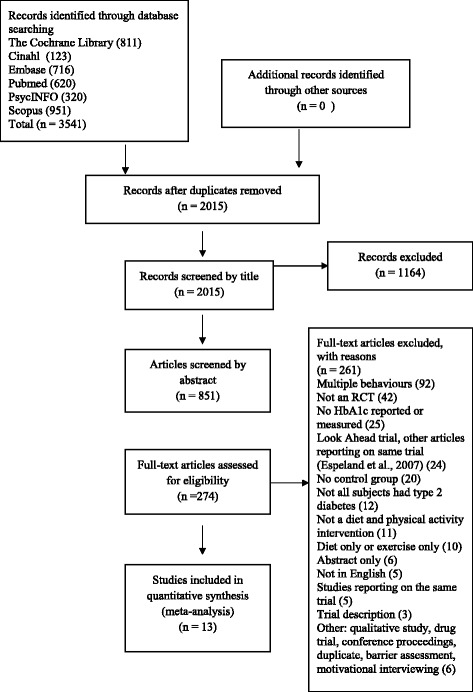
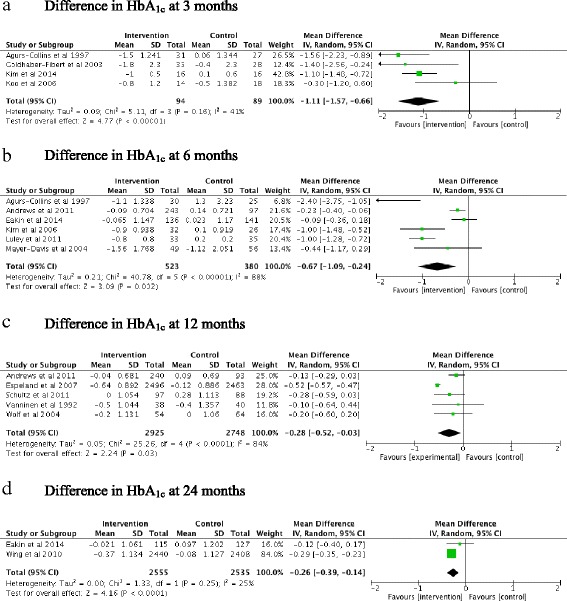
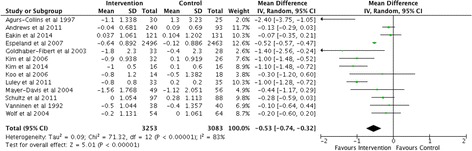
Changing diet and physical activity behaviour is one of the cornerstones of type 2 diabetes treatment, but changing behaviour is challenging . The objective of this study was to identify behaviour change techniques (BCTs) and intervention features of dietary and physical activity interventions for patients with type 2 diabetes that are associated with changes in HbA 1c and body weight. We performed a systematic review of papers published between 1975–2015 describing randomised controlled trials (RCTs) that focused exclusively on both diet and physical activity. The constituent BCTs, intervention features and methodological rigour of these interventions were evaluated. Changes in HbA 1c and body weight were meta-analysed and examined in relation to use of BCTs. Thirteen RCTs were identified. Meta-analyses revealed reductions in HbA 1c at 3, 6, 12 and 24 months of -1.11 % (12 mmol/mol), -0.67 % (7 mmol/mol), -0.28 % (3 mmol/mol) and -0.26 % (2 mmol/mol) with an overall reduction of -0.53 % (6 mmol/mol [95 % CI -0.74 to -0.32, P < 0.00001]) in intervention groups compared to control groups. Meta-analyses also showed a reduction in body weight of -2.7 kg, -3.64 kg, -3.77 kg and -3.18 kg at 3, 6, 12 and 24 months, overall reduction was -3.73 kg (95 % CI -6.09 to -1.37 kg, P = 0.002). Four of 46 BCTs identified were associated with >0.3 % reduction in HbA 1c : ‘instruction on how to perform a behaviour’, ‘behavioural practice/rehearsal’, ‘demonstration of the behaviour’ and ‘action planning’, as were intervention features ‘supervised physical activity’, ‘group sessions’, ‘contact with an exercise physiologist’, ‘contact with an exercise physiologist and a dietitian’, ‘baseline HbA 1c >8 %’ and interventions of greater frequency and intensity. Diet and physical activity interventions achieved clinically significant reductions in HbA 1c at three and six months, but not at 12 and 24 months. Specific BCTs and intervention features identified may inform more effective structured lifestyle intervention treatment strategies for type 2 diabetes.
Overview
The claims and statistics of this paper haven’t been checked yet.
Free: it reads the open-access text and checks the first 5 claims that cite a source we can check. Create a free account to check every claim.
Integrity signals
Registry
Cites
Statistics
Figures
Verification
Claims the paper makes
The claims and statistics of this paper haven’t been checked yet.
Free: it reads the open-access text and checks the first 5 claims that cite a source we can check. Create a free account to check every claim.
Claims other papers make about this one
Each is checked against this paper’s own text: does it say what the citing paper says it does?
The source backs part of the claim, not all of it — or backs it for a different population, condition or comparison.
In the citing paper
“Interventions shown to increase PA level or reduce sedentary behaviour include behaviour theory-based interventions, such as goal-setting, re-evaluation of goals, self-monitoring, and feedback.112,113”
From 2023 ESC guidelines for the management of cardiovascular disease in patients with diabetes. (2023) · cites this paper as [112]
Experimental — accuracy not yet measuredThe source backs part of the claim, not all of it — or backs it for a different population, condition or comparison.
In the citing paper
“Interventions utilizing these methods have shown to be effective at increasing physical activity participation in the short term [12,14]”
From Consumer-based wearable activity trackers increase physical activity participation: systematic review and meta-analysis (2019) · cites this paper as [12]
Experimental — accuracy not yet measuredThe source backs part of the claim, not all of it — or backs it for a different population, condition or comparison.
In the citing paper
“The use of structured lifestyle interventions is reported to be effective in increasing physical activity participation and reducing the progression of chronic diseases [10-12].”
From Consumer-based wearable activity trackers increase physical activity participation: systematic review and meta-analysis (2019) · cites this paper as [12]
Experimental — accuracy not yet measured
Self-check
Percentages, sums and reported differences re-computed from the paper’s own numbers.
The self-check needs the paper’s full text.
Citations
Cites
Preferred Reporting Items for Systematic Reviews and Meta-Analyses: the PRISMA statement
Moher, D., Liberati, A., Tetzlaff, J., Altman, D. G., & for the PRISMA Group (2009) · BMJ · doi:10.1136/bmj.b2535 · Cited by 83,823
Preferred Reporting Items for Systematic Reviews and Meta-Analyses: The PRISMA Statement
Moher, D., Liberati, A., Tetzlaff, J., Altman, D. G., & The PRISMA Group (2009) · PLoS Medicine · doi:10.1371/journal.pmed.1000097 · Cited by 64,042 · cited 1×
“A PRISMA (Preferred Reporting Items for Systematic Reviews and Meta-Analyses) checklist was created and PRISMA review guidelines were followed [22] (Additional file 1: 1.”
MethodPreferred reporting items for systematic reviews and meta-analyses: the PRISMA Statement.
(2009) · PubMed Central · Cited by 44,859
Self-efficacy: Toward a unifying theory of behavioral change
Bandura, A. (1977) · Psychological Review · doi:10.1037/0033-295x.84.2.191 · Cited by 43,925 · cited 1×
“Success of these three BCTs might be explained by their strong theoretical foundations [60, 61].”
BackgroundThe Cochrane Collaboration's tool for assessing risk of bias in randomised trials
Higgins, J. P. T., Altman, D. G., Gotzsche, P. C., Juni, P., Moher, D., Oxman, A. D., Savovic, J., Schulz, K. F., Weeks, L., Sterne, J. A. C., et al. (2011) · BMJ · doi:10.1136/bmj.d5928 · Cited by 33,817
Dermyshi, E., Wang, Y., Yan, C., Hong, W., Qiu, G., Gong, X., & Zhang, T. (2017) · Neonatology · doi:10.1159/000454668 · Cited by 24,451
(1985) · Medical Entomology and Zoology · Cited by 19,180
Wang, G., Ma, R., Qiao, G., Wada, K., Aizawa, Y., & Satoh, T. (2015) · Integrative Medicine International · doi:10.1159/000368408 · Cited by 18,657
Wild, S., Roglic, G., Green, A., Sicree, R., & King, H. (2004) · Diabetes Care · doi:10.2337/diacare.27.5.1047 · Cited by 15,297 · cited 1×
“In 2015, there were 415 million people with diabetes worldwide (91 % of which were type 2 diabetes) with figures expected to rise to 642 million by the year 2040, [1] which easily surpasses earlier predictions of 366 million by 2030 [2].”
BackgroundLozano, R., Naghavi, M., Foreman, K., Lim, S., Shibuya, K., Aboyans, V., Abraham, J., Adair, T., Aggarwal, R., Ahn, S. Y., et al. (2012) · The Lancet · doi:10.1016/s0140-6736(12)61728-0 · Cited by 14,070
Research works printed but not linked: 1
- Higgins J.P.T. DJJ: Cochrane Handbook for Systematic Reviews of Interventions Version 5.1.0 (updated March 2011). Chapter 7: Selecting studies and collecting data. The Cochrane Collaboration, 2011. Available from http://handbook.cochrane.org/. 2011, Chapter 7: Selecting studies and collecting data.
Cited by
Items 301–342 of 342
Guerreiro, M. P., Strawbridge, J., Cavaco, A. M. D. N., Félix, I. B., Marques, M. M., & Cadogan, C. A. (2021) · Figshare · doi:10.6084/m9.figshare.14634038
Hawkes, R. E., Miles, L. M., & French, D. (2021) · Figshare · doi:10.6084/m9.figshare.14594222
Guerreiro, M. P., Strawbridge, J., Cavaco, A. M. D. N., Félix, I. B., Marques, M. M., & Cadogan, C. A. (2021) · Figshare · doi:10.6084/m9.figshare.14634035
Brauer, P. M., Royall, D., Li, A., Rodrigues, A., Green, J., Macklin, S., Craig, A., Chan, M., Pasanen, J., Brunelle, L., et al. (2022) · Figshare · doi:10.6084/m9.figshare.19738528
Cardol, C. K., Boslooper‐Meulenbelt, K., van Middendorp, H., Meuleman, Y., Evers, A. W. M., & van Dijk, S. (2022) · Figshare · doi:10.6084/m9.figshare.20056777
Novak, J., Jurková, K., Lojkaskova, A., Jaklova, A., Kühnová, J., Pfeiferová, M., Král, N., Janek, M., Omcirk, D., Malisova, K., et al. (2024) · Figshare · doi:10.6084/m9.figshare.26699894
Azhar Hilmy, S. H., Nordin, N., Yusof, M. Y. P. M., Soh, T. Y. T., & Yusof, N. (2024) · Figshare · doi:10.6084/m9.figshare.26668695
Azhar Hilmy, S. H., Nordin, N., Yusof, M. Y. P. M., Soh, T. Y. T., & Yusof, N. (2024) · Figshare · doi:10.6084/m9.figshare.26668692
Almulhim, A. N., Hartley, H., Norman, P., Caton, S. J., Doğru, O. C., & Goyder, E. (2023) · Figshare · doi:10.6084/m9.figshare.22598573
Guerreiro, M. P., Strawbridge, J., Cavaco, A. M. D. N., Félix, I. B., Marques, M. M., & Cadogan, C. A. (2021) · Figshare · doi:10.6084/m9.figshare.14634047
Hawkes, R. E., Miles, L. M., & French, D. (2021) · Figshare · doi:10.6084/m9.figshare.14594216
Guerreiro, M. P., Strawbridge, J., Cavaco, A. M. D. N., Félix, I. B., Marques, M. M., & Cadogan, C. A. (2021) · Figshare · doi:10.6084/m9.figshare.14634044
Azhar Hilmy, S. H., Nordin, N., Yusof, M. Y. P. M., Soh, T. Y. T., & Yusof, N. (2024) · Figshare · doi:10.6084/m9.figshare.25017761
Azhar Hilmy, S. H., Nordin, N., Yusof, M. Y. P. M., Soh, T. Y. T., & Yusof, N. (2024) · Figshare · doi:10.6084/m9.figshare.25017928
Cardol, C. K., Boslooper‐Meulenbelt, K., van Middendorp, H., Meuleman, Y., Evers, A. W. M., & van Dijk, S. (2022) · Figshare · doi:10.6084/m9.figshare.20056771
Cardol, C. K., Boslooper‐Meulenbelt, K., van Middendorp, H., Meuleman, Y., Evers, A. W. M., & van Dijk, S. (2022) · Figshare · doi:10.6084/m9.figshare.20056780
Brauer, P. M., Royall, D., Li, A., Rodrigues, A., Green, J., Macklin, S., Craig, A., Chan, M., Pasanen, J., Brunelle, L., et al. (2022) · Figshare · doi:10.6084/m9.figshare.19738525
Liu, Y., Jiang, J., You, W., Gong, D., Ma, X., Wu, M., & Li, F. (2022) · Figshare · doi:10.6084/m9.figshare.21629262
Brauer, P. M., Royall, D., Li, A., Rodrigues, A., Green, J., Macklin, S., Craig, A., Chan, M., Pasanen, J., Brunelle, L., et al. (2022) · Figshare · doi:10.6084/m9.figshare.19738522
Hawkes, R. E., Miles, L. M., & French, D. (2021) · Figshare · doi:10.6084/m9.figshare.14594219
Novak, J., Jurková, K., Lojkaskova, A., Jaklova, A., Kühnová, J., Pfeiferová, M., Král, N., Janek, M., Omcirk, D., Malisova, K., et al. (2024) · Figshare · doi:10.6084/m9.figshare.26699891
Guerreiro, M. P., Strawbridge, J., Cavaco, A. M. D. N., Félix, I. B., Marques, M. M., & Cadogan, C. A. (2021) · Figshare · doi:10.6084/m9.figshare.14634041
van den Burg, E. L., Schoonakker, M. P., Korpershoek, B., Sommeling, L. E., Sturm, C. A., Lamb, H. J., Pijl, H., Numans, M. E., Adriaanse, M. A., & van Peet, P. G. (2024) · Figshare · doi:10.6084/m9.figshare.25744416
Cardol, C. K., Boslooper‐Meulenbelt, K., van Middendorp, H., Meuleman, Y., Evers, A. W. M., & van Dijk, S. (2022) · Figshare · doi:10.6084/m9.figshare.20056774
Rouyard, T., Endo, M., Nakamura, R., Moriyama, M., Stanyon, M., Kanke, S., Nakamura, K., Chen, C., Hara, Y., Ii, M., et al. (2023) · Figshare · doi:10.6084/m9.figshare.22790570
Hawkes, R. E., Miles, L. M., & French, D. (2021) · Figshare · doi:10.6084/m9.figshare.14594225
Zhong, Q., Chen, Y., Luo, M., Lin, Q., Tan, J., Xiao, S., Willey, J. A., Chen, J.-L., Whittemore, R., & Guo, J. (2023) · Figshare · doi:10.6084/m9.figshare.22598533
Behavior change techniques to improve treatment adherence in type 2 diabetes: A systematic review
Villalpando-Gutiérrez, A. R., Velázquez-Jurado, H., Burguete, C. P., Colín-Mendiola, K. P., Grostieta-Dominguez, J. E., García-Ulloa, A. C., & Pérez-Peralta, L. (2026) · Endocrinología Diabetes y Nutrición (English ed ) · doi:10.1016/j.endinu.2026.501774
Aittasalo, M., Tokola, K., Vähä‐Ypyä, H., Husu, P., Mänttäri, A., Martiskainen, T., Laatikainen, T., & Sievänen, H. T. (2026) · JMIR Formative Research · doi:10.2196/80304
“Previous studies on patients with T2D have shown more considerable impacts on physical behavior [11] and glycated hemoglobin [28] if self-monitoring was complemented with other intervention features.”
Khandoker, F., & Sharma, M. (2026) · Healthcare · doi:10.3390/healthcare14070875
“In many analyses, depression is treated as a covariate, mediator, or secondary outcome rather than a central phenomenon requiring theoretical explanation [12,13].”
Promotion de l'activité physique chez les femmes enceintes Guadeloupéennes
Ruart, S. (2020) · theses.fr (ABES) · doi:10.70675/9551b647z6fc0z4853za538zaaeff4f50b38
Roslyakova, T. (2022) · theses.fr (ABES) · doi:10.70675/46498d5fz4600z4bf6z8fdez062f5cc9232a
Maudet-Coulomb, E. (2023) · theses.fr (ABES) · doi:10.70675/ec2b97c9z7e12z4a7ezb3efz5f83c2610eef · Cited by 1
Weerasinghe, A. S., Weerasinghe, R. T., Ratnayake, A. D., & Ganegoda, G. U. (2026) · International Research Conference on Smart Computing and Systems Engineering (SCSE) · doi:10.1109/scse70081.2026.11499849
“Furthermore, clinical trials are crucial for asserting the system's real validity, though the system performs well in data-driven validations [5], [6].”
InfluentialType II Diabetes Risk Prediction: A Multifactor Approach Using Laboratory and Lifestyle Features
Weerasinghe, R. T., Weerasinghe, A. S., Ratnayake, A. D., & Ganegoda, G. U. (2026) · International Research Conference on Smart Computing and Systems Engineering (SCSE) · doi:10.1109/scse70081.2026.11499955
“However, traditional screening methods often fail to capture the early stages [4].”
He, Y., Dong, S., Liu, Y., Cao, X., Pan, W., Pan, W., Zhao, Y., & Feng, X. (2026) · JMIR mhealth and uhealth · doi:10.2196/preprints.101112
Maazaoui, S., Bladier, C., Jacquemot, A.-F., Redmond, N. M., Addamiano, M. C., Raynard, B., Gigandet, S., Lefeuvre‐Plesse, C., Schillinger, P., Véron, L., et al. (2026) · Research Square · doi:10.21203/rs.3.rs-9041398/v1
Wang, J., Caiola, C. E., Teng, C., Cho, Y., Xu, Z., Finik, J., Siamdoust, S., Chan, Y., Ko, E., Seidenfeld, J., et al. (2026) · Innovation in Aging · doi:10.1093/geroni/igag069
“While BCTs have proven effective across a range of health contexts, including diet and diabetes management (Cradock et al., 2017; Samdal et al., 2017), their systematic application to oral hygiene care, and particularly to dementia contexts, remains limited and insufficiently described.”
Song, Y., Nan, Y., Tiemuerniyazi, X., Yang, Z., Zhang, S. C., Li, X., & Feng, W. (2026) · Journal of Medical Internet Research · doi:10.2196/72226
“The observed improvement in HbA 1c is likely attributable to the structured integration of multiple BCTs embedded in the intervention, rather than simple information delivery alone [44,45].”
Sánchez, M. Y. C., Imán, A., Sangama, W. G., Kung, C. A. L. L., Panduro, S. K. D., Gutiérrez, O. H., Castillo-Paredes, A., & Vargas, J. J. N. (2026) · Nutrients · doi:10.3390/nu18162699
“In a meta-analysis of randomized controlled trials combining dietary and physical activity interventions, Cradock et al. reported a reduction in HbA1c of − 1.11 percentage points at three months and an overall reduction of − 0.53 percentage points across follow-up periods [31].”
InfluentialApplications of episodic future thinking in patients with chronic diseases: a scoping review
Song, R., Chen, N., Huang, X., Huang, H., Wang, Y., Huang, T., Zhu, M., & 汤先萍 (2026) · Frontiers in Public Health · doi:10.3389/fpubh.2026.1914394
Metadata
- Authors
- Cradock, K. A., ÓLaighin, G., Finucane, F. M., Gainforth, H. L., Quinlan, L. R., & Ginis, K. A. M.
- Affiliations
- Ollscoil na Gaillimhe – University of Galway (IE)
- University of British Columbia (CA)
- Corresponding author
- Quinlan, Leo R.
- ORCID
- Venue
- International Journal of Behavioral Nutrition and Physical Activity
- Published
- 2017-02-08
- Volume
- 14
- Issue
- 1
- Pages
- 18-18
- ISSN
- 1479-5868 (ISSN-L)
- PMC
- PMC5299734
- OpenAlex
- W2587248746
- Semantic Scholar
- 56a78b05da238ed510df8e467dd716f2352c9f50
- Cited by
- 343
- References
- 96
- Citations by year
- 2026: 12 · 2025: 31 · 2024: 46 · 2023: 38 · 2022: 52 · 2021: 59 · 2020: 38 · 2019: 29 · 2018: 29 · 2017: 8
- FWCI
- 3.32
- Type
- journal article
- Language
- en
- Open access
- gold
- doi.org
- Licence
- cc-by
- Locations
- International Journal of Behavioral Nutrition and Physical Activity (publishedVersion, cc-by)
- PubMed Central (publishedVersion, cc-by)
- PubMed (publishedVersion)
- ARAN (University of Galway Research Repository) (Ollscoil na Gaillimhe – University of Galway) (acceptedVersion, cc-by-nc-nd)
- Arrow@dit (Dublin Institute of Technology) (acceptedVersion)
- Arrow@dit (Dublin Institute of Technology) (submittedVersion, cc-by-nc-nd)
- ARAN (University of Galway Research Repository) (Ollscoil na Gaillimhe – University of Galway) (submittedVersion, cc-by-nc-nd)
- cIRcle (University of British Columbia) (submittedVersion, cc-by)
- University of Galway Research Repository (submittedVersion, cc-by)
- Lenus, The Irish Health Repository (Dr Steevens Hospital Library) (submittedVersion)
- Funders
- Irish Research Council for Science, Engineering and Technology (IE) (GOIPG/2013/873)
- Topics
- Social Sciences › Psychology › Applied Psychology › Behavioral Health and Interventions
- Health Sciences › Medicine › Endocrinology, Diabetes and Metabolism › Diabetes Management and Education
- Health Sciences › Medicine › Public Health, Environmental and Occupational Health › Physical Activity and Health
- Keywords
- type 2 diabetes, behaviour change techniques, dietary intervention, physical activity interventions, HbA1c, weight loss, action planning, supervised exercise, exercise physiologists, dietitians, intervention features, methodological quality, diabetes self-management education, lifestyle intervention
- MeSH terms
- Adult, Behavior Therapy, Diabetes Mellitus, Type 2, Diet, Feeding Behavior, Female, Glycated Hemoglobin, Humans, Life Style, Male, Exercise
About these checks
Registry, retraction, Cites and statistics results are computed, not judged, with one exception: a printed reference that no index lists is read once by a model before it counts as a citation error. Claims are extracted by a model and kept only when their quote appears verbatim in the text; each cited source is then checked, with a model’s help, for whether it says what the claim relies on. Those verdicts can be wrong — read the claim’s quote and the cited source before relying on one.
Statistics and arithmetic are recomputed, not judged.
Confidence bands are shown only for fields calibrated on our annotated test set. None is calibrated yet, so no band is shown.
What counts as a claim ›How we measure confidence ›How we check this ›
Are you an author, or do you see a problem with this page? Request a review
Data sources
Bibliographic data: Semantic Scholar, OpenAlex, Crossref.
Contains information from the Semantic Scholar Academic Graph Datasets, made available under the ODC Attribution License (ODC-BY 1.0).
Semantic Scholar’s data is described in: Kinney, R., et al. (2023). The Semantic Scholar Open Data Platform. arXiv:2301.10140.
