

Efficacy of interventions that use apps to improve diet, physical activity and sedentary behaviour: a systematic review
Open accessThe DOI matches its Crossref record; 79 of the 80 references it cites were found in a registry or an index.
Abstract
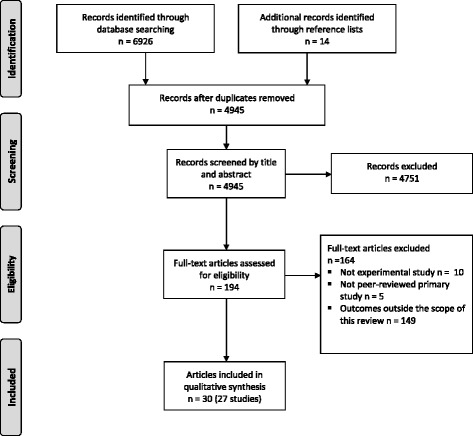
BACKGROUND: Health and fitness applications (apps) have gained popularity in interventions to improve diet, physical activity and sedentary behaviours but their efficacy is unclear. This systematic review examined the efficacy of interventions that use apps to improve diet, physical activity and sedentary behaviour in children and adults. METHODS: Systematic literature searches were conducted in five databases to identify papers published between 2006 and 2016. Studies were included if they used a smartphone app in an intervention to improve diet, physical activity and/or sedentary behaviour for prevention. Interventions could be stand-alone interventions using an app only, or multi-component interventions including an app as one of several intervention components. Outcomes measured were changes in the health behaviours and related health outcomes (i.e., fitness, body weight, blood pressure, glucose, cholesterol, quality of life). Study inclusion and methodological quality were independently assessed by two reviewers. RESULTS: Twenty-seven studies were included, most were randomised controlled trials (n = 19; 70%). Twenty-three studies targeted adults (17 showed significant health improvements) and four studies targeted children (two demonstrated significant health improvements). Twenty-one studies targeted physical activity (14 showed significant health improvements), 13 studies targeted diet (seven showed significant health improvements) and five studies targeted sedentary behaviour (two showed significant health improvements). More studies (n = 12; 63%) of those reporting significant effects detected between-group improvements in the health behaviour or related health outcomes, whilst fewer studies (n = 8; 42%) reported significant within-group improvements. A larger proportion of multi-component interventions (8 out of 13; 62%) showed significant between-group improvements compared to stand-alone app interventions (5 out of 14; 36%). Eleven studies reported app usage statistics, and three of them demonstrated that higher app usage was associated with improved health outcomes. CONCLUSIONS: This review provided modest evidence that app-based interventions to improve diet, physical activity and sedentary behaviours can be effective. Multi-component interventions appear to be more effective than stand-alone app interventions, however, this remains to be confirmed in controlled trials. Future research is needed on the optimal number and combination of app features, behaviour change techniques, and level of participant contact needed to maximise user engagement and intervention efficacy.
Overview
The claims and statistics of this paper haven’t been checked yet.
Free: it reads the open-access text and checks the first 5 claims that cite a source we can check. Create a free account to check every claim.
Integrity signals
Registry
Cites
Statistics
Figures
Verification
Claims the paper makes
The claims and statistics of this paper haven’t been checked yet.
Free: it reads the open-access text and checks the first 5 claims that cite a source we can check. Create a free account to check every claim.
Claims other papers make about this one
Each is checked against this paper’s own text: does it say what the citing paper says it does?
The source backs part of the claim, not all of it — or backs it for a different population, condition or comparison.
In the citing paper
“Digital health interventions that include some guidance tend to result in greater improvements than stand-alone interventions.161, 162”
From Digital health and telehealth in cancer care: A scoping review of reviews (2023) · cites this paper as [162]
Experimental — accuracy not yet measuredThe source backs part of the claim, not all of it — or backs it for a different population, condition or comparison.
In the citing paper
“A systematic review of the effectiveness of interventions that use applications to improve diet, physical activity and SB found evidence that interventions that combine personal advice were more successful than a mobile application alone [44].”
From Impact of a primary care-based mobile health intervention to ‘sit less and move more’ on HbA1c, blood pressure, and other clinical outcomes in office employees with type 2 diabetes: A randomized controlled trial (2025) · cites this paper as [44]
Experimental — accuracy not yet measuredThe cited source says what the claim attributes to it.
In the citing paper
“A review of 27 studies utilizing smartphone applications, which are more easily accessible on-the-go to offer motivational reinforcement, self-monitoring, and physical activity games, found significant improvements in health-related outcomes (blood pressure, cholesterol, overall fitness) and an average attrition rate of only 17%.110”
From The Impact of Physical Activity in Patients With Type 2 Diabetes (2025) · cites this paper as [110]
The cited source says what the claim attributes to it.
In the citing paper
“Some literature has suggested positive benefits for more holistic interventions that focus on multiple behaviors [87].”
From Barriers and facilitators to diet, physical activity and lifestyle behavior intervention adherence: a qualitative systematic review of the literature (2023) · cites this paper as [87]
1 more claim about this paper
Create a free account to see every claim other papers make about this one.
Self-check
Percentages, sums and reported differences re-computed from the paper’s own numbers.
The self-check needs the paper’s full text.
Citations
Cites
Preferred Reporting Items for Systematic Reviews and Meta-Analyses: the PRISMA statement
Moher, D., Liberati, A., Tetzlaff, J., Altman, D. G., & for the PRISMA Group (2009) · BMJ · doi:10.1136/bmj.b2535 · Cited by 83,823
Preferred Reporting Items for Systematic Reviews and Meta-Analyses: The PRISMA Statement
Moher, D., Liberati, A., Tetzlaff, J., Altman, D. G., & The PRISMA Group (2009) · PLoS Medicine · doi:10.1371/journal.pmed.1000097 · Cited by 64,042 · cited 3×
“viewers, as is standard practice for high quality systematic review [23].”
BackgroundInfluentialPreferred reporting items for systematic reviews and meta-analyses: the PRISMA Statement.
(2009) · PubMed Central · Cited by 44,859
Liberati, A., Altman, D. G., Tetzlaff, J., Mulrow, C., Gøtzsche, P. C., Ioannidis, J. P. A., Clarke, M., Devereaux, P. J., Kleijnen, J., & Moher, D. (2009) · PLoS Medicine · doi:10.1371/journal.pmed.1000100 · Cited by 28,164
Wang, G., Ma, R., Qiao, G., Wada, K., Aizawa, Y., & Satoh, T. (2015) · Integrative Medicine International · doi:10.1159/000368408 · Cited by 18,657
Liberati, A., Altman, D. G., Tetzlaff, J., Mulrow, C., Gotzsche, P. C., Ioannidis, J. P. A., Clarke, M., Devereaux, P. J., Kleijnen, J., & Moher, D. (2009) · BMJ · doi:10.1136/bmj.b2700 · Cited by 17,648
Moher, D., Hopewell, S., Schulz, K. F., Montori, V., Gotzsche, P. C., Devereaux, P. J., Elbourne, D., Egger, M., & Altman, D. G. (2010) · BMJ · doi:10.1136/bmj.c869 · Cited by 8,883 · cited 1×
“25-point criteria adapted from the CONSORT checklists for the reporting of randomised controlled trials [26].”
MethodWebb, T. L., Joseph, J., Yardley, L., & Michie, S. (2010) · Journal of Medical Internet Research · doi:10.2196/jmir.1376 · Cited by 2,517
Hilpert, M., Brockmeier, K., Dordel, S., Koch, B., Weiß, V., Ferrari, N., Tokarski, W., & Graf, C. (2017) · Obesity Facts · doi:10.1159/000464105 · Cited by 1,185
The IMAGE Study Group, Greaves, C. J., Sheppard, K. E., Abraham, C., Hardeman, W., Roden, M., Evans, P. H., & Schwarz, P. (2011) · BMC Public Health · doi:10.1186/1471-2458-11-119 · Cited by 1,163
Research works printed but not linked: 2
- Australian Communications and Media Authority Communications report 2014–15. Australian communications and media authority 2015
- Group Special Mobile Association The mobile economy. Group special mobile association 2015
Cited by
Items 501–600 of 1,002
Nutrition-Related Mobile Apps in the Spanish App Stores: Quality and Content Analysis
Fernandez-Lazaro, C. I., Santamaría, G., Milano, A. F., Martin-Vergel, M. I., & Fernández‐Lázaro, D. (2024) · JMIR mhealth and uhealth · doi:10.2196/52424 · Cited by 8
“Moreover, mHealth apps have proven to be effective in achieving healthier lifestyles through behavioral change by helping to increase physical activity levels and improve dietary patterns [12-14].”
BackgroundAgnes, T., Nayak, U. U., Kulkarni, M. M., & Maiya, A. G. (2024) · Journal of Taibah University Medical Sciences · doi:10.1016/j.jtumed.2024.10.001 · Cited by 11
Lin, Y., Lee, K., Ma, W., Syu, B.-S., Liao, W., Yang, H., Lu, S., & Hong, O. (2025) · BMC Public Health · doi:10.1186/s12889-025-22401-3 · Cited by 10
Kim, T.-Y., Lee, Y.-S., Yu, E.-J., Kim, M.-S., Yang, S.-Y., Hur, Y., & Kang, J. (2019) · Nutrition Research and Practice · doi:10.4162/nrp.2019.13.6.509 · Cited by 9
“Interventions that involve sending patient-directed short-message-service (SMS) through mobile applications (apps) help consumers achieve their behavioral goals by providing them with information about lifestyle changes, such as healthy diets or exercise, and self-management, as well as motivating educational material…”
BackgroundInfluentialDavies, A. R., Sharp, C., Homolova, L., & Bellis, M. A. (2019) · Bristol Research (University of Bristol) · Cited by 15
Evaluation of Behavior Change Interventions
Matthews, L., & Simpson, S. A. (2020) · Cambridge University Press eBooks · doi:10.1017/9781108677318.022 · Cited by 10
Ulmer, T., & Baldauf, M. (2022) · Lecture notes in computer science · doi:10.1007/978-3-031-05412-9_31 · Cited by 10
Duregon, F., Bullo, V., Blasio, A. D., Cugusi, L., Pizzichemi, M., Sciusco, S., Viscioni, G., Cruz‐Díaz, D., Bocalini, D. S., Bortoletto, A., et al. (2022) · International Journal of Environmental Research and Public Health · doi:10.3390/ijerph19169794 · Cited by 9
“Lifestyle behaviors, including diet, physical activity, and sedentary behavior, play an important role in maintaining well-being, and improving these behaviors is considered essential also to reduce the health burden of non-communicable diseases [48].”
BackgroundDietary Intervention on Overweight and Obesity after Confinement by COVID-19
Ramírez‐Manent, J. I., Tomás-Gil, P., Martí-Lliteras, P., Villalonga, J. L. C., Rifá, E. M.-A., & López‐González, Á. A. (2023) · Nutrients · doi:10.3390/nu15040912 · Cited by 10
Radhiyah, H., Aziz, A. F. A., Ali, M. F., Monoto, E. M. M., Arvinder-Singh, H. S., Alabed, A. A. A., Zaidi, W. A. W., Ibrahim, N. M., & FRCPE (2023) · BMC Family Practice · doi:10.1186/s12875-023-02138-x · Cited by 8
“Participants with better socioeconomic circumstances in the intervention group may have better access to healthier food choices, especially fruits and vegetables, thereby reducing their risk of NCDs [23].”
BackgroundSmith, R., Gould, R. L., Kenworthy, Y., Astbury, N. M., Smith, I. B. J., Birks, J., Bateman, P. A., Hirst, J. E., Jebb, S. A., Michalopoulou, M., et al. (2024) · BMC Pregnancy and Childbirth · doi:10.1186/s12884-024-06508-w · Cited by 9
“Multicomponent PA interventions appear to be more effective than standalone interventions [39, 40].”
Morales-Cahuancama, B., Verdezoto, N. X., Gonzales-Achuy, E., Quispe-Gala, C., Bautista-Olórtegui, W., Hinojosa-Mamani, P., & Aparco, J. P. (2024) · JMIR Formative Research · doi:10.2196/49168 · Cited by 8
“Due to the growing popularity of mobile phones and apps, several health apps aimed at modifiable risk factors such as children's diet have been developed [61].”
BackgroundThornton, L. K., Osman, B., Wescott, A. B., Sunderland, M., Champion, K., Green, O., Kay-Lambkin, F., Slade, T., Newton, N., Chapman, C., et al. (2020) · Systematic Reviews · doi:10.1186/s13643-020-01375-w · Cited by 4
Epton, T., & Armitage, C. J. (2020) · Cambridge University Press eBooks · doi:10.1017/9781108677318.038 · Cited by 8
Stieger, M., Allemand, M., & Lachman, M. E. (2020) · Contemporary Clinical Trials · doi:10.1016/j.cct.2020.106236 · Cited by 8
Rozga, M., Jones, K., Robinson, J., & Yahiro, A. M. (2021) · Public Health Nutrition · doi:10.1017/s1368980021002184 · Cited by 9
“Lipid profile 1(97) 1(37) 4(48,97,100,109) 1(35) 0 1(42)”
InfluentialLet's Move! The Social and Health Contributions From Pokémon GO
Finco, M. D., Rocha, R. S., Fão, R. W., & dos Santos, F. C. (2018) · International Journal of Game-Based Learning · doi:10.4018/ijgbl.2018040104 · Cited by 8
Pentakota, N., Ramaswamy, G., Thekkur, P., Nair, D., Chinnakali, P., & Saya, G. K. (2019) · International Journal of Adolescent Medicine and Health · doi:10.1515/ijamh-2018-0192 · Cited by 10
Cassidy, K.-L., Vallis, M., Conn, D. K., Massie, A. S., Checkland, C., Parsons, D., Mitchell, J. S., & Rabheru, K. (2020) · International Psychogeriatrics · doi:10.1017/s1041610220001325 · Cited by 8
Lampousi, A., Berglind, D., & Forsell, Y. (2020) · BMC Public Health · doi:10.1186/s12889-020-09830-y · Cited by 9
Nuss, H., Skizim, M., Afaneh, H., Miele, L., & SOTHERN, M. S. (2017) · Ethnicity & Disease · doi:10.18865/ed.27.s1.295 · Cited by 8
Rhea, C. K., Felsberg, D. T., & Maher, J. P. (2018) · American Journal of Health Education · doi:10.1080/19325037.2018.1473177 · Cited by 8
ICT tools for food management and waste prevention at the consumer level
Vogels, J. W. P. M., van der Haar, S., Zeinstra, G. G., & Bos-Brouwers, H. E. J. (2018) · Wageningen University & Research Publications · Cited by 11
Morris, A. S., Mackintosh, K. A., Owen, N., Dempsey, P. C., Dunstan, D. W., & McNarry, M. A. (2021) · International Journal of Environmental Research and Public Health · doi:10.3390/ijerph18189627 · Cited by 7
“E-health strategies, particularly those involving wearable activity trackers and smartphone applications, are one of the most rapidly growing market sectors and allow behavioral interventions to be delivered in real time, across a variety of settings [18,20,21].”
BackgroundInfluentialFiedler, J., Wunsch, K., Hubenschmid, S., Reiterer, H., Renner, B., & Wöll, A. (2025) · JMIR mhealth and uhealth · doi:10.2196/65558 · Cited by 7
“Recent reviews and meta-analyses provide preliminary evidence for the effectiveness of app-based health behavior change [52-54].”
Smith, R., Kenworthy, Y., Astbury, N. M., Birks, J., Bateman, P. A., Dyson, P. A., Hirst, J. E., Jebb, S. A., Michalopoulou, M., Pulsford, R. M., et al. (2022) · BMJ Open · doi:10.1136/bmjopen-2022-062525 · Cited by 8
Deslippe, A. L., González, O. D.-J., Buckler, E. J., Ball, G. D. C., Ho, J., Bucholz, A., Morrison, K. M., & Mâsse, L. C. (2022) · Childhood Obesity · doi:10.1089/chi.2022.0055 · Cited by 7
Mateo‐Orcajada, A., Vaquero‐Cristóbal, R., & Abenza‐Cano, L. (2023) · Journal of Physical Activity and Health · doi:10.1123/jpah.2023-0140 · Cited by 7
Kheirmandparizi, M., Gouin, J., Bouchaud, C. C., Kebbe, M., Bergeron, C., Civi, R. M., Rhodes, R. E., Farnesi, B., Bouguila, N., Conklin, A., et al. (2023) · PLoS ONE · doi:10.1371/journal.pone.0294652 · Cited by 9
“…effective than paper-based tools and websites in encouraging adherence to dietary self-monitoring [17, 18], inherent challenges are present with them that could reduce adherence [17–19]; for example, current mobile applications have an over-emphasis on calorie-counting and portion measurement [19].”
BackgroundHealth and Nutrition Promotion Programs in Papua New Guinea: A Scoping Review
Chen, J., Davies, A. J., Tran, P., Gronau, R., Rangan, A., Allman-Farinelli, M. A., Porykali, S., Oge, R., & Porykali, B. (2024) · Nutrients · doi:10.3390/nu16131999 · Cited by 7
Vandelanotte, C., Hodgetts, D., Peiris, D. L. I. H. K., Karki, A., Maher, C. A., Imam, T., Rashid, M. M., To, Q. G., & Trost, S. G. (2024) · Applied Psychology Health and Well-Being · doi:10.1111/aphw.12594 · Cited by 7
Self-citationA Survey on Machine Learning Approaches for Personalized Coaching with Human Digital Twins
Rietdijk, H. H., Conde-Céspedes, P., Dijkhuis, T. B., Oldenhuis, H. K. E., & Trocan, M. (2025) · Applied Sciences · doi:10.3390/app15137528 · Cited by 7
Adamakis, M. (2020) · Sport Sciences for Health · doi:10.1007/s11332-020-00654-2 · Cited by 7
Economic and Behavioral Economic Approaches to Behavior Change
Brown, P. M., Cameron, L. D., Wilkinson, M., & Taylor, D. (2020) · Cambridge University Press eBooks · doi:10.1017/9781108677318.042 · Cited by 10
Lindgren, H., Guerrero, E., Jingar, M., Lindvall, K., Ng, N., Sundberg, L. R., Ailiana, S., & Weinehall, L. (2020) · Studies in health technology and informatics · doi:10.3233/shti200640 · Cited by 7
“Multi-component interventions seem to be more effective than stand-alone applications [4].”
BackgroundSchöeppe, S., Salmon, J., Williams, S. L., Power, D., Waters, K., Alley, S., Rebar, A. L., Hayman, M., Duncan, M. J., & Vandelanotte, C. (2022) · Digital Health · doi:10.1177/20552076221129083 · Cited by 7
Self-citationEguchi, A., Kawamura, Y., Kawashima, T., Ghaznavi, C., Ishimura, K., Kohsaka, S., Matsuo, S., Mizuno, S., Sasaki, Y., Takahashi, A., et al. (2023) · JMIR Formative Research · doi:10.2196/48435 · Cited by 7
“Evidence suggests that greater engagement with smartphone apps may translate into more robust outcomes [13,23].”
BackgroundGomes, L., Teixeira, D., Sławińska, M., Davis, P., López-Flores, M., Nyström, M. B. T., Silva, M. N., Palmeira, A. L., & Pereira, H. V. (2024) · Retos · doi:10.47197/retos.v56.104357 · Cited by 7
“Smartphone applications (apps) have gained popularity as cost-effective interventions that can reach a large population (Aznar Díaz, Cáceres Reche, Trujillo Torres, & Romero Rodríguez, 2019; Schoeppe et al., 2016).”
BackgroundZhang, M., & Li, X. (2024) · Digital Health · doi:10.1177/20552076241277483 · Cited by 9
Chen, J., & Ye, S. (2024) · Frontiers in Public Health · doi:10.3389/fpubh.2024.1414837 · Cited by 8
de Bruijn, G., Dallinga, J. M., & Deutekom, M. D. L. F. (2021) · JMIR mhealth and uhealth · doi:10.2196/13391 · Cited by 7
“wide range of health-related behaviors, such as the treatment of alcohol use disorders [6], weight reduction [3], and physical activity promotion [3,5,7-9].”
Validity and reliability of a Wi-Fi smart scale to estimate body composition
Hood, K. M., Marr, C., Kirk-Sorrow, J., Farmer, J., Lee, C. M., Kern, M., & Bagley, J. R. (2019) · Health and Technology · doi:10.1007/s12553-019-00359-8 · Cited by 7
Dalayya, S., Elsaid, S. T. F. A., Ng, K. H., Song, T. L., & Lim, J. B. Y. (2023) · Human Behavior and Emerging Technologies · doi:10.1155/2023/8005764 · Cited by 11
Colmenero, B. R. R. (2023) · Retos · doi:10.47197/retos.v50.98385 · Cited by 7
Tiitinen, S., Ilomäki, S., Laitinen, J. H., Korkiakangas, E. E., Hannonen, H., & Ruusuvuori, J. (2019) · Patient Education and Counseling · doi:10.1016/j.pec.2019.08.015 · Cited by 9
“As we found only three studies that focused on reviewing the effectiveness of the techniques and the features of interventions [17-19], we decided to extend our focus and conducted additional searches on meta-analyses and reviews that focused specifically on BCTs in both singleand multi-behavior, as well as both techn…”
BackgroundUsability of Mobile Health Application for Individuals with Type 2 Diabetes Mellitus and Clinicians
Timurtaş, E., & Polat, M. G. (2020) · Clinical and Experimental Health Sciences · doi:10.33808/clinexphealthsci.599548 · Cited by 9
Changing Behavior Using Integrative Self-Control Theory
Hofmann, W., Dohle, S., & Diel, K. (2020) · Cambridge University Press eBooks · doi:10.1017/9781108677318.011 · Cited by 8
Mariscal‐Arcas, M., Jiménez-Casquet, M. J., de Buruaga, B. S., Delgado-Mingorance, S., Blas-Diaz, A., Cantero, L., Padial, M., Matas, M. E., Martinez, N. M., Salas, P., et al. (2021) · Frontiers in Communication · doi:10.3389/fcomm.2021.599661 · Cited by 7
Application of e-health programs in physical activity and health promotion
Gao, Z., & Wang, R. (2021) · Journal of sport and health science/Journal of Sport and Health Science · doi:10.1016/j.jshs.2021.09.007 · Cited by 7
“Specifically, some modern technologies, such as sedentary video games and computer games, have contributed to the epidemic of sedentary behavior and physical inactivity, whereas other novel technologies such as e-health have been increasingly used to promote physical activity (PA) and health.(2,3) Indeed, e-health enc…”
BackgroundBent, M. A., Valenzuela-Moss, J. N., Smith, K., Castillo, P., Speybroeck, A. L. V., Omar, H. N., Antoniak, K. S., Lin, A. J., & Wren, T. A. L. (2023) · Journal of Spinal Cord Medicine · doi:10.1080/10790268.2023.2231675 · Cited by 6
“…there is evidence supporting the effectiveness of app-based interventions in improving diet, physical activity, and sedentary behaviors; however, they concluded that multi-component interventions appear to be more effective than stand-alone app interventions, consistent with our findings (25).”
mHealth para mejorar la higiene oral de niños. Revisión de literatura
Pacheco-Vergara, M. J., & Cartes‐Velásquez, R. (2020) · Avances en Odontoestomatología · doi:10.4321/s0213-12852020000100004 · Cited by 6
Vilafranca-Cartagena, M., Bonet, A., Colillas-Malet, E., Puiggrós-Binefa, A., & Tort‐Nasarre, G. (2024) · Healthcare · doi:10.3390/healthcare12141373 · Cited by 7
Montes‐Ibarra, M., Godziuk, K., Thompson, R. B., Chan, C. B., Pituskin, E., Gross, D. P., Lam, G. Y., Schlögl, M., Mota, J. F., Paterson, D. I., et al. (2024) · Methods · doi:10.1016/j.ymeth.2024.10.004 · Cited by 6
de Freitas, F., Antônio, M. Â. R. D. G. M., Zago, M. R., Zambon, M. P., & Videira‐Silva, A. (2024) · Digital Health · doi:10.1177/20552076241291386 · Cited by 6
The role of e-health on the public knowledge and behavior in preventing COVID-19
Galavi, Z., Khajouei, R., & Jahani, Y. (2023) · Informatics in Medicine Unlocked · doi:10.1016/j.imu.2023.101193 · Cited by 8
Piernas, C., Lee, C., Hobson, A., Harmer, G., Payne, S., Noreik, M., & Jebb, S. A. (2023) · JMIR mhealth and uhealth · doi:10.2196/45854 · Cited by 6
“A systematic review of interventions using apps to support dietary behavioral improvements suggested greater benefits of multicomponent interventions compared with single-component interventions [38].”
Verain, M. C. D., Raaijmakers, I., Meijboom, S., & van der Haar, S. (2024) · Food Quality and Preference · doi:10.1016/j.foodqual.2024.105145 · Cited by 6
Weber, M., Raab, A. M., Schmitt, K., Büsching, G., Marcin, T., Spielmanns, M., Puhan, M. A., & Frei, A. L. (2024) · BMJ Open · doi:10.1136/bmjopen-2023-081397 · Cited by 7
“At the beginning of the development, we conducted an interdisciplinary workshop with experienced health professionals working with NSCLC survivors.”
MethodMyTrack+: Human-centered design of an mHealth app to support long-term weight loss maintenance
Chen, Y.-P., Woodward, J., Shankar, M. N., Bista, D., Ugwoaba, U. A., Brockmann, A., Ross, K. M., Ruiz, J., & Anthony, L. (2024) · Frontiers in Digital Health · doi:10.3389/fdgth.2024.1334058 · Cited by 6
Hurley, L., Nezami, B. T., Sciamanna, C., & Tate, D. F. (2024) · Digital Health · doi:10.1177/20552076241277351 · Cited by 7
Mateo‐Orcajada, A., Abenza‐Cano, L., López-Miñarro, P. Á., Meroño, L., Guerrero, A. M. G., Morales-Belando, M. T., González-Gálvez, N., Espeso-García, A., Abelleira-Lamela, T., Gómez-Cuesta, N., et al. (2025) · PLoS ONE · doi:10.1371/journal.pone.0322074 · Cited by 6
“This is because these tools have been shown to be effective in increasing the level of physical activity in this population [3,4], as well as in obtaining physical and body composition benefits [5–7].”
Developing a mobile data collection tool to manage a dispersed mental health workforce
Maddox, S., Read, D. M. Y., Dalton, H. E., Perkins, D. A., & Powell, N. (2020) · Rural and Remote Health · doi:10.22605/rrh5616 · Cited by 6
Body Mass Index and stimulus control: Results from a real-world study of eating behaviour
Franja, S., Elliston, K. G., & Ferguson, S. G. (2020) · Appetite · doi:10.1016/j.appet.2020.104783 · Cited by 7
Fuente-Vidal, A., Guerra-Balic, M., Noguera, O. R., Jerez‐Roig, J., & Montané, J. (2022) · International Journal of Environmental Research and Public Health · doi:10.3390/ijerph191610214 · Cited by 6
“Within a broader spectrum—and considering digital behavior change interventions as a whole usage—levels have been found to be typically low [4,19].”
BackgroundChatterjee, A., Prinz, A., & Riegler, M. (2022) · IEEE International Symposium on Medical Measurements and Applications (MeMeA) · doi:10.1109/memea54994.2022.9856556 · Cited by 7
“Web-based or mobile app-based interventions that improve physical activity and sedentary behavior may be effective [18][19].”
BackgroundMaterialität – Digitalisierung – Bildung
:null (2023) · Verlag Julius Klinkhardt eBooks · doi:10.35468/5979 · Cited by 7
Conner, M. T., Williams, D. M., & Rhodes, R. E. (2020) · Cambridge University Press eBooks · doi:10.1017/9781108677318.034 · Cited by 8
Application and evaluation of mobile nutrition management service for breast cancer patients
Choi, J. H., Park, S., Kwon, H. J., & Lee, H. (2020) · Journal of Nutrition and Health · doi:10.4163/jnh.2020.53.1.83 · Cited by 7
Egészpályás letámadás a kövérség ellen: Komplex beavatkozásokkal az elhízás visszaszorítására
Vitrai, J., & Bakacs, M. (2017) · Egészségfejlesztés · doi:10.24365/ef.v58i4.211 · Cited by 6
Bonn, S., Licitra, G., Bellocco, R., & Trolle Lagerros, Y. (2022) · Journal of Medical Internet Research · doi:10.2196/24725 · Cited by 5
“Contrasting these results, authors of another systematic review concluded that multicomponent interventions that combined the smartphone app with some other kind of intervention appeared more effective than stand-alone app interventions where the app was the only intervention component [10].”
Evaluation of Exercise Mobile Applications for Adults with Cardiovascular Disease Risk Factors
Chen, S., Wu, Y., Bushey, E. L., & Pescatello, L. S. (2023) · Journal of Cardiovascular Development and Disease · doi:10.3390/jcdd10120477 · Cited by 5
Emerson, C., Koob, C., Sease, K. K., & Griffin, S. F. (2025) · Journal of Autism and Developmental Disorders · doi:10.1007/s10803-024-06666-y · Cited by 5
“Several studies have demonstrated the success of mobile health (mHealth) obesity interventions in the general population, but little is known about the experiences of youth with ASD with such interventions (Schoeppe et al., 2016; Vandela-notte et al., 2016).”
Hietbrink, E. A. G., Middelweerd, A., Nijeweme-d’Hollosy, W. O., Schrijver, L. K., Laverman, G. D., & Vollenbroek-Hutten, M. M. R. (2025) · JMIR Formative Research · doi:10.2196/65026 · Cited by 5
Anderberg, I., Kemps, E., & Prichard, I. J. (2025) · Psychology of sport and exercise · doi:10.1016/j.psychsport.2025.102890 · Cited by 5
Diktas, H. E., Lozano, C. P., Saha, S., Broyles, S. T., Martin, C. K., & Apolzan, J. W. (2025) · Journal of Nutrition · doi:10.1016/j.tjnut.2025.09.027 · Cited by 5
Giardina, M., Zarcone, R., Accardi, G., Tabacchi, G., Bellafiore, M., Terzo, S., Liberto, V. D., Frinchi, M., Boffetta, P., Mazzucco, W., et al. (2025) · Nutrients · doi:10.3390/nu17223542 · Cited by 6
“Two reviews included interventions targeting both adults and children [16,30], while four reviews focused on adults and adolescents [6,8,26,30].”
InfluentialSimões, M. D. S., Proença, N. L., Lauria, V. T., Nascimento, M. B., Padovani, R. D. C., & Dourado, V. Z. (2026) · Journal of Medical Internet Research · doi:10.2196/73388 · Cited by 5
“Using smartphones as part of intervention programs can facilitate the auto-monitoring of PA, contributing to the behavior change process [6,7].”
InfluentialReinhardt, G., Timpel, P., Schwarz, P. E. H., & Harst, L. (2021) · Nutrients · doi:10.3390/nu13124215 · Cited by 5
“This is an even higher proportion of female participants than in other studies [43,44] even though telemedicine interventions are known to be more likely used by women [12,45,46].”
BackgroundResultThe Role of Mobile Applications in the Doctor’s Working Time Management System
Svyatenko, T. V., Gogunska, I. V., Semigina, T. V., Kasianenko, L., Salei, O., & Прокопенко, М. О. (2022) · International Journal of Statistics in Medical Research · doi:10.6000/1929-6029.2022.11.08 · Cited by 5
“reviews on the effectiveness of mobile health applications in enhancing physical activity, improving diet and nutrition [12], and improving health-related behaviours [13] among the population as a whole.”
BackgroundAizawa, T., Okudaira, H., Kitagawa, R., Kuroda, S., & Owan, H. (2024) · Economics & Human Biology · doi:10.1016/j.ehb.2024.101445 · Cited by 6
Quality evaluation of smartphone applications for physical activity promotion
Lee, J. B., & Woo, H. (2019) · 보건교육·건강증진학회지 · doi:10.14367/kjhep.2019.36.4.67 · Cited by 5
Lin, J., Wurst, R., Paganini, S., Hohberg, V., Kinkel, S., Göhner, W., Ramsenthaler, C., & Fuchs, R. (2020) · Trials · doi:10.1186/s13063-020-04438-4 · Cited by 6
“outcomes than interventions consisting of apps alone [28].”
BackgroundMethodInfluentialKatayama, A., Hase, A., & Miyatake, N. (2021) · Medicina · doi:10.3390/medicina57030231 · Cited by 5
“Furthermore, using health and fitness applications improved physical activity and sedentary behavior in 27 studies, including 19 RCTs [31].”
BackgroundXu, R., DiVito, J., Bannor, R., Schroeder, M. W., & Pagoto, S. (2022) · JMIR Formative Research · doi:10.2196/38068 · Cited by 5
“Although many studies have tested social media–delivered weight loss interventions or emphasized the importance of participant engagement in web-based communities [12-15,42], only a handful of studies have identified the factors that can influence participant engagement in digital health interventions [43,44], and mos…”
BackgroundThe Impact of Digital Technologies in Shaping Weight Loss Motivation Among Children and Adolescents
Wąsacz, M., Sarzyńska, I., Błajda, J., Orlov, N., & Kopańska, M. (2025) · Children · doi:10.3390/children12060685 · Cited by 5
“Interventions based on mobile apps, online platforms and smart devices show positive effects on weight management, especially when they combine education, behavioural monitoring and contact with caregivers [15,16].”
Caon, M., Carrino, S., Angelini, L., Khaled, O. A., Mugellini, E., Velickovski, F., & Andreoni, G. (2018) · Annual International Conference of the IEEE Engineering in Medicine and Biology Society (EMBC) · doi:10.1109/embc.2018.8512535 · Cited by 8
“A recent systematic review showed that there is an evidence that app-based interventions to improve diet, physical activity and sedentary behaviours can be effective [4].”
BackgroundWilkerson, A. H., Hamilton, C. N. B., Wu, C., McClendon, M., Walsh, S. M., Patterson, M. S., & Meyer, R. U. (2019) · Journal of Occupational and Environmental Medicine · doi:10.1097/jom.0000000000001704 · Cited by 6
“Previous research supports the use of smartphone apps during early initiation of behavior change and have shown efficacy in utilizing apps to support behavior change in multicomponent interventions.(26,27) Considering the high satisfaction in this study with the videos and apps, we suggest that researchers and practit…”
MethodUsing the Onitor ® Track for weight loss: A mixed methods study among overweight and obese women
Buchan, K., & Morgan, H. M. (2019) · Health Informatics Journal · doi:10.1177/1460458219890790 · Cited by 5
Addressing Underserved Populations and Disparities in Behavior Change
Schüz, B., & Hooper, M. W. (2020) · Cambridge University Press eBooks · doi:10.1017/9781108677318.027 · Cited by 8
Thomas, C., Simmons, E., Musbahi, A., Small, P. K., & Courtney, M. (2023) · Obesity Surgery · doi:10.1007/s11695-023-06566-7 · Cited by 5
Froome, H. M., Cheung, K. L., Martin, W. E., & Norris, E. (2024) · BMC Digital Health · doi:10.1186/s44247-024-00085-w · Cited by 5
“For children specifically, the literature has shown that mobile apps with the use of gamification features; such as rewards games, goals, avatars and stories, can improve FV intake [18, 35, 68, 69].”
BackgroundOptimizing Skin Quality via AI-Enhanced Physical Activity
Tertipi, Ν., Sfyri, Ε., Grech, V.-S., Kefala, V., & Rallis, E. A. (2025) · Cosmetics · doi:10.3390/cosmetics12030104 · Cited by 6
“The result is a dynamic program that evolves with the user, supporting continuous improvement and injury prevention [29].”
Sandborg, J., Markides, B. R., Simmons, S., Downing, K. L., Nicholson, J. M., Orellana, L., Koorts, H., Carson, V., Salmon, J., & Hesketh, K. D. (2025) · JMIR mhealth and uhealth · doi:10.2196/60478 · Cited by 4
“Examining user engagement is a critical component of evaluating mHealth interventions as it provides information on levels of intervention exposure and uptake and can facilitate the identification of factors that may optimize engagement [10].”
Homo smartphonus: Psychological Aspects of Smartphone Use—A Literature Review
Sorokowski, P., & Sobczak, M. (2025) · Multimodal Technologies and Interaction · doi:10.3390/mti9080083 · Cited by 4
Can fitness apps work long term? A 24-month quasiexperiment of 516 818 Canadian fitness app users
Nguyen, L., Faulkner, G., Taylor, C. M., & Mitchell, M. (2025) · British Journal of Sports Medicine · doi:10.1136/bjsports-2025-109901 · Cited by 4
“20 34–36 As with the main model, non-standardised post hoc contrasts estimated the difference from baseline for each key time-point (ie, 12 and 24 months).”
van Gelder, J., Tettero, T., Siezenga, A. M., & Mertens, E. C. A. (2026) · Journal of Medical Internet Research · doi:10.2196/84420 · Cited by 4
“Smartphones tend to be integrated in people’s daily lives, which provides the opportunity to deliver an intervention in their natural environment through frequent exposure and interaction [33,34].”
Sandborg, J., Markides, B. R., Marshall, S. K., Hesketh, K. D., Laws, R., & Downing, K. L. (2026) · Journal of Medical Internet Research · doi:10.2196/85525 · Cited by 6
“…important aspect is participant engagement, as it can provide information on levels of intervention exposure and uptake, which are crucial for effectiveness, as well as help identify factors that may optimize engagement [33] and ultimately inform the development of more impactful interventions.”
Imschloß, M., & Lorenz, J. (2018) · JMIR mhealth and uhealth · doi:10.2196/mhealth.9055 · Cited by 6
“So far, existing studies have examined the effectiveness of health-related mobile phone interventions and technology-enhanced interventions in general [9-15] or have assessed the prevalence and effectiveness of behavioral change techniques employed in the app design in particular [16,17].”
Changing Behavior in the Digital Age
Kavanagh, D. J. (2020) · Cambridge University Press eBooks · doi:10.1017/9781108677318.029 · Cited by 20
Goni, M. D., Naing, N. N., Hasan, H. B., Wan‐Arfah, N., Deris, Z. Z., Arifin, W. N., Baaba, A. A., Adam, B. M., & Arshad, M. (2021) · Frontiers in Public Health · doi:10.3389/fpubh.2021.594204 · Cited by 4
“The smartphone application was considered as the format of the intervention as the literature review provided several studies of successful digital-based interventions for health (31, 32).”
Method
Metadata
- Authors
- Schoeppe, S., Alley, S., Van Lippevelde, W., Bray, N. A., Williams, S. L., Duncan, M. J., & Vandelanotte, C.
- Affiliations
- Central Queensland University (AU)
- University of Newcastle Australia (AU)
- Venue
- International Journal of Behavioral Nutrition and Physical Activity
- Published
- 2016-12
- Volume
- 13
- Issue
- 1
- Pages
- 127-127
- ISSN
- 1479-5868 (ISSN-L)
- PMC
- PMC5142356
- OpenAlex
- W2560473567
- Cited by
- 949
- References
- 80
- Citations by year
- 2026: 40 · 2025: 89 · 2024: 103 · 2023: 91 · 2022: 138 · 2021: 133 · 2020: 173 · 2019: 90 · 2018: 69 · 2017: 23
- FWCI
- 11.58
- Type
- journal article
- Language
- en
- Open access
- gold
- doi.org
- Licence
- cc-by
- Locations
- International Journal of Behavioral Nutrition and Physical Activity (publishedVersion, cc-by)
- Europe PMC (PubMed Central) (publishedVersion, cc-by)
- PubMed Central (publishedVersion, cc-by)
- PubMed (publishedVersion)
- Ghent University Academic Bibliography (Ghent University) (publishedVersion, other-oa)
- Ghent University Academic Bibliography (Ghent University) (submittedVersion, cc-by)
- Acquire (CQUniversity) (submittedVersion, cc-by)
- Figshare (submittedVersion, cc-by)
- NOVA (University of Newcastle Australia) (submittedVersion, cc-by)
- Funders
- National Heart Foundation of Australia (ID 100427, ID 100029)
- National Health and Medical Research Council (GNT1125586)
- Topics
- Health Sciences › Health Professions › General Health Professions › Mobile Health and mHealth Applications
- Health Sciences › Medicine › Public Health, Environmental and Occupational Health › Physical Activity and Health
- Social Sciences › Psychology › Applied Psychology › Digital Mental Health Interventions
- Keywords
- mobile application, mobile health intervention, diet, physical activity, sedentary behavior, multicomponent intervention, app usage, user engagement, behaviour change techniques, children, adults, health behavior change, body weight, blood pressure, cholesterol, glucose, quality of life
- MeSH terms
- Smartphone, Adult, Child, Diet, Health Promotion, Humans, Health Behavior, Exercise, Sedentary Behavior, Mobile Applications
About these checks
Registry, retraction, Cites and statistics results are computed, not judged, with one exception: a printed reference that no index lists is read once by a model before it counts as a citation error. Claims are extracted by a model and kept only when their quote appears verbatim in the text; each cited source is then checked, with a model’s help, for whether it says what the claim relies on. Those verdicts can be wrong — read the claim’s quote and the cited source before relying on one.
Statistics and arithmetic are recomputed, not judged.
Confidence bands are shown only for fields calibrated on our annotated test set. None is calibrated yet, so no band is shown.
What counts as a claim ›How we measure confidence ›How we check this ›
Are you an author, or do you see a problem with this page? Request a review
Data sources
Bibliographic data: Semantic Scholar, OpenAlex, Crossref.
Contains information from the Semantic Scholar Academic Graph Datasets, made available under the ODC Attribution License (ODC-BY 1.0).
Semantic Scholar’s data is described in: Kinney, R., et al. (2023). The Semantic Scholar Open Data Platform. arXiv:2301.10140.
