

Efficacy of interventions that use apps to improve diet, physical activity and sedentary behaviour: a systematic review
Open accessThe DOI matches its Crossref record; 79 of the 80 references it cites were found in a registry or an index.
Abstract
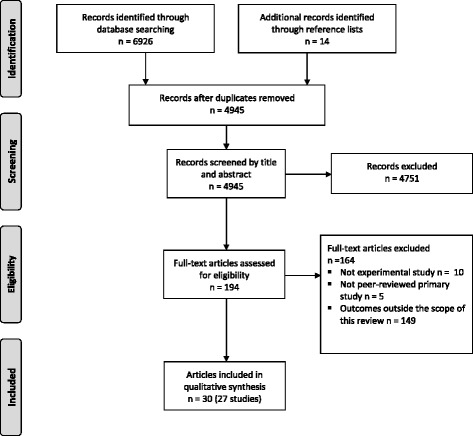
BACKGROUND: Health and fitness applications (apps) have gained popularity in interventions to improve diet, physical activity and sedentary behaviours but their efficacy is unclear. This systematic review examined the efficacy of interventions that use apps to improve diet, physical activity and sedentary behaviour in children and adults. METHODS: Systematic literature searches were conducted in five databases to identify papers published between 2006 and 2016. Studies were included if they used a smartphone app in an intervention to improve diet, physical activity and/or sedentary behaviour for prevention. Interventions could be stand-alone interventions using an app only, or multi-component interventions including an app as one of several intervention components. Outcomes measured were changes in the health behaviours and related health outcomes (i.e., fitness, body weight, blood pressure, glucose, cholesterol, quality of life). Study inclusion and methodological quality were independently assessed by two reviewers. RESULTS: Twenty-seven studies were included, most were randomised controlled trials (n = 19; 70%). Twenty-three studies targeted adults (17 showed significant health improvements) and four studies targeted children (two demonstrated significant health improvements). Twenty-one studies targeted physical activity (14 showed significant health improvements), 13 studies targeted diet (seven showed significant health improvements) and five studies targeted sedentary behaviour (two showed significant health improvements). More studies (n = 12; 63%) of those reporting significant effects detected between-group improvements in the health behaviour or related health outcomes, whilst fewer studies (n = 8; 42%) reported significant within-group improvements. A larger proportion of multi-component interventions (8 out of 13; 62%) showed significant between-group improvements compared to stand-alone app interventions (5 out of 14; 36%). Eleven studies reported app usage statistics, and three of them demonstrated that higher app usage was associated with improved health outcomes. CONCLUSIONS: This review provided modest evidence that app-based interventions to improve diet, physical activity and sedentary behaviours can be effective. Multi-component interventions appear to be more effective than stand-alone app interventions, however, this remains to be confirmed in controlled trials. Future research is needed on the optimal number and combination of app features, behaviour change techniques, and level of participant contact needed to maximise user engagement and intervention efficacy.
Overview
The claims and statistics of this paper haven’t been checked yet.
Free: it reads the open-access text and checks the first 5 claims that cite a source we can check. Create a free account to check every claim.
Integrity signals
Registry
Cites
Statistics
Figures
Verification
Claims the paper makes
The claims and statistics of this paper haven’t been checked yet.
Free: it reads the open-access text and checks the first 5 claims that cite a source we can check. Create a free account to check every claim.
Claims other papers make about this one
Each is checked against this paper’s own text: does it say what the citing paper says it does?
The source backs part of the claim, not all of it — or backs it for a different population, condition or comparison.
In the citing paper
“Digital health interventions that include some guidance tend to result in greater improvements than stand-alone interventions.161, 162”
From Digital health and telehealth in cancer care: A scoping review of reviews (2023) · cites this paper as [162]
Experimental — accuracy not yet measuredThe source backs part of the claim, not all of it — or backs it for a different population, condition or comparison.
In the citing paper
“A systematic review of the effectiveness of interventions that use applications to improve diet, physical activity and SB found evidence that interventions that combine personal advice were more successful than a mobile application alone [44].”
From Impact of a primary care-based mobile health intervention to ‘sit less and move more’ on HbA1c, blood pressure, and other clinical outcomes in office employees with type 2 diabetes: A randomized controlled trial (2025) · cites this paper as [44]
Experimental — accuracy not yet measuredThe cited source says what the claim attributes to it.
In the citing paper
“A review of 27 studies utilizing smartphone applications, which are more easily accessible on-the-go to offer motivational reinforcement, self-monitoring, and physical activity games, found significant improvements in health-related outcomes (blood pressure, cholesterol, overall fitness) and an average attrition rate of only 17%.110”
From The Impact of Physical Activity in Patients With Type 2 Diabetes (2025) · cites this paper as [110]
The cited source says what the claim attributes to it.
In the citing paper
“Some literature has suggested positive benefits for more holistic interventions that focus on multiple behaviors [87].”
From Barriers and facilitators to diet, physical activity and lifestyle behavior intervention adherence: a qualitative systematic review of the literature (2023) · cites this paper as [87]
1 more claim about this paper
Create a free account to see every claim other papers make about this one.
Self-check
Percentages, sums and reported differences re-computed from the paper’s own numbers.
The self-check needs the paper’s full text.
Citations
Cites
Preferred Reporting Items for Systematic Reviews and Meta-Analyses: the PRISMA statement
Moher, D., Liberati, A., Tetzlaff, J., Altman, D. G., & for the PRISMA Group (2009) · BMJ · doi:10.1136/bmj.b2535 · Cited by 83,823
Preferred Reporting Items for Systematic Reviews and Meta-Analyses: The PRISMA Statement
Moher, D., Liberati, A., Tetzlaff, J., Altman, D. G., & The PRISMA Group (2009) · PLoS Medicine · doi:10.1371/journal.pmed.1000097 · Cited by 64,042 · cited 3×
“viewers, as is standard practice for high quality systematic review [23].”
BackgroundInfluentialPreferred reporting items for systematic reviews and meta-analyses: the PRISMA Statement.
(2009) · PubMed Central · Cited by 44,859
Liberati, A., Altman, D. G., Tetzlaff, J., Mulrow, C., Gøtzsche, P. C., Ioannidis, J. P. A., Clarke, M., Devereaux, P. J., Kleijnen, J., & Moher, D. (2009) · PLoS Medicine · doi:10.1371/journal.pmed.1000100 · Cited by 28,164
Wang, G., Ma, R., Qiao, G., Wada, K., Aizawa, Y., & Satoh, T. (2015) · Integrative Medicine International · doi:10.1159/000368408 · Cited by 18,657
Liberati, A., Altman, D. G., Tetzlaff, J., Mulrow, C., Gotzsche, P. C., Ioannidis, J. P. A., Clarke, M., Devereaux, P. J., Kleijnen, J., & Moher, D. (2009) · BMJ · doi:10.1136/bmj.b2700 · Cited by 17,648
Moher, D., Hopewell, S., Schulz, K. F., Montori, V., Gotzsche, P. C., Devereaux, P. J., Elbourne, D., Egger, M., & Altman, D. G. (2010) · BMJ · doi:10.1136/bmj.c869 · Cited by 8,883 · cited 1×
“25-point criteria adapted from the CONSORT checklists for the reporting of randomised controlled trials [26].”
MethodWebb, T. L., Joseph, J., Yardley, L., & Michie, S. (2010) · Journal of Medical Internet Research · doi:10.2196/jmir.1376 · Cited by 2,517
Hilpert, M., Brockmeier, K., Dordel, S., Koch, B., Weiß, V., Ferrari, N., Tokarski, W., & Graf, C. (2017) · Obesity Facts · doi:10.1159/000464105 · Cited by 1,185
The IMAGE Study Group, Greaves, C. J., Sheppard, K. E., Abraham, C., Hardeman, W., Roden, M., Evans, P. H., & Schwarz, P. (2011) · BMC Public Health · doi:10.1186/1471-2458-11-119 · Cited by 1,163
Research works printed but not linked: 2
- Australian Communications and Media Authority Communications report 2014–15. Australian communications and media authority 2015
- Group Special Mobile Association The mobile economy. Group special mobile association 2015
Cited by
Items 801–900 of 1,001
Stockwell, S. (2021) · Anglia Ruskin Research Online (Anglia Ruskin University) · Cited by 1
Pessimistic Misperceptions of Risk and Health : Individual and Societal Perspectives
Debbeler, L. J. (2020) · KOPS (University of Konstanz)
Patient-facing mobile apps: Are ObGyns uniquely positioned to integrate them into practice?
Banashefski, B. (2021) · OBG Management · doi:10.12788/obgm.0102
“The literature also shows positive results for heart failure, weight management, smoking reduction, and lifestyle improvement.(3-5) Given their value, why aren’t patient engagement apps more routinely integrated into patient care programs? From a software development perspective, mobile apps are fairly easy to create.”
BackgroundMoura, K. B. D. A., Savaris, S. L., de Jesus, J. D., & de Lima, J. B. (2021) · International Journal of Cardiovascular Sciences · doi:10.36660/ijcs.20200318
Physical activity and cardiovascular disease risk in women with polycystic ovary syndrome
Woodward, A. (2021) · Sheffield Hallam University · doi:10.7190/shu-thesis-00398 · Cited by 2
Negreiros, A., Maciel, R. R. B. T., de Barros, B. C., & Padula, R. S. (2021) · doi:10.2196/preprints.34247
Factores psicoeducativos y motivacionales asociados a la actividad física en jóvenes adultos
Durán-Vinagre, M. Á., Herrera, S. S., & Vera, L. P. (2021) · International Journal of Developmental and Educational Psychology Revista INFAD de psicología · doi:10.17060/ijodaep.2021.n2.v2.2240
“En este sentido, el uso de las aplicaciones en dispositivos móviles ha contribuido a un incremento en la evaluación de la salud (Fanning et al., 2012), encontrando diferentes aplicaciones que permiten combinar los objetivos de salud con un sistema de seguimiento (Schoeppe et al., 2016).”
BackgroundAplicativos móveis de saúde para redução do comportamento sedentário
Ueno, D. T., Bonolo, A., Guimarães, J. A. C., Christofoletti, A. E. M., Nakamura, P. M., & Kokubun, E. (2021) · Pensar a Prática · doi:10.5216/rpp.v24.68552
Smartphones and apps in personal care with diabetes: a narrative review of the literature
Lettieri, M. (2022) · The Journal of AMD · doi:10.36171/jamd21.24.4.6
Entertainment and Physical Activities: New Connections Through the Use of Pokémon GO
Finco, M. D. (2021) · IGI Global eBooks · doi:10.4018/978-1-7998-7707-3.ch052
Fukuoka, Y., Lindgren, T. G., Mintz, Y. D., Hooper, J., & Aswani, A. J. (2018) · doi:10.2196/preprints.10042
Berninger, N. M. (2021) · Research Publications (Maastricht University) · doi:10.26481/dis.20210126nb
Nicholas, J., Thøgersen‐Ntoumani, C., Smith, B. J., Quested, E., & Ntoumanis, N. (2019) · doi:10.2196/preprints.16041
Hagger, M. S., Cameron, L. D., Hamilton, K., Hankonen, N. E., & Lintunen, T. (2020) · Cambridge University Press eBooks · doi:10.1017/9781108677318.047
Dallinga, J. M., Janssen, M., van der Werf, J., Walravens, R., Vos, S. B., & Deutekom, M. D. L. F. (2017) · doi:10.2196/preprints.9459.a
Kondo, M., Okitsu, T., Waki, K., Yamauchi, T., Nangaku, M., & Ohe, K. (2021) · doi:10.2196/preprints.33852
Khazaee-Pool, M., Pashaei, T., & Ponnet, K. S. (2019) · doi:10.2196/preprints.16183
Perspectives on the Collection of Health-related Data in Long-term Care
Wilkowska, W., Offermann, J., & Ziefle, M. (2022) · International Conference on PErvasive Technologies Related to Assistive Environments (PETRA) · doi:10.1145/3529190.3529198
“The probably most common application area of lifelogging applications is sport, aiming at the tracking and improvement of physical performance, conscious nutrition, and gamification [12].”
BackgroundEaton, M. M. (2021) · Digital Repository Service (Northeastern University) · doi:10.17760/d20423504
نموذج تدخل رقمی مقترح "Rigow" لتعزیز الممارسة الریاضیة والصحیة
الله, أ. م. أ. ج., & محمد, ف. ر. أ. ا. (2021) · مجلة أسيوط لعلوم وفنون التربية الرياضية · doi:10.21608/jprr.2021.254710
The pharmacists’ and mobile applications’ role in the treatment of hypertension
Tarnovski, L., Frkanec, S., Šarčević, A., Štrbac, T., Rašić, F., Lovaković, J., & Jelaković, B. (2022) · Rad Hrvatske akademije znanosti i umjetnosti Medicinske znanosti · doi:10.21857/m16wjcnq09
Dong, Z., Pan, W., Hu, A., & Ma, W. (2022) · Advances in Economics and Management Research · doi:10.56028/aemr.2.1.54 · Cited by 1
González-Gálvez, N., Vaquero‐Cristóbal, R., Mateo‐Orcajada, A., Pato, A. S., Bada-Jaime, J. D. D., Leiva-Arcas, A., & García-Roca, J. A. (2022) · Sustainability · doi:10.3390/su142315849
College Health and Dining ApplicationPreprint
Klein, T., Junk, M., Carmine, A., Khan, I., & Mohd, T. K. (2022) · Preprints.org · doi:10.20944/preprints202212.0470.v1
Fukushima, T., Tanaka, T., Fukushima, S., WATANABE, M., Aoki, J., Ito, A., Inamoto, Y., Sung-Won, K. I. M., Kawai, A., & Fukuda, T. (2022) · Physical Therapy Research · doi:10.1298/ptr.e10196
Reyes, M. S. R., & Prieto, C. (2022) · Revista Ciencia y Salud Integrando conocimientos · doi:10.34192/cienciaysalud.v6i6.539
Promoting Physical Activity in Children through Smartphone Service Intervention
Park, E. S., Park, E. S., Hong, J., Hong, J., Youn, H., Youn, H., Kim, D., Kim, D., Park, S., Park, S., et al. (2023) · Archives of Design Research · doi:10.15187/adr.2023.02.36.1.279
VLAG, Spierings, K. D. R., Health, F. C. S. &., CHL, P. D. , Lifestyles, C. A. H., Raghoebar, S., Haveman-Nies, A., Zeinstra, G. G., Ummels, M., Spierings, K. D. R., et al. (2023) · doi:10.18174/587836
Brouzes, C., Farid, M. T. A., Sayed, F. E. E., Tomé, D., Darcel, N., Lluch, A., & Lebrun, M. (2023) · Women · doi:10.3390/women3020021
Offermann, J., Maidhof, C., & Ziefle, M. (2023) · Lecture notes in computer science · doi:10.1007/978-3-031-34917-1_4 · Cited by 1
Ríos, I. D. P., & Collazos, J. E. M. (2023) · Archivos de Medicina (Manizales) · doi:10.30554/archmed.23.1.4584.2023
Governance von und durch Verhaltensdesign
Timko, C. (2023) · Springer eBooks · doi:10.1007/978-3-658-41247-0_2
Kaur, S., Dhandapani, M., Kaur, S., Dhaliwal, N., Kaur, J., Singh, M., & Kathwal, J. (2023) · Nursing & Midwifery Research Journal · doi:10.1177/0974150x231180061
Maternal Dietary and Lifestyle Patterns with Pregnancy, Birth, and Child Health Outcomes
Chia, A., Chen, L.-W., Lai, J. S., & Lim, S. X. (2023) · Frontiers research topics · doi:10.3389/978-2-8325-3844-9
Physical performance in daily life and sports: bridging the data analytics gap
Dijkhuis, T. B. (2024) · University of Groningen research database (University of Groningen / Centre for Information Technology) · doi:10.33612/diss.867738847
Cilbir, C. E., YEKDANEH, A. A., İşleyen, T. P., Akyürek, E., Evrendilek, H., & Kardeş, K. (2024) · doi:10.5152/0403
Osteoartrit ve Rehabilitasyonu
Kuş, G. (2024) · doi:10.5152/0409
Romatoid Artrit ve Rehabilitasyonu
Kısa, E. P. (2024) · doi:10.5152/0405
Spondiloartropatiler ve Rehabilitasyonu
Leblebici, G. (2024) · doi:10.5152/0408
Erişkin Romatolojik Hastalıklarda ICF Tabanlı Fizyoterapi ve Rehabilitasyon Değerlendirme Yöntemler
Güngör, F., Ovacık, U., Menengiç, K. N., Ulusoy, İ. K., & Akgüller, T. (2024) · doi:10.5152/0402
Behçet Hastalığı ve Rehabilitasyonu
Uzun, N. (2024) · doi:10.5152/0411
Sistemik Lupus Eritematozus ve Rehabilitasyonu
Türkmen, E. (2024) · doi:10.5152/0407
Polimiyozit-Dermatomiyozit ve Rehabilitasyonu
Güngör, F. (2024) · doi:10.5152/0413
Reyhan, A. Ç. (2024) · doi:10.5152/0410
Sistemik Skleroz ve Rehabilitasyonu
Karaaslan, T. C. (2024) · doi:10.5152/0406
Ailevi Akdeniz Ateşi ve Rehabilitasyonu
Uzun, N., & Albayrak, A. (2024) · doi:10.5152/0415
Steroid Miyopatisi ve Rehabilitasyonu
Hüseyinsinoğlu, B. E., & Tahran, Ö. (2024) · doi:10.5152/0414
Romatizmal Hastalıklarda Ortezleme
Karaaslan, T. C., & Mustafaoğlu, R. (2024) · doi:10.5152/0417
Fibromiyalji Sendromu ve Rehabilitasyonu
Yılmaz, M. (2024) · doi:10.5152/0412
Ovacık, U. (2024) · doi:10.5152/0404
Romatolojik Hastalıklarda Fizyoterapi ve Rehabilitasyon: Kanıta Dayalı Perspektif
Albayrak, A., YEKDANEH, A. A., Hüseyinsinoğlu, B. E., Cilbir, C. E., Akyürek, E., Kısa, E. P., Türkmen, E., Güngör, F., Kuş, G., Leblebici, G., et al. (2024) · doi:10.5152/0400 · Cited by 1
Çocukluk Çağı Romatizmaları ve Rehabilitasyonu
Tarakçı, E. (2024) · doi:10.5152/0416
СОВРЕМЕННЫЕ ИНСТРУМЕНТЫ ДЛЯ ОПРЕДЕЛЕНИЯ РИСКА ИНСУЛЬТА
Маматаева, Б. С., & Yrysova, M. B. (2024) · Evrazijskij žurnal zdravoohraneniâ. · doi:10.54890/1694-8882-2024-2-21
Mistiri, M. E., Banerjee, S., Rivera, D. E., Klasnja, P., Park, J.-H., & Hekler, E. B. (2024) · IFAC-PapersOnLine · doi:10.1016/j.ifacol.2024.08.590
Santos, A. B. D. S., Ramos, R., & Lirani, L. D. S. (2024) · Revista de Estudos Interdisciplinares · doi:10.56579/rei.v6i3.1187
Shete, O. R., Kakade, S. V., Kumbhar, U. T., & Ladda, K. (2024) · International Conference on Healthcare Innovations, Software and Engineering Technologies (HISET) · doi:10.1109/hiset61796.2024.00076
‘Can You Please Sit Still?!’: Exploring the Dynamics of Children's Sedentary Behaviours at Home
Rathod, A., Olsson, J., & Schwanen, T. (2024) · Children & Society · doi:10.1111/chso.12932
A team-based approach to type 2 diabetes and cardiovascular care
Neeland, I. J., & Rajagopalan, S. (2024) · The American Journal of Managed Care · doi:10.37765/ajmc.2024.89672 · Cited by 1
Motivacija i tjelesna aktivnost: učinkovitost mobilnih aplikacija među adolescentima
Dubovečak, I. (2024) · Napredak · doi:10.59549/n.165.3-4.4
Gandrieau, J. (2023) · theses.fr (ABES) · doi:10.70675/94eca3f6z5c30z4351z886cz34ef9f6bfd20 · Cited by 1
THE SIGNIFICANCE OF NUTRITION-RELATED APPS FOR THE YOUNGER GENERATION IN JOHANNESBURG, SOUTH AFRICA
Kesa, H., Koufie, G., & Tchuenchieu, A. (2025) · Global Journal of Public Health Medicine · doi:10.37557/gjphm.v7i1.292
Preventive Digital Health Interventions: Identifying the major risks
Pedersen, K. (2025) · Procedia Computer Science · doi:10.1016/j.procs.2025.02.193
Bhagyasri, A., Raja, I., Panwar, B., Duggani, M., Balakrishna, N., prabhu, I. J. P., & Kaktikar, S. (2024) · FoodSci Indian Journal of Research in Food Science and Nutrition · doi:10.15613/fijrfn/2024/v11i1/44790
“These results are in line with those of comparable research that has examined the low carbohydrate diet 15-17 and app-based interventions to improve diet, physical activity and sedentary behaviours can be effective 18,19 .”
Smith, A., McKenzie, J., & Gilbert, J. E. (2025) · doi:10.2196/preprints.66346
Lyons, S., Currie, S., Peters, S., Lavender, T., Turnbull, E., Bhatia, R., Khan, Z., & Smith, D. M. (2025) · International Breastfeeding Journal · doi:10.1186/s13006-025-00720-w
McCabe, C., Connolly, L., Quintana, Y., Weir, A., Moen, A., Ingvar, M., McCann, M., Doyle, C., Hughes, M., & Brenner, M. (2025) · Journal of Medical Internet Research · doi:10.2196/68757 · Cited by 1
“One way this has been achieved is through the use of digital health interventions (DHIs), which have the potential to improve health care through illness prevention and health promotion [2,3].”
Development of Langka Sports Game Application to Increase Physical Activity
Aminuddin, A. K., Nasuka, N., & Hidayah, T. (2025) · ACTIVE Journal of Physical Education Sport Health and Recreation · doi:10.15294/active.v14i1.22593
Study on the Satisfaction of Users With Nutrition Apps in South Africa
Kesa, H., Koufie, G. E., & Tchuenchieu, A. K. (2025) · Public Health Challenges · doi:10.1002/puh2.70055
Jensen, N., Lepariyo, W., Alulu, V., & Sibanda, S. (2025) · Nutrition Journal · doi:10.1186/s12937-025-01149-x · Cited by 1
“(e.g., [20, 21]).”
Mobile Phones and Healthy Aging: A Bibliometric and Visualized Review of 2205 Articles
Lv, W., Sun, Y., Zhu, Y., Chen, J., Xu, Q., Xu, Z., & Shen, C. Q. (2025) · Lecture notes in computer science · doi:10.1007/978-3-031-93505-3_14
Islam, T., Salma, K. U., Alam, N. B., Saha, R., Islam, A., & Amin, M. A. (2025) · Lecture notes in computer science · doi:10.1007/978-3-031-93061-4_15
Gulati, N., Singh, K., Morrissey, E. J., Calvache, P., Rose-Smith, J., Gore‐Massy, M., Chiu, F., Trinquart, L., Navarro-Millán, I. Y., Folta, S. C., et al. (2025) · Contemporary Clinical Trials Communications · doi:10.1016/j.conctc.2025.101508
“Numerous studies have suggested that mHealth interventions can facilitate health behavior change, including medication adherence and physical activity, particularly when paired with education and counseling [27 – 29].”
HOLISTIC FIT (Designing an Integrated Framework for Sustainable Fitness and Health)
Singh, B. (2025) · International Journal for Research in Applied Science and Engineering Technology · doi:10.22214/ijraset.2025.72364
Gadgets Utilization Among Junior High School Learners and their Behavior as Perceived by Teachers
Guizona, J., & Labay, L. (2025) · Psychology and Education A Multidisciplinary Journal · doi:10.70838/pemj.401010
Wright, A. J., Bushey, E. L., Wu, Y., Johnson, B. T., Kwiatek, K. M., & Pescatello, L. S. (2025) · doi:10.2196/preprints.79659
Mistiri, M. E., Torre, S. A. D. L., Marlin, B. M., Pavel, M., Klasnja, P., Spruijt‐Metz, D., & Rivera, D. E. (2025) · Control Engineering Practice · doi:10.1016/j.conengprac.2025.106460
Mahdi, S., Chilcott, J., & Buckland, N. J. (2025) · BMC Public Health · doi:10.1186/s12889-025-23400-0
“These findings are reflective of existing research on digital interventions [34, 63–65], where gradual engagement drop-off has been observed despite the inclusion of recommended app features [7].”
Hahn, S. L., Mattson, E., Cummings, J. L., Burnette, C. B., Loth, K. A., & Neumark‐Sztainer, D. (2025) · Appetite · doi:10.1016/j.appet.2025.108225
Shigematsu, R., Ichikawa, T., Oshima, Y., & Sasai, H. (2025) · Cureus · doi:10.7759/cureus.88184
“The smartphone-based intervention proved effective in increasing physical activity and reducing sedentary behavior, which is consistent with previous findings [22].”
Solat, F., Kalhori, S. R. N., Arji, G., Katigari, M. R., Farzi, J., Zeinalabedini, M., Shahmoradi, L., & Azadbakht, L. (2025) · BMC Women s Health · doi:10.1186/s12905-025-03936-4 · Cited by 1
“A low Glycemic Index (GI) diet, a reduction in saturated fats, and increased fiber intake can effectively reduce inflammation and body fat while helping to stabilize blood sugar levels [7].”
Anforderungen und Möglichkeiten von Digitalisierung in der Verhaltens- und Verhältnisprävention
Zeeb, H., Muellmann, S., & Schüz, B. (2025) · Springer eBooks · doi:10.1007/978-3-662-71115-6_3
Perin, M. S., Gallani, M. C. B. J., Nilson, E. A. F., Agbadjé, T. T., & Cornélio, M. E. (2025) · JMIR Human Factors · doi:10.2196/54174
“When evaluating other review studies, we found many have been using mobile apps to change eating habits [22,23], but still, few have been in the area of salt intake specifically.”
Jimeno, M., Barrios, M., Nieto, W., Acosta, T., Maldonado, P., Camelo, C., Juliao, R., Corcho, R., Molina, R. T., & Hernandez, Y. (2025) · Lecture notes in computer science · doi:10.1007/978-3-032-02406-0_8
Habik-Tatarowska, N. (2025) · Polish Journal of Public Health · doi:10.12923/2083-4829/2025-0005
Pichai, A. K., Sathya, A., SenthilKumar, T., Shanmugasundaram, S., & Karthik, R. (2026) · JMIR Rehabilitation and Assistive Technologies · doi:10.2196/69197
“A systematic review reveals that the mobile app–based intervention would enhance diet, physical activity, and sedentary behavior when applied modestly [12].”
Takenaka, H., Ida, K., Goto, S., & Suzuki, J. (2025) · Journal of Aging and Physical Activity · doi:10.1123/japa.2024-0347
Alzarea, H., Appannah, G., Gan, W. Y., Shukri, N. H. M., & Ahmad, A. (2025) · International Journal of Academic Research in Business and Social Sciences · doi:10.6007/ijarbss/v15-i10/26703
Online-Gesundheitskommunikation. Von Gesundheitsportalen über soziale Medien bis mobile Health
Stehr, P., & Rossmann, C. (2025) · Springer eBooks · doi:10.1007/978-3-658-18017-1_15-2
Falkenhain, K., Lowe, D. A., Locke, S., Singer, J., Weiss, E. J., & Little, J. P. (2025) · Obesity Science & Practice · doi:10.1002/osp4.70106 · Cited by 1
Fiedler, J. (2022) · Repository KITopen (Karlsruhe Institute of Technology) · doi:10.5445/ir/1000152016
Pearson, E., Prapavessis, H., Higgins, C., Petrella, R., White, L., & Mitchell, M. (2020) · Figshare · doi:10.6084/m9.figshare.13257522
Pearson, E., Prapavessis, H., Higgins, C., Petrella, R., White, L., & Mitchell, M. (2020) · Figshare · doi:10.6084/m9.figshare.13257510
Metadata
- Authors
- Schoeppe, S., Alley, S., Van Lippevelde, W., Bray, N. A., Williams, S. L., Duncan, M. J., & Vandelanotte, C.
- Affiliations
- Central Queensland University (AU)
- University of Newcastle Australia (AU)
- Venue
- International Journal of Behavioral Nutrition and Physical Activity
- Published
- 2016-12
- Volume
- 13
- Issue
- 1
- Pages
- 127-127
- ISSN
- 1479-5868 (ISSN-L)
- PMC
- PMC5142356
- OpenAlex
- W2560473567
- Cited by
- 949
- References
- 80
- Citations by year
- 2026: 40 · 2025: 89 · 2024: 103 · 2023: 91 · 2022: 138 · 2021: 133 · 2020: 173 · 2019: 90 · 2018: 69 · 2017: 23
- FWCI
- 11.58
- Type
- journal article
- Language
- en
- Open access
- gold
- doi.org
- Licence
- cc-by
- Locations
- International Journal of Behavioral Nutrition and Physical Activity (publishedVersion, cc-by)
- Europe PMC (PubMed Central) (publishedVersion, cc-by)
- PubMed Central (publishedVersion, cc-by)
- PubMed (publishedVersion)
- Ghent University Academic Bibliography (Ghent University) (publishedVersion, other-oa)
- Ghent University Academic Bibliography (Ghent University) (submittedVersion, cc-by)
- Acquire (CQUniversity) (submittedVersion, cc-by)
- Figshare (submittedVersion, cc-by)
- NOVA (University of Newcastle Australia) (submittedVersion, cc-by)
- Funders
- National Heart Foundation of Australia (ID 100427, ID 100029)
- National Health and Medical Research Council (GNT1125586)
- Topics
- Health Sciences › Health Professions › General Health Professions › Mobile Health and mHealth Applications
- Health Sciences › Medicine › Public Health, Environmental and Occupational Health › Physical Activity and Health
- Social Sciences › Psychology › Applied Psychology › Digital Mental Health Interventions
- Keywords
- mobile application, mobile health intervention, diet, physical activity, sedentary behavior, multicomponent intervention, app usage, user engagement, behaviour change techniques, children, adults, health behavior change, body weight, blood pressure, cholesterol, glucose, quality of life
- MeSH terms
- Smartphone, Adult, Child, Diet, Health Promotion, Humans, Health Behavior, Exercise, Sedentary Behavior, Mobile Applications
About these checks
Registry, retraction, Cites and statistics results are computed, not judged, with one exception: a printed reference that no index lists is read once by a model before it counts as a citation error. Claims are extracted by a model and kept only when their quote appears verbatim in the text; each cited source is then checked, with a model’s help, for whether it says what the claim relies on. Those verdicts can be wrong — read the claim’s quote and the cited source before relying on one.
Statistics and arithmetic are recomputed, not judged.
Confidence bands are shown only for fields calibrated on our annotated test set. None is calibrated yet, so no band is shown.
What counts as a claim ›How we measure confidence ›How we check this ›
Are you an author, or do you see a problem with this page? Request a review
Data sources
Bibliographic data: Semantic Scholar, OpenAlex, Crossref.
Contains information from the Semantic Scholar Academic Graph Datasets, made available under the ODC Attribution License (ODC-BY 1.0).
Semantic Scholar’s data is described in: Kinney, R., et al. (2023). The Semantic Scholar Open Data Platform. arXiv:2301.10140.
