

Antibiotics-induced depletion of mice microbiota induces changes in host serotonin biosynthesis and intestinal motility
Open accessThe DOI matches its Crossref record; 37 of the 37 references it cites were found in a registry or an index.
Abstract
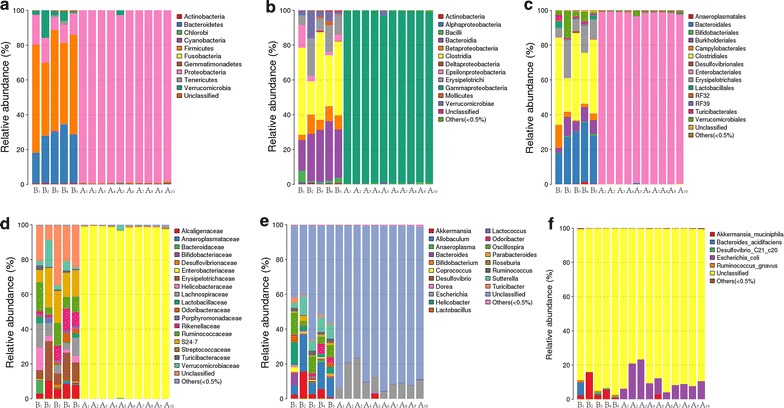
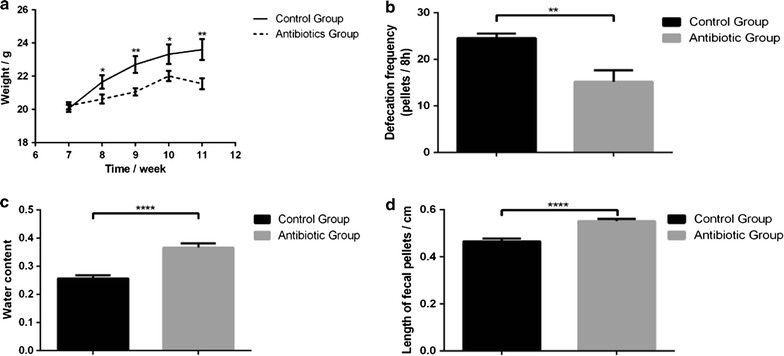
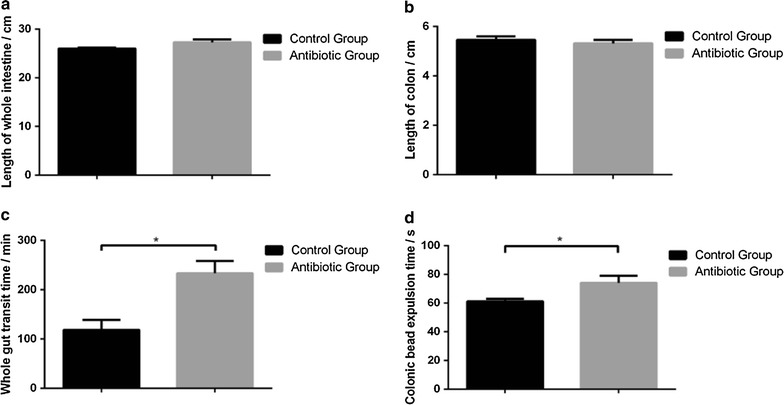
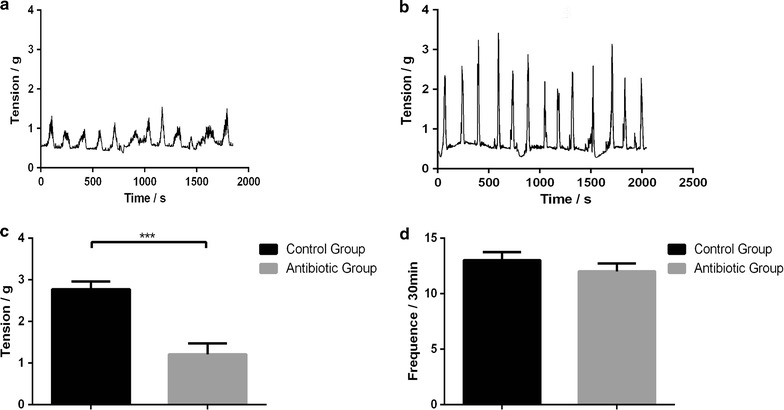
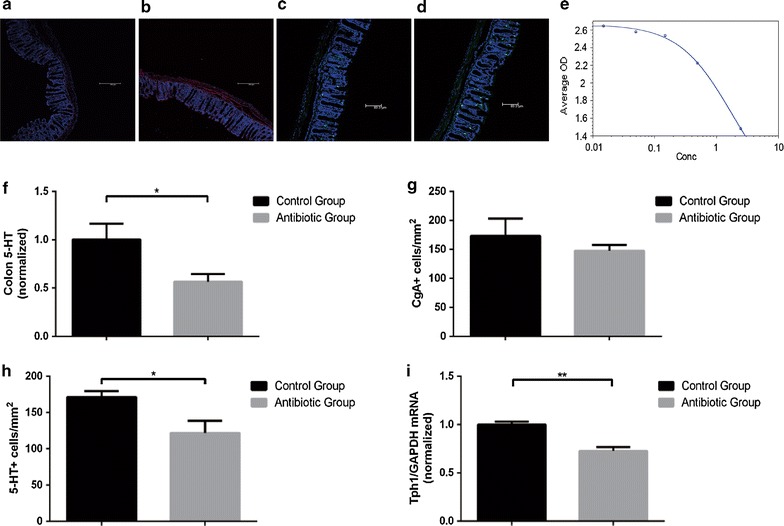
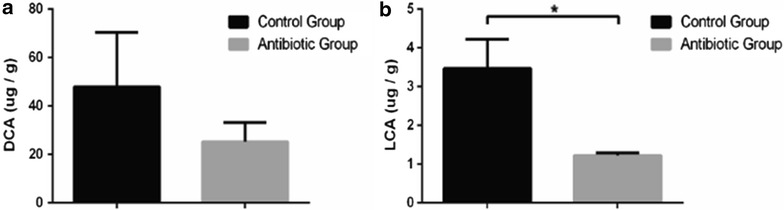
BACKGROUND: The gastrointestinal motility is affected by gut microbiota and the relationship between them has become a hot topic. However, mechanisms of microbiota in regulating motility have not been well defined. We thus investigated the effect of microbiota depletion by antibiotics on gastrointestinal motility, colonic serotonin levels, and bile acids metabolism. METHODS: After 4 weeks with antibiotics treatments, gastrointestinal and colon transit, defecation frequency, water content, and other fecal parameters were measured and analyzed in both wild-type and antibiotics-treated mice, respectively. Contractility of smooth muscle, serotonin levels, and bile acids levels in wild-type and antibiotics-treated mice were also analyzed. RESULTS: After antibiotics treatment, the richness and diversity of intestinal microbiota decreased significantly, and the fecal of mice had less output (P < 0.01), more water content (P < 0.01), and longer pellet length (P < 0.01). Antibiotics treatment in mice also resulted in delayed gastrointestinal and colonic motility (P < 0.05), and inhibition of phasic contractions of longitudinal muscle from isolated proximal colon (P < 0.01). In antibiotics-treated mice, serotonin, tryptophan hydroxylase 1, and secondary bile acids levels were decreased. CONCLUSION: Gut microbiota play an important role in the regulation of intestinal bile acids and serotonin metabolism, which could probably contribute to the association between gut microbiota and gastrointestinal motility as intermediates.
Overview
The claims and statistics of this paper haven’t been checked yet.
Free: it reads the open-access text and checks the first 5 claims that cite a source we can check. Create a free account to check every claim.
Integrity signals
Registry
Cites
Statistics
Figures
Verification
Claims the paper makes
The claims and statistics of this paper haven’t been checked yet.
Free: it reads the open-access text and checks the first 5 claims that cite a source we can check. Create a free account to check every claim.
Self-check
Percentages, sums and reported differences re-computed from the paper’s own numbers.
The self-check needs the paper’s full text.
Citations
Cites
Schloss, P. D., Westcott, S. L., Ryabin, T., Hall, J. R., Hartmann, M., Hollister, E. B., Lesniewski, R. A., Oakley, B. B., Parks, D. H., Robinson, C. J., et al. (2009) · Applied and Environmental Microbiology · doi:10.1128/aem.01541-09 · Cited by 19,549
Enterotypes of the human gut microbiome
MetaHIT Consortium (additional members), Arumugam, M., Raes, J., Pelletier, E., Le Paslier, D., Yamada, T., Mende, D. R., Fernandes, G. R., Tap, J., Bruls, T., et al. (2011) · Nature · doi:10.1038/nature09944 · Cited by 7,548
Recognition of Commensal Microflora by Toll-Like Receptors Is Required for Intestinal Homeostasis
Rakoff-Nahoum, S., Paglino, J., Eslami-Varzaneh, F., Edberg, S., & Medzhitov, R. (2004) · Cell · doi:10.1016/j.cell.2004.07.002 · Cited by 4,251 · cited 1×
“after antibiotics To determine the importance of commensal microbiota in gut motility, mice were subjected to a 4-week oral administration of antibiotics combination (ampicillin, neomycin sulfate, metronidazole, and vancomycin) [17, 18, 20, 28, 29].”
MethodThe gut microbiota--masters of host development and physiology
Sommer, F., & Bäckhed, F. (2013) · Nature Reviews Microbiology · doi:10.1038/nrmicro2974 · Cited by 3,681
Indigenous bacteria from the gut microbiota regulate host serotonin biosynthesis
Yano, J. M., Yu, K., Donaldson, G. P., Shastri, G. G., Ann, P., Ma, L., Nagler, C. R., Ismagilov, R. F., Mazmanian, S. K., & Hsiao, E. Y. (2015) · Cell · doi:10.1016/j.cell.2015.02.047 · Cited by 3,614 · cited 7×
“In antibiotics-treated mice, the 5-HT levels in colon was lower, which was consistent with that in a previous study [12].”
InfluentialMICROBIAL ECOLOGY OF THE GASTROINTESTINAL TRACT
Savage, D. C. (1977) · Annual Review of Microbiology · doi:10.1146/annurev.mi.31.100177.000543 · Cited by 2,436
TLR4 enhances TGF-β signaling and hepatic fibrosis
Seki, E., De Minicis, S., Österreicher, C. H., Kluwe, J., Osawa, Y., Brenner, D. A., & Schwabe, R. F. (2007) · Nature Medicine · doi:10.1038/nm1663 · Cited by 1,942
A G Protein-coupled Receptor Responsive to Bile Acids
Kawamata, Y., Fujii, R., Hosoya, M., Harada, M., Yoshida, H., Miwa, M., Fukusumi, S., Habata, Y., Itoh, T., Shintani, Y., et al. (2003) · Journal of Biological Chemistry · doi:10.1074/jbc.m209706200 · Cited by 1,628 · cited 10×
“Abbreviations GALT: gut-associated lymphoid tissue; 5-HT: 5-hydroxytryptamine; ECs: enterochromaffin cells; TPH: tryptophan hydroxylase; CGRP: calcitonin gene-related peptide; DCA: deoxycholic acid; LCA: lithocholic acid; BAs: bile acids; BSS: Bristol Stool Form Scale; STC: slow transit constipation; FMT: fecal microb…”
BackgroundInfluentialGut/brain axis and the microbiota
Mayer, E. A., Tillisch, K., & Gupta, A. (2015) · Journal of Clinical Investigation · doi:10.1172/jci76304 · Cited by 1,503
Microbiota regulates immune defense against respiratory tract influenza A virus infection
Ichinohe, T., Pang, I. K., Kumamoto, Y., Peaper, D. R., Ho, J. H., Murray, T. S., & Iwasaki, A. (2011) · Proceedings of the National Academy of Sciences · doi:10.1073/pnas.1019378108 · Cited by 1,502 · cited 1×
“after antibiotics To determine the importance of commensal microbiota in gut motility, mice were subjected to a 4-week oral administration of antibiotics combination (ampicillin, neomycin sulfate, metronidazole, and vancomycin) [17, 18, 20, 28, 29].”
MethodRecognition of peptidoglycan from the microbiota by Nod1 enhances systemic innate immunity
Clarke, T. B., Davis, K. M., Lysenko, E. S., Zhou, A. Y., Yu, Y., & Weiser, J. N. (2010) · Nature Medicine · doi:10.1038/nm.2087 · Cited by 1,154
Vandeputte, D., Falony, G., Vieira-Silva, S., Tito, R. Y., Joossens, M., & Raes, J. (2016) · Gut · doi:10.1136/gutjnl-2015-309618 · Cited by 1,028
5-Hydroxytryptamine (serotonin) in the gastrointestinal tract
Gershon, M. D. (2013) · Current Opinion in Endocrinology, Diabetes & Obesity · doi:10.1097/med.0b013e32835bc703 · Cited by 617 · cited 1×
“Tryptophan hydroxylase 1 (TPH1) and TPH2 are rate limiting enzymes in mucosal and neuronal serotonin biosynthesis, respectively [8].”
BackgroundUnderstanding the mechanisms of faecal microbiota transplantation
Khoruts, A., & Sadowsky, M. J. (2016) · Nature Reviews Gastroenterology & Hepatology · doi:10.1038/nrgastro.2016.98 · Cited by 561
Short-chain fatty acids stimulate colonic transit via intraluminal 5-HT release in rats
Fukumoto, S., Tatewaki, M., Yamada, T., Fujimiya, M., Mantyh, C., Voss, M., Eubanks, S., Harris, M., Pappas, T. N., & Takahashi, T. (2003) · American Journal of Physiology-Regulatory, Integrative and Comparative Physiology · doi:10.1152/ajpregu.00442.2002 · Cited by 465 · cited 1×
“[10] reported that 5-HT from ECs could stimulate 5-HT3 receptors which were located on the vagal sensory fibers, and the sensory information was transferred to the vagal efferent or it stimulated the release of acetylcholine which affected muscle contraction.”
BackgroundCommensal microbes and interferon-λ determine persistence of enteric murine norovirus infection
Baldridge, M. T., Nice, T. J., McCune, B. T., Yokoyama, C. C., Kambal, A., Wheadon, M., Diamond, M. S., Ivanova, Y., Artyomov, M., & Virgin, H. W. (2015) · Science · doi:10.1126/science.1258025 · Cited by 412
Li, Z., Chalazonitis, A., Huang, Y.-Y., Mann, J. J., Margolis, K. G., Yang, Q. M., Kim, D. O., Cote, F., Mallet, J., & Gershon, M. D. (2011) · Journal of Neuroscience · doi:10.1523/jneurosci.6684-10.2011 · Cited by 403 · cited 1×
“Then fecal pellets were monitored at 10 min intervals for the presence of the first blue pellet, and the time for expulsion of the first blue pellet was measured [24].”
MethodChen, J. J., Li, Z., Pan, H., Murphy, D. L., Tamir, H., Koepsell, H., & Gershon, M. D. (2001) · The Journal of Neuroscience · doi:10.1523/jneurosci.21-16-06348.2001 · Cited by 397
Structural changes in the gut microbiome of constipated patients
Zhu, L., Liu, W., Alkhouri, R., Baker, R. D., Bard, J. E., Quigley, E. M., & Baker, S. S. (2014) · Physiological Genomics · doi:10.1152/physiolgenomics.00082.2014 · Cited by 381
Alemi, F., Poole, D. P., Chiu, J., Schoonjans, K., Cattaruzza, F., Grider, J. R., Bunnett, N. W., & Corvera, C. U. (2013) · Gastroenterology · doi:10.1053/j.gastro.2012.09.055 · Cited by 362 · cited 6×
“Abbreviations GALT: gut-associated lymphoid tissue; 5-HT: 5-hydroxytryptamine; ECs: enterochromaffin cells; TPH: tryptophan hydroxylase; CGRP: calcitonin gene-related peptide; DCA: deoxycholic acid; LCA: lithocholic acid; BAs: bile acids; BSS: Bristol Stool Form Scale; STC: slow transit constipation; FMT: fecal microb…”
BackgroundMethodResultInfluentialDiagnosis and management of chronic constipation in adults
Rao, S. S. C., Rattanakovit, K., & Patcharatrakul, T. (2016) · Nature Reviews Gastroenterology & Hepatology · doi:10.1038/nrgastro.2016.53 · Cited by 337 · cited 5×
“Abbreviations GALT: gut-associated lymphoid tissue; 5-HT: 5-hydroxytryptamine; ECs: enterochromaffin cells; TPH: tryptophan hydroxylase; CGRP: calcitonin gene-related peptide; DCA: deoxycholic acid; LCA: lithocholic acid; BAs: bile acids; BSS: Bristol Stool Form Scale; STC: slow transit constipation; FMT: fecal microb…”
InfluentialThe Intestinal Microenvironment and Functional Gastrointestinal Disorders
Barbara, G., Feinle-Bisset, C., Ghoshal, U. C., Santos, J., Vanner, S. J., Vergnolle, N., Zoetendal, E. G., & Quigley, E. M. (2016) · Gastroenterology · doi:10.1053/j.gastro.2016.02.028 · Cited by 335
Interactions Between Commensal Bacteria and Gut Sensorimotor Function in Health and Disease
Barbara, G., Stanghellini, V., Brandi, G., Cremon, C., Nardo, G. D., De Giorgio, R., & Corinaldesi, R. (2005) · The American Journal of Gastroenterology · doi:10.1111/j.1572-0241.2005.00230.x · Cited by 325 · cited 3×
“Discussion The interactions between the composition of the microbiota and gut motility are bidirectional, which indicates that the microbiota play an important role in gut motor function and the gut motor function affects the diversity of microflora in the gastrointestinal tract [6].”
BackgroundInfluentialHe, W., Peng, Y., Zhang, W., Lv, N., Tang, J., Chen, C., Zhang, C., Gao, S., Chen, H., Zhi, G., et al. (2008) · Gastroenterology · doi:10.1053/j.gastro.2008.05.032 · Cited by 184
Self-citationYang, J., Tan, Q., Fu, Q., Zhou, Y., Hu, Y., Tang, S., Zhou, Y., Zhang, J., Qiu, J., & Lv, Q. (2016) · Breast Cancer · doi:10.1007/s12282-016-0734-z · Cited by 149
Xu, H., Hao, W., Zhou, Q., Wang, W., Xia, Z., Liu, C., Chen, X., Qin, M., & Chen, F. (2014) · PLoS ONE · doi:10.1371/journal.pone.0089269 · Cited by 142
Hintze, K. J., Cox, J. E., Rompato, G., Benninghoff, A. D., Ward, R. E., Broadbent, J., & Lefevre, M. (2014) · Gut Microbes · doi:10.4161/gmic.28403 · Cited by 135 · cited 1×
“after antibiotics To determine the importance of commensal microbiota in gut motility, mice were subjected to a 4-week oral administration of antibiotics combination (ampicillin, neomycin sulfate, metronidazole, and vancomycin) [17, 18, 20, 28, 29].”
MethodHeredia, D. J., Dickson, E. J., Bayguinov, P. O., Hennig, G. W., & Smith, T. K. (2009) · Gastroenterology · doi:10.1053/j.gastro.2008.12.010 · Cited by 133
Nezami, B. G., Mwangi, S. M., Lee, J. E., Jeppsson, S., Anitha, M., Yarandi, S. S., Farris, A. B., & Srinivasan, S. (2014) · Gastroenterology · doi:10.1053/j.gastro.2013.10.053 · Cited by 119
The enteric microbiota in the pathogenesis and management of constipation
Quigley, E. M. M. (2011) · Best Practice & Research Clinical Gastroenterology · doi:10.1016/j.bpg.2011.01.003 · Cited by 93
Treatment of Slow Transit Constipation With Fecal Microbiota Transplantation: A Pilot Study
Tian, H., Ding, C., Gong, J., Ge, X., McFarland, L. V., Gu, L., Wei, Y., Chen, Q., Zhu, W., Li, J., et al. (2016) · Journal of Clinical Gastroenterology · doi:10.1097/mcg.0000000000000472 · Cited by 81
Self-citationHe, W., Qiao, Y., Peng, Y., Zha, J., Zhang, C., Chen, C., Chen, C., Wang, P., Yang, X. Y., Li, C., et al. (2013) · Gastroenterology · doi:10.1053/j.gastro.2013.02.045 · Cited by 66
Self-citationStool frequency is associated with gut microbiota composition
Hadizadeh, F., Walter, S., Belheouane, M., Bonfiglio, F., Heinsen, F.-A., Andreasson, A., Agreus, L., Engstrand, L., Baines, J. F., Rafter, J., et al. (2017) · Gut · doi:10.1136/gutjnl-2016-311935 · Cited by 62
5-Hydroxytryptamine, enterotoxins, and intestinal fluid secretion
Lundgren, O. (1998) · Gastroenterology · doi:10.1016/s0016-5085(98)70275-6 · Cited by 35
Barrett, K. E. (2016) · The Journal of Physiology · doi:10.1113/jp272227 · Cited by 23
Obstructive cholestasis alters intestinal transit in mice: role of opioid system
Ghaffari, K., Savadkuhi, S. T., Honar, H., Riazi, K., Shafaroodi, H., Moezi, L., Ebrahimkhani, M. R., Tahmasebi, M. S. R., & Dehpour, A. R. (2004) · Life Sciences · doi:10.1016/j.lfs.2004.09.002 · Cited by 19
MECHANISMS MEDIATING SEROTONIN‐INDUCED CONTRACTION OF COLONIC MYOCYTES
Xu, L., Yu, B., Chen, J., & Luo, H. (2006) · Clinical and Experimental Pharmacology and Physiology · doi:10.1111/j.1440-1681.2007.04465.x · Cited by 14
Self-citation
Cited by
Introduction to the human gut microbiota
Thursby, E., & Juge, N. (2017) · Biochemical Journal · doi:10.1042/bcj20160510 · Cited by 3,600
Tryptophan Metabolism: A Link Between the Gut Microbiota and Brain
Gao, K., Mu, C.-L., Farzi, A., & Zhu, W.-Y. (2020) · Advances in Nutrition · doi:10.1093/advances/nmz127 · Cited by 1,029
“As evidenced by the down-regulation of the key synthase TPH1 in the colon (38), this study points to the possible role of commensal microbiota in the modulation of the intestinal serotonin synthesis.”
BackgroundIntestinal barrier and gut microbiota: Shaping our immune responses throughout life
Takiishi, T., Fenero, C. I. M., & Câmara, N. O. S. (2017) · Tissue Barriers · doi:10.1080/21688370.2017.1373208 · Cited by 1,009
Impact of antibiotics on the human microbiome and consequences for host health
Patangia, D. V., Anthony Ryan, C., Dempsey, E., Paul Ross, R., & Stanton, C. (2022) · MicrobiologyOpen · doi:10.1002/mbo3.1260 · Cited by 754
Factors affecting the composition of the gut microbiota, and its modulation
Hasan, N., & Yang, H. (2019) · PeerJ · doi:10.7717/peerj.7502 · Cited by 755
Metadata
- Authors
- Ge, X., Ding, C., Zhao, W., Xu, L., Tian, H., Gong, J., Zhu, M., Li, J., & Li, N.
- Affiliations
- Nanjing General Hospital of Nanjing Military Command (CN)
- Model Animal Research Center (CN)
- Nanjing University (CN)
- Corresponding author
- Gong, Jianfeng
- Li, Ning
- Venue
- Journal of Translational Medicine
- Published
- 2017-01-13
- Volume
- 15
- Issue
- 1
- Pages
- 13-13
- ISSN
- 1479-5876 (ISSN-L)
- PMC
- PMC5237163
- OpenAlex
- W2575984858
- Semantic Scholar
- 9db76f33cfaf0f649af0caf0745bee890496a963
- Cited by
- 274
- References
- 37
- Citations by year
- 2026: 24 · 2025: 34 · 2024: 41 · 2023: 36 · 2022: 36 · 2021: 27 · 2020: 32 · 2019: 21 · 2018: 14 · 2017: 9
- FWCI
- 21.76
- Type
- journal article
- Language
- en
- Open access
- gold
- doi.org
- Licence
- cc-by
- Locations
- Journal of Translational Medicine (publishedVersion, cc-by)
- PubMed Central (publishedVersion, cc-by)
- PubMed (publishedVersion)
- Funders
- National Natural Science Foundation of China (81270006)
- National Gastroenterology Research Project (2015BAI13B07)
- Topics
- Health Sciences › Medicine › Gastroenterology › Gastrointestinal motility and disorders
- Life Sciences › Biochemistry, Genetics and Molecular Biology › Molecular Biology › Gut microbiota and health
- Health Sciences › Medicine › Surgery › Congenital gastrointestinal and neural anomalies
- Keywords
- gut microbiota, antibiotic-induced microbiota depletion, intestinal motility, colonic motility, serotonin synthesis, tryptophan hydroxylase 1, secondary bile acids, smooth muscle contractility, fecal transit, gut-brain axis
- MeSH terms
- Gastrointestinal Microbiome, Animals, Anti-Bacterial Agents, Bile Acids and Salts, Cecum, Feces, Gastrointestinal Motility, Male, Mice, Inbred C57BL, Muscle Contraction, Organ Size, Serotonin, Metabolome, Microbiota
About these checks
Registry, retraction, Cites and statistics results are computed, not judged, with one exception: a printed reference that no index lists is read once by a model before it counts as a citation error. Claims are extracted by a model and kept only when their quote appears verbatim in the text; each cited source is then checked, with a model’s help, for whether it says what the claim relies on. Those verdicts can be wrong — read the claim’s quote and the cited source before relying on one.
Statistics and arithmetic are recomputed, not judged.
Confidence bands are shown only for fields calibrated on our annotated test set. None is calibrated yet, so no band is shown.
What counts as a claim ›How we measure confidence ›How we check this ›
Are you an author, or do you see a problem with this page? Request a review
Data sources
Bibliographic data: Semantic Scholar, OpenAlex, Crossref.
Contains information from the Semantic Scholar Academic Graph Datasets, made available under the ODC Attribution License (ODC-BY 1.0).
Semantic Scholar’s data is described in: Kinney, R., et al. (2023). The Semantic Scholar Open Data Platform. arXiv:2301.10140.
