

Pea proteins oral supplementation promotes muscle thickness gains during resistance training: a double-blind, randomized, Placebo-controlled clinical trial vs. Whey protein
Open accessThe DOI matches its Crossref record; 42 of the 44 references it cites were found in a registry or an index.
Abstract
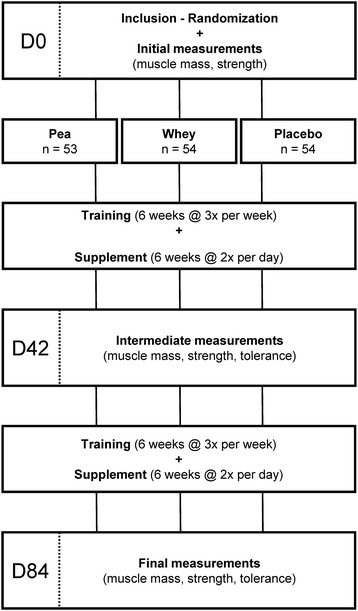
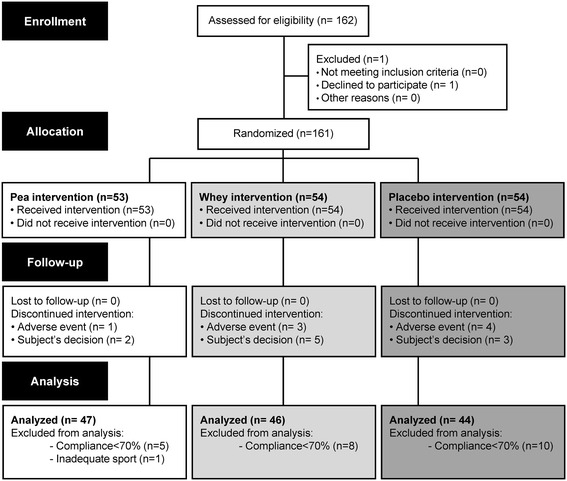
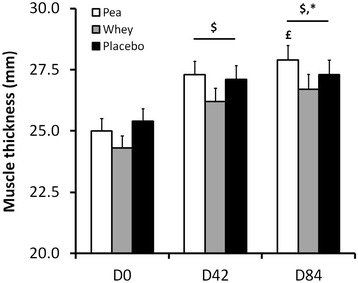
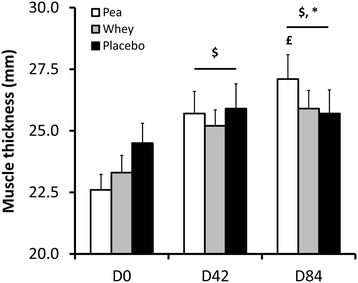
BACKGROUND: The effects of protein supplementation on muscle thickness and strength seem largely dependent on its composition. The current study aimed at comparing the impact of an oral supplementation with vegetable Pea protein (NUTRALYS®) vs. Whey protein and Placebo on biceps brachii muscle thickness and strength after a 12-week resistance training program. METHODS: One hundred and sixty one males, aged 18 to 35 years were enrolled in the study and underwent 12 weeks of resistance training on upper limb muscles. According to randomization, they were included in the Pea protein (n = 53), Whey protein (n = 54) or Placebo (n = 54) group. All had to take 25 g of the proteins or placebo twice a day during the 12-week training period. Tests were performed on biceps muscles at inclusion (D0), mid (D42) and post training (D84). Muscle thickness was evaluated using ultrasonography, and strength was measured on an isokinetic dynamometer. RESULTS: Results showed a significant time effect for biceps brachii muscle thickness (P < 0.0001). Thickness increased from 24.9 ± 3.8 mm to 26.9 ± 4.1 mm and 27.3 ± 4.4 mm at D0, D42 and D84, respectively, with only a trend toward significant differences between groups (P = 0.09). Performing a sensitivity study on the weakest participants (with regards to strength at inclusion), thickness increases were significantly different between groups (+20.2 ± 12.3%, +15.6 ± 13.5% and +8.6 ± 7.3% for Pea, Whey and Placebo, respectively; P < 0.05). Increases in thickness were significantly greater in the Pea group as compared to Placebo whereas there was no difference between Whey and the two other conditions. Muscle strength also increased with time with no statistical difference between groups. CONCLUSIONS: In addition to an appropriate training, the supplementation with pea protein promoted a greater increase of muscle thickness as compared to Placebo and especially for people starting or returning to a muscular strengthening. Since no difference was obtained between the two protein groups, vegetable pea proteins could be used as an alternative to Whey-based dietary products. TRIAL REGISTRATION: The present trial has been registered at ClinicalTrials.gov (NCT02128516).
Overview
The claims and statistics of this paper haven’t been checked yet.
Free: it reads the open-access text and checks the first 5 claims that cite a source we can check. Create a free account to check every claim.
Integrity signals
Registry
Cites
Statistics
Figures
Verification
Claims the paper makes
The claims and statistics of this paper haven’t been checked yet.
Free: it reads the open-access text and checks the first 5 claims that cite a source we can check. Create a free account to check every claim.
Claims other papers make about this one
Each is checked against this paper’s own text: does it say what the citing paper says it does?
The cited source doesn’t support the claim as written.
In the citing paper
“The average RET-induced increase, with all measures of 1RM included, was 27 kg (mean±SD; 27±22 kg22 32).”
From A systematic review, meta-analysis and meta-regression of the effect of protein supplementation on resistance training-induced gains in muscle mass and strength in healthy adults (2018) · cites this paper as [22]
Checked by a reasoning model — may be wrong.
Experimental — accuracy not yet measuredThe source backs part of the claim, not all of it — or backs it for a different population, condition or comparison.
In the citing paper
“Preliminary findings suggest that rice [98] and pea protein [103] may be able to stimulate similar changes in fat-free mass and strength as whey protein, although the reader should understand that many other factors (dose provided, training status of participants, duration of training and supplementation, etc.) will ultimately impact these outcomes and consequently more research is needed.”
From ISSN exercise & sports nutrition review update: research & recommendations (2018) · cites this paper as [103]
Experimental — accuracy not yet measuredIn the citing paper
“pea protein supplementation (25 g twice/day) was shown during 12 weeks of resistance training to increase biceps muscle thickness to the same degree as an equivalent amount of whey protein [123].”
From Plant Proteins: Assessing Their Nutritional Quality and Effects on Health and Physical Function (2020) · cites this paper as [123]
In the citing paper
“it has been shown that participants adhering to resistance training increased muscle mass comparably when supplemented with pea or whey protein [20], with rice or whey protein [58], when consuming a lacto-ovo-vegetarian or beef-containing diet [59], or when consuming a habitual omnivorous and vegan diet [21].”
From Vegan and omnivorous high protein diets support comparable daily myofibrillar protein synthesis rates and skeletal muscle hypertrophy in young adults (2023) · cites this paper as [20]
In the citing paper
“Although minimal MPS/MyoPS data are available for other non–animal-derived protein sources, pea protein isolate supplementation has been reported to facilitate comparable resistance training adaptation to that of whey protein supplementation in subjects consuming a high protein omnivorous diet [20].”
From Vegan and omnivorous high protein diets support comparable daily myofibrillar protein synthesis rates and skeletal muscle hypertrophy in young adults (2023) · cites this paper as [20]
Self-check
Percentages, sums and reported differences re-computed from the paper’s own numbers.
The self-check needs the paper’s full text.
Citations
Cites
Slow and fast dietary proteins differently modulate postprandial protein accretion
Boirie, Y., Dangin, M., Gachon, P., Vasson, M.-P., Maubois, J.-L., & Beaufrère, B. (1997) · Proceedings of the National Academy of Sciences · doi:10.1073/pnas.94.26.14930 · Cited by 1,453 · cited 2×
“Whey protein has a fast kinetic of digestion, bringing rapidly high concentration of amino-acids in plasma after ingestion, but this effect is transient and returns to resting levels within 2-3 h [7].”
BackgroundMixed muscle protein synthesis and breakdown after resistance exercise in humans
Phillips, S. M., Tipton, K. D., Aarsland, A., Wolf, S. E., & Wolfe, R. R. (1997) · American Journal of Physiology-Endocrinology and Metabolism · doi:10.1152/ajpendo.1997.273.1.e99 · Cited by 1,132 · cited 2×
“The best stimulus for protein synthesis appeared to be with protein feeding in close proximity to training sessions [31,32], with feeding recommended within the first two hours post-exercise [2,33,34].”
BackgroundTang, J. E., Moore, D. R., Kujbida, G. W., Tarnopolsky, M. A., & Phillips, S. M. (2009) · Journal of Applied Physiology · doi:10.1152/japplphysiol.00076.2009 · Cited by 998
Cermak, N. M., Res, P. T., de Groot, L. C., Saris, W. H., & van Loon, L. J. (2012) · The American Journal of Clinical Nutrition · doi:10.3945/ajcn.112.037556 · Cited by 827 · cited 1×
“In addition to increases in muscle mass, functional adaptations, such as strength or fatigue, are also obtained after EAA supplementation [8,9].”
BackgroundBiolo, G., Maggi, S. P., Williams, B. D., Tipton, K. D., & Wolfe, R. R. (1995) · American Journal of Physiology-Endocrinology and Metabolism · doi:10.1152/ajpendo.1995.268.3.e514 · Cited by 713 · cited 1×
“, muscle hypertrophy) is observed immediately after resistance exercises [2-4] as a result of a positive protein net balance; the difference between muscle fiber catabolism and anabolism.”
Background(2008) · Nutrition & Food Science · doi:10.1108/nfs.2008.01738aab.008 · Cited by 611
The Protein Digestibility–Corrected Amino Acid Score
Schaafsma, G. (2000) · The Journal of Nutrition · doi:10.1093/jn/130.7.1865s · Cited by 537 · cited 1×
“8% out of a maximum 100% [24] corresponding to the values of Whey or casein, while fruit proteins have a mean value of 76% and cereal proteins 59% [25].”
BackgroundBurd, N. A., West, D. W. D., Staples, A. W., Atherton, P. J., Baker, J. M., Moore, D. R., Holwerda, A. M., Parise, G., Rennie, M. J., Baker, S. K., et al. (2010) · PLoS ONE · doi:10.1371/journal.pone.0012033 · Cited by 531 · cited 1×
“Training volume [42] concomitant with the load used in terms of 1-RM’s percentage [43] are possible parameters.”
MethodTipton, K. D., Rasmussen, B. B., Miller, S. L., Wolf, S. E., Owens-Stovall, S. K., Petrini, B. E., & Wolfe, R. R. (2001) · American Journal of Physiology-Endocrinology and Metabolism · doi:10.1152/ajpendo.2001.281.2.e197 · Cited by 526 · cited 1×
“The best stimulus for protein synthesis appeared to be with protein feeding in close proximity to training sessions [31,32], with feeding recommended within the first two hours post-exercise [2,33,34].”
BackgroundRasmussen, B. B., Tipton, K. D., Miller, S. L., Wolf, S. E., & Wolfe, R. R. (2000) · Journal of Applied Physiology · doi:10.1152/jappl.2000.88.2.386 · Cited by 523 · cited 1×
“The best stimulus for protein synthesis appeared to be with protein feeding in close proximity to training sessions [31,32], with feeding recommended within the first two hours post-exercise [2,33,34].”
Background
Cited by
Items 101–151 of 151
Exploring aquatic weed protein for applications as meat alternatives
Rathod, N. B., Inumala, C., Pragnasree, P., & Kudre, T. G. (2025) · Critical Reviews in Food Science and Nutrition · doi:10.1080/10408398.2025.2578305 · Cited by 2
Huijgen, E., Wijnhoven, H. A. H., & Visser, M. (2025) · Journal of Nutrition · doi:10.1016/j.tjnut.2025.101266 · Cited by 2
Yellow pea germination impact on protein isolation - protein digestibility and quality
Anamaria, P. O. P., Ciont, C., Pop, O. L., Vodnar, D. C., Odocheanu, R., Mudura, E., Marțiș, G. S., Socaci, S., & Martău, G. A. (2026) · Journal of Food Composition and Analysis · doi:10.1016/j.jfca.2026.108902 · Cited by 2
Thondre, P. S., Young, E., Pledger, S., Kefyalew, S. S., Hatami, I., Perreau, C., Deremaux, L., Lefranc‐Millot, C., & Tammam, J. (2026) · PLoS ONE · doi:10.1371/journal.pone.0340386 · Cited by 2
Self-citationDrummond, M. D. M., da Silva, R. Â. D., Carvas, N., de Melo, M. S., & Ferreira, M. H. L. (2026) · Translational Sports Medicine · doi:10.1155/tsm2/5557511 · Cited by 4
Appicciutoli, D., & Sahin, A. W. (2026) · Food Hydrocolloids for Health · doi:10.1016/j.fhfh.2026.100288 · Cited by 3
Non-nutritive Sweeteners: Implications for Consumption in Athletic Populations
Machek, S. B., & Willoughby, D. S. (2019) · Strength and conditioning journal · doi:10.1519/ssc.0000000000000469 · Cited by 2
“Considering that pea protein is inferior to whey with regards to BCAA content, as well as other amino acids (lysine and threonine) implicated in the whey-mediated insulinogenic effect, there is a need to elucidate the differential effects of an NNSwhey mixture (8).”
BackgroundTihăuan, B.-M., Marinaș, I. C., Adascalului, M., Dobre, A. A., Pîrcălăbioru, G. G., Axinie, M., Ștefan, L. M., & Duță, D. E. (2023) · Applied Sciences · doi:10.3390/app13116829 · Cited by 2
Shaw, K. A., Chilibeck, P. D., Lindsay, D. L., Warkentin, T. D., Ko, J., & Zello, G. A. (2023) · Nutrition and Health · doi:10.1177/02601060231181605 · Cited by 5
“To our knowledge, no research has investigated the feasibility of a pea protein in improving dietary intakes of iron or protein, though research has reported pea protein to perform similarly to whey in inducing muscle hypertrophy and strength (Babault et al., 2015; Banaszek et al., 2019).”
Takagi, S., Maeda, K., Satake, S., Kinoshita, K., Iizuka, Y., Matsui, Y., & Arai, H. (2024) · European Geriatric Medicine · doi:10.1007/s41999-024-01049-z · Cited by 2
Smillie, L., Minehan, M., Knight-Agarwal, C. R., Oliver, C., & Turner, M. R. (2024) · JCSM Communications · doi:10.1002/rco2.109 · Cited by 2
Baklagiller: Fonksiyonel Özellikleri, Sağlık Etkileri ve Potansiyel Kullanımı
ATALAY, E., & Gökbulut, İ. (2021) · Akademik Gıda · doi:10.24323/akademik-gida.1050782 · Cited by 10
Jang, J., Park, H., Yoo, C., Park, Y., Kim, J., & Lim, K. (2017) · Physical Activity and Nutrition · doi:10.20463/jenb.2017.0036 · Cited by 3
“The supplementation of pea protein with RET promoted gains in biceps brachii muscle thickness in humans [15], and led to reduced pro-inflammatory cytokines such as tumor necrosis factor- α (TNF-α) and interleukin-6 (IL-6) in mice [16].”
BackgroundBiochemical Controversies Regarding the Use of Vegetal Proteins in Performance Athletes
Bătrînu, M.-G., Tero-Vescan, A., & Miklos, A. (2020) · Acta Biologica Marisiensis · doi:10.2478/abmj-2020-0006 · Cited by 4
“…used in combination with resistance training could be just as effective as whey protein supplements in terms of increasing strength and muscle mass (Babault et al., 2015) while a recent review by Craddock et al. (2016) concludes that a vegetarian diet does not improve athletic performance but does…”
BackgroundKohno, M. (2022) · IntechOpen eBooks · doi:10.5772/intechopen.99955 · Cited by 1
SUPERALIMENTOS: FUNDAMENTAÇÃO CIENTÍFICA
Ortelam, A., Camargo, R. B., Gazim, Z. C., Rahal, I. L., Laginestra, B. D. F. A., Silva, G. C. C., & Piau, R. (2022) · Arquivos de Ciências da Saúde da UNIPAR · doi:10.25110/arqsaude.v26i3.2022.8982 · Cited by 4
Produkty wegańskie – charakterystyka rynku i perspektywy rozwoju
Pielak, M. (2023) · Engineering Sciences And Technologies · doi:10.15611/nit.2023.39.09 · Cited by 5
Abedini, A., Ghahremani, Y., Sani, M. A., Aryan, S., Shahbazpour, N., & Nayebzadeh, K. (2025) · Future Foods · doi:10.1016/j.fufo.2025.100868 · Cited by 2
Cohen, S. A., Millovich, V., Newman, D., Withrow, N. A., Beseler, L., & Valentine, C. J. (2025) · Frontiers in Nutrition · doi:10.3389/fnut.2025.1619884 · Cited by 1
Karanth, S., Eyiz, V., Aydin, M., Tontul, İ., & Koehler, M. (2026) · Frontiers in Food Science and Technology · doi:10.3389/frfst.2025.1692329 · Cited by 1
Wang, S.-N., Liu, Y.-X., Sun, G.-Y., Liu, X., Sun, Y., Ma, Y.-X., Ning, S.-Y., & Shi, Y. (2026) · Frontiers in Nutrition · doi:10.3389/fnut.2026.1805807 · Cited by 1
“No significant difference existed between pea and whey protein groups (19).”
Supplements and high-protein foods in weight training: How do they affect maximum muscle strength?
Fardi, A., Sin, T. H., Pratama, A. O., & Mario, D. T. (2022) · JOURNAL SPORT AREA · doi:10.25299/sportarea.2022.vol7(2).9528 · Cited by 1
“Soy protein can be used as an alternative to replace whey supplements (Babault et al., 2015).”
BackgroundDutta, R. D. G., Kar, G., & Shukla, S. P. (2023) · International Journal of Medical Sciences and Pharma Research · doi:10.22270/ijmspr.v9i1.62 · Cited by 1
Craddock, J. C., Wakefield, A., Peoples, G. E., Goldman, D., & Larkin, T. (2024) · Cureus · doi:10.7759/cureus.59972 · Cited by 1
“…in support of this theory can be observed in several studies comparing varying protein types (soy, whey, rice, pea), whereby providing a protein dose that sufficiently meets the "leucine threshold" results in equivalent increases in muscle mass and strength regardless of protein origin [39-42].”
ResultФУНКЦІОНАЛЬНИЙ НАПІЙ ВІДНОВЛЮВАЛЬНОЇ ДІЇ ДЛЯ СПОРТСМЕНІВ, ВЛАСТИВОСТІ ТА ПОКАЗНИКИ ЯКОСТІ
Біленький, П., Тележенко, Л. М., & Біленька, І. Р. (2025) · Innovations and Technologies in the Service Sphere and Food Industry · doi:10.32782/2708-4949.2(16).2025.4 · Cited by 1
Nuszbaum, C., Wollmar, M., & Sjöberg, A. (2021) · Research Square · doi:10.21203/rs.3.rs-608825/v1 · Cited by 2
Nuszbaum, C., Wollmar, M., & Sjöberg, A. (2021) · Research Square · doi:10.21203/rs.3.rs-608825/v2 · Cited by 1
Shaw, K. A., Zello, G. A., Lindsay, D. L., Warkentin, T. D., Ko, J., & Chilibeck, P. D. (2022) · Research Square · doi:10.21203/rs.3.rs-2145800/v1 · Cited by 1
Roux, L. L. (2019) · theses.fr (ABES) · doi:10.70675/9e26b51bz92c7z48d4z9442z8bd572ee7696 · Cited by 2
L’équilibre des protéines végétales et des protéines animales
Lecerf, J. (2019) · Pratiques en nutrition · doi:10.1016/j.pranut.2019.05.007
Peri-exercise nutrition: an innovative approach to dietary assessment in trained populations
Kozior, M. (2020) · Arrow@dit (Dublin Institute of Technology) · doi:10.34961/6072
Plant and animal protein for muscle mass and strength gains: a systematic review
Meshtel, A. V., Rybakova, P. D., Miroshnikov, A. B., Vybornov, V. D., Antonov, A. G., Khanferyan, R. A., & Korosteleva, M. M. (2023) · Sports medicine research and practice · doi:10.47529/2223-2524.2022.4.6 · Cited by 3
The Relationship Between Supplementation and Sport
Újvári, G., Zsótér, B., & Veres, Z. (2024) · Analecta Technica Szegedinensia · doi:10.14232/analecta.2024.4.9-13
Ogunbusola, E. M., Alabi, O. O., & Amonsou, E. O. (2025) · Sustainable Food Proteins · doi:10.1002/sfp2.70004
Assessment of the Umami Flavour of Commercial Meat and Plant-Based Meat Analogues
Gay, G., & Thong, A. Z. (2025) · Proceedings in Technology Transfer · doi:10.1007/978-981-96-3770-6_4
More, S., & Nair, N. (2025) · Journal of Current Research in Food Science · doi:10.22271/foodsci.2025.v6.i1d.215
Top 5 Dietary Supplements for Bodybuilders
Haubenstricker, J. E., & Roberts, B. M. (2025) · Strength and conditioning journal · doi:10.1519/ssc.0000000000000925
Kahraman, O., & Gulkirpik, E. (2025) · Elsevier eBooks · doi:10.1016/b978-0-443-31652-4.00003-9
管, 宇. (2025) · Advances in Clinical Medicine · doi:10.12677/acm.2025.15102906
Guney-Coskun, M., Ersoy, N., & Ersoy, G. (2025) · Research Square · doi:10.21203/rs.3.rs-7534127/v1 · Cited by 1
A Systematic Review of Pea Protein Supplementation and Sports Performance
Aksu, Y., & Aras, D. (2026) · Journal of Advanced Studies in Health Science and Obesity · doi:10.51271/jashso.64 · Cited by 1
Hajj, S. E. (2022) · theses.fr (ABES) · doi:10.70675/5b42e204z603bz415fz8150z7f6a62958c77
Thermal Modifications of Plant Proteins
Sonkar, C., & Sonkar, N. (2026) · Springer eBooks · doi:10.1007/978-3-032-19821-1_4
Kravets, K. K., & Drozdovska, S. (2026) · Актуальні проблеми сучасної медицини Вісник Української медичної стоматологічної академії · doi:10.31718/2077-1096.26.2.144
Barasa, M. M., Horváth‐Szanics, E., Fábián, G. J., Berki, M., & Abrankó, L. (2026) · Applied Food Research · doi:10.1016/j.afres.2026.102436
Zhou, J., Shi, H., Sun, D., Meng, Y., Yang, Q., Cai, H., Feng, F., Zheng, Y., & Zhao, M. (2026) · Trends in Food Science & Technology · doi:10.1016/j.tifs.2026.105966
Li, Y., Qin, G., Wang, Z., & Zhang, J. (2026) · Frontiers in Nutrition · doi:10.3389/fnut.2026.1860234 · Cited by 1
Hao, S., Jin, F., Lei, X., He, Y., & Liu, Y. (2026) · Frontiers in Nutrition · doi:10.3389/fnut.2026.1871477 · Cited by 1
“Research suggests that although pea protein can contribute to muscle preservation, elevated dosages may be necessary to achieve an anabolic response comparable to that elicited by whey or casein, attributable to its amino acid deficiencies (18, 19).”
Corsetti, G., & Pasini, E. (2026) · Frontiers in Nutrition · doi:10.3389/fnut.2026.1970280
“…protein isolate following resistance exercise has produced gains in body composition, muscle hypertrophy and anaerobic performance comparable to WP, particularly when relatively high doses (approximately 40– 50 g per serving) are administered to compensate for the lower leucine content (97, 98).”
Oliveira, T. S. D. C., Fernandes, J. G., Wischral, D., Rigolon, T. C. B., Bieler, P. D., Campelo, P. H., Martins, E., & Stringheta, P. C. (2026) · Food Research International Reports · doi:10.1016/j.frinr.2026.100043
Callegari, I. O. M., Silva, G. M., & Oliveira, A. G. (2026) · Journal of the International Society of Sports Nutrition · doi:10.1080/15502783.2026.2752317
“Consistent findings were also reported for rice [27,28] and pea protein [29], as well as for plant-based protein blends rich in essential amino acids [30].”
Metadata
- Authors
- Babault, N., Païzis, C., Deley, G., Guérin-Deremaux, L., Saniez, M.-H., Lefranc-Millot, C., & Allaert, F. A.
- Affiliations
- Inserm (FR)
- Roquette Lestrem France
- Roquette Frères (France) (FR)
- ESC Dijon Bourgogne, École supérieure de commerce de Dijon-Bourgogne (FR)
- Corresponding author
- Babault, Nicolas
- Venue
- Journal of the International Society of Sports Nutrition
- Publisher
- Informa UK Limited
- Published
- 2015-10-20
- Volume
- 12
- Issue
- 1
- Pages
- 3-3
- ISSN
- 1550-2783 (ISSN-L)
- PMC
- PMC4307635
- OpenAlex
- W2129668538
- Cited by
- 151
- References
- 44
- Citations by year
- 2026: 16 · 2025: 16 · 2024: 16 · 2023: 18 · 2022: 27 · 2021: 15 · 2020: 19 · 2019: 11 · 2018: 3 · 2017: 6 · 2016: 4
- FWCI
- 2.31
- Type
- journal article
- Language
- en
- Open access
- gold
- doi.org
- Licence
- Locations
- Journal of the International Society of Sports Nutrition (publishedVersion, other-oa)
- Europe PMC (PubMed Central) (publishedVersion, cc-by)
- PubMed Central (publishedVersion, cc-by)
- PubMed (publishedVersion)
- HAL (submittedVersion, cc-by)
- Topics
- Health Sciences › Nursing › Nutrition and Dietetics › Muscle metabolism and nutrition
- Health Sciences › Medicine › Orthopedics and Sports Medicine › Sports Performance and Training
- Life Sciences › Biochemistry, Genetics and Molecular Biology › Molecular Biology › Muscle Physiology and Disorders
- Keywords
- pea protein, whey protein, protein supplementation, resistance training, muscle thickness, biceps brachii, muscle strength, isokinetic strength, muscle hypertrophy, plant proteins, upper limb training
About these checks
Registry, retraction, Cites and statistics results are computed, not judged, with one exception: a printed reference that no index lists is read once by a model before it counts as a citation error. Claims are extracted by a model and kept only when their quote appears verbatim in the text; each cited source is then checked, with a model’s help, for whether it says what the claim relies on. Those verdicts can be wrong — read the claim’s quote and the cited source before relying on one.
Statistics and arithmetic are recomputed, not judged.
Confidence bands are shown only for fields calibrated on our annotated test set. None is calibrated yet, so no band is shown.
What counts as a claim ›How we measure confidence ›How we check this ›
Are you an author, or do you see a problem with this page? Request a review
Data sources
Bibliographic data: Semantic Scholar, OpenAlex, Crossref.
Contains information from the Semantic Scholar Academic Graph Datasets, made available under the ODC Attribution License (ODC-BY 1.0).
Semantic Scholar’s data is described in: Kinney, R., et al. (2023). The Semantic Scholar Open Data Platform. arXiv:2301.10140.
