

Pea proteins oral supplementation promotes muscle thickness gains during resistance training: a double-blind, randomized, Placebo-controlled clinical trial vs. Whey protein
Open accessThe DOI matches its Crossref record; 44 of the 44 references it cites were found in a registry or an index.
Abstract
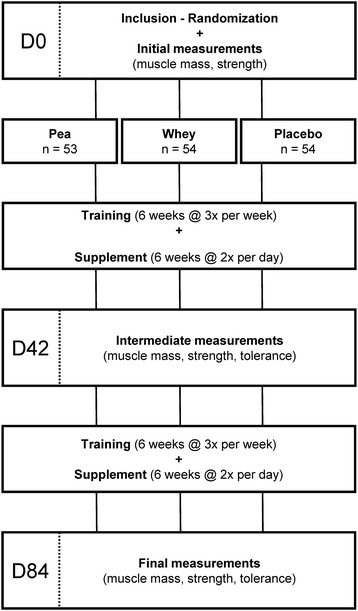
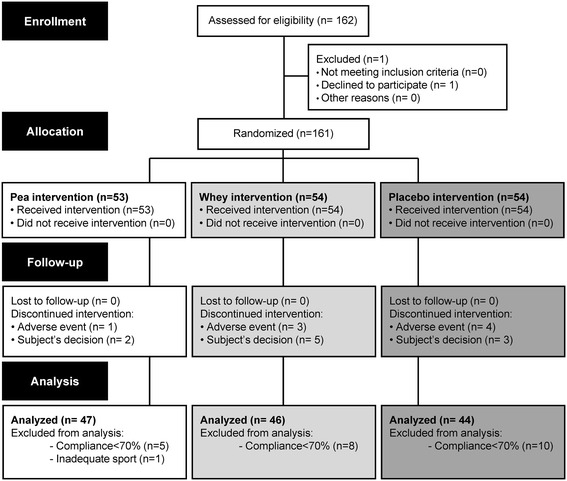
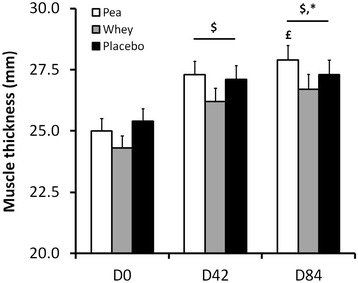
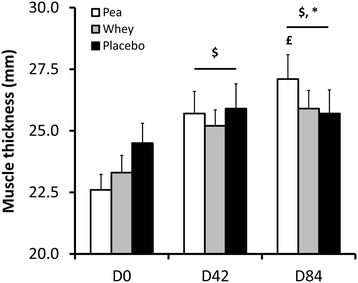
BACKGROUND: The effects of protein supplementation on muscle thickness and strength seem largely dependent on its composition. The current study aimed at comparing the impact of an oral supplementation with vegetable Pea protein (NUTRALYS®) vs. Whey protein and Placebo on biceps brachii muscle thickness and strength after a 12-week resistance training program. METHODS: One hundred and sixty one males, aged 18 to 35 years were enrolled in the study and underwent 12 weeks of resistance training on upper limb muscles. According to randomization, they were included in the Pea protein (n = 53), Whey protein (n = 54) or Placebo (n = 54) group. All had to take 25 g of the proteins or placebo twice a day during the 12-week training period. Tests were performed on biceps muscles at inclusion (D0), mid (D42) and post training (D84). Muscle thickness was evaluated using ultrasonography, and strength was measured on an isokinetic dynamometer. RESULTS: Results showed a significant time effect for biceps brachii muscle thickness (P < 0.0001). Thickness increased from 24.9 ± 3.8 mm to 26.9 ± 4.1 mm and 27.3 ± 4.4 mm at D0, D42 and D84, respectively, with only a trend toward significant differences between groups (P = 0.09). Performing a sensitivity study on the weakest participants (with regards to strength at inclusion), thickness increases were significantly different between groups (+20.2 ± 12.3%, +15.6 ± 13.5% and +8.6 ± 7.3% for Pea, Whey and Placebo, respectively; P < 0.05). Increases in thickness were significantly greater in the Pea group as compared to Placebo whereas there was no difference between Whey and the two other conditions. Muscle strength also increased with time with no statistical difference between groups. CONCLUSIONS: In addition to an appropriate training, the supplementation with pea protein promoted a greater increase of muscle thickness as compared to Placebo and especially for people starting or returning to a muscular strengthening. Since no difference was obtained between the two protein groups, vegetable pea proteins could be used as an alternative to Whey-based dietary products. TRIAL REGISTRATION: The present trial has been registered at ClinicalTrials.gov (NCT02128516).
Overview
The claims and statistics of this paper haven’t been checked yet.
Free: it reads the open-access text and checks the first 5 claims that cite a source we can check. Create a free account to check every claim.
Integrity signals
Registry
Cites
Statistics
Figures
Verification
Claims the paper makes
The claims and statistics of this paper haven’t been checked yet.
Free: it reads the open-access text and checks the first 5 claims that cite a source we can check. Create a free account to check every claim.
Claims other papers make about this one
Each is checked against this paper’s own text: does it say what the citing paper says it does?
The cited source doesn’t support the claim as written.
In the citing paper
“The average RET-induced increase, with all measures of 1RM included, was 27 kg (mean±SD; 27±22 kg22 32).”
From A systematic review, meta-analysis and meta-regression of the effect of protein supplementation on resistance training-induced gains in muscle mass and strength in healthy adults (2018) · cites this paper as [22]
Checked by a reasoning model — may be wrong.
Experimental — accuracy not yet measuredThe source backs part of the claim, not all of it — or backs it for a different population, condition or comparison.
In the citing paper
“Preliminary findings suggest that rice [98] and pea protein [103] may be able to stimulate similar changes in fat-free mass and strength as whey protein, although the reader should understand that many other factors (dose provided, training status of participants, duration of training and supplementation, etc.) will ultimately impact these outcomes and consequently more research is needed.”
From ISSN exercise & sports nutrition review update: research & recommendations (2018) · cites this paper as [103]
Experimental — accuracy not yet measuredIn the citing paper
“pea protein supplementation (25 g twice/day) was shown during 12 weeks of resistance training to increase biceps muscle thickness to the same degree as an equivalent amount of whey protein [123].”
From Plant Proteins: Assessing Their Nutritional Quality and Effects on Health and Physical Function (2020) · cites this paper as [123]
In the citing paper
“it has been shown that participants adhering to resistance training increased muscle mass comparably when supplemented with pea or whey protein [20], with rice or whey protein [58], when consuming a lacto-ovo-vegetarian or beef-containing diet [59], or when consuming a habitual omnivorous and vegan diet [21].”
From Vegan and omnivorous high protein diets support comparable daily myofibrillar protein synthesis rates and skeletal muscle hypertrophy in young adults (2023) · cites this paper as [20]
In the citing paper
“Although minimal MPS/MyoPS data are available for other non–animal-derived protein sources, pea protein isolate supplementation has been reported to facilitate comparable resistance training adaptation to that of whey protein supplementation in subjects consuming a high protein omnivorous diet [20].”
From Vegan and omnivorous high protein diets support comparable daily myofibrillar protein synthesis rates and skeletal muscle hypertrophy in young adults (2023) · cites this paper as [20]
Self-check
Percentages, sums and reported differences re-computed from the paper’s own numbers.
The self-check needs the paper’s full text.
Citations
Cites
Slow and fast dietary proteins differently modulate postprandial protein accretion
Boirie, Y., Dangin, M., Gachon, P., Vasson, M.-P., Maubois, J.-L., & Beaufrère, B. (1997) · Proceedings of the National Academy of Sciences · doi:10.1073/pnas.94.26.14930 · Cited by 1,453 · cited 2×
“Whey protein has a fast kinetic of digestion, bringing rapidly high concentration of amino-acids in plasma after ingestion, but this effect is transient and returns to resting levels within 2-3 h [7].”
BackgroundMixed muscle protein synthesis and breakdown after resistance exercise in humans
Phillips, S. M., Tipton, K. D., Aarsland, A., Wolf, S. E., & Wolfe, R. R. (1997) · American Journal of Physiology-Endocrinology and Metabolism · doi:10.1152/ajpendo.1997.273.1.e99 · Cited by 1,132 · cited 2×
“The best stimulus for protein synthesis appeared to be with protein feeding in close proximity to training sessions [31,32], with feeding recommended within the first two hours post-exercise [2,33,34].”
BackgroundTang, J. E., Moore, D. R., Kujbida, G. W., Tarnopolsky, M. A., & Phillips, S. M. (2009) · Journal of Applied Physiology · doi:10.1152/japplphysiol.00076.2009 · Cited by 998
Cermak, N. M., Res, P. T., de Groot, L. C., Saris, W. H., & van Loon, L. J. (2012) · The American Journal of Clinical Nutrition · doi:10.3945/ajcn.112.037556 · Cited by 827 · cited 1×
“In addition to increases in muscle mass, functional adaptations, such as strength or fatigue, are also obtained after EAA supplementation [8,9].”
BackgroundBiolo, G., Maggi, S. P., Williams, B. D., Tipton, K. D., & Wolfe, R. R. (1995) · American Journal of Physiology-Endocrinology and Metabolism · doi:10.1152/ajpendo.1995.268.3.e514 · Cited by 713 · cited 1×
“, muscle hypertrophy) is observed immediately after resistance exercises [2-4] as a result of a positive protein net balance; the difference between muscle fiber catabolism and anabolism.”
Background(2008) · Nutrition & Food Science · doi:10.1108/nfs.2008.01738aab.008 · Cited by 611
The Protein Digestibility–Corrected Amino Acid Score
Schaafsma, G. (2000) · The Journal of Nutrition · doi:10.1093/jn/130.7.1865s · Cited by 537 · cited 1×
“8% out of a maximum 100% [24] corresponding to the values of Whey or casein, while fruit proteins have a mean value of 76% and cereal proteins 59% [25].”
BackgroundBurd, N. A., West, D. W. D., Staples, A. W., Atherton, P. J., Baker, J. M., Moore, D. R., Holwerda, A. M., Parise, G., Rennie, M. J., Baker, S. K., et al. (2010) · PLoS ONE · doi:10.1371/journal.pone.0012033 · Cited by 531 · cited 1×
“Training volume [42] concomitant with the load used in terms of 1-RM’s percentage [43] are possible parameters.”
MethodTipton, K. D., Rasmussen, B. B., Miller, S. L., Wolf, S. E., Owens-Stovall, S. K., Petrini, B. E., & Wolfe, R. R. (2001) · American Journal of Physiology-Endocrinology and Metabolism · doi:10.1152/ajpendo.2001.281.2.e197 · Cited by 526 · cited 1×
“The best stimulus for protein synthesis appeared to be with protein feeding in close proximity to training sessions [31,32], with feeding recommended within the first two hours post-exercise [2,33,34].”
BackgroundRasmussen, B. B., Tipton, K. D., Miller, S. L., Wolf, S. E., & Wolfe, R. R. (2000) · Journal of Applied Physiology · doi:10.1152/jappl.2000.88.2.386 · Cited by 523 · cited 1×
“The best stimulus for protein synthesis appeared to be with protein feeding in close proximity to training sessions [31,32], with feeding recommended within the first two hours post-exercise [2,33,34].”
BackgroundHartman, J. W., Tang, J. E., Wilkinson, S. B., Tarnopolsky, M. A., Lawrence, R. L., Fullerton, A. V., & Phillips, S. M. (2007) · The American Journal of Clinical Nutrition · doi:10.1093/ajcn/86.2.373 · Cited by 498 · cited 1×
“The best stimulus for protein synthesis appeared to be with protein feeding in close proximity to training sessions [31,32], with feeding recommended within the first two hours post-exercise [2,33,34].”
BackgroundAhtiainen, J. P., Pakarinen, A., Alen, M., Kraemer, W. J., & H�kkinen, K. (2003) · European Journal of Applied Physiology · doi:10.1007/s00421-003-0833-3 · Cited by 469 · cited 1×
“For example, greater increases in muscle crosssectional area have been reported in subjects who had not previously engaged in resistance training in comparison with more accustomed subjects [36].”
ResultChanges in human muscle protein synthesis after resistance exercise
Chesley, A., MacDougall, J. D., Tarnopolsky, M. A., Atkinson, S. A., & Smith, K. (1992) · Journal of Applied Physiology · doi:10.1152/jappl.1992.73.4.1383 · Cited by 436 · cited 1×
“, muscle hypertrophy) is observed immediately after resistance exercises [2-4] as a result of a positive protein net balance; the difference between muscle fiber catabolism and anabolism.”
BackgroundControl of the size of the human muscle mass
Rennie, M. J., Wackerhage, H., Spangenburg, E. E., & Booth, F. W. (2004) · Annual Review of Physiology · doi:10.1146/annurev.physiol.66.052102.134444 · Cited by 399 · cited 1×
“In particular, it has now been well demonstrated that protein consumption after exercise shifts the balance in favor of muscle protein synthesis [5].”
BackgroundBurd, N. A., Tang, J. E., Moore, D. R., & Phillips, S. M. (2009) · Journal of Applied Physiology · doi:10.1152/japplphysiol.91351.2008 · Cited by 390 · cited 2×
“Background Amino acids accumulate in the sarcoplasm in the hours following exercise, especially of weight-training type [1].”
BackgroundKanehisa, H., Ito, M., Kawakami, Y., Fukunaga, T., & Miyatani, M. (2004) · European Journal of Applied Physiology · doi:10.1007/s00421-003-0974-4 · Cited by 355 · cited 1×
“The probe was placed perpendicular to the skin surface at two-thirds of the distance between the acromion process of the scapula and the lateral epicondyle of the humerus [15].”
Ingestion of Casein and Whey Proteins Result in Muscle Anabolism after Resistance Exercise
TIPTON, K. D., ELLIOTT, T. A., CREE, M. G., WOLF, S. E., SANFORD, A. P., & WOLFE, R. R. (2004) · Medicine & Science in Sports & Exercise · doi:10.1249/01.mss.0000147582.99810.c5 · Cited by 350 · cited 1×
“The aim of the present study was therefore to compare the effects of pea proteins against a reference protein (namely whey proteins which has previously been shown beneficial for muscle mass after resistance training [13,14]) and against placebo.”
Resistance training reduces the acute exercise-induced increase in muscle protein turnover
Phillips, S. M., Tipton, K. D., Ferrando, A. A., & Wolfe, R. R. (1999) · American Journal of Physiology-Endocrinology and Metabolism · doi:10.1152/ajpendo.1999.276.1.e118 · Cited by 336 · cited 2×
“The effects of amino acids supply may also depend on training status, since greater disturbances in protein turnover (protein synthesis and degradation) are obtained following training in novice than in experienced athletes [37].”
BackgroundStimulation of net muscle protein synthesis by whey protein ingestion before and after exercise
Tipton, K. D., Elliott, T. A., Cree, M. G., Aarsland, A. A., Sanford, A. P., & Wolfe, R. R. (2007) · American Journal of Physiology-Endocrinology and Metabolism · doi:10.1152/ajpendo.00166.2006 · Cited by 307 · cited 1×
“The best stimulus for protein synthesis appeared to be with protein feeding in close proximity to training sessions [31,32], with feeding recommended within the first two hours post-exercise [2,33,34].”
BackgroundSingle vs. multiple sets of resistance exercise for muscle hypertrophy: a meta-analysis.
Krieger, J. W. (2010) · Journal of Strength and Conditioning Research · doi:10.1519/jsc.0b013e3181d4d436 · Cited by 276 · cited 1×
“Training volume [42] concomitant with the load used in terms of 1-RM’s percentage [43] are possible parameters.”
MethodEffects of Supplement Timing and Resistance Exercise on Skeletal Muscle Hypertrophy
CRIBB, P. J., & HAYES, A. (2006) · Medicine & Science in Sports & Exercise · doi:10.1249/01.mss.0000233790.08788.3e · Cited by 270 · cited 3×
“Cribb PJ, Hayes A. Effects of supplement timing and resistance exercise on skeletal muscle hypertrophy.”
ResultInfluentialElectromyostimulation Training Effects on Neural Drive and Muscle Architecture
GONDIN, J., GUETTE, M., BALLAY, Y., & MARTIN, A. (2005) · Medicine & Science in Sports & Exercise · doi:10.1249/01.mss.0000175090.49048.41 · Cited by 253 · cited 1×
“Such result is in general accordance with the literature since muscle architectural changes have been shown to occur between the fourth and eighth weeks of resistance training [27].”
ResultThe Time Course for Elevated Muscle Protein Synthesis Following Heavy Resistance Exercise
MacDougall, J. D., Gibala, M. J., Tarnopolsky, M. A., MacDonald, J. R., Interisano, S. A., & Yarasheski, K. E. (1995) · Canadian Journal of Applied Physiology · doi:10.1139/h95-038 · Cited by 248 · cited 1×
“Moreover, the expected increase in protein synthesis following exercise appears to be smaller and shorter in trained athletes as compared with untrained subjects [38,39].”
BackgroundLemon, P. W., Tarnopolsky, M. A., MacDougall, J. D., & Atkinson, S. A. (1992) · Journal of Applied Physiology · doi:10.1152/jappl.1992.73.2.767 · Cited by 241 · cited 1×
“For instance, greater protein intakes are required during the early stages of intensive bodybuilding training and more particularly in novices [41].”
BackgroundHulmi, J. J., Lockwood, C. M., & Stout, J. R. (2010) · Nutrition & Metabolism · doi:10.1186/1743-7075-7-51 · Cited by 238 · cited 1×
“Whey was used as a benchmark because most studies have reported a positive effect on muscle hypertrophy in various populations such as young athletes [16-18].”
Tipton, K. (1999) · The Journal of Nutritional Biochemistry · doi:10.1016/s0955-2863(98)00087-4 · Cited by 231 · cited 1×
“Composition of supplements may play a key role in influencing net protein balance since previous studies have revealed that only essential amino acids (EAA) could stimulate muscle protein synthesis [6].”
BackgroundBørsheim, E., Cree, M. G., Tipton, K. D., Elliott, T. A., Aarsland, A., & Wolfe, R. R. (2004) · Journal of Applied Physiology · doi:10.1152/japplphysiol.00333.2003 · Cited by 231 · cited 1×
“It will maintain a positive protein balance (ratio of protein synthesis to degradation in favor of synthesis) and therefore muscle hypertrophy [28].”
BackgroundIkai, M., & Fukunaga, T. (1970) · Internationale Zeitschrift f�r Angewandte Physiologie Einschlie�lich Arbeitsphysiologie · doi:10.1007/bf00696025 · Cited by 210 · cited 1×
“An increase in muscle thickness, observed here, is fundamental for achieving a gain in strength [29].”
BackgroundDietary protein requirements and adaptive advantages in athletes
Phillips, S. M. (2012) · British Journal Of Nutrition · doi:10.1017/s0007114512002516 · Cited by 199 · cited 1×
“Indeed, in a recent review [35], the author recommended the ingestion of 20 g of high quality protein immediately after exercise to maximally stimulate protein synthesis.”
BackgroundProtein blend ingestion following resistance exercise promotes human muscle protein synthesis
Reidy, P. T., Walker, D. K., Dickinson, J. M., Gundermann, D. M., Drummond, M. J., Timmerman, K. L., Fry, C. S., Borack, M. S., Cope, M. B., Mukherjea, R., et al. (2013) · The Journal of Nutrition · doi:10.3945/jn.112.168021 · Cited by 178 · cited 1×
“5 g of EAA containing 2 to 3 g of leucine after exercise may maximize the protein synthetic response [20-22].”
Resistance-training-induced adaptations in skeletal muscle protein turnover in the fed state
Phillips, S. M., Parise, G., Roy, B. D., Tipton, K. D., Wolfe, R. R., & Tarnopolsky, M. A. (2002) · Canadian Journal of Physiology and Pharmacology · doi:10.1139/y02-134 · Cited by 166 · cited 1×
“Moreover, the expected increase in protein synthesis following exercise appears to be smaller and shorter in trained athletes as compared with untrained subjects [38,39].”
BackgroundNutritional Interventions to Promote Post-Exercise Muscle Protein Synthesis
Koopman, R., Saris, W. H. M., Wagenmakers, A. J. M., & van Loon, L. J. C. (2007) · Sports Medicine · doi:10.2165/00007256-200737100-00005 · Cited by 140 · cited 2×
“A literature review [19] indicated that leucine reportedly stimulates the muscle protein synthesis required to replace muscle protein damaged by resistance exercises.”
BackgroundFarup, J., Rahbek, S. K., Vendelbo, M. H., Matzon, A., Hindhede, J., Bejder, A., Ringgard, S., & Vissing, K. (2014) · Scandinavian Journal of Medicine & Science in Sports · doi:10.1111/sms.12083 · Cited by 106 · cited 1×
“Whey was used as a benchmark because most studies have reported a positive effect on muscle hypertrophy in various populations such as young athletes [16-18].”
MethodBurke, L. M., Winter, J. A., Cameron-Smith, D., Enslen, M., Farnfield, M., & Decombaz, J. (2012) · International Journal of Sport Nutrition and Exercise Metabolism · doi:10.1123/ijsnem.22.6.452 · Cited by 90 · cited 1×
“5 g of EAA containing 2 to 3 g of leucine after exercise may maximize the protein synthetic response [20-22].”
Effects of resistance training on elbow flexors of highly competitive bodybuilders
Alway, S. E., Grumbt, W. H., Stray-Gundersen, J., & Gonyea, W. J. (1992) · Journal of Applied Physiology · doi:10.1152/jappl.1992.72.4.1512 · Cited by 90 · cited 1×
“Furthermore, a plateau, or ‘ceiling effect’, of the adaptive responses to training is generally observed either for strength gains and muscle protein synthetic response [37,40].”
BackgroundFarnfield, M. M., Breen, L., Carey, K. A., Garnham, A., & Cameron-Smith, D. (2012) · Applied Physiology, Nutrition, and Metabolism · doi:10.1139/h11-132 · Cited by 89 · cited 2×
“This hypertrophy is supposed to be due to activation of the mTOR (mammalian target of rapamycin) signaling pathway resulting from the simultaneous action of protein ingestion and training [17].”
BackgroundMethodStark, M., Lukaszuk, J., Prawitz, A., & Salacinski, A. (2012) · Journal of the International Society of Sports Nutrition · doi:10.1186/1550-2783-9-54 · Cited by 84 · cited 2×
“For example, NUTRALYS® is a protein isolate obtained from pea (Pisum sativum) containing 85% of proteins and particularly rich in essential branched-chain amino acids (BCAA; leucine, isoleucine and valine) known to play an important role in muscle protein synthesis [11].”
BackgroundLong-term effects of leucine supplementation on body composition
Balage, M., & Dardevet, D. (2010) · Current Opinion in Clinical Nutrition and Metabolic Care · doi:10.1097/mco.0b013e328336f6b8 · Cited by 78 · cited 1×
“Studies have shown that an increased plasma concentration in leucine favors muscle protein synthesis and that its action on muscle mass is potentiated by the presence of other amino acids such as those contained in NUTRALYS® pea protein [12].”
BackgroundStrength Training's Chronic Effects on Muscle Architecture Parameters of Different Arm Sites
Matta, T., Simão, R., de Salles, B. F., Spineti, J., & Oliveira, L. F. (2011) · Journal of Strength and Conditioning Research · doi:10.1519/jsc.0b013e3181dba162 · Cited by 64 · cited 1×
“As shown previously [26] and as attested by the Placebo group, weight training alone had an impact on biceps brachii thickness.”
MethodThe Rationale for Consuming Protein Blends in Sports Nutrition
Paul, G. L. (2009) · Journal of the American College of Nutrition · doi:10.1080/07315724.2009.10718113 · Cited by 60 · cited 1×
“The aim of the present study was therefore to compare the effects of pea proteins against a reference protein (namely whey proteins which has previously been shown beneficial for muscle mass after resistance training [13,14]) and against placebo.”
Vieillevoye, S., POORTMANS, J. R., Duchateau, J., & Carpentier, A. (2010) · European Journal of Applied Physiology · doi:10.1007/s00421-010-1520-9 · Cited by 58 · cited 2×
“[10] found increases in lower body strength with EAA supplementation while no modification was obtained with placebo.”
Babault, N., Deley, G., Le Ruyet, P., Morgan, F., & Allaert, F. A. (2014) · Journal of the International Society of Sports Nutrition · doi:10.1186/1550-2783-11-36 · Cited by 42 · cited 1×
“In addition to increases in muscle mass, functional adaptations, such as strength or fatigue, are also obtained after EAA supplementation [8,9].”
BackgroundSelf-citationDabbicco, M., Cingolani, R., Ferrara, M., Tapfer, L., Fischer, A., & Ploog, K. (1992) · Journal of Applied Physics · doi:10.1063/1.351718 · Cited by 25
Recent developments in protein quality evaluation
Boutrif, E. (1991) · Food, nutrition and agriculture · Cited by 19
Cited by
Morton, R. W., Murphy, K. T., McKellar, S. R., Schoenfeld, B. J., Henselmans, M., Helms, E., Aragon, A. A., Devries, M. C., Banfield, L., Krieger, J. W., et al. (2018) · British Journal of Sports Medicine · doi:10.1136/bjsports-2017-097608 · Cited by 1,269
ISSN exercise & sports nutrition review update: research & recommendations
Kerksick, C. M., Wilborn, C. D., Roberts, M. D., Smith-Ryan, A., Kleiner, S. M., Jäger, R., Collins, R., Cooke, M., Davis, J. N., Galvan, E., et al. (2018) · Journal of the International Society of Sports Nutrition · doi:10.1186/s12970-018-0242-y · Cited by 945
“Preliminary findings suggest that rice [98] and pea protein [103] may be able to stimulate similar changes in fat-free mass and strength as whey protein, although the reader should understand that many other factors (dose provided, training status of participants, duration of training and supplementation, etc.”
BackgroundPlant Proteins: Assessing Their Nutritional Quality and Effects on Health and Physical Function
Hertzler, S. R., Lieblein-Boff, J. C., Weiler, M., & Allgeier, C. (2020) · Nutrients · doi:10.3390/nu12123704 · Cited by 594
Composition, physicochemical properties of pea protein and its application in functional foods
Lu, Z. X., He, J. F., Zhang, Y. C., & Bing, D. J. (2020) · Critical Reviews in Food Science and Nutrition · doi:10.1080/10408398.2019.1651248 · Cited by 529
“Babault et al. (2015) investigated the impacts of an oral supplementation with pea protein vs. Whey protein and placebo on muscle thickness and strength after a 12-week resistance training program.”
BackgroundBerrazaga, I., Micard, V., Gueugneau, M., & Walrand, S. (2019) · Nutrients · doi:10.3390/nu11081825 · Cited by 477
Metadata
- Authors
- Babault, N., Païzis, C., Deley, G., Guérin-Deremaux, L., Saniez, M.-H., Lefranc-Millot, C., & Allaert, F. A.
- Affiliations
- Inserm (FR)
- Roquette Lestrem France
- Roquette Frères (France) (FR)
- ESC Dijon Bourgogne, École supérieure de commerce de Dijon-Bourgogne (FR)
- Corresponding author
- Babault, Nicolas
- Venue
- Journal of the International Society of Sports Nutrition
- Publisher
- Informa UK Limited
- Published
- 2015-10-20
- Volume
- 12
- Issue
- 1
- Pages
- 3-3
- ISSN
- 1550-2783 (ISSN-L)
- PMC
- PMC4307635
- OpenAlex
- W2129668538
- Cited by
- 151
- References
- 44
- Citations by year
- 2026: 16 · 2025: 16 · 2024: 16 · 2023: 18 · 2022: 27 · 2021: 15 · 2020: 19 · 2019: 11 · 2018: 3 · 2017: 6 · 2016: 4
- FWCI
- 2.31
- Type
- journal article
- Language
- en
- Open access
- gold
- doi.org
- Licence
- Locations
- Journal of the International Society of Sports Nutrition (publishedVersion, other-oa)
- Europe PMC (PubMed Central) (publishedVersion, cc-by)
- PubMed Central (publishedVersion, cc-by)
- PubMed (publishedVersion)
- HAL (submittedVersion, cc-by)
- Topics
- Health Sciences › Nursing › Nutrition and Dietetics › Muscle metabolism and nutrition
- Health Sciences › Medicine › Orthopedics and Sports Medicine › Sports Performance and Training
- Life Sciences › Biochemistry, Genetics and Molecular Biology › Molecular Biology › Muscle Physiology and Disorders
- Keywords
- pea protein, whey protein, protein supplementation, resistance training, muscle thickness, biceps brachii, muscle strength, isokinetic strength, muscle hypertrophy, plant proteins, upper limb training
About these checks
Registry, retraction, Cites and statistics results are computed, not judged, with one exception: a printed reference that no index lists is read once by a model before it counts as a citation error. Claims are extracted by a model and kept only when their quote appears verbatim in the text; each cited source is then checked, with a model’s help, for whether it says what the claim relies on. Those verdicts can be wrong — read the claim’s quote and the cited source before relying on one.
Statistics and arithmetic are recomputed, not judged.
Confidence bands are shown only for fields calibrated on our annotated test set. None is calibrated yet, so no band is shown.
What counts as a claim ›How we measure confidence ›How we check this ›
Are you an author, or do you see a problem with this page? Request a review
Data sources
Bibliographic data: Semantic Scholar, OpenAlex, Crossref.
Contains information from the Semantic Scholar Academic Graph Datasets, made available under the ODC Attribution License (ODC-BY 1.0).
Semantic Scholar’s data is described in: Kinney, R., et al. (2023). The Semantic Scholar Open Data Platform. arXiv:2301.10140.
