

The DOI matches its Crossref record; 23 of the 23 references it cites were found in a registry or an index.
A high protein diet (3.4 g/kg/d) combined with a heavy resistance training program improves body composition in healthy trained men and women – a follow-up investigation
Open accessAbstract
BACKGROUND: The consumption of a high protein diet (>4 g/kg/d) in trained men and women who did not alter their exercise program has been previously shown to have no significant effect on body composition. Thus, the purpose of this investigation was to determine if a high protein diet in conjunction with a periodized heavy resistance training program would affect indices of body composition, performance and health. METHODS: Forty-eight healthy resistance-trained men and women completed this study (mean ± SD; Normal Protein group [NP n = 17, four female and 13 male]: 24.8 ± 6.9 yr; 174.0 ± 9.5 cm height; 74.7 ± 9.6 kg body weight; 2.4 ± 1.7 yr of training; High Protein group [HP n = 31, seven female and 24 male]: 22.9 ± 3.1 yr; 172.3 ± 7.7 cm; 74.3 ± 12.4 kg; 4.9 ± 4.1 yr of training). Moreover, all subjects participated in a split-routine, periodized heavy resistance-training program. Training and daily diet logs were kept by each subject. Subjects in the NP and HP groups were instructed to consume their baseline (~2 g/kg/d) and >3 g/kg/d of dietary protein, respectively. RESULTS: Subjects in the NP and HP groups consumed 2.3 and 3.4 g/kg/day of dietary protein during the treatment period. The NP group consumed significantly (p < 0.05) more protein during the treatment period compared to their baseline intake. The HP group consumed more (p < 0.05) total energy and protein during the treatment period compared to their baseline intake. Furthermore, the HP group consumed significantly more (p < 0.05) total calories and protein compared to the NP group. There were significant time by group (p ≤ 0.05) changes in body weight (change: +1.3 ± 1.3 kg NP, -0.1 ± 2.5 HP), fat mass (change: -0.3 ± 2.2 kg NP, -1.7 ± 2.3 HP), and % body fat (change: -0.7 ± 2.8 NP, -2.4 ± 2.9 HP). The NP group gained significantly more body weight than the HP group; however, the HP group experienced a greater decrease in fat mass and % body fat. There was a significant time effect for FFM; however, there was a non-significant time by group effect for FFM (change: +1.5 ± 1.8 NP, +1.5 ± 2.2 HP). Furthermore, a significant time effect (p ≤ 0.05) was seen in both groups vis a vis improvements in maximal strength (i.e., 1-RM squat and bench) vertical jump and pull-ups; however, there were no significant time by group effects (p ≥ 0.05) for all exercise performance measures. Additionally, there were no changes in any of the blood parameters (i.e., basic metabolic panel). CONCLUSION: Consuming a high protein diet (3.4 g/kg/d) in conjunction with a heavy resistance-training program may confer benefits with regards to body composition. Furthermore, there is no evidence that consuming a high protein diet has any deleterious effects.
Overview
The claims and statistics of this paper haven’t been checked yet.
Run the check — free, no account needed. It reads the open-access text and checks the sources it cites.
Integrity signals
Registry
Cites
Statistics
Figures
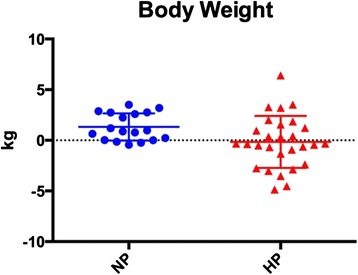
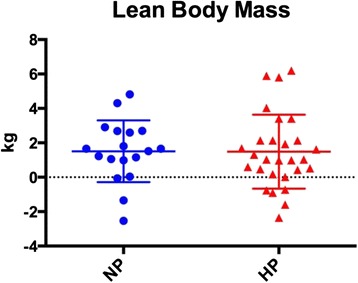
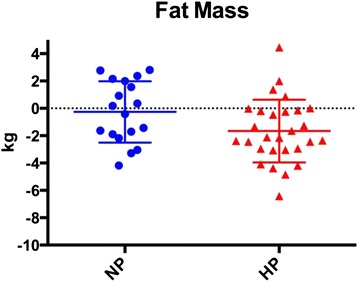
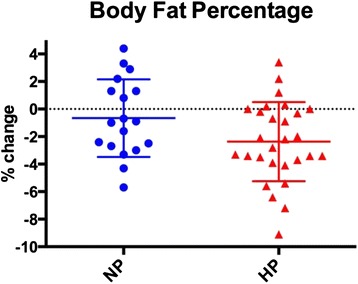
Verification
Claims the paper makes
The claims and statistics of this paper haven’t been checked yet.
Run the check — free, no account needed. It reads the open-access text and checks the sources it cites.
Claims other papers make about this one
Each is checked against this paper’s own text: does it say what the citing paper says it does?
The source backs part of the claim, not all of it — or backs it for a different population, condition or comparison.
In the citing paper
“A series of controlled investigations spanning up to one year in duration utilizing protein intakes of up to 2.5–3.3 g/kg/day in healthy resistance-trained individuals consistently indicate that increased intakes of protein exert no harmful effect on blood lipids or markers of kidney and liver function.”
From International Society of Sports Nutrition Position Stand: protein and exercise (2017) · cites this paper as [220]
Experimental — accuracy not yet measuredThe source backs part of the claim, not all of it — or backs it for a different population, condition or comparison.
In the citing paper
“A follow-up investigation [220] required participants to ingest up to 3.4 g/kg/day of protein for eight weeks while following a prescribed resistance training program and reported no changes in any of the blood parameters commonly used to assess clinical health (e.g., there was no effect on kidney or liver function).”
From International Society of Sports Nutrition Position Stand: protein and exercise (2017) · cites this paper as [220]
Experimental — accuracy not yet measuredThe source backs part of the claim, not all of it — or backs it for a different population, condition or comparison.
In the citing paper
“High protein diets (>2.2 g·kg−1·day−1) have not resulted in any adverse effects to bone mineral density or kidney function in healthy women [238,239].”
From International society of sports nutrition position stand: nutritional concerns of the female athlete (2023) · cites this paper as [238]
Experimental — accuracy not yet measuredThe cited source says what the claim attributes to it.
In the citing paper
“Both groups gained 1.5 kg of lean mass, but the high-protein group lost more fat mass (1.6 vs 0.3 kg in the control group).”
From International Society of Sports Nutrition position stand: diets for body weight reduction (2026) · cites this paper as [118]
The cited source says what the claim attributes to it.
In the citing paper
“A salient example of apparently protein-driven recomposition was by Antonio et al. [118], who compared the effects of normal/habitual protein intake (2.3 g/kg) versus high protein intake (3.4 g/kg) on body composition and performance in resistance-trained subjects. The 8-week trial involved a periodized, progressive resistance training program with sessions occurring 5 days/week. Despite the”
From International Society of Sports Nutrition position stand: diets for body weight reduction (2026) · cites this paper as [118]
The cited source says what the claim attributes to it.
In the citing paper
“Strength and exercise performance improved in both groups, with no statistically significant differences between the groups.”
From International Society of Sports Nutrition position stand: diets for body weight reduction (2026) · cites this paper as [118]
Self-check
Percentages, sums and reported differences re-computed from the paper’s own numbers.
The self-check needs the paper’s full text.
Citations
Cites
Moore, D. R., Robinson, M. J., Fry, J. L., Tang, J. E., Glover, E. I., Wilkinson, S. B., Prior, T., Tarnopolsky, M. A., & Phillips, S. M. (2009) · The American Journal of Clinical Nutrition · doi:10.3945/ajcn.2008.26401 · Cited by 973
International Society of Sports Nutrition position stand: protein and exercise
Campbell, B., Kreider, R. B., Ziegenfuss, T., La Bounty, P., Roberts, M., Burke, D., Landis, J., Lopez, H., & Antonio, J. (2007) · Journal of the International Society of Sports Nutrition · doi:10.1186/1550-2783-4-8 · Cited by 716
Self-citationTurner-McGrievy, G. M., Beets, M. W., Moore, J. B., Kaczynski, A. T., Barr-Anderson, D. J., & Tate, D. F. (2013) · Journal of the American Medical Informatics Association · doi:10.1136/amiajnl-2012-001510 · Cited by 373
(2005) · PubMed · Cited by 354
Variability in Muscle Size and Strength Gain After Unilateral Resistance Training
Shrier, I. (2006) · Yearbook of Sports Medicine · doi:10.1016/s0162-0908(08)70354-4 · Cited by 349
The use of unequal randomisation ratios in clinical trials: A review
Dumville, J. C., Hahn, S., Miles, J. N. V., & Torgerson, D. J. (2005) · Contemporary Clinical Trials · doi:10.1016/j.cct.2005.08.003 · Cited by 330
Protein requirements and supplementation in strength sports
Phillips, S. M. (2004) · Nutrition · doi:10.1016/j.nut.2004.04.009 · Cited by 320
Non-Exercise Activity Thermogenesis
Levine, J. A., Weg, M. W. V., Hill, J. O., & Klesges, R. C. (2006) · Arteriosclerosis Thrombosis and Vascular Biology · doi:10.1161/01.atv.0000205848.83210.73 · Cited by 226
Daly, R. M., O’Connell, S. L., Mundell, N. L., Grimes, C. A., Dunstan, D. W., & Nowson, C. A. (2014) · American Journal of Clinical Nutrition · doi:10.3945/ajcn.113.064154 · Cited by 215
Mitchell, C. J., Churchward-Venne, T. A., Parise, G., Bellamy, L., Baker, S. K., Smith, K., Atherton, P. J., & Phillips, S. M. (2014) · PLoS ONE · doi:10.1371/journal.pone.0089431 · Cited by 212
Research works printed but not linked: 1
- Mitchell CJ, 2014, PLoS One, 9
Cited by
Sorted by citations
Items 101–140 of 140
Recent Perspectives on the Role of Dietary Protein in Physically Active Individuals
Evans, C., Rojas, J., Curtis, J., & António, J. (2023) · Research Directs in Health Sciences · doi:10.53520/rdhs2023.10451 · Cited by 2
Resistance exercise protects mice from protein-induced fat accretion
Trautman, M. E., Braucher, L. N., Elliehausen, C., Zhu, W. G., Zelenovskiy, E., Green, M., Sonsalla, M. M., Yeh, C.-Y., Hornberger, T. A., Konopka, A. R., et al. (2023) · doi:10.7554/elife.91007.2 · Cited by 1
Energy Compensation with Exercise and Dietary-Induced Weight Loss
Hays, H. M., & Flack, K. D. (2021) · Journal of Clinical Exercise Physiology · doi:10.31189/2165-6193-10.2.51 · Cited by 1
The Medical Challenges of Bodybuilding: Health Risks of Drugs, Extreme Training, and Dieting
Lee, D. H., Lim, Y., & Park, E. J. (2025) · The Korean Journal of Sports Medicine · doi:10.5763/kjsm.2025.43.2.87 · Cited by 1
Kadir, S. A., Baranidharan, G., Jiffry, A., Krishnaswamy, G., & Sindrilla, M. (2025) · International Conference on Recent Innovation in Science Engineering and Technology (ICRISET) · doi:10.1109/icriset64803.2025.11252349 · Cited by 1
Aliakbari, M., Almusawy, A., Jalilpiran, Y., Afzalzadeh-Naeini, F., Amin, H. L., Amiri, S. M., Zebari, S. M. S., & Djafarian, K. (2026) · British Journal Of Nutrition · doi:10.1017/s0007114526106412 · Cited by 1
Comparison of two nutritional protocols in body re-composition of resistance-trained participants
Vargas-Molina, S., García-Palumbo, A., García-Sillero, M., Bonilla, D. A., Petro, J. L., Aragon, A. A., Schoenfeld, B. J., & Benítez-Porres, J. (2026) · European Journal of Applied Physiology · doi:10.1007/s00421-026-06209-6 · Cited by 1
Sajjapong, W., Leelahagul, P., Pongphibool, S., & Thongsuk, N. (2021) · Malaysian Journal of Nutrition · doi:10.31246/mjn-2020-0039 · Cited by 3
Impact of nutritional protein supplements on liver and kidney functions among athletes attending gym
Mousa, A. A., & Ali, W. I. (2022) · International Journal of Health Sciences · doi:10.53730/ijhs.v6ns5.10199 · Cited by 1
Monteiro, M. R. P., Aragão-Santos, J. C., Vasconcelos, A. B. S., de Resende–Neto, A. G., de Almeida, A. F. S., Gobbo, L. A., Hermosilla-Perona, F., Elvar, J. R. H., Vecchio, F. B. D., Aidar, F. J., et al. (2024) · Healthcare · doi:10.3390/healthcare12090932 · Cited by 3
Peinado, P. J. B., & Sotillo, A. A. (2024) · IntechOpen eBooks · doi:10.5772/intechopen.1007051 · Cited by 2
People’s Attitudes to Healthy Exercise Diet, a Market Investigation
Zhang, K. (2015) · Humanities and Social Sciences · doi:10.11648/j.hss.20150305.28
Lesiones musculares. Nutrición, suplementación y aplicación en los procesos de recuperación
del Cauca, U. C. D. V., & Pulido, L. H. P. (2018) · Editorial Universidad Santiago de Cali eBooks · doi:10.35985/9789585522220.5
Food in the occupational environment and its benefits in worker’s health
Pereira, P. M., Duarte, J., Pinho, O., Baptista, J. S., Ferraz, J., & de Santana, A. P. (2019) · Symposium on Occupational Safety and Health (SOSH) · doi:10.24840/978-972-752-260-6_0061-0067
Dietary Protein and Muscle in Aging People
Cesari, M., & Marzetti, E. (2018) · MDPI eBooks · doi:10.3390/books978-3-03897-458-1
Fatores associados ao elevado percentual de gordura corporal em indivíduos fisicamente ativos
Silveira, V. N. D. C., da Silva, S. C., Padilha, L. L., Moreira, J. S. B., Martins, I. C. V. D. S., Reis, A. D., dos Santos, A. F., de Castro, A. S., & Veloso, H. J. F. (2021) · DEMETRA Alimentação Nutrição & Saúde · doi:10.12957/demetra.2021.48505 · Cited by 1
Rieger, D. K., Faraco, J. P., & Mendes, B. C. (2021) · Extensio Revista Eletrônica de Extensão · doi:10.5007/1807-0221.2021.e69879
3rd Symposium on Occupational Safety and Health Proceedings Book
Pinho, O., Baptista, J. S., Branco, J. C., Duarte, J., Martins, R., Santiago, R. J., Marques, A. T., Baptista, J. S., Costa, J. T., Rosado, A. S., et al. (2019) · doi:10.24840/978-972-752-260-6
Hernández-Reyes, A., Vidal, A. L., Cámara‐Martos, F., Molina‐Luque, R., & Moreno-Rojas, R. (2020) · doi:10.21203/rs.3.rs-25907/v1
Resistance exercise protects mice from protein-induced fat accretion
Trautman, M. E., Braucher, L. N., Elliehausen, C., Zhu, W. G., Zelenovskiy, E., Green, M., Sonsalla, M. M., Yeh, C.-Y., Hornberger, T. A., Konopka, A. R., et al. (2022) · doi:10.1101/2022.10.18.512689
Karatoprak, A., Ersoy, N., & Ersoy, G. (2022) · Hacettepe Üniversitesi Sağlık Bilimleri Fakültesi Dergisi · doi:10.21020/husbfd.1064141
Ingesta óptima de proteínas en atletas de elite para el incremento de masa muscular
Badillo-Hernández, A. G., Cortés, T. L. F., Calderón‐Ramos, Z. G., & Polo, A. O. (2023) · Educación y Salud Boletín Científico Instituto de Ciencias de la Salud Universidad Autónoma del Estado de Hidalgo · doi:10.29057/icsa.v11i22.10119 · Cited by 1
Resistance exercise protects mice from protein-induced fat accretionPreprint
Trautman, M. E., Braucher, L. N., Elliehausen, C. J., Zhu, W. G., Zelenovskiy, E., Green, M., Sonsalla, M. M., Yeh, C., Hornberger, T. A., Konopka, A. R., et al. (2023) · eLife · doi:10.7554/elife.91007.1
Resistance exercise protects mice from protein-induced fat accretion
Trautman, M. E., Braucher, L. N., Elliehausen, C., Zhu, W. G., Zelenovskiy, E., Green, M., Sonsalla, M. M., Yeh, C.-Y., Hornberger, T. A., Konopka, A. R., et al. (2023) · eLife · doi:10.7554/elife.91007.3
Ottinger, C., Gheith, R. H., Sharp, M. H., Davis, J. M., Lowery, R. P., & Wilson, J. M. (2024) · doi:10.2196/preprints.57232
RELATIONSHIP BETWEEN HIGH PROTEIN DIET AND RISK OF KIDNEY DISEASE PROGRESSION AND NEPHROLITHIASIS
Banasiak, A., Tokarski, M. P., Łukaszewicz, S., Pawłowski, P., Rybak, J., Sadłowski, B., Bieganek, P., Sarnacka, S., Koćwin, J., & Kordialik, J. (2024) · Health Problems of Civilization · doi:10.5114/hpc.2024.140686
Moore, S. R., Baker, P. A., & Smith‐Ryan, A. E. (2024) · Clinical Physiology and Functional Imaging · doi:10.1111/cpf.12915
Ribeiro, A. S., da Silva, J. A., Kassiano, W., Stavinski, N. G. D. L., Martinho, D. V., Antunes, M., Cyrino, L. T., Sugihara, P., Fernandes, R. R., Santos, A. P., et al. (2025) · The Journal of Strength and Conditioning Research · doi:10.1519/jsc.0000000000005104
Future Directions and Emerging Trends in Nano-fuels for Athletes
Das, P., & Apanga, E. A. (2025) · Smart nanomaterials technology · doi:10.1007/978-981-96-5471-0_22
High protein diet and health: The role of protein snacks
Qi, X., & Tester, R. F. (2025) · Food Nutrition Chemistry · doi:10.18686/fnc355
Akehurst, E., Scott, D. M., Rodriguez, J. P., Gonzalez, C. A., Murphy, J., McCarthy, H., Dorgo, S., & Hayes, A. (2021) · Figshare · doi:10.6084/m9.figshare.14490232
The Crucial Role of Exercise in Promoting Adolescent Bone Health
Nasb, M., & Chen, N. (2026) · Advances in experimental medicine and biology · doi:10.1007/978-981-95-7000-3_12
The Role of Nutrition in Exercise and Sports
Ceci, R., & Duranti, G. (2026) · Nutrients · doi:10.3390/nu18091354
Reilly, R. R. (2026) · Strength and conditioning journal · doi:10.1519/ssc.0000000000000964
de Lorenzo, A., & Mihic, N. (2026) · Nefrología · doi:10.1016/j.nefro.2026.501611
Kaczmarek, K., Zawada, W., Leszczyńska, Z. J., Romaniuk, V., Szuleta, U., Benecka, A., Pietrończyk, J., Benecka, A., Dąbrowska, M., Wieczorek, Z., et al. (2026) · International Journal of Innovative Technologies in Social Science · doi:10.31435/ijitss.3(51).2026.6323
Bagheri, R., Ghobadi, H., Mansordehghan, M., CAMERA, D. M., & Kargarfard, M. (2026) · Journal of the International Society of Sports Nutrition · doi:10.1080/15502783.2026.2720742
THE IMPACT OF HIGH-PROTEIN DIETS ON RENAL FUNCTION: A COMPREHENSIVE REVIEW
Kułaga, M., Tyszkiewicz, K., Kasprzak, A., Grzybek, M., Mazur-Lesińska, D., Szostak, B., Wielgosz-Biała, S., Łozowski, B., Kasprzak, M., & Wilczyńska, B. (2026) · International Journal of Innovative Technologies in Social Science · doi:10.31435/ijitss.3(51).2026.5792
International Society of Sports Nutrition position stand: diets for body weight reduction
Aragon, A. A., Campbell, B. I., Schoenfeld, B. J., Stout, J. R., Kalman, D., Arciero, P. J., Arent, S. M., Kreider, R. B., Taylor, L. W., Bannock, L., et al. (2026) · Journal of the International Society of Sports Nutrition · doi:10.1080/15502783.2026.2740266
Common questions and misconceptions about diets: what does the scientific evidence really show?
António, J., Antonio, B. B., Aragon, A. A., Arent, S. M., Campbell, B. I., Candow, D. G., Eberhardt, H. K., Escalante, G., Evans, C., Forbes, S. C., et al. (2026) · Journal of the International Society of Sports Nutrition · doi:10.1080/15502783.2026.2707252
Metadata
- Authors
- Antonio, J., Ellerbroek, A., Silver, T., Orris, S., Scheiner, M., Gonzalez, A., & Peacock, C. A.
- Affiliations
- Exercise and Sports SciencesNova Southeastern University 3532 S. University Drive, University Park Plaza Suite 3532 33314 Davie FL USA
- Nova Southeastern University (US)
- ORCID
- Peacock, Corey A
- Venue
- Journal of the International Society of Sports Nutrition
- Publisher
- Informa UK Limited
- Published
- 2015-10-20
- Volume
- 12
- Issue
- 1
- Pages
- 39-39
- ISSN
- 1550-2783 (ISSN-L)
- PMC
- PMC4617900
- OpenAlex
- W2154555111
- Cited by
- 140
- References
- 23
- Citations by year
- 2026: 11 · 2025: 13 · 2024: 12 · 2023: 17 · 2022: 10 · 2021: 14 · 2020: 15 · 2019: 15 · 2018: 15 · 2017: 10 · 2016: 5 · 2015: 3
- FWCI
- 5.86
- Type
- journal article
- Language
- en
- Open access
- gold
- doi.org
- Licence
- Locations
- Journal of the International Society of Sports Nutrition (publishedVersion, cc-by)
- Europe PMC (PubMed Central) (publishedVersion, cc-by)
- PubMed Central (publishedVersion, cc-by)
- PubMed (publishedVersion)
- NSUWorks (Nova Southeastern University) (submittedVersion)
- Funders
- This study was unfunded
- Topics
- Health Sciences › Nursing › Nutrition and Dietetics › Muscle metabolism and nutrition
- Health Sciences › Medicine › Orthopedics and Sports Medicine › Sports Performance and Training
- Health Sciences › Medicine › Physiology (medical) › Body Composition Measurement Techniques
- Keywords
- high-protein diet, resistance training, body composition, fat mass, body fat percentage, training periodization, resistance-trained individuals, protein intake, energy intake, body weight, exercise performance, fat-free mass, trained women, trained men, follow-up study, weight loss, muscle hypertrophy, fat loss, muscular endurance, muscle power
- MeSH terms
- Adipose Tissue, Adolescent, Adult, Body Composition, Body Weight, Energy Intake, Dietary Proteins, Female, Follow-Up Studies, Humans, Male, Resistance Training, Young Adult
About these checks
Registry, retraction, Cites and statistics results are computed, not judged, with one exception: a printed reference that no index lists is read once by a model before it counts as a citation error. Claims are extracted by a model and kept only when their quote appears verbatim in the text; each cited source is then checked, with a model’s help, for whether it says what the claim relies on. Those verdicts can be wrong — read the claim’s quote and the cited source before relying on one.
Statistics and arithmetic are recomputed, not judged.
Confidence bands are shown only for fields calibrated on our annotated test set. None is calibrated yet, so no band is shown.
What counts as a claim ›How we measure confidence ›How we check this ›
Are you an author, or do you see a problem with this page? Request a review
