

The DOI matches its Crossref record; 160 of the 161 references it cites were found in a registry or an index.
Haptic wearables as sensory replacement, sensory augmentation and trainer – a review
Open accessAbstract
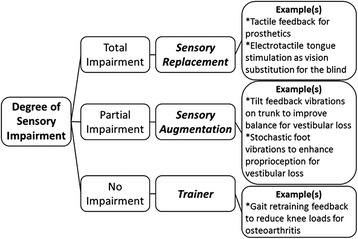
Sensory impairments decrease quality of life and can slow or hinder rehabilitation. Small, computationally powerful electronics have enabled the recent development of wearable systems aimed to improve function for individuals with sensory impairments. The purpose of this review is to synthesize current haptic wearable research for clinical applications involving sensory impairments. We define haptic wearables as untethered, ungrounded body worn devices that interact with skin directly or through clothing and can be used in natural environments outside a laboratory. Results of this review are categorized by degree of sensory impairment. Total impairment, such as in an amputee, blind, or deaf individual, involves haptics acting as sensory replacement; partial impairment, as is common in rehabilitation, involves haptics as sensory augmentation; and no impairment involves haptics as trainer. This review found that wearable haptic devices improved function for a variety of clinical applications including: rehabilitation, prosthetics, vestibular loss, osteoarthritis, vision loss and hearing loss. Future haptic wearables development should focus on clinical needs, intuitive and multimodal haptic displays, low energy demands, and biomechanical compliance for long-term usage.
Overview
The claims and statistics of this paper haven’t been checked yet.
Run the check — free, no account needed. It reads the open-access text and checks the sources it cites.
Integrity signals
Registry
Cites
Statistics
Figures
Verification
Claims the paper makes
The claims and statistics of this paper haven’t been checked yet.
Run the check — free, no account needed. It reads the open-access text and checks the sources it cites.
Claims other papers make about this one
Each is checked against this paper’s own text: does it say what the citing paper says it does?
The source backs part of the claim, not all of it — or backs it for a different population, condition or comparison.
In the citing paper
“Ease of use, comfort level, mobility and appearance need to be seriously considered if the blind are to be expected to use a particular device (Dakopolous & Bourbakis, 2010; Elli et al., 2014; Shull & Damian, 2015).”
From Designing sensory-substitution devices: Principles, pitfalls and potential1 (2016) · cites this paper as Shull & Damian, 2015
Experimental — accuracy not yet measuredThe source backs part of the claim, not all of it — or backs it for a different population, condition or comparison.
In the citing paper
“Although this presents many challenges, a feedback system that codes the environment through haptics and audition in conjunction may compensate for the drawbacks of using only each individual sense if strengths are strategically utilized and weaknesses avoided (Shull & Damian, 2015).”
From Designing sensory-substitution devices: Principles, pitfalls and potential1 (2016) · cites this paper as Shull & Damian, 2015
Experimental — accuracy not yet measured
Self-check
Percentages, sums and reported differences re-computed from the paper’s own numbers.
The self-check needs the paper’s full text.
Citations
Cites
A review of wearable sensors and systems with application in rehabilitation
Patel, S., Park, H., Bonato, P., Chan, L., & Rodgers, M. (2012) · Journal of NeuroEngineering and Rehabilitation · doi:10.1186/1743-0003-9-21 · Cited by 2,396
Johansson, R. S., & Westling, G. (1984) · Experimental Brain Research · doi:10.1007/bf00237997 · Cited by 1,731
Augmented visual, auditory, haptic, and multimodal feedback in motor learning: A review
Sigrist, R., Rauter, G., Riener, R., & Wolf, P. (2013) · Psychonomic Bulletin & Review · doi:10.3758/s13423-012-0333-8 · Cited by 1,416 · cited 1×
“Haptic wearables may be useful for partial sensory impairment as a means of sensory augmentation facilitating motor control and rehabilitation [20].”
BackgroundXu, S., Zhang, Y., Cho, J., Lee, J., Huang, X., Jia, L., Fan, J. A., Su, Y., Su, J., Zhang, H., et al. (2013) · Nature Communications · doi:10.1038/ncomms2553 · Cited by 1,404
Soft Robotics: A Perspective—Current Trends and Prospects for the Future
Majidi, C. (2013) · Soft Robotics · doi:10.1089/soro.2013.0001 · Cited by 1,306
Upper limb prosthesis use and abandonment
Biddiss, E. A., & Chau, T. T. (2007) · Prosthetics and Orthotics International · doi:10.1080/03093640600994581 · Cited by 1,123
Toward Flexible Polymer and Paper‐Based Energy Storage Devices
Nyholm, L., Nyström, G., Mihranyan, A., & Strømme, M. (2011) · Advanced Materials · doi:10.1002/adma.201004134 · Cited by 1,066
Stochastic resonance and sensory information processing: A tutorial and review of application
Moss, F., Ward, L. M., & Sannita, W. G. (2004) · Clinical Neurophysiology · doi:10.1016/j.clinph.2003.09.014 · Cited by 994
Vision substitution by tactile image projection
BACH-Y-RITA, P., COLLINS, C. C., SAUNDERS, F. A., WHITE, B., & SCADDEN, L. (1969) · Nature · doi:10.1038/221963a0 · Cited by 956
Sensory substitution and the human-machine interface
Bach-y-Rita, P., & W. Kercel, S. (2003) · Trends in Cognitive Sciences · doi:10.1016/j.tics.2003.10.013 · Cited by 858
Research works printed but not linked: 1
- Bächlin M, Förster K, Tröster G. SwimMaster: A Wearable Assistant for Swimmer. In: Proc 11th Int Conf Ubiquitous Comput - Ubicomp ’09. New York, New York, USA: ACM Press; 2009. p. 21.
Cited by
Sorted by citations
Items 101–200 of 245
Ballardini, G., Krueger, A. R., Giannoni, P., Marinelli, L., Casadio, M., & Scheidt, R. A. (2021) · Sensors · doi:10.3390/s21041519 · Cited by 12
Shull, P. B., Zhu, X., & Cutkosky, M. R. (2017) · IEEE Transactions on Haptics · doi:10.1109/toh.2017.2689023 · Cited by 12
Self-citationKahya, M., Hackman, D. E., Jacobs, L., Nilsson, D., Rumsey, Y., & Oddsson, L. (2022) · The Journals of Gerontology Series A · doi:10.1093/gerona/glac045 · Cited by 11
Improved Spatial Knowledge Acquisition through Sensory Augmentation
Schmidt, V., König, S. U., Dilawar, R., Pacheco, T. S., & Peter König, B. (2023) · Brain Sciences · doi:10.3390/brainsci13050720 · Cited by 11
Development of a Modular Adjustable Wearable Haptic Device for XR Applications
Najm, A., Banakou, D., & Michael‐Grigoriou, D. (2024) · Virtual Worlds · doi:10.3390/virtualworlds3040024 · Cited by 11
Paisa, R., Nilsson, N. C., & Serafin, S. (2023) · Frontiers in Computer Science · doi:10.3389/fcomp.2023.1085539 · Cited by 11
Haptic Learning of Semaphoric Finger Gestures
Gupta, A., Irudayaraj, A. A. R., Chandran, V., Palaniappan, G., Truong, K. N., & Balakrishnan, R. (2016) · ACM Symposium on User Interface Software and Technology (UIST) · doi:10.1145/2984511.2984558 · Cited by 11
VibroSleeve: A wearable vibro-tactile feedback device for arm guidance
Prabhu, D., Hasan, M. M., Wise, L. Z., MacMahon, C., & McCarthy, C. D. (2020) · Annual International Conference of the IEEE Engineering in Medicine and Biology Society (EMBC) · doi:10.1109/embc44109.2020.9176028 · Cited by 11
Dynamically autofocused 3D pulsed laser micromachining enables advanced 3D bioelectronics
Mariello, M., Troughton, J. G., Leng, Y., Wang, Z., Karam, N., Coles, L., González‐Martínez, J., Ali, K., Rogers, D. J., Lancaster, M. A., et al. (2025) · Science Advances · doi:10.1126/sciadv.adz4084 · Cited by 11
Escamilla-Nunez, R., Gouda, A., & Andrysek, J. (2023) · IEEE Transactions on Neural Systems and Rehabilitation Engineering · doi:10.1109/tnsre.2023.3282216 · Cited by 11
Khasnobish, A., Pal, M., Sardar, D., Tibarewala, D. N., & Konar, A. (2016) · Cognitive Neurodynamics · doi:10.1007/s11571-016-9386-0 · Cited by 10
Spatially Separated Cutaneous Haptic Guidance for Training of a Virtual Sensorimotor Task
Smith, C., Pezent, E., & O’Malley, M. K. (2020) · IEEE Haptics Symposium · doi:10.1109/haptics45997.2020.ras.hap20.11.2032900c · Cited by 10
Borresen, A., Chakka, K., Wu, R., Lin, C., Wolfe, C. B., Prabhakaran, B., & Annaswamy, T. M. (2022) · PM&R · doi:10.1002/pmrj.12883 · Cited by 10
Liao, Z., Luces, J. V. S., Ravankar, A. A., & Hirata, Y. (2023) · IEEE Robotics and Automation Letters · doi:10.1109/lra.2023.3294718 · Cited by 9
Multiscale Textile‐Based Haptic Interactions
Zook, Z. A., Jumet, B., Yousaf, A., Preston, D. J., & O’Malley, M. K. (2024) · Advanced Intelligent Systems · doi:10.1002/aisy.202300897 · Cited by 9
Choi, J., Baek, S., Lee, J., & Park, S. (2025) · International Journal of Extreme Manufacturing · doi:10.1088/2631-7990/ade836 · Cited by 11
Xie, E., Zhao, Z., Yang, W., Li, X., Qi, L., Gao, M., Cao, Y., Fan, S., Pan, Y., & Gao, S. (2026) · Biomedical Signal Processing and Control · doi:10.1016/j.bspc.2026.109461 · Cited by 9
The future of the labor force: higher cognition and more skills
Zhang, W., Lai, K., & Gong, Q. (2024) · Humanities and Social Sciences Communications · doi:10.1057/s41599-024-02962-1 · Cited by 15
Development of a Novel 2-Dimensional Neck Haptic Device for Gait Balance Training
Lee, H., Eizad, A., Park, J. H., Kim, Y., Hwang, S., Oh, M.-K., & Yoon, J. (2022) · IEEE Robotics and Automation Letters · doi:10.1109/lra.2022.3143568 · Cited by 9
Yoon, H. U., Kumar, N. A., & Hur, P. (2017) · Frontiers in Neurorobotics · doi:10.3389/fnbot.2017.00031 · Cited by 9
Williams, A. D., Boser, Q. A., Kumawat, A. S., Agarwal, K., Rouhani, H., & Vette, A. H. (2017) · Journal of Biomechanical Engineering · doi:10.1115/1.4038747 · Cited by 9
Integrating Force Sensing with Electro-Tactile Feedback in 3D Printed Haptic Interfaces
Perera, P. B., Marasinghe, H., Takami, T., Kajimoto, H., & Withana, A. I. (2024) · ACM International Symposium on Wearable Computers (ISWC) · doi:10.1145/3675095.3676612 · Cited by 12
Feng, J., Hamilton-Fletcher, G., Hudson, T. E., Beheshti, M., Porfiri, M., & Rizzo, J. (2025) · Disability and Rehabilitation Assistive Technology · doi:10.1080/17483107.2025.2458112 · Cited by 8
Signal, N., Olsen, S., Rashid, U., McLaren, R., Vandal, A. C., King, M., & Taylor, D. (2023) · Behavioral Sciences · doi:10.3390/bs13120995 · Cited by 8
Perception Accuracy of Vibrotactile Feedback during Locomotion
Demircan, E., Recinos, E., Abella, J., Khoo, I., Teng, S., & Wu, W. (2019) · International Conference on Ubiquitous Robots (UR) · doi:10.1109/urai.2019.8768771 · Cited by 8
Shi, S., Leineweber, M. J., & Andrysek, J. (2019) · Journal of vibration and acoustics · doi:10.1115/1.4043610 · Cited by 8
Zhou, C. W., Bette, S., Babendreyer, A., Hoffmann, C., Gerlach, S., Kremers, T., Ludwig, A., Hoffmann, B., Merkel, R., Uhlig, S., et al. (2021) · Sensors and Actuators B Chemical · doi:10.1016/j.snb.2021.129656 · Cited by 10
Rematerialization of the virtual and its challenges for design and technology education
Vartiainen, H., Tedre, M., Salonen, A., & Valtonen, T. (2020) · Techne serien - Forskning i slöjdpedagogik och slöjdvetenskap · Cited by 7
Rayes, R., Mazorow, R. N., Mrotek, L. A., & Scheidt, R. A. (2023) · Sensors · doi:10.3390/s23125455 · Cited by 7
Wrisley, D. M., McLean, G., Hill, J. B., & Oddsson, L. (2021) · Frontiers in Neurology · doi:10.3389/fneur.2021.655963 · Cited by 7
Optimum Operating Conditions for PZT Actuators for Vibrotactile Wearables
Logothetis, I., Matsouka, D., Vassiliadis, S. G., Vossou, C., & Siores, E. (2018) · Journal of Electronic Materials · doi:10.1007/s11664-018-6226-5 · Cited by 7
EXPLORATION OF VIBROTACTILE BIOFEEDBACK STRATEGIES TO INDUCE STANCE TIME ASYMMETRIES
Escamilla-Nunez, R., Sivasambu, H., & Andrysek, J. (2021) · Canadian Prosthetics & Orthotics Journal · doi:10.33137/cpoj.v5i1.36744 · Cited by 7
Lee, J., Lee, H., Eizad, A., & Yoon, J. (2021) · International Conference on Control, Automation and Systems (ICCAS) · doi:10.23919/iccas52745.2021.9650070 · Cited by 7
Altered foot placement modulation with somatosensory stimulation in people with chronic stroke
Schonhaut, E. B., Howard, K., Jacobs, C. J., Knight, H. L., Chesnutt, A. N., & Dean, J. C. (2024) · Journal of Biomechanics · doi:10.1016/j.jbiomech.2024.112043 · Cited by 6
Literature review of vibrotactile systems addressing freezing of gait in parkinsonians
Gonçalves, H. R., Minas, G. M. H., Rodrigues, M., & Santos, C. P. (2017) · IEEE International Conference on Autonomous Robot Systems and Competitions · doi:10.1109/icarsc.2017.7964060 · Cited by 6
HeatSense – Thermal Sensory Supplementation for Superhuman Sports
Ragozin, K., Chernyshov, G., & Kunze, K. S. (2019) · IEEE Conference on Virtual Reality and 3D User Interfaces (VR) · doi:10.1109/vr.2019.8798125 · Cited by 6
Shape-Kit: A Design Toolkit for Crafting On-Body Expressive Haptics
Zhou, R., Ding, J., Gao, C., Qian, W., Erickson, B., Balaam, M., Leithinger, D., & Nakagaki, K. (2025) · CHI Conference on Human Factors in Computing Systems · doi:10.1145/3706598.3713981 · Cited by 13
Yi, Y. J., Nguyen, A., Matin, N. H., Kang, Z., Balakrishnan, A., & Couch, S. (2025) · Virtual Reality · doi:10.1007/s10055-025-01233-x · Cited by 5
Jing, X., Yu, C., Yue, K., Lu, L., Gao, N., Shi, W., Zhang, M., Wang, R., & Shi, Y. (2024) · Proceedings of the ACM on Interactive Mobile Wearable and Ubiquitous Technologies · doi:10.1145/3678525 · Cited by 5
Vibrotactile Phantom Sensations in Haptic Wrist Rotation Guidance
Schäfer, N., Seiler, J., Latsch, B., Kupnik, M., & Beckerle, P. (2025) · IEEE Transactions on Haptics · doi:10.1109/toh.2025.3542604 · Cited by 5
Resonant Frequency Skin Stretch for Wearable Haptics
Shull, P. B., Tan, T., Culbertson, H., Zhu, X., & Okamura, A. M. (2019) · IEEE Transactions on Haptics · doi:10.1109/toh.2019.2917072 · Cited by 5
Self-citationHaptic Alternatives for Mobile Device Authentication by Older Technology Users
Kaur, K., & Cook, D. M. (2018) · Recent Advances in Information and Communication Technology 2018 · doi:10.1007/978-3-319-93692-5_24 · Cited by 5
Atentiveness for Potential Accidents at the Construction Site
Jelonek, M., & Herrmann, T. A. (2019) · Mensch und Computer (MuC) · doi:10.1145/3340764.3344885 · Cited by 5
Validation of Snaptics: A Modular Approach to Low-Cost Wearable Multi-Sensory Haptics
Zook, Z. A., Galvan, O., Ozor-Ilo, O. O., Selcuk, E., & O’Malley, M. K. (2024) · IEEE Transactions on Haptics · doi:10.1109/toh.2024.3437766 · Cited by 4
Sensory-Based Alterations and Countermeasures in Spaceflight and Spaceflight Analogs
White, B. L., Stankovic, A. S., Thoolen, S. J. J., Kosmyna, N., Ivković, V., & Strangman, G. E. (2025) · Aerospace Medicine and Human Performance · doi:10.3357/amhp.6584.2025 · Cited by 5
HaptiYarn: Development of an Actuator Yarn That Can Transform Everyday Textiles Into Haptic Devices
Lugoda, P., Arm, R., wooler, A., Barnes, L., Butt, A. T., de Oliveira, C. R. M., Shahidi, A. M., & Navaraj, W. T. (2024) · IEEE Transactions on Haptics · doi:10.1109/toh.2024.3371831 · Cited by 4
MusiKeys: Exploring Haptic-to-Auditory Sensory Substitution to Improve Mid-Air Text-Entry
Krasner, A., & Gabbard, J. L. (2024) · IEEE Transactions on Visualization and Computer Graphics · doi:10.1109/tvcg.2024.3372065 · Cited by 4
Piezo Ion Channels and Their Association With Haptic Technology Use: A Narrative Review
Gudin, J. A., Sakr, M., Fason, J., & Hurwitz, P. L. (2025) · Cureus · doi:10.7759/cureus.77433 · Cited by 4
Role of Wireless Wearable Technologies in Recent Advancements
Selvi, C. T., Subramaninan, R. S. S., Yogeswari, M., Subhasini, B., & Priya, G. V. (2021) · International Conference on Intelligent Communication Technologies and Virtual Mobile Networks (ICICV) · doi:10.1109/icicv50876.2021.9388572 · Cited by 4
National Council of State Boards of Nursing (2017) · Journal of Nursing Regulation · doi:10.1016/s2155-8256(17)30042-x · Cited by 4
Ma, C. Z.-H., Bao, T., DiCesare, C. A., Harris, I., Chambers, A. J., Shull, P. B., Zheng, Y., Cham, R., & Sienko, K. H. (2022) · Sensors · doi:10.3390/s22103641 · Cited by 4
Self-citationKlamroth-Marganska, V., Giovanoli, S., Easthope, C. A., & Schönhammer, J. G. (2022) · Springer eBooks · doi:10.1007/978-3-031-08995-4_25 · Cited by 4
A Vibrotactile Feedback Device for Seated Balance Assessment and Training
Williams, A. D., & Vette, A. H. (2019) · Journal of Visualized Experiments · doi:10.3791/58611 · Cited by 4
Understanding Human Perception of Vibrotactile Feedback in Walking and Running Tasks
Demircan, E., Khoo, I., Teng, S., & Wu, W. (2020) · Advances in Science Technology and Engineering Systems Journal · doi:10.25046/aj050267 · Cited by 4
Müller, F., Schnelle-Walka, D., Große-Puppendahl, T., Günther, S., Funk, M., Luyten, K., Brdiczka, O., Dezfuli, N., & Mühlhäuser, M. (2018) · CHI Conference Extended Abstracts on Human Factors in Computing Systems (CHI EA) · doi:10.1145/3170427.3170606 · Cited by 4
Wrisley, D. M., McLean, G., Hill, J. B., & Oddsson, L. (2020) · Preprints.org · doi:10.20944/preprints202008.0435.v1 · Cited by 4
SensoPatch: A Reconfigurable Haptic Feedback with High-Density Tactile Sensing Glove
Angkanapiwat, Y., Slepyan, A., Greene, R. J., & Thakor, N. V. (2024) · IEEE Biomedical Circuits and Systems Conference (BioCAS) · doi:10.1109/biocas61083.2024.10798282 · Cited by 3
Pro-Athlete: A guide system for visually impaired athletes in Olympic track race
Machado, A., & Carvalho, C. B. (2021) · ITEGAM- Journal of Engineering and Technology for Industrial Applications (ITEGAM-JETIA) · doi:10.5935/jetia.v7i28.746 · Cited by 3
Danry, V., Chicos, L., Fonseca, M., Ishraki, K., & Maes, P. (2024) · Augmented Humans International Conference (AHs) · doi:10.1145/3652920.3652932 · Cited by 3
Historical and futuristic perspectives of robotics
Ge, S. S., Zhao, D., Li, D., Mao, X., & Nemati, A. (2020) · Artificial Life and Robotics · doi:10.1007/s10015-020-00613-7 · Cited by 4
National Council of State Boards of Nursing (2017) · Journal of Nursing Regulation · doi:10.1016/s2155-8256(17)30045-5 · Cited by 3
Aug, A., Slepyan, A., Levenshus, E., & Thakor, N. V. (2022) · IEEE/RAS-EMBS International Conference on Biomedical Robotics and Biomechatronics (BioRob) · doi:10.1109/biorob52689.2022.9925475 · Cited by 3
Rock, C. G., Wurdeman, S. R., Stergiou, N., & Takahashi, K. Z. (2018) · PLoS ONE · doi:10.1371/journal.pone.0205098 · Cited by 3
The 1-Millisecond Challenge – Tactile Internet: From Concept to Standardization
Le, T. D., Nguyen, T. G., & Tran, T. T. T. (2020) · Journal of Telecommunications and the Digital Economy · doi:10.18080/jtde.v8n2.240 · Cited by 3
A Computational Internal Model to Quantify the Effect of Sensorimotor Augmentation on Motor Output
Dollahon, D., Ryu, S. C., & Park, H. (2020) · Annual International Conference of the IEEE Engineering in Medicine and Biology Society (EMBC) · doi:10.1109/embc44109.2020.9176109 · Cited by 3
Seizova-Cajić, T., Fuchs, X., & Brooks, J. (2023) · Neuromethods · doi:10.1007/978-1-0716-3068-6_4 · Cited by 3
Sharon, A., Yozevitch, R., & Holdengreber, E. (2025) · Technologies · doi:10.3390/technologies13080345 · Cited by 2
Open-source hardware and software platform for vibrotactile motion guidance
Rokhmanova, N., Martus, J., Faulkner, R. K., Fiene, J. P., & Kuchenbecker, K. J. (2025) · Device · doi:10.1016/j.device.2025.100966 · Cited by 2
Situated Haptic Interaction: Exploring the Role of Context in Affective Perception of Robotic Touch
Ren, Q., & Belpaeme, T. (2025) · IEEE RO-MAN · doi:10.1109/ro-man63969.2025.11217825 · Cited by 2
Haptic guidance: Advancements, challenges, and future directions in human-computer interaction
Sirwal, S. A., Ahmad, B., & Koul, M. H. (2026) · Proceedings of the Institution of Mechanical Engineers Part C Journal of Mechanical Engineering Science · doi:10.1177/09544062261416177 · Cited by 3
Automated dual-stream deep network design for activity recognition
Mohasel, S. M., Aghaei, A. A., Sheppard, J. W., & Pew, C. (2026) · Journal of Biomechanics · doi:10.1016/j.jbiomech.2026.113290 · Cited by 2
Ankit, A., Nguyen, A. C., & Mathews, N. (2017) · Proceedings of SPIE, the International Society for Optical Engineering/Proceedings of SPIE · doi:10.1117/12.2260300 · Cited by 2
IoT on Healthcare Using Clinical Decision Support System
Sundaramurthy, M. P. (2020) · Advances in medical technologies and clinical practice book series · doi:10.4018/978-1-7998-6527-8.ch013 · Cited by 2
Choi, H., & Yoo, S. (2023) · Fashion and Textiles · doi:10.1186/s40691-023-00350-y · Cited by 3
Integration of Smart Cane with Social Media: Design of a New Step Counter Algorithm for Cane
Messaoudi, M. D., Ménélas, B., & Mcheick, H. (2024) · IoT · doi:10.3390/iot5010009 · Cited by 2
Lee, J., Lee, H., Kim, M., Kim, Y., & Yoon, J. (2025) · Scientific Reports · doi:10.1038/s41598-025-11436-6 · Cited by 2
An instrumented wobble board for assessing and training dynamic sitting balance
Williams, A. D., Kumawat, A. S., Agarwal, K., Boser, Q. A., Rouhani, H., & Vette, A. H. (2017) · Conference proceedings/Conference proceedings - IEEE International Conference on Systems, Man, and Cybernetics · doi:10.1109/smc.2017.8122955 · Cited by 2
Haptics for Accessibility in Hardware for Rehabilitation
Tadayon, R. (2019) · Springer eBooks · doi:10.1007/978-3-030-34230-2_9 · Cited by 2
HapticLink: A Force-based Haptic Feedback System for Single and Double Lower-Limb Amputees
Leal, J. M. C., Gyllinsky, J. V., Zamudio, A. A. A., & Mankodiya, K. (2022) · Annual International Conference of the IEEE Engineering in Medicine and Biology Society (EMBC) · doi:10.1109/embc48229.2022.9871460 · Cited by 2
Proportional sway-based electrotactile feedback improves lateral standing balance
Krishna, V. S. R. H., Kim, J., Chang, S., Choe, Y., & Park, H. (2024) · Frontiers in Neuroscience · doi:10.3389/fnins.2024.1249783 · Cited by 2
Łukowska, M., Osiński, D., Ciupińska, K., Hat, K., Gwiaździński, P., Pin, S. H. D., Kałwak, W., Korczyk, M., Bizoń-Angov, P., Reuter, M., et al. (2022) · SSRN Electronic Journal · doi:10.2139/ssrn.4113324 · Cited by 3
Perception of and Response to a Haptic Device as a Function of Signal Complexity
Valdivia, A. A., & Blumenschein, L. H. (2023) · IEEE World Haptics Conference (WHC) · doi:10.1109/whc56415.2023.10224490 · Cited by 1
Jiang, P., Rossiter, J. M., & Kent, C. D. (2025) · PLoS ONE · doi:10.1371/journal.pone.0318354 · Cited by 1
Demonstrating Shape-Kit: A Design Toolkit for Crafting On-Body Expressive Haptics
Zhou, R., Ding, J., Gao, C., Qian, W., Erickson, B., Balaam, M., Leithinger, D., & Nakagaki, K. (2025) · CHI Conference Extended Abstracts on Human Factors in Computing Systems (CHI EA) · doi:10.1145/3706599.3721280 · Cited by 1
Slater, A., Ferris, S., Dixon, J. A., Renshaw, C., Moore, T. E., Frady, G., & Harrison, S. J. (2025) · Human Factors The Journal of the Human Factors and Ergonomics Society · doi:10.1177/00187208251348020 · Cited by 1
Yu, Y., Xu, H.-S., & Lin, M.-Y. (2025) · International ACM SIGACCESS Conference on Computers and Accessibility (ASSETS) · doi:10.1145/3663547.3759738 · Cited by 1
Enhancing hand function in patients with hematologic malignancies: a novel knitted glove approach
Mori, H., Mano, T., Nakajima, S., Sei, M., & Masuda, T. (2025) · Journal of Physical Therapy Science · doi:10.1589/jpts.38.14 · Cited by 1
Karimi, M., Brynjólfsson, S., Briem, K., Kristjansson, A. K., & Unnþórsson, R. (2026) · Biomimetics · doi:10.3390/biomimetics11020112 · Cited by 1
Shah, A., Hooshyar, D., & Tomberg, V. (2026) · ACM Transactions on Computing for Healthcare · doi:10.1145/3797877 · Cited by 3
Proprioception-inspired Feedback for Robot Manipulation using Wearable Haptics
Sasaki, T., İnami, M., & Prattichizzo, D. (2026) · IEEE/SICE International Symposium on System Integration (SII) · doi:10.1109/sii64115.2026.11404585 · Cited by 1
Ganguly, P., Bucchieri, A., Faraz, S. M., Barresi, G., Vashista, V., & Chauhan, M. S. (2026) · Assistive Technology · doi:10.1080/10400435.2026.2636114 · Cited by 1
Zhang, T. (2026) · AIP Advances · doi:10.1063/5.0314813 · Cited by 1
Mamillapalli, G., Rosenkranz, R., Kirchner, R., Зозуля, І., Altinsoy, M. E., & Shao, Y. (2026) · Sensors and Actuators A Physical · doi:10.1016/j.sna.2026.117796 · Cited by 1
A Comparative Study of a Real-Time Ankle Mobility Monitoring Wearable System
Mastrangelo, G., Chaparro-Rico, B. D. M., Russo, M., Ceccarelli, M., & Cafolla, D. (2026) · Robotics · doi:10.3390/robotics15040076 · Cited by 1
Mazorow, R. N., Rayes, R., Flores, J., Guidarelli, G. H., Bassindale, K. D., & Scheidt, R. A. (2026) · Restorative Neurology and Neuroscience · doi:10.1177/09226028261429797 · Cited by 1
Schnelle-Walka, D., Limonad, L., Große-Puppendahl, T., Lanir, J., Müller, F., Mecella, M., Luyten, K., Kuflik, T., Brdiczka, O., & Mühlhäuser, M. (2016) · ACM International Conference on Intelligent User Interfaces (IUI) · doi:10.1145/2876456.2882849 · Cited by 1
Wearable Electronics and Embedded Computing Systems for Biomedical Applications
Scilingo, E. P., & Valenza, G. (2017) · MDPI eBooks · doi:10.3390/books978-3-03842-387-4 · Cited by 1
The Effectiveness of an Interactive Digital Map for Visually Impaired People
Amrullah, M. E., Ramdani, F., & Tolle, H. (2022) · IOP Conference Series Earth and Environmental Science · doi:10.1088/1755-1315/1064/1/012043 · Cited by 1
Tetley, J., Holland, S., Caton, S., Donaldson, G., Georgiou, T., Visi, F., & Stockley, R. (2022) · Journal of Enabling Technologies · doi:10.1108/jet-01-2021-0003 · Cited by 1
Investigating Distinct Intensity Levels in Electrotactile Machine-to-Human Communication
Parsnejad, S., Dávila-Montero, S., Ashoori, E., & Mason, A. J. (2022) · IEEE International Symposium on Circuits and Systems proceedings · doi:10.1109/iscas48785.2022.9937988 · Cited by 2
Metadata
- Authors
- Shull, P. B., & Damian, D. D.
- Affiliations
- Shanghai Jiao Tong University (CN)
- Boston Children's Hospital (US)
- Corresponding author
- Shull, Peter B.
- Venue
- Journal of NeuroEngineering and Rehabilitation
- Published
- 2015-07-20
- Volume
- 12
- Issue
- 1
- Pages
- 59-59
- ISSN
- 1743-0003 (ISSN-L)
- PMC
- PMC4506766
- OpenAlex
- W1782270568
- Cited by
- 245
- References
- 161
- Citations by year
- 2026: 25 · 2025: 27 · 2024: 25 · 2023: 23 · 2022: 23 · 2021: 21 · 2020: 28 · 2019: 16 · 2018: 22 · 2017: 21 · 2016: 13 · 2015: 1
- FWCI
- 1.89
- Type
- journal article
- Language
- en
- Open access
- gold
- doi.org
- Locations
- Journal of NeuroEngineering and Rehabilitation (publishedVersion, cc-by)
- PubMed Central (publishedVersion, cc-by)
- PubMed (publishedVersion)
- White Rose Research Online (University of Leeds, The University of Sheffield, University of York) (acceptedVersion)
- Funders
- National Science Foundation (51121063)
- University of Michigan (14X120010006)
- Schweizerischer Nationalfonds zur Förderung der Wissenschaftlichen Forschung (143344)
- National Natural Science Foundation of China (973 Program, 51121063)
- Shanghai Jiao Tong University
- National Key Research and Development Program of China (2011CB013305)
- Topics
- Life Sciences › Neuroscience › Cognitive Neuroscience › Tactile and Sensory Interactions
- Physical Sciences › Engineering › Mechanical Engineering › Teleoperation and Haptic Systems
- Physical Sciences › Engineering › Biomedical Engineering › Prosthetics and Rehabilitation Robotics
- Keywords
- sensory impairment, sensory augmentation, rehabilitation, prosthetics, amputation, blindness, deafness, vestibular loss, osteoarthritis, vision loss, hearing loss, wearable devices
- MeSH terms
- Humans, Prosthesis Design, Sensation Disorders, Prostheses and Implants, Feedback, Sensory, Wireless Technology
About these checks
Registry, retraction, Cites and statistics results are computed, not judged, with one exception: a printed reference that no index lists is read once by a model before it counts as a citation error. Claims are extracted by a model and kept only when their quote appears verbatim in the text; each cited source is then checked, with a model’s help, for whether it says what the claim relies on. Those verdicts can be wrong — read the claim’s quote and the cited source before relying on one.
Statistics and arithmetic are recomputed, not judged.
Confidence bands are shown only for fields calibrated on our annotated test set. None is calibrated yet, so no band is shown.
What counts as a claim ›How we measure confidence ›How we check this ›
Are you an author, or do you see a problem with this page? Request a review
