

The DOI matches its Crossref record; 160 of the 161 references it cites were found in a registry or an index.
Haptic wearables as sensory replacement, sensory augmentation and trainer – a review
Open accessAbstract
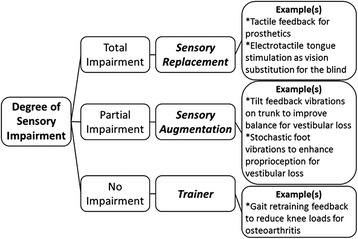
Sensory impairments decrease quality of life and can slow or hinder rehabilitation. Small, computationally powerful electronics have enabled the recent development of wearable systems aimed to improve function for individuals with sensory impairments. The purpose of this review is to synthesize current haptic wearable research for clinical applications involving sensory impairments. We define haptic wearables as untethered, ungrounded body worn devices that interact with skin directly or through clothing and can be used in natural environments outside a laboratory. Results of this review are categorized by degree of sensory impairment. Total impairment, such as in an amputee, blind, or deaf individual, involves haptics acting as sensory replacement; partial impairment, as is common in rehabilitation, involves haptics as sensory augmentation; and no impairment involves haptics as trainer. This review found that wearable haptic devices improved function for a variety of clinical applications including: rehabilitation, prosthetics, vestibular loss, osteoarthritis, vision loss and hearing loss. Future haptic wearables development should focus on clinical needs, intuitive and multimodal haptic displays, low energy demands, and biomechanical compliance for long-term usage.
Overview
The claims and statistics of this paper haven’t been checked yet.
Run the check — free, no account needed. It reads the open-access text and checks the sources it cites.
Integrity signals
Registry
Cites
Statistics
Figures
Verification
Claims the paper makes
The claims and statistics of this paper haven’t been checked yet.
Run the check — free, no account needed. It reads the open-access text and checks the sources it cites.
Claims other papers make about this one
Each is checked against this paper’s own text: does it say what the citing paper says it does?
The source backs part of the claim, not all of it — or backs it for a different population, condition or comparison.
In the citing paper
“Ease of use, comfort level, mobility and appearance need to be seriously considered if the blind are to be expected to use a particular device (Dakopolous & Bourbakis, 2010; Elli et al., 2014; Shull & Damian, 2015).”
From Designing sensory-substitution devices: Principles, pitfalls and potential1 (2016) · cites this paper as Shull & Damian, 2015
Experimental — accuracy not yet measuredThe source backs part of the claim, not all of it — or backs it for a different population, condition or comparison.
In the citing paper
“Although this presents many challenges, a feedback system that codes the environment through haptics and audition in conjunction may compensate for the drawbacks of using only each individual sense if strengths are strategically utilized and weaknesses avoided (Shull & Damian, 2015).”
From Designing sensory-substitution devices: Principles, pitfalls and potential1 (2016) · cites this paper as Shull & Damian, 2015
Experimental — accuracy not yet measured
Self-check
Percentages, sums and reported differences re-computed from the paper’s own numbers.
The self-check needs the paper’s full text.
Citations
Cites
A review of wearable sensors and systems with application in rehabilitation
Patel, S., Park, H., Bonato, P., Chan, L., & Rodgers, M. (2012) · Journal of NeuroEngineering and Rehabilitation · doi:10.1186/1743-0003-9-21 · Cited by 2,396
Johansson, R. S., & Westling, G. (1984) · Experimental Brain Research · doi:10.1007/bf00237997 · Cited by 1,731
Augmented visual, auditory, haptic, and multimodal feedback in motor learning: A review
Sigrist, R., Rauter, G., Riener, R., & Wolf, P. (2013) · Psychonomic Bulletin & Review · doi:10.3758/s13423-012-0333-8 · Cited by 1,416 · cited 1×
“Haptic wearables may be useful for partial sensory impairment as a means of sensory augmentation facilitating motor control and rehabilitation [20].”
BackgroundXu, S., Zhang, Y., Cho, J., Lee, J., Huang, X., Jia, L., Fan, J. A., Su, Y., Su, J., Zhang, H., et al. (2013) · Nature Communications · doi:10.1038/ncomms2553 · Cited by 1,404
Soft Robotics: A Perspective—Current Trends and Prospects for the Future
Majidi, C. (2013) · Soft Robotics · doi:10.1089/soro.2013.0001 · Cited by 1,306
Upper limb prosthesis use and abandonment
Biddiss, E. A., & Chau, T. T. (2007) · Prosthetics and Orthotics International · doi:10.1080/03093640600994581 · Cited by 1,123
Toward Flexible Polymer and Paper‐Based Energy Storage Devices
Nyholm, L., Nyström, G., Mihranyan, A., & Strømme, M. (2011) · Advanced Materials · doi:10.1002/adma.201004134 · Cited by 1,066
Stochastic resonance and sensory information processing: A tutorial and review of application
Moss, F., Ward, L. M., & Sannita, W. G. (2004) · Clinical Neurophysiology · doi:10.1016/j.clinph.2003.09.014 · Cited by 994
Vision substitution by tactile image projection
BACH-Y-RITA, P., COLLINS, C. C., SAUNDERS, F. A., WHITE, B., & SCADDEN, L. (1969) · Nature · doi:10.1038/221963a0 · Cited by 956
Sensory substitution and the human-machine interface
Bach-y-Rita, P., & W. Kercel, S. (2003) · Trends in Cognitive Sciences · doi:10.1016/j.tics.2003.10.013 · Cited by 858
Research works printed but not linked: 1
- Bächlin M, Förster K, Tröster G. SwimMaster: A Wearable Assistant for Swimmer. In: Proc 11th Int Conf Ubiquitous Comput - Ubicomp ’09. New York, New York, USA: ACM Press; 2009. p. 21.
Cited by
Sorted by citations
Items 201–245 of 245
Rizzetto, F., Rantas, S., Vezzulli, F., Cassin, S., Aseni, P., & Vertemati, M. (2023) · Springer eBooks · doi:10.1007/978-3-031-17273-1_58 · Cited by 1
O’Nascimento, R. (2023) · Multimodality & Society · doi:10.1177/26349795231194746 · Cited by 1
Vibrotactile Display of Distance Information in a Virtual Object Exploration Task
Rueschen, J. F., & Tan, H. Z. (2023) · IEEE World Haptics Conference (WHC) · doi:10.1109/whc56415.2023.10224511 · Cited by 1
Augmentation and Rehabilitation with Active Orthotic Devices
Onose, G., Morcov, M.-V., Sporea, C., Mirea, A., & Ciobanu, V. (2021) · Contemporary clinical neuroscience · doi:10.1007/978-3-030-54564-2_24 · Cited by 1
Mahani, M.-A. N., Bausenhart, K. M., Ulrich, R., & Ahmadabadi, M. N. (2022) · IEEE Transactions on Cognitive and Developmental Systems · doi:10.1109/tcds.2022.3144092 · Cited by 1
Expressive haptics for enhanced usability of mobile interfaces in situations of impairmentsPreprint
Bhatnagar, T., Cho, Y., Marquardt, N., & Holloway, C. (2019) · arXiv (Cornell University) · doi:10.48550/arxiv.1904.06119 · Cited by 1
Technology-Enabled Long-Term Care Services and Supports (T-eLTCSS) in Home Settings
Wang, L., Gu, D., & Wu, B. (2019) · Springer eBooks · doi:10.1007/978-3-319-69892-2_1111-1 · Cited by 1
Walk to the Beat: A Case Report of the Use of a Novel Haptic Device to Improve Walking after Stroke
Stockley, R. (2017) · Journal of Novel Physiotherapy and Physical Rehabilitation · doi:10.17352/2455-5487.000047
An Investigation into the Role of Tactile Feedback in the Neuromuscular Control of Spine Movement
Beaudette, S. M. (2018) · The Atrium (University of Guelph)
Instrumenting and Validating a Vibrotactile Device to Assess and Rehabilitate Dynamic Seated Balance
Williams, A. D. (2017) · ERA: Education and Research Archive (University of Alberta) · doi:10.7939/r3hd7p63q
Extended Hand Attributes for Touch Input, Touch Output and Touchless Interaction
Gupta, A. (2018) · TSpace (University of Toronto)
Mahani, M.-A. N., Bausenhart, K. M., Ulrich, R., & Ahmadabadi, M. N. (2020) · bioRxiv (Cold Spring Harbor Laboratory) · doi:10.1101/2020.01.29.924662
High Posterior Tibial Slope Influence Medial Meniscus Injuries in ACL Deficient Knees
Marcu, I., Oproiu, A. M., & Mihailide, N. (2018) · Revista de Chimie · doi:10.37358/rc.18.11.6734
Tekoäly, koneoppiminen ja teknologinen murros:
Vartiainen, H., Tedre, M., Jormanainen, I., Kahila, J., Valtonen, T., & Toivonen, T. (2021) · Ainedidaktiikka · doi:10.23988/ad.90776 · Cited by 19
Technology-Enabled Long-Term Care Services and Supports (T-eLTCSS) in Home Settings
Wang, L., Gu, D., & Wu, B. (2021) · Springer eBooks · doi:10.1007/978-3-030-22009-9_1111
Highlights of the 2017 Environmental Scan
(2017) · Journal of Nursing Regulation · doi:10.1016/s2155-8256(17)30014-5
National Council of State Boards of Nursing (2017) · Journal of Nursing Regulation · doi:10.1016/s2155-8256(17)30052-2
Štibrányiová, M. (2022) · Listy klinické logopedie · doi:10.36833/lkl.2022.003
Lee, J., Lee, H., Eizad, A., & Yoon, J. (2022) · IEEE/RAS-EMBS International Conference on Biomedical Robotics and Biomechatronics (BioRob) · doi:10.1109/biorob52689.2022.9925502
From Impossible to Unnoticed: Wearable Technologies and The Miniaturization of Grand Science
Rombokas, E., & Boe, D. A. (2023) · Elsevier eBooks · doi:10.1016/b978-0-12-815449-6.00041-x
Machine Learning-Assisted Wearable Thermo-Haptic Device for Creating Tactile Sensation
Boz, M., & Durgun, Y. (2024) · Bitlis Eren Üniversitesi Fen Bilimleri Dergisi · doi:10.17798/bitlisfen.1434202
СИСТЕМИ ЗВОРОТНОГО БІОЛОГІЧНОГО ЗВ’ЯЗКУ У ПАЦІЄНТІВ З АМПУТАЦІЄЮ: ОГЛЯД ЛІТЕРАТУРИ
Zavidnyuk, Y. V., Шевчук, О. О., Мисула, І. Р., Бакалюк, Т. Г., & Завіднюк, В. (2024) · Здобутки клінічної і експериментальної медицини · doi:10.11603/1811-2471.2024.v.i4.15022
Sensory Substitution and Embodiment: Shaping Performance and Immersion in Teleoperated SettingsPreprint
Cesari, V., Papini, G., Piarulli, A., Pra, Y. D., Gemignani, A., Bianchi, M., & Menicucci, D. (2025) · doi:10.31234/osf.io/pdg7k_v2
Chen, L., Chen, X., Xu, J., Cui, F., Cheng, C., & Lu, H. (2025) · doi:10.36227/techrxiv.175321799.92907795/v1
Haptic Perception on the Plantar Surface for Vibrotactile Feedback Insoles
Seiler, J., Schäfer, N., Scheiwein, M., KARAHAN, T., Raynaud, J., Suppelt, M., Latsch, B., Flor, H., Beckerle, P., & Kupnik, M. (2025) · IEEE World Haptics Conference (WHC) · doi:10.1109/whc64065.2025.11123284
Yi, J. H., Hwang, M., & Mane, P. (2025) · IEEE Access · doi:10.1109/access.2025.3641710
Conceptual Model for Patient-Computer Communication in Adaptive Smart Medical Wards
Levonevskiy, D. K., & Motienko, A. I. (2025) · International Conference on Control Systems, Mathematical Modeling, Automation and Energy Efficiency (SUMMA) · doi:10.1109/summa68668.2025.11302235
Repeating Bumps and Perception of Regularity: A Study on Effect of Vibrotactile Signal Shape
Dai, B., Nai, W., Sun, C., & Yan, X. (2026) · IEEE Access · doi:10.1109/access.2026.3671143
Liquid Touch: Soft and Wearable Vibrotactile Actuators Based on Room Temperature Liquid Metals
Mallqui, C., Cortazar, J. D., Pant, N., Dhong, C., & Lazarus, N. (2026) · Advanced Engineering Materials · doi:10.1002/adem.202502035
HPCS: Edge-Assisted AR Interface for Real-Time Vibrotactile Feedback in Ergonomic Training
Faisal, M., Banaganapalle, M. S. A., Khani, H. Q., Jarkas, M. A., Laamarti, F., & Saddik, A. E. (2026) · International Conference on Consumer Electronics · doi:10.1109/icce67443.2026.11449866
Arth, K. (2018) · theses.fr (ABES) · doi:10.70675/d5697db0z82e1z4b25z81c7zf85e85367636 · Cited by 1
Wearable sound : integrative design for hearing and feeling vibrations
Richards, C. (2023) · theses.fr (ABES) · doi:10.70675/ad6974f5zb436z481dza432zcd8f6dcbb6f8
Belt and whistles - adding lower body collision awareness for MR experiences
Abdlkarim, D., Mukherjee, D., Giunchi, D., Luca, M. D., & Ofek, E. (2026) · CHI Conference on Human Factors in Computing Systems · doi:10.1145/3772318.3793143
Effects of Spatiotemporal Parameters on Forearm Vibrotactile Stimulus Identification
Kim, D.-G., Lee, G., Nam, S., Park, C., & Choi, S. (2026) · IEEE Haptics Symposium · doi:10.1109/haptics66823.2026.11495459
Atmospheric Spine: Reconnecting Indoor Dwellers to Local Climate through Sensory Augmentation
Nie, Y., Wang, X., Bie, X., & Mo, Y. (2026) · Designing Interactive Systems Conference · doi:10.1145/3802974.3809445
SOUZA, G. V., da Silva, E. S., Carboni, A. P., & Martins, D. (2026) · Mechanisms and machine science · doi:10.1007/978-3-032-30258-8_22
Yousaf, A. N., Rowland, D., & Fey, A. M. (2026) · IEEE Transactions on Haptics · doi:10.1109/toh.2026.3708064
The Potential of Tangible Existence for Technology Inheritance
Hamada, T., Kasamatsu, K., & Ainoya, T. (2026) · Lecture notes in computer science · doi:10.1007/978-3-032-29175-2_14
Ehn, M., & Tobiasson, H. (2026) · doi:10.2196/preprints.105547
Ciutacu, T.-S., Cernăzanu-Glăvan, C., & Bulzan, A.-Ş. (2026) · Lecture notes in networks and systems · doi:10.1007/978-3-032-26214-1_4
Teaching Inclusive Interactive Clothing Design Through Embodied Feedback Translation
Wu, Q., Su, X., & Wang, Q. (2026) · International Conference on Distance Education and Learning (ICDEL) · doi:10.1109/icdel70250.2026.11663731
Feng, Y. (2026) · Academic Journal of Art and Design · doi:10.54097/0spm0m58
Cheng, J., Wang, Y., Wang, X., Guo, R., Kong, M., Ren, A., Huang, P., Liu, S., Li, J., Shi, Y., et al. (2026) · eScience · doi:10.1016/j.esci.2026.100663
Metadata
- Authors
- Shull, P. B., & Damian, D. D.
- Affiliations
- Shanghai Jiao Tong University (CN)
- Boston Children's Hospital (US)
- Corresponding author
- Shull, Peter B.
- Venue
- Journal of NeuroEngineering and Rehabilitation
- Published
- 2015-07-20
- Volume
- 12
- Issue
- 1
- Pages
- 59-59
- ISSN
- 1743-0003 (ISSN-L)
- PMC
- PMC4506766
- OpenAlex
- W1782270568
- Cited by
- 245
- References
- 161
- Citations by year
- 2026: 25 · 2025: 27 · 2024: 25 · 2023: 23 · 2022: 23 · 2021: 21 · 2020: 28 · 2019: 16 · 2018: 22 · 2017: 21 · 2016: 13 · 2015: 1
- FWCI
- 1.89
- Type
- journal article
- Language
- en
- Open access
- gold
- doi.org
- Locations
- Journal of NeuroEngineering and Rehabilitation (publishedVersion, cc-by)
- PubMed Central (publishedVersion, cc-by)
- PubMed (publishedVersion)
- White Rose Research Online (University of Leeds, The University of Sheffield, University of York) (acceptedVersion)
- Funders
- National Science Foundation (51121063)
- University of Michigan (14X120010006)
- Schweizerischer Nationalfonds zur Förderung der Wissenschaftlichen Forschung (143344)
- National Natural Science Foundation of China (973 Program, 51121063)
- Shanghai Jiao Tong University
- National Key Research and Development Program of China (2011CB013305)
- Topics
- Life Sciences › Neuroscience › Cognitive Neuroscience › Tactile and Sensory Interactions
- Physical Sciences › Engineering › Mechanical Engineering › Teleoperation and Haptic Systems
- Physical Sciences › Engineering › Biomedical Engineering › Prosthetics and Rehabilitation Robotics
- Keywords
- sensory impairment, sensory augmentation, rehabilitation, prosthetics, amputation, blindness, deafness, vestibular loss, osteoarthritis, vision loss, hearing loss, wearable devices
- MeSH terms
- Humans, Prosthesis Design, Sensation Disorders, Prostheses and Implants, Feedback, Sensory, Wireless Technology
About these checks
Registry, retraction, Cites and statistics results are computed, not judged, with one exception: a printed reference that no index lists is read once by a model before it counts as a citation error. Claims are extracted by a model and kept only when their quote appears verbatim in the text; each cited source is then checked, with a model’s help, for whether it says what the claim relies on. Those verdicts can be wrong — read the claim’s quote and the cited source before relying on one.
Statistics and arithmetic are recomputed, not judged.
Confidence bands are shown only for fields calibrated on our annotated test set. None is calibrated yet, so no band is shown.
What counts as a claim ›How we measure confidence ›How we check this ›
Are you an author, or do you see a problem with this page? Request a review
