

The DOI matches its Crossref record; 160 of the 161 references it cites were found in a registry or an index.
Haptic wearables as sensory replacement, sensory augmentation and trainer – a review
Open accessAbstract
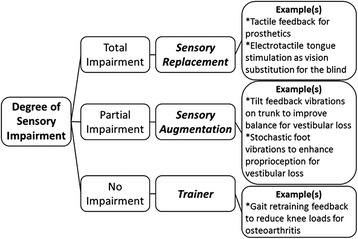
Sensory impairments decrease quality of life and can slow or hinder rehabilitation. Small, computationally powerful electronics have enabled the recent development of wearable systems aimed to improve function for individuals with sensory impairments. The purpose of this review is to synthesize current haptic wearable research for clinical applications involving sensory impairments. We define haptic wearables as untethered, ungrounded body worn devices that interact with skin directly or through clothing and can be used in natural environments outside a laboratory. Results of this review are categorized by degree of sensory impairment. Total impairment, such as in an amputee, blind, or deaf individual, involves haptics acting as sensory replacement; partial impairment, as is common in rehabilitation, involves haptics as sensory augmentation; and no impairment involves haptics as trainer. This review found that wearable haptic devices improved function for a variety of clinical applications including: rehabilitation, prosthetics, vestibular loss, osteoarthritis, vision loss and hearing loss. Future haptic wearables development should focus on clinical needs, intuitive and multimodal haptic displays, low energy demands, and biomechanical compliance for long-term usage.
Overview
The claims and statistics of this paper haven’t been checked yet.
Run the check — free, no account needed. It reads the open-access text and checks the sources it cites.
Integrity signals
Registry
Cites
Statistics
Figures
Verification
Claims the paper makes
The claims and statistics of this paper haven’t been checked yet.
Run the check — free, no account needed. It reads the open-access text and checks the sources it cites.
Claims other papers make about this one
Each is checked against this paper’s own text: does it say what the citing paper says it does?
The source backs part of the claim, not all of it — or backs it for a different population, condition or comparison.
In the citing paper
“Ease of use, comfort level, mobility and appearance need to be seriously considered if the blind are to be expected to use a particular device (Dakopolous & Bourbakis, 2010; Elli et al., 2014; Shull & Damian, 2015).”
From Designing sensory-substitution devices: Principles, pitfalls and potential1 (2016) · cites this paper as Shull & Damian, 2015
Experimental — accuracy not yet measuredThe source backs part of the claim, not all of it — or backs it for a different population, condition or comparison.
In the citing paper
“Although this presents many challenges, a feedback system that codes the environment through haptics and audition in conjunction may compensate for the drawbacks of using only each individual sense if strengths are strategically utilized and weaknesses avoided (Shull & Damian, 2015).”
From Designing sensory-substitution devices: Principles, pitfalls and potential1 (2016) · cites this paper as Shull & Damian, 2015
Experimental — accuracy not yet measured
Self-check
Percentages, sums and reported differences re-computed from the paper’s own numbers.
The self-check needs the paper’s full text.
Citations
Cites
A review of wearable sensors and systems with application in rehabilitation
Patel, S., Park, H., Bonato, P., Chan, L., & Rodgers, M. (2012) · Journal of NeuroEngineering and Rehabilitation · doi:10.1186/1743-0003-9-21 · Cited by 2,396
Johansson, R. S., & Westling, G. (1984) · Experimental Brain Research · doi:10.1007/bf00237997 · Cited by 1,731
Augmented visual, auditory, haptic, and multimodal feedback in motor learning: A review
Sigrist, R., Rauter, G., Riener, R., & Wolf, P. (2013) · Psychonomic Bulletin & Review · doi:10.3758/s13423-012-0333-8 · Cited by 1,416 · cited 1×
“Haptic wearables may be useful for partial sensory impairment as a means of sensory augmentation facilitating motor control and rehabilitation [20].”
BackgroundXu, S., Zhang, Y., Cho, J., Lee, J., Huang, X., Jia, L., Fan, J. A., Su, Y., Su, J., Zhang, H., et al. (2013) · Nature Communications · doi:10.1038/ncomms2553 · Cited by 1,404
Soft Robotics: A Perspective—Current Trends and Prospects for the Future
Majidi, C. (2013) · Soft Robotics · doi:10.1089/soro.2013.0001 · Cited by 1,306
Upper limb prosthesis use and abandonment
Biddiss, E. A., & Chau, T. T. (2007) · Prosthetics and Orthotics International · doi:10.1080/03093640600994581 · Cited by 1,123
Toward Flexible Polymer and Paper‐Based Energy Storage Devices
Nyholm, L., Nyström, G., Mihranyan, A., & Strømme, M. (2011) · Advanced Materials · doi:10.1002/adma.201004134 · Cited by 1,066
Stochastic resonance and sensory information processing: A tutorial and review of application
Moss, F., Ward, L. M., & Sannita, W. G. (2004) · Clinical Neurophysiology · doi:10.1016/j.clinph.2003.09.014 · Cited by 994
Vision substitution by tactile image projection
BACH-Y-RITA, P., COLLINS, C. C., SAUNDERS, F. A., WHITE, B., & SCADDEN, L. (1969) · Nature · doi:10.1038/221963a0 · Cited by 956
Sensory substitution and the human-machine interface
Bach-y-Rita, P., & W. Kercel, S. (2003) · Trends in Cognitive Sciences · doi:10.1016/j.tics.2003.10.013 · Cited by 858
Multifunctional Epidermal Electronics Printed Directly Onto the Skin
Yeo, W., Kim, Y., Lee, J., Ameen, A., Shi, L., Li, M., Wang, S., Ma, R., Jin, S. H., Kang, Z., et al. (2013) · Advanced Materials · doi:10.1002/adma.201204426 · Cited by 837
The benefits of noise in neural systems: bridging theory and experiment
McDonnell, M. D., & Ward, L. M. (2011) · Nature reviews. Neuroscience · doi:10.1038/nrn3061 · Cited by 794
A Wearable Sensor for Unobtrusive, Long-Term Assessment of Electrodermal Activity
Poh, M.-Z., Swenson, N. C., & Picard, R. W. (2010) · IEEE Transactions on Biomedical Engineering · doi:10.1109/tbme.2009.2038487 · Cited by 693
Wearable Obstacle Avoidance Electronic Travel Aids for Blind: A Survey
Dakopoulos, D., & Bourbakis, N. (2009) · IEEE Transactions on Systems Man and Cybernetics Part C (Applications and Reviews) · doi:10.1109/tsmcc.2009.2021255 · Cited by 657
Introduction to Research Topic – Binocular Rivalry: A Gateway to Studying Consciousness
Maier, A., Panagiotaropoulos, T. I., Tsuchiya, N., & Keliris, G. A. (2012) · Frontiers in Human Neuroscience · doi:10.3389/fnhum.2012.00263 · Cited by 632
Enhancing the quality of life through wearable technology
Park, S., & Jayaraman, S. (2003) · IEEE Engineering in Medicine and Biology Magazine · doi:10.1109/memb.2003.1213625 · Cited by 615
Tactile Displays: Guidance for Their Design and Application
Jones, L. A., & Sarter, N. B. (2008) · Human Factors The Journal of the Human Factors and Ergonomics Society · doi:10.1518/001872008x250638 · Cited by 587
Vibrating insoles and balance control in elderly people
Priplata, A. A., Niemi, J. B., Harry, J. D., Lipsitz, L. A., & Collins, J. J. (2003) · The Lancet · doi:10.1016/s0140-6736(03)14470-4 · Cited by 571
Fingertip contact influences human postural control
Jeka, J. J., & Lackner, J. R. (1994) · Experimental Brain Research · doi:10.1007/bf02738408 · Cited by 564
Consumer design priorities for upper limb prosthetics
Biddiss, E., Beaton, D., & Chau, T. (2007) · Disability and Rehabilitation: Assistive Technology · doi:10.1080/17483100701714733 · Cited by 519
Epidemiologic Overview of Individuals with Upper-Limb Loss and Their Reported Research Priorities
Atkins, D. J., Heard, D. C. Y., & Donovan, W. H. (1996) · JPO Journal of Prosthetics and Orthotics · doi:10.1097/00008526-199600810-00003 · Cited by 517
Waypoint navigation with a vibrotactile waist belt
Erp, J. B. F. V., Veen, H. A. H. C. V., Jansen, C., & Dobbins, T. (2005) · ACM Transactions on Applied Perception · doi:10.1145/1060581.1060585 · Cited by 477
Myoelectric forearm prostheses: State of the art from a user-centered perspective
Peerdeman, B., Boere, D., Witteveen, H. J. B., `tVeld, R. H. I., Hermens, H. J., Stramigioli, S., Rietman, H. S., Veltink, P. H., & Misra, S. (2011) · The Journal of Rehabilitation Research and Development · doi:10.1682/jrrd.2010.08.0161 · Cited by 467
Sensory feedback in upper limb prosthetics
Antfolk, C., D’Alonzo, M., Rosén, B., Lundborg, G., Sebelius, F., & Cipriani, C. (2013) · Expert Review of Medical Devices · doi:10.1586/erd.12.68 · Cited by 466
Axisa, F., Schmitt, P. M., Géhin, C., Delhomme, G., McAdams, E. T., & Dittmar, A. (2005) · IEEE Transactions on Information Technology in Biomedicine · doi:10.1109/titb.2005.854505 · Cited by 410
Shull, P. B., Jirattigalachote, W., Hunt, M. A., Cutkosky, M. R., & Delp, S. L. (2014) · Gait & Posture · doi:10.1016/j.gaitpost.2014.03.189 · Cited by 384
Self-citationNoise‐enhanced balance control in patients with diabetes and patients with stroke
Priplata, A. A., Patritti, B. L., Niemi, J. B., Hughes, R. L., Gravelle, D. C., Lipsitz, L. A., Veves, A., Stein, J. M., Bonato, P., & Collins, J. J. (2005) · Annals of Neurology · doi:10.1002/ana.20670 · Cited by 377
van Kuijk, A. A., Bakker, C. D., Hendriks, J. C., Geurts, A. C. H., Stegeman, D. F., & Pasman, J. W. (2014) · Journal of NeuroEngineering and Rehabilitation · doi:10.1186/1743-0003-11-1 · Cited by 374
Form perception with a 49-point electrotactile stimulus array on the tongue: a technical note.
Bach‐y‐Rita, P., Kaczmarek, K. A., Tyler, M. E., & Garcia-Lara, J. (1998) · PubMed · Cited by 338
Recent developments in biofeedback for neuromotor rehabilitation
Huang, H., Wolf, S. L., & He, J. (2006) · Journal of NeuroEngineering and Rehabilitation · doi:10.1186/1743-0003-3-11 · Cited by 333
Augurelle, A.-S., Smith, A. M., Lejeune, T. M., & Thonnard, J. (2003) · Journal of Neurophysiology · doi:10.1152/jn.00249.2002 · Cited by 332
ActiveBelt: Belt-Type Wearable Tactile Display for Directional Navigation
Tsukada, K., & Yasumura, M. (2004) · Lecture notes in computer science · doi:10.1007/978-3-540-30119-6_23 · Cited by 317
Development of Soft-Actuator-Based Wearable Tactile Display
Koo, I. M., Jung, K., Koo, J. C., Nam, J.-D., Lee, Y. K., & Choi, H. R. (2008) · IEEE Transactions on Robotics · doi:10.1109/tro.2008.921561 · Cited by 277
TIKL: Development of a Wearable Vibrotactile Feedback Suit for Improved Human Motor Learning
Lieberman, J., & Breazeal, C. (2007) · IEEE Transactions on Robotics · doi:10.1109/tro.2007.907481 · Cited by 272
Cognitive and sensory declines in old age: Gauging the evidence for a common cause.
Lindenberger, U., & Ghisletta, P. (2009) · Psychology and Aging · doi:10.1037/a0014986 · Cited by 266
Results of an internet survey of myoelectric prosthetic hand users
Pylatiuk, C., Schulz, S., & Döderlein, L. (2007) · Prosthetics & Orthotics International · doi:10.1080/03093640601061265 · Cited by 257
Prosthesis rejection in acquired major upper-limb amputees: a population-based survey
Østlie, K., Lesjø, I. M., Franklin, R. J., Garfelt, B., Skjeldal, O. H., & Magnus, P. M. (2011) · Disability and Rehabilitation Assistive Technology · doi:10.3109/17483107.2011.635405 · Cited by 240
Wearable Assistive Devices for the Blind
Velázquez, R. (2010) · Lecture notes in electrical engineering · doi:10.1007/978-3-642-15687-8_17 · Cited by 238
Shull, P. B., Shultz, R., Silder, A., Dragoo, J. L., Besier, T. F., Cutkosky, M. R., & Delp, S. L. (2012) · Journal of Biomechanics · doi:10.1016/j.jbiomech.2012.10.019 · Cited by 219
Self-citationAdventures in tactile literacy.
Geldard, F. A. (1957) · American Psychologist · doi:10.1037/h0040416 · Cited by 215
Shull, P. B., Silder, A., Shultz, R., Dragoo, J. L., Besier, T. F., Delp, S. L., & Cutkosky, M. R. (2013) · Journal of Orthopaedic Research® · doi:10.1002/jor.22340 · Cited by 215
Self-citationThe role of feed-forward and feedback processes for closed-loop prosthesis control
Saunders, I., & Vijayakumar, S. (2011) · Journal of NeuroEngineering and Rehabilitation · doi:10.1186/1743-0003-8-60 · Cited by 195
Antfolk, C., D’Alonzo, M., Controzzi, M., Lundborg, G., Rosén, B., Sebelius, F., & Cipriani, C. (2012) · IEEE Transactions on Neural Systems and Rehabilitation Engineering · doi:10.1109/tnsre.2012.2217989 · Cited by 194
Grasp stability during manipulative actions
Johansson, R. S., & Cole, K. J. (1994) · Canadian Journal of Physiology and Pharmacology · doi:10.1139/y94-075 · Cited by 188
Efficacy of rehabilitation robotics for walking training in neurological disorders: A review
Tefertiller, C., Pharo, B., Evans, N., & Winchester, P. (2011) · The Journal of Rehabilitation Research and Development · doi:10.1682/jrrd.2010.04.0055 · Cited by 167
Human-centered robotics applied to gait training and assessment
Riener, R., Lünenburger, L., & Colombo, G. (2006) · The Journal of Rehabilitation Research and Development · doi:10.1682/jrrd.2005.02.0046 · Cited by 162
Tactile display and vibrotactile pattern recognition on the torso
Jones, L. A., Lockyer, B., & Piateski, E. (2006) · Advanced Robotics · doi:10.1163/156855306778960563 · Cited by 161
Chapter 32 An integrated EMG/biomechanical model of upper body balance and posture during human gait
Winter, D. A., MacKinnon, C. D., Ruder, G. K., & Wieman, C. (1993) · Progress in brain research · doi:10.1016/s0079-6123(08)62295-5 · Cited by 157
Balance prosthesis based on micromechanical sensors using vibrotactile feedback of tilt
Wall, C., Weinberg, M. S., Schmidt, P. B., & Krebs, D. E. (2001) · IEEE Transactions on Biomedical Engineering · doi:10.1109/10.951518 · Cited by 153
A Navigation Aid for the Blind Using Tactile-Visual Sensory Substitution
Johnson, L. A., & Higgins, C. M. (2006) · Annual International Conference of the IEEE Engineering in Medicine and Biology Society (EMBC) · doi:10.1109/iembs.2006.259473 · Cited by 152
Haim, A., Rubin, G., Rozen, N., Goryachev, Y., Alon Wolf, A., & Salai, M. (2013) · Journal of Orthopaedic Research® · doi:10.1002/jor.22512 · Cited by 152
Vibro- and Electrotactile User Feedback on Hand Opening for Myoelectric Forearm Prostheses
Witteveen, H. J. B., Droog, E. A., Rietman, J. S., & Veltink, P. H. (2012) · IEEE Transactions on Biomedical Engineering · doi:10.1109/tbme.2012.2200678 · Cited by 150
Bächlin, M., Förster, K., & Tröster, G. (2009) · ACM International Joint Conference on Pervasive and Ubiquitous Computing (UbiComp) · doi:10.1145/1620545.1620578 · Cited by 148
Patterson, P. E., & Katz, J. A. (1992) · The Journal of Rehabilitation Research and Development · doi:10.1682/jrrd.1992.01.0001 · Cited by 147
Wheeler, J. W., Bark, K., Savall, J., & Cutkosky, M. R. (2010) · IEEE Transactions on Neural Systems and Rehabilitation Engineering · doi:10.1109/tnsre.2009.2039602 · Cited by 146
Variability and stability analysis of walking of transfemoral amputees
Lamoth, C. J. C., Ainsworth, E., Polomski, W. P., & Houdijk, H. (2010) · Medical Engineering & Physics · doi:10.1016/j.medengphy.2010.07.001 · Cited by 146
Tactile motion instructions for physical activities
Spelmezan, D., Jacobs, M., Hilgers, A., & Borchers, J. (2009) · Proceedings of the SIGCHI Conference on Human Factors in Computing Systems · doi:10.1145/1518701.1519044 · Cited by 146
The relationship between sensory impairment and motor recovery in patients with hemiplegia.
Kusoffsky, A., Wadell, I., & Nilsson, B. (1982) · PubMed · Cited by 140
A Haptic Feedback System for Lower-Limb Prostheses
Fan, R. E., Culjat, M. O., King, C., Franco, M. L., Boryk, R. J., Bisley, J. W., Dutson, E., & Grundfest, W. S. (2008) · IEEE Transactions on Neural Systems and Rehabilitation Engineering · doi:10.1109/tnsre.2008.920075 · Cited by 138
Subsensory vibrations to the feet reduce gait variability in elderly fallers
Galica, A. M., Kang, H. G., Priplata, A. A., D’Andrea, S. E., Starobinets, O. V., Sorond, F. A., Cupples, L. A., & Lipsitz, L. A. (2009) · Gait & Posture · doi:10.1016/j.gaitpost.2009.07.005 · Cited by 138
Shull, P. B., Lurie, K. L., Cutkosky, M. R., & Besier, T. F. (2011) · Journal of Biomechanics · doi:10.1016/j.jbiomech.2011.03.016 · Cited by 130
Self-citationTechnologies and combination therapies for enhancing movement training for people with a disability
Reinkensmeyer, D. J., & Boninger, M. L. (2012) · Journal of NeuroEngineering and Rehabilitation · doi:10.1186/1743-0003-9-17 · Cited by 125
A Navigation Aid for the Blind Using Tactile-Visual Sensory Substitution
Johnson, L. A., & Higgins, C. M. (2006) · Conference proceedings · doi:10.1109/iembs.2006.4398897 · Cited by 124
Rotational Skin Stretch Feedback: A Wearable Haptic Display for Motion
Bark, K., Wheeler, J. W., Shull, P. B., Savall, J., & Cutkosky, M. R. (2010) · IEEE Transactions on Haptics · doi:10.1109/toh.2010.21 · Cited by 118
Self-citationVibrotactile feedback systems: Current trends in rehabilitation, sports and information display
Alahakone, A. U., & Senanayake, S. M. N. A. (2009) · IEEE/ASME International Conference on Advanced Intelligent Mechatronics · doi:10.1109/aim.2009.5229741 · Cited by 117
Voice pitch as an aid to lipreading
Rosen, S., Fourcin, A. J., & Moore, B. C. J. (1981) · Nature · doi:10.1038/291150a0 · Cited by 117
Extended physiologic taction: design and evaluation of a proportional force feedback system.
Meek, S. G., Jacobsen, S. C., & Goulding, P. P. (1989) · PubMed · Cited by 116
The effect of rhythmic somatosensory cueing on gait in patients with Parkinson's disease
van Wegen, E. E. H., de Goede, C. J. T., Lim, I., Rietberg, M. B., Nieuwboer, A., Willems, A., Jones, D. E., Rochester, L., Hetherington, V., Berendse, H. W., et al. (2006) · Journal of the Neurological Sciences · doi:10.1016/j.jns.2006.05.034 · Cited by 116
The effects of vibrotactile biofeedback training on trunk sway in Parkinson's disease patients
Nanhoe-Mahabier, W., Allum, J. H. J., Pasman, E. P., Overeem, S., & Bloem, B. R. (2012) · Parkinsonism & Related Disorders · doi:10.1016/j.parkreldis.2012.05.018 · Cited by 109
Field-Based Validation of a Tactile Navigation Device
Elliott, L. R., van Erp, J. B. F., Redden, E. S., & Duistermaat, M. (2010) · IEEE Transactions on Haptics · doi:10.1109/toh.2010.3 · Cited by 103
Jonsdottir, J., Cattaneo, D., Recalcati, M., Regola, A., Rabuffetti, M., Ferrarin, M., & Casiraghi, A. (2010) · Neurorehabilitation and neural repair · doi:10.1177/1545968309355986 · Cited by 100
On the Design of Miniature Haptic Devices for Upper Extremity Prosthetics
Kim, K., Colgate, J. E., Santos-Munné, J. J., Makhlin, A. R., & Peshkin, M. A. (2009) · IEEE/ASME Transactions on Mechatronics · doi:10.1109/tmech.2009.2013944 · Cited by 100
Dozza, M., Wall, C., Peterka, R. J., Chiari, L., & Horak, F. B. (2008) · Journal of Vestibular Research · doi:10.3233/ves-2007-17405 · Cited by 99
Kentala, E. L., Vivas, J., & Wall, C. (2003) · Annals of Otology Rhinology & Laryngology · doi:10.1177/000348940311200503 · Cited by 94
Sensory Augmentation for the Blind
Kärcher, S. M., Fenzlaff, S., Hartmann, D., Nagel, S. K., & König, P. (2012) · Frontiers in Human Neuroscience · doi:10.3389/fnhum.2012.00037 · Cited by 93 · cited 1×
“[75] used a tactile belt consisting of 30 equidistantly spaced tactors in combination with a digital compass to display the direction of magnetic north by continually vibrating the closest tactor aligned with the magnetic north direction.”
MethodBlind navigation with a wearable range camera and vibrotactile helmet
Mann, S., Huang, J. H., Janzen, R. E., Lo, R., Rampersad, V., Chen, A. J., & Doha, T. (2011) · ACM International Conference on Multimedia (ACM MM) · doi:10.1145/2072298.2072005 · Cited by 93
Real-Time Knee Adduction Moment Feedback for Gait Retraining Through Visual and Tactile Displays
Wheeler, J. W., Shull, P. B., & Besier, T. F. (2011) · Journal of Biomechanical Engineering · doi:10.1115/1.4003621 · Cited by 92
Self-citationSienko, K. H., Balkwill, M. D., Oddsson, L., & Wall, C. (2009) · Journal of Vestibular Research · doi:10.3233/ves-2008-185-604 · Cited by 92
A novel two-dimensional tactile slip display: design, kinematics and perceptual experiments
Webster, R. J., III, Murphy, T. E., Verner, L. N., & Okamura, A. M. (2005) · ACM Transactions on Applied Perception · doi:10.1145/1060581.1060588 · Cited by 91
Crea, S., Cipriani, C., Donati, M., Carrozza, M. C., & Vitiello, N. (2014) · IEEE Transactions on Neural Systems and Rehabilitation Engineering · doi:10.1109/tnsre.2014.2365548 · Cited by 90
McDaniel, T. L., Krishna, S., Balasubramanian, V. N., Colbry, D., & Panchanathan, S. (2008) · IEEE International Workshop on Haptic Audio visual Environments and Games · doi:10.1109/have.2008.4685291 · Cited by 90
Effects of biofeedback on trunk sway during dual tasking in the healthy young and elderly
Verhoeff, L. L., Horlings, C. G. C., Janssen, L. J. F., Bridenbaugh, S. A., & Allum, J. H. J. (2009) · Gait & Posture · doi:10.1016/j.gaitpost.2009.03.002 · Cited by 88
Factors Influencing Stroke Rehabilitation
STERN, P. H., MCDOWELL, F. H., Miller, J. M., & ROBINSON, M. (1971) · Stroke · doi:10.1161/01.str.2.3.213 · Cited by 88
Amemiya, T., Yamashita, J., Hirota, K., & Hirose, M. (2004) · doi:10.1109/vr.2004.83 · Cited by 88
Can vibratory feedback be used to improve postural stability in persons with transtibial limb loss?
Rusaw, D. F., Hagberg, K., Nolan, L., & Ramstrand, N. (2012) · The Journal of Rehabilitation Research and Development · doi:10.1682/jrrd.2011.05.0088 · Cited by 87
Duran, O. P., Althoefer, K. A., & Seneviratne, L. D. (2003) · Cited by 87
Trunk sway reductions in young and older adults using multi-modal biofeedback
Davis, J. R., Carpenter, M. G., Tschanz, R., Meyes, S., Debrunner, D., Burger, J., & Allum, J. H. J. (2010) · Gait & Posture · doi:10.1016/j.gaitpost.2010.02.002 · Cited by 84
A Wireless Sensory Feedback Device for Real-Time Gait Feedback and Training
Redd, C. B., & Bamberg, S. J. M. (2012) · IEEE/ASME Transactions on Mechatronics · doi:10.1109/tmech.2012.2189014 · Cited by 80
Dowling, A. V., Favre, J., & Andriacchi, T. P. (2012) · The American Journal of Sports Medicine · doi:10.1177/0363546512437529 · Cited by 80
Ito, K., Okamoto, M., Akita, J., Ono, T., Gyobu, I., Takagi, T., Hoshi, T., & Mishima, Y. (2005) · CHI Conference Extended Abstracts on Human Factors in Computing Systems (CHI EA) · doi:10.1145/1056808.1056947 · Cited by 79
Balance prostheses for postural control
Wall, C., & Weinberg, M. S. (2003) · IEEE Engineering in Medicine and Biology Magazine · doi:10.1109/memb.2003.1195701 · Cited by 76
A Wearable Real-Time Intelligent Posture Corrective System Using Vibrotactile Feedback
Gopalai, A. A., & Senanayake, S. M. N. A. (2011) · IEEE/ASME Transactions on Mechatronics · doi:10.1109/tmech.2011.2161486 · Cited by 74
Spatially distributed tactile feedback for kinesthetic motion guidance
Kapur, P., Jensen, M., Buxbaum, L. J., Jax, S. A., & Kuchenbecker, K. J. (2010) · IEEE Haptics Symposium · doi:10.1109/haptic.2010.5444606 · Cited by 73
Steins, D., Dawes, H., Esser, P., & Collett, J. (2014) · Journal of NeuroEngineering and Rehabilitation · doi:10.1186/1743-0003-11-36 · Cited by 71
An oral tactile interface for blind navigation
Tang, H. N., & Beebe, D. J. (2006) · IEEE Transactions on Neural Systems and Rehabilitation Engineering · doi:10.1109/tnsre.2005.862696 · Cited by 70
Sensory substitution via cutaneous skin stretch feedback
Schorr, S. B., Quek, Z. F., Romano, R. Y., Nisky, I., Provancher, W. R., & Okamura, A. M. (2013) · Proceedings - IEEE International Conference on Robotics and Automation/Proceedings · doi:10.1109/icra.2013.6630894 · Cited by 70
User demands for sensory feedback in upper extremity prostheses
Lewis, S., Russold, M., Dietl, H., & Kaniušas, E. (2012) · IEEE International Symposium on Medical Measurements and Applications (MeMeA) · doi:10.1109/memea.2012.6226669 · Cited by 70
The effect of vibrotactile feedback on postural sway during locomotor activities
Sienko, K. H., Balkwill, M. D., Oddsson, L., & Wall, C. (2013) · Journal of NeuroEngineering and Rehabilitation · doi:10.1186/1743-0003-10-93 · Cited by 70
Intermittent Stimulation Delays Adaptation to Electrocutaneous Sensory Feedback
Buma, D. G., Buitenweg, J., & Veltink, P. (2007) · IEEE transactions on neural systems and rehabilitation engineering · doi:10.1109/tnsre.2007.903942 · Cited by 69
Augmented white cane with multimodal haptic feedback
Gallo, S., Chapuis, D., Santos-Carreras, L., Kim, Y., Rétornaz, P., Bleuler, H., & Gassert, R. (2010) · IEEE/RAS-EMBS International Conference on Biomedical Robotics and Biomechatronics (BioRob) · doi:10.1109/biorob.2010.5628066 · Cited by 68
Dowling, A. V., Fisher, D. S., & Andriacchi, T. P. (2010) · Journal of Biomechanical Engineering · doi:10.1115/1.4001584 · Cited by 67
Identifying the role of proprioception in upper-limb prosthesis control
Blank, A. A., Okamura, A. M., & Kuchenbecker, K. J. (2008) · ACM Transactions on Applied Perception · doi:10.1145/1773965.1773966 · Cited by 66
Controlling posture using a plantar pressure-based, tongue-placed tactile biofeedback system
Vuillerme, N., Olivier Chenu, A., Jacques Demongeot, A., & Yohan Payan, A. (2006) · Experimental Brain Research · doi:10.1007/s00221-006-0800-4 · Cited by 63
A Wearable Device for Real-Time Motion Error Detection and Vibrotactile Instructional Cuing
Lee, B.-C., Chen, S., & Sienko, K. H. (2011) · IEEE Transactions on Neural Systems and Rehabilitation Engineering · doi:10.1109/tnsre.2011.2140331 · Cited by 62
Vibrotactile Sensory Substitution for Electromyographic Control of Object Manipulation
Rombokas, E., Stepp, C. E., Chang, C., Malhotra, M., & Matsuoka, Y. (2013) · IEEE Transactions on Biomedical Engineering · doi:10.1109/tbme.2013.2252174 · Cited by 61
Meers, S., & Ward, K. (2005) · Research Online (University of Wollongong) · Cited by 60
Hewer, R. L. (1990) · QJM · doi:10.1093/oxfordjournals.qjmed.a068473 · Cited by 58
Bernstein, L. E., Demorest, M. E., Coulter, D. C., & O’Connell, M. P. (1991) · The Journal of the Acoustical Society of America · doi:10.1121/1.401771 · Cited by 57
Amemiya, T., Yamashita, J., Hirota, K., & Hirose, M. (2004) · IEEE Conference on Virtual Reality and 3D User Interfaces (VR) · doi:10.1109/vr.2004.1310070 · Cited by 57
Slip Speed Feedback for Grip Force Control
Damian, D. D., Arita, A. H., Martinez, H., & Pfeifer, R. (2012) · IEEE Transactions on Biomedical Engineering · doi:10.1109/tbme.2012.2199491 · Cited by 56
Self-citationEvaluation of RU-Netra ¿ Tactile Feedback Navigation System For The Visually Impaired
Shah, C., Bouzit, M., Youssef, M., & Vasquez, L. H. H. (2006) · International Conference on Virtual Rehabilitation · doi:10.1109/iwvr.2006.1707530 · Cited by 56
Directional postural responses induced by vibrotactile stimulations applied to the torso
Lee, B.-C., Martin, B. J., & Sienko, K. H. (2012) · Experimental Brain Research · doi:10.1007/s00221-012-3233-2 · Cited by 55
A Clear Advance in Soft Actuators
Rogers, J. A. (2013) · Science · doi:10.1126/science.1243314 · Cited by 54
SLIP AESTHEASIS: A Portable 2D Slip/Skin Stretch Display for the Fingertip
Tsagarakis, N. G., Horne, T., & Caldwell, D. G. (2005) · IEEE World Haptics Conference (WHC) · doi:10.1109/whc.2005.117 · Cited by 52
Effects of biofeedback on secondary-task response time and postural stability in older adults
Haggerty, S. E., Jiang, L.-T., Gałecki, A. T., & Sienko, K. H. (2012) · Gait & Posture · doi:10.1016/j.gaitpost.2011.10.359 · Cited by 50
Tongue-Based Biofeedback for Balance in Stroke: Results of an 8-Week Pilot Study
Badke, M. B., Sherman, J. E., Boyne, P., Page, S. J., & Dunning, K. K. (2011) · Archives of Physical Medicine and Rehabilitation · doi:10.1016/j.apmr.2011.03.030 · Cited by 47
Humans Can Integrate Force Feedback to Toes in Their Sensorimotor Control of a Robotic Hand
Panarese, A., Edin, B. B., Vecchi, F., Carrozza, M. C., & Johansson, R. S. (2009) · IEEE Transactions on Neural Systems and Rehabilitation Engineering · doi:10.1109/tnsre.2009.2021689 · Cited by 47
Vibrotactile Biofeedback Improves Tandem Gait in Patients with Unilateral Vestibular Loss
Horak, F. B., Dozza, M., Peterka, R. J., Chiari, L., & Wall, C. (2009) · Annals of the New York Academy of Sciences · doi:10.1111/j.1749-6632.2008.03707.x · Cited by 47
Antfolk, C., Balkenius, C., Lundborg, G., Rosén, B., & Sebelius, F. (2010) · BioMedical Engineering OnLine · doi:10.1186/1475-925x-9-50 · Cited by 46
Inertia sensor-based guidance system for upperlimb posture correction
Ding, Z. Q., Luo, Z., Causo, A., Chen, I., Yue, K. X., Yeo, S. H., & Ling, K. V. (2011) · Medical Engineering & Physics · doi:10.1016/j.medengphy.2011.09.002 · Cited by 45
Directional effects of biofeedback on trunk sway during gait tasks in healthy young subjects
Janssen, L. J. F., Verhoeff, L. L., Horlings, C. G. C., & Allum, J. H. J. (2009) · Gait & Posture · doi:10.1016/j.gaitpost.2008.12.009 · Cited by 45
Understanding the role of haptic feedback in a teleoperated/prosthetic grasp and lift task
Brown, J. D., Paek, A. Y., Syed, M., O’Malley, M. K., Shewokis, P. A., Contreras-Vidal, J. L., Davis, A. J., & Gillespie, R. B. (2013) · World Haptics Conference · doi:10.1109/whc.2013.6548420 · Cited by 43
Evaluation of two multichannel tactile aids for the hearing impaired
Weisenberger, J. M., Broadstone, S. M., & Saunders, F. A. (1989) · The Journal of the Acoustical Society of America · doi:10.1121/1.398608 · Cited by 42
Wall, C., & Kentala, E. L. (2010) · Journal of Vestibular Research · doi:10.3233/ves-2010-0369 · Cited by 41
Microprocessor Lower Limb Prosthetics: Review of Current State of the Art
Martin, J. D., Pollock, A., & Hettinger, J. (2010) · JPO Journal of Prosthetics and Orthotics · doi:10.1097/jpo.0b013e3181e8fe8a · Cited by 40
Using Haptic Feedback to Improve Grasp Force Control in Multiple Sclerosis Patients
Jiang, L., Cutkosky, M. R., Ruutiainen, J., & Raisamo, R. (2009) · IEEE Transactions on Robotics · doi:10.1109/tro.2009.2019789 · Cited by 37
Non-interrupting user interfaces for electronic body-worn swim devices
Förster, K., Bächlin, M., & Tröster, G. (2009) · International Conference on PErvasive Technologies Related to Assistive Environments (PETRA) · doi:10.1145/1579114.1579152 · Cited by 34
Comparison of remote pressure and vibrotactile feedback for prosthetic hand control
Tejeiro, C., Stepp, C. E., Malhotra, M., Rombokas, E., & Matsuoka, Y. (2012) · IEEE/RAS-EMBS International Conference on Biomedical Robotics and Biomechatronics (BioRob) · doi:10.1109/biorob.2012.6290268 · Cited by 32
A wearable tactile sensory aid for profoundly deaf children
Saunders, F. A., Hill, W. A., & Franklin, B. (1981) · Journal of Medical Systems · doi:10.1007/bf02222144 · Cited by 32
Informing haptic feedback design for gait retraining
Lurie, K. L., Shull, P. B., Nesbitt, K. F., & Cutkosky, M. R. (2011) · IEEE World Haptics Conference (WHC) · doi:10.1109/whc.2011.5945455 · Cited by 32
Self-citationHonegger, F., Hillebrandt, I. M., van den Elzen, N. G., Tang, K.-S., & Allum, J. H. J. (2013) · Journal of NeuroEngineering and Rehabilitation · doi:10.1186/1743-0003-10-115 · Cited by 32
Design of a serious game for learning vibrotactile messages
Ménélas, B., & Otis, M. J.-D. (2012) · IEEE International Workshop on Haptic Audio visual Environments and Games · doi:10.1109/have.2012.6374446 · Cited by 31
Task-dependent impedance and implications for upper-limb prosthesis control
Blank, A. A., Okamura, A. M., & Whitcomb, L. L. (2014) · The International Journal of Robotics Research · doi:10.1177/0278364913517728 · Cited by 29
The Reception of Environmental Sounds Through Wearable Tactual Aids
Reed, C. M., & Delhorne, L. A. (2003) · Ear and Hearing · doi:10.1097/01.aud.0000100207.97243.88 · Cited by 29
Tactual display of consonant voicing as a supplement to lipreading
Yuan, H., Reed, C. M., & Durlach, N. I. (2005) · The Journal of the Acoustical Society of America · doi:10.1121/1.1945787 · Cited by 28
Sensory Augmentation and Substitution
Kaczmarek, K. A. (1999) · The electrical engineering handbook/Electrical engineering handbook series/Electrical engineering handbook · doi:10.1201/9781420049510.ch143 · Cited by 28
Stepp, C. E., & Matsuoka, Y. (2011) · IEEE Transactions on Neural Systems and Rehabilitation Engineering · doi:10.1109/tnsre.2011.2168981 · Cited by 28
Wearable haptic device for cutaneous force and slip speed display
Damian, D. D., Ludersdorfer, M., Kim, Y., Arieta, A. H., Pfeifer, R., & Okamura, A. M. (2012) · Proceedings - IEEE International Conference on Robotics and Automation/Proceedings · doi:10.1109/icra.2012.6225000 · Cited by 27
Self-citationSharma, A., Torres-Moreno, R., Zabjek, K., & Andrysek, J. (2014) · The Journal of Rehabilitation Research and Development · doi:10.1682/jrrd.2013.07.0164 · Cited by 27
Perception of Springs With Visual and Proprioceptive Motion Cues: Implications for Prosthetics
Gurari, N., Kuchenbecker, K. J., & Okamura, A. M. (2012) · IEEE Transactions on Human-Machine Systems · doi:10.1109/tsmca.2012.2221038 · Cited by 26
Postural Reorganization Induced by Torso Cutaneous Covibration
Lee, B.-C., Martin, B. J., Ho, A., & Sienko, K. H. (2013) · Journal of Neuroscience · doi:10.1523/jneurosci.4715-12.2013 · Cited by 24
Preliminary evaluation of podotactile feedback in sighted and blind users
Velázquez, R., & Bazán, O. (2010) · Annual International Conference of the IEEE Engineering in Medicine and Biology Society (EMBC) · doi:10.1109/iembs.2010.5626205 · Cited by 20
Ghulyan-Bedikian, V., Paolino, M., & Paolino, F. (2013) · Gait & Posture · doi:10.1016/j.gaitpost.2013.03.018 · Cited by 18
Sensory-Motor Coupling in Rehabilitation Robotics
Arieta, A. H., Dermitzakis, K., Damian, D. D., Lungarella, M., & Pfeifer, R. (2008) · InTech eBooks · doi:10.5772/6066 · Cited by 16
Self-citationTactile feedback of object slip improves performance in a grasp and hold task
Walker, J. M., Blank, A. A., Shewokis, P. A., & O’Malley, M. K. (2014) · IEEE Haptics Symposium · doi:10.1109/haptics.2014.6775499 · Cited by 16
Study on lower back electrotactile stimulation characteristics for prosthetic sensory feedback
Seps, M., Dermitzakis, K., & Arieta, A. H. (2011) · IEEE/RSJ International Conference on Intelligent Robots and Systems (IROS) · doi:10.1109/iros.2011.6095110 · Cited by 16
Feasibility of error-based electrotactile and auditive feedback in prosthetic walking
Wentink, E. C., Talsma-Kerkdijk, E. J., Rietman, H. S., & Veltink, P. H. (2014) · Prosthetics and Orthotics International · doi:10.1177/0309364613520319 · Cited by 16
Co-location of force and action improves identification of force-displacement features
Brown, J. D., Gillespie, R. B., Gardner, D., & Gansallo, E. A. (2012) · IEEE Haptics Symposium · doi:10.1109/haptic.2012.6183789 · Cited by 15
Auxiliary Sensory Cues Improve Automatic Postural Responses in Individuals With Diabetic Neuropathy
Rao, N., & Aruin, A. S. (2010) · Neurorehabilitation and neural repair · doi:10.1177/1545968310376760 · Cited by 14
A wearable tactile intonation display for the deaf
Boothroyd, A. (1985) · IEEE Transactions on Acoustics Speech and Signal Processing · doi:10.1109/tassp.1985.1164496 · Cited by 13
Virtual pebble: A haptic state display for pedestrians
Jirattigalachote, W., Shull, P. B., & Cutkosky, M. R. (2011) · IEEE RO-MAN · doi:10.1109/roman.2011.6005279 · Cited by 12
Self-citationMcKinney, Z., Heberer, K. R., Nowroozi, B., Greenberg, M. B., Fowler, E., & Grundfest, W. S. (2014) · IEEE Haptics Symposium · doi:10.1109/haptics.2014.6775445 · Cited by 12
Sakajiri, M., Miyoshi, S., Nakamura, K., Fukushima, S., & Ifukube, T. (2010) · Conference proceedings/Conference proceedings - IEEE International Conference on Systems, Man, and Cybernetics · doi:10.1109/icsmc.2010.5642329 · Cited by 12
Harper, S., & Yeşilada, Y. (2010) · Disability and Rehabilitation Assistive Technology · doi:10.3109/17483107.2010.544369 · Cited by 11
McKinney, Z., Heberer, K. R., Fowler, E., Greenberg, M. B., Nowroozi, B., & Grundfest, W. S. (2014) · Studies in health technology and informatics · doi:10.3233/978-1-61499-375-9-271 · Cited by 9
Simultaneous vibrotactile feedback for multisensory upper limb prosthetics
van der Riet, D., Stopforth, R., Bright, G., & Diegel, O. (2013) · doi:10.1109/robomech.2013.6685493 · Cited by 8
Blank, A. A., Okamura, A. M., & Whitcomb, L. L. (2012) · IEEE/RAS-EMBS International Conference on Biomedical Robotics and Biomechatronics (BioRob) · doi:10.1109/biorob.2012.6290805 · Cited by 8
Rehabilitation of a traumatic lower limb amputee
GAILEY, R. S. (1998) · Physiotherapy Research International · doi:10.1002/pri.147 · Cited by 8
Lee, I., & Choi, S. (2013) · World Haptics Conference · doi:10.1109/whc.2013.6548471 · Cited by 3
Bernstein, L. E., Demorest, M. E., Coulter, D. C., & O’Connell, M. P. (1992) · The Journal of the Acoustical Society of America · doi:10.1121/1.403813 · Cited by 1
Research works printed but not linked: 1
- Bächlin M, Förster K, Tröster G. SwimMaster: A Wearable Assistant for Swimmer. In: Proc 11th Int Conf Ubiquitous Comput - Ubicomp ’09. New York, New York, USA: ACM Press; 2009. p. 21.
Cited by
Sorted by citations
Losey, D. P., McDonald, C. G., Battaglia, E., & O’Malley, M. K. (2018) · Applied Mechanics Reviews · doi:10.1115/1.4039145 · Cited by 424
Fernández‐Caramés, T. M., & Fraga‐Lamas, P. (2018) · Electronics · doi:10.3390/electronics7120405 · Cited by 392
Human augmentation: Past, present and future
Raisamo, R., Rakkolainen, I., Majaranta, P., Salminen, K., Rantala, J., & Farooq, A. (2019) · International Journal of Human-Computer Studies · doi:10.1016/j.ijhcs.2019.05.008 · Cited by 243
Soft, Wearable Robotics and Haptics: Technologies, Trends, and Emerging Applications
Zhu, M., Biswas, S., Dinulescu, S., Kastor, N., Hawkes, E. W., & Visell, Y. (2022) · Proceedings of the IEEE · doi:10.1109/jproc.2021.3140049 · Cited by 192
A bioinspired stretchable membrane-based compliance sensor
Beker, L., Matsuhisa, N., You, I., Ruth, S. R. A., Niu, S., Foudeh, A. M., Tok, J. B. ‐., Chen, X., & Bao, Z. (2020) · Proceedings of the National Academy of Sciences · doi:10.1073/pnas.1909532117 · Cited by 155
Metadata
- Authors
- Shull, P. B., & Damian, D. D.
- Affiliations
- Shanghai Jiao Tong University (CN)
- Boston Children's Hospital (US)
- Corresponding author
- Shull, Peter B.
- Venue
- Journal of NeuroEngineering and Rehabilitation
- Published
- 2015-07-20
- Volume
- 12
- Issue
- 1
- Pages
- 59-59
- ISSN
- 1743-0003 (ISSN-L)
- PMC
- PMC4506766
- OpenAlex
- W1782270568
- Cited by
- 245
- References
- 161
- Citations by year
- 2026: 25 · 2025: 27 · 2024: 25 · 2023: 23 · 2022: 23 · 2021: 21 · 2020: 28 · 2019: 16 · 2018: 22 · 2017: 21 · 2016: 13 · 2015: 1
- FWCI
- 1.89
- Type
- journal article
- Language
- en
- Open access
- gold
- doi.org
- Locations
- Journal of NeuroEngineering and Rehabilitation (publishedVersion, cc-by)
- PubMed Central (publishedVersion, cc-by)
- PubMed (publishedVersion)
- White Rose Research Online (University of Leeds, The University of Sheffield, University of York) (acceptedVersion)
- Funders
- National Science Foundation (51121063)
- University of Michigan (14X120010006)
- Schweizerischer Nationalfonds zur Förderung der Wissenschaftlichen Forschung (143344)
- National Natural Science Foundation of China (973 Program, 51121063)
- Shanghai Jiao Tong University
- National Key Research and Development Program of China (2011CB013305)
- Topics
- Life Sciences › Neuroscience › Cognitive Neuroscience › Tactile and Sensory Interactions
- Physical Sciences › Engineering › Mechanical Engineering › Teleoperation and Haptic Systems
- Physical Sciences › Engineering › Biomedical Engineering › Prosthetics and Rehabilitation Robotics
- Keywords
- sensory impairment, sensory augmentation, rehabilitation, prosthetics, amputation, blindness, deafness, vestibular loss, osteoarthritis, vision loss, hearing loss, wearable devices
- MeSH terms
- Humans, Prosthesis Design, Sensation Disorders, Prostheses and Implants, Feedback, Sensory, Wireless Technology
About these checks
Registry, retraction, Cites and statistics results are computed, not judged, with one exception: a printed reference that no index lists is read once by a model before it counts as a citation error. Claims are extracted by a model and kept only when their quote appears verbatim in the text; each cited source is then checked, with a model’s help, for whether it says what the claim relies on. Those verdicts can be wrong — read the claim’s quote and the cited source before relying on one.
Statistics and arithmetic are recomputed, not judged.
Confidence bands are shown only for fields calibrated on our annotated test set. None is calibrated yet, so no band is shown.
What counts as a claim ›How we measure confidence ›How we check this ›
Are you an author, or do you see a problem with this page? Request a review
