

Prevalence, type and concentration of human enterovirus and parechovirus in cerebrospinal fluid samples of pediatric patients over a 10-year period: a retrospective study
Open accessThe DOI matches its Crossref record; 33 of the 33 references it cites were found in a registry or an index; 4 of the 24 sources its claims cite were checked for support.
Abstract
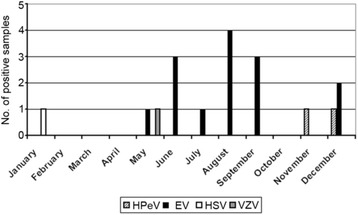
Among 327 pediatric CSF samples tested by PCR, overall viral pathogen prevalence was 5.5%; EV was 4.3%, HPeV 0.6%, HSV 0.3%, VZV 0.3%, and CMV was not detected.
Overview
CoChat Summary
TL;DR
In a 10-year retrospective single-center cohort of 327 pediatric CSF samples, enterovirus (EV) prevalence was 4.3% and human parechovirus (HPeV) prevalence was 0.6%, with both equally prevalent at 7.7% in infants <3 months of age. All typed EV belonged to species B, both HPeV were genotype 3, and HPeV3 infections showed higher RNA concentrations and sepsis-like illness.
Key findings
- Overall prevalence was 4.3% (14/327) for EV, 0.6% (2/327) for HPeV, and 0.3% (1/327) each for HSV and VZV; CMV was not detected (0/327). In children <3 months, EV and HPeV prevalence were both 7.7% (2/26).
- All successfully typed EV (n = 10) were EV species B: six echovirus 30, one echovirus 6, one echovirus 13, one CV-B3, and one CV-B6. Both HPeV infections occurred in fall 2008 and were typed as HPeV genotype 3.
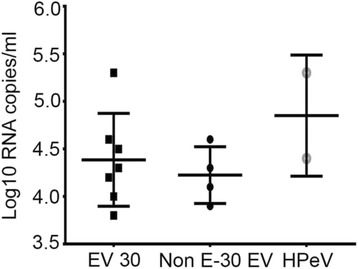
- Mean EV RNA concentration was 4.3 log10 copies/ml (95% CI 3.9–4.7). Mean concentrations were 4.4 log10 copies/ml for EV-30 (n = 7) versus 4.2 log10 copies/ml for other typed non-EV-30 EV (n = 4; p > 0.05); HPeV samples had a mean of 4.9 log10 copies/ml, with differences not statistically significant.
- Aseptic meningitis was diagnosed in 86% (12/14) of EV infections, whereas both HPeV infections presented as severe sepsis-like illness.
Methods
- Retrospective study of 327 archived CSF samples from 327 patients <18 years admitted to Bonn university hospital, collected May 1998 to October 2008; samples had been submitted for routine virological work-up due to suspected meningitis/encephalitis or other neurological symptoms/late-onset sepsis.
- Samples were tested by real-time RT-PCR for EV and HPeV and real-time PCR for CMV, HSV 1/2, and VZV; positive EV and HPeV samples were sequenced in VP1/VP2 or VP3/VP1 junction regions, and viral RNA concentrations were quantified using RNA transcripts.
- Statistical analysis used GraphPad Prism 6; comparisons included Mann-Whitney U-test, one-way ANOVA, and two-tailed t-tests where reported.
Limitations
- The authors state that the retrospective design prevented systematic retrieval of CSF white cell counts and corresponding blood samples, and bacterial testing was not systematically done; prolonged storage at −20 °C may have influenced results, no virus isolation was attempted, and the sample size per year was small. They also note that low HPeV concentrations below 500 copies/ml may have led to missed HPeV CNS infections.
- The text makes evident additional constraints: this was a single-center study with few positive cases (14 EV, 2 HPeV), clinical information was lacking for the HSV-1 and VZV cases, and typing failed in some EV samples due to low RNA concentrations or no leftover sample.
Model-written summary. Check it against the paper before relying on it.
Integrity signals
Registry
Cites
Statistics
Figures
Verification
Claims the paper makes
4 Valid · 1 Not valid · 16 Not checked · 41 Own results and interpretations
Every source the paper cites for this claim was checked and supports it.
In the paper
“In contrast to other studies, we did not observe a 2-year seasonality for HPeV [3].”
§ Prevalence, type and concentration of human enterovirus and parechovirus in cerebrospinal fluid samples of pediatric patients over a 10-year period: a retrospective study > Discussion
What the sources say
- Supportedcites [3] Harvala H Robertson I McWilliam Leitch EC Benschop K Wolthers KC Templeton K Epidemiology and clinical associations of human parechovirus respiratory infections J Clin Microbiol 2008 46 3446 3453 10.1128/JCM.01207-08 18753351 PMC2566073 source
The Discussion reports that previous studies found a two-year cycle of HPeV infections, especially HPeV3, with infections most frequent in even-numbered years in the Netherlands. That supports the cited contrast with other studies; the citing authors’ statement about what they themselves did not observe is not a finding attributed to this source. (LLM, conf=0.88)
plain- Asserted: passes — The authors put it forward as true.
- Checkable: passes — It can be checked against evidence.
- Load-bearing: unclear — It is unclear whether the paper’s conclusions depend on it.
- Based: passes — The paper gives a reason why it holds.
- Supported
Every source the paper cites for this claim was checked and supports it.
In the paper
“EV was the most prevalent pathogen with 3.4 % (11/327) using the assay described by Verstrepen et al. [9].”
§ Prevalence, type and concentration of human enterovirus and parechovirus in cerebrospinal fluid samples of pediatric patients over a 10-year period: a retrospective study > Results
What the sources say
- Supportedcites [9] Verstrepen WA Kuhn S Kockx MM Van De Vyvere ME Mertens AH Rapid detection of enterovirus RNA in cerebrospinal fluid specimens with a novel single-tube real-time reverse transcription-PCR assay J Clin Microbiol 2001 39 4093 4096 10.1128/JCM.39.11.4093-4096.2001 11682535 PMC88492 source
The paper’s introduction describes the enterovirus-detection assay, and its Discussion says the authors developed it for cerebrospinal fluid specimens. The citation identifies the assay used by the citing authors; the 3.4% (11/327) prevalence is their reported result, not a result attributed to Verstrepen et al. (LLM, conf=0.93)
plain- Asserted: passes — The authors put it forward as true.
- Checkable: passes — It can be checked against evidence.
- Load-bearing: passes — The paper’s conclusions depend on it.
- Based: passes — The paper gives a reason why it holds.
- Supported
The sources with a verdict support this claim; the rest weren’t checked yet, have no full text we could read, or their verdicts aren’t rated yet.
In the paper
“We did not detect EV71 although this strain is reported to circulate in different European countries [18, 19].”
§ Prevalence, type and concentration of human enterovirus and parechovirus in cerebrospinal fluid samples of pediatric patients over a 10-year period: a retrospective study > Discussion
What the sources say
- Not checked — no full text of the sourcecites [18] Rabenau HF Richter M Doerr HW Hand, foot and mouth disease: seroprevalence of Coxsackie A16 and Enterovirus 71 in Germany Med Microbiol Immunol 2010 199 45 51 10.1007/s00430-009-0133-6 19941005 source
- Supportedcites [19] Harvala H, Calvert J, Van Nguyen D, Clasper L, Gadsby N, Molyneaux P, et al. Comparison of diagnostic clinical samples and environmental sampling for enterovirus and parechovirus surveillance in Scotland, 2010 to 2012. Euro Surveill. 2014;19(15). 24762664 source
The citation [18,19] is attached to the clause 'this strain is reported to circulate in different European countries', and our copy of Harvala et al. supports exactly that: the Diversity of enteroviruses section states that EV71 was detected in CSF samples (nine cases), in faecal samples (where EV71 was one of the two most common types) and in sewage, indicating circulation in Scotland, with outbreaks previously reported in Finland and France; the Abstract likewise says EV71 is 'already widely circulating in Scotland'. The preceding clause ('We did not detect EV71') is the citing authors' own cohort result and is not attributed to this source — note that Harvala et al. did detect EV71, so that clause should not be read as coming from this paper. (LLM, conf=0.85)
plain- Asserted: passes — The authors put it forward as true.
- Checkable: passes — It can be checked against evidence.
- Load-bearing: unclear — It is unclear whether the paper’s conclusions depend on it.
- Based: passes — The paper gives a reason why it holds.
A result the paper reports from its own data — it cites no other source for it, so there is none to check. The quote shows it is in the paper.
In the paper
“No EV detections were seen in the years 1998, 1999, 2003 and 2006 (Table 1).”
§ Prevalence, type and concentration of human enterovirus and parechovirus in cerebrospinal fluid samples of pediatric patients over a 10-year period: a retrospective study > Results
plain- Asserted: passes — The authors put it forward as true.
- Checkable: passes — It can be checked against evidence.
- Load-bearing: unclear — It is unclear whether the paper’s conclusions depend on it.
- Based: passes — The paper gives a reason why it holds.
A result the paper reports from its own data — it cites no other source for it, so there is none to check. The quote shows it is in the paper.
In the paper
“The mean virus concentration of the EV positive samples was 4.3 log10 RNA copies/ml [95 % confidence interval (CI) 3.9–4.7 log10 RNA copies/ml].”
§ Prevalence, type and concentration of human enterovirus and parechovirus in cerebrospinal fluid samples of pediatric patients over a 10-year period: a retrospective study > Results
plain- Asserted: passes — The authors put it forward as true.
- Checkable: passes — It can be checked against evidence.
- Load-bearing: unclear — It is unclear whether the paper’s conclusions depend on it.
- Based: passes — The paper gives a reason why it holds.
22 more claims
Create a free account to see all 62 claims and every source verdict.
- Probably not a substantial claim. 25
- It may state two separate claims as one. 15
- The quote only partly states this claim. 2
Self-check
Percentages, sums and reported differences re-computed from the paper’s own numbers.
Each contradiction between two passages listed here was confirmed by an independent check.
Rated major: it would touch a result — a value a result rests on, reported and recomputed p-values on opposite sides of the significance level, two passages that conflict with no sign which is right, or a cited work retracted before this paper was published.
In the paper
§ Prevalence, type and concentration of human enterovirus and parechovirus in cerebrospinal fluid samples of pediatric patients over a 10-year period: a retrospective study > Abstract > Methods
“Positive samples for EV and HPeV were sequenced within the gene encoding the VP1 region (EV), the VP2 and the VP3/VP1 junction region (HPeV).”
§ Prevalence, type and concentration of human enterovirus and parechovirus in cerebrospinal fluid samples of pediatric patients over a 10-year period: a retrospective study > Methods > EV and HPeV typing
“EV positive samples were sequenced in the VP2 gene [33].”
Rated minor: it would not touch a result — a value no result rests on, a p-value that stays on the same side of the significance level, or a conflict that is clerical, resolved elsewhere in the paper, or outside its own findings.
In the paper
§ Prevalence, type and concentration of human enterovirus and parechovirus in cerebrospinal fluid samples of pediatric patients over a 10-year period: a retrospective study > Results
“The two HPeV cases were detected in October and November 2008, respectively.”
§ Prevalence, type and concentration of human enterovirus and parechovirus in cerebrospinal fluid samples of pediatric patients over a 10-year period: a retrospective study > Methods > Clinical specimens
“A total of 327 archived CSF samples from 327 patients had been collected from May 1998 until October 2008.”
Rated minor: it would not touch a result — a value no result rests on, a p-value that stays on the same side of the significance level, or a conflict that is clerical, resolved elsewhere in the paper, or outside its own findings.
In the paper
§ Prevalence, type and concentration of human enterovirus and parechovirus in cerebrospinal fluid samples of pediatric patients over a 10-year period: a retrospective study > Results
“Mean virus concentrations of typed EV (n = 2) and HPeV (n = 2) in children <3 months of age were not significantly different (4.5 log10 RNA copies/ml versus 4.9 log10 RNA copies/ml, p <0.05, two-tailed t-test).”
§ Prevalence, type and concentration of human enterovirus and parechovirus in cerebrospinal fluid samples of pediatric patients over a 10-year period: a retrospective study > Discussion
“Importantly, HPeV3 infections tended towards higher RNA concentrations compared to infections with EV although the difference was not statistically significant. This finding was also seen when only children <3 months of age where included in the analysis.”
Citations
Cites
Virology, epidemiology, pathogenesis, and control of enterovirus 71
Solomon, T., Lewthwaite, P., Perera, D., Cardosa, M. J., McMinn, P., & Ooi, M. H. (2010) · The Lancet Infectious Diseases · doi:10.1016/s1473-3099(10)70194-8 · Cited by 1,304
Greninger, A. L., Naccache, S. N., Messacar, K., Clayton, A., Yu, G., Somasekar, S., Federman, S., Stryke, D., Anderson, C., Yagi, S., et al. (2015) · The Lancet Infectious Diseases · doi:10.1016/s1473-3099(15)70093-9 · Cited by 390
Human parechovirus causes encephalitis with white matter injury in neonates
Verboon‐Maciolek, M. A., Groenendaal, F., Hahn, C. D., Hellmann, J., van Loon, A. M., Boivin, G., & de Vries, L. S. (2008) · Annals of Neurology · doi:10.1002/ana.21445 · Cited by 307
Isolation and identification of a novel human parechovirus
Ito, M., Yamashita, T., Tsuzuki, H., Takeda, N., & Sakae, K. (2004) · Journal of General Virology · doi:10.1099/vir.0.19456-0 · Cited by 257
Wolthers, K. C., Benschop, K. S. M., Schinkel, J., Molenkamp, R., Bergevoet, R. M., Spijkerman, I. J. B., Kraakman, H. C., & Pajkrt, D. (2008) · Clinical Infectious Diseases · doi:10.1086/589752 · Cited by 252 · cited 1×
“sepsis-like illness in children worldwide [1–3].”
Epidemiology and Clinical Associations of Human Parechovirus Respiratory Infections
Harvala, H., Robertson, I., McWilliam Leitch, E. C., Benschop, K., Wolthers, K. C., Templeton, K., & Simmonds, P. (2008) · Journal of Clinical Microbiology · doi:10.1128/jcm.01207-08 · Cited by 213 · cited 1×
“In contrast to other studies, we did not observe a 2-year seasonality for HPeV [3].”
ResultDetection of All Known Parechoviruses by Real-Time PCR
Nix, W. A., Maher, K., Johansson, E. S., Niklasson, B., Lindberg, A. M., Pallansch, M. A., & Oberste, M. S. (2008) · Journal of Clinical Microbiology · doi:10.1128/jcm.00277-08 · Cited by 182
Verstrepen, W. A., Kuhn, S., Kockx, M. M., Van De Vyvere, M. E., & Mertens, A. H. (2001) · Journal of Clinical Microbiology · doi:10.1128/jcm.39.11.4093-4096.2001 · Cited by 177
Detection of Herpes Simplex Virus DNA by Real-Time PCR
Kessler, H. H., Mühlbauer, G., Rinner, B., Stelzl, E., Berger, A., Dörr, H.-W., Santner, B., Marth, E., & Rabenau, H. (2000) · Journal of Clinical Microbiology · doi:10.1128/jcm.38.7.2638-2642.2000 · Cited by 174
Benschop, K., Thomas, X., Serpenti, C., Molenkamp, R., & Wolthers, K. (2008) · Journal of Clinical Microbiology · doi:10.1128/jcm.01379-08 · Cited by 167
Surveillance of enteroviruses in France, 2000–2004
Antona, D., Lévêque, N., Chomel, J. J., Dubrou, S., Lévy-Bruhl, D., & Lina, B. (2007) · European Journal of Clinical Microbiology & Infectious Diseases · doi:10.1007/s10096-007-0306-4 · Cited by 151
Parechoviruses in children: understanding a new infection
Harvala, H., Wolthers, K. C., & Simmonds, P. (2010) · Current Opinion in Infectious Diseases · doi:10.1097/qco.0b013e32833890ca · Cited by 138
Baumgarte, S., de Souza Luna, L. K., Grywna, K., Panning, M., Drexler, J. F., Karsten, C., Huppertz, H. I., & Drosten, C. (2008) · Journal of Clinical Microbiology · doi:10.1128/jcm.01468-07 · Cited by 136
Self-citationHand, foot and mouth disease: seroprevalence of Coxsackie A16 and Enterovirus 71 in Germany
Rabenau, H. F., Richter, M., & Doerr, H. W. (2010) · Medical Microbiology and Immunology · doi:10.1007/s00430-009-0133-6 · Cited by 119
Sharp, J., Harrison, C. J., Puckett, K., Selvaraju, S. B., Penaranda, S., Nix, W. A., Oberste, M. S., & Selvarangan, R. (2013) · Pediatric Infectious Disease Journal · doi:10.1097/inf.0b013e318276b328 · Cited by 117 · cited 1×
“Recent data from the USA indicate that the peak season for HPeV detection was in the summer months [12].”
Harvala, H., McLeish, N., Kondracka, J., McIntyre, C. L., McWilliam Leitch, E. C., Templeton, K., & Simmonds, P. (2011) · Journal of Medical Virology · doi:10.1002/jmv.22023 · Cited by 112
Dierssen, U., Rehren, F., Henke-Gendo, C., Harste, G., & Heim, A. (2008) · Journal of Clinical Virology · doi:10.1016/j.jcv.2007.11.016 · Cited by 107 · cited 4×
“We could show that the detection rate for EV increase by a quarter upon use of recently published assay [10].”
BackgroundMethodInfluentialPfeiffer, H. C., Bragstad, K., Skram, M. K., Dahl, H., Knudsen, P. K., Chawla, M. S., Holberg-Petersen, M., Vainio, K., Dudman, S. G., Kran, A. M., et al. (2015) · Eurosurveillance · doi:10.2807/1560-7917.es2015.20.10.21062 · Cited by 94
Harvala, H., Calvert, J., Van Nguyen, D., Clasper, L., Gadsby, N., Molyneaux, P., Templeton, K., McWilliams Leitch, C., & Simmonds, P. (2014) · Eurosurveillance · doi:10.2807/1560-7917.es2014.19.15.20772 · Cited by 87 · cited 3×
“We did not detect EV71 although this strain is reported to circulate in different European countries [18, 19].”
InfluentialTyping of Human Enterovirus by Partial Sequencing of VP2
Nasri, D., Bouslama, L., Omar, S., Saoudin, H., Bourlet, T., Aouni, M., Pozzetto, B., & Pillet, S. (2007) · Journal of Clinical Microbiology · doi:10.1128/jcm.00093-07 · Cited by 76
Harvala, H., Griffiths, M., Solomon, T., & Simmonds, P. (2014) · Journal of Infection · doi:10.1016/j.jinf.2014.02.017 · Cited by 69 · cited 3×
“concentrations <500 copies/ml in CSF samples of young infants submitted for bacterial sepsis screening [25].”
BackgroundInfluentialRoth, B., Enders, M., Arents, A., Pfitzner, A., & Terletskaia‐Ladwig, E. (2007) · Journal of Medical Virology · doi:10.1002/jmv.20917 · Cited by 68
Human parechoviruses are frequently detected in stool of healthy Finnish children
Kolehmainen, P., Oikarinen, S., Koskiniemi, M., Simell, O., Ilonen, J., Knip, M., Hyöty, H., & Tauriainen, S. (2012) · Journal of Clinical Virology · doi:10.1016/j.jcv.2012.02.006 · Cited by 62 · cited 1×
“On the other hand, HPeV was shown to be also present in stool samples of healthy children indicating asymptomatic shedding after infection [27].”
BackgroundHuman parechovirus seroprevalence in Finland and the Netherlands
Westerhuis, B., Kolehmainen, P., Benschop, K., Nurminen, N., Koen, G., Koskiniemi, M., Simell, O., Knip, M., Hyöty, H., Wolthers, K., et al. (2013) · Journal of Clinical Virology · doi:10.1016/j.jcv.2013.06.036 · Cited by 62 · cited 1×
“Another study showed a low prevalence of HPeV3 specific neutralizing antibodies among the adult Dutch (10 %) and Finnish (13 %) population [23].”
BackgroundStöcher, M., Reichl, V., Bozic, M., Kessler, H. H., Halwachs‐Baumann, G., Landt, O., Stekel, H., & Berg, J. (2003) · Journal of Clinical Virology · doi:10.1016/s1386-6532(02)00042-2 · Cited by 61
de Crom, S. C. M., Obihara, C. C., de Moor, R. A., Veldkamp, E. J. M., van Furth, A. M., & Rossen, J. W. A. (2013) · Journal of Clinical Virology · doi:10.1016/j.jcv.2013.07.017 · Cited by 61
Walters, B., Peñaranda, S., Nix, W. A., Oberste, M. S., Todd, K. M., Katz, B. Z., & Zheng, X. (2011) · Journal of Clinical Virology · doi:10.1016/j.jcv.2011.07.008 · Cited by 60 · cited 1×
“3 % for HPeV among children <3 months of age, which is in close agreement to our results [2].”
ResultVolle, R., Bailly, J.-L., Mirand, A., Pereira, B., Marque-Juillet, S., Chambon, M., Regagnon, C., Brebion, A., Henquell, C., Peigue-Lafeuille, H., et al. (2014) · The Journal of Infectious Diseases · doi:10.1093/infdis/jiu178 · Cited by 49 · cited 1×
“onstrated higher virus concentration in echovirus 30 cases compared to those with echovirus six infection [24].”
ResultIntroduction of a novel parechovirus RT-PCR clinical test in a regional medical center
Renaud, C., Kuypers, J., Ficken, E., Cent, A., Corey, L., & Englund, J. A. (2011) · Journal of Clinical Virology · doi:10.1016/j.jcv.2011.02.010 · Cited by 40 · cited 1×
“The mainstay of laboratory diagnostics for EV and HPeV infection depends on real-time reverse-transcription-PCR (RT-PCR), which has considerably improved the detection of EV as well as HPeV [8].”
BackgroundHuman parechovirus-3 infection in children, South Korea
Han, T.-H., Chung, J.-Y., You, S. J., Youn, J.-L., & Shim, G.-H. (2013) · Journal of Clinical Virology · doi:10.1016/j.jcv.2013.05.023 · Cited by 30 · cited 1×
“The highly variable epidemiology of HPeV is supported by recent findings from South Korea, where the majority of cases were detected in spring in one study and in summer in another study [14, 15].”
ResultSeo, J.-H., Yeom, J. S., Youn, H.-S., Han, T.-H., & Chung, J.-Y. (2015) · Korean Journal of Pediatrics · doi:10.3345/kjp.2015.58.3.102 · Cited by 29
Preiser, W., Brink, N. S., Ayliffe, U., et al. (2003) · Journal of Clinical Virology · doi:10.1016/s1386-6532(02)00022-7 · Cited by 26
Eis‐Hübinger, A. M., Eckerle, I., Helmer, A., Reber, U., Dresbach, T., Buderus, S., Drosten, C., & Müller, A. (2012) · Journal of Clinical Microbiology · doi:10.1128/jcm.02731-12 · Cited by 25
Self-citation
Cited by
Enterovirus and parechovirus infection in children: a brief overview
de Crom, S. C. M., Rossen, J. W. A., van Furth, A. M., & Obihara, C. C. (2016) · European Journal of Pediatrics · doi:10.1007/s00431-016-2725-7 · Cited by 192
Dyda, A., Stelzer‐Braid, S., Adam, D. C., Chughtai, A. A., & MacIntyre, C. R. (2018) · Eurosurveillance · doi:10.2807/1560-7917.es.2018.23.3.17-00310 · Cited by 137
Viral (aseptic) meningitis: A review.
Wright, W. F., Pinto, C. N., Palisoc, K., & Baghli, S. (2019) · Journal of the Neurological Sciences · doi:10.1016/j.jns.2019.01.050 · Cited by 116
Parechovirus A Pathogenesis and the Enigma of Genotype A-3
Sridhar, A., Karelehto, E., Brouwer, L., Pajkrt, D., & Wolthers, K. C. (2019) · Viruses · doi:10.3390/v11111062 · Cited by 60
Parechovirus: an important emerging infection in young infants
Britton, P. N., Jones, C., Macartney, K. K., & Cheng, A. C. (2018) · The Medical Journal of Australia · doi:10.5694/mja18.00149 · Cited by 58
Metadata
- Authors
- Vollbach, S., Müller, A., Drexler, J. F., Simon, A., Drosten, C., Eis-Hübinger, A. M., & Panning, M.
- Affiliations
- University of Bonn (DE)
- Corresponding author
- Panning, Marcus
- Venue
- Virology Journal
- Published
- 2015-11-25
- Volume
- 12
- Issue
- 1
- Pages
- 199-199
- ISSN
- 1743-422X (ISSN-L)
- PMC
- PMC4660665
- OpenAlex
- W2176691531
- Cited by
- 49
- References
- 33
- Citations by year
- 2025: 1 · 2024: 2 · 2023: 5 · 2022: 2 · 2021: 5 · 2020: 10 · 2019: 6 · 2018: 7 · 2017: 7 · 2016: 4
- FWCI
- 4.36
- Type
- journal article
- Language
- en
- Open access
- gold
- doi.org
- Licence
- cc-by
- Locations
- Virology Journal (publishedVersion, cc-by)
- Europe PMC (PubMed Central) (publishedVersion, cc-by)
- PubMed Central (publishedVersion, cc-by)
- PubMed (publishedVersion)
- FreiDok plus (Universitätsbibliothek Freiburg) (submittedVersion)
- Topics
- Health Sciences › Medicine › Infectious Diseases › Viral Infections and Immunology Research
- Health Sciences › Medicine › Infectious Diseases › Infectious Encephalopathies and Encephalitis
- Health Sciences › Medicine › Pediatrics, Perinatology and Child Health › Literature Analysis and Criticism
- Keywords
- human enteroviruses, parechovirus, cerebrospinal fluid, pediatric encephalitis, aseptic meningitis, viral prevalence, viral RNA concentration, VP1 gene sequencing, echovirus 30, sepsis-like illness, seasonal variation, virus typing
- MeSH terms
- Adolescent, Cerebrospinal Fluid, Child, Child, Preschool, Enterovirus Infections, Enterovirus, Female, Germany, Humans, Infant, Infant, Newborn, Male, Meningitis, Viral, Picornaviridae Infections, Retrospective Studies, RNA, Viral, Prevalence, Encephalitis, Viral, Viral Load, Reverse Transcriptase Polymerase Chain Reaction, Parechovirus, Real-Time Polymerase Chain Reaction
About these checks
Registry, retraction, Cites and statistics results are computed, not judged, with one exception: a printed reference that no index lists is read once by a model before it counts as a citation error. Claims are extracted by a model and kept only when their quote appears verbatim in the text; each cited source is then checked, with a model’s help, for whether it says what the claim relies on. Those verdicts can be wrong — read the claim’s quote and the cited source before relying on one.
The claim verdicts this report counts are experimental: their accuracy is not yet measured.
A language model drew the claims from the paper on 2026-10-10, under version 3 of the claim definition (model deepseek-v4.1-flash, prompt extract-v3).
A second model labelled each claim on 2026-10-10 (model jev-1.13-20260917, definition revision gold-guideline-v0.2).
Cited sources are checked with a language model’s help (gpt-6-sol and qwen3.8-omni-flash).
Statistics and arithmetic are recomputed, not judged.
Confidence bands are shown only for fields calibrated on our annotated test set. None is calibrated yet, so no band is shown.
What counts as a claim ›How we measure confidence ›How we check this ›
Are you an author, or do you see a problem with this page? Request a review
Data sources
Bibliographic data: Semantic Scholar, OpenAlex, Crossref.
Contains information from the Semantic Scholar Academic Graph Datasets, made available under the ODC Attribution License (ODC-BY 1.0).
Semantic Scholar’s data is described in: Kinney, R., et al. (2023). The Semantic Scholar Open Data Platform. arXiv:2301.10140.
