

The DOI matches its Crossref record; 85 of the 85 references it cites were found in a registry or an index.
The impact of protein quality on the promotion of resistance exercise-induced changes in muscle mass
Open accessAbstract
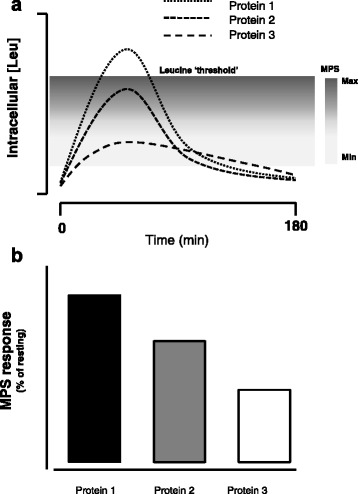
Protein supplementation during resistance exercise training augments hypertrophic gains. Protein ingestion and the resultant hyperaminoacidemia provides the building blocks (indispensable amino acids - IAA) for, and also triggers an increase in, muscle protein synthesis (MPS), suppression of muscle protein breakdown (MPB), and net positive protein balance (i.e., MPS > MPB). The key amino acid triggering the rise in MPS is leucine, which stimulates the mechanistic target of rapamycin complex-1, a key signalling protein, and triggers a rise in MPS. As such, ingested proteins with a high leucine content would be advantageous in triggering a rise in MPS. Thus, protein quality (reflected in IAA content and protein digestibility) has an impact on changes in MPS and could ultimately affect skeletal muscle mass. Protein quality has been measured by the protein digestibility-corrected amino acid score (PDCAAS); however, the digestible indispensable amino acid score (DIAAS) has been recommended as a better method for protein quality scoring. Under DIAAS there is the recognition that amino acids are individual nutrients and that protein quality is contingent on IAA content and ileal (as opposed to fecal) digestibility. Differences in protein quality may have important ramifications for exercise-induced changes in muscle mass gains made with resistance exercise as well as muscle remodelling. Thus, the purpose of this review is a critical appraisal of studies examining the effects of protein quality in supplementation on changes in muscle mass and strength as well as body composition during resistance training.
Overview
The claims and statistics of this paper haven’t been checked yet.
Run the check — free, no account needed. It reads the open-access text and checks the sources it cites.
Integrity signals
Registry
Cites
Statistics
Figures
Verification
Claims the paper makes
The claims and statistics of this paper haven’t been checked yet.
Run the check — free, no account needed. It reads the open-access text and checks the sources it cites.
Claims other papers make about this one
Each is checked against this paper’s own text: does it say what the citing paper says it does?
In the citing paper
“We selected collagen as a comparator as it provides an isonitrogenous and isoenergetic comparison (as opposed to carbohydrate, which is often used) (16), and as it has shown considerable and impressive anabolic properties in older adults (17) [which have been questioned (18)].”
Self-check
Percentages, sums and reported differences re-computed from the paper’s own numbers.
The self-check needs the paper’s full text.
Citations
Cites
Bauer, J., Biolo, G., Cederholm, T., Cesari, M., Cruz-Jentoft, A. J., Morley, J. E., Phillips, S., Sieber, C., Stehle, P., Teta, D., et al. (2013) · Journal of the American Medical Directors Association · doi:10.1016/j.jamda.2013.05.021 · Cited by 2,553 · cited 1×
“…further consideration in recommendations for using lower quality proteins is their potential use in populations such as the elderly for whom a requirement for protein [77, 78], and more importantly leucine [42, 79, 80], for retention of muscle mass appears to be higher than that of younger persons.”
Self-citationProtein and amino acid requirements in human nutrition.
(2007) · PubMed · Cited by 2,234
Deutz, N. E. P., Bauer, J. M., Barazzoni, R., Biolo, G., Boirie, Y., Bosy-Westphal, A., Cederholm, T., Cruz-Jentoft, A., Krznariç, Z., Nair, K. S., et al. (2014) · Clinical Nutrition · doi:10.1016/j.clnu.2014.04.007 · Cited by 1,738
Sestrin2 is a leucine sensor for the mTORC1 pathway
Wolfson, R. L., Chantranupong, L., Saxton, R. A., Shen, K., Scaria, S. M., Cantor, J. R., & Sabatini, D. M. (2016) · Science · doi:10.1126/science.aab2674 · Cited by 1,306
Tang, J. E., Moore, D. R., Kujbida, G. W., Tarnopolsky, M. A., & Phillips, S. M. (2009) · Journal of Applied Physiology · doi:10.1152/japplphysiol.00076.2009 · Cited by 998
Self-citationMoore, D. R., Robinson, M. J., Fry, J. L., Tang, J. E., Glover, E. I., Wilkinson, S. B., Prior, T., Tarnopolsky, M. A., & Phillips, S. M. (2009) · The American Journal of Clinical Nutrition · doi:10.3945/ajcn.2008.26401 · Cited by 973
Self-citationKatsanos, C. S., Kobayashi, H., Sheffield-Moore, M., Aarsland, A., & Wolfe, R. R. (2006) · American Journal of Physiology-Endocrinology and Metabolism · doi:10.1152/ajpendo.00488.2005 · Cited by 923
Volpi, E., Kobayashi, H., Sheffield-Moore, M., Mittendorfer, B., & Wolfe, R. R. (2003) · The American Journal of Clinical Nutrition · doi:10.1093/ajcn/78.2.250 · Cited by 846
Cermak, N. M., Res, P. T., de Groot, L. C., Saris, W. H., & van Loon, L. J. (2012) · The American Journal of Clinical Nutrition · doi:10.3945/ajcn.112.037556 · Cited by 827
Anthony, J. C., Yoshizawa, F., Anthony, T. G., Vary, T. C., Jefferson, L. S., & Kimball, S. R. (2000) · Journal of Nutrition · doi:10.1093/jn/130.10.2413 · Cited by 804
Cited by
Sorted by citations
Periodized Nutrition for Athletes
Jeukendrup, A. E. (2017) · Sports Medicine · doi:10.1007/s40279-017-0694-2 · Cited by 299
Collins, J., Maughan, R. J., Gleeson, M., Bilsborough, J., Jeukendrup, A., Morton, J. P., Phillips, S. M., Armstrong, L., Burke, L. M., Close, G. L., et al. (2021) · British Journal of Sports Medicine · doi:10.1136/bjsports-2019-101961 · Cited by 303
Self-citationVegan diets: practical advice for athletes and exercisers
Rogerson, D. (2017) · Journal of the International Society of Sports Nutrition · doi:10.1186/s12970-017-0192-9 · Cited by 269
Traylor, D. A., Gorissen, S. H. M., & Phillips, S. M. (2018) · Advances in Nutrition · doi:10.1093/advances/nmy003 · Cited by 243
Self-citationGorissen, S. H. M., & Witard, O. C. (2018) · Proceedings of the Nutrition Society · doi:10.1017/s002966511700194x · Cited by 221
Metadata
- Authors
- Phillips, S. M.
- Affiliations
- McMaster University (CA)
- Corresponding author
- Phillips, Stuart M.
- ORCID
- Phillips, Stuart M.
- Venue
- Nutrition & Metabolism
- Published
- 2016-09-29
- Volume
- 13
- Issue
- 1
- Pages
- 64-64
- ISSN
- 1743-7075 (ISSN-L)
- PMC
- PMC5041535
- OpenAlex
- W2526122202
- Cited by
- 168
- References
- 85
- Citations by year
- 2026: 15 · 2025: 20 · 2024: 15 · 2023: 17 · 2022: 18 · 2021: 22 · 2020: 20 · 2019: 10 · 2018: 16 · 2017: 15
- FWCI
- 1.48
- Type
- journal article
- Language
- en
- Open access
- gold
- doi.org
- Licence
- cc-by
- Locations
- Nutrition & Metabolism (publishedVersion, cc-by)
- Europe PMC (PubMed Central) (publishedVersion, cc-by)
- PubMed Central (publishedVersion, cc-by)
- PubMed (publishedVersion)
- Topics
- Health Sciences › Nursing › Nutrition and Dietetics › Muscle metabolism and nutrition
- Life Sciences › Biochemistry, Genetics and Molecular Biology › Molecular Biology › Muscle Physiology and Disorders
- Health Sciences › Medicine › Orthopedics and Sports Medicine › Sports Performance and Training
- Keywords
- protein quality, resistance training, muscle hypertrophy, muscle protein synthesis, muscle protein degradation, leucine, mTOR signaling, essential amino acids, PDCAAS, DIAAS, protein supplementation, skeletal muscle mass, muscle strength, body composition
About these checks
Registry, retraction, Cites and statistics results are computed, not judged, with one exception: a printed reference that no index lists is read once by a model before it counts as a citation error. Claims are extracted by a model and kept only when their quote appears verbatim in the text; each cited source is then checked, with a model’s help, for whether it says what the claim relies on. Those verdicts can be wrong — read the claim’s quote and the cited source before relying on one.
Statistics and arithmetic are recomputed, not judged.
Confidence bands are shown only for fields calibrated on our annotated test set. None is calibrated yet, so no band is shown.
What counts as a claim ›How we measure confidence ›How we check this ›
Are you an author, or do you see a problem with this page? Request a review
