

A refined compilation of implementation strategies: results from the Expert Recommendations for Implementing Change (ERIC) project
Open accessThe DOI matches its Crossref record; 61 of the 62 references it cites were found in a registry or an index; 15 of the 30 sources its claims cite were checked for support.
Abstract
BACKGROUND: Identifying, developing, and testing implementation strategies are important goals of implementation science. However, these efforts have been complicated by the use of inconsistent language and inadequate descriptions of implementation strategies in the literature. The Expert Recommendations for Implementing Change (ERIC) study aimed to refine a published compilation of implementation strategy terms and definitions by systematically gathering input from a wide range of stakeholders with expertise in implementation science and clinical practice. METHODS: Purposive sampling was used to recruit a panel of experts in implementation and clinical practice who engaged in three rounds of a modified Delphi process to generate consensus on implementation strategies and definitions. The first and second rounds involved Web-based surveys soliciting comments on implementation strategy terms and definitions. After each round, iterative refinements were made based upon participant feedback. The third round involved a live polling and consensus process via a Web-based platform and conference call. RESULTS: Participants identified substantial concerns with 31% of the terms and/or definitions and suggested five additional strategies. Seventy-five percent of definitions from the originally published compilation of strategies were retained after voting. Ultimately, the expert panel reached consensus on a final compilation of 73 implementation strategies. CONCLUSIONS: This research advances the field by improving the conceptual clarity, relevance, and comprehensiveness of implementation strategies that can be used in isolation or combination in implementation research and practice. Future phases of ERIC will focus on developing conceptually distinct categories of strategies as well as ratings for each strategy's importance and feasibility. Next, the expert panel will recommend multifaceted strategies for hypothetical yet real-world scenarios that vary by sites' endorsement of evidence-based programs and practices and the strength of contextual supports that surround the effort.
Overview
CoChat Summary
TL;DR
This paper reports the ERIC project’s modified Delphi process to refine a published compilation of implementation strategy terms and definitions through expert consensus. The result is a final compilation of 73 discrete implementation strategies, with 75% of original definitions retained after voting.
Key findings
- A panel of 71 experts participated across three modified Delphi rounds; round participation was 57, 43, and 40 experts, respectively.
- Participants identified substantial concerns with 31% of the original terms and/or definitions and suggested five additional strategies.
- Seventy-five percent of definitions from the original Powell et al. compilation were retained after voting, and the final compilation included 73 discrete implementation strategies.
- Of 21 alternative definitions suggested, an alternative was selected 81% of the time and the original definition was maintained 19% of the time; all five new strategies were retained in some form, with an average 84% vote to retain (range 100–71%).
Methods
- Purposive sampling recruited an expert panel of 71 implementation and clinical practice experts, mostly from the USA, with some Canadian affiliation.
- A three-round modified Delphi process was used: two Web-based surveys for feedback and iterative refinement, followed by a live Web-based polling and consensus meeting.
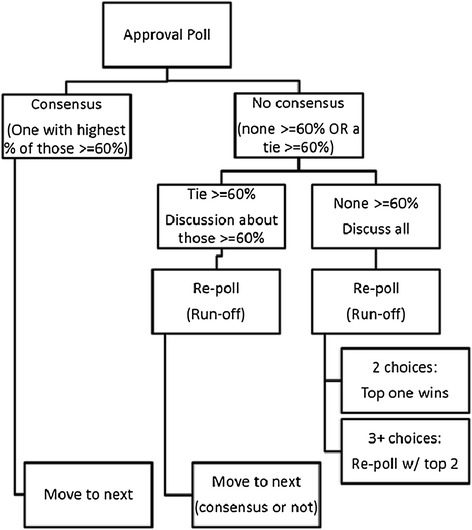
- Consensus voting used approval voting with a ≥60% supermajority threshold, followed by structured discussion and runoff voting when no clear winner emerged.
Limitations
- The paper states that using a different starting taxonomy may have yielded different results; the panel was limited to North America and mostly USA experts; online rather than in-person meetings may have produced less nuanced discussion; and some participants abstained from Round 3 voting for unknown reasons.
- The paper also states content limitations: the evidence base for each strategy was not considered, strategies were not explicitly tied to theories or conceptual models, and some strategies may be more applicable to US or North American settings.
- Evident from the text: the compilation is not intended as a checklist, and the authors note that no implementation effort could feasibly use every strategy; future research is needed to identify contexts and circumstances under which each discrete strategy is effective.
Model-written summary. Check it against the paper before relying on it.
Integrity signals
Registry
Cites
Statistics
Figures
Verification
Claims the paper makes
9 Valid · 0 Not valid · 8 Not checked · 53 Own results and interpretations
The cited sources support only part of this claim — read each source’s verdict below.
In the paper
“Second, published descriptions of implementation strategies too often do not include sufficient detail to enable either scientific or real-world replication [1,6]”
§ A refined compilation of implementation strategies: results from the Expert Recommendations for Implementing Change (ERIC) project > Background
What the sources say
- Could not verifycites [1] Proctor EK Powell BJ McMillen JC Implementation strategies: recommendations for specifying and reporting Implement Sci. 2013 8 1 11 10.1186/1748-5908-8-1 24289295 PMC3882890 sourceExperimental — accuracy not yet measured
Our copy of SENTRY contains no statement that published descriptions of implementation strategies lack sufficient detail for scientific or real-world replication; searched for replication/reproduce, intervention description detail, fidelity, reporting checklist, and generalizability. The closest passages are different points: the Background (p. n/a) notes prior single-centre and high-tech KT studies whose results 'are not applicable to hospitals without the required computer infrastructure' and whose generalizability remains untested, and the Discussion (p. n/a) concedes 'the lack of data on fidelity in the intervention group (i.e., the extent to which the intervention components were used/received as intended)' in their own trial. Neither addresses the adequacy of published reporting of implementation strategies, so this source neither supports nor contradicts the attributed claim. (LLM, conf=0.70)
- Supportedcites [6] Michie S Fixsen DL Grimshaw JM Eccles MP Specifying and reporting complex behaviour change interventions: the need for a scientific method Implement Sci. 2009 4 1 6 10.1186/1748-5908-4-40 19607700 PMC2717906 source
The 'Interventions aren't described' section (What is the problem?) states that published intervention evaluations 'are seldom reported by researchers or practitioners in enough detail to replicate them', and that researchers were less confident they could replicate behavioural interventions and judged they would need more information to deliver them in practice settings — covering both scientific and real-world replication. The Abstract reinforces this: complex behaviour change interventions 'are not well described; when they are described, the terminology used is inconsistent. This constrains scientific replication, and limits the subsequent introduction of successful interventions.' The only slight shift is terminological: this source speaks of 'behaviour change interventions' rather than 'implementation strategies', which the paired citation [6] presumably covers. (LLM, conf=0.88)
plain- Asserted: passes — The authors put it forward as true.
- Checkable: passes — It can be checked against evidence.
- Load-bearing: passes — The paper’s conclusions depend on it.
- Based: passes — The paper gives a reason why it holds.
- Could not verify
The cited sources support only part of this claim — read each source’s verdict below.
In the paper
“However, efforts to identify, develop, and test implementation strategies have been complicated by a lack of conceptual clarity [1,6-9].”
§ A refined compilation of implementation strategies: results from the Expert Recommendations for Implementing Change (ERIC) project > Background
What the sources say
- Could not verifycites [1] Proctor EK Powell BJ McMillen JC Implementation strategies: recommendations for specifying and reporting Implement Sci. 2013 8 1 11 10.1186/1748-5908-8-1 24289295 PMC3882890 sourceExperimental — accuracy not yet measured
The Background describes how the SENTRY intervention was developed, and the Discussion identifies practical barriers to testing and scaling it. The Results say that clinical risk terms such as “immobility” and “sepsis” needed clearer definitions, but no passage found in the search addresses a lack of conceptual clarity about implementation strategies as a complication in identifying, developing, or testing them. (LLM, conf=0.73)
- Supportedcites [6] Michie S Fixsen DL Grimshaw JM Eccles MP Specifying and reporting complex behaviour change interventions: the need for a scientific method Implement Sci. 2009 4 1 6 10.1186/1748-5908-4-40 19607700 PMC2717906 source
In “What is the problem? > Interventions aren't described” (page unavailable), the paper says interventions are often based on unstated or weakly applied models, leaving each new intervention and evaluation relatively isolated. It also says inconsistent terminology makes interventions difficult to distinguish and limits synthesis. Together, these passages support the claim that a lack of conceptual clarity complicates developing and testing implementation strategies. (LLM, conf=0.86)
- Partly supportedcites [7] McKibbon KA Lokker C Wilczynski NL Ciliska D Dobbins M Davis DA A cross-sectional study of the number and frequency of terms used to refer to knowledge translation in a body of health literature in 2006: a tower of Babel? Implement Sci. 2010 5 1 11 10.1186/1748-5908-5-16 21080976 PMC2834600 sourceExperimental — accuracy not yet measured
The Discussion (page unavailable) reports inconsistent terminology and definitions in knowledge translation and says this makes relevant research harder to find and understand. It does not specifically establish that this lack of clarity has complicated identifying, developing, or testing implementation strategies. (LLM, conf=0.84)
- Could not verifycites [8] Colquhoun H Leeman J Michie S Lokker C Bragge P Hempel S Towards a common terminology: a simplified framework of interventions to promote and integrate evidence into health practices, systems, and policies Implement Sci. 2014 9 1 6 10.1186/1748-5908-9-1 24885553 PMC4021969 sourceExperimental — accuracy not yet measured
The Background discusses factors affecting de-implementation and proposes a framework for prioritizing healthcare practices. The Empirical testing section discusses testing health policies, but neither section says that a lack of conceptual clarity has complicated efforts to identify, develop, or test implementation strategies. Searches for that phrase and related terms found no supporting passage in our copy. (LLM, conf=0.72)
- Supportedcites [9] Waltz TJ Powell BJ Chinman MJ Smith JL Matthieu MM Proctor EK Expert Recommendations for Implementing Change (ERIC): protocol for a mixed methods study Implement Sci. 2014 9 1 12 10.1186/1748-5908-9-39 24669765 PMC3987065 source
The Background section, “Lack of conceptual clarity for implementation strategies” (page not provided), says inconsistent terms and definitions hinder interpretation of research, synthesis, and replication. This supports the claim that conceptual ambiguity complicates work to identify, develop, and test implementation strategies. (LLM, conf=0.90)
plainstates a cause- Asserted: passes — The authors put it forward as true.
- Checkable: passes — It can be checked against evidence.
- Load-bearing: passes — The paper’s conclusions depend on it.
- Based: passes — The paper gives a reason why it holds.
- Could not verify
The cited sources support only part of this claim — read each source’s verdict below.
In the paper
“First, terms and definitions for implementation strategies are inconsistent [7,10].”
§ A refined compilation of implementation strategies: results from the Expert Recommendations for Implementing Change (ERIC) project > Background
What the sources say
- Partly supportedcites [7] McKibbon KA Lokker C Wilczynski NL Ciliska D Dobbins M Davis DA A cross-sectional study of the number and frequency of terms used to refer to knowledge translation in a body of health literature in 2006: a tower of Babel? Implement Sci. 2010 5 1 11 10.1186/1748-5908-5-16 21080976 PMC2834600 sourceExperimental — accuracy not yet measured
The Discussion reports inconsistent use of terms in articles about knowledge translation, and the Summary calls for standardizing terms and definitions. The study examines terminology for knowledge translation generally, however; it does not establish that definitions of implementation strategies specifically are inconsistent. The supplied copy gives section labels but no page numbers. (LLM, conf=0.83)
- Supportedcites [10] Powell BJ McMillen JC Proctor EK Carpenter CR Griffey RT Bunger AC A compilation of strategies for implementing clinical innovations in health and mental health Med Care Res Rev. 2012 69 123 57 10.1177/1077558711430690 22203646 PMC3524416 source
The Introduction says implementation strategies are rarely defined and that the terminology used to describe them is inconsistent. The Limitations section likewise describes improving consistency and clarity as an unfinished task. (LLM, conf=0.94)
plain- Asserted: passes — The authors put it forward as true.
- Checkable: passes — It can be checked against evidence.
- Load-bearing: passes — The paper’s conclusions depend on it.
- Based: passes — The paper gives a reason why it holds.
- Partly supported
Every source the paper cites for this claim was checked and supports it.
In the paper
“Powell et al. [10] proposed a consolidated compilation of 68 discrete (as opposed to multifaceted) implementation strategies and definitions based upon a review of the health and mental health literatures.”
§ A refined compilation of implementation strategies: results from the Expert Recommendations for Implementing Change (ERIC) project > Background
What the sources say
- Supportedcites [10] Powell BJ McMillen JC Proctor EK Carpenter CR Griffey RT Bunger AC A compilation of strategies for implementing clinical innovations in health and mental health Med Care Res Rev. 2012 69 123 57 10.1177/1077558711430690 22203646 PMC3524416 source
The Abstract states that the authors present a consolidated compilation of 68 discrete implementation strategies and definitions based on a review of 205 sources. The Introduction identifies health and mental health as the fields covered, and the Discussion distinguishes the discrete strategies from multifaceted implementation plans. (LLM, conf=0.95)
plain- Asserted: passes — The authors put it forward as true.
- Checkable: passes — It can be checked against evidence.
- Load-bearing: passes — The paper’s conclusions depend on it.
- Based: passes — The paper gives a reason why it holds.
- Supported
Every source the paper cites for this claim was checked and supports it.
In the paper
“Powell et al. [10] reviewed 41 compilations and reviews of implementation strategies and summarized them according to their foci and disciplines/clinical specialties that they represented”
§ A refined compilation of implementation strategies: results from the Expert Recommendations for Implementing Change (ERIC) project > Background
What the sources say
- Supportedcites [10] Powell BJ McMillen JC Proctor EK Carpenter CR Griffey RT Bunger AC A compilation of strategies for implementing clinical innovations in health and mental health Med Care Res Rev. 2012 69 123 57 10.1177/1077558711430690 22203646 PMC3524416 source
The Methods (Sources Identified) state that among the 205 sources identified, 41 were 'compilations, taxonomies, or reviews of multiple strategies', and the Introduction states 'For illustrative purposes, we provide brief summaries of 41 reviews and compilations of implementation strategies in Table 1.' The same Introduction section characterizes those sources by their foci — narrow scope on strategies with known effectiveness evidence, on 'specific medical conditions, fields of practice or disciplines', on a setting/study, exemplar programs, one level of target, or one type of strategy — which matches the claim's 'foci and disciplines/clinical specialties'. Only caveat: our copy does not reproduce Table 1's column headings, and the paper's overall review covered 205 sources rather than 41 alone. (LLM, conf=0.85)
plain- Asserted: passes — The authors put it forward as true.
- Checkable: passes — It can be checked against evidence.
- Load-bearing: passes — The paper’s conclusions depend on it.
- Based: passes — The paper gives a reason why it holds.
- Supported
17 more claims · 3 with their cited sources checked
Create a free account to see all 70 claims and to verify the 15 references still open.
- Probably not a substantial claim. 40
- It may state two separate claims as one. 23
- The quote only partly states this claim. 1
Claims other papers make about this one
Each is checked against this paper’s own text: does it say what the citing paper says it does?
The source backs part of the claim, not all of it — or backs it for a different population, condition or comparison.
In the citing paper
“In 2015, the Expert Recommendations for Implementing Change (ERIC) study organized a panel of implementation scientists to compile a standardized set of implementation strategy terms and definitions [2–4].”
From A systematic review of experimentally tested implementation strategies across health and human service settings: evidence from 2010-2022 (2024) · cites this paper as [2]
Experimental — accuracy not yet measuredThe source backs part of the claim, not all of it — or backs it for a different population, condition or comparison.
In the citing paper
“While there has been a rapid increase in the number of implementation trials over the past decade, the quality of trials has been criticised, and the effects of the strategies for such trials on implementation, patient or public health outcomes have been modest [11–13].”
From Guidance for conducting feasibility and pilot studies for implementation trials (2020) · cites this paper as [12]
Experimental — accuracy not yet measuredThe source backs part of the claim, not all of it — or backs it for a different population, condition or comparison.
In the citing paper
“The implementation of a new model of care is an ongoing process, usually lasting between 2 and 4 years [21,22].”
From Implementation of Brief Admission by Self-Referral in Child and Adolescent Psychiatry in Sweden: Insights from Implementers and Staff (2023) · cites this paper as [22]
Experimental — accuracy not yet measuredThe source backs part of the claim, not all of it — or backs it for a different population, condition or comparison.
In the citing paper
“Second, the operations manager was confident about the project, with an attitude that spread throughout the organization and helped us obtain a supportive organization [22].”
From Implementation of Brief Admission by Self-Referral in Child and Adolescent Psychiatry in Sweden: Insights from Implementers and Staff (2023) · cites this paper as [22]
Experimental — accuracy not yet measuredThe cited source says what the claim attributes to it.
In the citing paper
“Several resources can inform the use of implementation strategies, including established taxonomies of implementation strategies (6, 7, 24, 25) and behavior change techniques (27, 28), repositories of systematic reviews (38, 103, 104), methods for selecting and tailoring implementation strategies (40, 55, 56), and reporting guidelines that promote replicability (4, 98–100).”
From Enhancing the Impact of Implementation Strategies in Healthcare: A Research Agenda (2019) · cites this paper as [7]
11 more claims about this paper
Create a free account to see every claim other papers make about this one.
Citations
Cites
Damschroder, L. J., Aron, D. C., Keith, R. E., Kirsh, S. R., Alexander, J. A., & Lowery, J. C. (2009) · Implementation Science · doi:10.1186/1748-5908-4-50 · Cited by 14,496 · cited 3×
“, the Consolidated Framework for Implementation Research [47], Theoretical Domains Framework [48,49], Promoting Action on Research Implementation in Health Services (PARIHS) framework [50]).”
MethodSelf-citationPalinkas, L. A., Horwitz, S. M., Green, C. A., Wisdom, J. P., Duan, N., & Hoagwood, K. (2015) · Administration and Policy in Mental Health and Mental Health Services Research · doi:10.1007/s10488-013-0528-y · Cited by 12,038
Crossing the Quality Chasm: A New Health System for the 21st Century
Baker, A. (2001) · BMJ · doi:10.1136/bmj.323.7322.1192 · Cited by 10,736
Crossing the Quality Chasm: A New Health System for the 21st Century
Committee on Quality of Health Care in America (2002) · Journal For Healthcare Quality · doi:10.1111/j.1945-1474.2002.tb00463.x · Cited by 8,483
Cane, J., O’Connor, D., & Michie, S. (2012) · Implementation Science · doi:10.1186/1748-5908-7-37 · Cited by 4,888 · cited 2×
“, the Consolidated Framework for Implementation Research [47], Theoretical Domains Framework [48,49], Promoting Action on Research Implementation in Health Services (PARIHS) framework [50]).”
MethodFrom best evidence to best practice: effective implementation of change in patients' care
Grol, R., & Grimshaw, J. (2003) · The Lancet · doi:10.1016/s0140-6736(03)14546-1 · Cited by 4,531
Making psychological theory useful for implementing evidence based practice: a consensus approach
Michie, S. (2005) · Quality and Safety in Health Care · doi:10.1136/qshc.2004.011155 · Cited by 3,440 · cited 2×
“, the Consolidated Framework for Implementation Research [47], Theoretical Domains Framework [48,49], Promoting Action on Research Implementation in Health Services (PARIHS) framework [50]).”
MethodImplementation strategies: recommendations for specifying and reporting
Proctor, E. K., Powell, B. J., & McMillen, J. C. (2013) · Implementation Science · doi:10.1186/1748-5908-8-139 · Cited by 2,585 · cited 6×
“Taken together, these two deficiencies complicate the acquisition and interpretation of knowledge, preclude research syntheses such as systematic reviews and meta-analyses, limit replication in both research and practice, and ultimately stymie the translation and application of empirical studies that could inform impl…”
BackgroundMethodInfluentialSelf-citationBero, L. A., Grilli, R., Grimshaw, J. M., Harvey, E., Oxman, A. D., & Thomson, M. A. (1998) · BMJ · doi:10.1136/bmj.317.7156.465 · Cited by 2,396
Welcome to Implementation Science
Eccles, M. P., & Mittman, B. S. (2006) · Implementation Science · doi:10.1186/1748-5908-1-1 · Cited by 2,254
Research works printed but not linked: 4
- Cochrane Effective Practice and Organisation of Care Group Data collection checklist 2002 1 30
- Walter I Nutley S Davies H Developing a taxonomy of interventions used to increase the impact of research 2003 Andrews University of St. Andrews of St. Andrews
- Ryan R Lowe D Santesso N Hill S Development of a taxonomy of interventions directed at consumers to promote evidence-based prescribing and medicines use: a tool for evidence-based decision-making 2010 Melbourne, Australia In National Medicines Symposium
- Shojania KG McDonald KM Wachter RM Owens DK Closing the quality gap: a critical analysis of quality improvement strategies, volume 1—series overview and methodology. Technical review 9 2004 Agency for Healthcare Research and Quality Rockville, MD 20734525
Cited by
Items 501–600 of 1,024
Yakovchenko, V., Lamorte, C., Chinman, M., Goodrich, D. E., Gibson, S. P., Park, A., Bajaj, J. S., McCurdy, H. M., Morgan, T. R. M., & Rogal, S. S. (2023) · Implementation Science · doi:10.1186/s13012-023-01307-x · Cited by 39
“We used the ERIC study’s compilation of 73 implementation strategy terms and definitions established by expert consensus to systematically track and evaluate activities [26].”
MethodSelf-citationLeyva, B., Allen, J. D., Ospino, H., Tom, L. S., Negrón, R., Buesa, R., & Torres, M. I. (2017) · Translational Behavioral Medicine · doi:10.1007/s13142-017-0513-1 · Cited by 39
Applying the phenotype approach for rosacea to practice and research
Tan, J. K. L., Berg, M., Gallo, R. L., & Rosso, J. Q. D. (2018) · British Journal of Dermatology · doi:10.1111/bjd.16815 · Cited by 37
Training transfer: a systematic review of the impact of inner setting factors
Jackson, C. B., Brabson, L. A., Quetsch, L. B., & Herschell, A. D. (2018) · Advances in Health Sciences Education · doi:10.1007/s10459-018-9837-y · Cited by 45
Gask, L., Coupe, N., & Green, G. (2019) · BMC Health Services Research · doi:10.1186/s12913-019-4398-1 · Cited by 42
Parent empowerment and coaching in early intervention: study protocol for a feasibility study
Pellecchia, M., Beidas, R. S., Mandell, D. S., Cannuscio, C. C., Dunst, C. J., & Stahmer, A. C. (2020) · Pilot and Feasibility Studies · doi:10.1186/s40814-020-00568-3 · Cited by 49
“Implementation strategies are defined as “ methods or techniques used to enhance the adoption, implementation, and sustainability of a clinical program or practice ” [31] and encompass a wide range of strategies targeted toward systems, organizations, and individual clinicians [32].”
MethodKennedy, M. A., Bayes, S. J., Newton, R. U., Zissiadis, Y., Spry, N. A., Taaffe, D. R., Hart, N. H., Davis, M., Eiszele, A., & Galvao, D. A. (2020) · International Journal of Behavioral Nutrition and Physical Activity · doi:10.1186/s12966-020-01032-4 · Cited by 39
An Integrated Approach to Improve Maternal Mental Health and Well-Being During the COVID-19 Crisis
Shidhaye, R. R., Madhivanan, P., Shidhaye, P., & Krupp, K. (2020) · Frontiers in Psychiatry · doi:10.3389/fpsyt.2020.598746 · Cited by 38
“In addition to the training and clinical supervision of the health care providers, facilitation by the support team (52) using a range of implementation strategies (53) can be helpful in mitigating the challenges associated with the delivery of mental health services.”
BackgroundTewari, P., Sweeney, B. F., Lemos, J. L., Shapiro, L. M., Gardner, M. J., Morris, A. M., Baker, L. C., Harris, A. H. S., & Kamal, R. N. (2022) · JAMA Network Open · doi:10.1001/jamanetworkopen.2022.31911 · Cited by 38
Precision medicine in Australia: now is the time to get it right
O’Shea, R., Ma, A. S., Jamieson, R. V., & Rankin, N. M. (2022) · The Medical Journal of Australia · doi:10.5694/mja2.51777 · Cited by 39
Villalobos, A. V. K., Blachman-Demner, D. R., Percy‐Laurry, A., Belis, D., & Bhattacharya, M. (2023) · Implementation Science Communications · doi:10.1186/s43058-023-00462-y · Cited by 38
“…about study population demographics; details regarding interventions under study and where and by whom they are delivered; and details about the study design and methods (27, 28), implementation phase, implementation strategies used (29), and use of theories, models, and frameworks (30, 31).”
MethodMcGuier, E. A., Kolko, D. J., Stadnick, N. A., Brookman-Frazee, L., Wolk, C. B., Yuan, C. T., Burke, C. S., & Aarons, G. A. (2023) · Implementation Research and Practice · doi:10.1177/26334895231190855 · Cited by 34
“Some strategies included in the Expert Recommendations for Implementing Change (ERIC) compilation involve the creation of teams (e.g., create new clinical teams, organize clinician implementation team meetings; Powell et al., 2015).”
BackgroundMethodThe Veterans Health Administration REACH VET Program: Suicide Predictive Modeling in Practice
Matarazzo, B. B., Eagan, A. E., Landes, S. J., Mina, L. K., Clark, K., Gerard, G. R., McCarthy, J. F., Trafton, J. A., Bahraini, N. H., Brenner, L. A., et al. (2022) · Psychiatric Services · doi:10.1176/appi.ps.202100629 · Cited by 34
Bartley, L., Metz, A. J. R., & Fleming, W. O. (2022) · Frontiers in Health Services · doi:10.3389/frhs.2022.913585 · Cited by 36
Social needs screening and referral in pediatric primary care clinics: a multiple case study
Massar, R., Berry, C. A., & Paul, M. M. (2022) · BMC Health Services Research · doi:10.1186/s12913-022-08692-x · Cited by 38
“Findings across sites revealed several common implementation strategies corresponding to those described in the Expert Recommendations for Implementing Change (ERIC) project by Powell et al [24] to overcome barriers and support effective social needs screening and referral programs based in pediatric primary care sett…”
MethodDelaforce, A., Li, J., Grujovski, M., Parkinson, J. E., Richards, P., Fahy, M., Good, N. M., & Jayasena, R. (2023) · International Journal of Environmental Research and Public Health · doi:10.3390/ijerph20053794 · Cited by 36
“ERIC Cluster [12] ERIC Strategy [11] Definition [11]”
BackgroundMethodRobinson, R. F., Liday, C., Lee, S. J., Williams, I. C., Wright, M. C., An, S., & Nguyen, E. (2023) · JMIR AI · doi:10.2196/46487 · Cited by 41
Duffy, D. J., Richards, D., Hisler, G. C., & Timulák, L. (2025) · Journal of Medical Internet Research · doi:10.2196/47927 · Cited by 43
“Third, it will contribute to the existing literature regarding specific implementation strategies that are associated with the use of iCBT [31].”
Krahe, M. A., Baker, S., Woods, L., & Larkins, S. (2025) · Australian Journal of Rural Health · doi:10.1111/ajr.70045 · Cited by 35
“…each barrier, providing level 1 endorsed strategies (i.e., > 50% of the experts ranked this as one of their top seven strategies for that barrier) and level 2 endorsed strategies (i.e., between 20% and 50% of the experts ranked this as one of their top seven strategies for that barrier) [18, 19].”
Kanwal, F., Bril, F., Wong, V. W., Adams, L. A., Pfotenhauer, K. M., SKOLNIK, N., Wright, E. E., Eckel, R. H., Noureddin, M., Loomba, R. S., et al. (2026) · Gastroenterology · doi:10.1053/j.gastro.2026.01.047 · Cited by 47
Matthews, E. B., Stanhope, V., Choy-Brown, M., & Doherty, M. J. (2018) · Community Mental Health Journal · doi:10.1007/s10597-017-0216-6 · Cited by 36
“Educating stakeholders about a new innovation during the initial stages of an implementation effort has been identified as an effective implementation strategy (Powell et al. 2015).”
Morrow, A., Hogden, E., Kang, Y., Steinberg, J., Canfell, K., Solomon, M. J., Kench, J. G., Gill, A. J., Shaw, T. J., Pachter, N., et al. (2019) · Trials · doi:10.1186/s13063-019-3457-6 · Cited by 36
Ziemann, A., Brown, L., Sadler, E., Ocloo, J. E., Boaz, A., & Sandall, J. (2019) · Systematic Reviews · doi:10.1186/s13643-019-1180-8 · Cited by 40
Peven, K., Bick, D., Purssell, E., Rotevatn, T. A., Nielsen, J. H., & Taylor, C. (2020) · Health Policy and Planning · doi:10.1093/heapol/czaa122 · Cited by 39
“In the absence of such a comprehensive list of defined implementation strategies specifically for newborn health or the low- and low middle-income country setting, the strategies defined by Powell et al. (2015) proved useful for describing strategies used in implementing ENC interventions.”
BackgroundMethodInfluentialDavis, M. M., Gunn, R., Kenzie, E., Dickinson, C., Conway, C., Chau, A., Michaels, L., Brantley, S., Check, D. K., & Elder, N. (2021) · Journal of General Internal Medicine · doi:10.1007/s11606-021-06610-1 · Cited by 34
Phimphasone‐Brady, P., Chiao, J., Karamsetti, L., Sieja, A., Johnson, R. L., Macke, L. B., Lum, H. D., Lee, R., Farro, S. A., Loeb, D. F., et al. (2021) · Translational Behavioral Medicine · doi:10.1093/tbm/ibab060 · Cited by 40
“Implementation strategies are the approaches or strategies needed to improve or enhance the adoption or uptake of a program or innovation – more simply considered as “how” a program is implemented into a new setting [23].”
BackgroundMethodInfluentialSarkies, M., Robinson, S., Ludwick, T., Braithwaite, J., Nilsén, P., Aarons, G. A., Weiner, B. J., & Moullin, J. C. (2021) · Journal of Health Organization and Management · doi:10.1108/jhom-02-2021-0056 · Cited by 43
Vroom, E. B., & Massey, O. T. (2021) · The Journal of Behavioral Health Services & Research · doi:10.1007/s11414-021-09765-1 · Cited by 38
Guerin, R. J., Harden, S. M., Rabin, B. A., Rohlman, D. S., Cunningham, T. R., TePoel, M. R. W., Parish, M., & Glasgow, R. E. (2021) · International Journal of Environmental Research and Public Health · doi:10.3390/ijerph182111050 · Cited by 41
“Key strategies have been classified in the Expert Recommendations for Implementing Change (ERIC) compilation, which identified 73 distinct strategies across nine domains: (1) use evaluative and iterative strategies; (2) provide interactive assistance; (3) adapt and tailor context; (4) develop stakeholder interrelation…”
BackgroundMethodGeorge, E. R., Sabin, L., Elliott, P. A., Wolff, J. A., Osani, M. C., Hong, J. M., & Berry, W. R. (2022) · Implementation Research and Practice · doi:10.1177/26334895221077880 · Cited by 44
“…stage of development and implementation—are cited extensively in the literature as a key factor for the successful implementation of quality improvement initiatives within the health care sector (Blake & Chambers, 2012; Damschroder et al., 2009; Howell & Shea, 2006; Powell et al., 2015; Soo, 2010).”
BackgroundThe Intersection of Implementation Science and Pharmacy Practice Transformation
Smith, M., Blanchard, C., & Vuernick, E. L. (2019) · Annals of Pharmacotherapy · doi:10.1177/1060028019867253 · Cited by 35
Godbee, K., Gunn, J., Lautenschlager, N. T., Curran, E., & Palmer, V. J. (2019) · Primary Health Care Research & Development · doi:10.1017/s1463423619000744 · Cited by 33
Villarreal‐Zegarra, D., Alarcon-Ruiz, C. A., Meléndez‐Torres, G. J., Torres-Puente, R., Navarro‐Flores, A., Cavero, V., Ambrosio-Melgarejo, J., Rojas-Vargas, J., Almeida-Huanca, G., Albitres‐Flores, L., et al. (2022) · JMIR Mental Health · doi:10.2196/34760 · Cited by 40
“Therefore, to fill this gap, other researchers could use the ERIC project framework, which presents four general phases for implementing digital interventions in the health system: an implementation strategy exploration phase, preparation phase, implementation phase, and sustainability phase [53,56].”
MethodDeinse, T. B. V., Zielinski, M. J., Holliday, S. B., Rudd, B. N., & Crable, E. L. (2023) · Implementation Science Communications · doi:10.1186/s43058-023-00521-4 · Cited by 37
“…Services [53]; Rogers’ Organizational Diffusion of Innovations [54, 55]; Proctor’s Taxonomy of Implementation Outcomes [9]; Proctor’s Implementation Strategy Specification [15]; Practical, Robust, Implementation and Sustainability Model [56]; Expert Recommendations for Implementing Change [57].”
BackgroundAdvanced Pharmacy Australia Clinical Pharmacy Standards
Dooley, M. J., Bennett, G., Clayson‐Fisher, T., Hill, C., Lam, N., Marotti, S. B., O’Hara, K. E., Potts, C., Shum, B., Tong, E., et al. (2024) · Journal of Pharmacy Practice and Research · doi:10.1002/jppr.1959 · Cited by 35
Canfield, J. P. (2015) · Oxford University Press eBooks · doi:10.1093/acprof:oso/9780190213053.003.0005 · Cited by 33
Heyerdahl, L. W., Ngwira, B. M., Démolis, R., Nyirenda, G., Mwesawina, M., Rafael, F., Cavailler, P., Gargasson, J.-B. L., Mengel, M. A., Gessner, B. D., et al. (2017) · Vaccine · doi:10.1016/j.vaccine.2017.10.108 · Cited by 33
“On a more general basis, we recommend that the international community and public health officials support implementation science and take advantage of results when designing and implementing immunization strategies including campaigns [15].”
BackgroundTan, A. S. L., Mazor, K. M., McDonald, D. A., Lee, S. J., McNeal, D. M., Matlock, D. D., & Glasgow, R. E. (2018) · MDM Policy & Practice · doi:10.1177/2381468318808503 · Cited by 41
Implementation Science and Nutrition Education and Behavior: Opportunities for Integration
Swindle, T., Curran, G. M., & Johnson, S. L. (2019) · Journal of Nutrition Education and Behavior · doi:10.1016/j.jneb.2019.03.001 · Cited by 44
Stockdale, S. E., Hamilton, A. B., Bergman, A. A., Rose, D. E., Giannitrapani, K. F., Dresselhaus, T. R., Yano, E. M., & Rubenstein, L. V. (2020) · Implementation Science · doi:10.1186/s13012-020-0979-y · Cited by 38
Rogal, S. S., Chinman, M., Gellad, W. F., Mor, M. K., Zhang, H., McCarthy, S. A., Mauro, G. T., Hale, J. A., Lewis, E. T., Oliva, E. M., et al. (2020) · Implementation Science · doi:10.1186/s13012-020-01005-y · Cited by 36
Self-citationFisher, K., Markle‐Reid, M., Ploeg, J., Bartholomew, A., Griffith, L. E., Gafni, A., Thabane, L., & Yous, M. (2020) · Journal of Comorbidity · doi:10.1177/2235042x20963390 · Cited by 41
Kononowech, J., Hagedorn, H., Hall, C., Helfrich, C. D., Lambert‐Kerzner, A., Miller, S. C., Sales, A. E., & Damschroder, L. J. (2021) · Implementation Science Communications · doi:10.1186/s43058-021-00121-0 · Cited by 37
Self-citationRoche, S. D., Odoyo, J. B., Irungu, E., Kwach, B., Dollah, A., Nyerere, B., Peacock, S., Morton, J. F., O’Malley, G., Bukusi, E. A., et al. (2021) · Journal of the International AIDS Society · doi:10.1002/jia2.25845 · Cited by 37
“Our codebook included deductive codes for the types of waste in Ohno’s model for continuous quality improvement, implementation strategies from a modified version of the Expert Recommendations for Implementing Change [34,35] and change concepts identified by Langley et al. [36,37], as well as inductive codes identifie…”
MethodSmith, S. N., Almirall, D., Choi, S. Y., Koschmann, E., Rusch, A., Bilek, E. L., Lane, A., Abelson, J. L., Eisenberg, D., Himle, J. A., et al. (2022) · Implementation Science · doi:10.1186/s13012-022-01211-w · Cited by 38
“Implementation strategies—or theory-based techniques “used to enhance the adoption, implementation, or sustainability of an [EBP]” [28, 29]—hold potential for improving SP delivery of EBPs like CBT in schools.”
MethodRistkari, T., Kurki, M., Suominen, A., Gilbert, S., Sinokki, A., Kinnunen, M., Huttunen, J., McGrath, P., & Sourander, A. (2019) · Journal of Medical Internet Research · doi:10.2196/11446 · Cited by 35
“After an RCT study, when converting an evidence-based intervention into practice in a real-world setting, it is essential to tailor discrete multicomponent strategies for the implementation [27].”
Lu, A. D., Kaul, B., Reichert, J., Kilbourne, A. M., Sarmiento, K. F., & Whooley, M. A. (2020) · Journal of General Internal Medicine · doi:10.1007/s11606-020-06169-3 · Cited by 38
“At the San Francisco VA, groups of local and regional stakeholders also played key roles including the (1) facility director and leadership team, (2) sleep clinicians, (3) respiratory therapists, (4) sleep technologists, (5) scheduling clerks, (6) human resource specialists, (7) procurement staff, (8) mailroom personn…”
BackgroundChandra, D. K., Moll, A. P., Altice, F. L., DiDomizio, E. E., Andrews, L., & Shenoi, S. (2021) · Global Public Health · doi:10.1080/17441692.2021.1892793 · Cited by 36
Ziam, S., Lanoue, S., Sween-Cadieux, E. M., Gervais, M.-J., Lane, J., Gaid, D., Chouinard, L. J., Dagenais, C., Ridde, V., Jean, E., et al. (2024) · Health Research Policy and Systems · doi:10.1186/s12961-023-01090-7 · Cited by 50
“The KMb activities were categorized according to the Expert Recommendations for Implementing Change (ERIC) taxonomy [44].”
Kien, C., Daxenbichler, J., Titscher, V., Baenziger, J., Klingenstein, P., Naef, R., Klerings, I., Clack, L., Fila, J., & Sommer, I. (2024) · Implementation Science · doi:10.1186/s13012-024-01384-6 · Cited by 41
Tumuhimbise, W., Theuring, S., Kaggwa, F., Atukunda, E. C., Rubaihayo, J., Atwine, D., Sekandi, J. N., & Musiimenta, A. (2024) · Implementation Science · doi:10.1186/s13012-024-01400-9 · Cited by 37
“Only framework underscored the role of mandat - ing change that involves having leadership declare the priority of the innovation and their determination to have it implemented [41].”
BackgroundMethodInfluentialSchmitt, M. E., Hawkins, M. M., & Florsheim, P. (2025) · Implementation Science Communications · doi:10.1186/s43058-025-00712-1 · Cited by 41
“This continuous examination will help guide implementation strategies as perceptions change [30, 31].”
Stanhope, V., Manuel, J. I., Jessell, L., & Halliday, T. M. (2018) · Journal of Substance Abuse Treatment · doi:10.1016/j.jsat.2018.04.009 · Cited by 36
“To address these factors, strategies have been identified that can facilitate new implementation efforts (Powell et al., 2015).”
BackgroundMcHugh, S., Sinnott, C., Racine, E., Timmons, S., Byrne, M., & Kearney, P. M. (2018) · Implementation Science · doi:10.1186/s13012-018-0798-6 · Cited by 36
Moving family interventions into the real world: What matters to oncology stakeholders?
Ratcliff, C. G., Vinson, C. A., Milbury, K., & Badr, H. (2019) · Journal of Psychosocial Oncology · doi:10.1080/07347332.2018.1498426 · Cited by 31
Wright, N. J., Abantanga, F. A., Amoah, M., Appeadu‐Mensah, W., Bokhary, Z. M., Bvulani, B., Davies, J. I., Miti, S., Nandi, B., Nimako, B., et al. (2019) · Wellcome Open Research · doi:10.12688/wellcomeopenres.15113.1 · Cited by 36
Strengthening Geriatric Expertise in Swiss Nursing Homes: INTERCARE Implementation Study Protocol
Zúñiga, F., Geest, S. D., Guerbaaï, R.-A., Basinska, K., Nicca, D., Kressig, R. W., Zeller, A., Wellens, N. I. H., Pietro, C. D., Vlaeyen, E., et al. (2019) · Journal of the American Geriatrics Society · doi:10.1111/jgs.16074 · Cited by 38
“in the Expert Recommendations for Implementing Change (ERIC) [21], we use implementation strategies on the levels of planning, education, and quality management (cf.”
MethodDeinse, T. B. V., Bunger, A. C., Burgin, S., Wilson, A. B., & Cuddeback, G. S. (2019) · Health & Justice · doi:10.1186/s40352-019-0098-5 · Cited by 40
“Creating and enhancing stakeholder inter-relationships (Powell et al. 2015) may be a viable implementation strategy for agencies to consider in an overall implementation approach.”
BackgroundInfluentialStrategy Implementation in Organizations: A Conceptual Overview
Rani, P. (2019) · Management · doi:10.26493/1854-4231.14.205-218 · Cited by 32
“In addition, there are economic and non-economic resources that lack in an organization, and they are still required for strategy implementation (Powell et al. 2015).”
BackgroundBattaglia, T. A., Freund, K. M., Haas, J. S., Casanova, N. L., Bak, S. M., Cabral, H., Freedman, R. A., White, K. B., & Lemon, S. C. (2020) · Contemporary Clinical Trials · doi:10.1016/j.cct.2020.106007 · Cited by 36
Foster, M., Presseau, J., McCleary, N., Carroll, K. A., McIntyre, L., Hutton, B., & Brehaut, J. (2020) · Implementation Science · doi:10.1186/s13012-020-00981-5 · Cited by 35
“Using standard intervention categories and terms (such as those outlined by the EPOC taxonomy [46] or the Expert Recommendations for Implementing Change (ERIC) project [78]), reporting guidelines (such as the Template for Intervention Description and Replication (TIDieR) checklist [79]), and online access to more deta…”
BackgroundMethodThe Effect of Opioid Stewardship Interventions on Key Outcomes: A Systematic Review
Shoemaker-Hunt, S. J., & Wyant, B. E. (2020) · Journal of Patient Safety · doi:10.1097/pts.0000000000000710 · Cited by 34
“, physical therapy), painmanagement, behavioral health, or addiction specialists • Risk assessment Besides recommending these specific interventions, most OS initiatives also include implementation strategies to actually change practice; these implementation strategies are not necessarily unique to OS efforts (Table 1…”
BackgroundThe PAX Good Behavior Game: One Model for Evolving a More Nurturing Society
Johansson, M., Biglan, A., & Embry, D. D. (2020) · Clinical Child and Family Psychology Review · doi:10.1007/s10567-020-00323-3 · Cited by 44
Preparing Nursing Contexts for Evidence‐Based Practice Implementation: Where Should We Go From Here?
Cassidy, C. E., Flynn, R., & Shuman, C. J. (2021) · Worldviews on Evidence-Based Nursing · doi:10.1111/wvn.12487 · Cited by 40
Structure and processes of emergency observation units with a geriatric focus: a scoping review
Heeren, P., Hendrikx, A., Ceyssens, J., Devriendt, E., Deschodt, M., Desruelles, D., Flamaing, J., Sabbe, M. B., & Milisen, K. (2021) · BMC Geriatrics · doi:10.1186/s12877-021-02029-9 · Cited by 39
Howell, D., Powis, M., Kirkby, R. L., Amernic, H., Moody, L., Bryant‐Lukosius, D., O’Brien, M. A., Rask, S., & Krzyzanowska, M. K. (2021) · BMJ Quality & Safety · doi:10.1136/bmjqs-2020-012051 · Cited by 42
Weir, A., Presseau, J., Kitto, S. C., Colman, I., & Hatcher, S. (2021) · Clinical Trials · doi:10.1177/17407745211001504 · Cited by 36
Ahuja, S., Peiffer‐Smadja, N., Peven, K., White, M. C., Leather, A. J. M., Singh, S. K., Mendelson, M., Holmes, A. H., Birgand, G., & Sevdalis, N. (2021) · Annals of Surgery · doi:10.1097/sla.0000000000004909 · Cited by 40
“Implementation strategies are defined as methods or techniques used to facilitate the uptake of evidenced interventions or programs into clinical practice.(14) Implementation outcomes are akin to clinical outcomes(15); they are geared towards assessing the efficacy of an implementation process or strategy and they can…”
MethodMcClain, M. B., Shahidullah, J. D., Harris, B., McIntyre, L. L., & Azad, G. F. (2021) · School Psychology Review · doi:10.1080/2372966x.2021.1949247 · Cited by 38
“Powell et al. (2015) compiled a list of 73 implementation strategies and Cook et al. (2019) adapted these strategies to be applicable in schools (and added two more), resulting in 75 school-based implementation strategies.”
MethodIntegrating Pediatric Universal Behavioral Health Care at Federally Qualified Health Centers
Sheldrick, R. C., Bair‐Merritt, M. H., Durham, M. P., Rosenberg, J., Tamene, M., Bonacci, C., Daftary, G., Tang, M. H., Sengupta, N., Morris, A., et al. (2022) · PEDIATRICS · doi:10.1542/peds.2021-051822 · Cited by 35
Skar, A. S., Braathu, N., Jensen, T. K., & Ormhaug, S. M. (2022) · BMC Health Services Research · doi:10.1186/s12913-022-08497-y · Cited by 37
“The implementation strategies used (in italic) are named in accordance with the Expert Recommendations for Implementing Change (ERIC) [46].”
MethodInfluentialImplementation Science in Suicide Prevention
Reifels, L., Krishnamoorthy, S., Kõlves, K., & Francis, J. (2022) · Crisis · doi:10.1027/0227-5910/a000846 · Cited by 40
Dickson, K. S., Lind, T., Jobin, A., Kinnear, M., Lok, H., & Brookman-Frazee, L. I. (2021) · Administration and Policy in Mental Health and Mental Health Services Research · doi:10.1007/s10488-021-01133-7 · Cited by 36
Zhu, E. M., Buljac‐Samardžić, M., Ahaus, K., Sevdalis, N., & Huijsman, R. (2023) · Implementation Science · doi:10.1186/s13012-023-01314-y · Cited by 34
Hickey, M. D., Grochowski, J. R., Mayorga‐Munoz, F., Oskarsson, J., Imbert, E., Spinelli, M. A., Szumowski, J. D., Appa, A. A., Koester, K. A., Dauria, E., et al. (2024) · JAIDS Journal of Acquired Immune Deficiency Syndromes · doi:10.1097/qai.0000000000003421 · Cited by 35
“20,22 The Behavior Change Wheel outlines intervention options that can be applied to promote the individual-level behavior change needed for successful implementation and has been mapped to COM-B determinants of behavior.”
BackgroundImplementation and evaluation of service learning at higher education institutions
Schultes, M.-T., Graf, D., Holzer, J., Schober, B., & Spiel, C. (2025) · Evaluation and Program Planning · doi:10.1016/j.evalprogplan.2025.102622 · Cited by 46
Barnett, M. L., Miranda, J. M., Kia‐Keating, M., Saldana, L., Landsverk, J. A., & Lau, A. S. (2019) · BMJ Open · doi:10.1136/bmjopen-2019-028988 · Cited by 33
“Multiple implementation strategies have been identified that focus on increasing consumer engagement with EBPs, including (1) increasing demand for EBPs, (2) intervening with consumers to enhance uptake and adherence and (3) preparing consumers to be active participants in treatment.(23) These implementation strategie…”
BackgroundSchriger, S. H., Becker‐Haimes, E. M., Skriner, L. C., & Beidas, R. S. (2020) · Community Mental Health Journal · doi:10.1007/s10597-020-00681-w · Cited by 33
Bennett, S. H., Laver, K., MacAndrew, M., Beattie, E., Clemson, L. M., Runge, C. E., & Richardson, L. (2020) · International Psychogeriatrics · doi:10.1017/s1041610220001702 · Cited by 37
“…study design; the nature of the implementation strategies (categorized using Expert Recommendations for ImplementingChange) (ERIC) interventions (Powell et al., 2015; Waltz et al., 2015); how implementation strategies were selected (e.g. use of theory, consultation with stakeholders, mapping to…”
MethodKoffel, E., & Hagedorn, H. (2020) · Implementation Science Communications · doi:10.1186/s43058-020-00096-4 · Cited by 36
“We review several evidence-based strategies from the Expert Recommendations for Implementing Change (ERIC) project that address the main CFIR barriers identified in the interviews [25, 26].”
MethodRomney, W. M., Bellows, D. M., Tavernite, J. P., Salbach, N. M., & Deutsch, J. E. (2021) · Archives of Physical Medicine and Rehabilitation · doi:10.1016/j.apmr.2021.01.076 · Cited by 34
Reese, T. J., Schlechter, C. R., Kramer, H., Kukhareva, P., Weir, C. R., Fiol, G. D., Caverly, T. J., Hess, R., Flynn, M. C., Taft, T., et al. (2021) · Translational Behavioral Medicine · doi:10.1093/tbm/ibab115 · Cited by 33
Using Implementation Mapping to Build Organizational Readiness
Watson, A., Hernandez, B., Kolodny-Goetz, J., Walker, T. J., Lamont, A. E., Imm, P. S., Wandersman, A. H., & Fernández, M. E. (2022) · Frontiers in Public Health · doi:10.3389/fpubh.2022.904652 · Cited by 41
“Compilations of implementation strategies, such as the Expert Recommendations for Implementing Change [ERIC; (6)], are readily available to organizations and planners.”
MethodPatel, J., Tolppa, T., Biccard, B. M., Fazzini, B., Haniffa, R., Marletta, D., Moonesinghe, R., Pearse, R. M., Sutharshan, V., Stephens, T., et al. (2022) · World Journal of Surgery · doi:10.1007/s00268-022-06621-x · Cited by 40
Advancing Implementation Research and Practice in Behavioral Health Systems
Powell, B. J., & Beidas, R. S. (2016) · Administration and Policy in Mental Health and Mental Health Services Research · doi:10.1007/s10488-016-0762-1 · Cited by 34
“…is a federal priority (Institute of Medicine 2009a, b; National Institutes of Health 2013), and we call for more studies that build the evidence base for multifaceted, multilevel, and tailored implementation strategies in behavioral health systems (Powell et al. 2015a, b; Weiner et al. 2012).”
BackgroundMethodSelf-citationDickson, K. S., Lind, T., Jobin, A., Kinnear, M., Lok, H., & Brookman-Frazee, L. I. (2021) · Administration and Policy in Mental Health and Mental Health Services Research · doi:10.1007/s10488-021-01144-4 · Cited by 32
“…Availability 1 (6.3) Appropriate Recruitment 1 (6.3) Provider Training 1 (6.3) Parental Stress 1 (6.3) Implementation strategies were coded applying the Powell et al. (2012, 2015) taxonomy of implementation strategies implementation strategy to aid in training and use of the interventions tested.”
MethodInfluentialon behalf of the CRADLE Trial Collaborative Group, Vousden, N., Lawley, E., Nathan, H. L., Seed, P. T., Brown, A., Muchengwa, T., Charantimath, U., Bellad, M., Gidiri, M. F., et al. (2018) · BMC Pregnancy and Childbirth · doi:10.1186/s12884-018-1737-x · Cited by 30
“The choice of implementation strategy was guided by the Expert Recommendations for Implementing Change project [9] with the aim of improving understanding of the training materials and overcoming identified barriers to use.”
MethodKerins, C., McHugh, S., McSharry, J., Reardon, C. M., Hayes, C., Perry, I. J., Geaney, F., Seery, S., & Kelly, C. (2020) · International Journal of Behavioral Nutrition and Physical Activity · doi:10.1186/s12966-020-00948-1 · Cited by 30
“The Expert Recommendations for Implementing Change (ERIC) project provides a taxonomy of discrete implementation strategies that can be used in isolation or in combination to target factors influencing implementation at different levels [90].”
BackgroundProactive Referral to Behavioral Smoking Cessation Programs by Healthcare Staff: A Systematic Review
van Westen-Lagerweij, N. A., Walters, B. H., Potyka, F., Croes, E. A., & Willemsen, M. C. (2022) · Nicotine & Tobacco Research · doi:10.1093/ntr/ntac262 · Cited by 36
Spence, C., Shah, O. A., Cebula, A., Tucker, K., Sochart, D. H., Kader, D. F., & Asopa, V. (2023) · BJS Open · doi:10.1093/bjsopen/zrad113 · Cited by 36
Expanding a Behavioral View on Digital Health Access: Drivers and Strategies to Promote Equity
Kepper, M. M., Fowler, L. A., Kusters, I. S., Davis, J. W., Baqer, M., Henson, S. J. S., Xiao, Y., Tarfa, A., Yi, J. C., Gibson, B., et al. (2024) · Journal of Medical Internet Research · doi:10.2196/51355 · Cited by 40
Geng, E., Powell, B. J., Goss, C. W., Lewis, C. C., Sales, A. E., & Kim, B. (2025) · Implementation Science · doi:10.1186/s13012-025-01427-6 · Cited by 38
“CAGs could be considered a type of “involve patients in implementation effort” in the Expert Recommendation for Implementing Change strategy compilation [45].”
Self-citationClassification schemes for knowledge translation interventions: a practical resource for researchers
Slaughter, S. E., Zimmermann, G. L., Nuspl, M., Hanson, H. M., Albrecht, L., Esmail, R., Sauro, K. M., Newton, A. S., Donald, M., Dyson, M. P., et al. (2017) · BMC Medical Research Methodology · doi:10.1186/s12874-017-0441-2 · Cited by 35
Baldwin, L., Fischer, M. A., Powell, J., Holden, E., Tuzzio, L., Fagnan, L. J., Hummel, J., & Parchman, M. L. (2018) · Journal of Continuing Education in the Health Professions · doi:10.1097/ceh.0000000000000224 · Cited by 28
“Implementation strategies are “methods or techniques used to enhance the adoption, implementation, and sustainability of a clinical program or practice”(5) (eg, practice facilitation, educational outreach visits, shared learning collaboratives, anddata feedback and benchmarking).(6) Healthy Hearts Northwest (H2N) is a…”
MethodCo-creative technical assistance: essential functions and interim outcomes
Yazejian, N., Metz, A. J. R., Morgan, J., Louison, L., Bartley, L., Fleming, W. O., Haidar, L., & Schroeder, J. L. (2019) · Evidence & Policy · doi:10.1332/174426419x15468578679853 · Cited by 34
Arbuckle, M. R., Foster, F. P., Talley, R. M., Covell, N. H., & Essock, S. M. (2019) · Quality Management in Health Care · doi:10.1097/qmh.0000000000000234 · Cited by 37
“A recent compilation of implementation strategies includes 4 that are directly related to this collaboration: assessing for readiness and identifying barriers and facilitators to change, building a coalition, conducting local consensus discussions, and facilitation (defined as a process of interactive problem solving…”
BackgroundLocke, J. J., Kang‐Yi, C. D., Frederick, L., & Mandell, D. S. (2019) · Autism · doi:10.1177/1362361319895923 · Cited by 33
“As such, we recommend a collaborative decision-making approach involving multiple stakeholders (central office, school administrators, intervention agents)—including those with autism—to facilitate implementation of autism-related EBPs (Pellicano et al., 2014; Powell et al., 2015).”
BackgroundRisk assessments for violence and reoffending: Implementation and impact on risk management.
Viljoen, J. L., & Vincent, G. M. (2020) · Clinical Psychology Science and Practice · doi:10.1111/cpsp.12378 · Cited by 40
Rogal, S. S., Yakovchenko, V., Morgan, T. R. M., Bajaj, J. S., Gonzalez, R. I., Park, A., Beste, L. A., Miech, E. J., Lamorte, C., Neely, B., et al. (2020) · Implementation Science · doi:10.1186/s13012-020-01050-7 · Cited by 30
Self-citationPaulsen, M. M., Varsi, C., & Andersen, L. F. (2021) · BMC Health Services Research · doi:10.1186/s12913-021-06236-3 · Cited by 32
“In this study, implementation strategies from the Expert Recommendations for Implementing Change (ERIC) project, which includes a compilation of 73 implementation strategies [20, 21], were used.”
Method
Metadata
- Authors
- Powell, B. J., Waltz, T. J., Chinman, M. J., Damschroder, L. J., Smith, J. L., Matthieu, M. M., Proctor, E. K., & Kirchner, J. E.
- Affiliations
- University of Pennsylvania (US)
- Eastern Michigan University (US)
- RAND Corporation (US)
- VA Ann Arbor Healthcare System (US)
- Central Arkansas Veterans Healthcare System (US)
- Washington University in St. Louis (US)
- Corresponding author
- Powell, Byron J
- ORCID
- Venue
- Implementation Science
- Published
- 2015-02-12
- Volume
- 10
- Issue
- 1
- Pages
- 21-21
- ISSN
- 1748-5908 (ISSN-L)
- PMC
- PMC4328074
- OpenAlex
- W2010049072
- Cited by
- 4,963
- References
- 62
- Citations by year
- 2026: 687 · 2025: 734 · 2024: 800 · 2023: 659 · 2022: 645 · 2021: 576 · 2020: 357 · 2019: 217 · 2018: 142 · 2017: 77 · 2016: 43 · 2015: 20
- FWCI
- 171.87
- Type
- journal article
- Language
- en
- Open access
- gold
- doi.org
- Locations
- Implementation Science (publishedVersion, cc-by)
- Europe PMC (PubMed Central) (publishedVersion, cc-by)
- PubMed Central (publishedVersion, cc-by)
- PubMed (publishedVersion)
- Funders
- U.S. Department of Veterans Affairs (VISN4 MIRECC)
- Doris Duke Charitable Foundation
- Purdue University
- University of Pennsylvania
- Health Services Research and Development (QLP 55-025)
- University of Minnesota (55-025)
- Washington University in St. Louis
- University of Washington
- Johns Hopkins University
- Indiana University-Purdue University Indianapolis
- University of Arkansas for Medical Sciences
- Fahs-Beck Fund for Research and Experimentation
- Saint Louis University
- University of Massachusetts Boston
- Eastern Michigan University
- University of Toronto
- Quality Enhancement Research Initiative
- University of California, Los Angeles
- Perelman School of Medicine, University of Pennsylvania
- VISN 4 Mental Illness Research, Education, and Clinical Center
- National Institute of Mental Health (F31MH098478)
- National Institute of Diabetes and Digestive and Kidney Diseases (P30DK092950)
- NIH Clinical Center
- Topics
- Health Sciences › Health Professions › General Health Professions › Health Policy Implementation Science
- Social Sciences › Sociology and Political Science › Delphi Technique in Research
- Health Sciences › Health Professions › General Health Professions › Health Sciences Research and Education
- Keywords
- implementation strategies, Expert Recommendations for Implementing Change, terminology and definitions, expert consensus, Delphi method, stakeholder feedback, contextual support
- MeSH terms
- Delphi Technique, Humans, Organizational Innovation, Program Development, Quality Improvement
About these checks
Registry, retraction, Cites and statistics results are computed, not judged, with one exception: a printed reference that no index lists is read once by a model before it counts as a citation error. Claims are extracted by a model and kept only when their quote appears verbatim in the text; each cited source is then checked, with a model’s help, for whether it says what the claim relies on. Those verdicts can be wrong — read the claim’s quote and the cited source before relying on one.
The claim verdicts this report counts are experimental: their accuracy is not yet measured.
A language model drew the claims from the paper on 2026-10-05, under version 3 of the claim definition (model deepseek-v4.1-flash, prompt extract-v3).
A second model labelled each claim on 2026-10-05 (model jev-1.13-20260917, definition revision gold-guideline-v0.2).
Cited sources are checked with a language model’s help (qwen3.8-omni-flash and gpt-6-sol).
Statistics and arithmetic are recomputed, not judged.
Confidence bands are shown only for fields calibrated on our annotated test set. None is calibrated yet, so no band is shown.
What counts as a claim ›How we measure confidence ›How we check this ›
Are you an author, or do you see a problem with this page? Request a review
Data sources
Bibliographic data: Semantic Scholar, OpenAlex, Crossref.
Contains information from the Semantic Scholar Academic Graph Datasets, made available under the ODC Attribution License (ODC-BY 1.0).
Semantic Scholar’s data is described in: Kinney, R., et al. (2023). The Semantic Scholar Open Data Platform. arXiv:2301.10140.
