

A refined compilation of implementation strategies: results from the Expert Recommendations for Implementing Change (ERIC) project
Open accessThe DOI matches its Crossref record; 61 of the 62 references it cites were found in a registry or an index; 15 of the 30 sources its claims cite were checked for support.
Abstract
BACKGROUND: Identifying, developing, and testing implementation strategies are important goals of implementation science. However, these efforts have been complicated by the use of inconsistent language and inadequate descriptions of implementation strategies in the literature. The Expert Recommendations for Implementing Change (ERIC) study aimed to refine a published compilation of implementation strategy terms and definitions by systematically gathering input from a wide range of stakeholders with expertise in implementation science and clinical practice. METHODS: Purposive sampling was used to recruit a panel of experts in implementation and clinical practice who engaged in three rounds of a modified Delphi process to generate consensus on implementation strategies and definitions. The first and second rounds involved Web-based surveys soliciting comments on implementation strategy terms and definitions. After each round, iterative refinements were made based upon participant feedback. The third round involved a live polling and consensus process via a Web-based platform and conference call. RESULTS: Participants identified substantial concerns with 31% of the terms and/or definitions and suggested five additional strategies. Seventy-five percent of definitions from the originally published compilation of strategies were retained after voting. Ultimately, the expert panel reached consensus on a final compilation of 73 implementation strategies. CONCLUSIONS: This research advances the field by improving the conceptual clarity, relevance, and comprehensiveness of implementation strategies that can be used in isolation or combination in implementation research and practice. Future phases of ERIC will focus on developing conceptually distinct categories of strategies as well as ratings for each strategy's importance and feasibility. Next, the expert panel will recommend multifaceted strategies for hypothetical yet real-world scenarios that vary by sites' endorsement of evidence-based programs and practices and the strength of contextual supports that surround the effort.
Overview
CoChat Summary
TL;DR
This paper reports the ERIC project’s modified Delphi process to refine a published compilation of implementation strategy terms and definitions through expert consensus. The result is a final compilation of 73 discrete implementation strategies, with 75% of original definitions retained after voting.
Key findings
- A panel of 71 experts participated across three modified Delphi rounds; round participation was 57, 43, and 40 experts, respectively.
- Participants identified substantial concerns with 31% of the original terms and/or definitions and suggested five additional strategies.
- Seventy-five percent of definitions from the original Powell et al. compilation were retained after voting, and the final compilation included 73 discrete implementation strategies.
- Of 21 alternative definitions suggested, an alternative was selected 81% of the time and the original definition was maintained 19% of the time; all five new strategies were retained in some form, with an average 84% vote to retain (range 100–71%).
Methods
- Purposive sampling recruited an expert panel of 71 implementation and clinical practice experts, mostly from the USA, with some Canadian affiliation.
- A three-round modified Delphi process was used: two Web-based surveys for feedback and iterative refinement, followed by a live Web-based polling and consensus meeting.
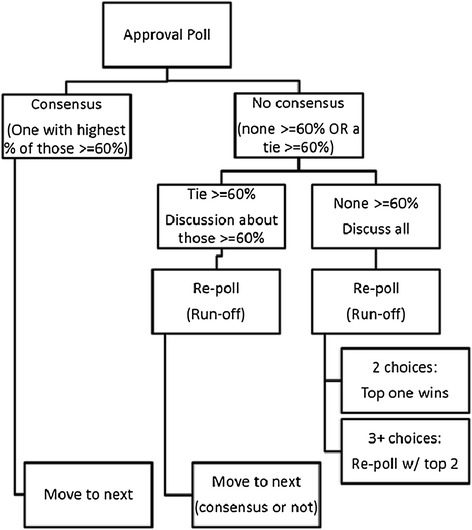
- Consensus voting used approval voting with a ≥60% supermajority threshold, followed by structured discussion and runoff voting when no clear winner emerged.
Limitations
- The paper states that using a different starting taxonomy may have yielded different results; the panel was limited to North America and mostly USA experts; online rather than in-person meetings may have produced less nuanced discussion; and some participants abstained from Round 3 voting for unknown reasons.
- The paper also states content limitations: the evidence base for each strategy was not considered, strategies were not explicitly tied to theories or conceptual models, and some strategies may be more applicable to US or North American settings.
- Evident from the text: the compilation is not intended as a checklist, and the authors note that no implementation effort could feasibly use every strategy; future research is needed to identify contexts and circumstances under which each discrete strategy is effective.
Model-written summary. Check it against the paper before relying on it.
Integrity signals
Registry
Cites
Statistics
Figures
Verification
Claims the paper makes
9 Valid · 0 Not valid · 8 Not checked · 53 Own results and interpretations
The cited sources support only part of this claim — read each source’s verdict below.
In the paper
“Second, published descriptions of implementation strategies too often do not include sufficient detail to enable either scientific or real-world replication [1,6]”
§ A refined compilation of implementation strategies: results from the Expert Recommendations for Implementing Change (ERIC) project > Background
What the sources say
- Could not verifycites [1] Proctor EK Powell BJ McMillen JC Implementation strategies: recommendations for specifying and reporting Implement Sci. 2013 8 1 11 10.1186/1748-5908-8-1 24289295 PMC3882890 sourceExperimental — accuracy not yet measured
Our copy of SENTRY contains no statement that published descriptions of implementation strategies lack sufficient detail for scientific or real-world replication; searched for replication/reproduce, intervention description detail, fidelity, reporting checklist, and generalizability. The closest passages are different points: the Background (p. n/a) notes prior single-centre and high-tech KT studies whose results 'are not applicable to hospitals without the required computer infrastructure' and whose generalizability remains untested, and the Discussion (p. n/a) concedes 'the lack of data on fidelity in the intervention group (i.e., the extent to which the intervention components were used/received as intended)' in their own trial. Neither addresses the adequacy of published reporting of implementation strategies, so this source neither supports nor contradicts the attributed claim. (LLM, conf=0.70)
- Supportedcites [6] Michie S Fixsen DL Grimshaw JM Eccles MP Specifying and reporting complex behaviour change interventions: the need for a scientific method Implement Sci. 2009 4 1 6 10.1186/1748-5908-4-40 19607700 PMC2717906 source
The 'Interventions aren't described' section (What is the problem?) states that published intervention evaluations 'are seldom reported by researchers or practitioners in enough detail to replicate them', and that researchers were less confident they could replicate behavioural interventions and judged they would need more information to deliver them in practice settings — covering both scientific and real-world replication. The Abstract reinforces this: complex behaviour change interventions 'are not well described; when they are described, the terminology used is inconsistent. This constrains scientific replication, and limits the subsequent introduction of successful interventions.' The only slight shift is terminological: this source speaks of 'behaviour change interventions' rather than 'implementation strategies', which the paired citation [6] presumably covers. (LLM, conf=0.88)
plain- Asserted: passes — The authors put it forward as true.
- Checkable: passes — It can be checked against evidence.
- Load-bearing: passes — The paper’s conclusions depend on it.
- Based: passes — The paper gives a reason why it holds.
- Could not verify
The cited sources support only part of this claim — read each source’s verdict below.
In the paper
“However, efforts to identify, develop, and test implementation strategies have been complicated by a lack of conceptual clarity [1,6-9].”
§ A refined compilation of implementation strategies: results from the Expert Recommendations for Implementing Change (ERIC) project > Background
What the sources say
- Could not verifycites [1] Proctor EK Powell BJ McMillen JC Implementation strategies: recommendations for specifying and reporting Implement Sci. 2013 8 1 11 10.1186/1748-5908-8-1 24289295 PMC3882890 sourceExperimental — accuracy not yet measured
The Background describes how the SENTRY intervention was developed, and the Discussion identifies practical barriers to testing and scaling it. The Results say that clinical risk terms such as “immobility” and “sepsis” needed clearer definitions, but no passage found in the search addresses a lack of conceptual clarity about implementation strategies as a complication in identifying, developing, or testing them. (LLM, conf=0.73)
- Supportedcites [6] Michie S Fixsen DL Grimshaw JM Eccles MP Specifying and reporting complex behaviour change interventions: the need for a scientific method Implement Sci. 2009 4 1 6 10.1186/1748-5908-4-40 19607700 PMC2717906 source
In “What is the problem? > Interventions aren't described” (page unavailable), the paper says interventions are often based on unstated or weakly applied models, leaving each new intervention and evaluation relatively isolated. It also says inconsistent terminology makes interventions difficult to distinguish and limits synthesis. Together, these passages support the claim that a lack of conceptual clarity complicates developing and testing implementation strategies. (LLM, conf=0.86)
- Partly supportedcites [7] McKibbon KA Lokker C Wilczynski NL Ciliska D Dobbins M Davis DA A cross-sectional study of the number and frequency of terms used to refer to knowledge translation in a body of health literature in 2006: a tower of Babel? Implement Sci. 2010 5 1 11 10.1186/1748-5908-5-16 21080976 PMC2834600 sourceExperimental — accuracy not yet measured
The Discussion (page unavailable) reports inconsistent terminology and definitions in knowledge translation and says this makes relevant research harder to find and understand. It does not specifically establish that this lack of clarity has complicated identifying, developing, or testing implementation strategies. (LLM, conf=0.84)
- Could not verifycites [8] Colquhoun H Leeman J Michie S Lokker C Bragge P Hempel S Towards a common terminology: a simplified framework of interventions to promote and integrate evidence into health practices, systems, and policies Implement Sci. 2014 9 1 6 10.1186/1748-5908-9-1 24885553 PMC4021969 sourceExperimental — accuracy not yet measured
The Background discusses factors affecting de-implementation and proposes a framework for prioritizing healthcare practices. The Empirical testing section discusses testing health policies, but neither section says that a lack of conceptual clarity has complicated efforts to identify, develop, or test implementation strategies. Searches for that phrase and related terms found no supporting passage in our copy. (LLM, conf=0.72)
- Supportedcites [9] Waltz TJ Powell BJ Chinman MJ Smith JL Matthieu MM Proctor EK Expert Recommendations for Implementing Change (ERIC): protocol for a mixed methods study Implement Sci. 2014 9 1 12 10.1186/1748-5908-9-39 24669765 PMC3987065 source
The Background section, “Lack of conceptual clarity for implementation strategies” (page not provided), says inconsistent terms and definitions hinder interpretation of research, synthesis, and replication. This supports the claim that conceptual ambiguity complicates work to identify, develop, and test implementation strategies. (LLM, conf=0.90)
plainstates a cause- Asserted: passes — The authors put it forward as true.
- Checkable: passes — It can be checked against evidence.
- Load-bearing: passes — The paper’s conclusions depend on it.
- Based: passes — The paper gives a reason why it holds.
- Could not verify
The cited sources support only part of this claim — read each source’s verdict below.
In the paper
“First, terms and definitions for implementation strategies are inconsistent [7,10].”
§ A refined compilation of implementation strategies: results from the Expert Recommendations for Implementing Change (ERIC) project > Background
What the sources say
- Partly supportedcites [7] McKibbon KA Lokker C Wilczynski NL Ciliska D Dobbins M Davis DA A cross-sectional study of the number and frequency of terms used to refer to knowledge translation in a body of health literature in 2006: a tower of Babel? Implement Sci. 2010 5 1 11 10.1186/1748-5908-5-16 21080976 PMC2834600 sourceExperimental — accuracy not yet measured
The Discussion reports inconsistent use of terms in articles about knowledge translation, and the Summary calls for standardizing terms and definitions. The study examines terminology for knowledge translation generally, however; it does not establish that definitions of implementation strategies specifically are inconsistent. The supplied copy gives section labels but no page numbers. (LLM, conf=0.83)
- Supportedcites [10] Powell BJ McMillen JC Proctor EK Carpenter CR Griffey RT Bunger AC A compilation of strategies for implementing clinical innovations in health and mental health Med Care Res Rev. 2012 69 123 57 10.1177/1077558711430690 22203646 PMC3524416 source
The Introduction says implementation strategies are rarely defined and that the terminology used to describe them is inconsistent. The Limitations section likewise describes improving consistency and clarity as an unfinished task. (LLM, conf=0.94)
plain- Asserted: passes — The authors put it forward as true.
- Checkable: passes — It can be checked against evidence.
- Load-bearing: passes — The paper’s conclusions depend on it.
- Based: passes — The paper gives a reason why it holds.
- Partly supported
Every source the paper cites for this claim was checked and supports it.
In the paper
“Powell et al. [10] proposed a consolidated compilation of 68 discrete (as opposed to multifaceted) implementation strategies and definitions based upon a review of the health and mental health literatures.”
§ A refined compilation of implementation strategies: results from the Expert Recommendations for Implementing Change (ERIC) project > Background
What the sources say
- Supportedcites [10] Powell BJ McMillen JC Proctor EK Carpenter CR Griffey RT Bunger AC A compilation of strategies for implementing clinical innovations in health and mental health Med Care Res Rev. 2012 69 123 57 10.1177/1077558711430690 22203646 PMC3524416 source
The Abstract states that the authors present a consolidated compilation of 68 discrete implementation strategies and definitions based on a review of 205 sources. The Introduction identifies health and mental health as the fields covered, and the Discussion distinguishes the discrete strategies from multifaceted implementation plans. (LLM, conf=0.95)
plain- Asserted: passes — The authors put it forward as true.
- Checkable: passes — It can be checked against evidence.
- Load-bearing: passes — The paper’s conclusions depend on it.
- Based: passes — The paper gives a reason why it holds.
- Supported
Every source the paper cites for this claim was checked and supports it.
In the paper
“Powell et al. [10] reviewed 41 compilations and reviews of implementation strategies and summarized them according to their foci and disciplines/clinical specialties that they represented”
§ A refined compilation of implementation strategies: results from the Expert Recommendations for Implementing Change (ERIC) project > Background
What the sources say
- Supportedcites [10] Powell BJ McMillen JC Proctor EK Carpenter CR Griffey RT Bunger AC A compilation of strategies for implementing clinical innovations in health and mental health Med Care Res Rev. 2012 69 123 57 10.1177/1077558711430690 22203646 PMC3524416 source
The Methods (Sources Identified) state that among the 205 sources identified, 41 were 'compilations, taxonomies, or reviews of multiple strategies', and the Introduction states 'For illustrative purposes, we provide brief summaries of 41 reviews and compilations of implementation strategies in Table 1.' The same Introduction section characterizes those sources by their foci — narrow scope on strategies with known effectiveness evidence, on 'specific medical conditions, fields of practice or disciplines', on a setting/study, exemplar programs, one level of target, or one type of strategy — which matches the claim's 'foci and disciplines/clinical specialties'. Only caveat: our copy does not reproduce Table 1's column headings, and the paper's overall review covered 205 sources rather than 41 alone. (LLM, conf=0.85)
plain- Asserted: passes — The authors put it forward as true.
- Checkable: passes — It can be checked against evidence.
- Load-bearing: passes — The paper’s conclusions depend on it.
- Based: passes — The paper gives a reason why it holds.
- Supported
17 more claims · 3 with their cited sources checked
Create a free account to see all 70 claims and to verify the 15 references still open.
- Probably not a substantial claim. 40
- It may state two separate claims as one. 23
- The quote only partly states this claim. 1
Claims other papers make about this one
Each is checked against this paper’s own text: does it say what the citing paper says it does?
The source backs part of the claim, not all of it — or backs it for a different population, condition or comparison.
In the citing paper
“In 2015, the Expert Recommendations for Implementing Change (ERIC) study organized a panel of implementation scientists to compile a standardized set of implementation strategy terms and definitions [2–4].”
From A systematic review of experimentally tested implementation strategies across health and human service settings: evidence from 2010-2022 (2024) · cites this paper as [2]
Experimental — accuracy not yet measuredThe source backs part of the claim, not all of it — or backs it for a different population, condition or comparison.
In the citing paper
“While there has been a rapid increase in the number of implementation trials over the past decade, the quality of trials has been criticised, and the effects of the strategies for such trials on implementation, patient or public health outcomes have been modest [11–13].”
From Guidance for conducting feasibility and pilot studies for implementation trials (2020) · cites this paper as [12]
Experimental — accuracy not yet measuredThe source backs part of the claim, not all of it — or backs it for a different population, condition or comparison.
In the citing paper
“The implementation of a new model of care is an ongoing process, usually lasting between 2 and 4 years [21,22].”
From Implementation of Brief Admission by Self-Referral in Child and Adolescent Psychiatry in Sweden: Insights from Implementers and Staff (2023) · cites this paper as [22]
Experimental — accuracy not yet measuredThe source backs part of the claim, not all of it — or backs it for a different population, condition or comparison.
In the citing paper
“Second, the operations manager was confident about the project, with an attitude that spread throughout the organization and helped us obtain a supportive organization [22].”
From Implementation of Brief Admission by Self-Referral in Child and Adolescent Psychiatry in Sweden: Insights from Implementers and Staff (2023) · cites this paper as [22]
Experimental — accuracy not yet measuredThe cited source says what the claim attributes to it.
In the citing paper
“Several resources can inform the use of implementation strategies, including established taxonomies of implementation strategies (6, 7, 24, 25) and behavior change techniques (27, 28), repositories of systematic reviews (38, 103, 104), methods for selecting and tailoring implementation strategies (40, 55, 56), and reporting guidelines that promote replicability (4, 98–100).”
From Enhancing the Impact of Implementation Strategies in Healthcare: A Research Agenda (2019) · cites this paper as [7]
11 more claims about this paper
Create a free account to see every claim other papers make about this one.
Citations
Cites
Damschroder, L. J., Aron, D. C., Keith, R. E., Kirsh, S. R., Alexander, J. A., & Lowery, J. C. (2009) · Implementation Science · doi:10.1186/1748-5908-4-50 · Cited by 14,496 · cited 3×
“, the Consolidated Framework for Implementation Research [47], Theoretical Domains Framework [48,49], Promoting Action on Research Implementation in Health Services (PARIHS) framework [50]).”
MethodSelf-citationPalinkas, L. A., Horwitz, S. M., Green, C. A., Wisdom, J. P., Duan, N., & Hoagwood, K. (2015) · Administration and Policy in Mental Health and Mental Health Services Research · doi:10.1007/s10488-013-0528-y · Cited by 12,038
Crossing the Quality Chasm: A New Health System for the 21st Century
Baker, A. (2001) · BMJ · doi:10.1136/bmj.323.7322.1192 · Cited by 10,736
Crossing the Quality Chasm: A New Health System for the 21st Century
Committee on Quality of Health Care in America (2002) · Journal For Healthcare Quality · doi:10.1111/j.1945-1474.2002.tb00463.x · Cited by 8,483
Cane, J., O’Connor, D., & Michie, S. (2012) · Implementation Science · doi:10.1186/1748-5908-7-37 · Cited by 4,888 · cited 2×
“, the Consolidated Framework for Implementation Research [47], Theoretical Domains Framework [48,49], Promoting Action on Research Implementation in Health Services (PARIHS) framework [50]).”
MethodFrom best evidence to best practice: effective implementation of change in patients' care
Grol, R., & Grimshaw, J. (2003) · The Lancet · doi:10.1016/s0140-6736(03)14546-1 · Cited by 4,531
Making psychological theory useful for implementing evidence based practice: a consensus approach
Michie, S. (2005) · Quality and Safety in Health Care · doi:10.1136/qshc.2004.011155 · Cited by 3,440 · cited 2×
“, the Consolidated Framework for Implementation Research [47], Theoretical Domains Framework [48,49], Promoting Action on Research Implementation in Health Services (PARIHS) framework [50]).”
MethodImplementation strategies: recommendations for specifying and reporting
Proctor, E. K., Powell, B. J., & McMillen, J. C. (2013) · Implementation Science · doi:10.1186/1748-5908-8-139 · Cited by 2,585 · cited 6×
“Taken together, these two deficiencies complicate the acquisition and interpretation of knowledge, preclude research syntheses such as systematic reviews and meta-analyses, limit replication in both research and practice, and ultimately stymie the translation and application of empirical studies that could inform impl…”
BackgroundMethodInfluentialSelf-citationBero, L. A., Grilli, R., Grimshaw, J. M., Harvey, E., Oxman, A. D., & Thomson, M. A. (1998) · BMJ · doi:10.1136/bmj.317.7156.465 · Cited by 2,396
Welcome to Implementation Science
Eccles, M. P., & Mittman, B. S. (2006) · Implementation Science · doi:10.1186/1748-5908-1-1 · Cited by 2,254
Research works printed but not linked: 4
- Cochrane Effective Practice and Organisation of Care Group Data collection checklist 2002 1 30
- Walter I Nutley S Davies H Developing a taxonomy of interventions used to increase the impact of research 2003 Andrews University of St. Andrews of St. Andrews
- Ryan R Lowe D Santesso N Hill S Development of a taxonomy of interventions directed at consumers to promote evidence-based prescribing and medicines use: a tool for evidence-based decision-making 2010 Melbourne, Australia In National Medicines Symposium
- Shojania KG McDonald KM Wachter RM Owens DK Closing the quality gap: a critical analysis of quality improvement strategies, volume 1—series overview and methodology. Technical review 9 2004 Agency for Healthcare Research and Quality Rockville, MD 20734525
Cited by
Items 101–200 of 1,024
Kemp, C. G., Jarrett, B. A., Kwon, C.-S., Song, L., Jetté, N., Sapag, J. C., Bass, J., Murray, L., Rao, D., & Baral, S. (2019) · BMC Medicine · doi:10.1186/s12916-018-1237-x · Cited by 138
“The emphasis is on implementation strategies, namely on approaches to facilitate, strengthen, or sustain the delivery of evidence-based technologies, practices, and services [22, 23].”
BackgroundWang, D. Y., Wong, E. L., Nilsén, P., Chung, V. C., Tian, Y., & Yeoh, E. (2023) · Implementation Science · doi:10.1186/s13012-023-01296-x · Cited by 175
“Implementation scientists have generated several comprehensive strategy taxonomies for implementation scientists to choose from, such as ERIC [122, 123] and EPOC [124], but to what extent specific strategies could address determinants were not tested [125].”
BackgroundBoyd, M. R., Powell, B. J., Endicott, D., & Lewis, C. C. (2018) · Behavior Therapy · doi:10.1016/j.beth.2017.11.012 · Cited by 137
“, 2012) and further did not align with any of the additional strategies proposed in the later version of the taxonomy (Powell et al., 2015).”
ResultSelf-citationImportance and feasibility of an adapted set of implementation strategies in schools
Lyon, A. R., Cook, C. R., Locke, J., Davis, C., Powell, B. J., & Waltz, T. J. (2019) · Journal of School Psychology · doi:10.1016/j.jsp.2019.07.014 · Cited by 135
“The taxonomy was then refined with input from a variety of implementation researchers and practitioners, yielding 73 unique strategies (Powell et al., 2015), placed into nine categories (Engage Consumers, Use Evaluative and Iterative Strategies, Change Infrastructure, Adapt and Tailor to Context, Develop Stakeholder I…”
BackgroundMethodInfluentialSelf-citationDevelopment of the Learning Health System Researcher Core Competencies
Forrest, C. B., Chesley, F. D., Tregear, M., & Mistry, K. B. (2017) · Health Services Research · doi:10.1111/1475-6773.12751 · Cited by 150
“, audit and feedback, financial incentives, coaching, mentoring) used to change provider behavior in order to enhance the uptake of an evidence-based clinical treatment or practice (Powell et al. 2015).”
von Thiele Schwarz, U., Aarons, G. A., & Hasson, H. (2019) · BMC Health Services Research · doi:10.1186/s12913-019-4668-y · Cited by 134
“Implementation strategies are systematic processes to adopt and integrate EBIs into clinical care [22].”
BackgroundOptimizing Cancer Care Delivery through Implementation Science
Adesoye, T., Greenberg, C. C., & Neuman, H. B. (2016) · Frontiers in Oncology · doi:10.3389/fonc.2016.00001 · Cited by 130
“These strategies vary in nature and complexity from a single component (such as reminders, educational meetings) to multifaceted designs, which include multiple discrete or interwoven strategies (5, 16, 17).”
BackgroundTumilowicz, A., Ruel, M. T., Pelto, G. H., Pelletier, D. L., Monterrosa, E. C., Lapping, K., Kraemer, K., de Regil, L. M., Bergeron, G., Arabi, M., et al. (2018) · Current Developments in Nutrition · doi:10.1093/cdn/nzy080 · Cited by 140
Reyes, A. D. L., Cook, C. R., Gresham, F. M., Makol, B. A., & Wang, M. (2019) · Journal of School Psychology · doi:10.1016/j.jsp.2019.05.005 · Cited by 151
Hagermoser Sanetti, L. M., & Collier-Meek, M. A. (2019) · Journal of School Psychology · doi:10.1016/j.jsp.2019.07.008 · Cited by 129
Koh, W. Q., Felding, S. A., Budak, K. B., Toomey, E. C., & Casey, D. (2021) · BMC Geriatrics · doi:10.1186/s12877-021-02277-9 · Cited by 148
Davis, M. M., Freeman, M., Shannon, J., Coronado, G. D., Stange, K. C., Guise, J., Wheeler, S. B., & Buckley, D. (2018) · BMC Cancer · doi:10.1186/s12885-017-3813-4 · Cited by 133
“Tools used in our review may inform such guidelines, including more routine application of Proctor, Powell and colleague’s recommendations for tracking and reporting implementation strategies [32, 34, 72] or Stange and colleague’s conceptualization of contextual factors [35–37].”
BackgroundMethodRapid Integration of Home Telehealth Visits Amidst COVID ‐19: What Do Older Adults Need to Succeed?
Hawley, C. E., Genovese, N., Owsiany, M. T., Triantafylidis, L. K., Moo, L. R., Linsky, A. M., Sullivan, J. L., & Paik, J. M. (2020) · Journal of the American Geriatrics Society · doi:10.1111/jgs.16845 · Cited by 132
“We mapped the most frequently occurring barriers to evidence-based implementation strategies to overcome them based on the Expert Recommendations for Implementing Change.31,32 We included these strategies when we designed our home telehealth pilot to address these patient-perceived barriers.”
MethodHull, L., Goulding, L., Khadjesari, Z., Davis, R. E., Healey, A., Bakolis, I., & Sevdalis, N. (2019) · Implementation Science · doi:10.1186/s13012-019-0897-z · Cited by 139
“A program of research is currently underway to improve guidance regarding how best to select implementation strategies [8, 32, 33].”
BackgroundCommunity engagement to implement evidence-based practices in the HEALing communities study
Martinez, L. S. S., Rapkin, B. D., Young, A. M., Freisthler, B., Glasgow, L., Hunt, T., Salsberry, P. J., Oga, E. A., Fallin‐Bennett, A., Plouck, T. J., et al. (2020) · Drug and Alcohol Dependence · doi:10.1016/j.drugalcdep.2020.108326 · Cited by 137
Dopp, A. R., Parisi, K. E., Munson, S. A., & Lyon, A. R. (2019) · Health Research Policy and Systems · doi:10.1186/s12961-018-0403-0 · Cited by 123
Lengnick-Hall, R., Stadnick, N. A., Dickson, K. S., Moullin, J. C., & Aarons, G. A. (2021) · Implementation Science · doi:10.1186/s13012-021-01099-y · Cited by 119
“Examples in the Expert Recommendations for Implementing Change project include accessing new funding, altering incentives for implementation or creating disincentives (de-implementation) structures, modifying payments or fees, building a coalition or communityacademic partnership, and staging implementation scaleup [2…”
BackgroundChen, E. S., Neta, G. I., & Roberts, M. C. (2020) · Translational Behavioral Medicine · doi:10.1093/tbm/ibaa079 · Cited by 137
“HCD methods may be particularly useful for operationalizing implementation strategies [6] within four of the nine broader implementation strategy categories identified by Waltz et al.”
BackgroundMethodInfluentialMoore, S. A., Boyne, P., Fulk, G. D., Verheyden, G., & Fini, N. A. (2022) · Stroke · doi:10.1161/strokeaha.122.038956 · Cited by 145
Janke, K. K., Bloom, T. J., Boyce, E. G., Johnson, J. L., Kopacek, K. J., O’Sullivan, T. A., Petrelli, H. M. W., Steeb, D. R., & Ross, L. J. (2021) · American Journal of Pharmaceutical Education · doi:10.5688/ajpe8714 · Cited by 137
“compilation report of implementation science strategies.(54) According to the National Implementation Research Network, implementation progresses through four stages of development: exploration, installation, initial implementation, and full implementation.”
BackgroundGoorts, K., Dizon, J. M. R., & Milanese, S. (2021) · BMC Health Services Research · doi:10.1186/s12913-021-06190-0 · Cited by 133
Use and effects of implementation strategies for practice guidelines in nursing: a systematic review
Cassidy, C. E., Harrison, M. B., Godfrey, C. M., Nincic, V., Khan, P. A., Oakley, P., Ross‐White, A., Grantmyre, H., & Graham, I. D. (2021) · Implementation Science · doi:10.1186/s13012-021-01165-5 · Cited by 136
“For example, the Expert Recommendations for Implementing Change (ERIC) project provides a compilation of implementation strategies, including strategies such as facilitation, promote adaptability, assess for readiness, identify barriers and facilitators, and develop academic partnerships [42].”
MethodDamschroder, L. J., Reardon, C. M., Sperber, N., Robinson, C. H., Fickel, J. J., & Oddone, E. Z. (2017) · Translational Behavioral Medicine · doi:10.1007/s13142-016-0424-6 · Cited by 117
Self-citationDesigning the Future of Children’s Mental Health Services
Lyon, A. R., Dopp, A. R., Brewer, S. K., Kientz, J. A., & Munson, S. A. (2020) · Administration and Policy in Mental Health and Mental Health Services Research · doi:10.1007/s10488-020-01038-x · Cited by 115
Bussières, A., Cancelliere, C., Ammendolia, C., Comer, C. M., Zoubi, F. A., Châtillon, C.-É., Chernish, G., Cox, J. M., Gliedt, J. A., Haskett, D., et al. (2021) · Journal of Pain · doi:10.1016/j.jpain.2021.03.147 · Cited by 137
Leveraging Implementation Science to Improve Cancer Care Delivery and Patient Outcomes
Mitchell, S. A., & Chambers, D. (2017) · Journal of Oncology Practice · doi:10.1200/jop.2017.024729 · Cited by 122
“TheERIC initiative identified73 implementation strategies grouped into six clusters.(1,2,48) ERIC provides a menu of strategies allowing researcher to compare and prioritize intervention options.”
MethodVancampfort, D., Firth, J., Stubbs, B., Schuch, F. B., Rosenbaum, S., Hallgren, M. Å., Deenik, J., Ward, P. B., Mugisha, J., Damme, T. V., et al. (2025) · World Psychiatry · doi:10.1002/wps.21314 · Cited by 129
Quantitative approaches for the evaluation of implementation research studies
Smith, J. D., & Hasan, M. M. (2019) · Psychiatry Research · doi:10.1016/j.psychres.2019.112521 · Cited by 174
Self-citationCooper, J., Murphy, J., Woods, C., Van Nassau, F., McGrath, A., Callaghan, D., Carroll, P., Kelly, P., Murphy, N., Murphy, M., et al. (2021) · International Journal of Behavioral Nutrition and Physical Activity · doi:10.1186/s12966-021-01177-w · Cited by 114
Web-Based Training Methods for Behavioral Health Providers: A Systematic Review
Jackson, C. B., Quetsch, L. B., Brabson, L. A., & Herschell, A. D. (2018) · Administration and Policy in Mental Health and Mental Health Services Research · doi:10.1007/s10488-018-0847-0 · Cited by 112
“Training has been identified as a key implementation strategy for improving provider knowledge and skill in an EBP; however, there is a lack of agreement regarding the most effective training methods (Fixsen et al. 2005; Powell et al. 2015; Stuart et al. 2004).”
Houghtaling, B., Serrano, E. L., Kraak, V. I., Harden, S. M., Davis, G. C., & Misyak, S. A. (2019) · International Journal of Behavioral Nutrition and Physical Activity · doi:10.1186/s12966-019-0767-8 · Cited by 131
Morena, A., Gaias, L. M., & Larkin, C. (2022) · Frontiers in Health Services · doi:10.3389/frhs.2022.896885 · Cited by 139
“Per the ERIC taxonomy (12), the implementation strategy “identify and prepare champions””
BackgroundMethodInfluentialLewis, C. C., Scott, K., & Marriott, B. R. (2018) · Implementation Science · doi:10.1186/s13012-018-0761-6 · Cited by 123
“We then organized the top-rated strategies into a 3-phase Implementation Blueprint guided by the implementation science literature and consensus among the CBT purveyor and implementation researchers regarding timing for optimal impact [9].”
BackgroundMethodYakovchenko, V., Miech, E. J., Chinman, M., Chartier, M., Gonzalez, R. I., Kirchner, J. E., Morgan, T. R. M., Park, A. Y. S., Powell, B. J., Proctor, E. K., et al. (2020) · Medical Care · doi:10.1097/mlr.0000000000001319 · Cited by 121
Self-citationThe Importance of Mental Models in Implementation Science
Holtrop, J. S., Scherer, L. D., Matlock, D. D., Glasgow, R. E., & Green, L. A. (2021) · Frontiers in Public Health · doi:10.3389/fpubh.2021.680316 · Cited by 138
“The Expert Recommendations for Implementing Change compilation (ERIC) provides a start with a compilation that lists 73 different implementation strategies in nine different categories (53, 54).”
MethodAligning implementation science with improvement practice: a call to action
Leeman, J., Rohweder, C. L., Lee, M., Brenner, A. T., Dwyer, A. J., Ko, L. K., O’Leary, M. C., Ryan, G. W., Vu, T. T., & Ramanadhan, S. (2021) · Implementation Science Communications · doi:10.1186/s43058-021-00201-1 · Cited by 123
Eldh, A. C., Almost, J., DeCorby-Watson, K., Gifford, W., Harvey, G., Hasson, H., Kenny, D. J., Moodie, S., Wallin, L., & Yost, J. (2017) · BMC Health Services Research · doi:10.1186/s12913-016-1958-5 · Cited by 126
Moullin, J. C., Sabater-Hernández, D., & Benrimoj, S. I. (2016) · BMC Health Services Research · doi:10.1186/s12913-016-1689-7 · Cited by 108
“[34], 51 were implicated by at least one pharmacy [Additional file 6].”
Computer-Based Interventions for Problematic Alcohol Use: a Review of Systematic Reviews
Sundström, C., Blankers, M., & Khadjesari, Z. (2017) · International Journal of Behavioral Medicine · doi:10.1007/s12529-016-9601-8 · Cited by 106
“Whilst this is a promising development, it is important that interventions intended to be widely disseminated under-go robust evaluation and that effective implementation strategies, best suited to their context, are used [38].”
BackgroundEvaluation of Pragmatic Telehealth Physical Therapy Implementation During the COVID-19 Pandemic
Miller, M. J., Pak, S. S., Keller, D. R., & Barnes, D. E. (2021) · Physical Therapy · doi:10.1093/ptj/pzaa193 · Cited by 106
Nathan, N., Powell, B. J., Shelton, R. C., Laur, C. V., Wolfenden, L., Hailemariam, M., Yoong, S. L., Sutherland, R., Kingsland, M., Waltz, T. J., et al. (2022) · Frontiers in Health Services · doi:10.3389/frhs.2022.905909 · Cited by 105
“The Expert Recommendations for Implementing Change (ERIC) compilation (8, 13) has been widely used in health and public health and has provided much-needed common terminology for implementation strategies.”
BackgroundMethodSelf-citationBruns, E. J., Parker, E. M. L., Hensley, S., Pullmann, M. D., Benjamin, P. H., Lyon, A. R., & Hoagwood, K. (2019) · Implementation Science · doi:10.1186/s13012-019-0944-9 · Cited by 125
Valenstein-Mah, H., Greer, N., McKenzie, L., Hansen, L., Strom, T. Q., Wiltsey Stirman, S., Wilt, T. J., & Kehle-Forbes, S. M. (2020) · Implementation Science · doi:10.1186/s13012-020-00998-w · Cited by 104
Stirman, S. W., Gutner, C. A., Langdon, K., & Graham, J. R. (2016) · Behavior Therapy · doi:10.1016/j.beth.2015.12.001 · Cited by 103
Powell, B. J., Mandell, D. S., Hadley, T. R., Rubin, R. M., Evans, A. C., Hurford, M. O., & Beidas, R. S. (2017) · Implementation Science · doi:10.1186/s13012-017-0593-9 · Cited by 102
“This limits our ability to understand how these factors coalesce to influence implementation success or failure and, hence, how implementation strategies [20, 21] should be selected and sequenced to promote the implementation of EBPs.”
BackgroundSelf-citationAlagöz, E., Chih, M., Hitchcock, M., Brown, R., & Quanbeck, A. (2018) · BMC Health Services Research · doi:10.1186/s12913-018-2856-9 · Cited by 122
“A compilation of discrete implementation strategies lists tactics such as “use an improvement/implementation advisor,” “Conduct educational outreach visits,” “Conduct ongoing training,” and “External facilitation,” all of which are examples of implementation strategies where external change agents play an essential ro…”
BackgroundMoise, N., Cené, C. W., Tabak, R. G., Young, D. R., Mills, K. T., Essien, U. R., Anderson, C. A. M., & López-Jiménez, F. A. (2022) · Circulation · doi:10.1161/cir.0000000000001096 · Cited by 112
Proctor, E., Hooley, C., Morse, A., McCrary, S., Kim, H., & Kohl, P. L. (2019) · Implementation Science · doi:10.1186/s13012-018-0845-3 · Cited by 99
“” Information about implementation strategies, for use by distribution agents such as IPOs or by individual agencies and providers, has only recently been compiled [23, 30].”
BackgroundSelf-citationFAST: A Framework to Assess Speed of Translation of Health Innovations to Practice and Policy
Proctor, E., Ramsey, A. T., Saldana, L., Maddox, T. M., Chambers, D. A., & Brownson, R. C. (2022) · Global Implementation Research and Applications · doi:10.1007/s43477-022-00045-4 · Cited by 95
Self-citationLourida, I., Abbott, R. A., Rogers, M., Lang, I. A., Stein, K., Kent, B., & Thompson Coon, J. (2017) · BMC Geriatrics · doi:10.1186/s12877-017-0528-y · Cited by 100
“We explored coding of dissemination and implementation approaches using two different classifications: the EPOC (Effective Practice and Organisation of Care) taxonomy of health systems interventions [17] and the ERIC (Expert Recommendations for Implementing Change) compilation of implementation strategies [18, 19].”
MethodKilbourne, A. M., Elwy, A. R., Sales, A. E., & Atkins, D. (2017) · Medical Care · doi:10.1097/mlr.0000000000000683 · Cited by 100
Huynh, A. K., Hamilton, A. B., Farmer, M. M., Bean-Mayberry, B., Stirman, S. W., Moin, T., & Finley, E. P. (2018) · Frontiers in Public Health · doi:10.3389/fpubh.2018.00134 · Cited by 100
“Powell and colleagues (9) have done much to support this effort by developing a compilation of 73 discrete implementation strategies through a process of expert review.”
BackgroundMethodInfluentialOperating Room Crisis Checklists and Emergency Manuals
Hepner, D. L., Arriaga, A. F., Cooper, J. B., Goldhaber-Fiebert, S. N., Gaba, D. M., Berry, W. R., Boorman, D. J., & Bader, A. M. (2017) · Anesthesiology · doi:10.1097/aln.0000000000001731 · Cited by 112
Current Implementation of Digital Health in Chronic Disease Management: Scoping Review
Pong, C. Y., Tseng, R. M. W. W., Tham, Y. C., & Lum, E. (2024) · Journal of Medical Internet Research · doi:10.2196/53576 · Cited by 126
“Table 3 shows the implementation strategies used, mapped to the ERIC taxonomy [202,204]”
Rogal, S. S., Yakovchenko, V., Waltz, T. J., Powell, B. J., Kirchner, J. E., Proctor, E. K., Gonzalez, R., Park, A., Ross, D., Morgan, T. R., et al. (2017) · Implementation Science · doi:10.1186/s13012-017-0588-6 · Cited by 98
“Overall sites used multiple strategies including those that were previously identified as less feasible by implementation researchers and clinical managers [3].”
BackgroundInfluentialSelf-citationThe top ten: best practice recommendations for aphasia
Simmons-Mackie, N., Worrall, L., Murray, L. L., Enderby, P., Rose, M. L., Paek, E. J., & Klippi, A. (2017) · Aphasiology · doi:10.1080/02687038.2016.1180662 · Cited by 96
Designs and methods for implementation research: Advancing the mission of the CTSA program
Hwang, S., Birken, S. A., Melvin, C. L., Rohweder, C. L., & Smith, J. D. (2020) · Journal of Clinical and Translational Science · doi:10.1017/cts.2020.16 · Cited by 109
Self-citationPatey, A. M., Grimshaw, J., & Francis, J. (2021) · Implementation Science · doi:10.1186/s13012-021-01089-0 · Cited by 117
Evidence-Based Practice in Speech-Language Pathology: Where Are We Now?
Greenwell, T., & Walsh, B. M. (2021) · American Journal of Speech-Language Pathology · doi:10.1044/2020_ajslp-20-00194 · Cited by 122
“Follow-up research into prevalent barriers is crucial toward the development of viable solutions to lessen their impact and advance implementation theory and practice (Powell et al., 2017). For example, although clinicians recognize the importance of external evidence, how often do they retrieve articles that help dev…”
BackgroundWarran, K., Burton, A., & Fancourt, D. E. (2022) · Wellcome Open Research · doi:10.12688/wellcomeopenres.17414.1 · Cited by 113
Strategies for de-implementation of low-value care—a scoping review
Ingvarsson, S., Hasson, H., Schwarz, U. V. T., Nilsén, P., Powell, B. J., Lindberg, C., & Augustsson, H. (2022) · Implementation Science · doi:10.1186/s13012-022-01247-y · Cited by 121
“One such taxonomy is the ERIC compilation [31], which consists of 73 discrete implementation strategies belonging to nine categories [35].”
BackgroundSelf-citationArtificial Intelligence and IoT in Elderly Fall Prevention: A Review
Mohan, D., Al-Hamid, D. Z., Chong, P. H. J., Sudheera, K. L. K., Gutiérrez, J., Chan, H. C. B., & Li, H. (2024) · IEEE Sensors Journal · doi:10.1109/jsen.2023.3344605 · Cited by 115
“3) Exercise Programs: a) Training programs using sensors and IoT: Hospitals and residential care facilities frequently implement fall prevention measures, as described in [40].”
BackgroundDeschodt, M., Laurent, G., Cornelissen, L., Yip, O., Zúñiga, F., Denhaerynck, K., Briel, M., Karabegović, A., & Geest, S. D. (2020) · International Journal of Nursing Studies · doi:10.1016/j.ijnurstu.2020.103552 · Cited by 108
From novice to expert: a qualitative study of implementation facilitation skills
Ritchie, M. J., Parker, L. E., & Kirchner, J. E. (2020) · Implementation Science Communications · doi:10.1186/s43058-020-00006-8 · Cited by 116
Self-citationA conceptual model to guide research on the activities and effects of innovation champions
Shea, C. M. (2021) · Implementation Research and Practice · doi:10.1177/2633489521990443 · Cited by 113
“In fact, expert consensus suggests that identifying and preparing champions is one of the more important and feasible implementation strategies (Waltz et al., 2015).”
InfluentialMetz, A. J. R., Albers, B., Burke, K., Bartley, L., Louison, L., Ward, C. S., & Farley, A. B. (2021) · Human Services Organizations Management Leadership & Governance · doi:10.1080/23303131.2021.1895401 · Cited by 118
“This suggests a need to more strongly integrate other implementation science concepts within the principles and competencies profile, such as implementation strategies (Powell et al., 2015), implementation outcomes (Proctor et al., 2011) and implementation determinants (Damschroder et al., 2009).”
BackgroundInfluentialAshcraft, L. E., Goodrich, D. E., Hero, J., Phares, A., Bachrach, R. L., Quinn, D. A., Qureshi, N., Ernecoff, N. C., Lederer, L. G., Scheunemann, L. P., et al. (2024) · Implementation Science · doi:10.1186/s13012-024-01369-5 · Cited by 89
Self-citationLivet, M., Haines, S. T., Curran, G. M., Seaton, T., Ward, C. S., Sorensen, T. D., & McClurg, M. R. (2018) · Pharmacotherapy The Journal of Human Pharmacology and Drug Therapy · doi:10.1002/phar.2114 · Cited by 91
“For example, previous research identified at least eight different components of implementation,(27) more than 20 multilevel factors that influence the level of implementation,(28) 14 steps or activities necessary to increase implementation effectiveness,(17) at least 8 different implementation outcomes,(29) and 73 im…”
BackgroundMethodImplementation Support Skills: Findings From a Systematic Integrative Review
Albers, B., Metz, A. J. R., Burke, K., Bührmann, L., Bartley, L., Driessen, P., & Varsi, C. (2020) · Research on Social Work Practice · doi:10.1177/1049731520967419 · Cited by 106
Lyon, A. R., Coifman, J., Cook, H., McRee, E., Liu, F. F., Ludwig, K. A., Dorsey, S., Koerner, K., Munson, S. A., & McCauley, E. (2021) · Implementation Science Communications · doi:10.1186/s43058-021-00183-0 · Cited by 101
Community–academic partnerships in implementation research
Pellecchia, M., Mandell, D. S., Nuske, H. J., Azad, G., Benjamin Wolk, C., Maddox, B. B., Reisinger, E. M., Skriner, L. C., Adams, D. R., Stewart, R., et al. (2018) · Journal of Community Psychology · doi:10.1002/jcop.21981 · Cited by 89
Alley, Z. M., Chapman, J. E., Schaper, H., & Saldana, L. (2023) · Implementation Science · doi:10.1186/s13012-023-01285-0 · Cited by 86
“Thus, supporting the field’s plea for implementation strategies that facilitate successful program start-up [36, 37], the present results illustrate that Engagement—informing a site about a program, engaging them in discussions about program fit, and providing them with program materials—is insufficient for successful…”
BackgroundRobert, G., Sarre, S., Maben, J., Griffiths, P., & Chable, R. (2019) · BMJ Quality & Safety · doi:10.1136/bmjqs-2019-009457 · Cited by 92
Kilbourne, A. M., Smith, S. N., Choi, S. Y., Koschmann, E., Liebrecht, C., Rusch, A., Abelson, J. L., Eisenberg, D., Himle, J. A., Fitzgerald, K. D., et al. (2018) · Implementation Science · doi:10.1186/s13012-018-0808-8 · Cited by 92
Barnes, C., McCrabb, S., Stacey, F., Nathan, N., Yoong, S. L., Grady, A., Sutherland, R., Hodder, R., Innes-Hughes, C., Davies, M., et al. (2021) · Translational Behavioral Medicine · doi:10.1093/tbm/ibab037 · Cited by 84
“Future research calls for studies of high methodological quality using validated and consistent measures of implementation whilst adequately reporting employed implementation strategies using taxonomies, such as the EPOC [32] or Expert Recommendations for Implementing Change [76] taxonomies.”
MethodOpportunities for Epidemiologists in Implementation Science: A Primer
Neta, G. I., Brownson, R. C., & Chambers, D. (2017) · American Journal of Epidemiology · doi:10.1093/aje/kwx323 · Cited by 100
Applying the Policy Ecology Framework to Philadelphia’s Behavioral Health Transformation Efforts
Powell, B. J., Beidas, R. S., Rubin, R. M., Stewart, R. E., Wolk, C. B., Matlin, S. L., Weaver, S., Hurford, M. O., Evans, A. C., Hadley, T. R., et al. (2016) · Administration and Policy in Mental Health and Mental Health Services Research · doi:10.1007/s10488-016-0733-6 · Cited by 82
Self-citationContextual factors related to implementation of classroom physical activity breaks
Carlson, J., Engelberg, J. K., Cain, K. L., Conway, T. L., Geremia, C. M., Bonilla, E. A., Kerner, J. F., & Sallis, J. F. (2017) · Translational Behavioral Medicine · doi:10.1007/s13142-017-0509-x · Cited by 94
“, [26]), few if any are specific to school physical activity.”
Gilhooly, D., Green, S. A., McCann, C., Black, N. A., & Moonesinghe, R. (2019) · Implementation Science · doi:10.1186/s13012-019-0894-2 · Cited by 88
“The ERIC project initially reviewed the literature, used experts to come to a consensus on detailed definitions for each strategy and then categorised them through concept mapping to arrive at a taxonomy to be used when implementing change [21, 37].”
MethodLewis, C. C., Powell, B. J., Brewer, S. K., Nguyen, A. M., Schriger, S. H., Vejnoska, S. F., Walsh-Bailey, C., Aarons, G. A., Beidas, R. S., Lyon, A. R., et al. (2021) · BMJ Open · doi:10.1136/bmjopen-2021-053474 · Cited by 83
Self-citationOh, A., Abazeed, A., & Chambers, D. (2021) · Frontiers in Public Health · doi:10.3389/fpubh.2021.681602 · Cited by 96
“In this case, a LHPS might identify key implementation strategies to drive deliberate change in health care practice, and we would have benefitted from iterative assessment of how EHRs affected intervention implementation (21).”
BackgroundVermont Oxford Network: a worldwide learning community
Edwards, E. M., Ehret, D. E. Y., Soll, R. F., & Horbar, J. D. (2019) · Translational Pediatrics · doi:10.21037/tp.2019.07.01 · Cited by 94
Lengnick‐Hall, R., Willging, C. E., Hurlburt, M. S., Fenwick, K. M., & Aarons, G. A. (2020) · Implementation Science · doi:10.1186/s13012-020-00999-9 · Cited by 87
Thoele, K., Ferren, M., Moffat, L., Keen, A., & Newhouse, R. (2020) · Implementation Science Communications · doi:10.1186/s43058-020-00081-x · Cited by 76
Cohen, F., & Yaeger, L. (2021) · Implementation Research and Practice · doi:10.1177/2633489521998790 · Cited by 88
“Frameworks such as RE-AIM, CFIR (Consolidated Framework for Implementation Research), and various others are useful to guide the development and rigorous evaluation of interventions (Powell et al., 2015; Proctor et al., 2011, 2013).”
Juckett, L., Bunger, A. C., McNett, M., Robinson, M. L., & Tucker, S. (2022) · Implementation Science · doi:10.1186/s13012-022-01216-5 · Cited by 92
“[2] Core intervention component Description”
MethodDopp, A. R., Narcisse, M.-R., Mundey, P., Silovsky, J. F., Smith, A. B., Mandell, D., Funderburk, B. W., Powell, B. J., Schmidt, S., Edwards, D., et al. (2020) · Implementation Research and Practice · doi:10.1177/2633489520939980 · Cited by 79
“…our financing strategy compilation and, using the modified Delphi method developed for the Expert Recommendations for Implementing Change project (Powell et al., 2015; Waltz et al., 2014), provide feedback on (1) the current strategies and definitions and (2) additional strategies or sources of…”
BackgroundMethodInfluentialSelf-citationSchwartz, J. M., Moy, A. J., Rossetti, S. C., Elhadad, N., & Cato, K. D. (2021) · Journal of the American Medical Informatics Association · doi:10.1093/jamia/ocaa296 · Cited by 83
Peters‐Corbett, A., Parke, S., Bear, H. A., & Clarke, T. (2023) · Child and Adolescent Mental Health · doi:10.1111/camh.12672 · Cited by 101
Zhou, P., Chen, L., Wu, Z., Wang, E., Yan, Y., Guan, X., Zhai, S., & Yang, K. (2023) · Journal of Clinical Epidemiology · doi:10.1016/j.jclinepi.2023.08.017 · Cited by 98
Implementation frameworks in child, youth and family services – Results from a scoping review
Albers, B., Mildon, R. L., Lyon, A. R., & Shlonsky, A. (2017) · Children and Youth Services Review · doi:10.1016/j.childyouth.2017.07.003 · Cited by 89
“…processes and to identify key influences that help individuals, organizations and systems to better understand and guide their implementation work (Greenhalgh, Robert, Macfarlane, Bate, & Kyriakidou, 2004; Novins et al., 2013; Powell et al., 2015; Tabak, Khoong, Chambers, & Brownson, 2012).”
BackgroundInfluentialDolansky, M. A., Schexnayder, J. K., Patrician, P. A., & Sales, A. E. (2017) · Nurse Educator · doi:10.1097/nne.0000000000000422 · Cited by 86
“Implementation strategies refer to formal methods or techniques used to enhance the adaption, implementation, and sustainability of a clinical practice or program.(19,20) They have been described as the how to of changing practice and are an essential focus of implementation science.”
InfluentialPreckel, B., Staender, S. E. A., Velasco, D. A., Brattebø, G., Feldman, J. M., ffrench‐O'Carroll, R., Fuchs‐Buder, T., Goldhaber-Fiebert, S. N., Haller, G., Haugen, A. S., et al. (2020) · European Journal of Anaesthesiology · doi:10.1097/eja.0000000000001244 · Cited by 89
“As discussed further elsewhere, implementing emergency manuals shares with other complex, socially adaptive, processes the need to influence frontline clinicians’ knowledge, attitudes and behaviours, and requires local adaptation and multiple coordinated approaches.(479,480) The vital prework is to agree locally on th…”
BackgroundConnolly, S. L., Hogan, T. P., Shimada, S. L., & Miller, C. J. (2020) · Journal of Technology in Behavioral Science · doi:10.1007/s41347-020-00165-4 · Cited by 95
Knoepke, C. E., Ingle, M. P., Matlock, D. D., Brownson, R. C., & Glasgow, R. E. (2019) · PLoS ONE · doi:10.1371/journal.pone.0216971 · Cited by 88
“Increased engagement of these types of stakeholders may speak to a more creative and inclusive conceptualization of engagement among those who have participated in more extensive D&I training It stands to reason that those without D&I training may not consider the perspectives of stakeholders other than clients/consum…”
BackgroundNavigating the field of implementation science towards maturity: challenges and opportunities
Chambers, D. A., & Emmons, K. M. (2024) · Implementation Science · doi:10.1186/s13012-024-01352-0 · Cited by 76
“…researchers and practitioners in this space have led the way in advancing theories, models, and frameworks (http:// www.dissemination-implementation.org), categorizing implementation strategies [22], developing measures and methods [23–25], and identifying emerging opportunities for research [26].”
BackgroundNathan, N. K., Sutherland, R. L., Hope, K., McCarthy, N. J., Pettett, M., Elton, B., Jackson, R., Trost, S. G., Lecathelinais, C., Reilly, K., et al. (2020) · Journal of Physical Activity and Health · doi:10.1123/jpah.2019-0595 · Cited by 76
Kilbourne, A. M., Geng, E., Eshun-Wilson, I., Sweeney, S., Shelley, D., Cohen, D. J., Kirchner, J. E., Fernandez, M. E., & Parchman, M. L. (2023) · Implementation Science Communications · doi:10.1186/s43058-023-00435-1 · Cited by 75
“Introduction Facilitation in healthcare settings (also referred to as practice facilitation or implementation facilitation, and henceforth referred to as healthcare facilitation) is an implementation strategy [1, 2] that supports people in health services organizations develop the means to change the structure and pro…”
BackgroundSelf-citationLarson, M. F., Cook, C. R., Fiat, A. E., & Lyon, A. R. (2018) · School Mental Health · doi:10.1007/s12310-018-9250-y · Cited by 104
“, 2015; Proctor, Powell, & McMillen, 2013), including some that target individual implementer factors to increase uptake and use of EBPs, none of the currently available implementation strategies focus on alleviating implementer stress prior to or during implementation (Powell et al., 2015; Waltz et al., 2014).”
BackgroundInfluentialRowe, S., Peters, D. H., Holloway, K., Chalker, J. C., Ross‐Degnan, D., & Rowe, A. K. (2019) · PLoS ONE · doi:10.1371/journal.pone.0217617 · Cited by 87
Metadata
- Authors
- Powell, B. J., Waltz, T. J., Chinman, M. J., Damschroder, L. J., Smith, J. L., Matthieu, M. M., Proctor, E. K., & Kirchner, J. E.
- Affiliations
- University of Pennsylvania (US)
- Eastern Michigan University (US)
- RAND Corporation (US)
- VA Ann Arbor Healthcare System (US)
- Central Arkansas Veterans Healthcare System (US)
- Washington University in St. Louis (US)
- Corresponding author
- Powell, Byron J
- ORCID
- Venue
- Implementation Science
- Published
- 2015-02-12
- Volume
- 10
- Issue
- 1
- Pages
- 21-21
- ISSN
- 1748-5908 (ISSN-L)
- PMC
- PMC4328074
- OpenAlex
- W2010049072
- Cited by
- 4,963
- References
- 62
- Citations by year
- 2026: 687 · 2025: 734 · 2024: 800 · 2023: 659 · 2022: 645 · 2021: 576 · 2020: 357 · 2019: 217 · 2018: 142 · 2017: 77 · 2016: 43 · 2015: 20
- FWCI
- 171.87
- Type
- journal article
- Language
- en
- Open access
- gold
- doi.org
- Locations
- Implementation Science (publishedVersion, cc-by)
- Europe PMC (PubMed Central) (publishedVersion, cc-by)
- PubMed Central (publishedVersion, cc-by)
- PubMed (publishedVersion)
- Funders
- U.S. Department of Veterans Affairs (VISN4 MIRECC)
- Doris Duke Charitable Foundation
- Purdue University
- University of Pennsylvania
- Health Services Research and Development (QLP 55-025)
- University of Minnesota (55-025)
- Washington University in St. Louis
- University of Washington
- Johns Hopkins University
- Indiana University-Purdue University Indianapolis
- University of Arkansas for Medical Sciences
- Fahs-Beck Fund for Research and Experimentation
- Saint Louis University
- University of Massachusetts Boston
- Eastern Michigan University
- University of Toronto
- Quality Enhancement Research Initiative
- University of California, Los Angeles
- Perelman School of Medicine, University of Pennsylvania
- VISN 4 Mental Illness Research, Education, and Clinical Center
- National Institute of Mental Health (F31MH098478)
- National Institute of Diabetes and Digestive and Kidney Diseases (P30DK092950)
- NIH Clinical Center
- Topics
- Health Sciences › Health Professions › General Health Professions › Health Policy Implementation Science
- Social Sciences › Sociology and Political Science › Delphi Technique in Research
- Health Sciences › Health Professions › General Health Professions › Health Sciences Research and Education
- Keywords
- implementation strategies, Expert Recommendations for Implementing Change, terminology and definitions, expert consensus, Delphi method, stakeholder feedback, contextual support
- MeSH terms
- Delphi Technique, Humans, Organizational Innovation, Program Development, Quality Improvement
About these checks
Registry, retraction, Cites and statistics results are computed, not judged, with one exception: a printed reference that no index lists is read once by a model before it counts as a citation error. Claims are extracted by a model and kept only when their quote appears verbatim in the text; each cited source is then checked, with a model’s help, for whether it says what the claim relies on. Those verdicts can be wrong — read the claim’s quote and the cited source before relying on one.
The claim verdicts this report counts are experimental: their accuracy is not yet measured.
A language model drew the claims from the paper on 2026-10-05, under version 3 of the claim definition (model deepseek-v4.1-flash, prompt extract-v3).
A second model labelled each claim on 2026-10-05 (model jev-1.13-20260917, definition revision gold-guideline-v0.2).
Cited sources are checked with a language model’s help (qwen3.8-omni-flash and gpt-6-sol).
Statistics and arithmetic are recomputed, not judged.
Confidence bands are shown only for fields calibrated on our annotated test set. None is calibrated yet, so no band is shown.
What counts as a claim ›How we measure confidence ›How we check this ›
Are you an author, or do you see a problem with this page? Request a review
Data sources
Bibliographic data: Semantic Scholar, OpenAlex, Crossref.
Contains information from the Semantic Scholar Academic Graph Datasets, made available under the ODC Attribution License (ODC-BY 1.0).
Semantic Scholar’s data is described in: Kinney, R., et al. (2023). The Semantic Scholar Open Data Platform. arXiv:2301.10140.
