

Achieving change in primary care—causes of the evidence to practice gap: systematic reviews of reviews
Open accessThe DOI matches its Crossref record; 108 of the 111 references it cites were found in a registry or an index; 51 of the 194 sources its claims cite were checked for support.
Abstract
BACKGROUND: This study is to identify, summarise and synthesise literature on the causes of the evidence to practice gap for complex interventions in primary care.
Overview
CoChat Summary
## TL;DR
This systematic review of reviews synthesized 70 reviews on why complex interventions do or do not get implemented in primary care. It found that implementation is shaped by a four-level framework: external context, organisation, professionals, and intervention, with “fit” between intervention and context repeatedly emphasized.
## Key findings
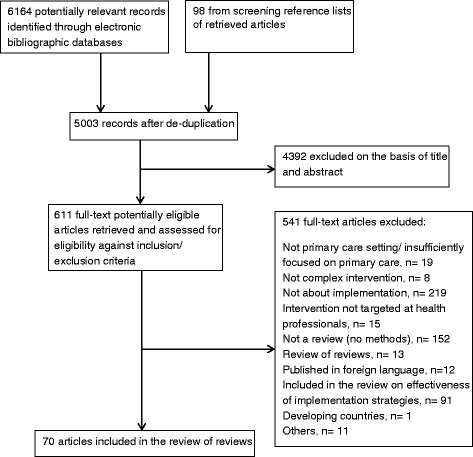
- The search identified 6,164 potentially eligible papers, and 70 reviews met inclusion criteria.
- Across those 70 reviews, 64 reported barriers, 49 reported facilitators, and 46 reported both.
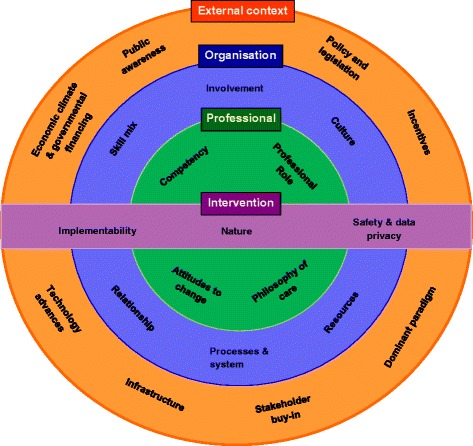
- The authors developed a four-level framework: external context, organisation, professionals, and intervention.
- The synthesis found 21 primary themes and 40 secondary themes; implementation was influenced by factors such as policy, incentives, leadership, resources, professional attitudes, and intervention usability/adaptability.
## Methods
- Design: Systematic review of reviews (“meta-review”) using a qualitative synthesis approach based on principles of meta-ethnography.
- Data/sample: Searched MEDLINE, EMBASE, CINAHL, Cochrane Library, and PsychINFO from inception to December 2013; included reviews in developed-country primary care that addressed complex interventions and the evidence-to-practice gap.
- Analysis: Extracted data from included reviews’ results and discussions, then synthesized them iteratively into themes and a conceptual framework; no formal quality appraisal of included reviews was undertaken, though PRISMA reporting was described.
## Limitations
- The paper states that it could not determine the relative “weighting” of findings because this was a review of reviews, not primary studies.
- It states that a formal quality assessment was not undertaken; instead, PRISMA adherence was described.
- It states that the search may not have identified all relevant literature, and the included reviews may not have captured all primary studies.
- Evident from the text: much of the evidence was reported as “barriers and facilitators” rather than actual causes, so the review could not truly establish causality.
Model-written summary. Check it against the paper before relying on it.
Integrity signals
Registry
Cites
Statistics
Figures
Verification
Claims the paper makes
37 Valid · 3 Not valid · 34 Not checked · 65 Own results and interpretations
Some cited sources support this claim and some don’t — read each source’s verdict below.
In the paper
“interventions that demonstrated clear and consistent clinical evidence of benefit [3, 16, 34, 35, 51, 55, 56, 68, 74, 89] or good applicability relevant to setting [3, 35, 68] were shown to facilitate implementation.”
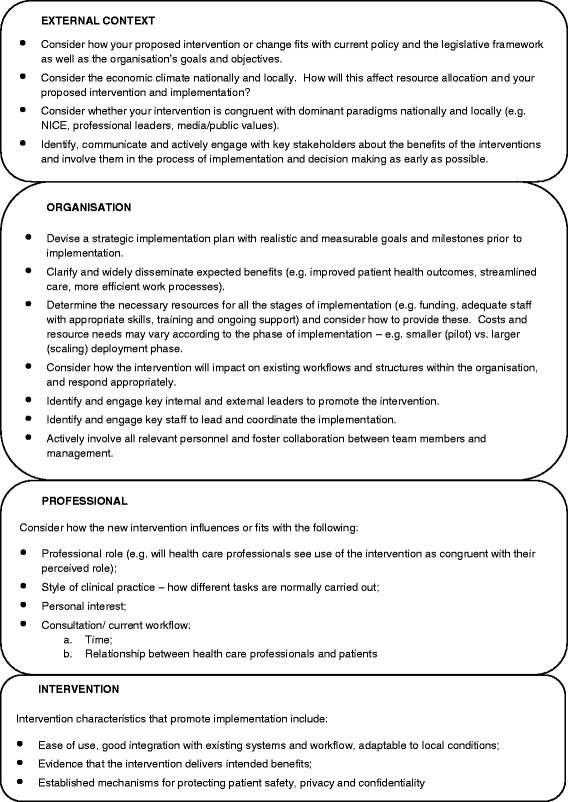
§ Achieving change in primary care—causes of the evidence to practice gap: systematic reviews of reviews > Results > Intervention The nature and characteristics of the intervention which included the complexity of the intervention, evidence of benefit, applicability and relevance, costs of an intervention, cost-effectiveness of an intervention, clarity, practicality and utility of intervention, customisation of intervention and IT compatibility were all viewed as aspects to be considered during implementation. Interventions that were complex were often associated with lower adoption [3, 35, 39, 87, 88]. By contrast, interventions that demonstrated clear and consistent clinical evidence of benefit [3, 16, 34, 35, 51, 55, 56, 68, 74, 89] or good applicability relevant to setting [3, 35, 68] were shown to facilitate implementation. The costs of an intervention and whether practices could obtain a positive return on investment [51] and in particular the time invested [42, 51] were considered to be features that would promote implementation. A lack of cost-effectiveness evidence relevant to the setting or poor cost-effectiveness could impede implementation [33, 57]. Additionally, interventions with good definitional clarity, such as well-organised guidelines with well-defined measurable actions that were based on clear strong recommendations, promoted implementation [35, 68]. Complex interventions that demonstrated good design, e.g. an overview of patient information (current health status and patient history) with a follow-up of patient adherence to their prescription and access to laboratory results was a facilitator of implementing e-prescribing [14] and showed good usability and reliability, e.g. user-friendly, easily accessible, fast, provides accurate and up-to-date information, content relevant to user, automatic prompting, information given at the time of decision-making [31, 35, 58, 69, 73, 74, 90] were associated with successful implementation. Customisation of intervention—the degree to which a new intervention can be modified to make it more applicable to specific contexts was a relevant factor. New interventions that could be customised to fit provider needs and preferences, organisational practices, values and cultural norms were shown to promote implementation [32, 37]. In addition, interventions compatible with the current operating IT system were more likely to be implemented [16, 56]. Implementability included the complexity of implementation process, benefit and harm as a result of implementation and resource requirement. The complexity of implementation can be determined by the scale of implementation, number of sites and processes required. Highly complex implementation plans were less likely to succeed as they often required complex project organisation [57]. Effective project management (e.g. using an incremental approach over time according to a strategic plan allowing a transition period between old and new system) was shown to facilitate implementation [77]. Benefit and harm as a result of implementation—adoption of a new intervention or process might bring potential benefit or harm to other aspects of care. For instance, implementing a new intervention usually required shifting organisational priorities and putting other projects on hold which resulted in initial lower productivity and increased staff workload [41, 76]. Conversely, implementation of a new intervention might lead to cost savings or more efficient workflow [51, 58]. Resources required for implementation—effective implementation required sufficient resources and funding to support not only start-up costs but also on-going costs and attention to sustainability [56]. Finally, safety and data privacy were perceived to be important for implementation. With regard to technology based interventions, there were concerns from both health care professionals and patients about the ownership of health information, secure data exchange, unauthorised sharing of confidential information about patients with fear of discrimination based on the health condition [51] and liability if patient information was lost [41]. The presence of sufficient security mechanisms to support trust between providers and patients [34] and technical measures to ensure systems compliance with data protection laws [84] were shown to promote implementation.
What the sources say
- Partly supportedcites [3] Mickan S Burls A Glasziou P Patterns of ‘leakage’ in the utilisation of clinical guidelines: a systematic review Postgrad Med J 2011 87 1032 670 9 10.1136/pgmj.2010.116012 21715571 PMC3181428 sourceExperimental — accuracy not yet measured
The Discussion (page not available) suggests that stronger evidence may explain higher agreement with drug and vaccination recommendations, but it does not establish that clear and consistent evidence of benefit facilitated implementation. The Results, under “Identification of barriers for guideline implementation” (page not available), report that practical considerations affected adherence and that limited equipment and staff made guidelines impractical. This supports the importance of fit with the setting, but not the stronger claim that good applicability was shown to facilitate implementation. (LLM, conf=0.85)
- Not matchedcites [16] Addington D Kyle T Desai S Wang J Facilitators and barriers to implementing quality measurement in primary mental health care: systematic review. [Review] Canadian Family Physician 2010 56 12 1322 31 21375065 PMC3001932
Its entry has no title and year that we can search by.
- Not checked — no full text of the sourcecites [34] Broens TH Huis in’t Veld RM Vollenbroek-Hutten MM Hermens HJ van Halteren AT Nieuwenhuis LJ Determinants of successful telemedicine implementations: a literature study J Telemed Telecare 2007 13 6 303 9 10.1258/135763307781644951 17785027 source
- Not checked — no full text of the sourcecites [35] Dulko D. Audit and feedback as a clinical practice guideline implementation strategy: a model for acute care nurse practitioners. Worldviews on Evidence-Based Nursing. 2007;4(4):200-9. 18076463 source
- Not checked — no full text of the sourcecites [51] Fontaine P Ross SE Zink T Schilling LM Systematic review of health information exchange in primary care practices. [Review] Journal of the American Board of Family Medicine: JABFM 2010 23 5 655 70 10.3122/jabfm.2010.05.090192 20823361 source
- Partly supportedcites [55] Dicenso A Bryant-Lukosius D Martin-Misener R Donald F Abelson J Bourgeault I Factors enabling advanced practice nursing role integration in Canada. [Review] Nursing leadership (Toronto, Ont) 2010 23 Spec-38 21478695 sourceExperimental — accuracy not yet measured
The Evaluation of the Role section (p. 15) says consistently positive evidence of APN effectiveness enables role implementation. Needs assessment and understanding of role (p. 8) says identifying a local service need or practice gap helps determine successful role integration. These findings concern advanced practice nursing roles in Canada, not interventions generally, so the citing sentence extends beyond the source's scope. (LLM, conf=0.86)
- Not checked — no full text of the sourcecites [56] Jarvis-Selinger S Chan E Payne R Plohman K Ho K Clinical telehealth across the disciplines: lessons learned Telemed J E Health 2008 14 7 720 5 10.1089/tmj.2007.0108 18817503 source
- Not checked — no full text of the sourcecites [68] Kendall E Sunderland N Muenchberger H Armstrong K When guidelines need guidance: considerations and strategies for improving the adoption of chronic disease evidence by general practitioners Journal of Evaluation in Clinical Practice 2009 15 6 1082 90 10.1111/j.1365-2753.2009.01147.x 20367709 source
- Disputedcites [74] Mollon B Chong J Jr Holbrook AM Sung M Thabane L Foster G Features predicting the success of computerized decision support for prescribing: a systematic review of randomized controlled trials BMC Med Inform Decis Mak 2009 9 11 10.1186/1472-6947-9-11 19210782 PMC2667396 sourceExperimental — accuracy not yet measured
The Results section (Association Between CDSS Features and Outcomes; no page available) says the review could not statistically evaluate which features were associated with success, and feature prevalence was generally similar in successful and unsuccessful implementation studies. The Discussion likewise says the descriptive comparison yielded no clear message. It therefore does not show that evidence of benefit or applicability to the setting facilitated implementation. (LLM, conf=0.88)
Checked by a reasoning model — may be wrong.
- Not checked — no full text of the sourcecites [89] Davis DA Taylor-Vaisey A Translating guidelines into practice: a systematic review of theoretic concepts, practical experience and research evidence in the adoption of clinical practice guidelines Can Med Assoc J 1997 157 408 16 9275952 PMC1227916
boostedstates a cause- Asserted: passes — The authors put it forward as true.
- Checkable: passes — It can be checked against evidence.
- Load-bearing: passes — The paper’s conclusions depend on it.
- Based: passes — The paper gives a reason why it holds.
- Partly supported
The cited sources support only part of this claim — read each source’s verdict below.
In the paper
“Almost all changes to practice in primary care involve “complex interventions”, i.e. interventions with multiple interconnecting components [11]”
§ Achieving change in primary care—causes of the evidence to practice gap: systematic reviews of reviews > Introduction
What the sources say
- Partly supportedcites [11] Craig P Dieppe P Macintyre S Michie S Nazareth I Petticrew M Developing and evaluating complex interventions: the new Medical Research Council guidance BMJ 2008 337 a1655 10.1136/bmj.a1655 18824488 PMC2769032 sourceExperimental — accuracy not yet measured
In “What are complex interventions?” (page not given), the paper describes complex interventions as having several interacting components and says few interventions are truly simple. It does not establish that almost all changes to practice specifically in primary care are complex interventions. (LLM, conf=0.83)
plain- Asserted: passes — The authors put it forward as true.
- Checkable: passes — It can be checked against evidence.
- Load-bearing: passes — The paper’s conclusions depend on it.
- Based: passes — The paper gives a reason why it holds.
- Partly supported
The cited sources support only part of this claim — read each source’s verdict below.
In the paper
“a systematic review including 29 guidelines recommendations from 11 studies shows that only one third of the research evidence informing guidelines is being routinely adhered to [3].”
§ Achieving change in primary care—causes of the evidence to practice gap: systematic reviews of reviews > Introduction
What the sources say
- Partly supportedcites [3] Mickan S Burls A Glasziou P Patterns of ‘leakage’ in the utilisation of clinical guidelines: a systematic review Postgrad Med J 2011 87 1032 670 9 10.1136/pgmj.2010.116012 21715571 PMC3181428 sourceExperimental — accuracy not yet measured
The Abstract Results report 11 studies covering 29 recommendations and median adherence of 34%. The Conclusion says it is *suggested* that only one third of the research evidence informing guidelines is routinely adhered to. The citing sentence presents that qualified estimate as a definitive finding, despite the variation across guidelines noted in the Results. (LLM, conf=0.84)
plain- Asserted: passes — The authors put it forward as true.
- Checkable: passes — It can be checked against evidence.
- Load-bearing: passes — The paper’s conclusions depend on it.
- Based: passes — The paper gives a reason why it holds.
- Partly supported
The cited sources support only part of this claim — read each source’s verdict below.
In the paper
“The presence of a positive culture which was receptive to change and valued innovation was viewed as important for implementation [32, 41, 58].”
§ Achieving change in primary care—causes of the evidence to practice gap: systematic reviews of reviews > Results > Organisation
What the sources say
- Not checked — no full text of the sourcecites [32] Durlak JA DuPre EP Implementation matters: a review of research on the influence of implementation on program outcomes and the factors affecting implementation Am J Community Psychol 2008 41 3–4 327 50 10.1007/s10464-008-9165-0 18322790 source
- Not matchedcites [41] Leatt P Shea C Studer M Wang V IT solutions for patient safety—best practices for successful implementation in healthcare Healthc Q 2006 9 1 94 104 16548440
Its entry has no title and year that we can search by.
- Partly supportedcites [58] Lau F, Price M, Boyd J, Partridge C, Bell H, Raworth R. Impact of electronic medical record on physician practice in office settings: a systematic review. BMC Medical Informatics and Decision Making. 2012;12(10). PMC3315440 22364529 sourceExperimental — accuracy not yet measured
The Results section, under “Factors influencing EMR adoption and effect” (page not provided), identifies organizational culture that supported EMR adoption and use. It does not specify that the culture was receptive to change or valued innovation, and its finding concerns office-based EMRs rather than implementation generally. (LLM, conf=0.82)
plain- Asserted: passes — The authors put it forward as true.
- Checkable: passes — It can be checked against evidence.
- Load-bearing: unclear — It is unclear whether the paper’s conclusions depend on it.
- Based: passes — The paper gives a reason why it holds.
- Rests on an assumption not shown here.
The cited sources support only part of this claim — read each source’s verdict below.
In the paper
“Adherence rates vary from just above 20 to over 80 % [3].”
§ Achieving change in primary care—causes of the evidence to practice gap: systematic reviews of reviews > Introduction
What the sources say
- Partly supportedcites [3] Mickan S Burls A Glasziou P Patterns of ‘leakage’ in the utilisation of clinical guidelines: a systematic review Postgrad Med J 2011 87 1032 670 9 10.1136/pgmj.2010.116012 21715571 PMC3181428 sourceExperimental — accuracy not yet measured
The Results section (‘Comparison of rates at each step’) gives this range for six drug-intervention recommendations. The citing sentence omits that restriction, making the range sound applicable to adherence rates generally. (LLM, conf=0.82)
plain- Asserted: passes — The authors put it forward as true.
- Checkable: passes — It can be checked against evidence.
- Load-bearing: unclear — It is unclear whether the paper’s conclusions depend on it.
- Based: passes — The paper gives a reason why it holds.
- Partly supported
59 more claims · 12 with their cited sources checked
Create a free account to see all 139 claims and to verify the 25 references still open.
- It may state two separate claims as one. 46
- Probably not a substantial claim. 43
- The quote only partly states this claim. 1
Claims other papers make about this one
Each is checked against this paper’s own text: does it say what the citing paper says it does?
The cited source says what the claim attributes to it.
In the citing paper
“Nowadays, it is common knowledge that implementation of innovations, including eHealth, is difficult and progresses only slowly [25-27].”
From Lessons Learned From a Living Lab on the Broad Adoption of eHealth in Primary Health Care (2018) · cites this paper as [25]
In the citing paper
“Lau et al (2016) stated in a recent systematic review of reviews that implementing any type of change in primary care is likely to be complex and that relevant barriers and facilitators are dynamic and likely to change over time [25].”
From Lessons Learned From a Living Lab on the Broad Adoption of eHealth in Primary Health Care (2018) · cites this paper as [25]
In the citing paper
“As reviews by Lau et al. [7, 8] have shown, changes in policy direction, organisational turbulence and the exigencies of everyday work in complex healthcare settings, all affect implementation processes.”
From Implementation, context and complexity (2016) · cites this paper as [7]
Citations
Cites
Rogers, E. M., Singhal, A., & Quinlan, M. M. (2019) · An Integrated Approach to Communication Theory and Research · doi:10.4324/9780203710753-35 · Cited by 37,322
Liberati, A., Altman, D. G., Tetzlaff, J., Mulrow, C., Gøtzsche, P. C., Ioannidis, J. P. A., Clarke, M., Devereaux, P. J., Kleijnen, J., & Moher, D. (2009) · PLoS Medicine · doi:10.1371/journal.pmed.1000100 · Cited by 28,164
Damschroder, L. J., Aron, D. C., Keith, R. E., Kirsh, S. R., Alexander, J. A., & Lowery, J. C. (2009) · Implementation Science · doi:10.1186/1748-5908-4-50 · Cited by 14,496 · cited 9×
“(DOC 43 kb) Abbreviations CFIR: Consolidated Framework for Implementation Research; MRC: Medical Research Council; NHS: National Health Service; NPT: Normalization Process Theory; TDF: Theoretical Domains Framework; USA: United States of America.”
BackgroundInfluentialDeveloping and evaluating complex interventions: the new Medical Research Council guidance
Craig, P., Dieppe, P., Macintyre, S., Michie, S., Nazareth, I., & Petticrew, M. (2008) · BMJ · doi:10.1136/bmj.a1655 · Cited by 10,995 · cited 1×
“components [11], and complex interventions can be particularly hard to implement, as they are likely to require change at multiple levels.”
BackgroundLiberati, A., Altman, D. G., Tetzlaff, J., Mulrow, C., Gøtzsche, P. C., Ioannidis, J. P. A., Clarke, M., Devereaux, P. J., Kleijnen, J., & Moher, D. (2009) · Annals of Internal Medicine · doi:10.7326/0003-4819-151-4-200908180-00136 · Cited by 10,349
Diffusion of Innovations in Service Organizations: Systematic Review and Recommendations
GREENHALGH, T., ROBERT, G., MACFARLANE, F., BATE, P., & KYRIAKIDOU, O. (2004) · The Milbank Quarterly · doi:10.1111/j.0887-378x.2004.00325.x · Cited by 7,448 · cited 2×
“Division of labour [34, 41, 44, 51, 55, 56, 58, 60, 61, 67, 71, 77, 79, 95, 103, 110] B: Lack of organisation and skill mix among support staff [67] F: Different skill mix (interdisciplinary approach) [77] √ √ √ √”
BackgroundWhy Don't Physicians Follow Clinical Practice Guidelines?: A Framework for Improvement
Cabana, M. D., Rand, C. S., Powe, N. R., Wu, A. W., Wilson, M. H., Abboud, P.-A. C., & Rubin, H. R. (1999) · JAMA · doi:10.1001/jama.282.15.1458 · Cited by 6,677
Process evaluation of complex interventions: Medical Research Council guidance
Moore, G. F., Audrey, S., Barker, M., Bond, L., Bonell, C., Hardeman, W., Moore, L., O'Cathain, A., Tinati, T., Wight, D., et al. (2015) · BMJ · doi:10.1136/bmj.h1258 · Cited by 6,204
Durlak, J. A., & DuPre, E. P. (2008) · American Journal of Community Psychology · doi:10.1007/s10464-008-9165-0 · Cited by 5,304 · cited 8×
“Durlak JA 2008 [32] Implementation matters: a review of research on the influence of implementation on programme outcomes and the factors affecting implementation Literature review To assess the impact of implementation on program outcomes and to identify factors affecting the implementation process Inclusion criteria…”
BackgroundInfluentialFrom best evidence to best practice: effective implementation of change in patients' care
Grol, R., & Grimshaw, J. (2003) · The Lancet · doi:10.1016/s0140-6736(03)14546-1 · Cited by 4,531
Research works printed but not linked: 5
- England NHS Five year forward view 2014
- Public Health Resource Unit Critical appraisal skills programme. 10 questions to help you make sense of qualitative research 2006 England Public Health Resource Unit
- Rogers E Diffusion of innovations. 5th edition ed 2003 New York Free Press
- Finch T May C Implementation, embedding and integration: an outline of Normalization Process Theory Sociology 2009 43 3 535 54 10.1177/0038038509103208 · DOI · Paper page
- Bate P Robert G Fulop N Ovretveit J Dixon-Woods M Perspectives on context 2014 London Health Foundation
Cited by
Ross, J., Stevenson, F., Lau, R., & Murray, E. (2016) · Implementation Science · doi:10.1186/s13012-016-0510-7 · Cited by 1,011
“The results from this review are comparable to another large systematic review of reviews by Lau et al. which synthesised the literature on the barriers and facilitators to the implementation of complex innovations within primary care settings [60].”
ResultSelf-citationImplementation, context and complexity
May, C. R., Johnson, M., & Finch, T. (2016) · Implementation Science · doi:10.1186/s13012-016-0506-3 · Cited by 978
“[7, 8] have shown, changes in policy direction, organisational turbulence and the exigencies of everyday work in complex healthcare settings, all affect implementation”
BackgroundDadi, A. F., Miller, E. R., Bisetegn, T. A., & Mwanri, L. (2020) · BMC Public Health · doi:10.1186/s12889-020-8293-9 · Cited by 421
“This approach aims to provide a single comprehensive source of evidence and in recent years has been increasingly used to guide policymakers and those developing intervention modalities, clinical guidelines, and in the evaluation of health care interventions [38, 39].”
BackgroundCorrea, V. C., Lugo-Agudelo, L. H., Aguirre-Acevedo, D. C., Contreras, J. A. P., Borrero, A. M. P., Patiño-Lugo, D. F., & Valencia, D. A. C. (2020) · Health Research Policy and Systems · doi:10.1186/s12961-020-00588-8 · Cited by 407
2017 national standards for diabetes self-management education and support
Beck, J., Greenwood, D. A., Blanton, L., Bollinger, S. T., Butcher, M. K., Condon, J. E., Cypress, M., Faulkner, P., Fischl, A. H., Francis, T., et al. (2017) · Diabetes Care · doi:10.2337/dci17-0025 · Cited by 348
“The evidence supports an interprofessional team approach to diabetes care, education, and support (93).”
BackgroundFinch, T. L., Girling, M., May, C. R., Mair, F. S., Murray, E., Treweek, S., McColl, E., Steen, I. N., Cook, C., Vernazza, C. R., et al. (2018) · BMC Medical Research Methodology · doi:10.1186/s12874-018-0591-x · Cited by 337
“There is a vast literature on implementation in this context and of the need for improvement in how change is implemented [4, 5], however the gap between research evidence and practice remains wide [6, 7].”
BackgroundSelf-citation2017 National Standards for Diabetes Self-Management Education and Support
Beck, J., Greenwood, D. A., Blanton, L., Bollinger, S. T., Butcher, M. K., Condon, J. E., Cypress, M., Faulkner, P., Fischl, A. H., Francis, T., et al. (2018) · The Diabetes Educator · doi:10.1177/0145721718754797 · Cited by 288
The physician’s experience of changing clinical practice: a struggle to unlearn
Gupta, D. M., Boland, R. J., & Aron, D. C. (2017) · Implementation Science · doi:10.1186/s13012-017-0555-2 · Cited by 269
2017 National Standards for Diabetes Self-Management Education and Support
Beck, J., Greenwood, D. A., Blanton, L., Bollinger, S. T., Butcher, M. K., Condon, J. E., Cypress, M., Faulkner, P., Fischl, A. H., Francis, T., et al. (2017) · The Diabetes Educator · doi:10.1177/0145721717722968 · Cited by 193
Yoong, S. L., Hall, A., Stacey, F., Grady, A., Sutherland, R., Wyse, R., Anderson, A., Nathan, N., & Wolfenden, L. (2020) · Implementation Science · doi:10.1186/s13012-020-01011-0 · Cited by 180
Lyon, A. R., Cook, C. R., Brown, E. C., Locke, J., Davis, C., Ehrhart, M., & Aarons, G. A. (2018) · Implementation Science · doi:10.1186/s13012-017-0705-6 · Cited by 199
Berardi, C., Antonini, M., Jordan, Z., Wechtler, H., Paolucci, F., & Hinwood, M. (2024) · BMC Health Services Research · doi:10.1186/s12913-023-10536-1 · Cited by 190
“Seven implementation frameworks were tested to determine which was the best fit to the identified themes [21, 22, 29–33].”
MethodRoss, J., Stevenson, F., Dack, C., Pal, K., May, C., Michie, S., Barnard, M., & Murray, E. (2018) · BMC Health Services Research · doi:10.1186/s12913-018-3615-7 · Cited by 144
Self-citationGöstemeyer, G., Baker, S. R., & Schwendicke, F. (2019) · Clinical Oral Investigations · doi:10.1007/s00784-019-02812-4 · Cited by 169
Leveraging Implementation Science to Improve Cancer Care Delivery and Patient Outcomes
Mitchell, S. A., & Chambers, D. (2017) · Journal of Oncology Practice · doi:10.1200/jop.2017.024729 · Cited by 122
Ritchie, M. J., Parker, L. E., Edlund, C. N., & Kirchner, J. E. (2017) · BMC Health Services Research · doi:10.1186/s12913-017-2217-0 · Cited by 113
“Additionally, interactions between different contextual elements can vary as well [16, 23].”
BackgroundColes, E., Wells, M., Maxwell, M., Harris, F., Anderson, J. M., Gray, N. M., Milner, G., & MacGillivray, S. A. (2017) · Systematic Reviews · doi:10.1186/s13643-017-0566-8 · Cited by 139
“It is accepted that the ‘fit’ between intervention and the different levels of context is crucial to success [14], although questions remain as to whether improvement interventions should be adapted to fit their context, or attempts should be made to modify local contexts in order to successfully implement change [23].”
BackgroundOwolabi, M. O., Yaria, J. O., Daivadanam, M., Makanjuola, A. I., Parker, G., Oldenburg, B., Vedanthan, R., Norris, S., Oguntoye, A. R., Osundina, M. A., et al. (2018) · Diabetes Care · doi:10.2337/dc17-1795 · Cited by 113
“The uniqueness of various countries with respect to socioeconomy, lifestyle, service delivery, health care policies, and probably pharmacogenomics informs the need for adaptation of DM guidelines to suite the country’s needs in the pursuit of precision medicine (38,39).”
BackgroundBriggs, A. M., Houlding-Braunberger, E., Hinman, R. S., Desmond, L., Bennell, K. L., Darlow, B. J. S., Pizzari, T., Leech, M. T., MacKay, C., Larmer, P. J., et al. (2019) · Osteoarthritis and Cartilage · doi:10.1016/j.joca.2018.12.024 · Cited by 114
Mather, M., Pettigrew, L. M., & Navaratnam, S. (2022) · Systematic Reviews · doi:10.1186/s13643-022-02030-2 · Cited by 137
“Existing reviews of reviews have looked at different types of effective BCIs, both in primary care [36, 37] and in healthcare in general [18], however none have looked at barriers and facilitators to PCPs’ behaviour change, using both the TDF and BCW models as a theoretical basis.”
BackgroundFlynn, R., Rotter, T., Hartfield, D. S., Newton, A. S., & Scott, S. D. (2019) · BMC Health Services Research · doi:10.1186/s12913-019-4744-3 · Cited by 114
Keyworth, C., Epton, T., Goldthorpe, J., Calam, R. M., & Armitage, C. J. (2018) · Implementation Science · doi:10.1186/s13012-018-0814-x · Cited by 112
“For example, increasing communication between healthcare professionals is recognised as an important aspect of delivery of effective patient care by the World Health Organization [39] and effective interprofessional collaboration may lead to improved communication between healthcare professionals, encourage joint deci…”
BackgroundBlaum, C. S., Rosen, J. D., Naik, A. D., Smith, C. D., Dindo, L. N., Vo, L., Hernandez‐Bigos, K., Esterson, J., Geda, M. E., Ferris, R. E., et al. (2018) · Journal of the American Geriatrics Society · doi:10.1111/jgs.15465 · Cited by 104
“Implementation strategy We planned PPC implementation to follow a Practice Change Framework.18,19 This framework features leadership support, clinical champions, team care, training, workflow support, HIT enhancements, collaborative learning for clinical decisionmaking,20 and Plan-Do-Study-Act (PDSA) methodology for c…”
MethodAl-Dhahir, I., Reijnders, T., Faber, J. S., van den Berg-Emons, R. J. G., Janssen, V. R., Kraaijenhagen, R. A., Visch, V., Chavannes, N. H., & Evers, A. W. M. (2022) · Journal of Medical Internet Research · doi:10.2196/34229 · Cited by 101
“For example, Lau et al [101] and Ross et al [102] found in their reviews that available resources, including time, funding, and staff, can be both barriers and facilitators in the implementation of interventions.”
Lessons Learned From a Living Lab on the Broad Adoption of eHealth in Primary Health Care
Swinkels, I. C. S., Huygens, M. W. J., Schoenmakers, T. M., Oude Nijeweme-D'Hollosy, W., van Velsen, L., Vermeulen, J., Schoone-Harmsen, M., Jansen, Y. J., van Schayck, O. C., Friele, R., et al. (2018) · Journal of Medical Internet Research · doi:10.2196/jmir.9110 · Cited by 90
“Lau et al (2016) stated in a recent systematic review of reviews that implementing any type of change in primary care is likely to be complex and that relevant barriers and facilitators are dynamic and likely to change over time [25].”
BackgroundDeprescribing medications for older adults in the primary care context: A mixed studies review
Gillespie, R. J., Harrison, L., & Mullan, J. (2018) · Health Science Reports · doi:10.1002/hsr2.45 · Cited by 98
Egerton, T., Nelligan, R. K., Setchell, J., Atkins, L., & Bennell, K. L. (2018) · BMC Rheumatology · doi:10.1186/s41927-018-0037-4 · Cited by 91
“Time pressure was identified in our findings and has been widely cited previously as a barrier to GPs ability to implement CPG recommendations including facilitating lifestyle changes [22, 30, 31, 33-36].”
BackgroundApproaches to clinical guideline development in healthcare: a scoping review and document analysis
Leo, A. D., Bloxsome, D., & Bayes, S. J. (2023) · BMC Health Services Research · doi:10.1186/s12913-022-08975-3 · Cited by 106
“To improve clinical practice standards and consumers’ health outcomes, well-developed CPGs and effective processes for evidence implementation are needed [39].”
BackgroundWebb, M. J., Wadley, G., & Sanci, L. A. (2018) · JMIR mhealth and uhealth · doi:10.2196/mhealth.8778 · Cited by 83
“The fit between an intervention and these dynamic contextual factors has been found to be critical in determining the success of an implementation in shortening the evidence-to-practice gap [15].”
Salvador‐Carulla, L., Woods, C., de Miquel, C., & Lukersmith, S. (2024) · Heliyon · doi:10.1016/j.heliyon.2024.e29930 · Cited by 121
Briggs, A. M., Chan, M. T.-L., & Slater, H. (2016) · Best Practice & Research Clinical Rheumatology · doi:10.1016/j.berh.2016.09.009 · Cited by 80
Ritchie, M. J., Kirchner, J. E., Townsend, J. C., Pitcock, J. A., Dollar, K. M., & Liu, C. (2019) · Journal of General Internal Medicine · doi:10.1007/s11606-019-05537-y · Cited by 73
“The substantial amount of resources utilized to facilitate implementation, ranging from $208,314 to $236,263 per network excluding travel cost, is not surprising given the complexity of PCMHI [1, 6, 13], the difficulty of changing the structure and processes of care [15, 39, 40], the large number of contextual barrier…”
BackgroundImplementation Science Training and Resources for Nurses and Nurse Scientists
Boehm, L. M., Stolldorf, D. P., & Jeffery, A. D. (2019) · Journal of Nursing Scholarship · doi:10.1111/jnu.12510 · Cited by 81
“Organizational change can be difficult to achieve due to a variety of contextual factors (e.g., capacity, leadership support, lack of interprofessional collaboration) known to impede implementation efforts (Arroyave, Penaranda, & Lewis, 2011; Lau et al., 2015; Shoemaker, 2015).”
BackgroundDziedzic, K., French, S., Davis, A. M., Geelhoed, E. A., & Porcheret, M. (2016) · Best Practice & Research Clinical Rheumatology · doi:10.1016/j.berh.2016.08.004 · Cited by 81
Self-citationHow Practice Facilitation Strategies Differ by Practice Context
Nguyen, A. M., Cuthel, A. M., Padgett, D. K., Niles, P. M., Rogers, E., Pham-Singer, H., Ferran, D., Kaplan, S. A., Berry, C. A., & Shelley, D. (2019) · Journal of General Internal Medicine · doi:10.1007/s11606-019-05350-7 · Cited by 70
Okeowo, D. A., Zaidi, S. T. R., Fylan, B., & Alldred, D. P. (2023) · International Journal of Pharmacy Practice · doi:10.1093/ijpp/riad001 · Cited by 78
Schwendicke, F., & Göstemeyer, G. (2016) · Implementation Science · doi:10.1186/s13012-016-0505-4 · Cited by 87
“, uncertain as to their effect on the target behavior (?) [18, 21, 22].”
BackgroundOwolabi, M., Miranda, J. J., Yaria, J., & Ovbiagele, B. (2016) · BMJ Global Health · doi:10.1136/bmjgh-2016-000105 · Cited by 68
Hall, C. L., Davies, E. B., Andrén, P., Murphy, T., Bennett, S., Brown, B. J., Brown, S., Chamberlain, L., Craven, M. P., Evans, A., et al. (2019) · BMJ Open · doi:10.1136/bmjopen-2018-027583 · Cited by 47
Self-citationThe complexity of implementation factors in professional pharmacy services
García‐Cárdenas, V., Pérez-Escamilla, B., Fernández-Llimós, F., & Benrimoj, S. I. (2017) · Research in Social and Administrative Pharmacy · doi:10.1016/j.sapharm.2017.05.016 · Cited by 76
Speerin, R., Needs, C., Chua, J., Woodhouse, L. J., Nordin, M. C., McGlasson, R. A., & Briggs, A. M. (2020) · Best Practice & Research Clinical Rheumatology · doi:10.1016/j.berh.2020.101548 · Cited by 70
“commission an intervention for implementation [12,60].”
Advancing practice for back pain through stratified care (STarT Back)
Sowden, G., Hill, J. C., Morsø, L., Louw, Q., & Foster, N. E. (2018) · Brazilian Journal of Physical Therapy · doi:10.1016/j.bjpt.2018.06.003 · Cited by 64
“Poor or ineffective implementation appears at least partly, to explain this.(48) Unfortunately, healthcare which does not integrate evidence not only runs the risk of harm but also misses the opportunity to benefit patients.”
BackgroundKanzow, P., Wiegand, A., Göstemeyer, G., & Schwendicke, F. (2017) · Journal of Dentistry · doi:10.1016/j.jdent.2017.09.010 · Cited by 78
“Themes were classified as barriers, facilitators, or conflicting themes [16,18,19].”
BackgroundShahmoradi, L., Safdari, R., Ahmadi, H., & Zahmatkeshan, M. (2021) · Medical Journal of the Islamic Republic of Iran · doi:10.47176/mjiri.35.27 · Cited by 112
Granger, C. L., Denehy, L., Remedios, L. J., Retica, S., Phongpagdi, P., Hart, N., & Parry, S. M. (2016) · Annals of the American Thoracic Society · doi:10.1513/annalsats.201607-540oc · Cited by 67
Camacho, J., Zanoletti-Mannello, M., Landis-Lewis, Z., Kane-Gill, S. L., & Boyce, R. D. (2020) · Journal of Medical Internet Research · doi:10.2196/18388 · Cited by 51
“This is partially explained because successful implementation of practice-change interventions is a multidimensional problem requiring attention to many factors [27-30].”
BackgroundParry, S. M., Remedios, L. J., Denehy, L., Knight, L. D., Beach, L. J., Rollinson, T. C., Berney, S. C., Puthucheary, Z., Morris, P. E., & Granger, C. L. (2016) · Journal of Critical Care · doi:10.1016/j.jcrc.2016.11.005 · Cited by 72
Adherence to guidelines in management of symptoms suggestive of heart failure in primary care
Hayhoe, B. W. J., Kim, D. J., Aylin, P. P., Majeed, A., Cowie, M., & Bottle, A. (2018) · Heart · doi:10.1136/heartjnl-2018-313971 · Cited by 63
Kovacs, E., Strobl, R., Phillips, A., Stephan, A., Müller, M., Gensichen, J. S., & Grill, E. (2018) · Journal of General Internal Medicine · doi:10.1007/s11606-018-4435-5 · Cited by 55
Bradbury, K. J., Morton, K., Band, R. J., May, C. R., McManus, R. J., Little, P. S., & Yardley, L. (2017) · BMC Medical Informatics and Decision Making · doi:10.1186/s12911-016-0397-x · Cited by 54
“financial incentivisation of some behaviours and not others) [31, 37].”
BackgroundEldh, A. C., Sverker, A., Bendtsen, P., & Nilsson, E. (2020) · JMIR Human Factors · doi:10.2196/21698 · Cited by 70
Briggs, A. M., Hinman, R. S., Darlow, B. J. S., Bennell, K. L., Leech, M. T., Pizzari, T., Greig, A. M., MacKay, C., Bendrups, A., Larmer, P. J., et al. (2019) · ACR Open Rheumatology · doi:10.1002/acr2.1032 · Cited by 54
“Although interprofessional primary care–based management is recommended across OA clinical guidelines, implementation of best‐practice primary care remains inadequate (4), and multiple barriers have been identified to explain evidence‐practice gaps (5).”
BackgroundAnrys, P., Strauven, G., Roussel, S., Ginste, M. V., Lepeleire, J. D., Foulon, V., & Spinewine, A. (2019) · Implementation Science · doi:10.1186/s13012-019-0945-8 · Cited by 43
“organization-related factors, individual professionals, and characteristics of the intervention [29].”
BackgroundStephan, A., Kovacs, E., Phillips, A., Schelling, J., Ulrich, S. M., & Grill, E. (2018) · Implementation Science · doi:10.1186/s13012-018-0716-y · Cited by 59
“Lack of motivation for change has been repeatedly reported as a major barrier in the literature [31, 38].”
BackgroundHaycock, J., Grivell, N., Redman, A., Saini, B., Vakulin, A., Lack, L. C., Lovato, N., Sweetman, A., Zwar, N. A., Stocks, N. P., et al. (2021) · BMC Family Practice · doi:10.1186/s12875-021-01510-z · Cited by 61
Breast cancer screening in Primary Health Care in Brazil: a systematic review
Sala, D. C. P., Okuno, M. F. P., Taminato, M., de Castro, C. P., Louvison, M. C. P., & Tanaka, O. Y. (2021) · Revista Brasileira de Enfermagem · doi:10.1590/0034-7167-2020-0995 · Cited by 65
2017 National Standards for Diabetes Self-Management Education and Support
Beck, J., Greenwood, D. A., Blanton, L., Bollinger, S. T., Butcher, M. K., Condon, J. E., Cypress, M., Faulkner, P., Fischl, A. H., Francis, T., et al. (2020) · The Diabetes Educator · doi:10.1177/0145721719897952 · Cited by 46
“The evidence supports an interprofessional team approach to diabetes care, education, and support.(93)”
Process evaluations of primary care interventions addressing chronic disease: a systematic review
Liu, H., Mohammed, A., Shanthosh, J., News, M., Laba, T., Hackett, M. L., Peiris, D., & Jan, S. (2019) · BMJ Open · doi:10.1136/bmjopen-2018-025127 · Cited by 51
“Such an approach could potentially facilitate a greater shared understanding between stakeholders and greater consistency in the reporting of context.(62) 64 66–68 Most of these studies were conducted in high-income countries with established PHC systems and universal health coverage (eg, National Health Service in th…”
BackgroundResultRiordan, F., Racine, E., Phillip, E. T., Bradley, C., Lorencatto, F., Murphy, M. E., Murphy, A., Browne, J. P., Smith, S. M., Kearney, P. M., et al. (2020) · Implementation Science · doi:10.1186/s13012-020-00982-4 · Cited by 52
“Primary care is diverse in terms of team composition, organisational structure, size, and workflow [100].”
BackgroundSwaithes, L., Paskins, Z., Dziedzic, K., & Finney, A. G. (2020) · Musculoskeletal Care · doi:10.1002/msc.1452 · Cited by 48
Self-citationSquires, J. E., Hutchinson, A. M., Coughlin, M., Bashir, K., Curran, J., Grimshaw, J., Dorrance, K., Aloisio, L. D., Brehaut, J., Francis, J., et al. (2021) · International Journal of Health Policy and Management · doi:10.34172/ijhpm.2021.32 · Cited by 58
“10 11-30 This first requires conceptual clarity of context and particularly, what comprises context.”
BackgroundEngagement With Project ECHO to Increase Medication-Assisted Treatment in Rural Primary Care
Salvador, J. G., Bhatt, S. R., Fowler, R. C., Ritz, J., James, R., Jacobsohn, V., Brakey, H. R., & Sussman, A. L. (2019) · Psychiatric Services · doi:10.1176/appi.ps.201900142 · Cited by 47
“Prior research has broadly characterized implementation barriers to changes in primary care practice (13).”
BackgroundBonfim, D., Belotti, L., de Almeida, L. Y., Eshriqui, I., Velasco, S. R. M., Monteiro, C. N., & Jantsch, A. G. (2023) · BMC Health Services Research · doi:10.1186/s12913-023-10382-1 · Cited by 41
“…researchers, health managers, and academic institutions together, facilitating partnerships, and providing structure and technical support to healthcare professionals to carry out research projects that are developed and conducted in PHC settings to tackle important aspects of PHC [7, 8].”
BackgroundBarry, H. E., Bedford, L. E., McGrattan, M., Ryan, C. A., Passmore, A. P., Robinson, A. L., Molloy, G. J., Darcy, C., Buchanan, H., & Hughes, C. M. (2020) · BMC Health Services Research · doi:10.1186/s12913-020-4971-7 · Cited by 44
2017 National Standards for Diabetes Self-Management Education and Support
Beck, J., Greenwood, D. A., Blanton, L., Bollinger, S. T., Butcher, M. K., Condon, J. E., Cypress, M., Faulkner, P., Fischl, A. H., Francis, T., et al. (2019) · The Diabetes Educator · doi:10.1177/0145721718820941 · Cited by 39
Holmes, J. A., Logan, P., Morris, R. P. G., & Radford, K. (2020) · Systematic Reviews · doi:10.1186/s13643-020-01508-1 · Cited by 44
“This would promote understanding between determinants and the overall context [102].”
BackgroundRamos, S. F., Júnior, G. A. D. S., Pereira, A. M., Dosea, A. S., Rocha, K. S. S., Pimentel, D. M. M., & de Lyra, D. P. (2018) · BMC Health Services Research · doi:10.1186/s12913-018-3403-4 · Cited by 48
“The presence of trained teams with defined and organized practices improves the work process of pharmacists, facilitating the implementation and ensuring quality in the services provided [55, 56].”
BackgroundMcKenzie, L., Shaw, L., Jordan, J. E., Alexander, M., O’Brien, M., Singer, S. J., & Manias, E. (2019) · The Joint Commission Journal on Quality and Patient Safety · doi:10.1016/j.jcjq.2019.07.005 · Cited by 44
“The four major themes identified as influencing the Program’s delivery (Table 4) had a high degree of concordance with those commonly cited in implementation science literature (inner organisational setting, characteristics of individuals/professionals, intervention characteristics and process) [51, 52].”
BackgroundLaycock, A. F., Harvey, G., Percival, N., Cunningham, F. C., Bailie, J., Matthews, V., Copley, K., Patel, L., & Bailie, R. S. (2018) · Health Research Policy and Systems · doi:10.1186/s12961-018-0392-z · Cited by 44
“Among other features, PHC should be client centred and culturally safe, based on the best available evidence and consider influences operating at different levels, including professional roles and skill mix, organisation-related factors and the wider policy context [16].”
BackgroundByrnes, A., Young, A., Mudge, A., Banks, M., Clark, D. A., & Bauer, J. D. (2018) · Nutrition & Dietetics · doi:10.1111/1747-0080.12464 · Cited by 43
Early implementation of the structured medication review in England: a qualitative study
Madden, M., Mills, T., Atkin, K. M., Stewart, D., & McCambridge, J. (2022) · British Journal of General Practice · doi:10.3399/bjgp.2022.0014 · Cited by 44
“22,23 Both knowledge about multiple conditions and communication skills are important preparation for SMRs.”
The Building Blocks of Implementation Frameworks and Models in Primary Care: A Narrative Review
Huybrechts, I., Declercq, A., Verté, E., Raeymaeckers, P., & Anthierens, S. (2021) · Frontiers in Public Health · doi:10.3389/fpubh.2021.675171 · Cited by 53
Byrnes, A., Young, A., Mudge, A., Banks, M., & Bauer, J. D. (2018) · European Journal of Clinical Nutrition · doi:10.1038/s41430-018-0276-x · Cited by 42
“requiring change, and the barriers and enablers relevant to the local context from the perspective of local staff [1, 8].”
BackgroundSystematic review and narrative synthesis of the impact of Appreciative Inquiry in healthcare
Merriel, A., Wilson, A., Decker, E., Hussein, J., Larkin, M., Barnard, K., O’Dair, M., Costello, A. M. D. L., Malata, A. M., & Coomarasamy, A. (2022) · BMJ Open Quality · doi:10.1136/bmjoq-2022-001911 · Cited by 57
“59 Considering Appreciative Inquiry specifically, we have shown on a small scale in our recent paper, how organisations take up interventions in different ways.”
Adekpedjou, R., Haesebaert, J., Stacey, D., Brière, N., Freitas, A., Rivest, L., & Légaré, F. (2020) · BMC Health Services Research · doi:10.1186/s12913-020-5064-3 · Cited by 28
Dentists’ opinions on using digital technologies in dental practice
van der Zande, M. M., Gorter, R. C., Bruers, J. J. M., Aartman, I. H. A., & Wismeijer, D. (2017) · Community Dentistry And Oral Epidemiology · doi:10.1111/cdoe.12345 · Cited by 45
Bailie, R. S., Matthews, V., Larkins, S., Thompson, S., Burgess, P., Weeramanthri, T. S., Bailie, J., Cunningham, F. C., Kwedza, R., & Clark, L. A. (2017) · BMJ Open · doi:10.1136/bmjopen-2017-016626 · Cited by 37
Gardner, K., Sibthorpe, B. M., Chan, M., Sargent, G. M., Dowden, M., & McAullay, D. R. (2018) · BMC Health Services Research · doi:10.1186/s12913-018-3308-2 · Cited by 37
“[77], barriers and enablers are themselves often contextual factors, sometimes part of the implementing organ-”
BackgroundHighfield, L., Valerio, M. A., Fernandez, M. E., & Eldridge-Bartholomew, L. K. (2018) · Frontiers in Public Health · doi:10.3389/fpubh.2018.00300 · Cited by 35
Zhang, Y., Stokes, J., Anselmi, L., Bower, P., & Xu, J. (2025) · Health Research Policy and Systems · doi:10.1186/s12961-024-01260-1 · Cited by 51
Silfee, V., Williams, K. R., Leber, B. D., Kogan, J. N., Nikolajski, C., Szigethy, E., & Serio, C. D. (2021) · JMIR Formative Research · doi:10.2196/28538 · Cited by 33
2017 National Standards for Diabetes Self-Management Education and Support
Beck, J. K., Greenwood, D. A., Blanton, L., Bollinger, S. T., Butcher, M. K., Condon, J. E., Cypress, M., Faulkner, P., Fischl, A. H., Francis, T., et al. (2021) · The Science of Diabetes Self-Management and Care · doi:10.1177/0145721720987926 · Cited by 43
“The evidence supports an interprofessional team approach to diabetes care, education, and support.(93)”
Kowalski, C. P., Veeser, M., & Heisler, M. (2018) · BMC Family Practice · doi:10.1186/s12875-018-0797-3 · Cited by 38
Howell, D., Powis, M., Kirkby, R. L., Amernic, H., Moody, L., Bryant‐Lukosius, D., O’Brien, M. A., Rask, S., & Krzyzanowska, M. K. (2021) · BMJ Quality & Safety · doi:10.1136/bmjqs-2020-012051 · Cited by 42
Stockdale, S. E., Hamilton, A. B., Bergman, A. A., Rose, D. E., Giannitrapani, K. F., Dresselhaus, T. R., Yano, E. M., & Rubenstein, L. V. (2020) · Implementation Science · doi:10.1186/s13012-020-0979-y · Cited by 38
Tinetti, M. E., Hashmi, A. Z., Ng, H., Doyle, M., Goto, T., Esterson, J., Naik, A. D., Dindo, L. N., & Li, F. (2024) · JAMA Network Open · doi:10.1001/jamanetworkopen.2023.52666 · Cited by 40
Chua, J., Briggs, A. M., Hansen, P., Chapple, C., & Abbott, J. H. (2020) · Osteoarthritis and Cartilage Open · doi:10.1016/j.ocarto.2020.100062 · Cited by 23
van den Muijsenbergh, M. E. T. C., LeMaster, J. W., Shahiri, P., Brouwer, M. A. E., Hussain, M., Dowrick, C. F., Papadakaki, M., Lionis, C. D., & MacFarlane, A. E. (2020) · Health Expectations · doi:10.1111/hex.13034 · Cited by 33
Baker, E., Gwernan‐Jones, R., Britten, N., Cox, M., McCabe, C., Retzer, A., Gill, L., Plappert, H., Reilly, S., Pinfold, V., et al. (2019) · BMC Psychiatry · doi:10.1186/s12888-018-1997-z · Cited by 38
A research utilisation framework for informing global health and development policies and programmes
Kim, C. Y., Wilcher, R., Petruney, T., Krueger, K., Wynne, L., & Zan, T. (2018) · Health Research Policy and Systems · doi:10.1186/s12961-018-0284-2 · Cited by 69
Sieverink, F., Kelders, S. M., Braakman‐Jansen, A., & van Gemert-Pijnen, J. (2019) · BMC Medical Informatics and Decision Making · doi:10.1186/s12911-019-0969-7 · Cited by 27
Iezadi, S., Aghdash, S. A., Ghiasi, A., Rezapour, A., Pourasghari, H., Pashazadeh, F., & Gholipour, K. (2020) · PLoS ONE · doi:10.1371/journal.pone.0239554 · Cited by 37
“It is widely accepted that the success of a PHI is related to the contextual factors [19, 20].”
BackgroundAndersen, C. A., Davidsen, A. S., Brodersen, J., Graumann, O., & Jensen, M. B. (2019) · BMC Family Practice · doi:10.1186/s12875-019-0984-x · Cited by 41
“Previous implementation research in general practice has focused on exploring GP behaviours in relation to an externally imposed guideline or intervention [17].”
BackgroundEngell, T., Kirkøen, B., Hammerstrøm, K. T., Kornør, H., Ludvigsen, K. H., & Hagen, K. A. (2020) · Prevention Science · doi:10.1007/s11121-020-01091-w · Cited by 35
Murray, E., Ross, J., Pal, K., Li, J., Dack, C., Stevenson, F., Sweeting, M., Parrott, S., Barnard, M., Yardley, L., et al. (2018) · Programme Grants for Applied Research · doi:10.3310/pgfar06050 · Cited by 19
Self-citationLeavy, B., Kwak, L., Hagströmer, M., & Franzén, E. (2017) · BMC Neurology · doi:10.1186/s12883-017-0809-2 · Cited by 31
“When the aim is to maximise the uptake of interventions in primary care, researchers are also advised to examine the influence of contextual factors on implementation, as this will give an indication of the ‘fit’ between the intervention and the context within which it is being embedded [25].”
BackgroundSteinskog, T. D., Tranvåg, O., Ciliska, D. K., Nortvedt, M. W., & Graverholt, B. (2021) · BMC Health Services Research · doi:10.1186/s12913-021-07282-7 · Cited by 25
“Professionalism, in the sense of possessing the competence to understand and use research findings, is also described as a facilitator of implementation [48] and a core competency of KT [49].”
BackgroundDesveaux, L., Halko, R., Marani, H., Feldman, S., & Ivers, N. M. (2019) · Journal of Continuing Education in the Health Professions · doi:10.1097/ceh.0000000000000238 · Cited by 30
“Alternative indicators might include organizational factors (ie, organizational climate, available resources, relationships, skill mix, and staff involvement) and provider factors (ie, professional role, philosophy of care, and competencies) known to influence the evidence practice gap in primary care.(26) The qualita…”
BackgroundMangiaracina, F., Chattat, R., Farina, E., Saibene, F. L., Gamberini, G., Brooker, D., Evans, S. C., Evans, S., Szcześniak, D. M., Urbanska, K., et al. (2016) · Aging & Mental Health · doi:10.1080/13607863.2016.1258540 · Cited by 28
“Lau et al. (2016) found comparable results in the primary care setting: appropriate law and legislation, skilled leadership, the availability of resources such as time, funding, staff, the benefit of the intervention, the fit between the intervention and the context facilitated the implementation…”
ResultNelson, C., & Madiba, S. (2020) · Journal of Primary Care & Community Health · doi:10.1177/2150132720975552 · Cited by 29
Metadata
- Authors
- Lau, R., Stevenson, F., Ong, B. N., Dziedzic, K., Treweek, S., Eldridge, S., Everitt, H., Kennedy, A., Qureshi, N., Rogers, A., Peacock, R., & Murray, E.
- Affiliations
- University College London (GB)
- Arthritis Research UK (GB)
- University of Aberdeen (GB)
- Queen Mary University of London (GB)
- University of Southampton (GB)
- University of Nottingham (GB)
- Corresponding author
- Lau, Rosa
- ORCID
- Venue
- Implementation Science
- Published
- 2015-12
- Volume
- 11
- Issue
- 1
- Pages
- 40-40
- ISSN
- 1748-5908 (ISSN-L)
- PMC
- PMC4802575
- OpenAlex
- W2303270948
- Cited by
- 533
- References
- 111
- Citations by year
- 2026: 43 · 2025: 33 · 2024: 76 · 2023: 47 · 2022: 55 · 2021: 77 · 2020: 64 · 2019: 47 · 2018: 48 · 2017: 29 · 2016: 13
- FWCI
- 5.41
- Type
- journal article
- Language
- en
- Open access
- gold
- doi.org
- Licence
- cc-by
- Locations
- Implementation Science (publishedVersion, cc-by)
- Europe PMC (PubMed Central) (publishedVersion, cc-by)
- PubMed Central (publishedVersion, cc-by)
- PubMed (publishedVersion)
- ePrints Soton (University of Southampton) (acceptedVersion)
- Keele Research Repository (Keele University) (submittedVersion, cc-by)
- Aberdeen University Research Archive (Aberdeen University) (submittedVersion)
- UCL Discovery (University College London) (submittedVersion)
- Funders
- NIHR SPCR (Project number 122)
- Topics
- Health Sciences › Health Professions › General Health Professions › Health Policy Implementation Science
- Health Sciences › Health Professions › General Health Professions › Health Sciences Research and Education
- Health Sciences › Medicine › Public Health, Environmental and Occupational Health › Clinical practice guidelines implementation
- Keywords
- knowledge-practice gap, complex interventions, primary care, implementation barriers and facilitators, organizational factors, technology implementation, health professionals' role, skill mix
- MeSH terms
- Health Services Research, Humans, Primary Health Care, Evidence-Based Practice, Translational Research, Biomedical
About these checks
Registry, retraction, Cites and statistics results are computed, not judged, with one exception: a printed reference that no index lists is read once by a model before it counts as a citation error. Claims are extracted by a model and kept only when their quote appears verbatim in the text; each cited source is then checked, with a model’s help, for whether it says what the claim relies on. Those verdicts can be wrong — read the claim’s quote and the cited source before relying on one.
The claim verdicts this report counts are experimental: their accuracy is not yet measured.
A language model drew the claims from the paper on 2026-10-10, under version 3 of the claim definition (model deepseek-v4.1-flash, prompt extract-v3).
A second model labelled each claim on 2026-10-10 (model jev-1.13-20260917, definition revision gold-guideline-v0.2).
Cited sources are checked with a language model’s help (gpt-6-sol).
Statistics and arithmetic are recomputed, not judged.
Confidence bands are shown only for fields calibrated on our annotated test set. None is calibrated yet, so no band is shown.
What counts as a claim ›How we measure confidence ›How we check this ›
Are you an author, or do you see a problem with this page? Request a review
Data sources
Bibliographic data: Semantic Scholar, OpenAlex, Crossref.
Contains information from the Semantic Scholar Academic Graph Datasets, made available under the ODC Attribution License (ODC-BY 1.0).
Semantic Scholar’s data is described in: Kinney, R., et al. (2023). The Semantic Scholar Open Data Platform. arXiv:2301.10140.
