

The DOI matches its Crossref record; 100 of the 103 references it cites were found in a registry or an index; 1 of the 45 sources its claims cite were checked for support.
PARIHS revisited: from heuristic to integrated framework for the successful implementation of knowledge into practice
Open accessAbstract
BACKGROUND: The Promoting Action on Research Implementation in Health Services, or PARIHS framework, was first published in 1998. Since this time, work has been ongoing to further develop, refine and test it. Widely used as an organising or conceptual framework to help both explain and predict why the implementation of evidence into practice is or is not successful, PARIHS was one of the first frameworks to make explicit the multi-dimensional and complex nature of implementation as well as highlighting the central importance of context. Several critiques of the framework have also pointed out its limitations and suggested areas for improvement. DISCUSSION: Building on the published critiques and a number of empirical studies, this paper introduces a revised version of the framework, called the integrated or i-PARIHS framework. The theoretical antecedents of the framework are described as well as outlining the revised and new elements, notably, the revision of how evidence is described; how the individual and teams are incorporated; and how context is further delineated. We describe how the framework can be operationalised and draw on case study data to demonstrate the preliminary testing of the face and content validity of the revised framework. This paper is presented for deliberation and discussion within the implementation science community. Responding to a series of critiques and helpful feedback on the utility of the original PARIHS framework, we seek feedback on the proposed improvements to the framework. We believe that the i-PARIHS framework creates a more integrated approach to understand the theoretical complexity from which implementation science draws its propositions and working hypotheses; that the new framework is more coherent and comprehensive and at the same time maintains it intuitive appeal; and that the models of facilitation described enable its more effective operationalisation.
Overview
AI snapshot
Written from the paper’s full text.
TL;DR
This paper revises the PARIHS framework into the integrated i-PARIHS framework, positioning facilitation as the active ingredient that aligns innovation, recipients, and inner/outer context. It draws on critiques, theoretical antecedents, and three implementation case studies to describe and preliminarily test the revised framework’s face and content validity.
Key findings
- The revised i-PARIHS framework replaces the original equation SI = ƒ(E,C,F) with SI = Facn(I + R + C), where successful implementation is specified as achievement of agreed implementation/project goals, uptake and embedding of the innovation, engagement and ownership by individuals/teams/stakeholders, and minimised context-related variation across settings.
- The CKD case reported recorded prevalence increased by 1.2% in 30 participating practices (n = 1,863 additional patients with CKD) compared with a national increase of 0.2%; blood pressure management improved from 34 to 74% (cohort 1) and 58 to 83% (cohort 2).
- The continence case’s cluster RCT showed no difference between control and intervention wards on overall compliance to continence recommendations, but significant improvements on several secondary outcomes and 1 of the 4 specific recommendations; the nutrition stepped wedge RCT showed no difference in weight loss after 1 week, though key audit measures improved.
- A cited systematic review found practices supported by a facilitator were 2.76 times more likely to adopt evidence-based clinical guidelines; within 23 studies, audit and feedback was used in 100% and interactive consensus building/goal setting in 91%; the NeoKIP trial reported reduced neonatal mortality of 49% in the third year.
Methods
- Design: conceptual and theoretical revision paper introducing the i-PARIHS framework, building on published critiques and empirical studies of the original PARIHS framework.
- Data/sample: three implementation case studies summarised in Table 1—CKD in primary care, continence care in nursing homes, and nutritional care of older adults in acute care—plus literature on PARIHS applications, critiques, and theoretical antecedents.
- Analysis: narrative synthesis and framework development, with case study data used to demonstrate preliminary testing of the face and content validity of the revised framework.
Limitations
- Stated: the authors note that ongoing development and evaluation of i-PARIHS are needed; prospective implementation studies remain limited; construct boundaries may overlap and attempts to distinguish them may be imperfect; the label “recipients” may imply a passive role; and future work is needed to test utility, applicability, and content and construct validity.
- Stated: evidence from effectiveness studies of facilitation is mixed, likely because facilitation itself is a complex intervention involving one or more facilitators applying combined improvement and team-focused strategies.
- Evident: validation reported here is preliminary face and content validity using illustrative case studies, not full psychometric or prospective outcome validation; two of the cited case study RCTs had null primary outcomes.
Model-written summary. Check it against the paper before relying on it.
Integrity signals
Registry
Cites
Statistics
Figures
Verification
Claims the paper makes
29 Not checked yet · 21 Own interpretation · 5 No basis given · 1 Partly supported · 1 Own result · accuracy not yet measured
The cited sources support only part of this claim — read each source’s verdict below.
In the paper
“For example, in the case study on promoting continence, in some of the countries studied, a focus on continence formed part of the external accreditation system for nursing homes. This created a driver for introducing changes to improve the management of continence at a local level [45].”
§ PARIHS revisited: from heuristic to integrated framework for the successful implementation of knowledge into practice > Main Text > The context construct
What the sources say
- Partly supportedcites [45] Harvey G, Kitson A, Munn Z. Promoting continence in nursing homes in four European countries: the use of PACES as a mechanism for improving the uptake of evidence-based recommendations. Int J Evid Based Healthc. 2012;10(4):388–96. sourceExperimental — accuracy not yet measured
The Results section (‘Progress in applying PACES to audit evidence-based continence recommendations’) reports that nursing homes introduced local changes after reviewing their continence-audit findings. It does not say that continence was part of an external accreditation system in some countries or that accreditation drove those changes; a search for ‘accreditation’ found no such passage. Page numbers are unavailable in our copy. (LLM, conf=0.82)
plaindirect- Asserted: passes — The authors put it forward as true.
- Checkable: passes — It can be checked against evidence.
- Load-bearing: unclear — It is unclear whether the paper’s conclusions depend on it.
- Based: passes — The paper gives a reason why it holds.
- Partly supported
In the paper
“Similarly in the case study of CKD, the presence of CKD indicators in the pay-for-performance system in primary care created an incentive for improvement [21].”
§ PARIHS revisited: from heuristic to integrated framework for the successful implementation of knowledge into practice > Main Text > The context construct
What the sources say
- Not checked yetcites [21] Harvey G, Oliver K, Humphreys J, Rothwell K, Hegarty J. Improving the identification and management of chronic kidney disease in primary care: lessons from a staged improvement collaborative. Int J Qual Health Care. 2015;27(1):10–6. source
plaindirect- Asserted: passes — The authors put it forward as true.
- Checkable: passes — It can be checked against evidence.
- Load-bearing: unclear — It is unclear whether the paper’s conclusions depend on it.
- Based: passes — The paper gives a reason why it holds.
The paper states this without a source or data behind it here, so there is nothing to check it against. The quote shows it is in the paper.
In the paper
“In all three cases, the methods employed by facilitators typically involved improvement approaches such as Plan-Do-Study-Act cycles and audit and feedback, underpinned by project management.”
§ PARIHS revisited: from heuristic to integrated framework for the successful implementation of knowledge into practice > Main Text > How the i-PARIHS framework is actioned
plainn = 3- Asserted: passes — The authors put it forward as true.
- Checkable: passes — It can be checked against evidence.
- Load-bearing: unclear — It is unclear whether the paper’s conclusions depend on it.
- Based: passes — The paper gives a reason why it holds.
None of the sources cited for this claim have been checked yet.
In the paper
“Increased interest and awareness of relevant theories that can and should inform implementation strategies [23–25]”
§ PARIHS revisited: from heuristic to integrated framework for the successful implementation of knowledge into practice > Main Text
What the sources say
- Not checked yetcites [23] Eccles M, Grimshaw J, Walker A, Johnston M, Pitts N. Changing the behavior of healthcare professionals: the use of theory in promoting the uptake of research findings. J Clin Epidemiol. 2005;58(2):107–12. source
- Not checked yetcites [24] Estabrooks CA, Thompson DS, Lovely JJ, Hofmeyer A. A guide to knowledge translation theory. J Contin Educ Health Prof. 2006;26(1):25–36. source
- Not checked yetcites [25] Rycroft-Malone J. Theory and knowledge translation: setting some coordinates. Nurs Res. 2007;56(4):S78–85. source
plain- Asserted: passes — The authors put it forward as true.
- Checkable: passes — It can be checked against evidence.
- Load-bearing: passes — The paper’s conclusions depend on it.
- Based: passes — The paper gives a reason why it holds.
None of the sources cited for this claim have been checked yet.
In the paper
“This extension enables the i-PARIHS framework to consider the impact individuals and teams have in supporting or resisting an innovation.”
§ PARIHS revisited: from heuristic to integrated framework for the successful implementation of knowledge into practice > Main Text > The recipient construct
What the sources say
- Not checked yetcites [12] Rycroft-Malone J, Seers K, Chandler J, Hawkes C, Crichton N, Allen C, et al. The role of evidence, context, and facilitation in an implementation trial: implications for the development of the PARIHS framework. Implement Sci. 2013;8(1):28. source
- Not checked yetcites [37] Flodgren G, Parmelli E, Doumit G, Gattellari M, O’Brien MA, Grimshaw J et al. Local opinion leaders: effects on professional practice and health care outcomes. Cochrane Database Syst Rev. 2011 Aug 10;(8):CD000125. source
plaindirect- Asserted: passes — The authors put it forward as true.
- Checkable: passes — It can be checked against evidence.
- Load-bearing: passes — The paper’s conclusions depend on it.
- Based: passes — The paper gives a reason why it holds.
In the paper
“Recognition of the diverse ways in which people were applying PARIHS, not simply to guide the implementation of more conventional research evidence in the form of clinical guidelines or evidence summaries, but to inform and evaluate developments in practice more generally [26]”
§ PARIHS revisited: from heuristic to integrated framework for the successful implementation of knowledge into practice > Main Text
What the sources say
- Not checked yetcites [26] McCormack B, Manley K, Titchen A. Practice development in nursing and healthcare. Chichester, UK: John Wiley & Sons; 2013.
plain- Asserted: passes — The authors put it forward as true.
- Checkable: passes — It can be checked against evidence.
- Load-bearing: passes — The paper’s conclusions depend on it.
- Based: passes — The paper gives a reason why it holds.
A conclusion the paper draws from its own results — it cites no other source for it, so there is none to check. The quote shows it is in the paper.
In the paper
“As these examples illustrate, the people involved in implementation, including their views, beliefs and established ways of practice, can significantly affect the ease of introducing an innovation or change.”
§ PARIHS revisited: from heuristic to integrated framework for the successful implementation of knowledge into practice > Main Text > The recipient construct
plainconditional- Asserted: passes — The authors put it forward as true.
- Checkable: passes — It can be checked against evidence.
- Load-bearing: passes — The paper’s conclusions depend on it.
- Based: passes — The paper gives a reason why it holds.
None of the sources cited for this claim have been checked yet.
In the paper
“The characteristic of the knowledge creates a set of conditions that make it more or less likely to be recognised and applied.”
§ PARIHS revisited: from heuristic to integrated framework for the successful implementation of knowledge into practice > Main Text > The innovation construct
What the sources say
- Not checked yetcites [33] Rogers EM. Diffusion of innovations. 4th ed. New York: The Free Press; 1995.
- Not checked yetcites [34] Rogers EM. Diffusion of innovations. 5th ed. New York: Free Press; 2003.
hedgedconditional- Asserted: passes — The authors put it forward as true.
- Checkable: passes — It can be checked against evidence.
- Load-bearing: passes — The paper’s conclusions depend on it.
- Based: passes — The paper gives a reason why it holds.
In the paper
“Growing evidence on the key role individuals play in the implementation process [12]”
§ PARIHS revisited: from heuristic to integrated framework for the successful implementation of knowledge into practice > Main Text
What the sources say
- Not checked yetcites [12] Rycroft-Malone J, Seers K, Chandler J, Hawkes C, Crichton N, Allen C, et al. The role of evidence, context, and facilitation in an implementation trial: implications for the development of the PARIHS framework. Implement Sci. 2013;8(1):28. source
hedgedcorrelational- Asserted: passes — The authors put it forward as true.
- Checkable: passes — It can be checked against evidence.
- Load-bearing: passes — The paper’s conclusions depend on it.
- Based: passes — The paper gives a reason why it holds.
None of the sources cited for this claim have been checked yet.
In the paper
“there is good evidence to suggest that groups or teams of individuals have an important role in determining the uptake of new knowledge in practice.”
§ PARIHS revisited: from heuristic to integrated framework for the successful implementation of knowledge into practice > Main Text > The recipient construct
What the sources say
- Not checked yetcites [38] Kislov R, Harvey G, Walshe K. Collaborations for leadership in applied health research and care: lessons from the theory of communities of practice. Implement Sci. 2011;6:64. source
- Not checked yetcites [39] Gabbay J, May A. Evidence based guidelines or collectively constructed “mindlines?” Ethnographic study of knowledge management in primary care. BMJ. 2004;329:1013. source
- Not checked yetcites [40] Wieringa S, Greenhalgh T. 10 years of mindlines: a systematic review and commentary. Implement Sci. 2015;10:45. source
hedgedcorrelational- Asserted: passes — The authors put it forward as true.
- Checkable: passes — It can be checked against evidence.
- Load-bearing: passes — The paper’s conclusions depend on it.
- Based: passes — The paper gives a reason why it holds.
- Probably not a substantial claim. 33
- It may state two separate claims as one. 16
In the paper
“This was particularly the case for older patients as some General Practitioners (GPs) and practice nurses viewed declining renal function as a natural part of ageing and believed that disclosing a diagnosis of CKD could cause unnecessary anxiety in patients. By adopting this approach, opportunities to improve self-management and overall management of cardiovascular disease and to address the issue”
§ PARIHS revisited: from heuristic to integrated framework for the successful implementation of knowledge into practice > Main Text > The recipient construct
What the sources say
- Not checked yetcites [41] Blakeman T, Protheroe J, Chew-Graham C, Rogers A, Kennedy A. Understanding the management of early-stage chronic kidney disease in primary care: a qualitative study. J Roy Coll Gen Pract. 2012;62:e233–42. source
hedgedconditional- Asserted: passes — The authors put it forward as true.
- Checkable: passes — It can be checked against evidence.
- Load-bearing: fails — The paper’s conclusions may not depend on it.
- Based: passes — The paper gives a reason why it holds.
Probably not a substantial claim. The paper’s conclusions may not depend on it. It may state two separate claims as one.
None of the sources cited for this claim have been checked yet.
In the paper
“In one nursing home, the staff responsible for facilitating implementation collected stories from residents about their experience of living with incontinence, which provided a very powerful motivational tool to convince their colleagues of the need to change.”
§ PARIHS revisited: from heuristic to integrated framework for the successful implementation of knowledge into practice > Main Text > The recipient construct
boosteddirect- Asserted: passes — The authors put it forward as true.
- Checkable: passes — It can be checked against evidence.
- Load-bearing: fails — The paper’s conclusions may not depend on it.
- Based: passes — The paper gives a reason why it holds.
Probably not a substantial claim. The paper’s conclusions may not depend on it.
None of the sources cited for this claim have been checked yet.
In the paper
“Focusing on goals to improve the assessment and attainment of continence amongst residents, a key area was addressing care staffs’ strongly held views as to whether such goals were achievable, particularly where residents had been managed as ‘incontinent’ over prolonged periods of time. This required a significant amount of effort to change the mindset amongst nursing home staff about achieving”
§ PARIHS revisited: from heuristic to integrated framework for the successful implementation of knowledge into practice > Main Text > The recipient construct
boosteddirect- Asserted: passes — The authors put it forward as true.
- Checkable: passes — It can be checked against evidence.
- Load-bearing: fails — The paper’s conclusions may not depend on it.
- Based: passes — The paper gives a reason why it holds.
Probably not a substantial claim. The paper’s conclusions may not depend on it. It may state two separate claims as one.
A result the paper reports from its own data — it cites no other source for it, so there is none to check. The quote shows it is in the paper.
In the paper
“However, the reality of making these supplements available at the point of care delivery required the agreement of financial support to make the supplements, and the fridges to store them in, available in the ward setting. Furthermore, negotiations with the stocks department were needed to address the issue of stock supply and management.”
§ PARIHS revisited: from heuristic to integrated framework for the successful implementation of knowledge into practice > Main Text > The context construct
plaindirectSingle case- Asserted: passes — The authors put it forward as true.
- Checkable: passes — It can be checked against evidence.
- Load-bearing: fails — The paper’s conclusions may not depend on it.
- Based: passes — The paper gives a reason why it holds.
Probably not a substantial claim. The paper’s conclusions may not depend on it. It may state two separate claims as one.
A conclusion the paper draws from its own results — it cites no other source for it, so there is none to check. The quote shows it is in the paper.
In the paper
“It is also apparent that the relationship between the innovation and the recipients is in many ways an inter-dependent one.”
§ PARIHS revisited: from heuristic to integrated framework for the successful implementation of knowledge into practice > Main Text > The recipient construct
plaincorrelational- Asserted: passes — The authors put it forward as true.
- Checkable: passes — It can be checked against evidence.
- Load-bearing: fails — The paper’s conclusions may not depend on it.
- Based: passes — The paper gives a reason why it holds.
Probably not a substantial claim. The paper’s conclusions may not depend on it.
The paper states this without a source or data behind it here, so there is nothing to check it against. The quote shows it is in the paper.
In the paper
“We argue that evidence is one type of knowledge and (new) knowledge is the substance that needs to be introduced in order to generate change and improvement.”
§ PARIHS revisited: from heuristic to integrated framework for the successful implementation of knowledge into practice > Main Text > The innovation construct
plaindirect- Asserted: passes — The authors put it forward as true.
- Checkable: fails — It may be too vague to check against evidence.
- Load-bearing: passes — The paper’s conclusions depend on it.
- Based: passes — The paper gives a reason why it holds.
Probably not a substantial claim. It may be too vague to check against evidence. It may state two separate claims as one.
The paper states this without a source or data behind it here, so there is nothing to check it against. The quote shows it is in the paper.
In the paper
“In the PARIHS framework, we defined context in terms of resources, culture, leadership and orientation to evaluation and learning; however, we did not delineate between the immediate local context and the wider organisational context.”
§ PARIHS revisited: from heuristic to integrated framework for the successful implementation of knowledge into practice > Main Text > The context construct
plain- Asserted: passes — The authors put it forward as true.
- Checkable: passes — It can be checked against evidence.
- Load-bearing: passes — The paper’s conclusions depend on it.
- Based: passes — The paper gives a reason why it holds.
Probably not a substantial claim. It may state two separate claims as one.
A conclusion the paper draws from its own results — it cites no other source for it, so there is none to check. The quote shows it is in the paper.
In the paper
“In our revised, i-PARIHS framework, successful implementation is primarily specified in terms of the achievement of implementation/project goals and results from the facilitation of an innovation with the recipients in their (local, organisational and health system) context (Table 2).”
§ PARIHS revisited: from heuristic to integrated framework for the successful implementation of knowledge into practice > Main Text
plaindirect- Asserted: passes — The authors put it forward as true.
- Checkable: passes — It can be checked against evidence.
- Load-bearing: passes — The paper’s conclusions depend on it.
- Based: passes — The paper gives a reason why it holds.
Probably not a substantial claim.
- The authors state this as an assumption: Successful implementation can be primarily specified as the achievement of implementation/project goals.
In the paper
“people rarely take evidence in the original form of a systematic review or clinical guideline and directly apply it within an implementation project rather they incorporate evidence in a number of different ways, which typically involves adapting the original evidence in some way to suit their particular situation”
§ PARIHS revisited: from heuristic to integrated framework for the successful implementation of knowledge into practice > Main Text > The innovation construct
What the sources say
- Not checked yetcites [30] Hargreaves D. Creative professionalism: the role of teachers in the knowledge society. London: Demos; 1998.
plain- Asserted: passes — The authors put it forward as true.
- Checkable: passes — It can be checked against evidence.
- Load-bearing: passes — The paper’s conclusions depend on it.
- Based: passes — The paper gives a reason why it holds.
It may state two separate claims as one.
A conclusion the paper draws from its own results — it cites no other source for it, so there is none to check. The quote shows it is in the paper.
In the paper
“This reinforces that there is not a single right way to apply facilitator roles; however, there are clear benefits in mechanisms that provide support and mentoring to new or less experienced facilitators.”
§ PARIHS revisited: from heuristic to integrated framework for the successful implementation of knowledge into practice > Main Text > How the i-PARIHS framework is actioned
boostedcorrelationaln = 3- Asserted: passes — The authors put it forward as true.
- Checkable: fails — It may be too vague to check against evidence.
- Load-bearing: fails — The paper’s conclusions may not depend on it.
- Based: passes — The paper gives a reason why it holds.
Probably not a substantial claim. It may be too vague to check against evidence. The paper’s conclusions may not depend on it. It may state two separate claims as one.
In the paper
“In some cases—and particularly where facilitation is part of another role—the facilitator may feel like a lone agent. However, given the scope and complexity of the role, this is not a desirable situation and can result in individual feelings of isolation and being overwhelmed [62].”
§ PARIHS revisited: from heuristic to integrated framework for the successful implementation of knowledge into practice > Main Text > How the i-PARIHS framework is actioned
What the sources say
- Not checked yetcites [62] Kitson A, Harvey G. Getting started with facilitation: the facilitator’s role. In: Harvey G, Kitson A, editors. Implementing evidence-based practice in healthcare: a facilitation guide. Abingdon, Oxon: Routledge; 2015. p. 70–84. source
hedgedconditional- Asserted: passes — The authors put it forward as true.
- Checkable: passes — It can be checked against evidence.
- Load-bearing: unclear — It is unclear whether the paper’s conclusions depend on it.
- Based: passes — The paper gives a reason why it holds.
It may state two separate claims as one.
A conclusion the paper draws from its own results — it cites no other source for it, so there is none to check. The quote shows it is in the paper.
In the paper
“The inter-play between constructs that influence implementation is generally poorly understood, not least due to the problems of boundary delineation mentioned above; as such, there is a need for more in-depth longitudinal studies which examine the dynamics of the innovation, the actors involved, the context and the proposed model of facilitation.”
§ PARIHS revisited: from heuristic to integrated framework for the successful implementation of knowledge into practice > Main Text > Where next?
plain- Asserted: passes — The authors put it forward as true.
- Checkable: fails — It may be too vague to check against evidence.
- Load-bearing: passes — The paper’s conclusions depend on it.
- Based: passes — The paper gives a reason why it holds.
Probably not a substantial claim. It may be too vague to check against evidence.
A conclusion the paper draws from its own results — it cites no other source for it, so there is none to check. The quote shows it is in the paper.
In the paper
“This reflects the work that has been undertaken to explicitly integrate the conceptual framework with supporting theories and an operational model of facilitation.”
§ PARIHS revisited: from heuristic to integrated framework for the successful implementation of knowledge into practice > Conclusions
plain- Asserted: passes — The authors put it forward as true.
- Checkable: passes — It can be checked against evidence.
- Load-bearing: passes — The paper’s conclusions depend on it.
- Based: passes — The paper gives a reason why it holds.
Probably not a substantial claim.
In the paper
“PARIHS claimed an eclectic provenance of relevant theories and philosophical perspectives [1].”
§ PARIHS revisited: from heuristic to integrated framework for the successful implementation of knowledge into practice > Main Text > The underpinning theoretical antecedents of the i-PARIHS framework
What the sources say
- Not checked yetcites [1] Kitson A, Rycroft-Malone J, Harvey G, McCormack B, Seers K, Titchen A. Evaluating the successful implementation of evidence into practice using the PARIHS framework: theoretical and practical challenges. Implement Sci. 2008;3:1. source
plain- Asserted: passes — The authors put it forward as true.
- Checkable: passes — It can be checked against evidence.
- Load-bearing: fails — The paper’s conclusions may not depend on it.
- Based: passes — The paper gives a reason why it holds.
Probably not a substantial claim. The paper’s conclusions may not depend on it.
In the paper
“Another criticism of PARIHS was the lack of detail around its theoretical foundations.”
§ PARIHS revisited: from heuristic to integrated framework for the successful implementation of knowledge into practice > Main Text > The underpinning theoretical antecedents of the i-PARIHS framework
What the sources say
- Not checked yetcites [1] Kitson A, Rycroft-Malone J, Harvey G, McCormack B, Seers K, Titchen A. Evaluating the successful implementation of evidence into practice using the PARIHS framework: theoretical and practical challenges. Implement Sci. 2008;3:1. source
plain- Asserted: passes — The authors put it forward as true.
- Checkable: passes — It can be checked against evidence.
- Load-bearing: passes — The paper’s conclusions depend on it.
- Based: passes — The paper gives a reason why it holds.
Probably not a substantial claim.
A conclusion the paper draws from its own results — it cites no other source for it, so there is none to check. The quote shows it is in the paper.
In the paper
“Experienced facilitators learn how to manage this uncertainty and keep individuals and teams on track.”
§ PARIHS revisited: from heuristic to integrated framework for the successful implementation of knowledge into practice > Main Text > How the i-PARIHS framework is actioned
plaindirect- Asserted: passes — The authors put it forward as true.
- Checkable: passes — It can be checked against evidence.
- Load-bearing: fails — The paper’s conclusions may not depend on it.
- Based: passes — The paper gives a reason why it holds.
Probably not a substantial claim. The paper’s conclusions may not depend on it. It may state two separate claims as one.
A conclusion the paper draws from its own results — it cites no other source for it, so there is none to check. The quote shows it is in the paper.
In the paper
“The i-PARIHS framework therefore locates the success or otherwise of implementation upon the ability of the facilitator and the facilitation process to enable recipients within their particular context to adopt and apply the innovation by tailoring their intervention appropriately.”
§ PARIHS revisited: from heuristic to integrated framework for the successful implementation of knowledge into practice > Main Text > The facilitation construct
plaindirect- Asserted: passes — The authors put it forward as true.
- Checkable: passes — It can be checked against evidence.
- Load-bearing: passes — The paper’s conclusions depend on it.
- Based: passes — The paper gives a reason why it holds.
Probably not a substantial claim.
- Rests on an assumption: Implementation of evidence into practice is a complex, multi-dimensional process.
None of the sources cited for this claim have been checked yet.
In the paper
“One that has been applied in healthcare is normalisation process theory [77, 78], which acknowledges the interaction of actors (recipients) within their context and proposes four constructs titled coherence, cognitive participation, collective action and reflexive monitoring as the generative mechanisms required to routinely embed innovations.”
§ PARIHS revisited: from heuristic to integrated framework for the successful implementation of knowledge into practice > Main Text > The underpinning theoretical antecedents of the i-PARIHS framework
What the sources say
- Not checked yetcites [77] May C, Finch T. Implementation, embedding, and integration: an outline of Normalization Process Theory. Sociology. 2009;43(3):535–54. source
- Not checked yetcites [78] May C, Mair F, Finch T, MacFarlane A, Dowrick C, Treweek S, et al. Development of a theory of implementation and integration: normalization Process Theory. Implement Sci. 2009;4(1):29. source
plaindirect- Asserted: passes — The authors put it forward as true.
- Checkable: passes — It can be checked against evidence.
- Load-bearing: passes — The paper’s conclusions depend on it.
- Based: passes — The paper gives a reason why it holds.
Probably not a substantial claim. It may state two separate claims as one.
A conclusion the paper draws from its own results — it cites no other source for it, so there is none to check. The quote shows it is in the paper.
In the paper
“From the discussion in the paper, we have tried to delineate the boundaries between the constructs of innovation, recipients and context; yet we know that, depending on the situation, there may be overlap between them thus any attempt to distinguish them may be imperfect and open for debate.”
§ PARIHS revisited: from heuristic to integrated framework for the successful implementation of knowledge into practice > Main Text > Where next?
hedgedcorrelational- Asserted: passes — The authors put it forward as true.
- Checkable: fails — It may be too vague to check against evidence.
- Load-bearing: fails — The paper’s conclusions may not depend on it.
- Based: passes — The paper gives a reason why it holds.
Probably not a substantial claim. It may be too vague to check against evidence. The paper’s conclusions may not depend on it. It may state two separate claims as one.
A conclusion the paper draws from its own results — it cites no other source for it, so there is none to check. The quote shows it is in the paper.
In the paper
“The reality, however, is very different; the interrelationship between the innovation, the recipients and the multiple layers of contexts is often unpredictable, fluid and iterative.”
§ PARIHS revisited: from heuristic to integrated framework for the successful implementation of knowledge into practice > Main Text > How the i-PARIHS framework is actioned
plaincorrelational- Asserted: passes — The authors put it forward as true.
- Checkable: fails — It may be too vague to check against evidence.
- Load-bearing: passes — The paper’s conclusions depend on it.
- Based: fails — The paper may give no reason why it holds.
Probably not a substantial claim. It may be too vague to check against evidence. The paper may give no reason why it holds.
None of the sources cited for this claim have been checked yet.
In the paper
“For example, Rogers highlighted the importance of understanding different groups within the intended audience for innovation and how they are likely to react, as well as making use of peer-to-peer conversations and credible, trusted teachers and leaders to bring people on board with the change [33, 34].”
§ PARIHS revisited: from heuristic to integrated framework for the successful implementation of knowledge into practice > Main Text > The underpinning theoretical antecedents of the i-PARIHS framework
What the sources say
- Not checked yetcites [33] Rogers EM. Diffusion of innovations. 4th ed. New York: The Free Press; 1995.
- Not checked yetcites [34] Rogers EM. Diffusion of innovations. 5th ed. New York: Free Press; 2003.
plaindirect- Asserted: passes — The authors put it forward as true.
- Checkable: passes — It can be checked against evidence.
- Load-bearing: fails — The paper’s conclusions may not depend on it.
- Based: passes — The paper gives a reason why it holds.
Probably not a substantial claim. The paper’s conclusions may not depend on it. It may state two separate claims as one.
In the paper
“In our deliberations with i-PARIHS, we have continued with the theoretical eclecticism but have tried to present it in a more coherent way [16].”
§ PARIHS revisited: from heuristic to integrated framework for the successful implementation of knowledge into practice > Main Text > The underpinning theoretical antecedents of the i-PARIHS framework
What the sources say
- Not checked yetcites [16] Harvey G, Kitson A. PARIHS re-visited: introducing i-PARIHS. In: Harvey G, Kitson A, editors. Implementing evidence-based practice in health care: a facilitation guide. Abingdon, Oxon: Routledge; 2015. p. 25–46. source
plain- Asserted: passes — The authors put it forward as true.
- Checkable: passes — It can be checked against evidence.
- Load-bearing: passes — The paper’s conclusions depend on it.
- Based: passes — The paper gives a reason why it holds.
Probably not a substantial claim.
A conclusion the paper draws from its own results — it cites no other source for it, so there is none to check. The quote shows it is in the paper.
In the paper
“From this brief overview of theories, a number of common themes are apparent which reinforce the complex, dynamic and non-linear nature of implementation and emphasise the importance of experiential learning at the level of individuals, teams and organisations.”
§ PARIHS revisited: from heuristic to integrated framework for the successful implementation of knowledge into practice > Main Text > The underpinning theoretical antecedents of the i-PARIHS framework
hedgedcorrelational- Asserted: passes — The authors put it forward as true.
- Checkable: passes — It can be checked against evidence.
- Load-bearing: passes — The paper’s conclusions depend on it.
- Based: passes — The paper gives a reason why it holds.
Probably not a substantial claim. It may state two separate claims as one.
None of the sources cited for this claim have been checked yet.
In the paper
“Fundamentally, this theoretical perspective on facilitation emphasises the importance of enabling others, as opposed to telling, teaching, persuading or coercing them to act.”
§ PARIHS revisited: from heuristic to integrated framework for the successful implementation of knowledge into practice > Main Text > The underpinning theoretical antecedents of the i-PARIHS framework
What the sources say
- Not checked yetcites [82] Rogers CR. Freedom to learn—a view of What Education Might Become. Charles Merrill: Columbus, Ohio; 1969.
- Not checked yetcites [83] Heron J. The facilitator’s handbook. London: Kogan Page; 1989.
plain- Asserted: passes — The authors put it forward as true.
- Checkable: passes — It can be checked against evidence.
- Load-bearing: fails — The paper’s conclusions may not depend on it.
- Based: passes — The paper gives a reason why it holds.
Probably not a substantial claim. The paper’s conclusions may not depend on it.
In the paper
“Within the 23 studies reviewed, facilitators employed a number of different facilitation strategies, in particular audit and feedback (used in 100 per cent of studies) and interactive consensus building and goal setting (91 per cent use), alongside reminders, tailoring to context and quality improvement tools such as Plan-Do-Study-Act (PDSA) cycles.”
§ PARIHS revisited: from heuristic to integrated framework for the successful implementation of knowledge into practice > Main Text > The facilitation construct
What the sources say
- Not checked yetcites [52] Baskerville NB, Liddy C, Hogg W. Systematic review and meta-analysis of practice facilitation within primary care settings. Ann Fam Med. 2012;10:63–74. source
plain- Asserted: passes — The authors put it forward as true.
- Checkable: passes — It can be checked against evidence.
- Load-bearing: unclear — It is unclear whether the paper’s conclusions depend on it.
- Based: passes — The paper gives a reason why it holds.
It may state two separate claims as one.
A conclusion the paper draws from its own results — it cites no other source for it, so there is none to check. The quote shows it is in the paper.
In the paper
“Likewise, we recognise that the labelling of the construct ‘recipients’ may present a rather passive role for the actors involved in implementation.”
§ PARIHS revisited: from heuristic to integrated framework for the successful implementation of knowledge into practice > Main Text > Where next?
hedgedconditional- Asserted: passes — The authors put it forward as true.
- Checkable: fails — It may be too vague to check against evidence.
- Load-bearing: fails — The paper’s conclusions may not depend on it.
- Based: passes — The paper gives a reason why it holds.
Probably not a substantial claim. It may be too vague to check against evidence. The paper’s conclusions may not depend on it.
A conclusion the paper draws from its own results — it cites no other source for it, so there is none to check. The quote shows it is in the paper.
In the paper
“Facilitation is operationalised through a network of novice, experienced and expert facilitators applying a range of enabling skills and improvement strategies to structure the implementation process, engage and manage relationships between key stakeholders and identify and negotiate barriers to implementation within the contextual setting.”
§ PARIHS revisited: from heuristic to integrated framework for the successful implementation of knowledge into practice > Conclusions
plain- Asserted: passes — The authors put it forward as true.
- Checkable: fails — It may be too vague to check against evidence.
- Load-bearing: passes — The paper’s conclusions depend on it.
- Based: fails — The paper may give no reason why it holds.
Probably not a substantial claim. It may be too vague to check against evidence. The paper may give no reason why it holds.
In the paper
“The PARIHS conceptual framework was developed in an attempt to represent the dynamic and multi-faceted nature of implementation in healthcare.”
§ PARIHS revisited: from heuristic to integrated framework for the successful implementation of knowledge into practice > Conclusions
What the sources say
- Not checked yetcites [1] Kitson A, Rycroft-Malone J, Harvey G, McCormack B, Seers K, Titchen A. Evaluating the successful implementation of evidence into practice using the PARIHS framework: theoretical and practical challenges. Implement Sci. 2008;3:1. source
plain- Asserted: passes — The authors put it forward as true.
- Checkable: passes — It can be checked against evidence.
- Load-bearing: fails — The paper’s conclusions may not depend on it.
- Based: passes — The paper gives a reason why it holds.
Probably not a substantial claim. The paper’s conclusions may not depend on it.
A conclusion the paper draws from its own results — it cites no other source for it, so there is none to check. The quote shows it is in the paper.
In the paper
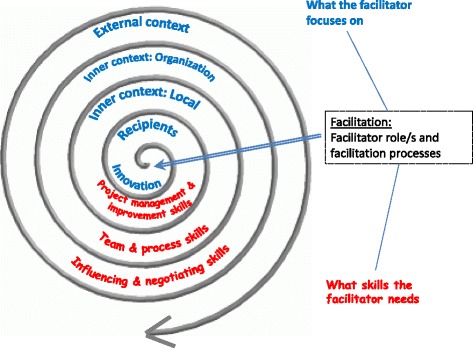
“The revised i-PARIHS framework positions facilitation as the active ingredient of implementation, assessing and aligning the innovation to be implemented with the intended recipients in their local, organisational and wider system context.”
§ PARIHS revisited: from heuristic to integrated framework for the successful implementation of knowledge into practice > Conclusions
plaindirect- Asserted: passes — The authors put it forward as true.
- Checkable: passes — It can be checked against evidence.
- Load-bearing: passes — The paper’s conclusions depend on it.
- Based: passes — The paper gives a reason why it holds.
Probably not a substantial claim. It may state two separate claims as one.
A conclusion the paper draws from its own results — it cites no other source for it, so there is none to check. The quote shows it is in the paper.
In the paper
“We propose that facilitation is the construct that activates implementation through assessing and responding to characteristics of the innovation and the recipients (both as individuals and in teams) within their contextual setting.”
§ PARIHS revisited: from heuristic to integrated framework for the successful implementation of knowledge into practice > Main Text > The facilitation construct
plaindirect- Asserted: passes — The authors put it forward as true.
- Checkable: fails — It may be too vague to check against evidence.
- Load-bearing: passes — The paper’s conclusions depend on it.
- Based: fails — The paper may give no reason why it holds.
Probably not a substantial claim. It may be too vague to check against evidence. The paper may give no reason why it holds.
- Rests on an assumption: Implementation of evidence into practice is a complex, multi-dimensional process.
A conclusion the paper draws from its own results — it cites no other source for it, so there is none to check. The quote shows it is in the paper.
In the paper
“Our hypothesis is that the further out into the spiral the facilitator moves, the greater the level of experience and skill they will need.”
§ PARIHS revisited: from heuristic to integrated framework for the successful implementation of knowledge into practice > Main Text > How the i-PARIHS framework is actioned
hedgedcorrelational- Asserted: fails — The authors may not put it forward as true.
- Checkable: passes — It can be checked against evidence.
- Load-bearing: fails — The paper’s conclusions may not depend on it.
- Based: fails — The paper may give no reason why it holds.
Probably not a substantial claim. The authors may not put it forward as true. The paper’s conclusions may not depend on it. The paper may give no reason why it holds.
In the paper
“Weiner’s theory of organisational readiness to change [71] proposes that readiness depends on collective behaviour change linked to two key factors, described as change commitment (wanting to change) and change efficacy (able to change).”
§ PARIHS revisited: from heuristic to integrated framework for the successful implementation of knowledge into practice > Main Text > The underpinning theoretical antecedents of the i-PARIHS framework
What the sources say
- Not checked yetcites [71] Weiner B. A theory of organizational readiness for change. Implement Sci. 2009;4(1):67. source
plaincorrelational- Asserted: passes — The authors put it forward as true.
- Checkable: passes — It can be checked against evidence.
- Load-bearing: fails — The paper’s conclusions may not depend on it.
- Based: passes — The paper gives a reason why it holds.
Probably not a substantial claim. The paper’s conclusions may not depend on it.
A conclusion the paper draws from its own results — it cites no other source for it, so there is none to check. The quote shows it is in the paper.
In the paper
“This likely reflects the fact that facilitation itself is a complex intervention, involving one or more individuals in the role of facilitator, applying a combination of improvement and team-focused strategies to enable and support change.”
§ PARIHS revisited: from heuristic to integrated framework for the successful implementation of knowledge into practice > Main Text > The facilitation construct
hedged- Asserted: passes — The authors put it forward as true.
- Checkable: fails — It may be too vague to check against evidence.
- Load-bearing: passes — The paper’s conclusions depend on it.
- Based: passes — The paper gives a reason why it holds.
Probably not a substantial claim. It may be too vague to check against evidence.
A conclusion the paper draws from its own results — it cites no other source for it, so there is none to check. The quote shows it is in the paper.
In the paper
“This in turn suggests that whilst novice facilitators may be able to support locally focused implementation projects (in terms of working with a local team to plan and undertake the project), they are likely to need the support of a more experienced facilitator to assess and negotiate some of the more challenging barriers or contextual factors they may encounter.”
§ PARIHS revisited: from heuristic to integrated framework for the successful implementation of knowledge into practice > Main Text > How the i-PARIHS framework is actioned
hedgedconditional- Asserted: passes — The authors put it forward as true.
- Checkable: fails — It may be too vague to check against evidence.
- Load-bearing: fails — The paper’s conclusions may not depend on it.
- Based: passes — The paper gives a reason why it holds.
Probably not a substantial claim. It may be too vague to check against evidence. The paper’s conclusions may not depend on it. It may state two separate claims as one.
None of the sources cited for this claim have been checked yet.
In the paper
“As others have noted, there is still more work to do on clarifying the concept of facilitation [80, 81].”
§ PARIHS revisited: from heuristic to integrated framework for the successful implementation of knowledge into practice > Main Text > The underpinning theoretical antecedents of the i-PARIHS framework
What the sources say
- Not checked yetcites [80] Dogherty EJ, Harrison MB, Graham ID. Facilitation as a role and process in achieving evidence-based practice in nursing: a focused review of concept and meaning. Worldviews Evid Based Nurs. 2010;7(2):76–89.
- Not checked yetcites [81] Berta W, Cranley L, Dearing JW, Dogherty EJ, Squires JE, Estabrooks CA. Why (we think) facilitation works: insights from organizational learning theory. Implement Sci. 2015;10(1):1–13. source
plain- Asserted: passes — The authors put it forward as true.
- Checkable: fails — It may be too vague to check against evidence.
- Load-bearing: fails — The paper’s conclusions may not depend on it.
- Based: passes — The paper gives a reason why it holds.
Probably not a substantial claim. It may be too vague to check against evidence. The paper’s conclusions may not depend on it.
The paper states this without a source or data behind it here, so there is nothing to check it against. The quote shows it is in the paper.
In the paper
“The framework has been widely applied, tested, reviewed and refined.”
§ PARIHS revisited: from heuristic to integrated framework for the successful implementation of knowledge into practice > Conclusions
plain- Asserted: passes — The authors put it forward as true.
- Checkable: passes — It can be checked against evidence.
- Load-bearing: passes — The paper’s conclusions depend on it.
- Based: fails — The paper may give no reason why it holds.
Probably not a substantial claim. The paper may give no reason why it holds.
The authors state this as an assumption.
Successful implementation can be primarily specified as the achievement of implementation/project goals.
“In our revised, i-PARIHS framework, successful implementation is primarily specified in terms of the achievement of implementation/project goals and results from the facilitation of an innovation with the recipients in their (local, organisational and health system) context (Table 2).”
The paper relies on this without support.
Implementation of evidence into practice is a complex, multi-dimensional process.
“PARIHS was one of the first frameworks to make explicit the multi-dimensional and complex nature of implementation as well as highlighting the central importance of context.”
Citations
Cites
Situated Learning: Legitimate Peripheral Participation.
Bloch, M. E. F., Lave, J., & Wenger, É. (1994) · Man · doi:10.2307/2804509 · Cited by 39,362
Rogers, E. M., Singhal, A., & Quinlan, M. M. (2019) · Routledge eBooks · doi:10.4324/9780203710753-35 · Cited by 37,670
Situated Learning: Legitimate Peripheral Participation
Lave, J., & Wenger, E. (1991) · Cambridge University Press eBooks · doi:10.1017/cbo9780511815355 · Cited by 35,324
(1983) · Cited by 33,192
(1999) · Cited by 28,356
Communities of Practice: Learning, Meaning, and Identity
Wenger, E. (1998) · doi:10.1017/cbo9780511803932 · Cited by 23,500
Valente, T. W. (2003) · Genetics in Medicine · doi:10.1097/01.gim.0000061743.67794.c4 · Cited by 20,559
The fifth discipline, the art and practice of the learning organization
Senge, P. M. (1991) · Performance + Instruction · doi:10.1002/pfi.4170300510 · Cited by 20,060
Damschroder, L. J., Aron, D. C., Keith, R. E., Kirsh, S. R., Alexander, J. A., & Lowery, J. C. (2009) · Implementation Science · doi:10.1186/1748-5908-4-50 · Cited by 14,496
Organizational Culture and Leadership
Tierney, W. G., & Schein, E. H. (1986) · Academy of Management Review · doi:10.2307/258322 · Cited by 9,614
Research works printed but not linked: 3
- Hargreaves D. Creative professionalism: the role of teachers in the knowledge society. London: Demos; 1998.
- Royal College of Nursing. Quality patient care: the dynamic standard setting system. Scutari: Harrow; 1990.
- Heron J. The facilitator’s handbook. London: Kogan Page; 1989.
Cited by
Sorted by citations
Items 201–300 of 999
Health Equity and Implementation Science in Heart, Lung, Blood, and Sleep-Related Research
Sterling, M. R., Echeverría, S. E., Commodore-Mensah, Y. Y., Breland, J. Y., & Nuñez-Smith, M. (2019) · Circulation Cardiovascular Quality and Outcomes · doi:10.1161/circoutcomes.119.005586 · Cited by 23
Klingshirn, H., Müller, M., Beutner, K., Hirt, J., Strobl, R., Grill, E., Meyer, G., & Saal, S. (2020) · BMC Geriatrics · doi:10.1186/s12877-020-01655-z · Cited by 26
Gustavson, A. M., Wisdom, J. P., Kenny, M. E., Salameh, H. A., Ackland, P. E., Clothier, B. A., Noorbaloochi, S., Gordon, A. J., & Hagedorn, H. (2021) · Implementation Science Communications · doi:10.1186/s43058-021-00119-8 · Cited by 23
Cijvat, C. D., Ronald Cornet, A., & Hägglund, M. (2021) · Frontiers in Public Health · doi:10.3389/fpubh.2021.621210 · Cited by 21
Östlind, E., Hansson, E. E., Eek, F., & Stigmar, K. (2022) · BMC Public Health · doi:10.1186/s12889-022-14065-0 · Cited by 23
Goldstein, S. P., Tovar, A., Espel‐Huynh, H., & Stowers, K. C. (2023) · Psychosomatic Medicine · doi:10.1097/psy.0000000000001176 · Cited by 24
Norton, T. C., Rodríguez, D., & Willems, S. J. T. (2019) · Health Research Policy and Systems · doi:10.1186/s12961-019-0463-9 · Cited by 24
Kyambade, M., & Namatovu, A. (2025) · Leadership in health services · doi:10.1108/lhs-02-2025-0025 · Cited by 30
Vikström, S., & Johansson, K. (2019) · Journal of Clinical Nursing · doi:10.1111/jocn.14884 · Cited by 24
Lövestam, E., Vivanti, A., Steiber, A. L., Boström, A., Devine, A., Haughey, O., Kiss, C., Lang, N. R., Lieffers, J. R. L., Lloyd, L., et al. (2020) · Journal of Human Nutrition and Dietetics · doi:10.1111/jhn.12700 · Cited by 24
Faculty Use of Collaborative Online International Learning (COIL) for Internationalization at Home
Mudiamu, S. S. (2020) · doi:10.15760/etd.7342 · Cited by 26
Gustafsson, T., Sundler, A. J., Lindberg, E., et al. (2021) · BMC Nursing · doi:10.1186/s12912-021-00565-8 · Cited by 20
Glass, J. E., Dorsey, C. N., Beatty, T. C., Bobb, J. F., Wong, E. S., Palazzo, L. G., King, D., Mogk, J. M., Stefanik-Guizlo, K., Idu, A., et al. (2023) · Implementation Science · doi:10.1186/s13012-022-01258-9 · Cited by 20
Thørrisen, M. M., Skogen, J. C., Kjeken, I., Jensen, I. B., & Aas, R. W. (2019) · Substance Abuse Treatment Prevention and Policy · doi:10.1186/s13011-019-0217-2 · Cited by 20
Warner, G., Kervin, E. K., Pesut, B., Urquhart, R., Duggleby, W., & Hill, T. G. (2021) · BMC Health Services Research · doi:10.1186/s12913-020-06031-6 · Cited by 23
Ekelöf, K., Sæther, E., Santesson, A. H. E., Wilander, M., Patriksson, K., Hesselman, S., Thies‐Lagergren, L., Rabe, H., & Andersson, O. (2022) · BMC Pregnancy and Childbirth · doi:10.1186/s12884-022-04915-5 · Cited by 21
Hu, S., Liu, S., Xian-feng, L., Zhao, J., Chen, J., Chen, W., & Hu, J. (2024) · International Nursing Review · doi:10.1111/inr.13054 · Cited by 31
Marsden, E. J., Craswell, A., Taylor, A., Barnett, A. G., Wong, P.-K., & Wallis, M. C. (2022) · BMC Geriatrics · doi:10.1186/s12877-022-02999-4 · Cited by 22
Yue, J., Liu, J., Zhao, Y., Williams, S., Zhang, B., Zhang, L., Zhang, Q., Liu, X., Wall, S. N., & Zhao, G. (2022) · BMC Health Services Research · doi:10.1186/s12913-022-07493-6 · Cited by 17
Frost, J., Wingham, J., Britten, N., Greaves, C. J., Abraham, C., Warren, F. C., Dalal, H. M., & Taylor, R. S. (2020) · BMC Medical Research Methodology · doi:10.1186/s12874-020-01060-5 · Cited by 22
Patient Perspectives of the Hospital Discharge Process: A Qualitative Study
Jones, K. C., Austad, K., Silver, S. R., Cordova-Ramos, E. G., Fantasia, K. L., Perez, D. C., Kremer, K., Wilson, S., Walkey, A. J., & Drainoni, M. (2023) · Journal of Patient Experience · doi:10.1177/23743735231171564 · Cited by 24
Smith, J. L., Ritchie, M. J., Kim, B., Miller, C. J., Chinman, M., Kelly, P. A., Landes, S. J., & Kirchner, J. E. (2024) · Global Implementation Research and Applications · doi:10.1007/s43477-024-00119-5 · Cited by 22
Use of Implementation Science to Advance Nurse-Led Evidence-Based Practices in Clinical Settings
McNett, M., Tucker, S., Thomas, B. K., Gorsuch, P., & Gallagher‐Ford, L. (2021) · Nurse Leader · doi:10.1016/j.mnl.2021.11.002 · Cited by 23
Yakovchenko, V., Bolton, R. E., Drainoni, M., & Gifford, A. L. (2019) · BMC Health Services Research · doi:10.1186/s12913-019-4043-z · Cited by 18
Clinicians as novice facilitators: a SIMPLE case study
Young, A., Keller, H., Barnes, R., & Bell, J. (2018) · Journal of Health Organization and Management · doi:10.1108/jhom-03-2018-0071 · Cited by 22
Owen, R. R., Woodward, E. N., Drummond, K. L., Deen, T. L., Oliver, K. A., Petersen, N. J., Meit, S. S., Fortney, J. C., & Kirchner, J. E. (2019) · Implementation Science · doi:10.1186/s13012-019-0875-5 · Cited by 20
Björkdahl, A., Johansson, U. E., Kjellin, L., & Pelto‐Piri, V. (2023) · International Journal of Mental Health Nursing · doi:10.1111/inm.13222 · Cited by 23
Evaluating implementation strategies to support documentation of veterans' care preferences
Carpenter, J. G., Scott, W., Kononowech, J., Foglia, M. B., Haverhals, L. M., Hogikyan, R. V., Kolanowski, A. M., Landis‐Lewis, Z., Levy, C. R., Miller, S. C., et al. (2022) · Health Services Research · doi:10.1111/1475-6773.13958 · Cited by 18
Nilsén, P., Reed, J. E., Nair, M., Savage, C., Macrae, C., Barlow, J. G., Svedberg, P., Larsson, I., Lundgren, L. E., & Nygren, J. (2022) · Frontiers in Health Services · doi:10.3389/frhs.2022.961475 · Cited by 23
Cao, S., Gu, M., Feng, M., et al. (2021) · Journal of Nursing Management · doi:10.1111/jonm.13458 · Cited by 22
Hunter, S. C., Kim, B. H., & Kitson, A. A. (2020) · Implementation Science Communications · doi:10.1186/s43058-020-00046-0 · Cited by 22
Self-citationImplementing safe abortion in Ghana: “We must tell our story and tell it well”
Chavkin, W., Baffoe, P., & Awoonor‐Williams, J. K. (2018) · International Journal of Gynecology & Obstetrics · doi:10.1002/ijgo.12674 · Cited by 22
Steffen, K. M., Spinella, P. C., Holdsworth, L. M., Ford, M. A., Lee, G. M., Asch, S. M., Proctor, E. K., & Doctor, A. (2021) · Frontiers in Pediatrics · doi:10.3389/fped.2021.800461 · Cited by 21
Leadership perspective on the implementation of guidelines on healthcare-associated infections
Hegarty, J. M., Murphy, S., Creedon, S. A., et al. (2019) · BMJ Leader · doi:10.1136/leader-2018-000111 · Cited by 21
A Seat at the Table: Supporting Persons with Severe Dementia in Communicating Their Preferences
Burshnic, V., & Bourgeois, M. S. (2020) · Clinical Gerontologist · doi:10.1080/07317115.2020.1764686 · Cited by 19
Bracci, E. L., Allen, M. J., Carter, H. E., Cyarto, L., Dwyer, T., Graves, N., Lee, X. J., Meyer, C., Oprescu, F., & Harvey, G. (2023) · BMJ Open · doi:10.1136/bmjopen-2022-066857 · Cited by 12
Self-citationAdjognon, O. L., Brady, J. E., Gerber, M. R., Dichter, M. E., Grillo, A. R., Hamilton, A. B., Stirman, S. W., & Iverson, K. M. (2021) · The Journal of the American Board of Family Medicine · doi:10.3122/jabfm.2021.02.200311 · Cited by 19
Interventions to Increase Colorectal Cancer Screening Uptake in Primary Care: A Systematic Review
Adhikari, K., Manalili, K., Law, J., Bischoff, M., & Teare, G. F. (2022) · The Journal of the American Board of Family Medicine · doi:10.3122/jabfm.2022.04.210399 · Cited by 20
The Role of Implementation Science in Reducing Sexual and Gender Minority Mental Health Disparities
Perry, N. S., & Elwy, A. R. (2021) · LGBT Health · doi:10.1089/lgbt.2020.0379 · Cited by 18
Patient-centric culture and implications for patient engagement during the COVID-19 pandemic
Majid, U., & Wasim, A. (2020) · Patient Experience Journal · doi:10.35680/2372-0247.1398 · Cited by 20
Lynch, E. A., Connell, L., Carvalho, L. B., & Bird, M. (2021) · Disability and Rehabilitation · doi:10.1080/09638288.2021.1891304 · Cited by 20
Pighills, A., Tynan, A., Furness, L., & Rawle, M. (2019) · Australian Occupational Therapy Journal · doi:10.1111/1440-1630.12560 · Cited by 21
Serious Illness Care Programme—contextual factors and implementation strategies: a qualitative study
Paladino, J., Sanders, J. J., Kilpatrick, L., Prabhakar, R., Kumar, P. P., O’Connor, N. R., Durieux, B. N., Fromme, E. K., Benjamin, E. M., & Mitchell, S. E. (2022) · BMJ Supportive & Palliative Care · doi:10.1136/bmjspcare-2021-003401 · Cited by 19
Implementation of a diabetes prevention program within two community sites: a qualitative assessment
Dineen, T. E., Bean, C. N., & Jung, M. E. (2022) · Implementation Science Communications · doi:10.1186/s43058-022-00258-6 · Cited by 20
Joudrey, P. J., Nelson, C. R., Lawson, K. A., Morford, K. L., Muley, D., Watson, C., Okafor, M., Wang, E. A., & Crusto, C. A. (2021) · Journal of Substance Abuse Treatment · doi:10.1016/j.jsat.2021.108476 · Cited by 21
Naef, R., Kaeppeli, B. M., Lanter, R., & Petry, H. (2020) · Journal of Family Nursing · doi:10.1177/1074840720915598 · Cited by 21
Karam, M., Macq, J., Duchesnes, C., Crismer, A., & Belche, J.-L. (2021) · Journal of Interprofessional Care · doi:10.1080/13561820.2021.1929878 · Cited by 21
Granberg, A., Matérne, M., Lundqvist, L., & Duberg, A. (2021) · BMC Health Services Research · doi:10.1186/s12913-021-06570-6 · Cited by 19
Supporting first-line managers in implementing oral care guidelines in nursing homes
Eldh, A. C., Olai, L., Jönsson, B., Wallin, L., Denti, L., & Elf, M. (2017) · Nordic journal of nursing research · doi:10.1177/2057158517713379 · Cited by 17
Lennon, O. C., Phelan, D., Wallace, D., King, J. B., & Barrett, T. (2019) · Physiotherapy Research International · doi:10.1002/pri.1774 · Cited by 22
Aquino, J., Crilly, J. L., & Ranse, K. (2022) · International Emergency Nursing · doi:10.1016/j.ienj.2022.101168 · Cited by 23
Malone, S. M., McKay, V., Krucylak, C., Powell, B. J., Liu, J., Terrill, C. M., Saito, J. M., Rangel, S. J., & Newland, J. G. (2021) · Implementation Science · doi:10.1186/s13012-021-01096-1 · Cited by 19
Melnyk, B. M., Hsieh, A. P., & Mu, J. (2022) · Worldviews on Evidence-Based Nursing · doi:10.1111/wvn.12603 · Cited by 20
McClatchey, K., Marsh, V., Steed, L., Holmes, S., Taylor, S. J., Wiener-Ogilvie, S., Neal, J., Last, R., Saxon, A., Pinnock, H., et al. (2022) · Trials · doi:10.1186/s13063-022-06147-6 · Cited by 14
Raphiphatthana, B., Sweet, M., Puszka, S., Dingwall, K. M., & Nagel, T. M. (2020) · BMC Health Services Research · doi:10.1186/s12913-020-05431-y · Cited by 19
Strehlenert, H., Hansson, J., Nyström, M. E., & Hasson, H. (2019) · BMC Health Services Research · doi:10.1186/s12913-019-4591-2 · Cited by 25
Practical application of hybrid effectiveness–implementation studies for intervention research
Handley, M. A., Murphy, L., Sherwin, E. B., & Shade, S. B. (2025) · International Journal of Epidemiology · doi:10.1093/ije/dyaf039 · Cited by 20
Hall, L., White, N. M., Allen, M. J., et al. (2020) · Antimicrobial Resistance and Infection Control · doi:10.1186/s13756-020-0694-0 · Cited by 19
Process mining for healthcare decision analytics with micro-costing estimations
Leemans, S., Partington, A., Karnon, J., & Wynn, M. (2022) · Artif. Intell. Medicine · doi:10.1016/j.artmed.2022.102473 · Cited by 20
Implementing Evidence Based Practice nursing using the PDSA model: Process, lessons and implications
Katowa-Mukwato, P., Mwiinga-Kalusopa, V., Chitundu, K., Kanyanta, M., Chanda, D., Mwelwa, M. M., Wahila, R., Mundia, P., & Carrier, J. (2020) · International Journal of Africa Nursing Sciences · doi:10.1016/j.ijans.2020.100261 · Cited by 20
Chouliara, N., Cameron, T. M., Byrne, A., Lewis, S., Langhorne, P., Robinson, T. G., Waring, J. J., Walker, M. F., & Fisher, R. J. (2023) · BMC Health Services Research · doi:10.1186/s12913-023-09290-1 · Cited by 21
Lockwood, C. S., Munn, Z., Jordan, Z., Pilla, B., Püschel, V. A. D. A., dos Santos, K. B., Albornos-Muñóz, L., Kent, B., Mu, P., Khalil, H., et al. (2022) · Journal of Clinical Epidemiology · doi:10.1016/j.jclinepi.2022.04.007 · Cited by 20
Pol-Castañeda, S., Rodríguez-Calero, M. Á., Gomila, C. J. V., Blanco‐Mavillard, I., Lallemand, C. Z., Ferrer-Cruz, F., & de Pedro‐Gómez, J. E. (2022) · BMC Nursing · doi:10.1186/s12912-022-01110-x · Cited by 18
Branch‐Elliman, W., Lamkin, R. P., Shin, M. H., Mull, H. J., Epshtein, I., Golenbock, S. W., Schweizer, M. L., Colborn, K. L., Rove, J. Y., Strymish, J. M., et al. (2022) · Implementation Science · doi:10.1186/s13012-022-01186-8 · Cited by 19
Minogue, V., Matvienko‐Sikar, K., Hayes, C. B., Morrissey, M., Gorman, G., & Terrés, A. (2021) · Health Research Policy and Systems · doi:10.1186/s12961-021-00747-5 · Cited by 23
Doupe, M. B., Brunkert, T., Wagg, A., Ginsburg, L. R., Norton, P., Berta, W. B., Knopp‐Sihota, J., & Estabrooks, C. A. (2022) · Pilot and Feasibility Studies · doi:10.1186/s40814-022-00975-8 · Cited by 16
Eriksson, L., Bergström, A., Hoa, D. T. P., Nga, N. T., & Eldh, A. C. (2017) · PLoS ONE · doi:10.1371/journal.pone.0182626 · Cited by 16
Wagg, A., Hoben, M., Ginsburg, L. R., Doupe, M. B., Berta, W. B., Song, Y., Norton, P., Knopp‐Sihota, J., & Estabrooks, C. A. (2023) · Implementation Science · doi:10.1186/s13012-022-01259-8 · Cited by 14
Seacrist, M. J., Bingham, D., Scheich, B., & Byfield, R. (2017) · Journal of Obstetric, Gynecologic & Neonatal Nursing · doi:10.1016/j.jogn.2017.11.009 · Cited by 19
Nationwide Environmental Scan of Knowledge Brokers Training
Gaid, D., Mate, K., Ahmed, S., Thomas, A., & Bussières, A. (2021) · Journal of Continuing Education in the Health Professions · doi:10.1097/ceh.0000000000000355 · Cited by 14
Alostaz, Z., Rose, L., Mehta, S., et al. (2022) · Nursing in Critical Care · doi:10.1111/nicc.12864 · Cited by 18
Coronado, G. D., Leo, M. C., Ramsey, K., Coury, J., Petrik, A. F., Patzel, M., Kenzie, E. S., Thompson, J. H., Brodt, E., Mummadi, R., et al. (2022) · Implementation Science Communications · doi:10.1186/s43058-022-00285-3 · Cited by 20
Pineda, R. G., Roussin, J., Kwon, J., et al. (2021) · BMC Pediatrics · doi:10.1186/s12887-021-02594-3 · Cited by 19
Eldh, A. C., Nyman, M. H., Joelsson‐Alm, E., & Wallin, L. (2023) · Frontiers in Health Services · doi:10.3389/frhs.2023.1112936 · Cited by 18
Gifford, W., Lewis, K. B., Eldh, A. C., Fiset, V., Abdul-Fatah, T., Åberg, A. C., Thavorn, K., Graham, I. D., & Wallin, L. (2019) · Pilot and Feasibility Studies · doi:10.1186/s40814-019-0485-7 · Cited by 22
Tuepker, A., Elnitsky, C., Newell, S., Zaugg, T., & Henry, J. (2018) · PLoS ONE · doi:10.1371/journal.pone.0196105 · Cited by 17
Barnden, R., Snowdon, D. A., Lannin, N. A., Lynch, E. A., Srikanth, V. K., & Andrew, N. E. (2023) · BMC Health Services Research · doi:10.1186/s12913-023-09609-y · Cited by 19
Diffin, J., Ewing, G., Harvey, G., & Grande, G. (2018) · Worldviews on Evidence-Based Nursing · doi:10.1111/wvn.12323 · Cited by 19
Self-citationDubrowski, R., Barwick, M. A., & Dubrowski, A. (2018) · Springer eBooks · doi:10.1007/978-3-319-90518-1_10 · Cited by 14
Woo, B., Ng, W. M., Tan, I. F., & Zhou, W. (2023) · Journal of Clinical Nursing · doi:10.1111/jocn.16970 · Cited by 18
From harm reduction to legalization: The Uruguayan model for safe abortion
Stifani, B. M., Couto, M., & Gómez, A. L. (2018) · International Journal of Gynecology & Obstetrics · doi:10.1002/ijgo.12677 · Cited by 18
Quinn, J. M., Gephart, S. M., & Davis, M. P. (2019) · Worldviews on Evidence-Based Nursing · doi:10.1111/wvn.12413 · Cited by 18
Paediatric palliative care: a systematic review
Nilsson, S., Öhlén, J., Hessman, E., & Brännström, M. (2019) · BMJ Supportive & Palliative Care · doi:10.1136/bmjspcare-2019-001934 · Cited by 17
Close Collaboration with Parents—Implementation and effectiveness
Ahlqvist‐Björkroth, S., Axelin, A., & Lehtonen, L. (2024) · Acta Paediatrica · doi:10.1111/apa.17210 · Cited by 18
Angelini, E., Wolf, A., Wijk, H., Brisby, H., & Baranto, A. (2021) · BMC Health Services Research · doi:10.1186/s12913-021-06819-0 · Cited by 23
Nyman, M. H., Forsman, H., Wallin, L., Ostaszkiewicz, J., Hommel, A., & Eldh, A. C. (2018) · Journal of Evaluation in Clinical Practice · doi:10.1111/jep.12879 · Cited by 19
Urban, K., Wright, P. B., Hester, A. L., Curran, G. M., Rojo, M. O., & Tsai, P. (2020) · Clinical Interventions in Aging · doi:10.2147/cia.s256416 · Cited by 12
Levenson, J. C., & Williamson, A. A. (2023) · Journal of Clinical Sleep Medicine · doi:10.5664/jcsm.10476 · Cited by 19
Balasubramanian, B. A., Heurtin‐Roberts, S., Krasny, S., et al. (2017) · The Journal of the American Board of Family Medicine · doi:10.3122/jabfm.2017.03.160151 · Cited by 18
Eriksson, C., Eriksson, G. M., Johansson, U., & Guidetti, S. G. E. (2019) · Scandinavian Journal of Occupational Therapy · doi:10.1080/11038128.2019.1573917 · Cited by 18
Mudge, A., McRae, P., Young, A., Blackberry, I., Lee‐Steere, K., Barrimore, S. E., Quirke, T., & Harvey, G. (2023) · BMC Health Services Research · doi:10.1186/s12913-023-09659-2 · Cited by 20
Self-citationNdabu, T., Mulgund, P., Sharman, R., & Singh, R. K. P. G. (2021) · JMIR Human Factors · doi:10.2196/21884 · Cited by 18
Walshe, C., Kinley, J., Patel, S., Goodman, C. M., Bunn, F., Lynch, J. K., Scott, D. R. M., Lund, A. D., Stacpoole, M., Preston, N. J., et al. (2019) · BMC Geriatrics · doi:10.1186/s12877-019-1275-z · Cited by 17
Hawkins, E. J., Lott, A. M. K., Danner, A. N., Malte, C. A., Hagedorn, H., Berger, D. B., Donovan, L. M., Sayre, G. G., Mariano, A. J., & Saxon, A. J. (2020) · Pain Medicine · doi:10.1093/pm/pnaa435 · Cited by 17
Aspinall, C., Slark, J., Parr, J. M., et al. (2024) · Journal of Advanced Nursing · doi:10.1111/jan.16043 · Cited by 17
Abortion as a human right: The struggle to implement the abortion law in Colombia
Stifani, B. M., Urbano, L. G., Vélez, A. C. G., & Velásquez, C. V. (2018) · International Journal of Gynecology & Obstetrics · doi:10.1002/ijgo.12672 · Cited by 18
Clubhouses Response to COVID-19: Member Challenges and Clubhouse Adaptations
Mutschler, C., Junaid, S., & McShane, K. (2021) · Community Mental Health Journal · doi:10.1007/s10597-020-00753-x · Cited by 17
Warner, E. T., Huguet, N., Fredericks, M., Gundersen, D. A., Nederveld, A., Brown, M. C., Houston, T. K., Davis, K. L., Mazzucca, S., Rendle, K. A. S., et al. (2023) · Social Science & Medicine · doi:10.1016/j.socscimed.2023.116095 · Cited by 16
Ritchie, M. J., Parker, L. E., & Kirchner, J. E. (2023) · BMC Health Services Research · doi:10.1186/s12913-023-09598-y · Cited by 16
Serafica, R. C., Reyes, A. T., Cacciata, M. C., Kawi, J., Leyva, E. W. A., Sy, F. S., & Evangelista, L. S. (2024) · Journal of Transcultural Nursing · doi:10.1177/10436596241271270 · Cited by 18
Metadata
- Authors
- Harvey, G., & Kitson, A.
- Affiliations
- University of Manchester (GB)
- University of Oxford (GB)
- Corresponding author
- Harvey, Gill
- Venue
- Implementation Science
- Published
- 2015-12
- Volume
- 11
- Issue
- 1
- Pages
- 33-33
- ISSN
- 1748-5908 (ISSN-L)
- PMC
- PMC4807546
- OpenAlex
- W2306592406
- Cited by
- 1,271
- References
- 103
- Citations by year
- 2026: 115 · 2025: 130 · 2024: 203 · 2023: 166 · 2022: 187 · 2021: 170 · 2020: 115 · 2019: 86 · 2018: 61 · 2017: 33 · 2016: 3
- FWCI
- 59.12
- Type
- journal article
- Language
- en
- Open access
- gold
- doi.org
- Licence
- cc-by
- Locations
- Implementation Science (publishedVersion, cc-by)
- PubMed Central (publishedVersion, cc-by)
- PubMed (publishedVersion)
- Flinders Academic Commons (Flinders University) (publishedVersion)
- Research Explorer (The University of Manchester) (submittedVersion, cc-by)
- Adelaide Research & Scholarship (AR&S) (University of Adelaide) (submittedVersion, cc-by)
- Flinders Academic Commons (Flinders University) (submittedVersion)
- Topics
- Health Sciences › Health Professions › General Health Professions › Health Policy Implementation Science
- Health Sciences › Health Professions › General Health Professions › Health Sciences Research and Education
- Health Sciences › Medicine › Public Health, Environmental and Occupational Health › Clinical practice guidelines implementation
- Keywords
- PARIHS framework, i-PARIHS framework, implementation research, implementation context, implementation facilitation, implementation teams, face and content validity
- MeSH terms
- Delivery of Health Care, Diffusion of Innovation, Translational Research, Biomedical
About these checks
Registry, retraction, Cites and statistics results are computed, not judged, with one exception: a printed reference that no index lists is read once by a model before it counts as a citation error. Claims are extracted by a model and kept only when their quote appears verbatim in the text; each cited source is then checked, with a model’s help, for whether it says what the claim relies on. Those verdicts can be wrong — read the claim’s quote and the cited source before relying on one.
A language model drew the claims from the paper on 2026-10-06, under version 3 of the claim definition (model deepseek-v4.1-flash, prompt extract-v3).
A second model labelled each claim on 2026-10-06 (model jev-1.13-20260917, definition revision gold-guideline-v0.2).
Cited sources are checked with a language model’s help (gpt-6-sol).
Statistics and arithmetic are recomputed, not judged.
Confidence bands are shown only for fields calibrated on our annotated test set. None is calibrated yet, so no band is shown.
What counts as a claim ›How we measure confidence ›How we check this ›
Are you an author, or do you see a problem with this page? Request a review
