

A guide to using the Theoretical Domains Framework of behaviour change to investigate implementation problems
Open accessThe DOI matches its Crossref record; 90 of the 90 references it cites were found in a registry or an index; 40 of the 57 sources its claims cite were checked for support.
Abstract
BACKGROUND: Implementing new practices requires changes in the behaviour of relevant actors, and this is facilitated by understanding of the determinants of current and desired behaviours. The Theoretical Domains Framework (TDF) was developed by a collaboration of behavioural scientists and implementation researchers who identified theories relevant to implementation and grouped constructs from these theories into domains. The collaboration aimed to provide a comprehensive, theory-informed approach to identify determinants of behaviour. The first version was published in 2005, and a subsequent version following a validation exercise was published in 2012. This guide offers practical guidance for those who wish to apply the TDF to assess implementation problems and support intervention design. It presents a brief rationale for using a theoretical approach to investigate and address implementation problems, summarises the TDF and its development, and describes how to apply the TDF to achieve implementation objectives. Examples from the implementation research literature are presented to illustrate relevant methods and practical considerations. METHODS: Researchers from Canada, the UK and Australia attended a 3-day meeting in December 2012 to build an international collaboration among researchers and decision-makers interested in the advancing use of the TDF. The participants were experienced in using the TDF to assess implementation problems, design interventions, and/or understand change processes. This guide is an output of the meeting and also draws on the authors' collective experience. Examples from the implementation research literature judged by authors to be representative of specific applications of the TDF are included in this guide. RESULTS: We explain and illustrate methods, with a focus on qualitative approaches, for selecting and specifying target behaviours key to implementation, selecting the study design, deciding the sampling strategy, developing study materials, collecting and analysing data, and reporting findings of TDF-based studies. Areas for development include methods for triangulating data, e.g. from interviews, questionnaires and observation and methods for designing interventions based on TDF-based problem analysis. CONCLUSIONS: We offer this guide to the implementation community to assist in the application of the TDF to achieve implementation objectives. Benefits of using the TDF include the provision of a theoretical basis for implementation studies, good coverage of potential reasons for slow diffusion of evidence into practice and a method for progressing from theory-based investigation to intervention.
Overview
CoChat Summary
TL;DR
This guide explains how to apply the Theoretical Domains Framework (TDF) to investigate implementation problems, focusing mainly on qualitative interview and focus group methods. It outlines steps from specifying target behaviours to analysing and reporting TDF-based data, with illustrative examples and stated limitations.
Key findings
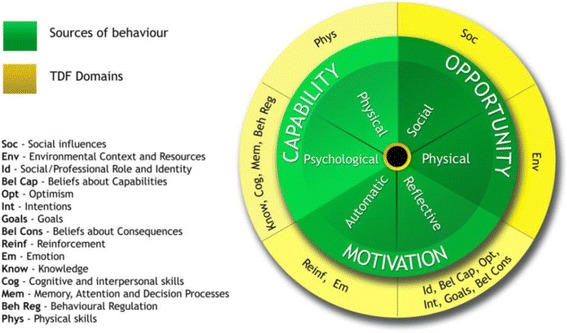
- The TDF is an integrated theoretical framework synthesised from 128 theoretical constructs from 33 theories; version 1 has 12 domains, and version 2 has 14 domains covering 84 theoretical constructs. It has been cited in over 800 peer-reviewed publications (Web of Knowledge accessed April 2017).
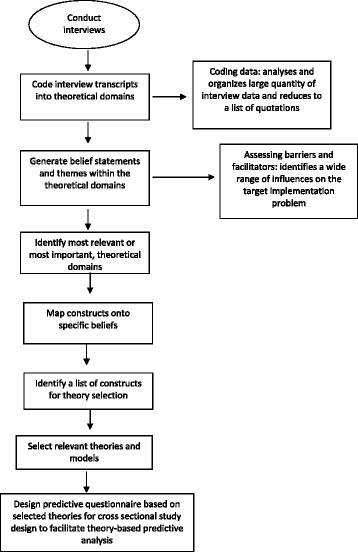
- The guide provides step-by-step methodological guidance for TDF-based implementation research, primarily qualitative interviews and focus groups: selecting and specifying target behaviours, selecting study design, deciding sampling strategy, developing interview schedules, collecting and analysing data, and reporting findings.
- Benefits of using the TDF include providing a theoretical basis for implementation studies, good coverage of potential reasons for slow diffusion of evidence into practice, and a method for progressing from theory-based investigation to intervention. Areas for development include methods for triangulating data (e.g., interviews, questionnaires, observation) and methods for designing interventions based on TDF-based problem analysis.
- Illustrative examples include a low back pain study with focus groups of 42 GPs and a cluster randomised trial randomising 47 practices (53 GPs) to control and 45 practices (59 GPs) to intervention; an SDD Delphi study that interviewed 141 participants; and a diabetes management qualitative systematic review that included 32 studies.
Methods
- Design: researchers from Canada, the UK and Australia attended a 3-day collaborative meeting in December 2012 to discuss the state of the science in using the TDF in implementation research and identify areas needing further development. Participants represented health psychology, sociology, implementation and health services research, statistics, and clinical disciplines including general practice, occupational therapy and chiropractic.
- Guide production: the group identified key steps in applying the TDF, pooled their experience and expertise to elaborate each step, and selected examples from the implementation research literature judged representative of specific TDF applications. The guide draws on the authors’ collective experience.
- Analysis: no datasets were generated or analysed for this article; the guide is a narrative, consensus-based resource focused mainly on qualitative approaches.
Limitations
- Stated in the paper: the scope is mostly limited to qualitative approaches, mainly interview and focus group data, with limited detail on using the TDF with other data collection methods such as survey or observation.
- Stated in the paper: illustrative applications were selected based on an informal rather than structured consensus process, leaving the possibility of selection bias in these examples; the aim was not to be representative but to provide examples across settings and implementation problems.
- Evident from the text: the guide is not a systematic review or an empirical validation of TDF application; its recommendations rest on the authors’ collective experience and selected illustrative examples.
Model-written summary. Check it against the paper before relying on it.
Integrity signals
Registry
Cites
Statistics
Figures
Verification
Claims the paper makes
25 Valid · 2 Not valid · 8 Not checked · 49 Own results and interpretations
Every source the paper cites for this claim was checked and supports it.
In the paper
“In an effort to make theories more accessible to those working in implementation, a team of behavioural scientists developed the TDF in collaboration with implementation researchers [15].”
§ A guide to using the Theoretical Domains Framework of behaviour change to investigate implementation problems > Development of the TDF
What the sources say
- Supportedcites [15] 15. Michie S, Johnston M, Abraham C, Lawton R, Parker D, Walker A, et al. Making psychological theory useful for implementing evidence based practice: a consensus approach. Qual Saf Health Care. 2005;14(1):26-33. source
The Discussion states that the project sought to simplify psychological theory and make it accessible to people involved in implementing evidence-based practice. The Health psychology theorists and Health services researchers sections describe the psychologists who developed the domains and the implementation researchers who evaluated them. Page numbers are not available in our copy. (LLM, conf=0.93)
plainstates a cause- Asserted: passes — The authors put it forward as true.
- Checkable: passes — It can be checked against evidence.
- Load-bearing: unclear — It is unclear whether the paper’s conclusions depend on it.
- Based: passes — The paper gives a reason why it holds.
- Supported
Every source the paper cites for this claim was checked and supports it.
In the paper
“The version of TDF, resulting from this validation, showed similar structure and content to the original with slight differences leading to 14 domains covering 84 theoretical constructs.”
§ A guide to using the Theoretical Domains Framework of behaviour change to investigate implementation problems > Development of the TDF
What the sources say
- Supportedcites [16] 16. Cane J, O'Connor D, Michie S. Validation of the theoretical domains framework for use in behaviour change and implementation research. Implement Sci. 2012;7:37. doi:10.1186/1748-5908-7-37. source
The Discussion reports good support for the TDF’s basic structure alongside refinements producing 14 domains. The Conclusions state that the refined framework contains 84 component constructs. (LLM, conf=0.93)
plainstates a cause- Asserted: passes — The authors put it forward as true.
- Checkable: passes — It can be checked against evidence.
- Load-bearing: unclear — It is unclear whether the paper’s conclusions depend on it.
- Based: passes — The paper gives a reason why it holds.
- Supported
The cited sources support only part of this claim — read each source’s verdict below.
In the paper
“The TDF is an integrated theoretical framework synthesised from 128 theoretical constructs from 33 theories judged most relevant to implementation questions.”
§ A guide to using the Theoretical Domains Framework of behaviour change to investigate implementation problems > Development of the TDF
What the sources say
- Partly supportedcites [15] 15. Michie S, Johnston M, Abraham C, Lawton R, Parker D, Walker A, et al. Making psychological theory useful for implementing evidence based practice: a consensus approach. Qual Saf Health Care. 2005;14(1):26-33. sourceExperimental — accuracy not yet measured
The Results report identifying 128 constructs drawn from 33 psychological theories, and the paper describes developing an integrative framework for implementation research. But the Simplifying into theoretical domains section says only a subset of those constructs was prioritised as particularly relevant; it does not say that all 128 were judged most relevant to implementation questions. Page numbers are unavailable in our copy. (LLM, conf=0.84)
plain- Asserted: passes — The authors put it forward as true.
- Checkable: passes — It can be checked against evidence.
- Load-bearing: unclear — It is unclear whether the paper’s conclusions depend on it.
- Based: passes — The paper gives a reason why it holds.
- Partly supported
Every source the paper cites for this claim was checked and supports it.
In the paper
“The Theoretical Domains Framework (TDF) was initially developed for implementation research to identify influences on health professional behaviour related to implementation of evidence-based recommendations and has been cited in over 800 peer-review publications (Web of Knowledge accessed April 2017).”
§ A guide to using the Theoretical Domains Framework of behaviour change to investigate implementation problems > Background
What the sources say
- Supportedcites [15] 15. Michie S, Johnston M, Abraham C, Lawton R, Parker D, Walker A, et al. Making psychological theory useful for implementing evidence based practice: a consensus approach. Qual Saf Health Care. 2005;14(1):26-33. source
The Abstract says the framework was developed for implementation research to study implementation of evidence-based practice and understand healthcare professionals’ behaviour. The Discussion says its theoretical domains were intended to explain failures to implement evidence-based practice. The separate publication-count statement is attributed to Web of Knowledge, not this source. (LLM, conf=0.93)
plain- Asserted: passes — The authors put it forward as true.
- Checkable: passes — It can be checked against evidence.
- Load-bearing: unclear — It is unclear whether the paper’s conclusions depend on it.
- Based: passes — The paper gives a reason why it holds.
- Supported
Every source the paper cites for this claim was checked and supports it.
In the paper
“The TDF underwent a validation exercise with an independent group of behavioural experts to investigate the optimal structure and content of the framework [16].”
§ A guide to using the Theoretical Domains Framework of behaviour change to investigate implementation problems > Development of the TDF
What the sources say
- Supportedcites [16] 16. Cane J, O'Connor D, Michie S. Validation of the theoretical domains framework for use in behaviour change and implementation research. Implement Sci. 2012;7:37. doi:10.1186/1748-5908-7-37. source
The Background states that the study aimed to validate the TDF’s optimal domain structure and content. The Materials > Procedure passage says participants had expertise in behaviour change theory and did not know the original framework, supporting the description of an independent group of experts. (LLM, conf=0.94)
plain- Asserted: passes — The authors put it forward as true.
- Checkable: passes — It can be checked against evidence.
- Load-bearing: unclear — It is unclear whether the paper’s conclusions depend on it.
- Based: passes — The paper gives a reason why it holds.
- Supported
16 more claims · 9 with their cited sources checked
Create a free account to see all 84 claims and every source verdict.
- Probably not a substantial claim. 59
- It may state two separate claims as one. 19
Claims other papers make about this one
Each is checked against this paper’s own text: does it say what the citing paper says it does?
The cited source says what the claim attributes to it.
In the citing paper
“The TDF organizes constructs across 14 domains, ranging from individual knowledge and skills to environmental context and social influences.”
The cited source says what the claim attributes to it.
In the citing paper
“The 14 domains of the TDF, described elsewhere [24], offer a concise coding framework that can be usefully conceptualized as possible targets for behavior change interventions.”
From Influences on the Uptake of and Engagement With Health and Well-Being Smartphone Apps: Systematic Review (2020) · cites this paper as [24]
Self-check
Percentages, sums and reported differences re-computed from the paper’s own numbers.
Each contradiction between two passages listed here was confirmed by an independent check.
Rated minor: it would not touch a result — a value no result rests on, a p-value that stays on the same side of the significance level, or a conflict that is clerical, resolved elsewhere in the paper, or outside its own findings.
In the paper
§ A guide to using the Theoretical Domains Framework of behaviour change to investigate implementation problems > 5. Collect the data
“In the example given above reported in Francis et al. [15], this step resulted in a list of belief statements supported by responses made in the interviews within each theoretical domain.”
§ A guide to using the Theoretical Domains Framework of behaviour change to investigate implementation problems > References
“15. Michie S, Johnston M, Abraham C, Lawton R, Parker D, Walker A, et al. Making psychological theory useful for implementing evidence based practice: a consensus approach.”
Rated minor: it would not touch a result — a value no result rests on, a p-value that stays on the same side of the significance level, or a conflict that is clerical, resolved elsewhere in the paper, or outside its own findings.
In the paper
§ A guide to using the Theoretical Domains Framework of behaviour change to investigate implementation problems > 3. Decide the sampling strategy
“## 3. Decide the sampling strategy”
§ A guide to using the Theoretical Domains Framework of behaviour change to investigate implementation problems > Conclusions
“| 3. Develop study materials | Although materials from previous studies may be | Requires in-depth understanding of the theoretical |”
Citations
Cites
Using thematic analysis in psychology
Braun, V., & Clarke, V. (2006) · Qualitative Research in Psychology · doi:10.1191/1478088706qp063oa · Cited by 194,414
The Measurement of Observer Agreement for Categorical Data
Landis, J. R., & Koch, G. G. (1977) · Biometrics · doi:10.2307/2529310 · Cited by 81,148 · cited 1×
“6 or percentage agreement > 60% is achieved [63].”
BackgroundThe Discovery of Grounded Theory: Strategies for Qualitative Research.
Wagner, H. R., Glaser, B. G., & Strauss, A. L. (1968) · Social Forces · doi:10.2307/2575405 · Cited by 46,361
Three Approaches to Qualitative Content Analysis
Hsieh, H.-F., & Shannon, S. E. (2005) · Qualitative Health Research · doi:10.1177/1049732305276687 · Cited by 44,601 · cited 1×
“theory and/or relevant research findings to interpret meaning from the content of qualitative data for initial codes [57].”
BackgroundThe Discovery of Grounded Theory; Strategies for Qualitative Research
Glaser, B. G., Strauss, A. L., & Strutzel, E. (1968) · Nursing Research · doi:10.1097/00006199-196807000-00014 · Cited by 39,449
(2006) · Cited by 18,730
Damschroder, L. J., Aron, D. C., Keith, R. E., Kirsh, S. R., Alexander, J. A., & Lowery, J. C. (2009) · Implementation Science · doi:10.1186/1748-5908-4-50 · Cited by 14,496 · cited 2×
“by Normalisation Process Theory [66], the Consolidated Framework For Implementation Research [67] and the Yorkshire Contributory Factors Framework [68].”
MethodHao (2015) · doi:10.1002/14651858 · Cited by 11,321
Developing and evaluating complex interventions: the new Medical Research Council guidance
Craig, P., Dieppe, P., Macintyre, S., Michie, S., Nazareth, I., & Petticrew, M. (2008) · BMJ · doi:10.1136/bmj.a1655 · Cited by 10,995
Self-citationQualitative research practice: a guide for social science students and researchers
(2003) · Choice Reviews Online · doi:10.5860/choice.41-1319 · Cited by 10,543
Cited by
Items 2,901–3,000 of 3,792
Castillo, G., Clarkin, C., Rajaratnam, T., Ahmad, F., Anderson, S., Cruz, G. A. D., Aleem, N., Carleton, R. N., Charbonneau, M., Crewdson, A., et al. (2025) · JMIR Research Protocols · doi:10.2196/75285
“This work is guided throughout by the Theoretical Domains Framework (TDF) [50-52].”
Wu, J. K., Beidas, R. S., Szymczak, J. E., Srinivas, S. K., Parry, S. I., Levine, L. D., & Hamm, R. F. (2025) · Pregnancy · doi:10.1002/pmf2.70117 · Cited by 1
“Compared to other frameworks, such as the Theoretical Domains Framework (TDF), which focuses on behavior change at an individual level [16], CFIR was chosen to elicit more organization-level constructs for interpro-fessional behavior change that could be implemented from our results.”
Ezzat, A. M., Gibbs, A., Silva, D. D. O., Pazzinatto, M. F., Kemp, J. L., Manski-Nankervis, J.-A. E., & Barton, C. J. (2025) · BMC Family Practice · doi:10.1186/s12875-025-02968-x · Cited by 1
“Our interview guide was informed by the Theoretical Domains Framework, a comprehensive framework which synthesizes multiple behaviour change theories, consisting of 14 domains covering psychological, social and environmental determinants of behaviour [39].”
Dolgin, K., Kayyali, R., Wells, J. S., et al. (2025) · Scientific Reports · doi:10.1038/s41598-025-17866-6
Canino, H., Antonopoulou, V., D’Lima, D., & Tyler, C. (2025) · Humanities and Social Sciences Communications · doi:10.1057/s41599-025-05793-w · Cited by 1
“The framework maps theoretical domains to components of the COM-B model to operationalise the model for speci fi c target behaviours (see Cane et al. 2012 and Atkins et al. 2017) for mapping).”
InfluentialWolfenden, L., Wilczynska, M., McCrabb, S., Lecathelinais, C., Couper, L., Kuchenmüller, T., Mamblona, D. M., Nathan, N., Presseau, J., Taylor, N. J., et al. (2025) · medRxiv · doi:10.1101/2025.09.24.25336521
Townsend, R. F., Shannon, O. M., Stevenson, E., Ritchie, C. W., Minihane, A. M., Devine, P., Casey, S., Fullerton, N., Leroi, I., LAWLOR, B. A., et al. (2025) · BMC Public Health · doi:10.1186/s12889-025-24175-0 · Cited by 3
“Identified survey items were mapped onto the Theoretical Domain Framework (TDF) and Health Beliefs Model (HBM) behaviour change frameworks [23, 24].”
Lee, L. A., Krewulak, K. D., Gilfoyle, E., Choong, K. L. M., O’Hearn, K., Todd, M., Foster, J. R., Birnie, K. A., Doig, C. J., Letourneau, N. L., et al. (2025) · Australian Critical Care · doi:10.1016/j.aucc.2025.101440 · Cited by 1
Jungbluth, L., Wright, J. C., Bragge, P., & Goodwin, D. M. (2025) · BMC Health Services Research · doi:10.1186/s12913-025-13463-5 · Cited by 2
“Clearly expressing behaviours of interest lays the foundation for a targeted investigation into their specific facilitators and barriers [24, 25].”
Shankar, R., Devi, F., & Qian, X. (2025) · medRxiv · doi:10.1101/2025.09.30.25337030
“This systematic review will employ the Theoretical Domains Framework (TDF) as the primary organizing structure for understanding barriers and facilitators to physical activity participation among socially isolated older adults [33].”
Srinivasan, D., Wang, R., Roberts, S. B., Lapointe‐Shaw, L., Tang, T., Birken, S. A., Harris, A., Ivers, N. M., Lorencatto, F., McCleary, N., et al. (2025) · BMC Health Services Research · doi:10.1186/s12913-025-13304-5 · Cited by 1
“The TDF is an individual-level determinant framework that assesses influences on individual behaviour [67], while the CFIR is one of the most commonly used determinant frameworks to assess contextual factors [65].”
Self-citationAndersen, L. N., Waddell, A., Boland, L., Rathleff, M. S., Hansen, M. P., Thomsen, J. L., Elwyn, G. J., Jepsen, J. F., & Lyng, K. D. (2025) · medRxiv · doi:10.1101/2025.10.02.25336876
Beer, H., Guccione, L., Khot, A. S., Harrison, S. J., & Krishnasamy, M. (2025) · doi:10.2196/preprints.85053
Thorsen, V., Glegg, S., & Harris, K. C. (2025) · Paediatrics & Child Health · doi:10.1093/pch/pxaf040
Marsden, D. L., Boyle, K., Birnie, J., Buzio, A., Dunne, J., Hill, K. M., Lambkin, D., Lever, S., Minett, F., Ormond, S., et al. (2025) · BMC Health Services Research · doi:10.1186/s12913-025-13309-0
“We used the TDF to identify potential influencers on implementation (barriers and facilitators) then mapped these to the COM-B model using the Behaviour Change Wheel to identify strategies to address the key barriers [25].”
Brown, A., Hudson, N., Jackson, J. K., Pinfold, J., Wolfenden, L., Nathan, N., Sewter, R., Kavalec, S., Davies, L. J., Young, S., et al. (2025) · JMIR Research Protocols · doi:10.2196/81390
“The preimplementation strategies, as illustrated in (Multimedia Appendix 2 [26,38-41]), were consistent across the intervention and control and included: • Involve executive boards: executive endorsement or management support.”
InfluentialAlenezi, A. A., Makhdoom, A. K., Alanazi, R. A., Alanazi, F. S. Z., Alenezi, Y. M., Alanazi, Z. A., Bayomy, N. A., & Fawzy, M. S. (2025) · Healthcare · doi:10.3390/healthcare13202604
“The predictor variables were the TDF domains assessed in the questionnaire, including knowledge, skills, beliefs about capabilities, beliefs about consequences, reinforcement, social influences, environmental context and resources, intentions, and emotion [11,13].”
InfluentialZink, S., Feiring, M., & Kjeken, I. (2025) · Scandinavian Journal of Occupational Therapy · doi:10.1080/11038128.2025.2572343
“For a more granular analysis, we applied the TDF v2, which elaborates on the conditions outlined in the COM-B model [55].”
Ostaszkiewicz, J., Gilbert, A., Tay, C., Watt, E., Barry, D., Taylor, W., Cecil, J., Cockerell, R., Crowe, H., Lau, L.-M., et al. (2025) · Pilot and Feasibility Studies · doi:10.1186/s40814-025-01700-x
“A “Framework” analytical approach [22] informed by the 14-domain version of the Theoretical Domains Framework [23] and based on the research objectives will be used to describe the feasibility of the Bundle .”
A Framework for Evaluating Learning Management Systems in Higher Education
Ebrahim, B., & Agunbiade, O. Y. (2025) · Lecture notes in networks and systems · doi:10.1007/978-3-032-04725-0_13
Byerly, S. E., & Yeh, D. D. (2025) · Nutrition in Clinical Practice · doi:10.1002/ncp.70053
“27 Early ‐ stage frameworks include Exploration, Preparation, Implementation, Sustainment (EPIS), CFIR, and TDF and are focused on needs assessment and planning.”
InfluentialForte, V., Cossu, G., Primavera, D., Tusconi, M., Zreik, T., Contu, F., Bitti, B., Simmenroth, A., & Carta, M. G. (2025) · BMJ Open · doi:10.1136/bmjopen-2025-107428
“To facilitate comparison of educational strategies and investigate potential implementation challenges, the Theoretical Domains Framework 44 will be applied as a coding framework for behaviour change to identify which determinants of GPs’ prescribing behaviour (eg, knowledge, skills, beliefs about…”
Patel, A., Paz, S. H., Katz, M. L., Bergman, A. A., Ryan, V., Spritzer, K. L., Ganz, D. A., Wenger, N. S., Walling, A. M., & Hays, R. D. (2025) · Journal of General Internal Medicine · doi:10.1007/s11606-025-09921-9
“12,13 Examples of relevant interventions that can be mapped to barriers that did not improve following serious illness communication skills training include: 1) sharing case vignettes with clinicians about how early GCC improved outcomes for patients (addressing “beliefs about consequences”); 2)…”
Dahlin, P., Jepsen, P. U., Molzen, L., Madsen, L. G., Düring, S. W., Benthien, K. S., Winther‐Jensen, M., Grew, J., Kirk, J. W., Jensen, K. J., et al. (2025) · Trials · doi:10.1186/s13063-025-09151-8
“The interview questions will be meticulously crafted to comprehensively cover the theoretical domain framework constructs [44–46].”
Golder, J. E., Bauer, J. D., Barker, L. A., Lemoh, C. N., Foster, A. M., Breik, L., Ng, M. Y., Gibson, S., & Davidson, Z. E. (2025) · Nutrition in Clinical Practice · doi:10.1002/ncp.70054 · Cited by 1
Lewis, J. A., Samuels, L. R., Spalluto, L. B., et al. (2025) · JTO Clinical and Research Reports · doi:10.1016/j.jtocrr.2025.100905
Olar, P., Gray, C. S., Bakel, T. V., Benjamin, J., & Fralick, M. (2025) · medRxiv · doi:10.1101/2025.10.27.25338651
“32, 33 Both frameworks are tools used in implementation science to understand the factors influencing behaviour change, particularly in healthcare settings.”
Lim, Z. Z., Lim, S. Y., Lu, S., & Gutman, L. M. (2025) · JMIR Human Factors · doi:10.2196/71549
“The Theoretical Domains Framework (TDF) is often used alongside the COM-B model to provide greater granularity [34] and a more detailed understanding of different types of behavioral influences.”
Schoonakker, M. P., van den Burg, E. L., Sturm, C. A., Lamb, H. J., Pijl, H., Numans, M. E., Adriaanse, M. A., & van Peet, P. G. (2026) · Clinical Nutrition Open Science · doi:10.1016/j.nutos.2026.100730
Cottrell, M. A., & Winter, S. (2025) · Health Services Management Research · doi:10.1177/09514848251384284
Jones, C., Birt, L., Scott, S., et al. (2025) · International Journal of Pharmacy Practice · doi:10.1093/ijpp/riaf093.052
Jones, C. R., Birt, L., Scott, S., et al. (2025) · International Journal of Pharmacy Practice · doi:10.1093/ijpp/riaf093.051
Depasquale, C., Roberts, S., Zlotos, L., et al. (2025) · International Journal of Pharmacy Practice · doi:10.1093/ijpp/riaf093.069
Breare, H., Maxwell‐Smith, C., Kerr, D. A., & Mullan, B. A. (2025) · Behavioral Sciences · doi:10.3390/bs15111523 · Cited by 1
“Overall, findings from the TDF domains were moderate to high across professional identity, intentions, skills, beliefs about capabilities, and automaticity of delivering behaviour change conversations.”
InfluentialAdapting Intervention Mapping to Improve Patient-Centeredness of Mental Health Services
Domlyn, A. M., Dedert, E. A., & Wilson, S. M. (2025) · Prevention Science · doi:10.1007/s11121-025-01850-7
“TDF was developed from synthesizing 128 theoretical concepts and 33 behavior theories into 14 behavior change domains relevant for health professionals implementing new practices (Atkins et al., 2017).”
Plant, B., Tull, F., Bartels, J., Mestroni, K., & Faulkner, N. (2025) · Transportation Research Part A Policy and Practice · doi:10.1016/j.tra.2025.104732
Ketema, D. B., Jun, M., Kotwal, S. S., et al. (2025) · PLoS ONE · doi:10.1371/journal.pone.0336781
Marfo, E. A., Adjei, C. A., Salami, B. O., et al. (2025) · Global Qualitative Nursing Research · doi:10.1177/23333936251391556
“A research assistant coded four transcripts independently in duplicate (Atkins et al., 2017).”
da Silva, J. N., Munce, S., Law, S., Gopaul, U., Yu, A., Bayley, M. T., & MacDonald, S. L. (2025) · doi:10.2196/preprints.86514
Beckley, A. A., & Wong, C. K. (2025) · Implementation Science Communications · doi:10.1186/s43058-025-00815-9 · Cited by 2
Taylor, R. L., Lawrence, J. S., Anderson, A., Chow, C., Siddiqui, N., Leon, R. J., Marshall, S., & Greenfield, D. (2025) · International Journal of Healthcare Management · doi:10.1080/20479700.2025.2583163
Angom, O., Otaalo, B., Mwanja, H., Kiggundu, R., Senono, R., Ssebulime, J., Mackline, H., Kambugu, A., Owarwo, N. C., & Castelnuovo, B. (2025) · Wellcome Open Research · doi:10.12688/wellcomeopenres.24984.1
Shakhina, N., Skotida, P., Krishnan-Barman, S., Wessel, M., Brickwedde, E. M. Z., House, T., & Gill, R. (2025) · Behavioural Public Policy · doi:10.1017/bpp.2025.10016
Smith, M. A., & Doughty, F. L. (2025) · Energy Research & Social Science · doi:10.1016/j.erss.2025.104459 · Cited by 2
Measures and Models of Reach in Healthcare Interventions in LMICs: A Systematic Review
Tshikovhi, T., Curran, R., Murdoch, J., & Fairall, L. R. (2025) · NIHR Open Research · doi:10.3310/nihropenres.14108.1
Yinusa, G., Surr, C., Thomas, S., Fenge, L., Howdon, D., Major, J., Heward, M., Taylor, G. T., Knight, H. P., Townson, J., et al. (2025) · Pilot and Feasibility Studies · doi:10.1186/s40814-025-01722-5
“In line with the recommendations for using the BCW in practice [32, 33], the Acceptability, Practicability, Effectiveness/cost-effectiveness, Affordability, Safety/side-effects, Equity (APEASE) criteria were applied during initial judgments to decide which intervention functions, policy categories…”
Eziyi Iche, K. A. L. U., Enebeli, U. U., Uzochukwu, B. S. C., Enebeli, E. L., Kalu, F. A., Igwe, P. C., Kalu, J. J., Kalu, B. O., Amadi, A. N., Cherima, Y. J., et al. (2025) · medRxiv · doi:10.1101/2025.11.17.25340288
“Qualitative guides were informed by the theoretical domains framework, 16 and were piloted and refined for cultural relevance.”
“The missing link”: utility of brain health dashboards in supporting healthy ageing in primary care
Adam, P. J., & Siette, J. (2025) · BMC Medical Informatics and Decision Making · doi:10.1186/s12911-025-03288-x
Davine, E. C., Busby, P. A., Peters, S., Harris, D., Timmer, B. H. B., Sanci, L. A., & Sarant, J. Z. (2025) · International Journal of Audiology · doi:10.1080/14992027.2025.2590560
Khan, S., Loughran, M. T., Armitage, C. J., Leverton, T., Mehta, N., Oliver, F., O’Driscoll, M. P., Nassar, G., Sutton, C., Lewis, K., et al. (2025) · Archives of Public Health · doi:10.1186/s13690-025-01756-4
“…of the Theoretical Domains Framework (TDF) (e.g., knowledge, social influences, beliefs about capabilities) for a more precise analysis of barriers and facilitators that address the study aims, thus providing behavioural determinants to target for future interventions [29, 38, 39] (see Figure 1).”
Mpox – die Rolle des ÖGD in der gesundheitlichen Versorgung
Wolff, D., von Sommoggy, J., Niering, M., et al. (2025) · Public Health Forum · doi:10.1515/pubhef-2025-0084
Earl, C., Bean, D. J., & Lewis, G. N. (2025) · Musculoskeletal Science and Practice · doi:10.1016/j.msksp.2025.103462
Akafity, G., Acolatse, J. E. E., Wanat, M., Incoom, R., Rauf, A., Seaton, R. A., Sneddon, J., Cameron, E., Ngyedu, E. K., Godman, B., et al. (2025) · medRxiv · doi:10.1101/2025.11.24.25340917 · Cited by 1
Beer, H., Guccione, L., Khot, A. S., Harrison, S. J., & Krishnasamy, M. (2025) · JMIR Research Protocols · doi:10.2196/85053
“This study will use the Consolidated Framework for Implementation Research (CFIR; described below) [17,18] to allow for the systematic exploration and description of barriers to and enablers of implementing NEST-SPs for patients with MM. Identified barriers will be mapped to the CFIR Expert…”
Whish‐Wilson, G. A., Edbrooke, L., Krishnasamy, M., Visentin, E., Kinnersly, E. G., Mitchell, R., Granger, C. L., & Parry, S. M. (2025) · Supportive Care in Cancer · doi:10.1007/s00520-025-10091-x
“The Theoretical Domains Framework (TDF) [16] and the Theoretical Framework of Acceptability (TFA) [17] were utilised to provide a robust, theory-based exploration from the lenses of behaviour change (barriers and enablers) and retrospective intervention acceptability [16–19].”
Wise, J., Whitmarsh, L. E., & Hampton, S. (2026) · Transportation Research Part A Policy and Practice · doi:10.2139/ssrn.5871923
Kristensen, C. B., Asimakopoulou, K. G., Ide, M., & Forbes, A. (2025) · Diabetic Medicine · doi:10.1111/dme.70181
Imad, N., Hall, A. E., Giles, L., Pearson, N., Shoesmith, A., Nathan, N., Grady, A., Renda, A., Belski, R., & Yoong, S. (2025) · Health Promotion International · doi:10.1093/heapro/daaf199
Gerritsen, S., Dimopoulos-Bick, T. L., Limakatso, K., Czerniec, B., Horn, C., Scott, N., Warner‐Smith, M., McGill, S., Lévesque, J., & O'Brien, T. A. (2025) · Public Health Research & Practice · doi:10.1071/pu25032
Parkinson, B., Chan, P., Morrow, A., Hogden, E., Canfell, K., Kang, Y., Caruana, M., Steinberg, J., Taylor, N. J., Parkinson, B., et al. (2025) · Value in Health · doi:10.1016/j.jval.2025.11.015 · Cited by 2
Lunt, J. (2025) · Springer eBooks · doi:10.1007/978-3-031-94529-8_7
A Framework for Consultancy in Health Psychology
Brady, R., & Varkonyi-Sepp, J. (2025) · Springer eBooks · doi:10.1007/978-3-031-94529-8_3
von Sommoggy, J., Steinmann, J. R., Lander, J., Bitzer, E. M., Pawellek, M., Brandstetter, S., Apfelbacher, C., & Fillenberg, B. D. (2025) · BMJ Open · doi:10.1136/bmjopen-2024-098402
“To develop items regarding barriers and enablers, we used the Cabana framework, 31 which focuses on barriers regarding adherence to clinical practice guidelines and the Theoretical Domains Framework, 32 which concentrates on identifying determinants of current and desired professional behaviour.”
Prasada, I. Y., Mulyo, J. H., Perwitasari, H., & Nugroho, A. D. (2025) · MethodsX · doi:10.1016/j.mex.2025.103763
Meadows, J., Lee, M. X., Ahmad, R., Wehling, H., Zhu, N., Taylor-Egbeyemi, J., Smith, L., Weston, D., Hand, K. S. P., & Lecky, D. M. (2025) · JAC-Antimicrobial Resistance · doi:10.1093/jacamr/dlaf212 · Cited by 1
Kastaun, S., Hoppe, S., Crutzen, R., et al. (2025) · doi:10.2196/preprints.89467
Ribeiro, M. I., Simons, M., van Uden, D., Genga, L., & Gorp, P. M. E. V. (2025) · doi:10.2196/preprints.89518
Rodrigues, A., Kemp, E., Faulkner, S., McBride, K., Aquino, M. R. J., Wilson, R., Vasiljevic, M., Robson, C. N., Harland, J., Loraine, M., et al. (2025) · medRxiv · doi:10.64898/2025.12.16.25342378
Li, H., Feng, Z., Zhu, C., et al. (2025) · BMJ Open · doi:10.1136/bmjopen-2025-112642
“19 This analysis identified a range of individual-level influences, including knowledge gaps, psychological skills, beliefs and environmental and social factors.”
Piastrelli, F. T., Nascimento, G. M., de Oliveira, H. A., Valente, P. K., & Boszczowski, Í. (2025) · Antimicrobial Stewardship & Healthcare Epidemiology · doi:10.1017/ash.2025.10249
“12 There is a need for more comprehensive studies on this topic, particularly in the ICU setting.”
Coenen, I., Lenie, S., Coteur, K., Hughes, C. M., & Foulon, V. (2025) · Antibiotics · doi:10.3390/antibiotics15010005
“The Theoretical Domains Framework (TDF) provides a structured, theory-driven approach to investigating such determinants, condensing 112 behavioural constructs into 14 domains that map onto the Capability, Opportunity, Motivation—Behaviour (COM-B) model [13].”
Jugovac, S., & Pasalich, D. S. (2025) · Child Psychiatry & Human Development · doi:10.1007/s10578-025-01946-9
Poß-Doering, R., Kuehn, L., Kamradt, M., Glassen, K., Fleischhauer, T., Kaufmann‐Kolle, P., Koeppen, M., Wollny, A., Altiner, A., & Wensing, M. (2020) · Figshare · doi:10.6084/m9.figshare.13467429
Kinchen, G., Cox, S., Kale, D., & Shahab, L. (2022) · Figshare · doi:10.6084/m9.figshare.20408434
Bravington, A., Chen, H., Dyson, J., Jones, L., Dalgliesh, C., Bryan, A., Patnick, J., & Macleod, U. (2022) · Figshare · doi:10.6084/m9.figshare.19726749
Atkins, L., Sallis, A., Chadborn, T., Shaw, K., Schneider, A., Hopkins, S., Bunten, A., Michie, S., & Lorencatto, F. (2020) · Figshare · doi:10.6084/m9.figshare.12612688
Self-citationAdditional file 2 of A scoping review of de-implementation frameworks and models
Walsh‐Bailey, C., Tsai, E., Tabak, R. G., Morshed, A. B., Norton, W. E., McKay, V. R., Brownson, R. C., & Gifford, S. E. (2021) · Figshare · doi:10.6084/m9.figshare.17079065
Ayorinde, A., Boardman, F., McGranahan, M., et al. (2021) · Figshare · doi:10.6084/m9.figshare.17088230
Poß-Doering, R., Kuehn, L., Kamradt, M., Glassen, K., Fleischhauer, T., Kaufmann‐Kolle, P., Koeppen, M., Wollny, A., Altiner, A., & Wensing, M. (2020) · Figshare · doi:10.6084/m9.figshare.13467445
Horppu, R., Väänänen, A., & Kausto, J. (2022) · Figshare · doi:10.6084/m9.figshare.19401852
Horppu, R., Väänänen, A., & Kausto, J. (2022) · Figshare · doi:10.6084/m9.figshare.19401840
Schexnayder, J. K., Longenecker, C. T., Muiruri, C., Bosworth, H. B., Gebhardt, D., Gonzales, S. E., Hanson, J. E., Hileman, C. O., Okeke, N. L., Sico, I. P., et al. (2021) · Figshare · doi:10.6084/m9.figshare.13979419
Kinchen, G., Cox, S., Kale, D., & Shahab, L. (2022) · Figshare · doi:10.6084/m9.figshare.20408431
Jenkins, H. J., Moloney, N. A., French, S. D., Maher, C. G., Dear, B. F., MAGNUSSEN, J. S., & Hancock, M. J. (2022) · Figshare · doi:10.6084/m9.figshare.20175642
Pellet, J., Weiss, M., Zúñiga, F., & Mabire, C. (2021) · Figshare · doi:10.6084/m9.figshare.14234533
Szewczyk, Z., Reeves, P., Kingsland, M., Doherty, E. L., Elliott, E., Wolfenden, L., Tsang, T. W., Dunlop, A. J., Searles, A., & Wiggers, J. (2022) · Figshare · doi:10.6084/m9.figshare.19126380
Kurlander, J. E., Helminski, D., Lanham, M. S. M., Henstock, J. L., Kidwell, K., Krein, S. L., Saini, S. D., Richardson, C. R., Vries, R. G. D., Resnicow, K., et al. (2022) · Figshare · doi:10.6084/m9.figshare.19090827
Kentab, B. Y., Barry, H. E., Al-Aqeel, S. A., & Hughes, C. M. (2024) · Figshare · doi:10.6084/m9.figshare.26712938
Oliwa, J. N., Nzinga, J., Masini, E., van Hensbroek, M. B., Jones, C., English, M., & Hoog, A. H. V. (2020) · Figshare · doi:10.6084/m9.figshare.13291009
Atkins, L., Sallis, A., Chadborn, T., Shaw, K., Schneider, A., Hopkins, S., Bunten, A., Michie, S., & Lorencatto, F. (2020) · Figshare · doi:10.6084/m9.figshare.12612673
Self-citationNgo, H., Maarsingh, O. R., van de Berg, R., Blanker, M. H., Bruintjes, T. D., Castien, R., Dijkstra, R. F., Rutgers, S., Slottje, P., Twisk, J. W. R., et al. (2024) · Figshare · doi:10.6084/m9.figshare.26643946
Backman, C., Papp, S., Harley, A., Skidmore, B., Green, M., Shah, S., Berdusco, R., Poitras, S., Beaulé, P. E., & French-Merkley, V. (2024) · Figshare · doi:10.6084/m9.figshare.26621953
Shuldiner, J., Lam, E., Shah, N., Grimshaw, J., Desveaux, L., Heisey, R., Taccone, M. S., Taljaard, M., Thavorn, K., Hodgson, D., et al. (2024) · Figshare · doi:10.6084/m9.figshare.26684919
Self-citationGleadhill, C., Alderman, K. B., Davidson, S. R. E., Kamper, S. J., Tutty, A., Robson, E., da Silva, P. V., Donald, B., Dooley, K., Manvell, J., et al. (2022) · Figshare · doi:10.6084/m9.figshare.21592574
Waddell, A., Lennox, A., Spassova, G., & Bragge, P. (2021) · Figshare · doi:10.6084/m9.figshare.15087614
Shuldiner, J., Lam, E., Shah, N., Grimshaw, J., Desveaux, L., Heisey, R., Taccone, M. S., Taljaard, M., Thavorn, K., Hodgson, D., et al. (2024) · Figshare · doi:10.6084/m9.figshare.26684904
Self-citationWearn, A., Haste, A., Haighton, C., Mallion, V., & Rodrigues, A. M. (2021) · Figshare · doi:10.6084/m9.figshare.14634194
Turner, R. R., Arden, M. A., Reale, S., Sutton, E., Taylor, S. J., Bourke, L., Greenfield, D., Morrissey, D., Brown, J., Doherty, P., et al. (2021) · Figshare · doi:10.6084/m9.figshare.14314661
Patel, V. C., McPhail, M. J. W., Uddin, R., Jafari, H., Lawrence, V., Boutillier, C. L., Shearer, J., Yaziji, N., Cape, A., Ahmed, H., et al. (2024) · Figshare · doi:10.6084/m9.figshare.25622130
Metadata
- Authors
- Atkins, L., Francis, J., Islam, R., O’Connor, D., Patey, A., Ivers, N., Foy, R., Duncan, E. M., Colquhoun, H., Grimshaw, J. M., Lawton, R., & Michie, S.
- Affiliations
- University College London (GB)
- University of London (GB)
- Ottawa Hospital Research Institute (CA)
- Monash University (AU)
- University of Toronto (CA)
- University of Leeds (GB)
- University of Aberdeen (GB)
- University of Ottawa (CA)
- Corresponding author
- Atkins, Lou
- ORCID
- Venue
- Implementation Science
- Published
- 2017-06-21
- Volume
- 12
- Issue
- 1
- Pages
- 77-77
- ISSN
- 1748-5908 (ISSN-L)
- PMC
- PMC5480145
- OpenAlex
- W2674995983
- Semantic Scholar
- 7ae5ea98c6f51755ffa2f67330dea33e0663f161
- Cited by
- 3,819
- References
- 87
- Citations by year
- 2026: 501 · 2025: 619 · 2024: 623 · 2023: 531 · 2022: 554 · 2021: 437 · 2020: 309 · 2019: 160 · 2018: 67 · 2017: 12
- FWCI
- 242.11
- Type
- journal article
- Language
- en
- Open access
- gold
- doi.org
- Licence
- cc-by
- Locations
- Implementation Science (publishedVersion, cc-by)
- Europe PMC (PubMed Central) (publishedVersion, other-oa)
- PubMed Central (publishedVersion, cc-by)
- PubMed (publishedVersion)
- UCL Discovery (University College London) (publishedVersion)
- White Rose Research Online (University of Leeds, The University of Sheffield, University of York) (acceptedVersion)
- TSpace (University of Toronto) (acceptedVersion, cc-by)
- City Research Online (City University London) (acceptedVersion)
- Monash University Research Portal (Monash University) (submittedVersion, other-oa)
- Aberdeen University Research Archive (Aberdeen University) (submittedVersion)
- DOAJ (DOAJ: Directory of Open Access Journals) (submittedVersion, cc-by-sa)
- Minerva Access (University of Melbourne) (submittedVersion, cc-by)
- Funders
- Canadian Institutes of Health Research
- Topics
- Health Sciences › Health Professions › General Health Professions › Health Policy Implementation Science
- Social Sciences › Psychology › Applied Psychology › Behavioral Health and Interventions
- Health Sciences › Health Professions › General Health Professions › Health Sciences Research and Education
- Keywords
- Theoretical Domains Framework, behavior change, implementation problems, implementation research, behavioral factors, intervention design, qualitative research
- MeSH terms
- Australia, Canada, Diffusion of Innovation, United Kingdom, Health Plan Implementation, Health Services Research, Humans, Health Behavior
About these checks
Registry, retraction, Cites and statistics results are computed, not judged, with one exception: a printed reference that no index lists is read once by a model before it counts as a citation error. Claims are extracted by a model and kept only when their quote appears verbatim in the text; each cited source is then checked, with a model’s help, for whether it says what the claim relies on. Those verdicts can be wrong — read the claim’s quote and the cited source before relying on one.
The claim verdicts this report counts are experimental: their accuracy is not yet measured.
A language model drew the claims from the paper on 2026-10-16, under version 3 of the claim definition (model deepseek-v4.1-flash, prompt extract-v3).
A second model labelled each claim on 2026-10-16 (model jev-1.13-20260917, definition revision gold-guideline-v0.2).
Cited sources are checked with a language model’s help (gpt-6-sol).
Statistics and arithmetic are recomputed, not judged.
Confidence bands are shown only for fields calibrated on our annotated test set. None is calibrated yet, so no band is shown.
What counts as a claim ›How we measure confidence ›How we check this ›
Are you an author, or do you see a problem with this page? Request a review
Data sources
Bibliographic data: Semantic Scholar, OpenAlex, Crossref.
Contains information from the Semantic Scholar Academic Graph Datasets, made available under the ODC Attribution License (ODC-BY 1.0).
Semantic Scholar’s data is described in: Kinney, R., et al. (2023). The Semantic Scholar Open Data Platform. arXiv:2301.10140.
