

A guide to using the Theoretical Domains Framework of behaviour change to investigate implementation problems
Open accessThe DOI matches its Crossref record; 90 of the 90 references it cites were found in a registry or an index; 40 of the 57 sources its claims cite were checked for support.
Abstract
BACKGROUND: Implementing new practices requires changes in the behaviour of relevant actors, and this is facilitated by understanding of the determinants of current and desired behaviours. The Theoretical Domains Framework (TDF) was developed by a collaboration of behavioural scientists and implementation researchers who identified theories relevant to implementation and grouped constructs from these theories into domains. The collaboration aimed to provide a comprehensive, theory-informed approach to identify determinants of behaviour. The first version was published in 2005, and a subsequent version following a validation exercise was published in 2012. This guide offers practical guidance for those who wish to apply the TDF to assess implementation problems and support intervention design. It presents a brief rationale for using a theoretical approach to investigate and address implementation problems, summarises the TDF and its development, and describes how to apply the TDF to achieve implementation objectives. Examples from the implementation research literature are presented to illustrate relevant methods and practical considerations. METHODS: Researchers from Canada, the UK and Australia attended a 3-day meeting in December 2012 to build an international collaboration among researchers and decision-makers interested in the advancing use of the TDF. The participants were experienced in using the TDF to assess implementation problems, design interventions, and/or understand change processes. This guide is an output of the meeting and also draws on the authors' collective experience. Examples from the implementation research literature judged by authors to be representative of specific applications of the TDF are included in this guide. RESULTS: We explain and illustrate methods, with a focus on qualitative approaches, for selecting and specifying target behaviours key to implementation, selecting the study design, deciding the sampling strategy, developing study materials, collecting and analysing data, and reporting findings of TDF-based studies. Areas for development include methods for triangulating data, e.g. from interviews, questionnaires and observation and methods for designing interventions based on TDF-based problem analysis. CONCLUSIONS: We offer this guide to the implementation community to assist in the application of the TDF to achieve implementation objectives. Benefits of using the TDF include the provision of a theoretical basis for implementation studies, good coverage of potential reasons for slow diffusion of evidence into practice and a method for progressing from theory-based investigation to intervention.
Overview
CoChat Summary
TL;DR
This guide explains how to apply the Theoretical Domains Framework (TDF) to investigate implementation problems, focusing mainly on qualitative interview and focus group methods. It outlines steps from specifying target behaviours to analysing and reporting TDF-based data, with illustrative examples and stated limitations.
Key findings
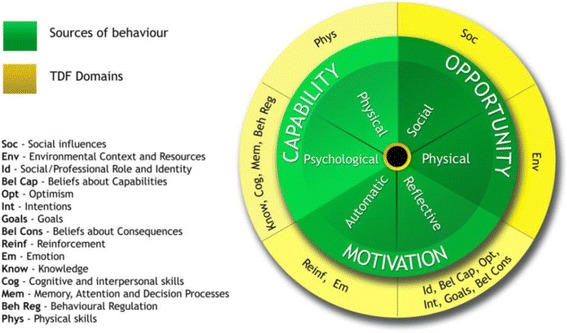
- The TDF is an integrated theoretical framework synthesised from 128 theoretical constructs from 33 theories; version 1 has 12 domains, and version 2 has 14 domains covering 84 theoretical constructs. It has been cited in over 800 peer-reviewed publications (Web of Knowledge accessed April 2017).
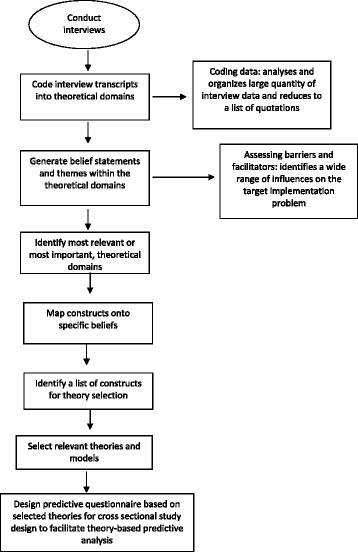
- The guide provides step-by-step methodological guidance for TDF-based implementation research, primarily qualitative interviews and focus groups: selecting and specifying target behaviours, selecting study design, deciding sampling strategy, developing interview schedules, collecting and analysing data, and reporting findings.
- Benefits of using the TDF include providing a theoretical basis for implementation studies, good coverage of potential reasons for slow diffusion of evidence into practice, and a method for progressing from theory-based investigation to intervention. Areas for development include methods for triangulating data (e.g., interviews, questionnaires, observation) and methods for designing interventions based on TDF-based problem analysis.
- Illustrative examples include a low back pain study with focus groups of 42 GPs and a cluster randomised trial randomising 47 practices (53 GPs) to control and 45 practices (59 GPs) to intervention; an SDD Delphi study that interviewed 141 participants; and a diabetes management qualitative systematic review that included 32 studies.
Methods
- Design: researchers from Canada, the UK and Australia attended a 3-day collaborative meeting in December 2012 to discuss the state of the science in using the TDF in implementation research and identify areas needing further development. Participants represented health psychology, sociology, implementation and health services research, statistics, and clinical disciplines including general practice, occupational therapy and chiropractic.
- Guide production: the group identified key steps in applying the TDF, pooled their experience and expertise to elaborate each step, and selected examples from the implementation research literature judged representative of specific TDF applications. The guide draws on the authors’ collective experience.
- Analysis: no datasets were generated or analysed for this article; the guide is a narrative, consensus-based resource focused mainly on qualitative approaches.
Limitations
- Stated in the paper: the scope is mostly limited to qualitative approaches, mainly interview and focus group data, with limited detail on using the TDF with other data collection methods such as survey or observation.
- Stated in the paper: illustrative applications were selected based on an informal rather than structured consensus process, leaving the possibility of selection bias in these examples; the aim was not to be representative but to provide examples across settings and implementation problems.
- Evident from the text: the guide is not a systematic review or an empirical validation of TDF application; its recommendations rest on the authors’ collective experience and selected illustrative examples.
Model-written summary. Check it against the paper before relying on it.
Integrity signals
Registry
Cites
Statistics
Figures
Verification
Claims the paper makes
25 Valid · 2 Not valid · 8 Not checked · 49 Own results and interpretations
Every source the paper cites for this claim was checked and supports it.
In the paper
“In an effort to make theories more accessible to those working in implementation, a team of behavioural scientists developed the TDF in collaboration with implementation researchers [15].”
§ A guide to using the Theoretical Domains Framework of behaviour change to investigate implementation problems > Development of the TDF
What the sources say
- Supportedcites [15] 15. Michie S, Johnston M, Abraham C, Lawton R, Parker D, Walker A, et al. Making psychological theory useful for implementing evidence based practice: a consensus approach. Qual Saf Health Care. 2005;14(1):26-33. source
The Discussion states that the project sought to simplify psychological theory and make it accessible to people involved in implementing evidence-based practice. The Health psychology theorists and Health services researchers sections describe the psychologists who developed the domains and the implementation researchers who evaluated them. Page numbers are not available in our copy. (LLM, conf=0.93)
plainstates a cause- Asserted: passes — The authors put it forward as true.
- Checkable: passes — It can be checked against evidence.
- Load-bearing: unclear — It is unclear whether the paper’s conclusions depend on it.
- Based: passes — The paper gives a reason why it holds.
- Supported
Every source the paper cites for this claim was checked and supports it.
In the paper
“The version of TDF, resulting from this validation, showed similar structure and content to the original with slight differences leading to 14 domains covering 84 theoretical constructs.”
§ A guide to using the Theoretical Domains Framework of behaviour change to investigate implementation problems > Development of the TDF
What the sources say
- Supportedcites [16] 16. Cane J, O'Connor D, Michie S. Validation of the theoretical domains framework for use in behaviour change and implementation research. Implement Sci. 2012;7:37. doi:10.1186/1748-5908-7-37. source
The Discussion reports good support for the TDF’s basic structure alongside refinements producing 14 domains. The Conclusions state that the refined framework contains 84 component constructs. (LLM, conf=0.93)
plainstates a cause- Asserted: passes — The authors put it forward as true.
- Checkable: passes — It can be checked against evidence.
- Load-bearing: unclear — It is unclear whether the paper’s conclusions depend on it.
- Based: passes — The paper gives a reason why it holds.
- Supported
The cited sources support only part of this claim — read each source’s verdict below.
In the paper
“The TDF is an integrated theoretical framework synthesised from 128 theoretical constructs from 33 theories judged most relevant to implementation questions.”
§ A guide to using the Theoretical Domains Framework of behaviour change to investigate implementation problems > Development of the TDF
What the sources say
- Partly supportedcites [15] 15. Michie S, Johnston M, Abraham C, Lawton R, Parker D, Walker A, et al. Making psychological theory useful for implementing evidence based practice: a consensus approach. Qual Saf Health Care. 2005;14(1):26-33. sourceExperimental — accuracy not yet measured
The Results report identifying 128 constructs drawn from 33 psychological theories, and the paper describes developing an integrative framework for implementation research. But the Simplifying into theoretical domains section says only a subset of those constructs was prioritised as particularly relevant; it does not say that all 128 were judged most relevant to implementation questions. Page numbers are unavailable in our copy. (LLM, conf=0.84)
plain- Asserted: passes — The authors put it forward as true.
- Checkable: passes — It can be checked against evidence.
- Load-bearing: unclear — It is unclear whether the paper’s conclusions depend on it.
- Based: passes — The paper gives a reason why it holds.
- Partly supported
Every source the paper cites for this claim was checked and supports it.
In the paper
“The Theoretical Domains Framework (TDF) was initially developed for implementation research to identify influences on health professional behaviour related to implementation of evidence-based recommendations and has been cited in over 800 peer-review publications (Web of Knowledge accessed April 2017).”
§ A guide to using the Theoretical Domains Framework of behaviour change to investigate implementation problems > Background
What the sources say
- Supportedcites [15] 15. Michie S, Johnston M, Abraham C, Lawton R, Parker D, Walker A, et al. Making psychological theory useful for implementing evidence based practice: a consensus approach. Qual Saf Health Care. 2005;14(1):26-33. source
The Abstract says the framework was developed for implementation research to study implementation of evidence-based practice and understand healthcare professionals’ behaviour. The Discussion says its theoretical domains were intended to explain failures to implement evidence-based practice. The separate publication-count statement is attributed to Web of Knowledge, not this source. (LLM, conf=0.93)
plain- Asserted: passes — The authors put it forward as true.
- Checkable: passes — It can be checked against evidence.
- Load-bearing: unclear — It is unclear whether the paper’s conclusions depend on it.
- Based: passes — The paper gives a reason why it holds.
- Supported
Every source the paper cites for this claim was checked and supports it.
In the paper
“The TDF underwent a validation exercise with an independent group of behavioural experts to investigate the optimal structure and content of the framework [16].”
§ A guide to using the Theoretical Domains Framework of behaviour change to investigate implementation problems > Development of the TDF
What the sources say
- Supportedcites [16] 16. Cane J, O'Connor D, Michie S. Validation of the theoretical domains framework for use in behaviour change and implementation research. Implement Sci. 2012;7:37. doi:10.1186/1748-5908-7-37. source
The Background states that the study aimed to validate the TDF’s optimal domain structure and content. The Materials > Procedure passage says participants had expertise in behaviour change theory and did not know the original framework, supporting the description of an independent group of experts. (LLM, conf=0.94)
plain- Asserted: passes — The authors put it forward as true.
- Checkable: passes — It can be checked against evidence.
- Load-bearing: unclear — It is unclear whether the paper’s conclusions depend on it.
- Based: passes — The paper gives a reason why it holds.
- Supported
16 more claims · 9 with their cited sources checked
Create a free account to see all 84 claims and every source verdict.
- Probably not a substantial claim. 59
- It may state two separate claims as one. 19
Claims other papers make about this one
Each is checked against this paper’s own text: does it say what the citing paper says it does?
The cited source says what the claim attributes to it.
In the citing paper
“The TDF organizes constructs across 14 domains, ranging from individual knowledge and skills to environmental context and social influences.”
The cited source says what the claim attributes to it.
In the citing paper
“The 14 domains of the TDF, described elsewhere [24], offer a concise coding framework that can be usefully conceptualized as possible targets for behavior change interventions.”
From Influences on the Uptake of and Engagement With Health and Well-Being Smartphone Apps: Systematic Review (2020) · cites this paper as [24]
Self-check
Percentages, sums and reported differences re-computed from the paper’s own numbers.
Each contradiction between two passages listed here was confirmed by an independent check.
Rated minor: it would not touch a result — a value no result rests on, a p-value that stays on the same side of the significance level, or a conflict that is clerical, resolved elsewhere in the paper, or outside its own findings.
In the paper
§ A guide to using the Theoretical Domains Framework of behaviour change to investigate implementation problems > 5. Collect the data
“In the example given above reported in Francis et al. [15], this step resulted in a list of belief statements supported by responses made in the interviews within each theoretical domain.”
§ A guide to using the Theoretical Domains Framework of behaviour change to investigate implementation problems > References
“15. Michie S, Johnston M, Abraham C, Lawton R, Parker D, Walker A, et al. Making psychological theory useful for implementing evidence based practice: a consensus approach.”
Rated minor: it would not touch a result — a value no result rests on, a p-value that stays on the same side of the significance level, or a conflict that is clerical, resolved elsewhere in the paper, or outside its own findings.
In the paper
§ A guide to using the Theoretical Domains Framework of behaviour change to investigate implementation problems > 3. Decide the sampling strategy
“## 3. Decide the sampling strategy”
§ A guide to using the Theoretical Domains Framework of behaviour change to investigate implementation problems > Conclusions
“| 3. Develop study materials | Although materials from previous studies may be | Requires in-depth understanding of the theoretical |”
Citations
Cites
Using thematic analysis in psychology
Braun, V., & Clarke, V. (2006) · Qualitative Research in Psychology · doi:10.1191/1478088706qp063oa · Cited by 194,414
The Measurement of Observer Agreement for Categorical Data
Landis, J. R., & Koch, G. G. (1977) · Biometrics · doi:10.2307/2529310 · Cited by 81,148 · cited 1×
“6 or percentage agreement > 60% is achieved [63].”
BackgroundThe Discovery of Grounded Theory: Strategies for Qualitative Research.
Wagner, H. R., Glaser, B. G., & Strauss, A. L. (1968) · Social Forces · doi:10.2307/2575405 · Cited by 46,361
Three Approaches to Qualitative Content Analysis
Hsieh, H.-F., & Shannon, S. E. (2005) · Qualitative Health Research · doi:10.1177/1049732305276687 · Cited by 44,601 · cited 1×
“theory and/or relevant research findings to interpret meaning from the content of qualitative data for initial codes [57].”
BackgroundThe Discovery of Grounded Theory; Strategies for Qualitative Research
Glaser, B. G., Strauss, A. L., & Strutzel, E. (1968) · Nursing Research · doi:10.1097/00006199-196807000-00014 · Cited by 39,449
(2006) · Cited by 18,730
Damschroder, L. J., Aron, D. C., Keith, R. E., Kirsh, S. R., Alexander, J. A., & Lowery, J. C. (2009) · Implementation Science · doi:10.1186/1748-5908-4-50 · Cited by 14,496 · cited 2×
“by Normalisation Process Theory [66], the Consolidated Framework For Implementation Research [67] and the Yorkshire Contributory Factors Framework [68].”
MethodHao (2015) · doi:10.1002/14651858 · Cited by 11,321
Developing and evaluating complex interventions: the new Medical Research Council guidance
Craig, P., Dieppe, P., Macintyre, S., Michie, S., Nazareth, I., & Petticrew, M. (2008) · BMJ · doi:10.1136/bmj.a1655 · Cited by 10,995
Self-citationQualitative research practice: a guide for social science students and researchers
(2003) · Choice Reviews Online · doi:10.5860/choice.41-1319 · Cited by 10,543
Cited by
Items 2,701–2,800 of 3,792
Theeb, S. D., & Othman, K. B. (2023) · Law Policy and Social Science · doi:10.55265/lpssjournal.v2i1.24
“It contained a sound approach, sound advice, and an outstanding method by expressly embracing the dialogue strategy (Atkins et al., 2017).”
BackgroundMethodWhelan, L., Leal, J. R., Leslie, M., Barkema, H. W., Ocampo, W., & Rennert‐May, E. (2023) · Research Square · doi:10.21203/rs.3.rs-2705877/v1
Sykes, M. J., O’Mahony, L., Wiggin, D. A., & Timmons, S. (2023) · Research Square · doi:10.21203/rs.3.rs-2509473/v2
Houghtaling, B., Kourouma, P., Pradhananga, N., & Balis, L. E. (2023) · Work · doi:10.3233/wor-220337 · Cited by 1
“The TDF is a widely applied implementation science framework used to understand barriers and facilitators to individuals’ decisions or behaviors related to the adoption, implementation, and sustainment of evidence-based interventions [14, 15].”
MethodReilly, K., Jackson, J. K., Lum, M., et al. (2023) · Research Square · doi:10.21203/rs.3.rs-2720485/v1
Gericke, C., Rippy, S., & D’Lima, D. (2023) · doi:10.31219/osf.io/jq3tx
Isenor, C., Weiss, M. J., Beed, S. D., et al. (2023) · Healthcare Management Forum · doi:10.1177/08404704231175024
“Using the theoretical domains framework to help inform the local and national groups about factors which influence behaviour change, the consortium facilitated collaboration with the leads of all activities.(17) At each phase, information generated by projects was shared with NS clinical and administrative leads so pr…”
Kha, R., Wen, Q., Bender, N., et al. (2023) · medRxiv · doi:10.1101/2023.05.24.23290417
“This current qualitative study aims to use the theoretical domains framework (Atkins et al., 2017) to investigate the barriers and enablers of people with AMD to future participation in the proposed MINGLE program.”
MethodEaton, C. K., McWilliams, E., Yablon, D., Kesim, I., Ge, R., MIRUS, K. A., Sconiers, T., Donkoh, A., Lawrence, M., George, C., et al. (2023) · doi:10.2196/preprints.49024
Fleming, A., Monaghan, Á., Benjamin-Payne, N., et al. (2023) · JAC-Antimicrobial Resistance · doi:10.1093/jacamr/dlad066.043
Cunha‐Cruz, J., Hilgert, J. B., Harter, C., Rothen, M. L., Hort, K., & Mallott, E. (2023) · Frontiers in Oral Health · doi:10.3389/froh.2023.1195736 · Cited by 2
Palm, K., Kronlid, C., Brantnell, A., Elf, M., & Borg, J. (2023) · JMIR Research Protocols · doi:10.2196/44562
“This can be troublesome when previous research has shown that implementing and introducing new technology in general in health care is often problematic [16,17].”
BackgroundSánchez, T. E., Matvienko‐Sikar, K., Greene, R. A., Byrne, M., & O’Donoghue, K. (2023) · HRB Open Research · doi:10.12688/hrbopenres.13751.1
Adams, S. E., Holland, A. J. A., & Brown, J. K. (2023) · medRxiv · doi:10.1101/2023.07.26.23293058
“To do this, we used the COM-B model of behaviour, underpinned by a Theoretical Domains Framework (TDF).(22, 24) The COM-B model integrates a number of behaviour-change theories, grouping domains of Behaviour into three main areas.”
BackgroundMethodKrosta, K. M. E., Tomsic, I., Stolz, M., Krauth, C., Chaberny, I. F., & von Lengerke, T. (2023) · Research Square · doi:10.21203/rs.3.rs-3199535/v1
Reedman, S. E., Armstrong, E., Sakzewski, L., Oftedal, S., Ahmadi, M. N., Burgess, A., Blake, T. L., Keramat, S. A., Dutia, I. M., Pool, D., et al. (2023) · medRxiv · doi:10.1101/2023.08.06.23293736
“including participation frequency of attendance and level of involvement, and barriers and facilitators to community Frame Running on the Theoretical Domains Framework (TDF) based questionnaire and qualitative interview at study exit.(29)”
BackgroundPerceptions of Patient-Reported Outcome Measures in Acute Care Pediatric Physical Therapy
Tischler, D., Pitney, W. A., Wood, J., Shotwell, M., & Mooney, C. (2023) · Journal of Acute Care Physical Therapy · doi:10.1097/jat.0000000000000220
Identifying Target Behaviours and Potential Barriers to Change (Phase 2a)
Patey, A. M., McCleary, N., Presseau, J., Kool, T., van Dulmen, S., & Grimshaw, J. (2023) · Wiley eBooks · doi:10.1002/9781119862758.ch8
Self-citationSelecting De‐Implementation Strategies and Designing Interventions
Presseau, J., McCleary, N., Patey, A. M., McHugh, S., & Lorencatto, F. (2023) · Wiley eBooks · doi:10.1002/9781119862758.ch9
Self-citationxploration of the Physical Activity Guidelines for People with Multiple Sclerosis
Humphreys, L. J. (2022) · Sheffield Hallam University · doi:10.7190/shu-thesis-00537 · Cited by 1
Developing, Implementing and Evaluating Complex Services/Interventions, and Generating the Evidence
Cadogan, C. A. (2023) · Springer eBooks · doi:10.1007/978-3-030-64477-2_54
Kwok, G., Senger, A., Sharma, A., Mandato, I., & Devine, K. A. (2023) · Research Square · doi:10.21203/rs.3.rs-3571508/v1
Michaleff, Z. A., Hattingh, L., Greenwood, H., Mickan, S. M., Jones, M., van der Merwe, M., Thomas, R., Carlini, J., Henry, D. A., Stehlik, P., et al. (2023) · Emergency Medicine Australasia · doi:10.1111/1742-6723.14338
What is available to support pain management in Parkinson’s: a scoping review protocol
Parkinson, M., Ryan, C. G., Avery, L., Hand, A., Ramaswamy, B., Jones, J., Lindop, F., Silverdale, M., Baker, K., & Naisby, J. (2023) · International Journal for Equity in Health · doi:10.1186/s12939-023-02046-7
Krosta, K. M. E., Tomsic, I., Stolz, M., Krauth, C., Chaberny, I. F., & von Lengerke, T. (2023) · Research Square · doi:10.21203/rs.3.rs-3199535/v2
Benoit, B., Cassidy, C. E., Campbell-Yeo, M. L., Gillis, D. E., Kirk, S., Sim, M., LeDrew, M., Loring, S., Murphy, G. T., Rose, A. E., et al. (2023) · Nursing Reports · doi:10.3390/nursrep13040143 · Cited by 1
“We will use the TDF domains (Supplementary S1) [29] and Behaviour Change Wheel intervention functions (Supplementary S2) [30] to categorize coded data to facilitate triangulation of findings [44,46] with study interviews.”
BackgroundMethodInfluentialA Framework for Implementing National Respiratory Guidelines in Wales
Jefferies, R. (2023) · Cronfa (Swansea University) · doi:10.23889/suthesis.65359
AlBurno, H. (2023) · Research Publications (Maastricht University) · doi:10.26481/dis.20240118ha
Mirzaei, V., Wolstencroft, J., Estrin, G. L., Buckley, E., Sayani, S., Katakis, P., Anand, R., Squire, T., Short, E., Frankson, P., et al. (2023) · doi:10.2196/preprints.55741
Final Year BDS Student Perception of Artificial Intelligence Use in Dental Practice
Islam, N. A. B., & Nasiruddin (2024) · Journal of Preventive and Social Medicine · doi:10.3329/jopsom.v41i2.66643
Applequist, J., Wilson, R. E., Perkins, M., et al. (2024) · medRxiv · doi:10.1101/2024.01.06.24300904
Chauhan, A., Chitkara, U., Walsan, R., Sansom‐Daly, U. M., Manias, E., Seah, D. S. E., Dalli, A., Challam, S., El‐Kabbout, N., Tieu, N. T., et al. (2024) · Research Square · doi:10.21203/rs.3.rs-3854846/v1
Mustakim, F., Ahmad, M. N., Kadir, R. A., et al. (2023) · Journal of BioMed Research and Reports · doi:10.59657/2837-4681.brs.23.033
Tan, A., Rao, S., & Salman, Μ. D. (2024) · Agriculture · doi:10.3390/agriculture14020248
Putri, D. W., & Amadea, J. (2024) · E3S Web of Conferences · doi:10.1051/e3sconf/202448504013
“This study used Theoretical Domains Framework (TDF) as theoretical framework which is a synthesis of 33 theories of behaviour and behaviour change clustered into 14 domains [8].”
MethodA mixed-methods needs assessment for an antimicrobial stewardship curriculum in pediatrics
Constantinescu, C., Conly, J. M., Vayalumkal, J. V., Gilfoyle, E., Oguaju, C., & Kassam, A. (2024) · Antimicrobial Stewardship & Healthcare Epidemiology · doi:10.1017/ash.2024.8
“The PICU respondents identified the pharmacists as a source of information and education for AS.”
BackgroundInfluentialRyan, L., Donoghue, G. O., Heary, C., Birney, S., Crotty, M., Hanlon, M. L. D., Conlan, O., & Walsh, J. C. (2024) · doi:10.31219/osf.io/qnasm
Bernard, S., Wiebe, E. M., Waters, A., et al. (2024) · Journal of Cancer Survivorship · doi:10.1007/s11764-024-01565-8
“Questions were mapped to the capability, opportunity, motivation-behavior change (COM-B) model for behavior change [14, 15].”
Daly, J., Doherty, E. L., Tully, B., Wiggers, J., Hollis, J., Licata, M., Foster, M., Tzelepis, F., Lecathelinais, C., & Kingsland, M. (2024) · BMJ Open · doi:10.1136/bmjopen-2023-076725 · Cited by 18
“The priority barriers were defined in terms of the Theoretical Domains Framework 45 55 and Capacity, Oppor-tunity, Motivation—Behaviour model 42 and mapped using the Behaviour Change Wheel 42 to intervention functions and The Theory and Techniques Tool 58 to behaviour change techniques (see online…”
MethodFaulkner, S., Drake, R., Eisner, E., & Bee, P. (2023) · Figshare · doi:10.6084/m9.figshare.23930401
Taylor, N. J., McKay, S., Long, J. C., Gaff, C., North, K. N., Braithwaite, J., Francis, J., & Best, S. (2023) · Figshare · doi:10.6084/m9.figshare.23722278
Self-citationGhamgosar, A., Nemati‐Anaraki, L., & Panahi, S. (2023) · Figshare · doi:10.6084/m9.figshare.24091742
Taylor, N. J., McKay, S., Long, J. C., Gaff, C., North, K. N., Braithwaite, J., Francis, J., & Best, S. (2023) · Figshare · doi:10.6084/m9.figshare.23722275
Self-citationUmaefulam, V. O., Wilson, M. K., Boucher, M. C., Brent, M. H., Dogba, M. J., Drescher, O., Grimshaw, J., Ivers, N. M., Lawrenson, J. G., Lorencatto, F., et al. (2023) · Figshare · doi:10.6084/m9.figshare.22621529
Self-citationThe Influence of Maternal Family Care on Childbirth Self-Efficacy—The Mediating Role of Well-Being
张, 欢. (2024) · Advances in Psychology · doi:10.12677/ap.2024.144191
Fontaine, G., Presseau, J., Bruneau, J., et al. (2024) · Research Square · doi:10.21203/rs.3.rs-4312938/v1
Self-citationCanino, H., Antonopoulou, V., D’Lima, D., & Tyler, C. (2024) · SSRN Electronic Journal · doi:10.2139/ssrn.4812568
Younas, A., & Fàbregues, S. (2024) · Journal of Nursing Scholarship · doi:10.1111/jnu.12977 · Cited by 1
Engeda, E. H., Aldersey, H. M., Davison, C., Gelaye, K. A., & Fayed, N. (2024) · PLoS ONE · doi:10.1371/journal.pone.0298769
“In addition, EE developed a coding guide (S2 Table), according to the recommendations highlighted in a published TDF guide [37], which facilitated the coding process and minimized coding inconsistencies between multiple coders.”
BackgroundMethodInfluentialEvidence to Practice: Implementing Evidence-Based Prevention Programs
Fuhr, D. C., & Wensing, M. (2024) · Springer eBooks · doi:10.1007/978-1-4614-6625-3_93-1
Deforche, B. I., & Verloigne, M. (2023) · Springer eBooks · doi:10.1007/978-1-4614-6625-3_82-1 · Cited by 1
Farragher, E., Wall, L., Wynne, O., Wiggers, J. H., Hollis, J., Wolfenden, L., Paolucci, F., Daly, J., Mallise, C. A., Attia, J., et al. (2024) · Research Square · doi:10.21203/rs.3.rs-4380999/v1
Ruyobeza, B., Grobbelaar, S. S. S., & Botha, A. (2024) · IEEE Engineering Management Review · doi:10.1109/emr.2024.3412795
“…stage to stage as an ongoing, process-related changes across time, along a logical model of behavior change or by progressive reflection [33],[35],[36],[37],[46],[51],[52], [57];and interpretative reflections around the target health behavior, such as revaluing behavior and disrupting its…”
InfluentialBoivin, A., & Berube, M. (2024) · Recherche en soins infirmiers · doi:10.3917/rsi.156.0031
Kramer, C. B., Nelson, K. M., Sayre, G. G., Williams, J. L., Spruill, L., Fennell, T., Gray, K. E., Weiner, B. J., Fan, V. S., Jones‐Smith, J. C., et al. (2024) · AJPM Focus · doi:10.1016/j.focus.2024.100257 · Cited by 1
“The TDF de fi nes this domain as the ability to retain information, focus selectively on aspects of the environment, and choose between 2 or more alternatives.”
BackgroundMethodInfluentialda Silva, J. G. S. T., Pagano, R., da Silva, L. R., Khouri, F. J. E., Tokunaga, S. M., Torreglosa, C. R., Barreto, J. O. M., Lara, E. M. D. S., Santos, R. H. N., Marcadenti, A., et al. (2024) · Revista Contexto & Saúde · doi:10.21527/2176-7114.2024.48.14630
Development and validation of the medical attitudes towards deprescribing questionnaire: comment
Shapoval, V., Patey, A. M., Henrard, S., & Spinewine, A. (2024) · Internal and Emergency Medicine · doi:10.1007/s11739-024-03675-8
“Perhaps, one of the most commonly used frameworks is the Theoretical Domain Framework (TDF) which offers guidance for researchers to apply in both qualitative and quantitative research [4].”
Self-citationMichele, L. D., Thomson, K. E., Bell, A., et al. (2024) · Research Square · doi:10.21203/rs.3.rs-4634136/v1
Beckley, A. A., & Wong, C. K. (2024) · Research Square · doi:10.21203/rs.3.rs-4456817/v1
Callaghan, C. T., Cunningham, C., & O’Sullivan, R. (2024) · BJGP Open · doi:10.3399/bjgpo.2023.0256
“21,22 The TDF is an integrative framework of theories of behaviour change developed to identify influences on behaviour in the implementation of evidence-based recommendations.”
Nettelrodt, K. M. E., Tomsic, I., Stolz, M., Krauth, C., Chaberny, I. F., & von Lengerke, T. (2024) · Psychology Research and Behavior Management · doi:10.2147/prbm.s464335
“36 The present items therefore reflect the need for a concise survey instrument.”
BackgroundLasheen, R. A., Kavanagh, P. M., Doyle, B., Downey, C., Siersbaek, R., Stanistreet, D., & Doyle, F. (2024) · HRB Open Research · doi:10.12688/hrbopenres.13923.1 · Cited by 1
“…Behaviour Change Wheel (BCW) so that for each element reported it will be possible to design interventions aligning with the generated theory that can be used as a basis for evidence-based and theory-informed translation of the financial incentive interventions in different contexts 30,31,49–52 .”
Davidson, S. R. E., Kamper, S. J., Haskins, R., Petkovic, D., Feenan, N., Smith, D. P., O'Flynn, M., Pallas, J., Donald, B., Smiles, J. P., et al. (2024) · doi:10.31219/osf.io/b97nd
Strengthening the Chain: A Continuing Medical Education Program for Test Results Follow-up
Normand, É., Ramsey, H., Mimeault, R., Lemay, K., Heroux, D., & McDougall, A. (2024) · Journal of Continuing Education in the Health Professions · doi:10.1097/ceh.0000000000000568 · Cited by 2
Lott, L. B. D., Gonzalez, L. A., Guetterman, T. C., Kerber, K. A., & Zikmund‐Fisher, B. J. (2024) · Journal of Neuro-Ophthalmology · doi:10.1097/wno.0000000000002219
Mohsen, M., Abbaticchio, A., Zhang, T., Jassal, S. V., & Battistella, M. (2024) · BMC Family Practice · doi:10.1186/s12875-024-02564-5
“Implementing new interventions such as CDS tools requires changes in the “individual and collective behav-iour” of the relevant actors [21].”
BackgroundMethodInfluentialMacKay, D., Maple-Brown, L. J., Freeman, N. S., Boyle, J. A., Campbell, S., McLean, A., Corpus, S., Whitbread, C., Dokkum, P. V., Connors, C. M., et al. (2024) · International Journal of Environmental Research and Public Health · doi:10.3390/ijerph21091139
“Many factors influencing clinician behaviour have been identified in previous literature [33].”
BackgroundFarragher, E., Wall, L., Wynne, O., Wiggers, J., Hollis, J., Wolfenden, L., Paolucci, F., Daly, J., Mallise, C. A., Attia, J. R., et al. (2025) · BMC Health Services Research · doi:10.1186/s12913-025-13108-7
“The use of determinant theories and frameworks such as the Theoretical Domains Framework (TDF) is recommended to identify barriers to implementation of guideline recommended care, by defining the structural and psychological processes that affect behavioural change [22].”
Best, S., Peters, S., Guccione, L., Francis, J., & Klaic, M. (2024) · Translational Behavioral Medicine · doi:10.1093/tbm/ibae044
Self-citationQualitative Research on Reformulation With Food Manufacturers in Northern Ireland
Ireland, I. N. (2024) · FSA research and evidence. · doi:10.46756/001c.121818
Girling, C., Davids, I. R., Totton, N., Arden, M. A., Hind, D., & Wildman, M. J. (2024) · Learning Health Systems · doi:10.1002/lrh2.10453 · Cited by 14
“The interview topic guide (Additional File 2) was based upon constructs from the Theoretical Domains Framework (TDF), 23,24 mapped to the COM-B framework and devised by investigators with expertise in behavior change (MA) and CF (MW).”
Rantsi, M., Blankart, K. E., Lauri, K., Jyrkkä, J., & Hyttinen, V. (2024) · SSRN Electronic Journal · doi:10.2139/ssrn.4959345
Challenges in the quality of medicine use
Taxis, K., & Llor, C. (2024) · Wiley eBooks · doi:10.1002/9781119911685.ch49
Hawkins, J., Sengupta, S., Kloss, K. A., Schwenzer, C., Smith, F. N., Jones, L. M., Mitchell, J. A., Nwankwo, R. B., & Piatt, G. (2024) · BMJ Open · doi:10.1136/bmjopen-2023-073689
Active Ingredient Prescribing in Australia: exploring pharmacists' experiences
Swifte, T., Bowden, M., & Ndukwe, H. C. (2024) · Journal of Pharmacy Practice and Research · doi:10.1002/jppr.1935
Lou, Y., Hong, S., & Li, W. (2024) · Journal of Aging and Physical Activity · doi:10.1123/japa.2023-0086
Kruger, K., Kuhnmuench, C., Ikari, R., Gates, K., & Bell, S. A. (2024) · Journal of Applied Gerontology · doi:10.1177/07334648241288659 · Cited by 1
“…a different aspect of behavior — used widely across disciplines to discover triggers that in fl uence changes in the behavior of healthcare providers (Atkins et al., 2017; Lavall´ee et al., 2018; Lee et al., 2018; Phillips et al., 2015), also contributed to the development of the interview…”
Schultz, E., Eppler, S. L., Shapiro, L. M., & Kamal, R. N. (2024) · Hand · doi:10.1177/15589447241277843
“The second phase included generating belief statements summarizing the previously coded text, following previously established methodology for the qualitative coding within the TDF. 18,27 For example, many physicians mentioned patient-specific factors such as comorbidities or age impacting their treatment decision, wh…”
InfluentialEyles, J. P., Kobayashi, S., Duong, V., Hunter, D. J., Avdalis, C., Buttel, T., Dawson, G., Dório, M., D'Souza, N., Foster, K., et al. (2024) · Arthritis Care & Research · doi:10.1002/acr.25454
“36 At the workshops, we further mapped the barriers to the TDF domains and used the Theory and Technique Tool 37 to identify and select potential behavior change techniques and strategies to address the barriers.”
Chapman, S. J., Ahmed, S., Cave, L., Morton, K., Tiernan, J. P., Limbert, S., Naylor, M., Vargas‐Palacios, A., Lonsdale, M. D. S., Davies, C. L., et al. (2024) · Colorectal Disease · doi:10.1111/codi.17210
Li, Z., Lu, F., Dong, L., Dai, Y., Bao, R., Wu, J., Rao, Y., & Wang, H. (2024) · Australian Critical Care · doi:10.1016/j.aucc.2024.101136
Sõber-Williams, E. K., Lucci, V.-E. M., McBride, C. B., McGrath, M. S., Willms, R., Gainforth, H. L., & Claydon, V. E. (2024) · Disability and Rehabilitation · doi:10.1080/09638288.2024.2429747
Health Behavior Theories and Promotion for Cervical Cancer Screening Uptake
Dsouza, J. P. (2024) · Springer eBooks · doi:10.1007/978-981-97-0821-5_34-1 · Cited by 2
O’Shea, J., Hughes, C. M., Molloy, G. J., Cadogan, C. A., Vellinga, A., Fahey, T. P., Hayward, G., Ryan, P. M., Fleming, A., Morrissey, E. C., et al. (2024) · HRB Open Research · doi:10.12688/hrbopenres.13962.1 · Cited by 1
“…will be considered: (i) How modifiable the behaviour is likely to be; (ii) how central it is in bringing about the desired change in clinical practice; (iii) probable/potential positive or negative effects on other related behaviours if change occurs; and (iv) its amenability to measurement 24 .”
InfluentialWalters, G. I., Foley, H., Huntley, C., Naveed, A., Nettleton, K., Reilly, C., Thomas, M., Walker, C., & Wheeler, K. (2024) · BJGP Open · doi:10.3399/bjgpo.2024.0094
Keeler-Villa, N. R., Beaulieu, D. A., Harris-Lane, L. M., Bérubé, S., Burke, K., Churchill, A., Cornish, P. A., Goguen, B., Jaouich, A., Michaud, M., et al. (2024) · Administration and Policy in Mental Health and Mental Health Services Research · doi:10.1007/s10488-024-01423-w · Cited by 2
“Questions were developed to understand: (1) implementation strategies in accordance with the Expert Recommendation for Implementation Change (Powell et al., 2015); (2) implementation determinants using the CFIR (Damschroder et al., 2009, 2022); and (3) barriers and facilitators to implementation that aligned with the…”
InfluentialTo, D., Southerst, D., Atkinson-Graham, M., Yu, H., Connell, G. P., Draper, C., & Cancelliere, C. (2024) · Chiropractic & Manual Therapies · doi:10.1186/s12998-024-00560-1 · Cited by 1
Barriers and Facilitators to COVID-19 Return to School
McElhinny, M. L., Allison‐Burbank, J. D., Edwards, A., et al. (2024) · SAGE Open · doi:10.1177/21582440241301899
“The TDF frames the factors determining current and desired behaviors (Atkins et al., 2017).”
InfluentialTucker, J., Mehrez, M., Ferreira, S., et al. (2024) · Disability and Rehabilitation · doi:10.1080/09638288.2024.2435532
“…was created from a synthesis of behavior change theories, was used to develop the open-ended questions included in the interview guide (table 1) [23]. the purpose of employing the tDF was to facilitate the identification and description of factors influencing behavior concerning the assessment…”
Safadi, H., Lám, J., Baranyi, I., & Belicza, É. (2024) · IME - Az egészségügyi vezetők szaklapja · doi:10.53020/ime-2024-403 · Cited by 2
McDonough, S., Stephenson, A., Grimmett, C., Bennett, K., Coyle, N., Grealis, S., Kinneavy, C., FitzGerald, O., French, H., Stokes, M. J., et al. (2024) · HRB Open Research · doi:10.12688/hrbopenres.14002.1 · Cited by 2
“Using the TDF domains to structure the topic guide ensures a robust theoretical basis to the questioning that covers a wide range of behavioural influences 56 .”
Walters, G. I., Foley, H., Huntley, C., Naveed, A., Nettleton, K., Reilly, C., Thomas, M., Walker, C., & Wheeler, K. (2024) · medRxiv · doi:10.1101/2024.02.22.24303183
Sheehan, K. J., Guerra, S., Ayis, S. A., Goubar, A., Foster, N. E., Martin, F. C., Godfrey, E. L., Cameron, I. D., Gregson, C. L., Walsh, N. E., et al. (2024) · PLoS ONE · doi:10.1371/journal.pone.0306870 · Cited by 1
“…follow a deductive approach informed by the categories of treatment fidelity (design, training of providers, delivery, receipt and enactment), and to identify barriers and/or facilitators (inclusive of acceptability and aligned to Normalisation Process Theory [14]) to future implementation [61].”
Slaghmuylder, Y., Lauwerier, E., Hecke, A. V., Crombez, G., Schelfout, S., Naert, E., & Pype, P. F. (2024) · Disability and Rehabilitation · doi:10.1080/09638288.2024.2443045 · Cited by 1
“…role/ identity - HcPs might be more inclined to manage pain in a integrated and interdisciplinary manner (i.e., the intended outcome) [24,28,31]. as such, the objective of this study was to evaluate the e-learning intervention by exploring the predefined cMo hypothesis through the…”
Metadata
- Authors
- Atkins, L., Francis, J., Islam, R., O’Connor, D., Patey, A., Ivers, N., Foy, R., Duncan, E. M., Colquhoun, H., Grimshaw, J. M., Lawton, R., & Michie, S.
- Affiliations
- University College London (GB)
- University of London (GB)
- Ottawa Hospital Research Institute (CA)
- Monash University (AU)
- University of Toronto (CA)
- University of Leeds (GB)
- University of Aberdeen (GB)
- University of Ottawa (CA)
- Corresponding author
- Atkins, Lou
- ORCID
- Venue
- Implementation Science
- Published
- 2017-06-21
- Volume
- 12
- Issue
- 1
- Pages
- 77-77
- ISSN
- 1748-5908 (ISSN-L)
- PMC
- PMC5480145
- OpenAlex
- W2674995983
- Semantic Scholar
- 7ae5ea98c6f51755ffa2f67330dea33e0663f161
- Cited by
- 3,819
- References
- 87
- Citations by year
- 2026: 501 · 2025: 619 · 2024: 623 · 2023: 531 · 2022: 554 · 2021: 437 · 2020: 309 · 2019: 160 · 2018: 67 · 2017: 12
- FWCI
- 242.11
- Type
- journal article
- Language
- en
- Open access
- gold
- doi.org
- Licence
- cc-by
- Locations
- Implementation Science (publishedVersion, cc-by)
- Europe PMC (PubMed Central) (publishedVersion, other-oa)
- PubMed Central (publishedVersion, cc-by)
- PubMed (publishedVersion)
- UCL Discovery (University College London) (publishedVersion)
- White Rose Research Online (University of Leeds, The University of Sheffield, University of York) (acceptedVersion)
- TSpace (University of Toronto) (acceptedVersion, cc-by)
- City Research Online (City University London) (acceptedVersion)
- Monash University Research Portal (Monash University) (submittedVersion, other-oa)
- Aberdeen University Research Archive (Aberdeen University) (submittedVersion)
- DOAJ (DOAJ: Directory of Open Access Journals) (submittedVersion, cc-by-sa)
- Minerva Access (University of Melbourne) (submittedVersion, cc-by)
- Funders
- Canadian Institutes of Health Research
- Topics
- Health Sciences › Health Professions › General Health Professions › Health Policy Implementation Science
- Social Sciences › Psychology › Applied Psychology › Behavioral Health and Interventions
- Health Sciences › Health Professions › General Health Professions › Health Sciences Research and Education
- Keywords
- Theoretical Domains Framework, behavior change, implementation problems, implementation research, behavioral factors, intervention design, qualitative research
- MeSH terms
- Australia, Canada, Diffusion of Innovation, United Kingdom, Health Plan Implementation, Health Services Research, Humans, Health Behavior
About these checks
Registry, retraction, Cites and statistics results are computed, not judged, with one exception: a printed reference that no index lists is read once by a model before it counts as a citation error. Claims are extracted by a model and kept only when their quote appears verbatim in the text; each cited source is then checked, with a model’s help, for whether it says what the claim relies on. Those verdicts can be wrong — read the claim’s quote and the cited source before relying on one.
The claim verdicts this report counts are experimental: their accuracy is not yet measured.
A language model drew the claims from the paper on 2026-10-16, under version 3 of the claim definition (model deepseek-v4.1-flash, prompt extract-v3).
A second model labelled each claim on 2026-10-16 (model jev-1.13-20260917, definition revision gold-guideline-v0.2).
Cited sources are checked with a language model’s help (gpt-6-sol).
Statistics and arithmetic are recomputed, not judged.
Confidence bands are shown only for fields calibrated on our annotated test set. None is calibrated yet, so no band is shown.
What counts as a claim ›How we measure confidence ›How we check this ›
Are you an author, or do you see a problem with this page? Request a review
Data sources
Bibliographic data: Semantic Scholar, OpenAlex, Crossref.
Contains information from the Semantic Scholar Academic Graph Datasets, made available under the ODC Attribution License (ODC-BY 1.0).
Semantic Scholar’s data is described in: Kinney, R., et al. (2023). The Semantic Scholar Open Data Platform. arXiv:2301.10140.
