

A guide to using the Theoretical Domains Framework of behaviour change to investigate implementation problems
Open accessThe DOI matches its Crossref record; 90 of the 90 references it cites were found in a registry or an index; 40 of the 57 sources its claims cite were checked for support.
Abstract
BACKGROUND: Implementing new practices requires changes in the behaviour of relevant actors, and this is facilitated by understanding of the determinants of current and desired behaviours. The Theoretical Domains Framework (TDF) was developed by a collaboration of behavioural scientists and implementation researchers who identified theories relevant to implementation and grouped constructs from these theories into domains. The collaboration aimed to provide a comprehensive, theory-informed approach to identify determinants of behaviour. The first version was published in 2005, and a subsequent version following a validation exercise was published in 2012. This guide offers practical guidance for those who wish to apply the TDF to assess implementation problems and support intervention design. It presents a brief rationale for using a theoretical approach to investigate and address implementation problems, summarises the TDF and its development, and describes how to apply the TDF to achieve implementation objectives. Examples from the implementation research literature are presented to illustrate relevant methods and practical considerations. METHODS: Researchers from Canada, the UK and Australia attended a 3-day meeting in December 2012 to build an international collaboration among researchers and decision-makers interested in the advancing use of the TDF. The participants were experienced in using the TDF to assess implementation problems, design interventions, and/or understand change processes. This guide is an output of the meeting and also draws on the authors' collective experience. Examples from the implementation research literature judged by authors to be representative of specific applications of the TDF are included in this guide. RESULTS: We explain and illustrate methods, with a focus on qualitative approaches, for selecting and specifying target behaviours key to implementation, selecting the study design, deciding the sampling strategy, developing study materials, collecting and analysing data, and reporting findings of TDF-based studies. Areas for development include methods for triangulating data, e.g. from interviews, questionnaires and observation and methods for designing interventions based on TDF-based problem analysis. CONCLUSIONS: We offer this guide to the implementation community to assist in the application of the TDF to achieve implementation objectives. Benefits of using the TDF include the provision of a theoretical basis for implementation studies, good coverage of potential reasons for slow diffusion of evidence into practice and a method for progressing from theory-based investigation to intervention.
Overview
CoChat Summary
TL;DR
This guide explains how to apply the Theoretical Domains Framework (TDF) to investigate implementation problems, focusing mainly on qualitative interview and focus group methods. It outlines steps from specifying target behaviours to analysing and reporting TDF-based data, with illustrative examples and stated limitations.
Key findings
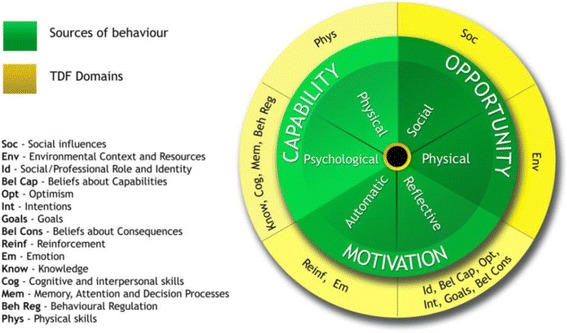
- The TDF is an integrated theoretical framework synthesised from 128 theoretical constructs from 33 theories; version 1 has 12 domains, and version 2 has 14 domains covering 84 theoretical constructs. It has been cited in over 800 peer-reviewed publications (Web of Knowledge accessed April 2017).
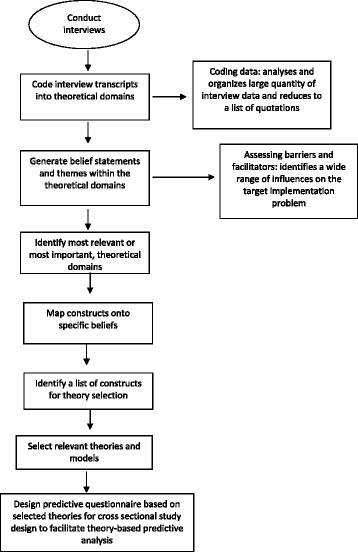
- The guide provides step-by-step methodological guidance for TDF-based implementation research, primarily qualitative interviews and focus groups: selecting and specifying target behaviours, selecting study design, deciding sampling strategy, developing interview schedules, collecting and analysing data, and reporting findings.
- Benefits of using the TDF include providing a theoretical basis for implementation studies, good coverage of potential reasons for slow diffusion of evidence into practice, and a method for progressing from theory-based investigation to intervention. Areas for development include methods for triangulating data (e.g., interviews, questionnaires, observation) and methods for designing interventions based on TDF-based problem analysis.
- Illustrative examples include a low back pain study with focus groups of 42 GPs and a cluster randomised trial randomising 47 practices (53 GPs) to control and 45 practices (59 GPs) to intervention; an SDD Delphi study that interviewed 141 participants; and a diabetes management qualitative systematic review that included 32 studies.
Methods
- Design: researchers from Canada, the UK and Australia attended a 3-day collaborative meeting in December 2012 to discuss the state of the science in using the TDF in implementation research and identify areas needing further development. Participants represented health psychology, sociology, implementation and health services research, statistics, and clinical disciplines including general practice, occupational therapy and chiropractic.
- Guide production: the group identified key steps in applying the TDF, pooled their experience and expertise to elaborate each step, and selected examples from the implementation research literature judged representative of specific TDF applications. The guide draws on the authors’ collective experience.
- Analysis: no datasets were generated or analysed for this article; the guide is a narrative, consensus-based resource focused mainly on qualitative approaches.
Limitations
- Stated in the paper: the scope is mostly limited to qualitative approaches, mainly interview and focus group data, with limited detail on using the TDF with other data collection methods such as survey or observation.
- Stated in the paper: illustrative applications were selected based on an informal rather than structured consensus process, leaving the possibility of selection bias in these examples; the aim was not to be representative but to provide examples across settings and implementation problems.
- Evident from the text: the guide is not a systematic review or an empirical validation of TDF application; its recommendations rest on the authors’ collective experience and selected illustrative examples.
Model-written summary. Check it against the paper before relying on it.
Integrity signals
Registry
Cites
Statistics
Figures
Verification
Claims the paper makes
25 Valid · 2 Not valid · 8 Not checked · 49 Own results and interpretations
Every source the paper cites for this claim was checked and supports it.
In the paper
“In an effort to make theories more accessible to those working in implementation, a team of behavioural scientists developed the TDF in collaboration with implementation researchers [15].”
§ A guide to using the Theoretical Domains Framework of behaviour change to investigate implementation problems > Development of the TDF
What the sources say
- Supportedcites [15] 15. Michie S, Johnston M, Abraham C, Lawton R, Parker D, Walker A, et al. Making psychological theory useful for implementing evidence based practice: a consensus approach. Qual Saf Health Care. 2005;14(1):26-33. source
The Discussion states that the project sought to simplify psychological theory and make it accessible to people involved in implementing evidence-based practice. The Health psychology theorists and Health services researchers sections describe the psychologists who developed the domains and the implementation researchers who evaluated them. Page numbers are not available in our copy. (LLM, conf=0.93)
plainstates a cause- Asserted: passes — The authors put it forward as true.
- Checkable: passes — It can be checked against evidence.
- Load-bearing: unclear — It is unclear whether the paper’s conclusions depend on it.
- Based: passes — The paper gives a reason why it holds.
- Supported
Every source the paper cites for this claim was checked and supports it.
In the paper
“The version of TDF, resulting from this validation, showed similar structure and content to the original with slight differences leading to 14 domains covering 84 theoretical constructs.”
§ A guide to using the Theoretical Domains Framework of behaviour change to investigate implementation problems > Development of the TDF
What the sources say
- Supportedcites [16] 16. Cane J, O'Connor D, Michie S. Validation of the theoretical domains framework for use in behaviour change and implementation research. Implement Sci. 2012;7:37. doi:10.1186/1748-5908-7-37. source
The Discussion reports good support for the TDF’s basic structure alongside refinements producing 14 domains. The Conclusions state that the refined framework contains 84 component constructs. (LLM, conf=0.93)
plainstates a cause- Asserted: passes — The authors put it forward as true.
- Checkable: passes — It can be checked against evidence.
- Load-bearing: unclear — It is unclear whether the paper’s conclusions depend on it.
- Based: passes — The paper gives a reason why it holds.
- Supported
The cited sources support only part of this claim — read each source’s verdict below.
In the paper
“The TDF is an integrated theoretical framework synthesised from 128 theoretical constructs from 33 theories judged most relevant to implementation questions.”
§ A guide to using the Theoretical Domains Framework of behaviour change to investigate implementation problems > Development of the TDF
What the sources say
- Partly supportedcites [15] 15. Michie S, Johnston M, Abraham C, Lawton R, Parker D, Walker A, et al. Making psychological theory useful for implementing evidence based practice: a consensus approach. Qual Saf Health Care. 2005;14(1):26-33. sourceExperimental — accuracy not yet measured
The Results report identifying 128 constructs drawn from 33 psychological theories, and the paper describes developing an integrative framework for implementation research. But the Simplifying into theoretical domains section says only a subset of those constructs was prioritised as particularly relevant; it does not say that all 128 were judged most relevant to implementation questions. Page numbers are unavailable in our copy. (LLM, conf=0.84)
plain- Asserted: passes — The authors put it forward as true.
- Checkable: passes — It can be checked against evidence.
- Load-bearing: unclear — It is unclear whether the paper’s conclusions depend on it.
- Based: passes — The paper gives a reason why it holds.
- Partly supported
Every source the paper cites for this claim was checked and supports it.
In the paper
“The Theoretical Domains Framework (TDF) was initially developed for implementation research to identify influences on health professional behaviour related to implementation of evidence-based recommendations and has been cited in over 800 peer-review publications (Web of Knowledge accessed April 2017).”
§ A guide to using the Theoretical Domains Framework of behaviour change to investigate implementation problems > Background
What the sources say
- Supportedcites [15] 15. Michie S, Johnston M, Abraham C, Lawton R, Parker D, Walker A, et al. Making psychological theory useful for implementing evidence based practice: a consensus approach. Qual Saf Health Care. 2005;14(1):26-33. source
The Abstract says the framework was developed for implementation research to study implementation of evidence-based practice and understand healthcare professionals’ behaviour. The Discussion says its theoretical domains were intended to explain failures to implement evidence-based practice. The separate publication-count statement is attributed to Web of Knowledge, not this source. (LLM, conf=0.93)
plain- Asserted: passes — The authors put it forward as true.
- Checkable: passes — It can be checked against evidence.
- Load-bearing: unclear — It is unclear whether the paper’s conclusions depend on it.
- Based: passes — The paper gives a reason why it holds.
- Supported
Every source the paper cites for this claim was checked and supports it.
In the paper
“The TDF underwent a validation exercise with an independent group of behavioural experts to investigate the optimal structure and content of the framework [16].”
§ A guide to using the Theoretical Domains Framework of behaviour change to investigate implementation problems > Development of the TDF
What the sources say
- Supportedcites [16] 16. Cane J, O'Connor D, Michie S. Validation of the theoretical domains framework for use in behaviour change and implementation research. Implement Sci. 2012;7:37. doi:10.1186/1748-5908-7-37. source
The Background states that the study aimed to validate the TDF’s optimal domain structure and content. The Materials > Procedure passage says participants had expertise in behaviour change theory and did not know the original framework, supporting the description of an independent group of experts. (LLM, conf=0.94)
plain- Asserted: passes — The authors put it forward as true.
- Checkable: passes — It can be checked against evidence.
- Load-bearing: unclear — It is unclear whether the paper’s conclusions depend on it.
- Based: passes — The paper gives a reason why it holds.
- Supported
16 more claims · 9 with their cited sources checked
Create a free account to see all 84 claims and every source verdict.
- Probably not a substantial claim. 59
- It may state two separate claims as one. 19
Claims other papers make about this one
Each is checked against this paper’s own text: does it say what the citing paper says it does?
The cited source says what the claim attributes to it.
In the citing paper
“The TDF organizes constructs across 14 domains, ranging from individual knowledge and skills to environmental context and social influences.”
The cited source says what the claim attributes to it.
In the citing paper
“The 14 domains of the TDF, described elsewhere [24], offer a concise coding framework that can be usefully conceptualized as possible targets for behavior change interventions.”
From Influences on the Uptake of and Engagement With Health and Well-Being Smartphone Apps: Systematic Review (2020) · cites this paper as [24]
Self-check
Percentages, sums and reported differences re-computed from the paper’s own numbers.
Each contradiction between two passages listed here was confirmed by an independent check.
Rated minor: it would not touch a result — a value no result rests on, a p-value that stays on the same side of the significance level, or a conflict that is clerical, resolved elsewhere in the paper, or outside its own findings.
In the paper
§ A guide to using the Theoretical Domains Framework of behaviour change to investigate implementation problems > 5. Collect the data
“In the example given above reported in Francis et al. [15], this step resulted in a list of belief statements supported by responses made in the interviews within each theoretical domain.”
§ A guide to using the Theoretical Domains Framework of behaviour change to investigate implementation problems > References
“15. Michie S, Johnston M, Abraham C, Lawton R, Parker D, Walker A, et al. Making psychological theory useful for implementing evidence based practice: a consensus approach.”
Rated minor: it would not touch a result — a value no result rests on, a p-value that stays on the same side of the significance level, or a conflict that is clerical, resolved elsewhere in the paper, or outside its own findings.
In the paper
§ A guide to using the Theoretical Domains Framework of behaviour change to investigate implementation problems > 3. Decide the sampling strategy
“## 3. Decide the sampling strategy”
§ A guide to using the Theoretical Domains Framework of behaviour change to investigate implementation problems > Conclusions
“| 3. Develop study materials | Although materials from previous studies may be | Requires in-depth understanding of the theoretical |”
Citations
Cites
Using thematic analysis in psychology
Braun, V., & Clarke, V. (2006) · Qualitative Research in Psychology · doi:10.1191/1478088706qp063oa · Cited by 194,414
The Measurement of Observer Agreement for Categorical Data
Landis, J. R., & Koch, G. G. (1977) · Biometrics · doi:10.2307/2529310 · Cited by 81,148 · cited 1×
“6 or percentage agreement > 60% is achieved [63].”
BackgroundThe Discovery of Grounded Theory: Strategies for Qualitative Research.
Wagner, H. R., Glaser, B. G., & Strauss, A. L. (1968) · Social Forces · doi:10.2307/2575405 · Cited by 46,361
Three Approaches to Qualitative Content Analysis
Hsieh, H.-F., & Shannon, S. E. (2005) · Qualitative Health Research · doi:10.1177/1049732305276687 · Cited by 44,601 · cited 1×
“theory and/or relevant research findings to interpret meaning from the content of qualitative data for initial codes [57].”
BackgroundThe Discovery of Grounded Theory; Strategies for Qualitative Research
Glaser, B. G., Strauss, A. L., & Strutzel, E. (1968) · Nursing Research · doi:10.1097/00006199-196807000-00014 · Cited by 39,449
(2006) · Cited by 18,730
Damschroder, L. J., Aron, D. C., Keith, R. E., Kirsh, S. R., Alexander, J. A., & Lowery, J. C. (2009) · Implementation Science · doi:10.1186/1748-5908-4-50 · Cited by 14,496 · cited 2×
“by Normalisation Process Theory [66], the Consolidated Framework For Implementation Research [67] and the Yorkshire Contributory Factors Framework [68].”
MethodHao (2015) · doi:10.1002/14651858 · Cited by 11,321
Developing and evaluating complex interventions: the new Medical Research Council guidance
Craig, P., Dieppe, P., Macintyre, S., Michie, S., Nazareth, I., & Petticrew, M. (2008) · BMJ · doi:10.1136/bmj.a1655 · Cited by 10,995
Self-citationQualitative research practice: a guide for social science students and researchers
(2003) · Choice Reviews Online · doi:10.5860/choice.41-1319 · Cited by 10,543
Cited by
Qualitative methods in implementation research: An introduction
Hamilton, A. B., & Finley, E. P. (2019) · Psychiatry Research · doi:10.1016/j.psychres.2019.112516 · Cited by 1,315
“, 2013), Theoretical Domains Framework (Atkins et al., 2017; Lawton et al., 2016), as well as with the Consolidated Framework for Implementation Research (CFIR; Damschroder et al.”
Systematic review of the Exploration, Preparation, Implementation, Sustainment (EPIS) framework
Moullin, J. C., Dickson, K. S., Stadnick, N. A., Rabin, B., & Aarons, G. A. (2019) · Implementation Science · doi:10.1186/s13012-018-0842-6 · Cited by 1,223
Implementation Mapping: Using Intervention Mapping to Develop Implementation Strategies
Fernandez, M. E., ten Hoor, G. A., van Lieshout, S., Rodriguez, S. A., Beidas, R. S., Parcel, G., Ruiter, R. A. C., Markham, C. M., & Kok, G. (2019) · Frontiers in Public Health · doi:10.3389/fpubh.2019.00158 · Cited by 914
“Further, using the ISF, planners can think through the process of adoption and implementation at multiple levels and identify key actors at each of them (60).”
MethodEnhancing the Impact of Implementation Strategies in Healthcare: A Research Agenda
Powell, B. J., Fernandez, M. E., Williams, N. J., Aarons, G. A., Beidas, R. S., Lewis, C. C., McHugh, S. M., & Weiner, B. J. (2019) · Frontiers in Public Health · doi:10.3389/fpubh.2019.00003 · Cited by 775
Smith, J. D., Li, D. H., & Rafferty, M. R. (2020) · Implementation Science · doi:10.1186/s13012-020-01041-8 · Cited by 706
Ten recommendations for using implementation frameworks in research and practice
Moullin, J. C., Dickson, K. S., Stadnick, N. A., Albers, B., Nilsen, P., Broder-Fingert, S., Mukasa, B., & Aarons, G. A. (2020) · Implementation Science Communications · doi:10.1186/s43058-020-00023-7 · Cited by 488
Woodward, E. N., Matthieu, M. M., Uchendu, U. S., Rogal, S., & Kirchner, J. E. (2019) · Implementation Science · doi:10.1186/s13012-019-0861-y · Cited by 470
“For example, within the Theoretical Domains Framework (version 2) [32], provider knowledge, skills (including competence), social identity, and social influence are just a few of the constructs in which health equity determinants could be embedded.”
Graça, J., Godinho, C. A., & Truninger, M. (2019) · Trends in Food Science & Technology · doi:10.1016/j.tifs.2019.07.046 · Cited by 447
“The COM-B model is linked to the 14 domains of the Theoretical Domains Framework (Atkins et al., 2017), which has been obtained from a synthesis of 33 theories of behavior and behavior change (Cane, O’Conner & Michie, 2012).”
MethodAction, actor, context, target, time (AACTT): a framework for specifying behaviour
Presseau, J., McCleary, N., Lorencatto, F., Patey, A. M., Grimshaw, J. M., & Francis, J. J. (2019) · Implementation Science · doi:10.1186/s13012-019-0951-x · Cited by 411
“Birken SA, Powell BJ, Presseau J, Kirk MA, Lorencatto F, Gould NJ, et al. Combined use of the Consolidated Framework for Implementation Research (CFIR) and the Theoretical Domains Framework (TDF): a systematic review.”
BackgroundMethodInfluentialSelf-citationBrown, B., Gude, W. T., Blakeman, T., van der Veer, S. N., Ivers, N., Francis, J. J., Lorencatto, F., Presseau, J., Peek, N., & Daker-White, G. (2019) · Implementation Science · doi:10.1186/s13012-019-0883-5 · Cited by 387
Self-citationSpiteri, K., Broom, D., Hassan Bekhet, A., Xerri de Caro, J., Laventure, B., & Grafton, K. (2019) · Journal of Aging and Physical Activity · doi:10.1123/japa.2018-0343 · Cited by 367
Stover, A. M., Haverman, L., van Oers, H. A., Greenhalgh, J., Potter, C. M., On behalf of the ISOQOL PROMs/PREMs in Clinical Practice Implementation Science Work Group, Ahmed, S., Greenhalgh, J., Gibbons, E., Haverman, L., et al. (2021) · Quality of Life Research · doi:10.1007/s11136-020-02564-9 · Cited by 308
Cassar, S., Salmon, J., Timperio, A., Naylor, P.-J., van Nassau, F., Contardo Ayala, A. M., & Koorts, H. (2019) · International Journal of Behavioral Nutrition and Physical Activity · doi:10.1186/s12966-019-0876-4 · Cited by 304
Waddell, A., Lennox, A., Spassova, G., & Bragge, P. (2021) · Implementation Science · doi:10.1186/s13012-021-01142-y · Cited by 298
Digital Engagement of Older Adults: Scoping Review
Kebede, A. S., Ozolins, L.-L., Holst, H., & Galvin, K. (2022) · Journal of Medical Internet Research · doi:10.2196/40192 · Cited by 298
“Furthermore, the application in synthesizing evidence generated using quantitative and qualitative methodologies has increased owing to robust, structured, and replicable nature of the models [21,22].”
Szinay, D., Jones, A., Chadborn, T., Brown, J., & Naughton, F. (2020) · Journal of Medical Internet Research · doi:10.2196/17572 · Cited by 289
“The TDF, being linked to the COM-B model [24], can be used as subthemes under the components of the COM-B model (see Multimedia Appendix 1).”
BackgroundMethodInfluentialMcGowan, L. J., Powell, R., & French, D. P. (2020) · British Journal of Health Psychology · doi:10.1111/bjhp.12437 · Cited by 280
“The guidance from Atkins et al. (2017) does discuss use of an inductive approach to analysis; however, they suggest firstly coding data into TDF domains prior to employing inductive processes, meaning data are already confined within the domains.”
BackgroundMethodInfluentialDe-implementing wisely: developing the evidence base to reduce low-value care
Grimshaw, J. M., Patey, A. M., Kirkham, K. R., Hall, A., Dowling, S. K., Rodondi, N., Ellen, M., Kool, T., van Dulmen, S. A., Kerr, E. A., et al. (2020) · BMJ Quality & Safety · doi:10.1136/bmjqs-2019-010060 · Cited by 279
Self-citationForsetlund, L., O'Brien, M. A., Forsén, L., Mwai, L., Reinar, L. M., Okwen, M. P., Horsley, T., & Rose, C. J. (2021) · Cochrane Database of Systematic Reviews · doi:10.1002/14651858.cd003030.pub3 · Cited by 268
Wang, T., Tan, J.-Y. (., Liu, X.-L., & Zhao, I. (2023) · BMJ Open · doi:10.1136/bmjopen-2022-062158 · Cited by 261
Williams, L., Gallant, A. J., Rasmussen, S., Brown Nicholls, L. A., Cogan, N., Deakin, K., Young, D., & Flowers, P. (2020) · British Journal of Health Psychology · doi:10.1111/bjhp.12468 · Cited by 247
Le, P. D., Eschliman, E. L., Grivel, M. M., Tang, J., Cho, Y. G., Yang, X., Tay, C., Li, T., Bass, J., & Yang, L. H. (2022) · Implementation Science · doi:10.1186/s13012-021-01179-z · Cited by 233
“Our preliminary conceptual model integrated the domains and constructs specified in the Consolidated Framework for Implementation Research (CFIR; [32]) and the Theoretical Domains Framework (TDF; [33]).”
MethodZamboni, K., Baker, U., Tyagi, M., Schellenberg, J., Hill, Z., & Hanson, C. (2020) · Implementation Science · doi:10.1186/s13012-020-0978-z · Cited by 231
“who should do what differently, where, how and with whom, to consider the influences on those behaviours, and to prioritise targeting behaviours that are modifiable as well as central to achieving change in clinical practice [75].”
BackgroundMalliaras, P., Merolli, M., Williams, C. M., Caneiro, J. P., Haines, T., & Barton, C. (2021) · Musculoskeletal Science and Practice · doi:10.1016/j.msksp.2021.102340 · Cited by 213
“It provides a theoretical lens through which to view the cognitive, affective, social and environmental influences on behaviour (Atkins et al., 2017).”
Sheridan, R., Martin-Kerry, J., Hudson, J., Parker, A., Bower, P., & Knapp, P. (2020) · Trials · doi:10.1186/s13063-020-4197-3 · Cited by 223
Lynch, E. A., Mudge, A., Knowles, S., Kitson, A. L., Hunter, S. C., & Harvey, G. (2018) · BMC Health Services Research · doi:10.1186/s12913-018-3671-z · Cited by 220
“To explore how theoretical approaches have been applied in the literature to date, we searched for and identified review papers for 6 of our 10 theoretical approaches: KTA [20], the Reach, Effectiveness, Adoption, Implementation, and Maintenance Framework (RE-AIM) [21], CFIR [22], NPT [23], PARIHS [24] and TDF [25].”
BackgroundMethodInfluentialGriffith, J., Marani, H., & Monkman, H. (2021) · Journal of Medical Internet Research · doi:10.2196/26874 · Cited by 214
“The Theoretical Domains Framework (TDF) was selected because of its ability to help identify the barriers and facilitators to behavior change while taking into account social and environmental factors [12].”
Berardi, C., Antonini, M., Jordan, Z., Wechtler, H., Paolucci, F., & Hinwood, M. (2024) · BMC Health Services Research · doi:10.1186/s12913-023-10536-1 · Cited by 190
“Seven implementation frameworks were tested to determine which was the best fit to the identified themes [21, 22, 29–33].”
MethodBrown, C. E. B., Richardson, K., Halil-Pizzirani, B., Atkins, L., Yücel, M., & Segrave, R. A. (2024) · BMC Public Health · doi:10.1186/s12889-023-17621-4 · Cited by 186
Self-citationGraham‐Rowe, E., Lorencatto, F., Lawrenson, J. G., Burr, J. M., Grimshaw, J. M., Ivers, N. M., Presseau, J., Vale, L., Peto, T., Bunce, C., et al. (2018) · Diabetic Medicine · doi:10.1111/dme.13686 · Cited by 182
Self-citationPeriodic reflections: a method of guided discussions for documenting implementation phenomena
Finley, E. P., Huynh, A. K., Farmer, M. M., Bean-Mayberry, B., Moin, T., Oishi, S. M., Moreau, J. L., Dyer, K. E., Lanham, H. J., Leykum, L., et al. (2018) · BMC Medical Research Methodology · doi:10.1186/s12874-018-0610-y · Cited by 177
“Healthcare personnel responsible for implementing new practices must integrate new practices with existing knowledge, beliefs, and practices [2, 3]; more often than not, they must achieve this integration in dialogue with diverse social partners, including patients, staff, other providers, and leadership [4].”
BackgroundHoek, A. C., Malekpour, S., Raven, R., Court, E., & Byrne, E. (2021) · Sustainable Production and Consumption · doi:10.1016/j.spc.2020.12.009 · Cited by 174
Smartphone Apps to Support Self-Management of Hypertension: Review and Content Analysis
Alessa, T., Hawley, M. S., Hock, E. S., & de Witte, L. (2019) · JMIR mHealth and uHealth · doi:10.2196/13645 · Cited by 170
“It may also help researchers understand which BCTs are effective and how they exert their effects [36-38].”
Kilbourne, A. M., Goodrich, D. E., Miake-Lye, I., Braganza, M. Z., & Bowersox, N. W. (2019) · Medical Care · doi:10.1097/mlr.0000000000001144 · Cited by 167
Physical Activity Promotion: A Systematic Review of The Perceptions of Healthcare Professionals
Albert, F. A., Crowe, M. J., Malau-Aduli, A. E. O., & Malau-Aduli, B. S. (2020) · International Journal of Environmental Research and Public Health · doi:10.3390/ijerph17124358 · Cited by 163
“The TDF domains included: knowledge, skill, social/professional role and identity, beliefs about capabilities, optimism, beliefs about consequences, reinforcement, intentions, goals, memory, attention, decision process, environmental context and resources, social influences, emotion, and behavioral regulation [59].”
BackgroundTrends in guideline implementation: an updated scoping review
Peters, S., Sukumar, K., Blanchard, S., Ramasamy, A., Malinowski, J., Ginex, P., Senerth, E., Corremans, M., Munn, Z., Kredo, T., et al. (2022) · Implementation Science · doi:10.1186/s13012-022-01223-6 · Cited by 163
“• Theoretical Domains Framework [162] [48, 68, 70, 74, 85, 105, 132] 7 (28%)”
Gardiner, K. M., Singleton, J., Sheridan, J. L., Kyle, G. J., & Nissen, L. M. (2019) · PLoS ONE · doi:10.1371/journal.pone.0216556 · Cited by 165
Digital health interventions to support family caregivers: An updated systematic review
Zhai, S., Chu, F., Tan, M., Chi, N., Ward, T. M., & Yuwen, W. (2023) · Digital Health · doi:10.1177/20552076231171967 · Cited by 236
Hall, A. M., Scurrey, S. R. M., Pike, A. E., Albury, C., Richmond, H., Matthews, J. J., Toomey, E. C., Hayden, J. A., & Etchegary, H. (2019) · Implementation Science · doi:10.1186/s13012-019-0884-4 · Cited by 169
Porritt, K. A., McArthur, A., Lockwood, C. S., & Munn, Z. (2022) · International Journal of Evidence-Based Healthcare · doi:10.1097/xeb.0000000000000361 · Cited by 197
March, A., Stapley, E., Hayes, D., Town, R., & Deighton, J. (2022) · International Journal of Environmental Research and Public Health · doi:10.3390/ijerph19063587 · Cited by 215
“For example, it would also be useful to underpin future research with a framework such as the Theoretical Domains Framework, which draws on behaviour change theories [56].”
MethodShelton, R. C., Lee, M., Brotzman, L., Wolfenden, L., Nathan, N., & Wainberg, M. L. (2020) · International Journal of Behavioral Medicine · doi:10.1007/s12529-020-09848-x · Cited by 163
“Theoretical Domains Framework of behaviour change [120] A compilation of theories relevant to implementation and grouped constructs from these theories into domains.”
BackgroundGöstemeyer, G., Baker, S. R., & Schwendicke, F. (2019) · Clinical Oral Investigations · doi:10.1007/s00784-019-02812-4 · Cited by 169
Reprint of: Qualitative methods in implementation research: An introduction
Hamilton, A. B., & Finley, E. P. (2019) · Psychiatry Research · doi:10.1016/j.psychres.2019.112629 · Cited by 262
A scoping review of de-implementation frameworks and models
Walsh‐Bailey, C., Tsai, E., Tabak, R. G., Morshed, A. B., Norton, W. E., McKay, V., Brownson, R. C., & Gifford, S. E. (2021) · Implementation Science · doi:10.1186/s13012-021-01173-5 · Cited by 163
“, Theoretical Domains Framework developed by implementation scientists and behavioral researchers [79]).”
BackgroundWolfenden, L., Goldman, S., Stacey, F. G., Grady, A., Kingsland, M., Williams, C. M., Wiggers, J., Milat, A., Rissel, C., Bauman, A., et al. (2018) · Cochrane Database of Systematic Reviews · doi:10.1002/14651858.cd012439.pub2 · Cited by 130
Chapman, E., Haby, M. M., Toma, T. S., de Bortoli, M. C., Illanes, E., V, Oliveros, M. J., & Barreto, J. (2020) · Implementation Science · doi:10.1186/s13012-020-0974-3 · Cited by 173
Keyworth, C., Epton, T., Goldthorpe, J., Calam, R. M., & Armitage, C. J. (2019) · British Journal of Health Psychology · doi:10.1111/bjhp.12368 · Cited by 154
“The fourteen-domain TDF (described in Table S2) was deemed to be the most suitable analytical framework (Atkins et al., 2017), as it prompts a detailed analysis of environmental (e.”
BackgroundAtkins, L., Sallis, A., Chadborn, T., Shaw, K., Schneider, A., Hopkins, S., Bunten, A., Michie, S., & Lorencatto, F. (2020) · Implementation Science · doi:10.1186/s13012-020-01001-2 · Cited by 144
Self-citationThompson, W., Tonkin-Crine, S., Pavitt, S. H., McEachan, R. R. C., Douglas, G. V. A., Aggarwal, V. R., & Sandoe, J. A. T. (2019) · Journal of Antimicrobial Chemotherapy · doi:10.1093/jac/dkz152 · Cited by 123
Cassidy, C. E., Bishop, A., Steenbeek, A., Langille, D. B., Martin‐Misener, R., & Curran, J. (2018) · BMC Health Services Research · doi:10.1186/s12913-018-3379-0 · Cited by 155
“[31] Additional prompts were prepared to probe domains if further clarification was needed.”
BackgroundMethodMakama, M., Awoke, M. A., Skouteris, H., Moran, L., & Lim, S. S. (2021) · Obesity Reviews · doi:10.1111/obr.13167 · Cited by 144
“The Theoretical Domains Framework (TDF) is an integrative framework developed from the synthesis of 33 psychological and organisational theories.(14,15) TheTDF consist of 14 domains that are an expansion of the three core components: capability, opportunity and motivation in the Capability, Opportunity, Motivation and…”
MethodNeale, E. P., Middleton, J., & Lambert, K. (2020) · BMC Nephrology · doi:10.1186/s12882-020-01731-x · Cited by 132
Chan, V. C. H., Ross, G. B., Clouthier, A. L., Fischer, S. L., & Graham, R. B. (2021) · Applied Ergonomics · doi:10.1016/j.apergo.2021.103574 · Cited by 127
Benham, J. L., Lang, R., Burns, K. K., MacKean, G., Léveillé, T., McCormack, B., Sheikh, H., Fullerton, M. M., Tang, T., Boucher, J.-C., et al. (2021) · PLoS ONE · doi:10.1371/journal.pone.0246941 · Cited by 127
“The Theoretical Domains Framework [13] tells us that in order to facilitate behaviour change, we need to understand the characteristics of the people in whom we are trying to effect change, their behavioural context, and the components driving change.”
Backgroundvan Dijk, H., Köke, A. J. A., Elbers, S., Mollema, J., Smeets, R., & Wittink, H. M. (2023) · International Journal of Environmental Research and Public Health · doi:10.3390/ijerph20021634 · Cited by 155
“Environmental Context and Resources/TDF(v2) Environmental Context and Resources [20]”
BackgroundMethodInfluentialThe Kirkpatrick model for training evaluation: bibliometric analysis after 60 years (1959–2020)
Alsalamah, A., & Callinan, C. J. (2021) · Industrial and Commercial Training · doi:10.1108/ict-12-2020-0115 · Cited by 189
Briggs, A. M., Houlding-Braunberger, E., Hinman, R. S., Desmond, L., Bennell, K. L., Darlow, B. J. S., Pizzari, T., Leech, M. T., MacKay, C., Larmer, P. J., et al. (2019) · Osteoarthritis and Cartilage · doi:10.1016/j.joca.2018.12.024 · Cited by 114
Etherington, C., Rodrigues, I. B., Giangregorio, L., Graham, I. D., Hoens, A. M., Kasperavicius, D., Kelly, C., Moore, J. E., Ponzano, M., Presseau, J., et al. (2020) · BMC Medical Research Methodology · doi:10.1186/s12874-020-01056-1 · Cited by 135
“Based on its content and widespread use [5, 42, 43], the TDF is a useful exemplar for enhancing a KT framework with intersectional considerations.”
BackgroundMethodThomas, R. J., O’Hare, G. M. P., & Coyle, D. (2023) · Technological Forecasting and Social Change · doi:10.1016/j.techfore.2023.122374 · Cited by 148
Etherington, C., Burns, J. K., Kitto, S. C., Brehaut, J., Britton, M., Singh, S. S., & Boet, S. (2021) · PLoS ONE · doi:10.1371/journal.pone.0249576 · Cited by 171
“33 theories of behaviour and behaviour change relevant to determinants of behaviour and intervention development in healthcare [23, 36].”
BackgroundMethodInfluentialMather, M., Pettigrew, L. M., & Navaratnam, S. (2022) · Systematic Reviews · doi:10.1186/s13643-022-02030-2 · Cited by 137
“This is a surprising finding, as the central premise of the TDF model is that domains linked to all three areas of the COM-B (capability, opportunity and motivation) model should interact to produce behaviour [25].”
BackgroundMethodInfluentialReid, R. J., Wodchis, W. P., Kuluski, K., Lee-Foon, N. K., Lavis, J. N., Rosella, L. C., & Desveaux, L. (2024) · SSM - Health Systems · doi:10.1016/j.ssmhs.2024.100010 · Cited by 144
McAllister, S., Robert, G., Tsianakas, V., & McCrae, N. (2019) · International Journal of Nursing Studies · doi:10.1016/j.ijnurstu.2019.02.013 · Cited by 100
“As engagement works within a system of many interdependent behaviours, prioritising two or three key behaviours is encouraged (Atkins et al., 2017).”
BackgroundNilsén, P., Ingvarsson, S., Hasson, H., Schwarz, U. V. T., & Augustsson, H. (2020) · Implementation Research and Practice · doi:10.1177/2633489520953762 · Cited by 118
Perski, O., Keller, J., Kale, D., Asiamah-Asare, B. K. Y., Schneider, V., Powell, D., Naughton, F., ten Hoor, G. A., Verboon, P., & Kwaśnicka, D. (2022) · Health Psychology Review · doi:10.1080/17437199.2022.2112258 · Cited by 129
Considerations and methods for placebo controls in surgical trials (ASPIRE guidelines)
Beard, D. J., Campbell, M. K., Blazeby, J. M., Carr, A. J., Weijer, C., Cuthbertson, B. H., Buchbinder, R., Pinkney, T., Bishop, F. L., Pugh, J., et al. (2020) · The Lancet · doi:10.1016/s0140-6736(19)33137-x · Cited by 96
Jeong, D., Presseau, J., ElChamaa, R., Naumann, D. N., Mascaro, C., Luconi, F., Smith, K., & Kitto, S. C. (2018) · Academic Medicine · doi:10.1097/acm.0000000000002237 · Cited by 111
Barriers and enablers to physical activity in patients during hospital stay: a scoping review
Geelen, S. J. G., van Dijk - Huisman, H. C., de Bie, R. A., Veenhof, C., Engelbert, R., van der Schaaf, M., & Lenssen, A. F. (2021) · Systematic Reviews · doi:10.1186/s13643-021-01843-x · Cited by 94
“TDF has been extensively used as a guide to identify and categorize modifiable factors that influence behavior [25].”
BackgroundMethodInfluentialVancampfort, D., Firth, J., Stubbs, B., Schuch, F. B., Rosenbaum, S., Hallgren, M. Å., Deenik, J., Ward, P. B., Mugisha, J., Damme, T. V., et al. (2025) · World Psychiatry · doi:10.1002/wps.21314 · Cited by 129
“For determinants, including their identification as barriers and facilitators, broad frameworks such as the Consolidated Framework for Implementation Research 96 could be used, or specific models such as the Theoretical Domains Framework 25 or the Capability, Opportunity, and Motivation model (COM B) 97 for more indi…”
Weatherson, K. A., McKay, R. C., Gainforth, H. L., & Jung, M. E. (2017) · BMC Public Health · doi:10.1186/s12889-017-4846-y · Cited by 120
“The TDF has been successfully applied in many settings to identify influences on a variety of behaviours [27].”
BackgroundLavallée, J. F., Gray, T. A., Dumville, J. C., & Cullum, N. A. (2018) · International Journal of Nursing Studies · doi:10.1016/j.ijnurstu.2017.12.015 · Cited by 93
Patton, D., Cadogan, C. A., Ryan, C. A., Francis, J., Gormley, G., Passmore, P., Kerse, N. M., & Hughes, C. M. (2017) · Health Expectations · doi:10.1111/hex.12595 · Cited by 102
Self-citationOgeil, R. P., Chakraborty, S. P., Young, A. C., & Lubman, D. I. (2020) · BMC Family Practice · doi:10.1186/s12875-019-1070-0 · Cited by 88
Dyson, J., & Cowdell, F. (2021) · International Journal for Quality in Health Care · doi:10.1093/intqhc/mzab106 · Cited by 113
Martis, R., Brown, J., McAra-Couper, J., & Crowther, C. A. (2018) · BMC Pregnancy and Childbirth · doi:10.1186/s12884-018-1710-8 · Cited by 86
“Where text fitted into multiple domains, two researchers (RM and JB) discussed and decided which text should be coded into the domain that best reflects the key theme [19] and whether a statement represented a barrier or enabler to achieving optimal glycaemic control.”
BackgroundBarnes, K., Hladkowicz, E., Dorrance, K., Bryson, G. L., Forster, A. J., Gagné, S., Huang, A., Lalu, M. M., Lavallée, L. T., Saunders, C., et al. (2023) · BMC Geriatrics · doi:10.1186/s12877-023-03990-3 · Cited by 84
“Although initially developed to guide implementation science related to health professionals’ behaviour, the TDF has since been used to assess barriers and facilitators to behavior change in a variety of settings, including for patients [41].”
BackgroundMichie, S., & Johnston, M. (2017) · Implementation Science · doi:10.1186/s13012-017-0660-2 · Cited by 83
Self-citationRonto, R., Rathi, N., Worsley, A., Sanders, T., Lonsdale, C., & Wolfenden, L. (2020) · Public Health Nutrition · doi:10.1017/s1368980019004865 · Cited by 106
“TDF provides a method for theoretically assessing implementation-related barriers and enablers and is commonly used in clinical and community settings(40).”
MethodMichie, S., Johnston, M., Rothman, A. J., de Bruin, M., Kelly, M. P., Carey, R., Bohlen, L. C., Groarke, H., Anderson, N., & Zink, S. (2021) · Health Services and Delivery Research · doi:10.3310/hsdr09010 · Cited by 105
Self-citationScience as behaviour: Using a behaviour change approach to increase uptake of open science
Norris, E., & O’Connor, D. B. (2019) · Psychology & Health · doi:10.1080/08870446.2019.1679373 · Cited by 81
“…elucidation of Open Science concerns could be achieved by also applying the Theoretical Domains Framework (TDF) to question design and analysis (Atkins et al., 2017; Cane, O’Connor, & Michie, 2012): comprising of 14 theoretical constructs such as ‘Knowledge’, ‘Skills’, ‘Intentions’ and ‘Social…”
MethodSelf-citationWallis, J. A., Ackerman, I. N., Brusco, N. K., Kemp, J. L., Sherwood, J., Young, K., Jennings, S., Trivett, A., & Barton, C. J. (2020) · Osteoarthritis and Cartilage Open · doi:10.1016/j.ocarto.2020.100095 · Cited by 88
Dong, H., Wang, H., & Han, J. (2022) · Frontiers in Environmental Science · doi:10.3389/fenvs.2022.927668 · Cited by 111
“When individuals perceive that implementing a behavior is useful and brings resources to their development, they will investigate and learn more to determine whether they should implement the behavior (Atkins et al., 2017).”
BackgroundBarriers and Enablers to Buying Biodegradable and Compostable Plastic Packaging
Allison, A. L., Lorencatto, F., Michie, S., & Miodownik, M. A. (2021) · Sustainability · doi:10.3390/su13031463 · Cited by 104
“However, the principles extend to COM-B, as they are associated frameworks.”
BackgroundInfluentialSelf-citationWeller, C. D., Richards, C., Turnour, L., & Victoria Team (2021) · Frontiers in Pharmacology · doi:10.3389/fphar.2021.663570 · Cited by 95
“To understand patients’ behavior related to VLU management adherence we were guided by the Theoretical Domains Framework (TDF) (Michie et al., 2005).”
BackgroundMethodInfluentialBarriers and enablers to the effective implementation of robotic assisted surgery
Lawrie, L., Gillies, K., Duncan, E., Davies, L. J., Beard, D. J., & Campbell, M. (2022) · PLoS ONE · doi:10.1371/journal.pone.0273696 · Cited by 108
“Core domain barriers and enablers were identified based on reported frequency, the presence of conflicting opinions and/or the extent to which a domain barrier/enabler was thought to impact implementation [13].”
BackgroundSelf-citationScott, S., Twigg, M. J., Clark, A., Farrow, C., May, H. M., Patel, M., Taylor, J., Wright, D. J., & Bhattacharya, D. (2019) · Age and Ageing · doi:10.1093/ageing/afz133 · Cited by 86
“An understanding of whose behaviour needs changing and their barriers and enablers to this behaviour is key to behaviour change [4].”
BackgroundMethodZhou, P., Chen, L., Wu, Z., Wang, E., Yan, Y., Guan, X., Zhai, S., & Yang, K. (2023) · Journal of Clinical Epidemiology · doi:10.1016/j.jclinepi.2023.08.017 · Cited by 98
Oketch, S. Y., Kwena, Z., Choi, Y., Adewumi, K., Moghadassi, M., Bukusi, E. A., & Huchko, M. J. (2019) · BMC Women's Health · doi:10.1186/s12905-019-0778-2 · Cited by 144
Biesheuvel, M. M., Santman-Berends, I. M. G. A., Barkema, H. W., Ritter, C., Berezowski, J. A., Guelbenzu‐Gonzalo, M., & Kaler, J. (2021) · Frontiers in Veterinary Science · doi:10.3389/fvets.2021.687699 · Cited by 107
“Explicit use of theory can help to identify influences on behavior change, understand mechanisms of change, and inform implementation of interventions (14).”
BackgroundMangurian, C. V., Niu, G. C., Schillinger, D., Newcomer, J. W., Dilley, J., & Handley, M. A. (2017) · Implementation Science · doi:10.1186/s13012-017-0663-z · Cited by 85
“Since each domain of the TDF correlates to a BCW COM-B component, using the two together allows for an expansion of the COM-B components into very specific domains [67].”
MethodWang, M., Zhang, P.-Z., Zhou, C.-Y., & Lai, N.-Y. (2019) · International Journal of Environmental Research and Public Health · doi:10.3390/ijerph16203861 · Cited by 104
“The verification of each variable should be measured using a minimum of three items to ensure the rationality of the questions [90].”
MethodGarne-Dalgaard, A., Mann, S., Bredahl, T. V. G., & Stochkendahl, M. J. (2019) · Chiropractic & Manual Therapies · doi:10.1186/s12998-019-0268-5 · Cited by 94
Szinay, D., Perski, O., Jones, A., Chadborn, T., Brown, J., & Naughton, F. (2021) · JMIR mhealth and uhealth · doi:10.2196/29098 · Cited by 91
“The Theoretical Domains Framework (TDF) [27] is a synthesis of 33 theories and 128 psychological constructs and includes 14 domains that can be mapped under the 3 main components of the COM-B model.”
BackgroundAbou, J., Crutzen, S., Tromp, V. N. M. F., Heringa, M., van Marum, R. J., Elders, P. J. M., Taxis, K., Denig, P., & Hugtenburg, J. G. (2022) · Drugs & Aging · doi:10.1007/s40266-021-00918-7 · Cited by 83
“For studying barriers and enablers, the Theoretical Domains Framework (TDF) was considered appropriate [29].”
BackgroundHaskell, L., Tavender, E. J., Wilson, C. L., O’Brien, S., Babl, F. E., Borland, M. L., Cotterell, E., Schembri, R., Orsini, F., Sheridan, N., et al. (2021) · Archives of Pediatrics and Adolescent Medicine · doi:10.1001/jamapediatrics.2021.0295 · Cited by 85
“Nursing inpatient pediatrics 30 (22-39) 26 (21-36)”
BackgroundBonner, C., Tuckerman, J., Kaufman, J., Costa, D. S. J., Dürrheim, D. N., Trevena, L. J., Thomas, S. L., & Danchin, M. H. (2021) · Implementation Science Communications · doi:10.1186/s43058-021-00202-0 · Cited by 101
“This paper provides analysis techniques for anyone seeking to understand an implementation issue that already has a large amount of qualitative and/or quantitative research— complementing an earlier paper that focuses on how to apply the TDF in primary qualitative research [7].”
BackgroundMethodInfluentialCheung, W. J., Patey, A. M., Frank, J. R., Mackay, M., & Boet, S. (2018) · Academic Medicine · doi:10.1097/acm.0000000000002396 · Cited by 78
Self-citationRzewuska, M., Charani, E., Clarkson, J., Davey, P. G., Duncan, E., Francis, J., Gillies, K., Kern, W. V., Lorencatto, F., Marwick, C., et al. (2018) · Clinical Microbiology and Infection · doi:10.1016/j.cmi.2018.08.020 · Cited by 79
Self-citationIerano, C., Thursky, K., Peel, T. N., Rajkhowa, A., Marshall, C. L., & Ayton, D. (2019) · PLoS ONE · doi:10.1371/journal.pone.0225011 · Cited by 85
Metadata
- Authors
- Atkins, L., Francis, J., Islam, R., O’Connor, D., Patey, A., Ivers, N., Foy, R., Duncan, E. M., Colquhoun, H., Grimshaw, J. M., Lawton, R., & Michie, S.
- Affiliations
- University College London (GB)
- University of London (GB)
- Ottawa Hospital Research Institute (CA)
- Monash University (AU)
- University of Toronto (CA)
- University of Leeds (GB)
- University of Aberdeen (GB)
- University of Ottawa (CA)
- Corresponding author
- Atkins, Lou
- ORCID
- Venue
- Implementation Science
- Published
- 2017-06-21
- Volume
- 12
- Issue
- 1
- Pages
- 77-77
- ISSN
- 1748-5908 (ISSN-L)
- PMC
- PMC5480145
- OpenAlex
- W2674995983
- Semantic Scholar
- 7ae5ea98c6f51755ffa2f67330dea33e0663f161
- Cited by
- 3,819
- References
- 87
- Citations by year
- 2026: 501 · 2025: 619 · 2024: 623 · 2023: 531 · 2022: 554 · 2021: 437 · 2020: 309 · 2019: 160 · 2018: 67 · 2017: 12
- FWCI
- 242.11
- Type
- journal article
- Language
- en
- Open access
- gold
- doi.org
- Licence
- cc-by
- Locations
- Implementation Science (publishedVersion, cc-by)
- Europe PMC (PubMed Central) (publishedVersion, other-oa)
- PubMed Central (publishedVersion, cc-by)
- PubMed (publishedVersion)
- UCL Discovery (University College London) (publishedVersion)
- White Rose Research Online (University of Leeds, The University of Sheffield, University of York) (acceptedVersion)
- TSpace (University of Toronto) (acceptedVersion, cc-by)
- City Research Online (City University London) (acceptedVersion)
- Monash University Research Portal (Monash University) (submittedVersion, other-oa)
- Aberdeen University Research Archive (Aberdeen University) (submittedVersion)
- DOAJ (DOAJ: Directory of Open Access Journals) (submittedVersion, cc-by-sa)
- Minerva Access (University of Melbourne) (submittedVersion, cc-by)
- Funders
- Canadian Institutes of Health Research
- Topics
- Health Sciences › Health Professions › General Health Professions › Health Policy Implementation Science
- Social Sciences › Psychology › Applied Psychology › Behavioral Health and Interventions
- Health Sciences › Health Professions › General Health Professions › Health Sciences Research and Education
- Keywords
- Theoretical Domains Framework, behavior change, implementation problems, implementation research, behavioral factors, intervention design, qualitative research
- MeSH terms
- Australia, Canada, Diffusion of Innovation, United Kingdom, Health Plan Implementation, Health Services Research, Humans, Health Behavior
About these checks
Registry, retraction, Cites and statistics results are computed, not judged, with one exception: a printed reference that no index lists is read once by a model before it counts as a citation error. Claims are extracted by a model and kept only when their quote appears verbatim in the text; each cited source is then checked, with a model’s help, for whether it says what the claim relies on. Those verdicts can be wrong — read the claim’s quote and the cited source before relying on one.
The claim verdicts this report counts are experimental: their accuracy is not yet measured.
A language model drew the claims from the paper on 2026-10-16, under version 3 of the claim definition (model deepseek-v4.1-flash, prompt extract-v3).
A second model labelled each claim on 2026-10-16 (model jev-1.13-20260917, definition revision gold-guideline-v0.2).
Cited sources are checked with a language model’s help (gpt-6-sol).
Statistics and arithmetic are recomputed, not judged.
Confidence bands are shown only for fields calibrated on our annotated test set. None is calibrated yet, so no band is shown.
What counts as a claim ›How we measure confidence ›How we check this ›
Are you an author, or do you see a problem with this page? Request a review
Data sources
Bibliographic data: Semantic Scholar, OpenAlex, Crossref.
Contains information from the Semantic Scholar Academic Graph Datasets, made available under the ODC Attribution License (ODC-BY 1.0).
Semantic Scholar’s data is described in: Kinney, R., et al. (2023). The Semantic Scholar Open Data Platform. arXiv:2301.10140.
