

Comparison of rapid vs in-depth qualitative analytic methods from a process evaluation of academic detailing in the Veterans Health Administration
Open accessThe DOI matches its Crossref record; 21 of the 22 references it cites were found in a registry or an index.
Abstract
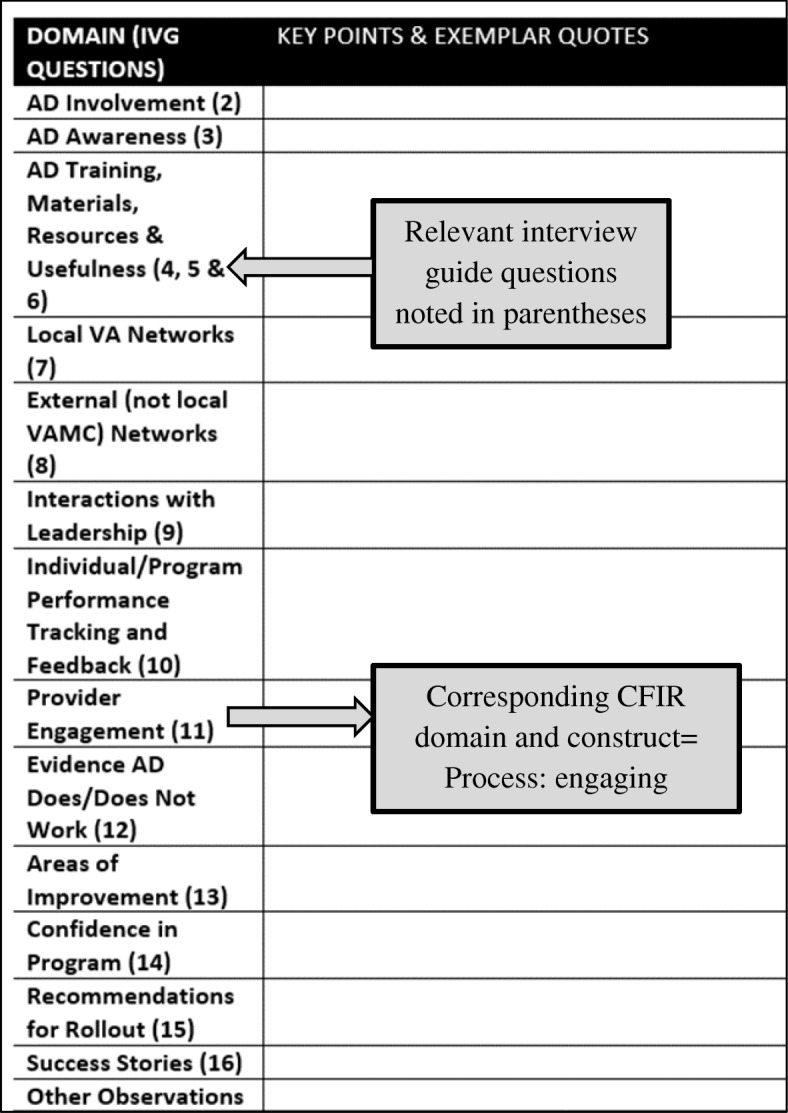
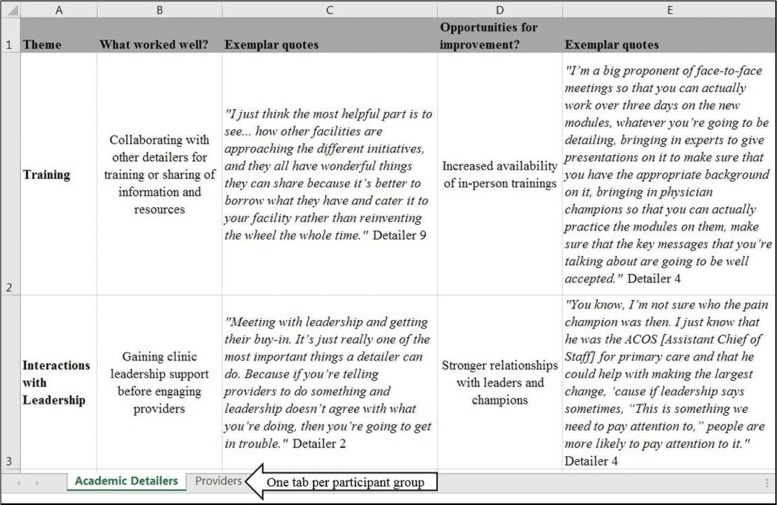
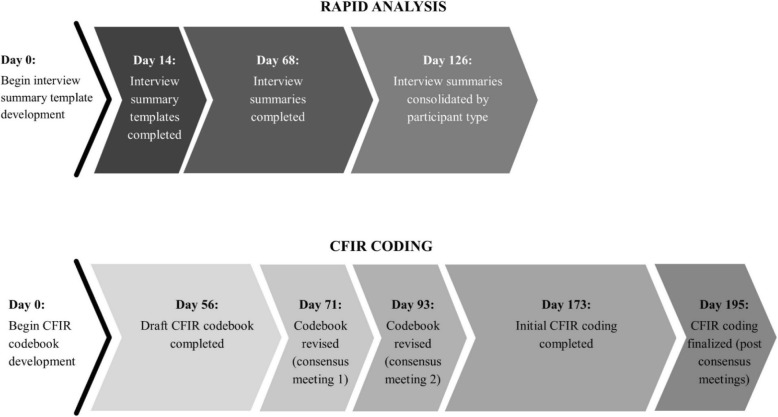
BACKGROUND: It is challenging to conduct and quickly disseminate findings from in-depth qualitative analyses, which can impede timely implementation of interventions because of its time-consuming methods. To better understand tradeoffs between the need for actionable results and scientific rigor, we present our method for conducting a framework-guided rapid analysis (RA) and a comparison of these findings to an in-depth analysis of interview transcripts. METHODS: Set within the context of an evaluation of a successful academic detailing (AD) program for opioid prescribing in the Veterans Health Administration, we developed interview guides informed by the Consolidated Framework for Implementation Research (CFIR) and interviewed 10 academic detailers (clinical pharmacists) and 20 primary care providers to elicit detail about successful features of the program. For the RA, verbatim transcripts were summarized using a structured template (based on CFIR); summaries were subsequently consolidated into matrices by participant type to identify aspects of the program that worked well and ways to facilitate implementation elsewhere. For comparison purposes, we later conducted an in-depth analysis of the transcripts. We described our RA approach and qualitatively compared the RA and deductive in-depth analysis with respect to consistency of themes and resource intensity. RESULTS: Integrating the CFIR throughout the RA and in-depth analysis was helpful for providing structure and consistency across both analyses. Findings from the two analyses were consistent. The most frequently coded constructs from the in-depth analysis aligned well with themes from the RA, and the latter methods were sufficient and appropriate for addressing the primary evaluation goals. Our approach to RA was less resource-intensive than the in-depth analysis, allowing for timely dissemination of findings to our operations partner that could be integrated into ongoing implementation. CONCLUSIONS: In-depth analyses can be resource-intensive. If consistent with project needs (e.g., to quickly produce information to inform ongoing implementation or to comply with a policy mandate), it is reasonable to consider using RA, especially when faced with resource constraints. Our RA provided valid findings in a short timeframe, enabling identification of actionable suggestions for our operations partner.
Overview
The claims and statistics of this paper haven’t been checked yet.
Free: it reads the open-access text and checks the first 5 claims that cite a source we can check. Create a free account to check every claim.
Integrity signals
Registry
Cites
Statistics
Figures
Verification
Claims the paper makes
The claims and statistics of this paper haven’t been checked yet.
Free: it reads the open-access text and checks the first 5 claims that cite a source we can check. Create a free account to check every claim.
Claims other papers make about this one
Each is checked against this paper’s own text: does it say what the citing paper says it does?
The source backs part of the claim, not all of it — or backs it for a different population, condition or comparison.
In the citing paper
“Rapid qualitative analyses has been compared directly with more traditional thematic analysis and found to produce closely aligned results, and is thus considered to have comparable rigor [40].”
From Addressing chronic pain with Focused Acceptance and Commitment Therapy in integrated primary care: findings from a mixed methods pilot randomized controlled trial (2022) · cites this paper as [40]
Experimental — accuracy not yet measuredIn the citing paper
“We analyzed qualitative interview data using rapid qualitative analysis [39, 40].”
Self-check
Percentages, sums and reported differences re-computed from the paper’s own numbers.
The self-check needs the paper’s full text.
Citations
Cites
Three Approaches to Qualitative Content Analysis
Hsieh, H.-F., & Shannon, S. E. (2005) · Qualitative Health Research · doi:10.1177/1049732305276687 · Cited by 44,601 · cited 1×
“The in-depth analysis is line with content analysis using a directed approach [17].”
MethodGraneheim, U. H., & Lundman, B. (2004) · Nurse Education Today · doi:10.1016/j.nedt.2003.10.001 · Cited by 20,772 · cited 1×
“To increase the likelihood of credibility, dependability, and trustworthiness of data, there are several decisions that should be considered when conducting qualitative evaluations, from design through execution [24].”
BackgroundQualitative Data Analysis: A Methods Sourcebook
Miles, M. B., Huberman, A. M., & Saldaña, J. (1988) · Cited by 20,701
Damschroder, L. J., Aron, D. C., Keith, R. E., Kirsh, S. R., Alexander, J. A., & Lowery, J. C. (2009) · Implementation Science · doi:10.1186/1748-5908-4-50 · Cited by 14,496 · cited 1×
“After completion of the RA, we conducted an in-depth, deductive analysis of the data using the CFIR to code transcripts [16].”
MethodSelf-citationCode Saturation Versus Meaning Saturation: How Many Interviews Are Enough?
Hennink, M. M., Kaiser, B. N., & Marconi, V. C. (2017) · Qualitative Health Research · doi:10.1177/1049732316665344 · Cited by 4,597 · cited 1×
“It is important to keep in mind that the combination of the strength and frequency of qualitative comments is what helps us understand their relative importance and contributions to our research [20], regardless of whether you are using a rapid or in-depth analytic approach.”
BackgroundWelcome to Implementation Science
Eccles, M. P., & Mittman, B. S. (2006) · Implementation Science · doi:10.1186/1748-5908-1-1 · Cited by 2,254 · cited 1×
“to promote the systematic uptake of research findings and other evidence-based practices into routine practice” [2].”
BackgroundA systematic review of the use of the Consolidated Framework for Implementation Research
Kirk, M. A., Kelley, C., Yankey, N., Birken, S. A., Abadie, B., & Damschroder, L. (2015) · Implementation Science · doi:10.1186/s13012-016-0437-z · Cited by 1,496 · cited 4×
“Damschroder LJ, Aron DC, Keith RE, Kirsh SR, Alexander JA, Lowery JC. Fostering implementation of health services research findings into practice: a consolidated framework for advancing implementation science.”
MethodInfluentialSelf-citationValidity, reliability, and generalizability in qualitative research
Leung, L. (2015) · Journal of Family Medicine and Primary Care · doi:10.4103/2249-4863.161306 · Cited by 1,404 · cited 2×
“With respect to consistency of our RA and in-depth analysis findings [14], themes from the RA were well-aligned with the CFIR domains and constructs from the in-depth analysis.”
ResultMatrix Analysis as a Complementary Analytic Strategy in Qualitative Inquiry
Averill, J. B. (2002) · Qualitative Health Research · doi:10.1177/10432302012006011 · Cited by 839
Damschroder, L. J., & Lowery, J. C. (2013) · Implementation Science · doi:10.1186/1748-5908-8-51 · Cited by 734
Self-citation
Research works printed but not linked: 1
- 15. Interim Under Secretary for Health. System-wide Implementation of Academic Detailing and Pain Program Champions. 2015.
Cited by
Items 801–900 of 912
The design of a scalable intervention for adolescents with internalizing problems
Hill, E. K., Bond, L., Carmio, N., Hatkevich, C. E., Nag, D., Romero, S. A., Schwartz, K. T. G., Sternberg, A., Tandon, T., Vergara, C. M. J., et al. (2026) · SSM - Mental Health · doi:10.1016/j.ssmmh.2026.100624
Ceccato, E., Zanin, S., Merlino, L., Bonetto, C., & Sala, A. (2026) · IJEDO · doi:10.32044/ijedo.2026.05
Sheinfil, A. Z., Morales-Aseff, D., Lebowitz, Z., Rodriguez‐Barradas, M. C., Giordano, T. P., & Ecker, A. H. (2026) · Journal of Substance Use and Addiction Treatment · doi:10.1016/j.josat.2026.209957 · Cited by 1
McReynolds, V., Ibemere, S. O., You, H., Anaya, B., Huang, M. W., Gonzalez-Guarda, R. M., Bettger, J. P., & Oyesanya, T. O. (2026) · Western Journal of Nursing Research · doi:10.1177/01939459261421129 · Cited by 1
“56,71,72 The steps outlined in this study can also support the integration of cultural and linguistic adaptation processes into institutional research standards.”
Blonigen, D. M., Hyde, J. K., Smith, J., Torrestower, S., Podchiyska, T., Taylor, T. J., Raciborski, R. A., Roy, S. G., & Midboe, A. M. (2026) · Implementation Science · doi:10.1186/s13012-026-01499-y
“De-identified De-identified audio-files of all interviews will be transcribed and analyzed using a rapid qualitative approach, which has been found to yield equivalent findings to more in-depth, time-intensive methods [41].”
Self-citationGoff, S. L., Qasba, N. T., Vergo, A. V., Detterman, C., Winston, L., Gebhardt, L., Fennell, L., & Attanasio, L. B. (2026) · Journal of Midwifery & Women s Health · doi:10.1111/jmwh.70110
Liu, Y., Mitchell, J. W., Brown, L., Chandler, C. J., Odom, U., Jenkins, D., Osman, A., & Zhang, C. (2026) · Discover Public Health · doi:10.1186/s12982-026-01773-w
“This approach helps researchers quickly identify patterns and themes without compromising interpretive depth, making it ideal for studies that require the production of timely, actionable insights to address challenges in research and community settings [44, 45].”
Conrad, M., Kimber, J. M., Moskal, D., Pietropaoli, V. A., King, P. R., & Beehler, G. P. (2026) · Translational Behavioral Medicine · doi:10.1093/tbm/ibag011
Tupetz, A., Saripalli, N., O’Leary, P., Chappell, G., & Hanlin, E. R. (2026) · Frontiers in Public Health · doi:10.3389/fpubh.2026.1805972
Smith, C., Frerichs, L., Leiva, H., Burwell, L., Gilkey, M. B., Shea, C. M., Sleath, B. L., Golin, C. E., Schilling, S., & Allison, B. A. (2026) · Digital Health · doi:10.1177/20552076261444839
“30,31 A primarily descriptive approach was used given the highly applied nature of the research question.”
Nath, B., Levy, D. R., Strycharz, H., Sherak, R. A. G., Gilkes, J., Oladele, C., Sarpong, D. F., Schoenfeld, E. M., Hawk, K. F., Panthagani, K. M., et al. (2026) · PEC Innovation · doi:10.1016/j.pecinn.2026.100478
“…rigor, the team: (1) built on existing patient-facing MOUD interventions to leverage effective components and eliminate ineffective ones; and (2) used a rapid qualitative analysis approach to generate timely, actionable insights more quickly than traditional qualitative methods [48 – 50].”
Goldstein, E. V., Sanger, A., & Hill, J. L. (2026) · Journal of Primary Care & Community Health · doi:10.1177/21501319261439554
“19 20-23 Given the urgency of the recent increase in firearm-involved suicide deaths among Black Americans, 1,19 we conducted RQA to expeditiously generate and disseminate new insights across multiple dissemination products locally and beyond.”
Brewer, J. R., Lee, P., Levey, N., Ditre, J. W., Chen, N., Mudgal, C., Bhashyam, A. R., Garg, R., Ring, D., Vranceanu, A., et al. (2026) · Pain Management · doi:10.1080/17581869.2026.2660326
Anvari, M. S., Anane, J. S., Sacko, C. A., Atkinson, G. E., Kihiuria, M. W., Sonn, M. R., Anthony, J. L., Derenoncourt, M., Belcher, A. M., WEINTRAUB, E., et al. (2026) · Journal of Substance Use and Addiction Treatment · doi:10.1016/j.josat.2026.209990
Gurung, S., MacDonell, K. K., Sizemore, K. M., Ferraris, C. M., & Naar, S. (2026) · AIDS and Behavior · doi:10.1007/s10461-026-05154-x
Hernandez‐Vallant, A., Zolli, N., Martinez, A., Robinson, N., & Meinzer, M. C. (2026) · Research in Neurodiversity · doi:10.1016/j.rin.2026.100029
Panicker, L., Tofa, M., & Lowell, A. (2026) · International Indigenous Policy Journal · doi:10.18584/iipj.2026.16.3.22864
Uy, W. F., Balis, L. E., Nelson, K., Shaw, E., Isack, M., Flournoy, L., Deelo, J., & Yaroch, A. L. (2026) · Ecology of Food and Nutrition · doi:10.1080/03670244.2026.2669920 · Cited by 1
“Rapid qualitative methods have become more common in implementation science as a tool for generating rigorous results in a shorter timeframe than traditional research (Gale et al. 2019; Kowalski et al. 2024).”
Heuer, J. N., Kalvesmaki, A., Matson, S., Waslo, C. S., Panahi, S., George, R. T., & Pugh, M. J. (2026) · Medical Care Research and Review · doi:10.1177/10775587261445776
“The interview note summaries were entered into analysis matrices in Microsoft Excel by the first independent coder (Gale et al., 2019; Keniston et al., 2023).”
InfluentialComber, E. R., Ullman, A. J., Gibson, V., Takashima, M., Byrnes, J., & Keogh, S. J. (2026) · European Journal of Oncology Nursing · doi:10.1016/j.ejon.2026.103216
Dickson, K. S., Holt, T., Galligan, M. R. L., Anthony, L. G., Kenworthy, L. E., & Brookman-Frazee, L. I. (2026) · Evidence-Based Practice in Child and Adolescent Mental Health · doi:10.1080/23794925.2026.2673504
Ziegler, A., Walcott-George, K., Sullivan, A., Gailor, M., Kayler, L. K., & Tumiel‐Berhalter, L. (2026) · Healthcare · doi:10.3390/healthcare14101403
“…timeline while maintaining analytic rigor, each interview was distilled into a 2–3-page summary across pre-specified domains for PCP and nephrologist interviews (e.g., how CKD concepts and laboratory results were explained; how fears, questions, and treatment options were addressed) [24–26].”
Rhodes, E., LaPlant, H. W., Segura‐Pérez, S., & Pérez‐Escamilla, R. (2026) · International Breastfeeding Journal · doi:10.1186/s13006-026-00844-7
“Throughout data collection, researchers and research assistants initiated a rapid qualitative analysis [33, 34].”
Kay, M. C., Richardson, T. N., Bell, L., Shelton, S. M., & Wasser, H. (2026) · Childhood Obesity · doi:10.1177/21532176261450308
“61,62 This approach reduces data by using templates for quick comparison of data across participants.”
Vroom, E. B., Finley, E. P., & Potter, J. S. (2026) · Addiction Science & Clinical Practice · doi:10.1186/s13722-026-00678-y
“These were discussed among the entire research team and refined, which included constant reference back to the matrix, summaries, and, when necessary, the original transcripts for verification and to enhance the validity of synthesized findings [40].”
Lau‐Min, K. S., Psenka, R., Holtze, M., Metri, C., Hansen, A., Lo, S. B., Decker, V. B., Manz, C. R., Parikh, A. R., Nipp, R. D., et al. (2026) · Journal of Pain and Symptom Management · doi:10.1016/j.jpainsymman.2026.05.012
Cultural Humility in Action: Contextualizing Coping Power for Middle Schools in Guadalajara, Mexico
Solís, M. G. O., Pérez, P., Aguayo, D., Birchfield, K., Medeles, A. U., Hernández, H., & Bradshaw, C. P. (2026) · School Psychology International · doi:10.1177/01430343261455040
Stetten, N. E., Ressel, K., Resnik, L. J., & Freburger, J. K. (2026) · Learning Health Systems · doi:10.1002/lrh2.70099
Crocker, R. M., Schneider, J. L., Rivelli, J. S., Gautom, P., Escaron, A. L., & Coronado, G. D. (2026) · Cancer Prevention Research · doi:10.1158/1940-6207.capr-25-0526
Schwartz, J., Meehan, K., Cohn, E. B., Bacci, J. L., Calo, W. A., Ko, L., & Shah, P. D. (2026) · Human Vaccines & Immunotherapeutics · doi:10.1080/21645515.2026.2685449
“24 Briefly, two research members (JB, KM) summarized the verbatim interview transcripts using a structured template based on the 5As Behavioral Counseling Framework to generate synopses and identify exemplar quotes about *“Avg” refers to average and “SD” refers to standard deviation for age and…”
From Surviving to Thriving: Promoting Cancer Survivorship Health Through Community, Space, & Policy
Saunders, D. M. (2026) · UA Campus Repository (The University of Arizona)
Raudales, P. N., Jimenez-Zambrano, A. M., Velasquez, S., Anariba, D. C., Sandra Liliana Rodríguez, M., Aguilar, G. M., Wilson, P. T., & Czaja, A. S. (2026) · Journal of Graduate Medical Education · doi:10.4300/jgme-d-25-00728.1
Glascock, M., Wangen, M., Ferrari, R. M., Leary, M. C. O. A., Schwartz, J., Ndugulile, M., Unger, J. M., Fedorenko, C. R., Li, L., Marciniak, M. W., et al. (2026) · Contemporary Clinical Trials · doi:10.1016/j.cct.2026.108443
Merker, V. L., Carias, S. C., Ferner, R. E., Golding, J. F., Plotkin, S. R., & Buono, F. D. (2026) · medRxiv · doi:10.64898/2026.06.09.26355287
“Analysis: Rapid qualitative analysis was used to review participant feedback in real-time to make iterative adjustments to the draft measure prior to subsequent interviews (Gale et al., 2013; Gale et al., 2019).”
Frier, K. C., Dietl, M., Aronson, S., Dhani, J. S., James, K., Betensky, D. J., Selzer, F., Losina, E., Katz, J. N., Kim, J. S., et al. (2026) · ACR Open Rheumatology · doi:10.1002/acr2.90070
“42,43 The Framework Analysis approach allows for both inductive and deductive analyses, depending on the research question posed.”
Adapting an Adolescent Depression Prevention Program for Pediatric Primary Care
Davis, M., Dysart, G. C., Kelly, S. D., Houlihan, A. L., & Young, J. F. (2026) · Academic Pediatrics · doi:10.1016/j.acap.2026.103363
A Mixed-Methods Study of the Variation in Routine Preoperative Clinic Utilization
Kim, E., Mott, N. M., Seiler, K., Kim, H., Booth, D. H. R., Arias, D. A., Odayar, V., Jiang, L., Henderson, J., Hassett, K. P., et al. (2026) · Journal of Surgical Research · doi:10.1016/j.jss.2026.05.080
Wright, T., Finley, E. P., Ashford, R. D., Olmos, D. I., Jean-Berluche, D., & Potter, J. S. (2026) · JMIR Formative Research · doi:10.2196/74076
“The interview data were analyzed using a rapid qualitative analysis approach (under the supervision of a doctoral-level qualitative researcher) to quickly transform data into actionable contributions [13].”
Bonett, S., Sweeney, A., Correa, N., Li, Q., Hernandez, B., Watson, D. L., Williams, J., Brady, K. A., Gaither-Hardy, D., Joffe, A., et al. (2026) · Implementation Science Communications · doi:10.1186/s43058-026-01009-7
“Interview We utilized a rapid qualitative approach to analyze the interview transcripts [27, 28].”
Angelva, N. E., Gurschler, F., Single, M., Zumbrunnen, V., Näf, D., Kampus, N., Cioffi, E., Marcin, T., Savic, B., Wilhelm, M., et al. (2026) · JMIR Rehabilitation and Assistive Technologies · doi:10.2196/100614
“Open-ended responses from the written posttask questionnaire were analyzed using rapid content analysis, an approach suited to formative and implementation-oriented evaluations that require timely identification of actionable themes [25].”
Roybal, K. L., James, T. T., Chun, L. L. M. W., & Squire, K. M. (2026) · BMC Health Services Research · doi:10.1186/s12913-026-15058-0
“The study team selected this method to ensure a systematic analysis grounded in both analytic rigor and efficiency [37–39], with a goal of presenting timely, actionable findings to health system and philanthropic stakeholders.”
Presciutti, A., Rochon, E. A., Newman, M., Ratay, C. R., Elmer, J., Perman, S. M., Vranceanu, A., & Mace, R. A. (2026) · Aging & Mental Health · doi:10.1080/13607863.2026.2696969
Sasnal, M., Giannitrapani, K. F., Langston, A. H., Doruk, R. N., Morris, A. M., Harris, A. H. S., & Arya, S. (2026) · Annals of Surgery Open · doi:10.1097/as9.0000000000000690
“7,8,19,20 23 This article presents CFIR-informed formative evaluation 24 conducted during the pre-implementation phase of a hybrid I stepped-wedge cluster randomized clinical trial titled “Patient-Centered Multidisciplinary Care for Veterans Undergoing Surgery” (“PAUSE”) (ClinicalTrials.gov ID…”
InfluentialFeldman, N., Nathan, M., Lipschitz, J. M., Salama, K., Campbell, L. E., Wang, P., Mittal, L. P., & Carusi, D. A. (2026) · BMC Health Services Research · doi:10.1186/s12913-026-15368-3
Breen, K. E., Barnett, M. E., Kennedy, J., Gilliland, J. L., Tutino, R. C., Ongaro, G., & MacGregor, M. (2026) · Psycho-Oncology · doi:10.1002/pon.70541
“Rapid analysis, a form of qualitative content analysis, was conducted in two phases [23].”
Nalavenkata, S. B., Bergengren, O., Lynch, K., Emard, N., Austria, M. D., Martin, S., Ogbennaya, G., Dualeh, K., Stevanović, K., Patel, M. I., et al. (2026) · BMJ Open · doi:10.1136/bmjopen-2024-095951 · Cited by 1
Jutagir, D. R., Claros, M., Hoyos, L., Abbo, Y., Cajamarca, S., Wolchok, R. E., López, M. R., Espinosa, A., Santos, Y. D. L., Gilliland, J. L., et al. (2026) · SSM - Qualitative Research in Health · doi:10.1016/j.ssmqr.2026.100826
Cockroft, J. D., Ritger, C., Bloedow, B., Dorsey, B., & Glasgow, R. E. (2026) · Implementation Science Communications · doi:10.1186/s43058-026-01037-3
“To support rigor, we double populated and reconciled 20% of transcripts to iteratively refine the matrix domains [29, 30].”
Higgins, A., Balian, L. N., Hopkins, L. H., Rama, A., Ziolkowski, R., & Rodriguez, N. M. (2026) · International Journal of Qualitative Methods · doi:10.1177/16094069261465280
Hezel, D. M., Yap, D. L., Bernero, L., Clayton, M., Bezahler, A., Simpson, H. B., & Patel, S. (2026) · Journal of Technology in Behavioral Science · doi:10.1007/s41347-026-00676-6
Optimizing Urban Drainage Systems to Cope with Continuous Flooding
Zaki, A., Huda, N., & Amir, S. (2024) · Journal of Moeslim Research Technik · doi:10.70177/technik.v1i4.1554
“Instruments for data collection will include an online survey and structured interview guides (Budd et al., 2020; Gale et al., 2019).”
Stephenson, S. J., & Reiss, R. (2026) · The Open Journal of Occupational Therapy · doi:10.15453/2168-6408.2490
Emovon, A., Driggers-Jones, L., Engelhard, M., Maslow, G., Dawson, G., Goldstein, B. A., & Franz, L. (2026) · JAMIA Open · doi:10.1093/jamiaopen/ooag145
“37,38 40–42”
Sharma, P., Imsande, K. G., Wood, A., Hepp, J., Tommarello, M., II, Hammond, C. J., Brockman, T. A., Hopkins, I., Kelpin, S. S., Bormann, N. L., et al. (2026) · doi:10.2196/preprints.107866
Vroom, E. B., Bolton, C. D., Finley, E. P., & Potter, J. S. (2026) · Journal of Substance Use and Addiction Treatment · doi:10.1016/j.josat.2026.210082
Arlinghaus, K. R., Bresnahan, C., Barry, M. R., Morales, S., & Hooper, L. (2026) · Childhood Obesity · doi:10.1177/21532176261473766
“30,31 This approach is particularly effective for generating actionable results in time-sensitive research.”
Acceptability of a decision aid for the treatment of symptomatic carotid artery disease
Eklund, K., Wallace, B. C., Columbo, J. A., Krafcik, B. M., Fullard, M. E., Matlock, D. D., & Knoepke, C. E. (2026) · Seminars in Vascular Surgery · doi:10.1053/j.semvascsurg.2026.07.010
Emoji in clinical messaging: results of a focus group study
Halverson, C. M. E., Echols, H., Kang, L., Vershaw, S. L., & Lee, J. L.-Y. (2026) · JAMIA Open · doi:10.1093/jamiaopen/ooag159
“19,20 Guided by an RQA framework, our analysis incorporated template-and matrix-based techniques.”
Martínez, O., Muñoz‐Laboy, M., Aponte‐Soto, L., Martinez, A., Rivera, S., Alvarez, D. L., Rodríguez, E. I. S., Yang, C., Serrano, P. A., & Rodríguez-Díaz, C. E. (2026) · Archives of Public Health · doi:10.1186/s13690-026-02029-4
Magel, J. S., Beneciuk, J. M., Blosser, P., Fritz, J. M., Hanley, A. W., Garland, E. L., Hartman, P., Matev, T., Shen, J., Gordon, A. J., et al. (2026) · Archives of Rehabilitation Research and Clinical Translation · doi:10.1016/j.arrct.2026.100680
Felton, J. W., Vanderziel, A., Hampton, T., Johnson, J., Ward, V., Sprecher, M., Sulaiman, S., O’Connell, L., Yi, R., & Chronis-Tuscano, A. (2026) · Evidence-Based Practice in Child and Adolescent Mental Health · doi:10.1080/23794925.2026.2714863
Martinez, R. G., Cramer, E. R., Norris, L. A., Matson, A., Lang, C., Henrikson, N. B., Blasi, P. R., Palazzo, L. G., Hoopes, A. J., Dorsey, S., et al. (2026) · Implementation Science Communications · doi:10.1186/s43058-026-01011-z
Peridischarge Management After Sepsis
Hauschildt, K. E., Hogan, C. K., Byrd, K. M., Takamine, L. H., Whittington, T. N., Akgün, K. M., Edwards, S. T., Epstein, L. H., Jimenez, G., King, M. D., et al. (2026) · CHEST Critical Care · doi:10.1016/j.chstcc.2026.100313
Hoopes, A. J., Matson, A., Cramer, E. R., Meza, R. D., Klasnja, P., Dorsey, S., Weiner, B. J., Lyon, A. R., Palazzo, L. G., & Martinez, R. G. (2026) · Implementation Research and Practice · doi:10.1177/26334895261467984
“For that reason, we employed rapid qualitative analysis (Gale et al., 2019) approach consistent with other qualitative methods used in NIMBLE (e.g., rapid ethnography).”
Mandated supporting, not reporting: Reimagining maternal health care for women who use drugs
Ciraldo, K. J., Plesons, M., Sansbury, G. M., Culbertson, K., Khakani, H., Finster, J., Suarez, E., Tookes, H., & Nowotny, K. M. (2026) · Social Science & Medicine · doi:10.1016/j.socscimed.2026.119713
Navigating the strain: Systemic factors contributing to burnout in emergency nursing
Glasgow, T. E., Jackson, A., Benishek, L. E., Dhindsa, H. S., & DiazGranados, D. (2026) · Journal of Workplace Behavioral Health · doi:10.1080/15555240.2026.2715725
CMS Hospice Care Index Live Discharge Quality Measurement: Insights From Nonprofit Hospice Leaders
Sheldon, K. G., Luth, E. A., Brennan, C., Murphy, M., & Zhang, Y. (2026) · Journal of Pain and Symptom Management · doi:10.1016/j.jpainsymman.2026.08.007
Henderson, M. S. G., JaKa, M. M., Zibley, L. J., Crouse, B. K., Werner, A., O’Connor, P. J., Ekstrom, H. L., Borson, S., Rossom, R. C., & Hanson, L. R. (2026) · Research on Aging · doi:10.1177/01640275261478946
Parental Perspectives on Future Outcomes for Children Diagnosed With Fetal Neurological Conditions
Bach, A., Callahan, K. P., Gano, D. L., Lemmon, M. E., Venkatesan, C., & Agarwal, S. (2026) · Pediatric Neurology · doi:10.1016/j.pediatrneurol.2026.08.008
Rapid Deductive Qualitative Analysis in Implementation Science: A Practical Training Protocol
Palmer, S., & Balis, L. E. (2026) · American Journal of Qualitative Research · doi:10.66815/ajqr/19192
Reid, M. J., LeLaurin, J. H., Ali, S., Sorial, C., Bylund, C. L., Woodard, J. N., Wollney, E. N., Goede, D. L., Lee, J.-H., Nelson, D., et al. (2026) · Current Oncology · doi:10.3390/curroncol33090499
Pragmatic Measures in Aided Language Measurement: AAC Clinical Expert Perspectives
Smith, M. H. (2026) · UNM’s Digital Repository (University of New Mexico)
Marrocco, S. L. (2025) · Scholarship@Western (Western University)
Morse, B., Reale, C., Latella, E., Bauguess, H. D., Schilling, L. M., & Soares, A. (2026) · JMIR Formative Research · doi:10.2196/30427
“Two researchers independently reviewed transcripts and video of the MoSCoW interaction using a descriptive approach [28,29] and rapid qualitative analysis template [30-32], iterating to consensus [33].”
Nattress, N. (2026) · UNM’s Digital Repository (University of New Mexico)
Gregory, V. L., Zapolski, T. C. B., Marriott, B. R., Lipsey, A. D., Hicks, A. I., & Lee, C. (2026) · Race and Social Problems · doi:10.1007/s12552-026-09522-z
“Interviews were analyzed using rapid qualitative analysis (Gale et al., 2019; Hamilton, 2013).”
Adams, M., Durden, J. A., Leslie, S. E., Vemuru, S. R., Higgins, M. G., Matlock, D. D., Baimas‐George, M. R., Daly, R., Lee, C., Colborn, K. L., et al. (2026) · Supportive Care in Cancer · doi:10.1007/s00520-026-11199-4
Owens, C., Gunn, R., Cook, N., Fein, H. L., Pisciotta, M., Fee, C., Larson, Z., Templeton, A. R., & Gold, R. B. (2026) · Journal of General Internal Medicine · doi:10.1007/s11606-026-10735-6
Rojas, N. M., Katter, J., Springer, B., Huang-Greco, N., Albert, S., & Kerker, B. D. (2026) · Journal of Education · doi:10.1177/00220574261488820
Toscano, J., Kwok, K. Y., & Simione, M. (2026) · PLOS Digital Health · doi:10.1371/journal.pdig.0001721
“Open-response survey items elicited qualitative feedback, and framework-guided rapid analysis methods were used [17].”
Amberson, T., Dorcy, K. S., Sheffield, P., Gallegos, D., & Laing, S. S. (2026) · Journal of Primary Care & Community Health · doi:10.1177/21501319261485527
“11,13 Given that traditional thematic analysis can be time and resource intensive, this method is especially useful when resources (i.e., time, software) are limited 13 and when preliminary results are needed to immediately inform ongoing implementation processes.”
Ziegler, A. M., Harold, P., & Tumiel‐Berhalter, L. (2026) · Translational Behavioral Medicine · doi:10.1093/tbm/ibag062
“Focus group transcripts from four sessions across three practices were reviewed following a Rapid qualitative analysis approach [30, 31] Quantitative survey data were summarized using descriptive statistics, including mean and frequencies for Likert-scale responses.”
Marrufo, T. J., Hassan, S., Florindo, G., dos Santos, P. F., Maholela, P., Mocumbi, A. O., Inlamea, O., Mugabe, V. A., José, A., Kitron, U. D., et al. (2026) · Frontiers in Climate · doi:10.3389/fclim.2026.1912968
Wei, X.-H., Chen, X.-Y., Wang, Y.-Y., Fu, J.-J., Yang, G.-Y., Sun, J., & Lu, C.-L. (2026) · Evidence-Based Chinese Medicine and Technology Assessment · doi:10.26599/ecmta.2026.9570046
Intawong, K., Upreti, S., Langgapin, S., Shrivastav, G., Atsawakornkan, T., Puritat, K., & Muenkaew, N. (2026) · International Journal of Developmental Disabilities · doi:10.1080/20473869.2026.2737184
Chen, J. H., Veenstra, D. L., Crosslin, D. R., Jarvik, G. P., & Knerr, S. A. (2026) · Genetics in Medicine · doi:10.1016/j.gim.2026.102737
Edwards, E. E., Choate, S. A., Decker, H. R., Roberson, P., Jacola, M., Priddy, M., & Schaefer, B. P. (2026) · Journal of Community Health · doi:10.1007/s10900-026-01636-0
Scherer, L. D., Parmet, T., Schapira, M. M., Cappella, J. N., Hersch, J. K., McCaffery, K. J., Lewis, C. L., Tate, C. E., & Morse, B. (2026) · BMJ Open · doi:10.1136/bmjopen-2026-117793 · Cited by 2
“I spend a lot of time with my kids and I'm a single parent, so my time is extremely valuable and don't have the energy to go to another doctor’s appointment.”
The Rural WAVE (Wellness and Veteran Engagement) Initiative
Parry, K. J., Blue, C. M., Clark, S. C., Conzemius, J. L., Hale-Gallardo, J. L., Halliburton, L., Hicken, B. L., Lanford, T. J., Lynch, C., Miao, J. W., et al. (2026) · The Journal of Rural Health · doi:10.1111/jrh.70211 · Cited by 1
Jamison, J., Young, S., Mandell, D. S., Hoagwood, K., Hurley, K. D., Anthony, B. J., Ruiter, R. A. C., Barnett, M. L., Wolk, C. B., Moore, T. M., et al. (2026) · JMIR Research Protocols · doi:10.2196/104843
Martínez, O., Cora‐Cruz, M. S., Perez, S., French, A., Gerena, A. C., & Fang, C. Y. (2026) · Women s Health · doi:10.1177/17455057261493721
Patel, K., Geiss, C., Welniak, T. L., Rodriguez, Y., Fulton, H. J., Jessin, N., Muzaffar, J., Kirtane, K., Chung, C. H., Yang, G. Q., et al. (2026) · Head & Neck · doi:10.1002/hed.70491
Coco, L., Finlayson, T. L., López-Gálvez, N. I., Ruedas, P., Rosiles, A. L., Toji-Ruiz, B., Angel, B., Torres, E., & Zúñiga, M. L. (2026) · JMIR Research Protocols · doi:10.2196/93134
“Brief postintervention interviews will be analyzed using rapid qualitative content analysis with structured summaries and matrix displays to identify participants’ perceptions of the intervention, barriers and facilitators to implementation, and recommendations for refinement [53,54].”
Research sustainability: Lessons and opportunities for global biomedical research institutions
Ruderman, L. W., Tully, V. F., & Dominique, J. K. (2026) · Global Public Health · doi:10.1080/17441692.2026.2743950
Rios, L. (2026) · eScholarship (California Digital Library)
Blue, C. M., Eldridge, M. R., King, H. A., Zervakis, J., Armendariz, J., Boggan, J. C., Huang, L., Shah, P., Soltys, M. D., & Caputo, L. M. (2026) · Journal of Hospital Medicine · doi:10.1002/jhm.70507
“23,25 Our team engaged in reflexivity, peer debriefing, and triangulation to increase credibility.”
Morse, B., Reale, C., Nuguyen, A., Latella, E., Bauguess, H., Roberts, P. R., SooHoo, S., El-Kareh, R. E., Faiman, J., Soares, A., et al. (2026) · medRxiv · doi:10.64898/2026.10.12.26365343
Spears, C. A., Gonzalez, C., Borghi, S. E. “., Correa-Fernández, V., Fraire, L., Chilito, C., Wangen, M., Bernal, R., Ramirez, D. B., Self‐Brown, S., et al. (2026) · Preventive Medicine · doi:10.1016/j.ypmed.2026.108679
Delineating a Spectrum of Physician Participation in Medical Aid in Dying: A Qualitative Exploration
ALBRIGHT, K. J., Gerasta, D. J., Becker, T. D., Kini, V., Matlock, D. D., Fischer, S. M., & Campbell, E. G. (2026) · Journal of the American Geriatrics Society · doi:10.1111/jgs.70775
Hawes, S. M., Beltran, D. R., Bernal, Z., Cruz, D., Loney, L. A., Ly, L. H., & Morales, C. (2026) · Journal of Shelter Medicine and Community Animal Health · doi:10.56771/jsmcah.v5.173
Metadata
- Authors
- Gale, R. C., Wu, J., Erhardt, T., Bounthavong, M., Reardon, C. M., Damschroder, L. J., & Midboe, A. M.
- Affiliations
- VA Palo Alto Health Care System (US)
- Veterans Health Administration (US)
- VA Center for Clinical Management Research (US)
- Corresponding author
- Midboe, Amanda M.
- Venue
- Implementation Science
- Published
- 2019-02-01
- Volume
- 14
- Issue
- 1
- Pages
- 11-11
- ISSN
- 1748-5908 (ISSN-L)
- PMC
- PMC6359833
- OpenAlex
- W2938766056
- Semantic Scholar
- a626f0fe88503d634d82db688e6c0efe34af9c01
- Cited by
- 846
- References
- 22
- Citations by year
- 2026: 136 · 2025: 146 · 2024: 177 · 2023: 122 · 2022: 154 · 2021: 74 · 2020: 32 · 2019: 5
- FWCI
- 90.32
- Type
- journal article
- Language
- en
- Open access
- gold
- doi.org
- Licence
- cc-by
- creativecommons.org/licenses/by/4.0/ (tdm)
- Locations
- Implementation Science (publishedVersion, cc-by)
- Europe PMC (PubMed Central) (publishedVersion, other-oa)
- PubMed Central (publishedVersion, cc-by)
- PubMed (publishedVersion)
- DOAJ (DOAJ: Directory of Open Access Journals) (submittedVersion, cc-by-sa)
- eScholarship (California Digital Library) (submittedVersion, cc-by)
- Funders
- U.S. Department of Veterans Affairs
- Quality Enhancement Research Initiative
- Veterans Affairs San Diego Healthcare System
- Topics
- Health Sciences › Health Professions › General Health Professions › Health Policy Implementation Science
- Social Sciences › Education › Qualitative Research Methods and Applications
- Social Sciences › Public Administration › Evaluation and Performance Assessment
- Keywords
- rapid qualitative analysis, academic detailing, opioid prescribing, Consolidated Framework for Implementation Research, clinical pharmacists, primary care providers, implementation research, process evaluation, resource intensity, Veterans Health Administration
- MeSH terms
- Implementation Science, Analgesics, Opioid, Data Collection, Humans, Interviews as Topic, Practice Patterns, Physicians', Drug Prescriptions, United States, United States Department of Veterans Affairs, Program Evaluation, Process Assessment, Health Care, Information Dissemination, Qualitative Research, Veterans Health
About these checks
Registry, retraction, Cites and statistics results are computed, not judged, with one exception: a printed reference that no index lists is read once by a model before it counts as a citation error. Claims are extracted by a model and kept only when their quote appears verbatim in the text; each cited source is then checked, with a model’s help, for whether it says what the claim relies on. Those verdicts can be wrong — read the claim’s quote and the cited source before relying on one.
Statistics and arithmetic are recomputed, not judged.
Confidence bands are shown only for fields calibrated on our annotated test set. None is calibrated yet, so no band is shown.
What counts as a claim ›How we measure confidence ›How we check this ›
Are you an author, or do you see a problem with this page? Request a review
Data sources
Bibliographic data: Semantic Scholar, OpenAlex, Crossref.
Contains information from the Semantic Scholar Academic Graph Datasets, made available under the ODC Attribution License (ODC-BY 1.0).
Semantic Scholar’s data is described in: Kinney, R., et al. (2023). The Semantic Scholar Open Data Platform. arXiv:2301.10140.
