

Choosing implementation strategies to address contextual barriers: diversity in recommendations and future directions
Open accessThe DOI matches its Crossref record; 50 of the 50 references it cites were found in a registry or an index.
Abstract
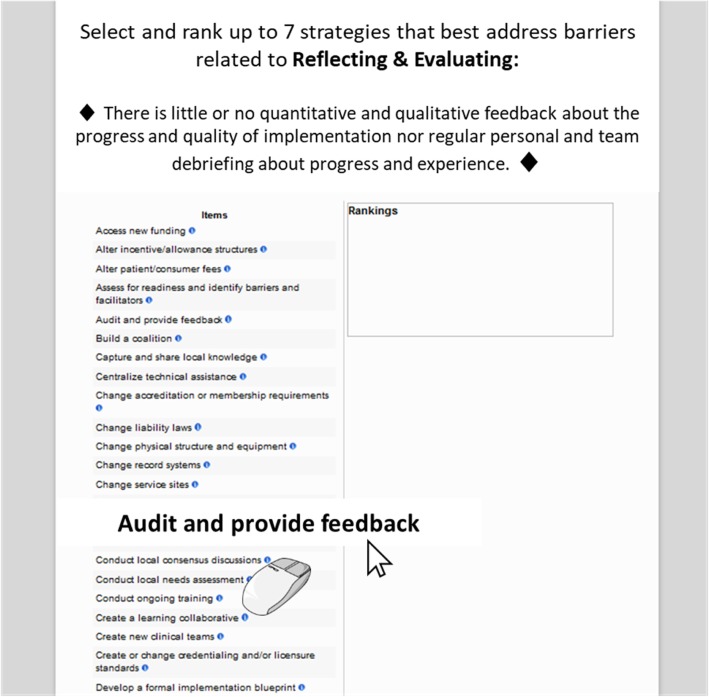
BACKGROUND: A fundamental challenge of implementation is identifying contextual determinants (i.e., barriers and facilitators) and determining which implementation strategies will address them. Numerous conceptual frameworks (e.g., the Consolidated Framework for Implementation Research; CFIR) have been developed to guide the identification of contextual determinants, and compilations of implementation strategies (e.g., the Expert Recommendations for Implementing Change compilation; ERIC) have been developed which can support selection and reporting of implementation strategies. The aim of this study was to identify which ERIC implementation strategies would best address specific CFIR-based contextual barriers. METHODS: Implementation researchers and practitioners were recruited to participate in an online series of tasks involving matching specific ERIC implementation strategies to specific implementation barriers. Participants were presented with brief descriptions of barriers based on CFIR construct definitions. They were asked to rank up to seven implementation strategies that would best address each barrier. Barriers were presented in a random order, and participants had the option to respond to the barrier or skip to another barrier. Participants were also asked about considerations that most influenced their choices. RESULTS: Four hundred thirty-five invitations were emailed and 169 (39%) individuals participated. Respondents had considerable heterogeneity in opinions regarding which ERIC strategies best addressed each CFIR barrier. Across the 39 CFIR barriers, an average of 47 different ERIC strategies (SD = 4.8, range 35 to 55) was endorsed at least once for each, as being one of seven strategies that would best address the barrier. A tool was developed that allows users to specify high-priority CFIR-based barriers and receive a prioritized list of strategies based on endorsements provided by participants. CONCLUSIONS: The wide heterogeneity of endorsements obtained in this study's task suggests that there are relatively few consistent relationships between CFIR-based barriers and ERIC implementation strategies. Despite this heterogeneity, a tool aggregating endorsements across multiple barriers can support taking a structured approach to consider a broad range of strategies given those barriers. This study's results point to the need for a more detailed evaluation of the underlying determinants of barriers and how these determinants are addressed by strategies as part of the implementation planning process.
Overview
The claims and statistics of this paper haven’t been checked yet.
Free: it reads the open-access text and checks the first 5 claims that cite a source we can check. Create a free account to check every claim.
Integrity signals
Registry
Cites
Statistics
Figures
Verification
Claims the paper makes
The claims and statistics of this paper haven’t been checked yet.
Free: it reads the open-access text and checks the first 5 claims that cite a source we can check. Create a free account to check every claim.
Claims other papers make about this one
Each is checked against this paper’s own text: does it say what the citing paper says it does?
The source backs part of the claim, not all of it — or backs it for a different population, condition or comparison.
In the citing paper
“a few best practices have been added: Teaming [42, 46, 73], Assessing Needs [46, 47], Assessing Context, Tailoring Strategies [14], and Adapting [45, 74, 75].”
From The updated consolidated framework for implementation research based on user feedback (2022) · cites this paper as [14]
Experimental — accuracy not yet measuredThe source backs part of the claim, not all of it — or backs it for a different population, condition or comparison.
In the citing paper
“Current literature also reflects an increasing number of studies testing the effectiveness of implementation strategies and the mechanisms that explain how these strategies may influence implementation outcomes [25–31].”
From Ten years of implementation outcomes research: a scoping review (2023) · cites this paper as [26]
Experimental — accuracy not yet measuredThe cited source says what the claim attributes to it.
In the citing paper
“Determinant frameworks can thus be used to inform choice of implementation strategies that may best address contextual determinants [14], generate hypotheses to prospectively guide predictions of implementation outcomes, or retrospectively explain implementation outcomes by assessing differences in determinants across implementation settings [11, 13, 15].”
From The updated consolidated framework for implementation research based on user feedback (2022) · cites this paper as [14]
Self-check
Percentages, sums and reported differences re-computed from the paper’s own numbers.
The self-check needs the paper’s full text.
Citations
Cites
Damschroder, L. J., Aron, D. C., Keith, R. E., Kirsh, S. R., Alexander, J. A., & Lowery, J. C. (2009) · Implementation Science · doi:10.1186/1748-5908-4-50 · Cited by 14,496
Self-citationHoffmann, T. C., Glasziou, P. P., Boutron, I., Milne, R., Perera, R., Moher, D., Altman, D. G., Barbour, V., Macdonald, H., Johnston, M., et al. (2014) · BMJ · doi:10.1136/bmj.g1687 · Cited by 10,548
Proctor, E., Silmere, H., Raghavan, R., Hovmand, P., Aarons, G., Bunger, A., Griffey, R., & Hensley, M. (2011) · Administration and Policy in Mental Health and Mental Health Services Research · doi:10.1007/s10488-010-0319-7 · Cited by 8,721
Michie, S., Richardson, M., Johnston, M., Abraham, C., Francis, J., Hardeman, W., Eccles, M. P., Cane, J., & Wood, C. E. (2013) · Annals of Behavioral Medicine · doi:10.1007/s12160-013-9486-6 · Cited by 7,629
What's in a name? Qualitative description revisited
Sandelowski, M. (2010) · Research in Nursing & Health · doi:10.1002/nur.20362 · Cited by 4,975
Powell, B. J., Waltz, T. J., Chinman, M. J., Damschroder, L. J., Smith, J. L., Matthieu, M. M., Proctor, E. K., & Kirchner, J. E. (2015) · Implementation Science · doi:10.1186/s13012-015-0209-1 · Cited by 4,963
Self-citationMaking sense of implementation theories, models and frameworks
Nilsen, P. (2015) · Implementation Science · doi:10.1186/s13012-015-0242-0 · Cited by 4,447
Implementation strategies: recommendations for specifying and reporting
Proctor, E. K., Powell, B. J., & McMillen, J. C. (2013) · Implementation Science · doi:10.1186/1748-5908-8-139 · Cited by 2,585
Self-citationKnowledge translation of research findings
Grimshaw, J. M., Eccles, M. P., Lavis, J. N., Hill, S. J., & Squires, J. E. (2012) · Implementation Science · doi:10.1186/1748-5908-7-50 · Cited by 2,407
Planning health promotion programs an intervention mapping approach
Bartholomew, L. K., Parcel, G. S., Kok, G., & Gottlieb, N. (2006) · Research Publications (Maastricht University) · Cited by 2,289
The Challenge of Innovation Implementation
Klein, K. J., & Sorra, J. S. (1996) · The Academy of Management Review · doi:10.2307/259164 · Cited by 2,113
Planning Health Promotion Programs: An Intervention Mapping Approach
Hicking-Woodison, L. (2017) · Nursing Standard · doi:10.7748/ns.32.6.33.s38 · Cited by 1,841
Bridging Research and Practice
Tabak, R. G., Khoong, E. C., Chambers, D. A., & Brownson, R. C. (2012) · American Journal of Preventive Medicine · doi:10.1016/j.amepre.2012.05.024 · Cited by 1,386
A taxonomy of behaviour change methods: an Intervention Mapping approach
Kok, G., Gottlieb, N. H., Peters, G.-J. Y., Mullen, P. D., Parcel, G. S., Ruiter, R. A. C., Fernández, M. E., Markham, C., & Bartholomew, L. K. (2016) · Health Psychology Review · doi:10.1080/17437199.2015.1077155 · Cited by 1,137
Self-citationWaltz, T. J., Powell, B. J., Matthieu, M. M., Damschroder, L. J., Chinman, M. J., Smith, J. L., Proctor, E. K., & Kirchner, J. E. (2015) · Implementation Science · doi:10.1186/s13012-015-0295-0 · Cited by 1,108
Self-citationIntervention Mapping: A Process for Developing Theory and Evidence-Based Health Education Programs
Bartholomew, L. K., Parcel, G. S., & Kok, G. (1998) · Health Education & Behavior · doi:10.1177/109019819802500502 · Cited by 1,102
A compilation of strategies for implementing clinical innovations in health and mental health
Powell, B. J., McMillen, J. C., Proctor, E. K., Carpenter, C. R., Griffey, R. T., Bunger, A. C., Glass, J. E., & York, J. L. (2012) · Medical Care Research and Review · doi:10.1177/1077558711430690 · Cited by 1,069
Self-citationBaker, R., Camosso-Stefinovic, J., Gillies, C., Shaw, E. J., Cheater, F., Flottorp, S., & Robertson, N. (2010) · Cochrane Database of Systematic Reviews · doi:10.1002/14651858.cd005470.pub2 · Cited by 1,003
Methods to Improve the Selection and Tailoring of Implementation Strategies
Powell, B. J., Beidas, R. S., Lewis, C. C., Aarons, G. A., McMillen, J. C., Proctor, E. K., & Mandell, D. S. (2017) · The Journal of Behavioral Health Services & Research · doi:10.1007/s11414-015-9475-6 · Cited by 967
Self-citationEnhancing the Impact of Implementation Strategies in Healthcare: A Research Agenda
Powell, B. J., Fernandez, M. E., Williams, N. J., Aarons, G. A., Beidas, R. S., Lewis, C. C., McHugh, S. M., & Weiner, B. J. (2019) · Frontiers in Public Health · doi:10.3389/fpubh.2019.00003 · Cited by 775
Self-citationTailored interventions to address determinants of practice
Baker, R., Camosso-Stefinovic, J., Gillies, C., Shaw, E. J., Cheater, F., Flottorp, S., Robertson, N., Wensing, M., Fiander, M., Eccles, M. P., et al. (2015) · Cochrane Database of Systematic Reviews · doi:10.1002/14651858.cd005470.pub3 · Cited by 711 · cited 1×
“Results from a systematic literature review [16] concluded that tailored implementation strategies:”
BackgroundKnowledge Translation in Health Care: Moving from Evidence to Practice
(2009) · International Journal of Health Care Quality Assurance · doi:10.1108/ijhcqa.2009.06222fae.002 · Cited by 694
Lewis, C. C., Klasnja, P., Powell, B. J., Lyon, A. R., Tuzzio, L., Jones, S., Walsh-Bailey, C., & Weiner, B. (2018) · Frontiers in Public Health · doi:10.3389/fpubh.2018.00136 · Cited by 588
Self-citationAn implementation research agenda
Eccles, M. P., Armstrong, D., Baker, R., Cleary, K., Davies, H., Davies, S., Glasziou, P., Ilott, I., Kinmonth, A.-L., Leng, G., et al. (2009) · Implementation Science · doi:10.1186/1748-5908-4-18 · Cited by 481
Colquhoun, H. L., Squires, J. E., Kolehmainen, N., Fraser, C., & Grimshaw, J. M. (2017) · Implementation Science · doi:10.1186/s13012-017-0560-5 · Cited by 283
Tailoring quality improvement interventions to identified barriers: a multiple case analysis
Bosch, M., Van Der Weijden, T., Wensing, M., & Grol, R. (2007) · Journal of Evaluation in Clinical Practice · doi:10.1111/j.1365-2753.2006.00660.x · Cited by 272
Fernandez, M. E., Walker, T. J., Weiner, B. J., Calo, W. A., Liang, S., Risendal, B., Friedman, D. B., Tu, S. P., Williams, R. S., Jacobs, S., et al. (2018) · Implementation Science · doi:10.1186/s13012-018-0736-7 · Cited by 254
Self-citationOrganizational crisis: The logic of failure
Probst, G., & Raisch, S. (2005) · Academy of Management Perspectives · doi:10.5465/ame.2005.15841958 · Cited by 249 · cited 1×
“Academic researchers can be even more critical of change efforts, noting that implementation efforts can even lead to organizational crises [2].”
BackgroundTracking implementation strategies: a description of a practical approach and early findings
Bunger, A. C., Powell, B. J., Robertson, H. A., MacDowell, H., Birken, S. A., & Shea, C. (2017) · Health Research Policy and Systems · doi:10.1186/s12961-017-0175-y · Cited by 208
Self-citationFernández, M. E., Gonzales, A., Tortolero-Luna, G., Williams, J., Saavedra-Embesi, M., Chan, W., & Vernon, S. W. (2009) · American Journal of Public Health · doi:10.2105/ajph.2008.136713 · Cited by 192
Self-citationTailored Implementation for Chronic Diseases (TICD): a project protocol
Wensing, M., Oxman, A., Baker, R., Godycki-Cwirko, M., Flottorp, S., Szecsenyi, J., Grimshaw, J., & Eccles, M. (2011) · Implementation Science · doi:10.1186/1748-5908-6-103 · Cited by 184
Initial National Priorities for Comparative Effectiveness Research
(2009) · National Academies Press eBooks · doi:10.17226/12648 · Cited by 174
In Search of Synergy: Strategies for Combining Interventions at Multiple Levels
Weiner, B. J., Lewis, M. A., Clauser, S. B., & Stitzenberg, K. B. (2012) · JNCI Monographs · doi:10.1093/jncimonographs/lgs001 · Cited by 149
Boyd, M. R., Powell, B. J., Endicott, D., & Lewis, C. C. (2018) · Behavior Therapy · doi:10.1016/j.beth.2017.11.012 · Cited by 137
Self-citationDamschroder, L. J., Reardon, C. M., Sperber, N., Robinson, C. H., Fickel, J. J., & Oddone, E. Z. (2017) · Translational Behavioral Medicine · doi:10.1007/s13142-016-0424-6 · Cited by 117
Self-citationRogal, S. S., Yakovchenko, V., Waltz, T. J., Powell, B. J., Kirchner, J. E., Proctor, E. K., Gonzalez, R., Park, A., Ross, D., Morgan, T. R., et al. (2017) · Implementation Science · doi:10.1186/s13012-017-0588-6 · Cited by 98
Self-citationPeels, D. A., Bolman, C., Golsteijn, R. H. J., De Vries, H., Mudde, A. N., van Stralen, M. M., & Lechner, L. (2012) · Journal of Medical Internet Research · doi:10.2196/jmir.2229 · Cited by 80
Fernández, M. E., Gonzales, A., Tortolero-Luna, G., Partida, S., & Bartholomew, L. K. (2005) · Health Promotion Practice · doi:10.1177/1524839905278810 · Cited by 80
Self-citationGarbutt, J. M., Dodd, S., Walling, E., Lee, A. A., Kulka, K., & Lobb, R. (2018) · Implementation Science · doi:10.1186/s13012-018-0729-6 · Cited by 75
Implementation Science in Health Care
Mittman, B. S. (2012) · Dissemination and Implementation Research in HealthTranslating Science to Practice · doi:10.1093/acprof:oso/9780199751877.003.0019 · Cited by 73
Selecting, Tailoring, and implementing knowledge translation interventions
Wensing, M., Bosch, M., & Grol, R. P. T. M. (2009) · Cited by 39
Development and selection of strategies for improving patient care
Grol, R. P. T. M., Bosch, M., & Wensing, M. (2013) · Wiley eBooks · doi:10.1002/9781118525975.ch10 · Cited by 36
Bartholomew, L. K., Cushman, W. C., Cutler, J. A., Davis, B. R., Dawson, G., Einhorn, P. T., Graumlich, J. F., Piller, L. B., Pressel, S., Roccella, E. J., et al. (2009) · Clinical Trials · doi:10.1177/1740774509338234 · Cited by 34
van Nassau, F., Singh, A. S., van Mechelen, W., Paulussen, T. G., Brug, J., & Chinapaw, M. J. M. (2013) · BMC Public Health · doi:10.1186/1471-2458-13-1201 · Cited by 33
Newman, K., Eerd, D. V., Powell, B. J., Urquhart, R., Cornelissen, E., Chan, V. W. Y., & Lal, S. (2015) · Implementation Science · doi:10.1186/s13012-015-0282-5 · Cited by 29
Self-citationPeskin, M. F., Hernandez, B., Gabay, E. K., Cuccaro, P. M., Li, D. H., Ratliff, E. A., Reed-Hirsch, K. N., Rivera, Y., Johnson-Baker, K., Emery, S. T., et al. (2017) · Frontiers in Public Health · doi:10.3389/fpubh.2017.00203 · Cited by 25
van Schijndel‐Speet, M., Evenhuis, H. M., van Wijck, R., & Echteld, M. A. (2014) · Journal of Evaluation in Clinical Practice · doi:10.1111/jep.12145 · Cited by 23
Verloigne, M., Ahrens, W., Henauw, S. D., Verbestel, V., Mårild, S., Pigeot, I., & Bourdeaudhuij, I. D. (2015) · Obesity Reviews · doi:10.1111/obr.12353 · Cited by 23
Powell, B. J., Garcia, K. G., & Fernández, M. E. (2018) · Oxford University Press eBooks · doi:10.1093/med/9780190647421.003.0007 · Cited by 19 · cited 1×
“, why it works), though work to link these strategies to potential mechanisms is currently underway [34, 35].”
BackgroundSelf-citationThe National Institutes of Health
Cheney, C. (2017) · Routledge eBooks · doi:10.4324/9781351325127-9 · Cited by 6
Research works printed but not linked: 2
- Waltz TJ, Powell BJ, Chinman MJ, Damschroder LJ, Smith JL, Matthieu MM, Proctor EK, Kirchner JE. Structuring complex recommendations: methods and general findings. Implement Sci. 2016;11(Suppl 1):A23.
- Powell BJ, Aarons GA, Amaya-Jackson L, Haley A, Weiner BJ. The collaborative approach to selecting and tailoring implementation strategies (COAST-IS). Implement Sci. 2018;13((Suppl 3): A79):39–40.
Cited by
The updated consolidated framework for implementation research based on user feedback
Damschroder, L. J., Reardon, C. M., Widerquist, M. A. O., & Lowery, J. (2022) · Implementation Science · doi:10.1186/s13012-022-01245-0 · Cited by 4,452
“Determinant frameworks can thus be used to inform choice of implementation strategies that may best address contextual determinants [14], generate hypotheses to prospectively guide predictions of implementation outcomes, or retrospectively explain implementation outcomes by assessing differences in determinants across…”
BackgroundMethodSelf-citationImplementation Mapping: Using Intervention Mapping to Develop Implementation Strategies
Fernandez, M. E., ten Hoor, G. A., van Lieshout, S., Rodriguez, S. A., Beidas, R. S., Parcel, G., Ruiter, R. A. C., Markham, C. M., & Kok, G. (2019) · Frontiers in Public Health · doi:10.3389/fpubh.2019.00158 · Cited by 914
Damschroder, L. J., Reardon, C. M., Opra Widerquist, M. A., & Lowery, J. (2022) · Implementation Science · doi:10.1186/s13012-021-01181-5 · Cited by 784
“Knowledge of contextual barriers and facilitators is used to adapt EBIs [6], select and tailor implementation strategies [3, 7], and predict and/or explain implementation outcomes [8, 9].”
BackgroundSelf-citationSmith, J. D., Li, D. H., & Rafferty, M. R. (2020) · Implementation Science · doi:10.1186/s13012-020-01041-8 · Cited by 706
The FRAME-IS: a framework for documenting modifications to implementation strategies in healthcare
Miller, C. J., Barnett, M. L., Baumann, A. A., Gutner, C. A., & Wiltsey-Stirman, S. (2021) · Implementation Science · doi:10.1186/s13012-021-01105-3 · Cited by 490
“Recent work suggests little consensus in the field regarding the selection of specific implementation strategies for a given implementation project, or the mechanisms of action for those strategies [14].”
Background
Metadata
- Authors
- Waltz, T. J., Powell, B. J., Fernández, M. E., Abadie, B., & Damschroder, L. J.
- Affiliations
- Eastern Michigan University (US)
- University of North Carolina at Chapel Hill (US)
- The University of Texas Health Science Center at Houston (US)
- VA Center for Clinical Management Research (US)
- Corresponding author
- Damschroder, Laura J.
- Venue
- Implementation Science
- Published
- 2019-04-29
- Volume
- 14
- Issue
- 1
- Pages
- 42-42
- ISSN
- 1748-5908 (ISSN-L)
- PMC
- PMC6489173
- OpenAlex
- W2947410237
- Cited by
- 1,136
- References
- 50
- Citations by year
- 2026: 176 · 2025: 194 · 2024: 220 · 2023: 171 · 2022: 166 · 2021: 121 · 2020: 79 · 2019: 8
- FWCI
- 127.40
- Type
- journal article
- Language
- en
- Open access
- gold
- doi.org
- Licence
- cc-by
- creativecommons.org/licenses/by/4.0/ (tdm)
- creativecommons.org/licenses/by/4.0/ (vor)
- Locations
- Implementation Science (publishedVersion, cc-by)
- Europe PMC (PubMed Central) (publishedVersion, cc-by)
- PubMed Central (publishedVersion, cc-by)
- PubMed (publishedVersion)
- DOAJ (DOAJ: Directory of Open Access Journals) (submittedVersion, cc-by-sa)
- Funders
- U.S. Department of Veterans Affairs (QLP 92-025; QUERI DM, DIB 98-001)
- Topics
- Health Sciences › Health Professions › General Health Professions › Health Policy Implementation Science
- Health Sciences › Health Professions › General Health Professions › Health Sciences Research and Education
- Health Sciences › Medicine › Public Health, Environmental and Occupational Health › Clinical practice guidelines implementation
- Keywords
- implementation strategies, contextual barriers, Consolidated Framework for Implementation Research, Expert Recommendations for Implementing Change, ERIC, implementation planning, strategy selection, implementation barriers and facilitators
- MeSH terms
- Implementation Science, Health Plan Implementation, Health Services Research, Humans, Models, Theoretical, Quality of Health Care, Evidence-Based Practice
About these checks
Registry, retraction, Cites and statistics results are computed, not judged, with one exception: a printed reference that no index lists is read once by a model before it counts as a citation error. Claims are extracted by a model and kept only when their quote appears verbatim in the text; each cited source is then checked, with a model’s help, for whether it says what the claim relies on. Those verdicts can be wrong — read the claim’s quote and the cited source before relying on one.
Statistics and arithmetic are recomputed, not judged.
Confidence bands are shown only for fields calibrated on our annotated test set. None is calibrated yet, so no band is shown.
What counts as a claim ›How we measure confidence ›How we check this ›
Are you an author, or do you see a problem with this page? Request a review
Data sources
Bibliographic data: Semantic Scholar, OpenAlex, Crossref.
Contains information from the Semantic Scholar Academic Graph Datasets, made available under the ODC Attribution License (ODC-BY 1.0).
Semantic Scholar’s data is described in: Kinney, R., et al. (2023). The Semantic Scholar Open Data Platform. arXiv:2301.10140.
