

Choosing implementation strategies to address contextual barriers: diversity in recommendations and future directions
Open accessThe DOI matches its Crossref record; 50 of the 50 references it cites were found in a registry or an index.
Abstract
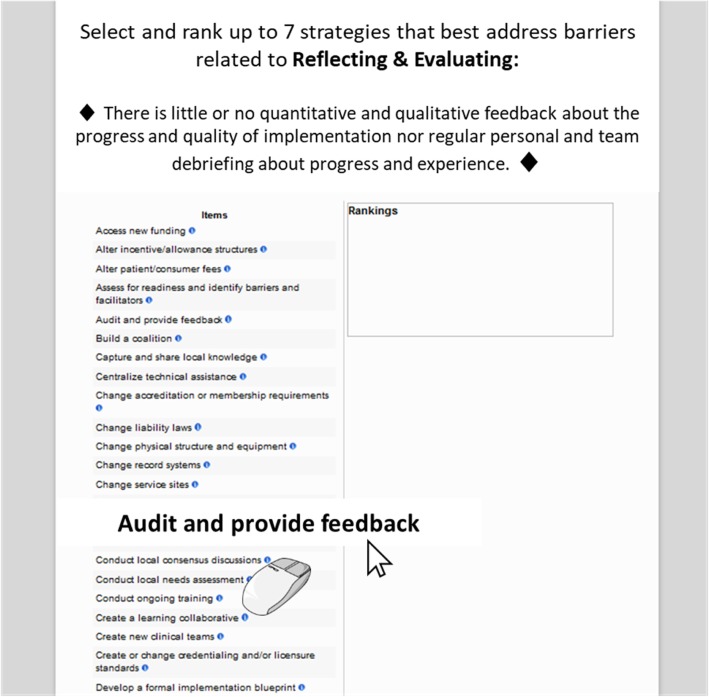
BACKGROUND: A fundamental challenge of implementation is identifying contextual determinants (i.e., barriers and facilitators) and determining which implementation strategies will address them. Numerous conceptual frameworks (e.g., the Consolidated Framework for Implementation Research; CFIR) have been developed to guide the identification of contextual determinants, and compilations of implementation strategies (e.g., the Expert Recommendations for Implementing Change compilation; ERIC) have been developed which can support selection and reporting of implementation strategies. The aim of this study was to identify which ERIC implementation strategies would best address specific CFIR-based contextual barriers. METHODS: Implementation researchers and practitioners were recruited to participate in an online series of tasks involving matching specific ERIC implementation strategies to specific implementation barriers. Participants were presented with brief descriptions of barriers based on CFIR construct definitions. They were asked to rank up to seven implementation strategies that would best address each barrier. Barriers were presented in a random order, and participants had the option to respond to the barrier or skip to another barrier. Participants were also asked about considerations that most influenced their choices. RESULTS: Four hundred thirty-five invitations were emailed and 169 (39%) individuals participated. Respondents had considerable heterogeneity in opinions regarding which ERIC strategies best addressed each CFIR barrier. Across the 39 CFIR barriers, an average of 47 different ERIC strategies (SD = 4.8, range 35 to 55) was endorsed at least once for each, as being one of seven strategies that would best address the barrier. A tool was developed that allows users to specify high-priority CFIR-based barriers and receive a prioritized list of strategies based on endorsements provided by participants. CONCLUSIONS: The wide heterogeneity of endorsements obtained in this study's task suggests that there are relatively few consistent relationships between CFIR-based barriers and ERIC implementation strategies. Despite this heterogeneity, a tool aggregating endorsements across multiple barriers can support taking a structured approach to consider a broad range of strategies given those barriers. This study's results point to the need for a more detailed evaluation of the underlying determinants of barriers and how these determinants are addressed by strategies as part of the implementation planning process.
Overview
The claims and statistics of this paper haven’t been checked yet.
Free: it reads the open-access text and checks the first 5 claims that cite a source we can check. Create a free account to check every claim.
Integrity signals
Registry
Cites
Statistics
Figures
Verification
Claims the paper makes
The claims and statistics of this paper haven’t been checked yet.
Free: it reads the open-access text and checks the first 5 claims that cite a source we can check. Create a free account to check every claim.
Claims other papers make about this one
Each is checked against this paper’s own text: does it say what the citing paper says it does?
The source backs part of the claim, not all of it — or backs it for a different population, condition or comparison.
In the citing paper
“a few best practices have been added: Teaming [42, 46, 73], Assessing Needs [46, 47], Assessing Context, Tailoring Strategies [14], and Adapting [45, 74, 75].”
From The updated consolidated framework for implementation research based on user feedback (2022) · cites this paper as [14]
Experimental — accuracy not yet measuredThe source backs part of the claim, not all of it — or backs it for a different population, condition or comparison.
In the citing paper
“Current literature also reflects an increasing number of studies testing the effectiveness of implementation strategies and the mechanisms that explain how these strategies may influence implementation outcomes [25–31].”
From Ten years of implementation outcomes research: a scoping review (2023) · cites this paper as [26]
Experimental — accuracy not yet measuredThe cited source says what the claim attributes to it.
In the citing paper
“Determinant frameworks can thus be used to inform choice of implementation strategies that may best address contextual determinants [14], generate hypotheses to prospectively guide predictions of implementation outcomes, or retrospectively explain implementation outcomes by assessing differences in determinants across implementation settings [11, 13, 15].”
From The updated consolidated framework for implementation research based on user feedback (2022) · cites this paper as [14]
Self-check
Percentages, sums and reported differences re-computed from the paper’s own numbers.
The self-check needs the paper’s full text.
Citations
Cites
Damschroder, L. J., Aron, D. C., Keith, R. E., Kirsh, S. R., Alexander, J. A., & Lowery, J. C. (2009) · Implementation Science · doi:10.1186/1748-5908-4-50 · Cited by 14,496
Self-citationHoffmann, T. C., Glasziou, P. P., Boutron, I., Milne, R., Perera, R., Moher, D., Altman, D. G., Barbour, V., Macdonald, H., Johnston, M., et al. (2014) · BMJ · doi:10.1136/bmj.g1687 · Cited by 10,548
Proctor, E., Silmere, H., Raghavan, R., Hovmand, P., Aarons, G., Bunger, A., Griffey, R., & Hensley, M. (2011) · Administration and Policy in Mental Health and Mental Health Services Research · doi:10.1007/s10488-010-0319-7 · Cited by 8,721
Michie, S., Richardson, M., Johnston, M., Abraham, C., Francis, J., Hardeman, W., Eccles, M. P., Cane, J., & Wood, C. E. (2013) · Annals of Behavioral Medicine · doi:10.1007/s12160-013-9486-6 · Cited by 7,629
What's in a name? Qualitative description revisited
Sandelowski, M. (2010) · Research in Nursing & Health · doi:10.1002/nur.20362 · Cited by 4,975
Powell, B. J., Waltz, T. J., Chinman, M. J., Damschroder, L. J., Smith, J. L., Matthieu, M. M., Proctor, E. K., & Kirchner, J. E. (2015) · Implementation Science · doi:10.1186/s13012-015-0209-1 · Cited by 4,963
Self-citationMaking sense of implementation theories, models and frameworks
Nilsen, P. (2015) · Implementation Science · doi:10.1186/s13012-015-0242-0 · Cited by 4,447
Implementation strategies: recommendations for specifying and reporting
Proctor, E. K., Powell, B. J., & McMillen, J. C. (2013) · Implementation Science · doi:10.1186/1748-5908-8-139 · Cited by 2,585
Self-citationKnowledge translation of research findings
Grimshaw, J. M., Eccles, M. P., Lavis, J. N., Hill, S. J., & Squires, J. E. (2012) · Implementation Science · doi:10.1186/1748-5908-7-50 · Cited by 2,407
Planning health promotion programs an intervention mapping approach
Bartholomew, L. K., Parcel, G. S., Kok, G., & Gottlieb, N. (2006) · Research Publications (Maastricht University) · Cited by 2,321
Research works printed but not linked: 2
- Waltz TJ Powell BJ Chinman MJ Damschroder LJ Smith JL Matthieu MM Proctor EK Kirchner JE Structuring complex recommendations: methods and general findings Implement Sci 2016 11 Suppl 1 A23
- Powell BJ Aarons GA Amaya-Jackson L Haley A Weiner BJ The collaborative approach to selecting and tailoring implementation strategies (COAST-IS) Implement Sci 2018 13 (Suppl 3): A79 39 40
Cited by
The updated consolidated framework for implementation research based on user feedback
Damschroder, L. J., Reardon, C. M., Widerquist, M. A. O., & Lowery, J. (2022) · Implementation Science · doi:10.1186/s13012-022-01245-0 · Cited by 4,452
“Determinant frameworks can thus be used to inform choice of implementation strategies that may best address contextual determinants [14], generate hypotheses to prospectively guide predictions of implementation outcomes, or retrospectively explain implementation outcomes by assessing differences in determinants across…”
BackgroundMethodSelf-citationImplementation Mapping: Using Intervention Mapping to Develop Implementation Strategies
Fernandez, M. E., ten Hoor, G. A., van Lieshout, S., Rodriguez, S. A., Beidas, R. S., Parcel, G., Ruiter, R. A. C., Markham, C. M., & Kok, G. (2019) · Frontiers in Public Health · doi:10.3389/fpubh.2019.00158 · Cited by 914
Damschroder, L. J., Reardon, C. M., Opra Widerquist, M. A., & Lowery, J. (2022) · Implementation Science · doi:10.1186/s13012-021-01181-5 · Cited by 784
“Knowledge of contextual barriers and facilitators is used to adapt EBIs [6], select and tailor implementation strategies [3, 7], and predict and/or explain implementation outcomes [8, 9].”
BackgroundSelf-citationSmith, J. D., Li, D. H., & Rafferty, M. R. (2020) · Implementation Science · doi:10.1186/s13012-020-01041-8 · Cited by 706
The FRAME-IS: a framework for documenting modifications to implementation strategies in healthcare
Miller, C. J., Barnett, M. L., Baumann, A. A., Gutner, C. A., & Wiltsey-Stirman, S. (2021) · Implementation Science · doi:10.1186/s13012-021-01105-3 · Cited by 490
“Recent work suggests little consensus in the field regarding the selection of specific implementation strategies for a given implementation project, or the mechanisms of action for those strategies [14].”
BackgroundTen years of implementation outcomes research: a scoping review
Proctor, E. K., Bunger, A. C., Lengnick-Hall, R., Gerke, D. R., Martin, J. K., Phillips, R. J., & Swanson, J. C. (2023) · Implementation Science · doi:10.1186/s13012-023-01286-z · Cited by 424
Cassar, S., Salmon, J., Timperio, A., Naylor, P.-J., van Nassau, F., Contardo Ayala, A. M., & Koorts, H. (2019) · International Journal of Behavioral Nutrition and Physical Activity · doi:10.1186/s12966-019-0876-4 · Cited by 304
Reardon, C. M., Damschroder, L. J., Ashcraft, L. E., Kerins, C., Bachrach, R. L., Nevedal, A. L., Domlyn, A. M., Dodge, J., Chinman, M., & Rogal, S. (2025) · Implementation Science · doi:10.1186/s13012-025-01450-7 · Cited by 172
“In addition, a tool to help users “match” strategies to barriers was developed using the original CFIR [72], with strategies being drawn from Expert Recommendations for Implementing Change (ERIC) [73, 74].”
Self-citationDavis, R., & D’Lima, D. (2020) · Implementation Science · doi:10.1186/s13012-020-01051-6 · Cited by 170
Lyon, A. R., Brewer, S. K., & Areán, P. A. (2020) · American Psychologist · doi:10.1037/amp0000652 · Cited by 152
“Furthermore, strategies that directly target the innovation level are far fewer than those at levels such as the inner setting or individual service providers (Waltz et al., 2019).”
BackgroundBunce, A., Gruß, I., Davis, J. V., Cowburn, S., Cohen, D. J., Oakley, J., & Gold, R. B. (2020) · Implementation Science · doi:10.1186/s13012-020-01048-1 · Cited by 158
“Implementation science seeks to develop evidence to improve the accurate identification of (i) implementation barriers relevant to specific interventions [4–6], and (ii) implementation strategies likely to address such barriers [5, 7, 8].”
Backgroundvon Thiele Schwarz, U., Aarons, G. A., & Hasson, H. (2019) · BMC Health Services Research · doi:10.1186/s12913-019-4668-y · Cited by 134
“The proposition to view implementation strategies as ways to create fit between an intervention and a specific context opens up new innovative approaches to choosing and matching implementation strategies, which has proven to be challenging [70].”
BackgroundDopp, A. R., Parisi, K. E., Munson, S. A., & Lyon, A. R. (2019) · Health Research Policy and Systems · doi:10.1186/s12961-018-0403-0 · Cited by 123
Koh, W. Q., Felding, S. A., Budak, K. B., Toomey, E. C., & Casey, D. (2021) · BMC Geriatrics · doi:10.1186/s12877-021-02277-9 · Cited by 148
“Waltz and colleagues [116] developed a tool for mapping barriers identified on each CFIR domain to the Expert Recommendations for Implementing Change (ERIC), which contains a comprehensive Koh et al.”
MethodImplementation of Virtual Reality in Health Professions Education: Scoping Review
Lie, S. S., Helle, N., Sletteland, N. V., Vikman, M. D., & Bonsaksen, T. (2023) · JMIR Medical Education · doi:10.2196/41589 · Cited by 172
“A total of 7 categories emerged from the synthesis of the articles selected for this review, but we were unable to identify any links between them and the potential category, as May outlined [13].”
BackgroundInfluentialRapid Integration of Home Telehealth Visits Amidst COVID ‐19: What Do Older Adults Need to Succeed?
Hawley, C. E., Genovese, N., Owsiany, M. T., Triantafylidis, L. K., Moo, L. R., Linsky, A. M., Sullivan, J. L., & Paik, J. M. (2020) · Journal of the American Geriatrics Society · doi:10.1111/jgs.16845 · Cited by 132
Designing the Future of Children’s Mental Health Services
Lyon, A. R., Dopp, A. R., Brewer, S. K., Kientz, J. A., & Munson, S. A. (2020) · Administration and Policy in Mental Health and Mental Health Services Research · doi:10.1007/s10488-020-01038-x · Cited by 115
Morena, A., Gaias, L. M., & Larkin, C. (2022) · Frontiers in Health Services · doi:10.3389/frhs.2022.896885 · Cited by 139
“When implementation researchers and practitioners were asked to rank the implementation strategies that would best address each of the CFIR barrier domains, identifying and preparing clinical champions was the most consistently rated strategy across all providerlevel barriers (11).”
BackgroundThe Importance of Mental Models in Implementation Science
Holtrop, J. S., Scherer, L. D., Matlock, D. D., Glasgow, R. E., & Green, L. A. (2021) · Frontiers in Public Health · doi:10.3389/fpubh.2021.680316 · Cited by 138
“The Expert Recommendations for Implementing Change compilation (ERIC) provides a start with a compilation that lists 73 different implementation strategies in nine different categories (53, 54).”
MethodArtificial intelligence for diabetes care: current and future prospects
Sheng, B., Pushpanathan, K., Guan, Z., Lim, Q. H., Lim, Z. W., Yew, S. M. E., Goh, J. H. L., Bee, Y. M., Sabanayagam, C., Sevdalis, N., et al. (2024) · The Lancet Diabetes & Endocrinology · doi:10.1016/s2213-8587(24)00154-2 · Cited by 106
Nathan, N., Powell, B. J., Shelton, R. C., Laur, C. V., Wolfenden, L., Hailemariam, M., Yoong, S. L., Sutherland, R., Kingsland, M., Waltz, T. J., et al. (2022) · Frontiers in Health Services · doi:10.3389/frhs.2022.905909 · Cited by 105
“Therefore, strategies for the sustainment of EBIs should be considered and planned for in unison with strategies for implementation for any progress to be made in this area.”
BackgroundSelf-citationThe Science of Learning Health Systems: Scoping Review of Empirical Research
Ellis, L. A., Sarkies, M., Churruca, K., Dammery, G., Meulenbroeks, I., Smith, C. L., Pomare, C., Mahmoud, Z., Zurynski, Y. A., & Braithwaite, J. (2022) · JMIR Medical Informatics · doi:10.2196/34907 · Cited by 103
“The CFIR [59] is 1 of the most widely used determinant frameworks, designed specifically to systematically assess barriers and facilitators to implementation within local settings, that can help guide decisions about the needs of the local context [84].”
BackgroundImplementation Support Skills: Findings From a Systematic Integrative Review
Albers, B., Metz, A. J. R., Burke, K., Bührmann, L., Bartley, L., Driessen, P., & Varsi, C. (2020) · Research on Social Work Practice · doi:10.1177/1049731520967419 · Cited by 106
“…with implementation barriers, reflected in difficulties with identifying relevant implementation strategies, and with using these with the proper frequency, intensity, and fidelity required to achieve their intended benefit (Eisman et al., 2019; Powell et al., 2019, 2020; Waltz et al., 2019).”
BackgroundArtificial Intelligence and Mapping a New Direction in Laboratory Medicine: A Review
Herman, D. S., Rhoads, D. D., Schulz, W. L., & Durant, T. J. S. (2021) · Clinical Chemistry · doi:10.1093/clinchem/hvab165 · Cited by 81
The adoption of social determinants of health documentation in clinical settings
Kepper, M. M., Walsh‐Bailey, C., Prusaczyk, B., Zhao, M., Herrick, C., & Foraker, R. (2023) · Health Services Research · doi:10.1111/1475-6773.14039 · Cited by 79
Domlyn, A. M., Scott, V. C., Livet, M., Lamont, A. E., Watson, A., Kenworthy, T., Talford, M., Yannayon, M., & Wandersman, A. H. (2021) · Journal of Community Psychology · doi:10.1002/jcop.22531 · Cited by 81
Iowa Implementation for Sustainability Framework
Cullen, L., Hanrahan, K., Edmonds, S. W., Reisinger, H. S., & Wagner, M. (2022) · Implementation Science · doi:10.1186/s13012-021-01157-5 · Cited by 100
“Understanding how implementation strategies work and the mechanism of action facilitates efficient and effective selection of implementation strategies, identifying strategy bundles, and importantly matching strategies to local setting’s contextual needs [19, 21, 73, 74].”
BackgroundRogers, H. L., Hernando, S. P., Núñez-Fernández, S., Sánchez, Á., Martos, C., Moreno, M., & Grandes, G. (2021) · Journal of Health Organization and Management · doi:10.1108/jhom-12-2020-0512 · Cited by 82
“The experts were asked to identify the Eric strategies that best align with CFIR-based contextual barriers (see Waltz et al., 2019).”
BackgroundMethodBalis, L. E., Houghtaling, B., & Harden, S. M. (2022) · Translational Behavioral Medicine · doi:10.1093/tbm/ibac061 · Cited by 63
Implementation Science Research in Communication Sciences and Disorders: A Scoping Review
Douglas, N., Feuerstein, J. L., Oshita, J. Y., Schliep, M. E., & Danowski, M. (2022) · American Journal of Speech-Language Pathology · doi:10.1044/2021_ajslp-21-00126 · Cited by 69
Murrell, J. E., Pisegna, J. L., & Juckett, L. A. (2021) · Implementation Science · doi:10.1186/s13012-021-01178-0 · Cited by 60
“The assessment of barriers and facilitators is a central precursor to selecting implementation strategies that effectively facilitate the use of evidence in practice [78].”
BackgroundMethodNorton, W. E., Loudon, K., Chambers, D. A., & Zwarenstein, M. (2021) · Implementation Science · doi:10.1186/s13012-020-01075-y · Cited by 58
“We incorporate this thinking into the PRECIS-2PS tool by encouraging trial teams to better specify strategies [29, 30], consider adaptation of strategies [31, 32], costs of strategies [33], and describe and track changes to strategies, usual care, and implementation-as-usual over time [34] before and during the trial.”
MethodConceptual tensions and practical trade-offs in tailoring implementation interventions
McHugh, S., Riordan, F., Curran, G. M., Lewis, C. C., Wolfenden, L., Presseau, J., Lengnick‐Hall, R., & Powell, B. J. (2022) · Frontiers in Health Services · doi:10.3389/frhs.2022.974095 · Cited by 69
“Studies have used a variety of methods to match strategies to determinants using popular tools such as the CFIR-ERIC matching tool (35), and the Theoretical Domains Framework and Behavior Change Wheel (BCW) (36, 37).”
MethodSelf-citationvan Oers, H. A., Teela, L., Schepers, S. A., Grootenhuis, M. A., & Haverman, L. (2020) · Quality of Life Research · doi:10.1007/s11136-020-02586-3 · Cited by 63
Sarkies, M., Long, J. C., Pomare, C., Wu, W., Clay‐Williams, R., Nguyen, H. M., Francis‐Auton, E., Westbrook, J. I., Lévesque, J., Watson, D. E., et al. (2020) · Implementation Science · doi:10.1186/s13012-020-01049-0 · Cited by 68
“barriers and facilitators) at play for any given implementation effort, so that strategies to address them can be determined, matched, and tailored as part of an implementation planning process [71].”
BackgroundPiat, M., Wainwright, M., Sofouli, E., Vachon, B., Deslauriers, T., Préfontaine, C., & Frati, F. (2021) · Systematic Reviews · doi:10.1186/s13643-021-01646-0 · Cited by 75
“1 [166] to help prioritize strategies to consider including in their implementation plans.”
BackgroundMethodSchroeder, D. M., Luig, T., Finch, T. L., Beesoon, S., & Campbell-Scherer, D. L. (2022) · Implementation Science Communications · doi:10.1186/s43058-022-00264-8 · Cited by 70
Strategies to adapt and implement health system guidelines and recommendations: a scoping review
Breneol, S., Curran, J., Marten, R., Minocha, K., Johnson, C., Wong, H., Langlois, É. V., Wozney, L., Vélez, C. M., Cassidy, C. E., et al. (2022) · Health Research Policy and Systems · doi:10.1186/s12961-022-00865-8 · Cited by 78
Balis, L. E., & Houghtaling, B. (2023) · Implementation Science Communications · doi:10.1186/s43058-023-00532-1 · Cited by 61
“…starting point for selecting implementation strategies, provides common language and terminology for these strategies in clinical settings, and allows for systematic reporting and synthesis across studies to better understand which strategies are effective for which EBIs in which contexts [29].”
BackgroundMethodInfluentialPowell, B. J., Haley, A. D., Patel, S. V., Amaya-Jackson, L., Glienke, B., Blythe, M., Lengnick-Hall, R., McCrary, S., Beidas, R. S., Lewis, C. C., et al. (2020) · Implementation Science Communications · doi:10.1186/s43058-020-00009-5 · Cited by 51
“Dissemination of educational materials COAST-IS participants will receive educational materials that provide a basic overview of implementation science and practice [87–89], describe the rationale for selecting and tailoring strategies [13, 17, 18, 25], introduce Intervention Mapping and its major steps [29, 30], and…”
Self-citationKlaiman, T. A., Silvestri, J. A., Srinivasan, T. L., Szymanski, S., Tran, T., Oredeko, F., Sjoding, M. W., Fuchs, B. D., Maillie, S., Jablonski, J., et al. (2020) · Annals of the American Thoracic Society · doi:10.1513/annalsats.202005-571oc · Cited by 55
Equitability of Depression Screening After Implementation of General Adult Screening in Primary Care
Garcia, M. E., Hinton, L., Neuhaus, J. M., Feldman, M. D., Livaudais‐Toman, J., & Karliner, L. (2022) · JAMA Network Open · doi:10.1001/jamanetworkopen.2022.27658 · Cited by 64
Ailabouni, N. J., Reeve, E., Helfrich, C. D., Hilmer, S. N., & Wagenaar, B. H. (2021) · Research in Social and Administrative Pharmacy · doi:10.1016/j.sapharm.2021.05.018 · Cited by 53
Development of an integrative coding framework for evaluating context within implementation science
Rogers, L., De Brún, A., & McAuliffe, E. (2020) · BMC Medical Research Methodology · doi:10.1186/s12874-020-01044-5 · Cited by 48
“This tool supports researchers in choosing the best implementation strategy to address CFIR-based barriers [57].”
BackgroundMethodInfluentialMielke, J., Geest, S. D., Zúñiga, F., Brunkert, T., Zullig, L. L., Pfadenhauer, L. M., & Staudacher, S. (2022) · Frontiers in Health Services · doi:10.3389/frhs.2022.953731 · Cited by 56
“And finally, we strongly believe that approaching contextual analysis from a constructivist viewpoint broadens and deepens the contextual knowledge available to inform IS projects’ subsequent phases, thereby maximizing both uptake and sustainability (8, 9, 52, 109).”
BackgroundMielke, J., Leppla, L., Valenta, S., Zullig, L. L., Zúñiga, F., Staudacher, S., Teynor, A., & Geest, S. D. (2022) · Implementation Science Communications · doi:10.1186/s43058-022-00354-7 · Cited by 56
“The ERIC compilation’s strategies address specific constructs described in the CFIR framework [7].”
MethodFlynn, R., Cassidy, C. E., Dobson, L., Al-Rassi, J., Langley, J. E., Swindle, J., Graham, I. D., & Scott, S. D. (2023) · Implementation Science · doi:10.1186/s13012-023-01320-0 · Cited by 61
Roche, S. D., Wairimu, N., Mogere, P., Kamolloh, K., Odoyo, J. B., Kwena, Z., Bukusi, E. A., Ngure, K., Baeten, J. M., & Ortblad, K. F. (2021) · AIDS and Behavior · doi:10.1007/s10461-021-03229-5 · Cited by 59
“Taking an implementation science approach, pharmacy PrEP implementers may be more likely to succeed if they pursue strategies that specifically target the determinants identified in our study [37, 38].”
BackgroundOvercoming barriers to evidence-based patient blood management: a restricted review
Delaforce, A., Duff, J. S., Munday, J., & Hardy, J. (2020) · Implementation Science · doi:10.1186/s13012-020-0965-4 · Cited by 57
Vranceanu, A., Bakhshaie, J., Reichman, M., Doorley, J. D., Mace, R. A., Jacobs, C. A., Harris, M. B., Archer, K. R., Ring, D., & Elwy, A. R. (2021) · Implementation Science Communications · doi:10.1186/s43058-021-00208-8 · Cited by 56
“using the CFIR-ERIC matching tool [37], to ensure a comprehensive, data-driven approach to implementation”
MethodZamantakis, A., Li, D. H., Benbow, N., Smith, J. D., & Mustanski, B. S. (2022) · AIDS and Behavior · doi:10.1007/s10461-022-03943-8 · Cited by 51
“For example, the need to adapt behavioral interventions for increasing PrEP uptake and adherence can be facilitated through capturing and sharing local knowledge (Waltz et al., 2019).”
InfluentialRobinson, C. H., & Damschroder, L. J. (2023) · Implementation Science Communications · doi:10.1186/s43058-022-00380-5 · Cited by 53
“list recommended strategies that may best address each CFIR construct that manifests as a barrier [1].”
BackgroundSelf-citationKnapp, A. A., Carroll, A. J., Mohanty, N., Fu, E. S., Powell, B. J., Hamilton, A., Burton, N. D., Coldren, E., Hossain, T., Limaye, D., et al. (2022) · Implementation Science Communications · doi:10.1186/s43058-022-00276-4 · Cited by 57
“For example, implementation researchers may use the Expert Recommendations for Implementing Change (ERIC) [1], a compilation of 73 discrete implementation strategies that was developed through a modified Delphi process with a wide range of stakeholders and is useful for identifying strategies and matching them to iden…”
MethodSelf-citationTuzzio, L., O’Meara, E. S., Holden, E., Parchman, M. L., Ralston, J. D., Powell, J., & Baldwin, L. (2020) · American Journal of Preventive Medicine · doi:10.1016/j.amepre.2020.07.027 · Cited by 50
Chan, P. S.-F., Fang, Y., Wong, M. C. S., Huang, J., Wang, Z. J., & Yeoh, E. (2021) · Implementation Science · doi:10.1186/s13012-021-01170-8 · Cited by 59
Afshar, M., Adelaine, S., Resnik, F., Mundt, M. P., Long, J., Leaf, M., Ampian, T., Wills, G. J., Schnapp, B., Chao, M., et al. (2023) · JMIR Medical Informatics · doi:10.2196/44977 · Cited by 44
“Using the Consolidated Framework for Implementation Research–Expert Recommendations for Implementing Change matching tool [29], we will tailor relevant implementation strategies to enhance provider uptake and use of the tool.”
Kinney, A. R., Stearns‐Yoder, K. A., Hoffberg, A. S., Middleton, A., Weaver, J., Roseen, E. J., Juckett, L., & Brenner, L. A. (2023) · Archives of Physical Medicine and Rehabilitation · doi:10.1016/j.apmr.2023.03.005 · Cited by 47
Applying implementation frameworks to the clinical trial context
Stensland, K. D., Sales, A. E., Damschroder, L. J., & Skolarus, T. A. (2022) · Implementation Science Communications · doi:10.1186/s43058-022-00355-6 · Cited by 52
Self-citationAn implementation science approach to geriatric screening in an emergency department
Southerland, L. T., Hunold, K. M., Fossen, J. V., Caterino, J. M., Gulker, P., Stephens, J. A., Bischof, J. J., Farrell, E., Carpenter, C. R., & Mion, L. C. (2021) · Journal of the American Geriatrics Society · doi:10.1111/jgs.17481 · Cited by 44
A research agenda to advance the study of implementation mechanisms
Lewis, C. C., Frank, H. E., Cruden, G., Kim, B., Stahmer, A. C., Lyon, A. R., Albers, B., Aarons, G. A., Beidas, R. S., Mittman, B. S., et al. (2024) · Implementation Science Communications · doi:10.1186/s43058-024-00633-5 · Cited by 51
Self-citationOyelana, O., Kamanzi, J., & Richter, S. M. (2020) · International Journal of Africa Nursing Sciences · doi:10.1016/j.ijans.2020.100267 · Cited by 75
Implementation of digital health interventions in rehabilitation: A scoping review
Pearce, L. M. N., Costa, N., Sherrington, C., & Hassett, L. M. (2023) · Clinical Rehabilitation · doi:10.1177/02692155231172299 · Cited by 57
Embedding implementation science in the research pipeline
Zullig, L. L., Drake, C., Check, D. K., Brunkert, T., Deschodt, M., Olson, M. S., & Geest, S. D. (2023) · Translational Behavioral Medicine · doi:10.1093/tbm/ibad050 · Cited by 47
Amarasinghe, I., Hong, Y., & Stewart, R. A. (2024) · Building and Environment · doi:10.1016/j.buildenv.2024.111359 · Cited by 57
“Following the study analysis method conducted by Waltz, Powell, Fern ´ andez, Abadie and Damschroder [80], two types of strategies (Level 1 and Level 2) were identified.”
MethodPiat, M., Wainwright, M., Sofouli, E., Albert, H., Casey, R., Rivest, M.-P., Briand, C., Kasdorf, S., Labonté, L., LeBlanc, S., et al. (2021) · Implementation Science Communications · doi:10.1186/s43058-020-00099-1 · Cited by 45
“1 [4] caution that it should be used carefully because of the overall heterogeneity of the data on which the tool is based.”
BackgroundMethodInfluentialHu, J., Ruan, H., Li, Q., Gifford, W., Zhou, Y., Yu, L., & Harrison, D. M. (2020) · Journal of Pediatric Nursing · doi:10.1016/j.pedn.2020.06.004 · Cited by 54
Jacobsohn, G. C., Leaf, M. A., Liao, F., Maru, A., Engstrom, C. J., Salwei, M. E., Pankratz, G. T., Eastman, A., Carayon, P., Wiegmann, D. A., et al. (2021) · Healthcare · doi:10.1016/j.hjdsi.2021.100598 · Cited by 55
Shin, M. H., Montano, A.-R. L., Adjognon, O. L., Harvey, K. L. L., Solimeo, S. L., & Sullivan, J. L. (2022) · The Gerontologist · doi:10.1093/geront/gnac157 · Cited by 44
Mustanski, B. S., Queiroz, A. A. F. L. N., Merle, J. L., Zamantakis, A., Zapata, J. P., Li, D. H., Benbow, N., Pyra, M. N., & Smith, J. D. (2023) · Annual Review of Psychology · doi:10.1146/annurev-psych-032620-035725 · Cited by 42
Cheung, D. S. K., Ho, L. Y. W., Chan, L. C. K., Kwok, R. K. H., & Lai, C. K. Y. (2022) · Clinical Interventions in Aging · doi:10.2147/cia.s370661 · Cited by 40
“The Expert Recommendations for Implementing Change (ERIC) were also considered when designing the implementation strategies targeting the identified barriers.(16) The CRIF framework is composed of determinants that have been organized into five major domains: intervention characteristics, outer setting, inner setting,…”
MethodImplementation strategies for telemental health: a systematic review
Appleton, R., Barnett, P., Juan, N. V. S., Tuudah, E., Lyons, N., Parker, J., Roxburgh, E., Spyridonidis, S., Tamworth, M., Worden, M., et al. (2023) · BMC Health Services Research · doi:10.1186/s12913-022-08993-1 · Cited by 56
“Research indicates that ERIC strategies are considered suitable to influence different implementation outcomes (36), but there is currently little consensus or evidence regarding which”
BackgroundMethodMielke, J., Brunkert, T., Zúñiga, F., Simon, M., Zullig, L. L., & Geest, S. D. (2022) · BMC Medical Research Methodology · doi:10.1186/s12874-022-01772-w · Cited by 57
Ellis, S. D., Geana, M., Griebling, T. L., McWilliams, C., Gills, J. R. R., Stratton, K. L., Mackay, C. B., Shifter, A., Zganjar, A. J., & Thrasher, B. J. (2019) · Trials · doi:10.1186/s13063-019-3658-z · Cited by 35
Rutten, L. J. F., Ridgeway, J. L., & Griffin, J. M. (2024) · Mayo Clinic Proceedings · doi:10.1016/j.mayocp.2023.02.005 · Cited by 48
Juckett, L., Bunger, A. C., Jarrott, S. E., Dabelko‐Schoeny, H., Krok‐Schoen, J. L., Poling, R. M., Mion, L. C., & Tucker, S. (2020) · The Gerontologist · doi:10.1093/geront/gnaa133 · Cited by 38
McInnes, E., Dale, S., Craig, L., Phillips, R., Fasugba, O., Schadewaldt, V., Cheung, N. W., Cadilhac, D. A.-M., Grimshaw, J., Levi, C. R., et al. (2020) · Implementation Science · doi:10.1186/s13012-020-01057-0 · Cited by 39
Wu, X. S., Miles, A., & Braakhuis, A. J. (2022) · Current Developments in Nutrition · doi:10.1093/cdn/nzac032 · Cited by 44
Yakovchenko, V., Lamorte, C., Chinman, M., Goodrich, D. E., Gibson, S. P., Park, A., Bajaj, J. S., McCurdy, H. M., Morgan, T. R. M., & Rogal, S. S. (2023) · Implementation Science · doi:10.1186/s13012-023-01307-x · Cited by 39
“We used the CFIR-ERIC Matching Tool [6] to generate “recommended” implementation strategies based on barriers reported during focus groups.”
BackgroundMethodInfluentialMcNett, M., Tucker, S., Zadvinskis, I. M., Tolles, D., Thomas, B. K., Gorsuch, P., & Gallagher‐Ford, L. (2022) · Global Implementation Research and Applications · doi:10.1007/s43477-022-00051-6 · Cited by 39
“See Table 1 for the definitions of CFIR constructs and facilitator/barrier themes (Waltz et al., 2019).”
BackgroundInfluentialMetz, A. J. R., Kainz, K., & Boaz, A. (2023) · Frontiers in Health Services · doi:10.3389/frhs.2022.959386 · Cited by 45
“Implementation scientists have identified key methods for tailoring implementation strategies to address variation in implementation contexts (21, 72, 73).”
BackgroundInfluentialDelaforce, A., Li, J., Grujovski, M., Parkinson, J. E., Richards, P., Fahy, M., Good, N. M., & Jayasena, R. (2023) · International Journal of Environmental Research and Public Health · doi:10.3390/ijerph20053794 · Cited by 36
“Such strategies are supported by the ERIC tool [2,39], which proposes that a purposeful re-examination of implementation can help address the barrier of executing an intervention.”
MethodDugstad, J., Sundling, V., Nilsen, E. R., & Eide, H. (2020) · BMC Health Services Research · doi:10.1186/s12913-020-4998-9 · Cited by 40
Vax, S., Farkas, M. D., Russinova, Z. L., Mueser, K. T., & Drainoni, M. (2021) · Implementation Science · doi:10.1186/s13012-021-01132-0 · Cited by 54
“, [21, 22, 53]) to include them in the typology and provide a more holistic view of current knowledge.”
BackgroundKononowech, J., Hagedorn, H., Hall, C., Helfrich, C. D., Lambert‐Kerzner, A., Miller, S. C., Sales, A. E., & Damschroder, L. J. (2021) · Implementation Science Communications · doi:10.1186/s43058-021-00121-0 · Cited by 37
Self-citationCarruthers, S., Mleczko, N., Page, S., Ahuja, S., Ellis, C., Howlin, P., Leadbitter, K., Taylor, L. J., Slonims, V., & Charman, T. (2022) · Autism · doi:10.1177/13623613221125630 · Cited by 36
“The CFIR–Expert Recommendations for Implementing Change compilation (ERIC) mapping tool (Waltz et al., 2019) matches barriers to implementation strategies that could overcome them.”
BackgroundKlasnja, P., Meza, R. D., Pullmann, M. D., Mettert, K. D., Hawkes, R. J., Palazzo, L. G., Weiner, B. J., & Lewis, C. C. (2024) · Implementation Research and Practice · doi:10.1177/26334895241248851 · Cited by 42
“Implementation strategies are often mismatched with critical determinants (Waltz et al., 2019), resulting in strategies that have little or no impact on implementation outcomes.”
InfluentialSmith, S. N., Almirall, D., Choi, S. Y., Koschmann, E., Rusch, A., Bilek, E. L., Lane, A., Abelson, J. L., Eisenberg, D., Himle, J. A., et al. (2022) · Implementation Science · doi:10.1186/s13012-022-01211-w · Cited by 38
“These analyses will help to inform a more fully tailored adaptive implementation strategy for efficiently scaling up SP-delivered CBT in schools by matching implementation strategies to identified barriers [101] or short-term implementation outcomes [41].”
BackgroundKerins, C., McHugh, S., McSharry, J., Reardon, C. M., Hayes, C., Perry, I. J., Geaney, F., Seery, S., & Kelly, C. (2020) · International Journal of Behavioral Nutrition and Physical Activity · doi:10.1186/s12966-020-00948-1 · Cited by 30
“More recently, the CFIR-ERIC Implementation Strategy Matching Tool has been developed to match ERIC implementation strategies to address CFIR-based barriers [91].”
Method‘It’s All About Context’: Building School Capacity to Implement a Whole-School Approach to Bullying
Pearce, N., Monks, H., Alderman, N., Hearn, L., Burns, S. K., Runions, K., Francis, J., & CROSS, D. S. (2022) · International Journal of Bullying Prevention · doi:10.1007/s42380-022-00138-6 · Cited by 75
“Despite an abundance of research identifying barriers to successful implementation of school bullying prevention interventions, research into the most effective implementation support strategies to match individual school contextual barriers is still in the early stages (Waltz et al., 2019).”
Rogal, S. S., Yakovchenko, V., Morgan, T. R. M., Bajaj, J. S., Gonzalez, R. I., Park, A., Beste, L. A., Miech, E. J., Lamorte, C., Neely, B., et al. (2020) · Implementation Science · doi:10.1186/s13012-020-01050-7 · Cited by 30
Self-citationHowell, D., Powis, M., Kirkby, R. L., Amernic, H., Moody, L., Bryant‐Lukosius, D., O’Brien, M. A., Rask, S., & Krzyzanowska, M. K. (2021) · BMJ Quality & Safety · doi:10.1136/bmjqs-2020-012051 · Cited by 42
Implementation Barriers: A TASKS Framework
Yang, J., Yang, L., Quan, H., & Zeng, Y. (2021) · Journal of Integrated Design and Process Science · doi:10.3233/jid-210011 · Cited by 39
“While most of the research in implementation science takes a bottom-up, inductive evidence-based approach (Bach-Mortensen et al., 2018; Waltz et al., 2019), we propose a deductive theory-based approach, aiming to model the cause-effect relations between influencing factors and barriers.”
McHugh, S., Riordan, F., Kerins, C., Curran, G. M., Lewis, C. C., Presseau, J., Wolfenden, L., & Powell, B. J. (2023) · HRB Open Research · doi:10.12688/hrbopenres.13675.1 · Cited by 31
Self-citationBalis, L. E., Houghtaling, B., Clausen, W., Lane, H., Wende, M. E., Pereira, E. L., McLoughlin, G. M., & Harden, S. M. (2024) · International Journal of Behavioral Nutrition and Physical Activity · doi:10.1186/s12966-024-01685-5 · Cited by 39
“For instance, a pragmatic process with a guidance tool for community settings could be a useful starting point for considering implementation determinants or outcomes and matching implementation strategies [49].”
Krahe, M. A., Baker, S., Woods, L., & Larkins, S. (2025) · Australian Journal of Rural Health · doi:10.1111/ajr.70045 · Cited by 35
“…each barrier, providing level 1 endorsed strategies (i.e., > 50% of the experts ranked this as one of their top seven strategies for that barrier) and level 2 endorsed strategies (i.e., between 20% and 50% of the experts ranked this as one of their top seven strategies for that barrier) [18, 19].”
Weir, A., Presseau, J., Kitto, S. C., Colman, I., & Hatcher, S. (2021) · Clinical Trials · doi:10.1177/17407745211001504 · Cited by 36
“The ERIC strategies (as ranked by the ordering described above) that were endorsed as a Level 1 strategy for at least one identified CFIR construct were as follows: (1) ‘Identify and prepare champions’, (2) ‘Conduct local needs assessment’, (3) ‘Conduct educational meetings’, (4) ‘Inform local opinion leaders’, (5) ‘B…”
MethodHow can a behavioral economics lens contribute to implementation science?
Hodson, N., Powell, B. J., Nilsén, P., & Beidas, R. S. (2024) · Implementation Science · doi:10.1186/s13012-024-01362-y · Cited by 31
“…approaches as required Strategies to behaviour change Increasingly matching implementation strategies to barriers identified by participants [63] Designing choice architecture that makes evidence-based practices the default or makes them salient, creates competition, or makes the…”
BackgroundSelf-citationSchmitt, M. E., Hawkins, M. M., & Florsheim, P. (2025) · Implementation Science Communications · doi:10.1186/s43058-025-00712-1 · Cited by 41
“This continuous examination will help guide implementation strategies as perceptions change [30, 31].”
Brakema, E. A., Vermond, D., Pinnock, H., Lionis, C. D., Kirenga, B., An, P. L., Sooronbaev, T., Chavannes, N. H., & van der Kleij, R. (2020) · European Respiratory Journal · doi:10.1183/13993003.00127-2020 · Cited by 28
Koffel, E., & Hagedorn, H. (2020) · Implementation Science Communications · doi:10.1186/s43058-020-00096-4 · Cited by 36
Metadata
- Authors
- Waltz, T. J., Powell, B. J., Fernández, M. E., Abadie, B., & Damschroder, L. J.
- Affiliations
- Eastern Michigan University (US)
- University of North Carolina at Chapel Hill (US)
- The University of Texas Health Science Center at Houston (US)
- VA Center for Clinical Management Research (US)
- Corresponding author
- Damschroder, Laura J.
- Venue
- Implementation Science
- Published
- 2019-04-29
- Volume
- 14
- Issue
- 1
- Pages
- 42-42
- ISSN
- 1748-5908 (ISSN-L)
- PMC
- PMC6489173
- OpenAlex
- W2947410237
- Cited by
- 1,136
- References
- 50
- Citations by year
- 2026: 176 · 2025: 194 · 2024: 220 · 2023: 171 · 2022: 166 · 2021: 121 · 2020: 79 · 2019: 8
- FWCI
- 127.40
- Type
- journal article
- Language
- en
- Open access
- gold
- doi.org
- Licence
- cc-by
- creativecommons.org/licenses/by/4.0/ (tdm)
- creativecommons.org/licenses/by/4.0/ (vor)
- Locations
- Implementation Science (publishedVersion, cc-by)
- Europe PMC (PubMed Central) (publishedVersion, cc-by)
- PubMed Central (publishedVersion, cc-by)
- PubMed (publishedVersion)
- DOAJ (DOAJ: Directory of Open Access Journals) (submittedVersion, cc-by-sa)
- Funders
- U.S. Department of Veterans Affairs (QLP 92-025; QUERI DM, DIB 98-001)
- Topics
- Health Sciences › Health Professions › General Health Professions › Health Policy Implementation Science
- Health Sciences › Health Professions › General Health Professions › Health Sciences Research and Education
- Health Sciences › Medicine › Public Health, Environmental and Occupational Health › Clinical practice guidelines implementation
- Keywords
- implementation strategies, contextual barriers, Consolidated Framework for Implementation Research, Expert Recommendations for Implementing Change, ERIC, implementation planning, strategy selection, implementation barriers and facilitators
- MeSH terms
- Implementation Science, Health Plan Implementation, Health Services Research, Humans, Models, Theoretical, Quality of Health Care, Evidence-Based Practice
About these checks
Registry, retraction, Cites and statistics results are computed, not judged, with one exception: a printed reference that no index lists is read once by a model before it counts as a citation error. Claims are extracted by a model and kept only when their quote appears verbatim in the text; each cited source is then checked, with a model’s help, for whether it says what the claim relies on. Those verdicts can be wrong — read the claim’s quote and the cited source before relying on one.
Statistics and arithmetic are recomputed, not judged.
Confidence bands are shown only for fields calibrated on our annotated test set. None is calibrated yet, so no band is shown.
What counts as a claim ›How we measure confidence ›How we check this ›
Are you an author, or do you see a problem with this page? Request a review
Data sources
Bibliographic data: Semantic Scholar, OpenAlex, Crossref.
Contains information from the Semantic Scholar Academic Graph Datasets, made available under the ODC Attribution License (ODC-BY 1.0).
Semantic Scholar’s data is described in: Kinney, R., et al. (2023). The Semantic Scholar Open Data Platform. arXiv:2301.10140.
