

Harnessing the power of theorising in implementation science
Open accessThe DOI matches its Crossref record; 58 of the 58 references it cites were found in a registry or an index.
Abstract
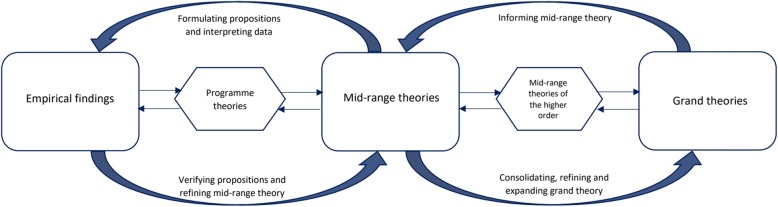
Theories occupy different positions in the scientific circle of enquiry as they vary in scope, abstraction, and complexity. Mid-range theories play a crucial bridging role between raw empirical observations and all-encompassing grand-theoretical schemes. A shift of perspective from ‘theories’ as products to ‘theorising’ as a process can enable empirical researchers to capitalise on the two-way relationships between empirical data and different levels of theory and contribute to the advancement of knowledge. This can be facilitated by embracing theoretically informative (in addition to merely theoretically informed) research, developing mechanism-based explanations, and broadening the repertoire of grand-theoretical orientations.
Overview
The claims and statistics of this paper haven’t been checked yet.
Free: it reads the open-access text and checks the first 5 claims that cite a source we can check. Create a free account to check every claim.
Integrity signals
Registry
Cites
Statistics
Figures
Verification
Claims the paper makes
The claims and statistics of this paper haven’t been checked yet.
Free: it reads the open-access text and checks the first 5 claims that cite a source we can check. Create a free account to check every claim.
Claims other papers make about this one
Each is checked against this paper’s own text: does it say what the citing paper says it does?
The cited source says what the claim attributes to it.
In the citing paper
“Implementation scientists have been called to engage in “theory-building” science where theory is improved with every application and theorizing becomes “an iterative and recursive process” [16].”
From The updated consolidated framework for implementation research based on user feedback (2022) · cites this paper as [16]
Self-check
Percentages, sums and reported differences re-computed from the paper’s own numbers.
The self-check needs the paper’s full text.
Citations
Cites
Damschroder, L. J., Aron, D. C., Keith, R. E., Kirsh, S. R., Alexander, J. A., & Lowery, J. C. (2009) · Implementation Science · doi:10.1186/1748-5908-4-50 · Cited by 14,496 · cited 1×
“CFIR [Consolidated Framework for Implementation Research] [16] or TDF [Theoretical Domains Framework] [17])”
MethodQualitative research practice: a guide for social science students and researchers
(2003) · Choice Reviews Online · doi:10.5860/choice.41-1319 · Cited by 10,543
Social Theory and Social Structure
Ross, E. J., & Merton, R. K. (1958) · The American Catholic Sociological Review · doi:10.2307/3709394 · Cited by 10,315
Social Theory and Social Structure.
Bock, K. E., & Merton, R. K. (1969) · American Sociological Review · doi:10.2307/2091967 · Cited by 6,660
Making sense of implementation theories, models and frameworks
Nilsen, P. (2015) · Implementation Science · doi:10.1186/s13012-015-0242-0 · Cited by 4,447 · cited 2×
“The gradual maturation of implementation science as a discipline is also reflected in laudable endeavours to systematise and make sense of this theoretical knowledge [3 – 6] as well as to critically reflect on the current state of the field in general [7, 8].”
What Constitutes a Theoretical Contribution?
Whetten, D. A. (1989) · The Academy of Management Review · doi:10.2307/258554 · Cited by 4,129 · cited 1×
“Here, theory is a tool which should be improved with each subsequent application, rather than merely having its utility confirmed [36].”
BackgroundMaking psychological theory useful for implementing evidence based practice: a consensus approach
Michie, S. (2005) · Quality and Safety in Health Care · doi:10.1136/qshc.2004.011155 · Cited by 3,440 · cited 1×
“The evidence-based practice paradigm [48] and the discipline of behaviour change psychology [17] have been particularly influential in this regard, whilst the iterative development of NPT has involved continuous engagement with fundamental theoretical questions debated by several sociological…”
Qualitative Data Analysis for Health Services Research: Developing Taxonomy, Themes, and Theory
Bradley, E. H., Curry, L. A., & Devers, K. J. (2007) · Health Services Research · doi:10.1111/j.1475-6773.2006.00684.x · Cited by 3,437 · cited 1×
“Themes and propositions should evolve from the data that link different determinants, concepts, or factors together, thus reflecting relationships between them [40].”
BackgroundThe SAGE handbook of organizational research methods
Buchanan, D., & Bryman, A. E. (2009) · Cited by 2,559
Theory Construction as Disciplined Imagination
Weick, K. E. (1989) · The Academy of Management Review · doi:10.2307/258556 · Cited by 2,134 · cited 2×
“Mid-range theories are seen as fundamental for all social sciences as they are sufficiently broad to provide practically adequate explanations applicable to a range of contexts, yet focused enough to generate testable propositions and guide empirical enquiry [11, 22].”
Cited by
Items 301–323 of 323
Jindal‐Snape, D. (2026) · Springer eBooks · doi:10.1007/978-3-032-11145-6_30
Understanding Multiple and Multi-Dimensional Transitions (MMT) Theory and Its XII Pillars
Jindal‐Snape, D. (2026) · Springer eBooks · doi:10.1007/978-3-032-11145-6_1
Behavioural design as a process ecosystem: a review and synthesis
Cash, P. J., Schmidt, R., & Baxter, W. (2026) · Design Science · doi:10.1017/dsj.2026.10067
“For example, risky exploratory process that deal with high levels of uncertainty often form the basis for multiple spin-out process that take advantage of the many problem and solution perspectives typically identified in the initial exploration (Kislov et al. 2019).”
Hogg, B., Coppens, E., Gatto, D. L., Gil, C. D. C., Ayuso‐Mateos, J. L., Bakiu, K., Callanan, A., Pashoja, A. C., da Conceição, V., Dandi, Ε., et al. (2026) · PLoS ONE · doi:10.1371/journal.pone.0352598
Martens, M., Wouters, E., & van Olmen, J. (2026) · Implementation Science Communications · doi:10.1186/s43058-026-01021-x
“Yet, it is not only theories as finished products that matter [18].”
Coe, M., Woodward, K. F., Gimbel, S., & Mukumbang, F. C. (2026) · Implementation Science · doi:10.1186/s13012-026-01517-z
“MRTs are grounded in data to permit empirical testing and conceptualized enough to provide transferrable lessons [13].”
InfluentialBartelt, C. (2026) · NYME Repository of Dissertations (University of West Hungary) · doi:10.13147/soe.2026.14
O'Connor, A., Morris, H., Griffiths, A., Blewitt, C., Savaglio, M., Brownson, R. C., Metz, A., Ezeanolue, E. E., Gooey, M., Fernando, G., et al. (2026) · Journal of Health Equity · doi:10.1080/29944694.2026.2711603
Mody, A., Sikombe, K., Simbeza, S., Mukamba, N., Beres, L. K., Pry, J. M., Sharma, A., Mutale, J., Dube, A. Z., Mulabe, M., et al. (2026) · PLoS Medicine · doi:10.1371/journal.pmed.1005052
“We conceptualized these ideas using a mechanistic theory of change [49–51] based on Green’s PRECEDE-PROCEED approach (which advocates for interventions that predispose, enable and reinforce behavior change) and Michie’s Capability— Opportunity—Motivation segmentation of mechanisms of behavior…”
Swindle, T., Rutledge, J. M., Rushing, T., Zhang, D., & Curran, G. M. (2026) · Implementation Science · doi:10.1186/s13012-026-01537-9
“Our work will test this theory and, in so doing, contribute to theory refinement [89] and advance knowledge about how and why deimplementation strategies succeed or fail [90].”
Epeni, A., Oluoch, D., Harriss, E., Kemei, A., Kang'au, M., & Tuti, T. (2026) · Research Square · doi:10.21203/rs.3.rs-10934261/v1
Korezelidou, A., Mendieta, M. J., Mielke, J., Decouttere, C., Zullig, L. L., de Geest, S., & Dhaini, S. (2026) · Research Square · doi:10.21203/rs.3.rs-10240816/v1
Sjöberg, A., Sundberg, L. R., & Lindström, M. (2026) · Frontiers in Health Services · doi:10.3389/frhs.2026.1771613
“Yet explaining how these barriers influence outcomes requires mechanism-based analyses that account for the complexity of social context and human agency (26, 27).”
Bamber, J. D. L., Ahlberg, S., & Cordier, R. (2026) · Global Implementation Research and Applications · doi:10.1007/s43477-026-00249-y
The design and implementation of group based Functional Imagery Training for weight loss.
O'Rourke, S. (2024) · PEARL (University of Plymouth) · Cited by 1
Arunagiri, K. P., Allison, P. J., Kannan, S., & Talla, P. K. (2026) · Digital Health · doi:10.1177/20552076261483455
Implementing health coaching for people with long-term conditions: a scoping review
Stretton, C., Rosedale, A., Davenport, A. C., & Pryor, J. (2026) · Journal of Primary Health Care · doi:10.1071/hc26082
Schmitt, M. E., Garza, R. H., Smith, S. N., Cho, Y. I., Weinhardt, L. S., & Florsheim, P. (2026) · Health Promotion Practice · doi:10.1177/15248399261494553
Theoretical frameworks shaping healthcare incident reporting and learning systems: a scoping review
Baharnah, A. M. A. A., Bowie, P., Sattar, A., Ferguson, J., Alkutbe, R. B., & O'Donnell, C. (2026) · BMJ Open · doi:10.1136/bmjopen-2026-124497
Nicosia, F. M., Zamora, K., Rizzo, A., Spar, M. J., Silvestrini, M., & Brown, R. T. (2023) · doi:10.1371/journal.pone.0290741.r003
Mielke, J., Geest, S. D., Zúñiga, F., Brunkert, T., Zullig, L. L., Pfadenhauer, L. M., & Staudacher, S. (2022) · doi:10.3389/frhs.2022.953731.s001
Telfer, J. (2024) · Greenwich Academic Literature Archive (University of Greenwich)
Metadata
- Authors
- Kislov, R., Pope, C., Martin, G. P., & Wilson, P. M.
- Affiliations
- Manchester Metropolitan University (GB)
- University of Oxford (GB)
- University of Cambridge (GB)
- University of Manchester (GB)
- Corresponding author
- Kislov, Roman
- Venue
- Implementation Science
- Published
- 2019-12-11
- Volume
- 14
- Issue
- 1
- Pages
- 103-103
- ISSN
- 1748-5908 (ISSN-L)
- PMC
- PMC6905028
- OpenAlex
- W2995894510
- Semantic Scholar
- 8c65ab66885d4efe5eace626f966c09708a3a48b
- Cited by
- 289
- References
- 58
- Citations by year
- 2026: 39 · 2025: 39 · 2024: 45 · 2023: 38 · 2022: 51 · 2021: 52 · 2020: 24 · 2019: 1
- FWCI
- 43.63
- Type
- journal article
- Language
- en
- Open access
- gold
- doi.org
- Licence
- cc-by
- creativecommons.org/licenses/by/4.0 (tdm)
- creativecommons.org/licenses/by/4.0 (vor)
- Locations
- Implementation Science (publishedVersion, cc-by)
- PubMed Central (publishedVersion, cc-by)
- PubMed (publishedVersion)
- e-space (Manchester Metropolitan University) (acceptedVersion)
- DOAJ (DOAJ: Directory of Open Access Journals) (submittedVersion, cc-by-sa)
- Figshare (submittedVersion, cc-by)
- Research Explorer (The University of Manchester) (submittedVersion, cc-by)
- Apollo (University of Cambridge) (submittedVersion, cc-by)
- Apollo (cc-by)
- Funders
- National Institute for Health and Care Research
- Topics
- Health Sciences › Health Professions › General Health Professions › Health Policy Implementation Science
- Social Sciences › Education › Qualitative Research Methods and Applications
- Health Sciences › Nursing › Research and Theory › Methodologies in Health Research and Practice
- Keywords
- theorizing, middle-range theory, grand theory, theory development, mechanistic explanation, theoretical orientation
- MeSH terms
- Implementation Science, Health Services Research, Humans
About these checks
Registry, retraction, Cites and statistics results are computed, not judged, with one exception: a printed reference that no index lists is read once by a model before it counts as a citation error. Claims are extracted by a model and kept only when their quote appears verbatim in the text; each cited source is then checked, with a model’s help, for whether it says what the claim relies on. Those verdicts can be wrong — read the claim’s quote and the cited source before relying on one.
Statistics and arithmetic are recomputed, not judged.
Confidence bands are shown only for fields calibrated on our annotated test set. None is calibrated yet, so no band is shown.
What counts as a claim ›How we measure confidence ›How we check this ›
Are you an author, or do you see a problem with this page? Request a review
Data sources
Bibliographic data: Semantic Scholar, OpenAlex, Crossref.
Contains information from the Semantic Scholar Academic Graph Datasets, made available under the ODC Attribution License (ODC-BY 1.0).
Semantic Scholar’s data is described in: Kinney, R., et al. (2023). The Semantic Scholar Open Data Platform. arXiv:2301.10140.
