

Harnessing the power of theorising in implementation science
Open accessThe DOI matches its Crossref record; 58 of the 58 references it cites were found in a registry or an index.
Abstract
Theories occupy different positions in the scientific circle of enquiry as they vary in scope, abstraction, and complexity. Mid-range theories play a crucial bridging role between raw empirical observations and all-encompassing grand-theoretical schemes. A shift of perspective from ‘theories’ as products to ‘theorising’ as a process can enable empirical researchers to capitalise on the two-way relationships between empirical data and different levels of theory and contribute to the advancement of knowledge. This can be facilitated by embracing theoretically informative (in addition to merely theoretically informed) research, developing mechanism-based explanations, and broadening the repertoire of grand-theoretical orientations.
Overview
The claims and statistics of this paper haven’t been checked yet.
Free: it reads the open-access text and checks the first 5 claims that cite a source we can check. Create a free account to check every claim.
Integrity signals
Registry
Cites
Statistics
Figures
Verification
Claims the paper makes
The claims and statistics of this paper haven’t been checked yet.
Free: it reads the open-access text and checks the first 5 claims that cite a source we can check. Create a free account to check every claim.
Claims other papers make about this one
Each is checked against this paper’s own text: does it say what the citing paper says it does?
The cited source says what the claim attributes to it.
In the citing paper
“Implementation scientists have been called to engage in “theory-building” science where theory is improved with every application and theorizing becomes “an iterative and recursive process” [16].”
From The updated consolidated framework for implementation research based on user feedback (2022) · cites this paper as [16]
Self-check
Percentages, sums and reported differences re-computed from the paper’s own numbers.
The self-check needs the paper’s full text.
Citations
Cites
Damschroder, L. J., Aron, D. C., Keith, R. E., Kirsh, S. R., Alexander, J. A., & Lowery, J. C. (2009) · Implementation Science · doi:10.1186/1748-5908-4-50 · Cited by 14,496 · cited 1×
“CFIR [Consolidated Framework for Implementation Research] [16] or TDF [Theoretical Domains Framework] [17])”
MethodQualitative research practice: a guide for social science students and researchers
(2003) · Choice Reviews Online · doi:10.5860/choice.41-1319 · Cited by 10,543
Social Theory and Social Structure
Ross, E. J., & Merton, R. K. (1958) · The American Catholic Sociological Review · doi:10.2307/3709394 · Cited by 10,315
Social Theory and Social Structure.
Bock, K. E., & Merton, R. K. (1969) · American Sociological Review · doi:10.2307/2091967 · Cited by 6,660
Making sense of implementation theories, models and frameworks
Nilsen, P. (2015) · Implementation Science · doi:10.1186/s13012-015-0242-0 · Cited by 4,447 · cited 2×
“The gradual maturation of implementation science as a discipline is also reflected in laudable endeavours to systematise and make sense of this theoretical knowledge [3 – 6] as well as to critically reflect on the current state of the field in general [7, 8].”
What Constitutes a Theoretical Contribution?
Whetten, D. A. (1989) · The Academy of Management Review · doi:10.2307/258554 · Cited by 4,129 · cited 1×
“Here, theory is a tool which should be improved with each subsequent application, rather than merely having its utility confirmed [36].”
BackgroundMaking psychological theory useful for implementing evidence based practice: a consensus approach
Michie, S. (2005) · Quality and Safety in Health Care · doi:10.1136/qshc.2004.011155 · Cited by 3,440 · cited 1×
“The evidence-based practice paradigm [48] and the discipline of behaviour change psychology [17] have been particularly influential in this regard, whilst the iterative development of NPT has involved continuous engagement with fundamental theoretical questions debated by several sociological…”
Qualitative Data Analysis for Health Services Research: Developing Taxonomy, Themes, and Theory
Bradley, E. H., Curry, L. A., & Devers, K. J. (2007) · Health Services Research · doi:10.1111/j.1475-6773.2006.00684.x · Cited by 3,437 · cited 1×
“Themes and propositions should evolve from the data that link different determinants, concepts, or factors together, thus reflecting relationships between them [40].”
BackgroundThe SAGE handbook of organizational research methods
Buchanan, D., & Bryman, A. E. (2009) · Cited by 2,559
Theory Construction as Disciplined Imagination
Weick, K. E. (1989) · The Academy of Management Review · doi:10.2307/258556 · Cited by 2,134 · cited 2×
“Mid-range theories are seen as fundamental for all social sciences as they are sufficiently broad to provide practically adequate explanations applicable to a range of contexts, yet focused enough to generate testable propositions and guide empirical enquiry [11, 22].”
Implementing, Embedding, and Integrating Practices: An Outline of Normalization Process Theory
May, C., & Finch, T. (2009) · Sociology · doi:10.1177/0038038509103208 · Cited by 2,115 · cited 1×
“…paradigm [48] and the discipline of behaviour change psychology [17] have been particularly influential in this regard, whilst the iterative development of NPT has involved continuous engagement with fundamental theoretical questions debated by several sociological schools of thought [14, 30].”
Building Theory about Theory Building: What Constitutes a Theoretical Contribution?
Corley, K. G., & Gioia, D. A. (2011) · Academy of Management Review · doi:10.5465/amr.2009.0486 · Cited by 1,682 · cited 2×
“By developing concepts and explicating their interrelationships, it also seeks to postulate how and why a phenomenon occurs [12].”
Causal Mechanisms in the Social Sciences
Hedström, P., & Ylikoski, P. (2010) · Annual Review of Sociology · doi:10.1146/annurev.soc.012809.102632 · Cited by 1,630 · cited 2×
“Rather than treating mechanisms as intervening variables, a mechanism-based explanation discloses their internal structure, shedding light onto ‘ how the participating entities and their properties, activities, and relations produce the effect of interest ’ [44].”
What Theory is Not, Theorizing Is
Weick, K. E. (1995) · Administrative Science Quarterly · doi:10.2307/2393789 · Cited by 1,367 · cited 1×
“We follow Weick in acknowledging that products of theorising seldom emerge as fully developed theories, resulting instead in ‘ approximations ’ or ‘ interim struggles ’ that can inform subsequent work and thus contribute to incremental accumulation of knowledge [28].”
Harvey, G., & Kitson, A. (2015) · Implementation Science · doi:10.1186/s13012-016-0398-2 · Cited by 1,271 · cited 1×
“Interestingly, this dynamic approach is apparent in the development of NPT and PARIHS, both of which have evolved significantly in response to empirical verification and conceptual critique [15, 30].”
Method in Social Science: Revised 2nd Edition
Sayer, A. (2002) · Routledge eBooks · doi:10.4324/9780203163603 · Cited by 1,248
Complex interventions: how “out of control” can a randomised controlled trial be?
Hawe, P., Shiell, A., & Riley, T. (2004) · BMJ · doi:10.1136/bmj.328.7455.1561 · Cited by 1,244 · cited 1×
“…of implementation interventions, the focus should move away from the precise ‘ form ’ of an intervention (i.e. what is being delivered) towards its ‘ functions ’ (i.e. what processes are initiated) and ‘ purposes ’ (i.e. through which mechanisms of change intervention components work) [34, 45].”
Theorising interventions as events in systems
Hawe, P., Shiell, A., & Riley, T. (2009) · American Journal of Community Psychology · doi:10.1007/s10464-009-9229-9 · Cited by 1,143 · cited 3×
“Mechanisms can involve a range of more dynamic processes, including multiplication, non-linear relationships, feedback loops, and phase transitions, and mid-range theorising can further explore the resulting evolution of structures and practices triggered by implementation interventions [43].”
Implementation, context and complexity
May, C. R., Johnson, M., & Finch, T. (2016) · Implementation Science · doi:10.1186/s13012-016-0506-3 · Cited by 978 · cited 4×
“Adopting a temporal perspective would also enable us to switch from a current preoccupation with the beginnings of implementation journeys towards enhancing our understanding of sustainability and scale up [9].”
InfluentialEnhancing the Impact of Implementation Strategies in Healthcare: A Research Agenda
Powell, B. J., Fernandez, M. E., Williams, N. J., Aarons, G. A., Beidas, R. S., Lewis, C. C., McHugh, S. M., & Weiner, B. J. (2019) · Frontiers in Public Health · doi:10.3389/fpubh.2019.00003 · Cited by 775 · cited 1×
“The gradual maturation of implementation science as a discipline is also reflected in laudable endeavours to systematise and make sense of this theoretical knowledge [3 – 6] as well as to critically reflect on the current state of the field in general [7, 8].”
Demystifying theory and its use in improvement
Davidoff, F., Dixon-Woods, M., Leviton, L., & Michie, S. (2015) · BMJ Quality & Safety · doi:10.1136/bmjqs-2014-003627 · Cited by 714 · cited 1×
“…that pertain to specific interventions, mid-range theories whose application is restricted to a certain subset of social phenomena relevant to a particular range of contexts, and grand theories , aiming to construct all-encompassing meta-narratives that span space and time (Table 1) [18, 21].”
May, C. R., Cummings, A., Girling, M., Bracher, M., Mair, F. S., May, C. M., Murray, E., Myall, M., Rapley, T., & Finch, T. (2018) · Implementation Science · doi:10.1186/s13012-018-0758-1 · Cited by 683 · cited 4×
“For instance, a systematic review on the use of normalisation process theory (NPT) shows that studies informed by this theoretical approach rarely engage in its critique or add a contribution to it [30].”
InfluentialDavies, P., Walker, A. E., & Grimshaw, J. M. (2010) · Implementation Science · doi:10.1186/1748-5908-5-14 · Cited by 619
Lewis, C. C., Klasnja, P., Powell, B. J., Lyon, A. R., Tuzzio, L., Jones, S., Walsh-Bailey, C., & Weiner, B. (2018) · Frontiers in Public Health · doi:10.3389/fpubh.2018.00136 · Cited by 588 · cited 2×
“Relatively little attention is paid to explicating functional relationships between different determinants, causal mechanisms through which different stages of implementation or contextual variables influence outcomes, or additional mediators and moderators affecting these causal pathways [42].”
Bonell, C., Fletcher, A., Morton, M., Lorenc, T., & Moore, L. (2012) · Social Science & Medicine · doi:10.1016/j.socscimed.2012.08.032 · Cited by 582 · cited 3×
“In critical realist trials, which bring together outcome and process data collected in a theoretically informed way across several stages, iterative refinement, augmentation, and testing of study hypotheses can lead to the development of empirically informed mid-range theory [33, 34].”
Abend, G. (2008) · Sociological Theory · doi:10.1111/j.1467-9558.2008.00324.x · Cited by 503 · cited 1×
“However, despite the propensity for contradiction or inconsistency (and accompanying paradigm wars), mutual understanding across different approaches is not only possible but can even be potentially enlightening [52, 58].”
BackgroundClarity out of chaos: Use of theory in implementation research
Damschroder, L. J. (2020) · Psychiatry Research · doi:10.1016/j.psychres.2019.06.036 · Cited by 422 · cited 4×
“This is accompanied, perhaps unsurprisingly, by a relative paucity of theory testing and refinement in empirical research informed by these models and frameworks [2].”
InfluentialKnowledge translation in health: how implementation science could contribute more
Wensing, M., & Grol, R. (2019) · BMC Medicine · doi:10.1186/s12916-019-1322-9 · Cited by 413 · cited 4×
“The gradual maturation of implementation science as a discipline is also reflected in laudable endeavours to systematise and make sense of this theoretical knowledge [3 – 6] as well as to critically reflect on the current state of the field in general [7, 8].”
InfluentialBirken, S. A., Powell, B. J., Presseau, J., Kirk, M. A., Lorencatto, F., Gould, N. J., Shea, C. M., Weiner, B. J., Francis, J. J., Yu, Y., et al. (2017) · Implementation Science · doi:10.1186/s13012-016-0534-z · Cited by 385 · cited 2×
“The gradual maturation of implementation science as a discipline is also reflected in laudable endeavours to systematise and make sense of this theoretical knowledge [3 – 6] as well as to critically reflect on the current state of the field in general [7, 8].”
Designing theoretically-informed implementation interventions
The Improved Clinical Effectiveness through Behavioural Research Group (ICEBeRG) (2006) · Implementation Science · doi:10.1186/1748-5908-1-4 · Cited by 380
Llewelyn, S. (2003) · Accounting, Auditing & Accountability Journal · doi:10.1108/09513570310492344 · Cited by 370 · cited 2×
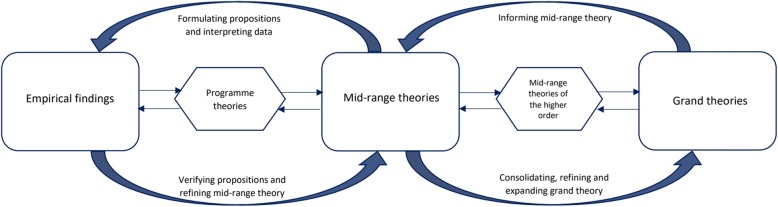
“Mid-range theories play an important bridging role between empirical observations (and programme theories based on them), characterised by a low level of abstraction and generalisability, and the highly [20] generic and abstract ‘ view from on high ’ [23] offered by grand theories.”
Nilsen, P., Ståhl, C., Roback, K., & Cairney, P. (2013) · Implementation Science · doi:10.1186/1748-5908-8-63 · Cited by 346 · cited 2×
“…is thus clearly interdisciplinary, but this interdisciplinarity does not necessarily channel down to the level of empirical exploration, where cross-fertilisation with other social science disciplines and their theoretical orientations remains relatively low and somewhat unequal [31, 49, 50].”
Evaluating qualitative management research: Towards a contingent criteriology
Johnson, P., Buehring, A., Cassell, C., & Symon, G. (2006) · International Journal of Management Reviews · doi:10.1111/j.1468-2370.2006.00124.x · Cited by 283 · cited 3×
“Diversity of philosophical and theoretical approaches, accumulated by the social sciences, genuinely reflects the complexity of the social world and the multiple ways we can make sense of it [51, 52].”
Cornelissen, J. P. (2017) · Journal of Management Studies · doi:10.1111/joms.12210 · Cited by 268 · cited 2×
“En-gaging with diverse styles of theorising has the potential to uncover complex and processual forms of causality, where constructs interact in bidirectional, cumulative, or emergent ways, and to cut across multiple levels of analysis [53].”
A systematic review of the use of theory in randomized controlled trials of audit and feedback
Colquhoun, H. L., Brehaut, J. C., Sales, A., Ivers, N., Grimshaw, J., Michie, S., Carroll, K., Chalifoux, M., & Eva, K. W. (2013) · Implementation Science · doi:10.1186/1748-5908-8-66 · Cited by 231
Editor's Comments: Why Theory?
Suddaby, R. (2014) · Academy of Management Review · doi:10.5465/amr.2014.0252 · Cited by 218 · cited 1×
“…be large-scale and transformative to be revelatory and original [12], though they do need to represent more than tinkering, navel-gazing, or adding terminological clutter — potential side effects observed when ‘ theoretical contribution ’ is valorised and risks becoming an end in itself [38, 39].”
Before theory comes theorizing or how to make social science more interesting
Swedberg, R. (2016) · The British Journal of Sociology · doi:10.1111/1468-4446.12184 · Cited by 217 · cited 1×
“This mandates a change of perspective from ‘ theories ’ as finished products to ‘ theo-rising ’ as the process of developing, refining, and expanding theoretical knowledge [26, 27].”
Theorizing about the service dominant logic: The bridging role of middle range theory
Brodie, R. J., Saren, M., & Pels, J. (2011) · Marketing Theory · doi:10.1177/1470593110393714 · Cited by 191 · cited 2×
“The bridging role of mid-range theories can be demonstrated in the ‘ scientific circle of enquiry ’ [25] emphasising the two-way connections between empirical observations and theories at different levels of conceptual abstraction (Fig.”
Stetler, C. B., Mittman, B. S., & Francis, J. (2008) · Implementation Science · doi:10.1186/1748-5908-3-8 · Cited by 176
Rycroft-Malone, J., Burton, C. R., Wilkinson, J., Harvey, G., McCormack, B., Baker, R., Dopson, S., Graham, I. D., Staniszewska, S., Thompson, C., et al. (2015) · Implementation Science · doi:10.1186/s13012-016-0380-z · Cited by 170 · cited 1×
“…a highly systema-tised programme theory conceptualising an intervention across multiple settings can be viewed as a lower-order mid-range theory [13], whilst those implementation frameworks consolidating multiple pre-existing theories aim to present a more generic view of implementation and can…”
Realist RCTs of complex interventions – An oxymoron
Marchal, B., Westhorp, G., Wong, G., Van Belle, S., Greenhalgh, T., Kegels, G., & Pawson, R. (2013) · Social Science & Medicine · doi:10.1016/j.socscimed.2013.06.025 · Cited by 165 · cited 1×
“…ontological and epistemological assumptions espoused by different approaches [55], but as the somewhat blinkered polemic around realist trials has shown [34, 56, 57], what is understood as commensurable is open to debate, with pragmatic considerations clashing with epistemological purism.”
Use of theory to plan or evaluate guideline implementation among physicians: a scoping review
Members of the Guidelines International Network Implementation Working Group, Liang, L., Bernhardsson, S., Vernooij, R. W. M., Armstrong, M. J., Bussières, A., Brouwers, M. C., & Gagliardi, A. R. (2017) · Implementation Science · doi:10.1186/s13012-017-0557-0 · Cited by 158 · cited 1×
“…informative implementation research: using empirical data to refine theory Although use of theory in implementation science has increased over time [29], research to date has adopted a largely theoretically informed approach, where theory is applied to design an intervention or to systematise or…”
Ashworth, R., McDermott, A. M., & Currie, G. (2018) · Journal of Public Administration Research and Theory · doi:10.1093/jopart/muy057 · Cited by 157 · cited 1×
“1 Bridging role of mid-range theories in the scientific circle of enquiry (Adapted from Brodie et al. [25]) see things in the data that might otherwise be taken for granted and develop new theoretical hypotheses or propositions that are, in turn, evaluated by empirical observations [32].”
Foy, R., Ovretveit, J., Shekelle, P. G., Pronovost, P. J., Taylor, S. L., Dy, S., Hempel, S., McDonald, K. M., Rubenstein, L. V., & Wachter, R. M. (2011) · BMJ Quality & Safety · doi:10.1136/bmjqs.2010.047993 · Cited by 148 · cited 1×
“…is thus clearly interdisciplinary, but this interdisciplinarity does not necessarily channel down to the level of empirical exploration, where cross-fertilisation with other social science disciplines and their theoretical orientations remains relatively low and somewhat unequal [31, 49, 50].”
Toward a Method of Middle-Range Theorizing
Bourgeois, L. J. (1979) · The Academy of Management Review · doi:10.2307/257201 · Cited by 143 · cited 2×
“This mandates a change of perspective from ‘ theories ’ as finished products to ‘ theo-rising ’ as the process of developing, refining, and expanding theoretical knowledge [26, 27].”
Pinder, C. C., & Moore, L. F. (1980) · Springer eBooks · doi:10.1007/978-94-009-8733-3_16 · Cited by 133 · cited 1×
“…mid-range theory [13], whilst those implementation frameworks consolidating multiple pre-existing theories aim to present a more generic view of implementation and can thus be viewed as ‘ mid-range theories of higher-order ’ positioned closer to grand theories in the conceptual ‘ ladder ’ [24].”
Harvey, G., Fitzgerald, L., Fielden, S., McBride, A., Waterman, H., Bamford, D., Kislov, R., & Boaden, R. (2011) · Implementation Science · doi:10.1186/1748-5908-6-96 · Cited by 101 · cited 1×
“Programme theories ‘Small theories’ providing a sensible and plausible explanation about how a specific policy, intervention, or project is supposed to function and achieve its objectives - Purposefully practical and accessible, providing concrete working models rather than higher-level abstractions - Uncover assumpti…”
BackgroundSelf-citationNew Game, Old Rules? Mechanisms and Consequences of Legitimation in Boundary Spanning Activities
Kislov, R., Hyde, P., & McDonald, R. (2017) · Organization Studies · doi:10.1177/0170840616679455 · Cited by 90 · cited 1×
“(See, for example, an empirical study selectively deploying Bourdieu ’ s concepts and ideas to develop a mid-range theory of boundary spanners ’ legitimacy [54].)”
Self-citationUnderstanding contexts: how explanatory theories can help
Davidoff, F. (2019) · Implementation Science · doi:10.1186/s13012-019-0872-8 · Cited by 87 · cited 2×
“Determinant frameworks , or ‘ static theories ’ [41], focus on identifying and cataloguing multiple (and often heterogeneous) components of healthcare systems which act as ‘ barriers ’ or ‘ enablers ’ to successful implementation, thus influencing its outcomes.”
Jamal, F., Fletcher, A., Shackleton, N., Elbourne, D., Viner, R., & Bonell, C. (2015) · Trials · doi:10.1186/s13063-015-0980-y · Cited by 82 · cited 1×
“In critical realist trials, which bring together outcome and process data collected in a theoretically informed way across several stages, iterative refinement, augmentation, and testing of study hypotheses can lead to the development of empirically informed mid-range theory [33, 34].”
Harvey, G., McCormack, B. G., Kitson, A. A., Lynch, E. A., & Titchen, A. (2018) · Implementation Science · doi:10.1186/s13012-018-0812-z · Cited by 79 · cited 1×
“As shown, for example, by studies of facilitation as an implementation strategy [46, 47], intervention integrity should be defined functionally in relation to fit with the underlying causal mechanisms (what the intervention does ), rather than compositionally (what the intervention is ).”
Engaging with theory: from theoretically informed to theoretically informative improvement research
Kislov, R. (2018) · BMJ Quality & Safety · doi:10.1136/bmjqs-2018-009036 · Cited by 69 · cited 5×
“…implementation frameworks with even more exhaustive or forensically dissected sets of factors, it may be more beneficial to focus on a relatively limited number of elements relevant to the problem at hand, and to explore complex relationships and interdependencies between them in depth [1, 44 ].”
InfluentialSelf-citationVan Belle, S., van de Pas, R., & Marchal, B. (2017) · BMJ Global Health · doi:10.1136/bmjgh-2016-000181 · Cited by 65 · cited 2×
“The theoretical basis of implementation science is thus clearly interdisciplinary, but this interdisciplinarity does not necessarily channel down to the level of empirical exploration, where cross-fertilisation with other social science disciplines and their theoretical orientations remains relatively low and somewhat…”
BackgroundThe possibility of critical realist randomised controlled trials
Porter, S., McConnell, T., & Reid, J. (2017) · Trials · doi:10.1186/s13063-017-1855-1 · Cited by 46 · cited 1×
“…ontological and epistemological assumptions espoused by different approaches [55], but as the somewhat blinkered polemic around realist trials has shown [34, 56, 57], what is understood as commensurable is open to debate, with pragmatic considerations clashing with epistemological purism.”
Sales, A. E., Wilson, P. M., Wensing, M., Aarons, G. A., Armstrong, R., Flottorp, S. A., Hutchinson, A. M., Presseau, J., Rogers, A. E., Sevdalis, N., et al. (2019) · Implementation Science · doi:10.1186/s13012-019-0922-2 · Cited by 46 · cited 1×
“Our suggestions may be of use to authors seeking to publish in Implementation Science as they are expected to clearly articulate how their empirical work adds to the existing theoretical thinking in the field [10].”
Self-citationKislov, R., Humphreys, J., & Harvey, G. (2016) · Public Management Review · doi:10.1080/14719037.2016.1266022 · Cited by 42 · cited 1×
“As shown, for example, by studies of facilitation as an implementation strategy [46, 47], intervention integrity should be defined functionally in relation to fit with the underlying causal mechanisms (what the intervention does ), rather than compositionally (what the intervention is ).”
Self-citationTourish, D. (2011) · Edward Elgar Publishing eBooks · doi:10.4337/9780857933591.00019 · Cited by 5 · cited 1×
“…be large-scale and transformative to be revelatory and original [12], though they do need to represent more than tinkering, navel-gazing, or adding terminological clutter — potential side effects observed when ‘ theoretical contribution ’ is valorised and risks becoming an end in itself [38, 39].”
(2002) · Sage eBooks
Cited by
The updated consolidated framework for implementation research based on user feedback
Damschroder, L. J., Reardon, C. M., Widerquist, M. A. O., & Lowery, J. (2022) · Implementation Science · doi:10.1186/s13012-022-01245-0 · Cited by 4,452
“Systematic reviews of empirical findings are needed to further inform or refine theoretical concepts encapsulated within and across constructs and middle-range theories need to be developed to understand interrelationships between constructs [16].”
BackgroundInfluentialDamschroder, L. J., Reardon, C. M., Opra Widerquist, M. A., & Lowery, J. (2022) · Implementation Science · doi:10.1186/s13012-021-01181-5 · Cited by 784
“Conclusion As implementation science matures as a discipline, frameworks must mature too [60, 61].”
BackgroundUnderstanding and applying the RE-AIM framework: Clarifications and resources
Holtrop, J. S., Estabrooks, P. A., Gaglio, B., Harden, S. M., Kessler, R. S., King, D. K., Kwan, B. M., Ory, M. G., Rabin, B. A., Shelton, R. C., et al. (2021) · Journal of Clinical and Translational Science · doi:10.1017/cts.2021.789 · Cited by 549
Pragmatic approaches to analyzing qualitative data for implementation science: an introduction
Ramanadhan, S., Revette, A. C., Lee, R. M., & Aveling, E. L. (2021) · Implementation Science Communications · doi:10.1186/s43058-021-00174-1 · Cited by 280
Retroductive Theorizing: A Contribution of Critical Realism to Mixed Methods Research
Mukumbang, F. C. (2021) · Journal of Mixed Methods Research · doi:10.1177/15586898211049847 · Cited by 297
“Kislov et al. (2019) proposed that for more nuanced theorizing, theoretical traditions, theory-driven approaches, and methods should be adopted to approach empirical data in an informative way.”
Background
Metadata
- Authors
- Kislov, R., Pope, C., Martin, G. P., & Wilson, P. M.
- Affiliations
- Manchester Metropolitan University (GB)
- University of Oxford (GB)
- University of Cambridge (GB)
- University of Manchester (GB)
- Corresponding author
- Kislov, Roman
- Venue
- Implementation Science
- Published
- 2019-12-11
- Volume
- 14
- Issue
- 1
- Pages
- 103-103
- ISSN
- 1748-5908 (ISSN-L)
- PMC
- PMC6905028
- OpenAlex
- W2995894510
- Cited by
- 289
- References
- 58
- Citations by year
- 2026: 39 · 2025: 39 · 2024: 45 · 2023: 38 · 2022: 51 · 2021: 52 · 2020: 24 · 2019: 1
- FWCI
- 43.63
- Type
- journal article
- Language
- en
- Open access
- gold
- doi.org
- Licence
- cc-by
- creativecommons.org/licenses/by/4.0 (tdm)
- creativecommons.org/licenses/by/4.0 (vor)
- Locations
- Implementation Science (publishedVersion, cc-by)
- PubMed Central (publishedVersion, cc-by)
- PubMed (publishedVersion)
- e-space (Manchester Metropolitan University) (acceptedVersion)
- DOAJ (DOAJ: Directory of Open Access Journals) (submittedVersion, cc-by-sa)
- Figshare (submittedVersion, cc-by)
- Research Explorer (The University of Manchester) (submittedVersion, cc-by)
- Apollo (University of Cambridge) (submittedVersion, cc-by)
- Apollo (cc-by)
- Funders
- National Institute for Health and Care Research
- Topics
- Health Sciences › Health Professions › General Health Professions › Health Policy Implementation Science
- Social Sciences › Education › Qualitative Research Methods and Applications
- Health Sciences › Nursing › Research and Theory › Methodologies in Health Research and Practice
- Keywords
- theorizing, middle-range theory, grand theory, theory development, mechanistic explanation, theoretical orientation
- MeSH terms
- Implementation Science, Health Services Research, Humans
About these checks
Registry, retraction, Cites and statistics results are computed, not judged, with one exception: a printed reference that no index lists is read once by a model before it counts as a citation error. Claims are extracted by a model and kept only when their quote appears verbatim in the text; each cited source is then checked, with a model’s help, for whether it says what the claim relies on. Those verdicts can be wrong — read the claim’s quote and the cited source before relying on one.
Statistics and arithmetic are recomputed, not judged.
Confidence bands are shown only for fields calibrated on our annotated test set. None is calibrated yet, so no band is shown.
What counts as a claim ›How we measure confidence ›How we check this ›
Are you an author, or do you see a problem with this page? Request a review
Data sources
Bibliographic data: Semantic Scholar, OpenAlex, Crossref.
Contains information from the Semantic Scholar Academic Graph Datasets, made available under the ODC Attribution License (ODC-BY 1.0).
Semantic Scholar’s data is described in: Kinney, R., et al. (2023). The Semantic Scholar Open Data Platform. arXiv:2301.10140.
