

Harnessing the power of theorising in implementation science
Open accessThe DOI matches its Crossref record; 58 of the 58 references it cites were found in a registry or an index.
Abstract
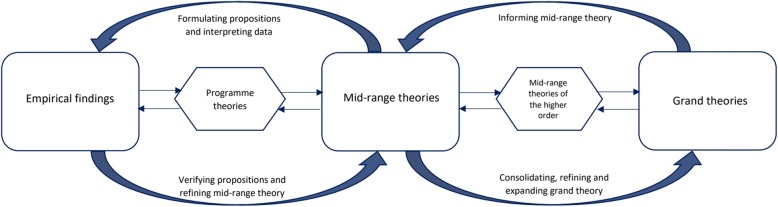
Theories occupy different positions in the scientific circle of enquiry as they vary in scope, abstraction, and complexity. Mid-range theories play a crucial bridging role between raw empirical observations and all-encompassing grand-theoretical schemes. A shift of perspective from ‘theories’ as products to ‘theorising’ as a process can enable empirical researchers to capitalise on the two-way relationships between empirical data and different levels of theory and contribute to the advancement of knowledge. This can be facilitated by embracing theoretically informative (in addition to merely theoretically informed) research, developing mechanism-based explanations, and broadening the repertoire of grand-theoretical orientations.
Overview
The claims and statistics of this paper haven’t been checked yet.
Free: it reads the open-access text and checks the first 5 claims that cite a source we can check. Create a free account to check every claim.
Integrity signals
Registry
Cites
Statistics
Figures
Verification
Claims the paper makes
The claims and statistics of this paper haven’t been checked yet.
Free: it reads the open-access text and checks the first 5 claims that cite a source we can check. Create a free account to check every claim.
Claims other papers make about this one
Each is checked against this paper’s own text: does it say what the citing paper says it does?
The cited source says what the claim attributes to it.
In the citing paper
“Implementation scientists have been called to engage in “theory-building” science where theory is improved with every application and theorizing becomes “an iterative and recursive process” [16].”
From The updated consolidated framework for implementation research based on user feedback (2022) · cites this paper as [16]
Self-check
Percentages, sums and reported differences re-computed from the paper’s own numbers.
The self-check needs the paper’s full text.
Citations
Cites
Damschroder, L. J., Aron, D. C., Keith, R. E., Kirsh, S. R., Alexander, J. A., & Lowery, J. C. (2009) · Implementation Science · doi:10.1186/1748-5908-4-50 · Cited by 14,496 · cited 1×
“CFIR [Consolidated Framework for Implementation Research] [16] or TDF [Theoretical Domains Framework] [17])”
MethodQualitative research practice: a guide for social science students and researchers
(2003) · Choice Reviews Online · doi:10.5860/choice.41-1319 · Cited by 10,543
Social Theory and Social Structure
Ross, E. J., & Merton, R. K. (1958) · The American Catholic Sociological Review · doi:10.2307/3709394 · Cited by 10,315
Social Theory and Social Structure.
Bock, K. E., & Merton, R. K. (1969) · American Sociological Review · doi:10.2307/2091967 · Cited by 6,660
Making sense of implementation theories, models and frameworks
Nilsen, P. (2015) · Implementation Science · doi:10.1186/s13012-015-0242-0 · Cited by 4,447 · cited 2×
“The gradual maturation of implementation science as a discipline is also reflected in laudable endeavours to systematise and make sense of this theoretical knowledge [3 – 6] as well as to critically reflect on the current state of the field in general [7, 8].”
What Constitutes a Theoretical Contribution?
Whetten, D. A. (1989) · The Academy of Management Review · doi:10.2307/258554 · Cited by 4,129 · cited 1×
“Here, theory is a tool which should be improved with each subsequent application, rather than merely having its utility confirmed [36].”
BackgroundMaking psychological theory useful for implementing evidence based practice: a consensus approach
Michie, S. (2005) · Quality and Safety in Health Care · doi:10.1136/qshc.2004.011155 · Cited by 3,440 · cited 1×
“The evidence-based practice paradigm [48] and the discipline of behaviour change psychology [17] have been particularly influential in this regard, whilst the iterative development of NPT has involved continuous engagement with fundamental theoretical questions debated by several sociological…”
Qualitative Data Analysis for Health Services Research: Developing Taxonomy, Themes, and Theory
Bradley, E. H., Curry, L. A., & Devers, K. J. (2007) · Health Services Research · doi:10.1111/j.1475-6773.2006.00684.x · Cited by 3,437 · cited 1×
“Themes and propositions should evolve from the data that link different determinants, concepts, or factors together, thus reflecting relationships between them [40].”
BackgroundThe SAGE handbook of organizational research methods
Buchanan, D., & Bryman, A. E. (2009) · Cited by 2,559
Theory Construction as Disciplined Imagination
Weick, K. E. (1989) · The Academy of Management Review · doi:10.2307/258556 · Cited by 2,134 · cited 2×
“Mid-range theories are seen as fundamental for all social sciences as they are sufficiently broad to provide practically adequate explanations applicable to a range of contexts, yet focused enough to generate testable propositions and guide empirical enquiry [11, 22].”
Cited by
The updated consolidated framework for implementation research based on user feedback
Damschroder, L. J., Reardon, C. M., Widerquist, M. A. O., & Lowery, J. (2022) · Implementation Science · doi:10.1186/s13012-022-01245-0 · Cited by 4,452
“Systematic reviews of empirical findings are needed to further inform or refine theoretical concepts encapsulated within and across constructs and middle-range theories need to be developed to understand interrelationships between constructs [16].”
BackgroundInfluentialDamschroder, L. J., Reardon, C. M., Opra Widerquist, M. A., & Lowery, J. (2022) · Implementation Science · doi:10.1186/s13012-021-01181-5 · Cited by 784
“Conclusion As implementation science matures as a discipline, frameworks must mature too [60, 61].”
BackgroundUnderstanding and applying the RE-AIM framework: Clarifications and resources
Holtrop, J. S., Estabrooks, P. A., Gaglio, B., Harden, S. M., Kessler, R. S., King, D. K., Kwan, B. M., Ory, M. G., Rabin, B. A., Shelton, R. C., et al. (2021) · Journal of Clinical and Translational Science · doi:10.1017/cts.2021.789 · Cited by 549
Pragmatic approaches to analyzing qualitative data for implementation science: an introduction
Ramanadhan, S., Revette, A. C., Lee, R. M., & Aveling, E. L. (2021) · Implementation Science Communications · doi:10.1186/s43058-021-00174-1 · Cited by 280
Retroductive Theorizing: A Contribution of Critical Realism to Mixed Methods Research
Mukumbang, F. C. (2021) · Journal of Mixed Methods Research · doi:10.1177/15586898211049847 · Cited by 297
“Kislov et al. (2019) proposed that for more nuanced theorizing, theoretical traditions, theory-driven approaches, and methods should be adopted to approach empirical data in an informative way.”
BackgroundBeidas, R. S., Dorsey, S., Lewis, C. C., Lyon, A. R., Powell, B. J., Purtle, J., Saldana, L., Shelton, R. C., Stirman, S. W., & Lane-Fall, M. B. (2022) · Implementation Science · doi:10.1186/s13012-022-01226-3 · Cited by 230
Reardon, C. M., Damschroder, L. J., Ashcraft, L. E., Kerins, C., Bachrach, R. L., Nevedal, A. L., Domlyn, A. M., Dodge, J., Chinman, M., & Rogal, S. (2025) · Implementation Science · doi:10.1186/s13012-025-01450-7 · Cited by 172
“Advances in research rely on users critically reflecting on and refining theories, models, and frameworks [5], and after 15 years of use in the field, CFIR was revised based on user feedback obtained via literature review and survey.”
Using implementation science theories and frameworks in global health
Ridde, V., Pérez, D., & Robert, E. (2020) · BMJ Global Health · doi:10.1136/bmjgh-2019-002269 · Cited by 169
“The present enthusiasm for implementation has been boosted by the development of implementation research, 24 which has a dedicated journal ( Implementation Science 25 ) and prompted the development of methodological guides.”
Hogg, H. D. J., Al-Zubaidy, M., Technology Enhanced Macular Services Study Reference Group, Talks, J., Denniston, A. K., Kelly, C. J., Malawana, J., Papoutsi, C., Teare, M. D., Keane, P. A., et al. (2023) · Journal of Medical Internet Research · doi:10.2196/39742 · Cited by 163
“This means that NASSS can readily accommodate perspectives from various stakeholders, contexts, and tools without enforcing excessive assumptions about the mechanisms of implementation, which is well-suited to the heterogeneous literature to be synthesized [24].”
Wang, D. Y., Wong, E. L., Nilsén, P., Chung, V. C., Tian, Y., & Yeoh, E. (2023) · Implementation Science · doi:10.1186/s13012-023-01296-x · Cited by 175
A scoping review of de-implementation frameworks and models
Walsh‐Bailey, C., Tsai, E., Tabak, R. G., Morshed, A. B., Norton, W. E., McKay, V., Brownson, R. C., & Gifford, S. E. (2021) · Implementation Science · doi:10.1186/s13012-021-01173-5 · Cited by 163
Rabin, B. A., Cakici, J. A., Golden, C. A., Estabrooks, P. A., Glasgow, R. E., & Gaglio, B. (2022) · Implementation Science · doi:10.1186/s13012-022-01234-3 · Cited by 129
Current Implementation of Digital Health in Chronic Disease Management: Scoping Review
Pong, C. Y., Tseng, R. M. W. W., Tham, Y. C., & Lum, E. (2024) · Journal of Medical Internet Research · doi:10.2196/53576 · Cited by 126
“…science frameworks represents missed opportunities to generate reliable translation and scale-up of evidence-based innovations through a deeper understanding of contextual influences and eliciting mechanisms of implementation, as well as productive theorizing of implementation research [23,295].”
Rogers, L., Brún, A. D., Birken, S. A., Davies, C., & McAuliffe, É. (2020) · BMC Health Services Research · doi:10.1186/s12913-020-05905-z · Cited by 102
“ical knowledge remains a one way process [38].”
BackgroundA scoping review of frameworks in empirical studies and a review of dissemination frameworks
Baumann, A. A., Hooley, C., Kryzer, E., Morshed, A. B., Gutner, C. A., Malone, S. M., Walsh‐Bailey, C., Pilar, M. R., Sandler, B., Tabak, R. G., et al. (2022) · Implementation Science · doi:10.1186/s13012-022-01225-4 · Cited by 88
Implementation science in maternity care: a scoping review
Dadich, A., Piper, A., & Coates, D. (2021) · Implementation Science · doi:10.1186/s13012-021-01083-6 · Cited by 78
“Despite the myriad theories, models and frameworks to promote evidence-based population health, there is still a long way to go [23, 24], particularly in maternity care [25–28].”
BackgroundUnderstanding contexts: how explanatory theories can help
Davidoff, F. (2019) · Implementation Science · doi:10.1186/s13012-019-0872-8 · Cited by 87
Making implementation science more real
Sarkies, M., Francis‐Auton, E., Long, J. C., Pomare, C., Hardwick, R., & Braithwaite, J. (2022) · BMC Medical Research Methodology · doi:10.1186/s12874-022-01661-2 · Cited by 79
Grounding implementation science in health equity for cancer prevention and control
Adsul, P., Chambers, D., Brandt, H. M., Fernández, M. E., Ramanadhan, S., Torres, E., Leeman, J., Baquero, B. I., Fleisher, L. G., Escoffery, C., et al. (2022) · Implementation Science Communications · doi:10.1186/s43058-022-00311-4 · Cited by 72
“With approximately 150 TMFs [38, 39], implementation scientists have emphasized the value of TMFs and theorizing [39, 40] in research studies.”
BackgroundPatey, A. M., Fontaine, G., Francis, J., McCleary, N., Presseau, J., & Grimshaw, J. (2022) · Psychology and Health · doi:10.1080/08870446.2022.2100887 · Cited by 77
“…and which are ultimately used to support human behaviour change, could be applied in the same manner to HCP behaviour. over recent years, implementation science has drawn on theories traditionally developed to explain general health behaviours (Kislov et al., 2019; Presseau et al., 2021).”
BackgroundGlasgow, R. E., Trinkley, K. E., Ford, B., & Rabin, B. A. (2024) · Global Implementation Research and Applications · doi:10.1007/s43477-024-00134-6 · Cited by 70
“It is important to describe how frameworks evolve over time to explain why and how they have changed, and to increase odds that researchers will use current, updated versions of the framework rather than the original version (Glasgow et al., 1999, 2019a, b; Kislov et al., 2019).”
Evidence-based practice implementation in healthcare in China: a living scoping review
Zhao, J., Bai, W., Zhang, Q., Su, Y., Wang, J., Xiao-ning, D., Zhou, Y., Kong, C., Qing, Y., Gong, S., et al. (2022) · The Lancet Regional Health - Western Pacific · doi:10.1016/j.lanwpc.2021.100355 · Cited by 81
Bradshaw, A., Santarelli, M., Mulderrig, M., Khamis, A. M., Sartain, K., Boland, J. W., Bennett, M., Johnson, M. J., Pearson, M., & Murtagh, F. E. (2020) · Palliative Medicine · doi:10.1177/0269216320972049 · Cited by 69
Grant, A. M., Bugge, C., & Wells, M. (2020) · Trials · doi:10.1186/s13063-020-04880-4 · Cited by 75
Haines, E. R., Dopp, A. R., Lyon, A. R., Witteman, H. O., Bender, M., Vaisson, G., Hitch, D., & Birken, S. A. (2021) · Implementation Science Communications · doi:10.1186/s43058-021-00147-4 · Cited by 71
“There is a critical need for the development of “relational and dynamic approaches to theorizing the complex interplay between the characteristics of interventions, the activities of implementers, and the properties of variable broader contexts” [19].”
BackgroundSchroeder, D. M., Luig, T., Finch, T. L., Beesoon, S., & Campbell-Scherer, D. L. (2022) · Implementation Science Communications · doi:10.1186/s43058-022-00264-8 · Cited by 70
Harvey, G., Rycroft‐Malone, J., Seers, K., Wilson, P. M., Cassidy, C. E., Embrett, M. G., Hu, J., Pearson, M., Semenic, S. E., Zhao, J., et al. (2023) · Frontiers in Health Services · doi:10.3389/frhs.2023.1162762 · Cited by 70
Self-citationRoberts, N. A., Janda, M., Stover, A. M., Alexander, K. E., Wyld, D., & Mudge, A. (2020) · Quality of Life Research · doi:10.1007/s11136-020-02669-1 · Cited by 68
Munn, Z., Dias, M. M., Tufănaru, C., Porritt, K. A., Stern, C., Jordan, Z., Aromataris, E., & Pearson, A. (2021) · JBI Evidence Synthesis · doi:10.11124/jbies-20-00364 · Cited by 69
Ardito, V., Golubev, G., Ciani, O., & Tarricone, R. (2023) · JMIR Cancer · doi:10.2196/42092 · Cited by 56
“CFIR integrates perspectives from different stakeholders and settings without inferring assumptions or drawing conclusions about the mechanisms of implementation, which is well suited to the heterogeneous literature to be synthesized [44].”
BackgroundDevelopment of a qualitative data analysis codebook informed by the i-PARIHS framework
Ritchie, M. J., Drummond, K. L., Smith, B. N., Sullivan, J. L., & Landes, S. J. (2022) · Implementation Science Communications · doi:10.1186/s43058-022-00344-9 · Cited by 67
“, i-PARIHS, are often treated as “received wisdom” that can inform research [45] with less emphasis on using research findings iteratively and recursively to further develop, refine, and expand them [46].”
BackgroundWilson, P. M., & Kislov, R. (2022) · Cambridge University Press eBooks · doi:10.1017/9781009237055 · Cited by 74
Self-citationA guide to systems-level, participatory, theory-informed implementation research in global health
Seward, N., Hanlon, C., Hinrichs, S., Lund, C., Murdoch, J., Salisbury, T. T., Verhey, R., Shidhaye, R. R., Thornicroft, G., Araya, R., et al. (2021) · BMJ Global Health · doi:10.1136/bmjgh-2021-005365 · Cited by 68
Bridges and Mechanisms: Integrating Systems Science Thinking into Implementation Research
Luke, D. A., Powell, B. J., & Paniagua-Ávila, A. (2023) · Annual Review of Public Health · doi:10.1146/annurev-publhealth-060922-040205 · Cited by 61
Mielke, J., Geest, S. D., Zúñiga, F., Brunkert, T., Zullig, L. L., Pfadenhauer, L. M., & Staudacher, S. (2022) · Frontiers in Health Services · doi:10.3389/frhs.2022.953731 · Cited by 56
“To understand what agents do, it is necessary first to identify the social structures, norms, values and beliefs that drive their actions, and to explore how context and agents interact and mutually influence one another (58).”
BackgroundMcLean, R. K. D., Carden, F., Aiken, A. B., Armstrong, R., Bray, J., Cassidy, C. E., Daub, O., Ruggiero, E. D., Fierro, L. A., Gagnon, M., et al. (2023) · Health Research Policy and Systems · doi:10.1186/s12961-023-00990-y · Cited by 52
“This recommendation is aligned with recent literature which makes the case for refining models and frameworks through subsequent research and application rather than treating them as reified and unchangeable products [33], particularly when supporting patient and public involvement in research [8].”
MethodSelf-citationFontaine, G., Mooney, M., Porat‐Dahlerbruch, J., Cahir, K., Ellen, M., Spinewine, A., Taylor, N., Laritz, R., Bourbeau-Allard, È., & Grimshaw, J. (2025) · Implementation Science · doi:10.1186/s13012-025-01436-5 · Cited by 56
A research agenda to advance the study of implementation mechanisms
Lewis, C. C., Frank, H. E., Cruden, G., Kim, B., Stahmer, A. C., Lyon, A. R., Albers, B., Aarons, G. A., Beidas, R. S., Mittman, B. S., et al. (2024) · Implementation Science Communications · doi:10.1186/s43058-024-00633-5 · Cited by 51
Duan, Y., Iaconi, A., Wang, J., Perez, J. S., Song, Y., Chamberlain, S. A., Shrestha, S., Choroschun, K., Hoben, M., Beeber, A., et al. (2022) · Implementation Science · doi:10.1186/s13012-022-01254-z · Cited by 46
“These integrated models might support developing mid-range theories, which are seen as critical for implementation science because they generate testable propositions and provide practically adequate explanations applicable to a specified set of contexts [51].”
BackgroundGliedt, J. A., Spector, A. L., Schneider, M., Williams, J. S., & Young, S. (2023) · INQUIRY The Journal of Health Care Organization Provision and Financing · doi:10.1177/00469580231176855 · Cited by 55
What theories underpin performance-based financing? A scoping review
Paul, É., Bodson, O., & Ridde, V. (2021) · Journal of Health Organization and Management · doi:10.1108/jhom-04-2020-0161 · Cited by 47
van Olmen, J., Menon, S., Susič, A. P., Ir, P., Klipstein‐Grobusch, K., Wouters, E., Peñalvo, J. L., Zavrnik, Č., Te, V., Martens, M., et al. (2020) · Global Health Action · doi:10.1080/16549716.2020.1824382 · Cited by 43
“The theorising approach applied in the scale-up phase will strengthen and refine existing scale-up theories with the empirical evidence collected, and enhance the knowledge on mechanisms of implementation and specifically on the science of scale-up [35].”
BackgroundMethodInfluentialde Mello, N. F., Silva, S. N., Gomes, D. F., Girardi, J. D. M., & Barreto, J. O. M. (2024) · Implementation Science · doi:10.1186/s13012-024-01389-1 · Cited by 45
Sarkies, M., Robinson, S., Ludwick, T., Braithwaite, J., Nilsén, P., Aarons, G. A., Weiner, B. J., & Moullin, J. C. (2021) · Journal of Health Organization and Management · doi:10.1108/jhom-02-2021-0056 · Cited by 43
Hill, B. (2020) · Obesity Reviews · doi:10.1111/obr.13147 · Cited by 40
“Theory is important for informing intervention design.(57,58) Although there is no rule on which theo-”
BackgroundPain management in people with severe mental illness: an agenda for progress
Onwumere, J., Stubbs, B., Stirling, M., Shiers, D., Gaughran, F., Rice, A. S. C., C de C Williams, A., & Scott, W. (2022) · Pain · doi:10.1097/j.pain.0000000000002633 · Cited by 35
“The number and complexity of available theories can present a challenge for implementation research, particularly where empirical findings are underused in refining theory.(57) Nonetheless, implementation theories may help identify barriers to and facilitators of integrating existing and novel treatments for pain and…”
BackgroundGeng, E., Powell, B. J., Goss, C. W., Lewis, C. C., Sales, A. E., & Kim, B. (2025) · Implementation Science · doi:10.1186/s13012-025-01427-6 · Cited by 38
Hennein, R., Ggita, J. M., Turimumahoro, P., Ochom, E., Gupta, A. J., Katamba, A., Armstrong-Hough, M. J., & Davis, J. L. (2022) · Implementation Science Communications · doi:10.1186/s43058-022-00279-1 · Cited by 36
Pescud, M., Rychetnik, L., Allender, S. E., Irving, M. J., Finegood, D. T., Riley, T., Ison, R. L., Rutter, H., & Friel, S. (2021) · Systems · doi:10.3390/systems9030061 · Cited by 34
Gasteiger, N., van der Veer, S. N., Wilson, P. M., & Dowding, D. (2021) · BMJ Open · doi:10.1136/bmjopen-2021-050033 · Cited by 39
Self-citationMukumbang, F. C., & Wong, G. (2025) · Qualitative Health Research · doi:10.1177/10497323251316401 · Cited by 33
Brooks, H. L., Devereux‐Fitzgerald, A., Richmond, L., Bee, P., Lovell, K., Caton, N., Cherry, M. G., Edwards, B. M., Downs, J. L., Bush, L. E., et al. (2022) · Social Psychiatry and Psychiatric Epidemiology · doi:10.1007/s00127-022-02242-w · Cited by 33
“This would allow hypotheses to be generated for future testing and would inform logic models for social network interventions to allow for theorizing to be initiated in terms of what works best for whom in what circumstances [45, 46].”
BackgroundTheorizing is for everybody: Advancing the process of theorizing in implementation science
Meza, R. D., Moreland, J. C., Pullmann, M. D., Klasnja, P., Lewis, C. C., & Weiner, B. J. (2023) · Frontiers in Health Services · doi:10.3389/frhs.2023.1134931 · Cited by 36
“There has been a call to shift from treating theories as static products to engaging in a process of theorizing that draws on empirical data to develop, validate, modify or expand theoretical explanations in implementation science (4).”
BackgroundLast, B. S., Schriger, S. H., Timon, C. E., Frank, H. E., Buttenheim, A. M., Rudd, B. N., Fernandez-Marcote, S., Comeau, C., Shoyinka, S. O., & Beidas, R. S. (2021) · Implementation Science Communications · doi:10.1186/s43058-020-00105-6 · Cited by 31
“Investigators find it challenging to select among the multitude of theories and frameworks available to them, in large part due to their sheer quantity, varying levels of scope, and limited external validity (2, 5).”
BackgroundNwaozuru, U., Murphy, P., Richard, A., Obiezu‐Umeh, C., Shato, T., Obionu, I. M., Gbaja-Biamila, T. A., Oladele, D. A., Mason, S., Takenaka, B. P., et al. (2025) · Implementation Science Communications · doi:10.1186/s43058-025-00716-x · Cited by 31
“As we map the mechanisms for implementation [96, 97], it may be critical to map the mechanisms for sustainability and how varying contexts impact it [98].”
Ball, H., Eisner, E., Nicholas, J., Wilson, P. M., & Bucci, S. (2025) · BMC Public Health · doi:10.1186/s12889-025-22189-2 · Cited by 29
Self-citationMay, C. R., Hillis, A., Albers, B., Desveaux, L., Gilbert, A. W., Girling, M., Kislov, R., MacFarlane, A. E., Mair, F. S., Potthoff, S., et al. (2025) · Implementation Science · doi:10.1186/s13012-025-01444-5 · Cited by 28
Self-citationLong, J. C., Sarkies, M., Francis‐Auton, E., Nguyen, H. M., Pomare, C., Hardwick, R., & Braithwaite, J. (2022) · BMJ Open · doi:10.1136/bmjopen-2021-058158 · Cited by 26
Skouteris, H., Green, R., Chung, A., Bergmeier, H. J., Amir, L. H., Baidwan, S. K., Chater, A., Chamberlain, C., Emond, R., Gibbons, K. L., et al. (2022) · Health & Social Care in the Community · doi:10.1111/hsc.14106 · Cited by 27
“Women and children are particularly likely to be adversely impacted (Kotlar et al., 2021 ; Yoshikawa et al., 2020 ).”
BackgroundCan self-management programmes change healthcare utilisation in COPD?
Smalley, K. R., Aufegger, L., Flott, K., Mayer, E. K., & Darzi, A. W. (2020) · Patient Education and Counseling · doi:10.1016/j.pec.2020.08.015 · Cited by 25
“Disentangling the ambiguous impacts of interventions like SMPs requires theory-informed evaluations, as well as empiricallyinformed revision of the theories that guide implementation [7].”
MethodContext-acceptability theories: example of family planning interventions in five African countries
Webster, J., Krishnaratne, S., Hoyt, J., Demissie, S. D., Spilotros, N., Landegger, J., Kambanje, M., Pryor, S., Moseti, E., Marcus, S., et al. (2021) · Implementation Science · doi:10.1186/s13012-020-01074-z · Cited by 28
Toward a conceptualization of personalized services in apparel e-commerce fulfillment
Jain, S., & Sundström, M. (2021) · Research Journal of Textile and Apparel · doi:10.1108/rjta-06-2020-0066 · Cited by 30
Wensing, M., Sales, A., Wilson, P., Armstrong, R., Kislov, R., Rankin, N. M., Ramaswamy, R., & Xu, D. (2021) · Implementation Science · doi:10.1186/s13012-021-01175-3 · Cited by 23
“Implementation Science prefers studies that relate to existing theories, frameworks, or concepts, seeking to yield new theoretical insights applicable to a wide range of settings and useful for guiding future empirical enquiry [6].”
BackgroundSelf-citationAldridge, W. A., Roppolo, R. H., Brown, J., Bumbarger, B. K., & Boothroyd, R. I. (2023) · Implementation Research and Practice · doi:10.1177/26334895231179761 · Cited by 25
“Our approach to developing this theory of change reflects Kislov et al. (2019), who advocated for theorizing in implementation science rather than adherence to finished theoretical products.”
BackgroundMethodYıldızbaşı, A., Celik, S. E., Arıöz, Y., Chen, Z., Sun, L., & Öztürk, C. (2024) · Journal of Cleaner Production · doi:10.1016/j.jclepro.2024.144553 · Cited by 26
Cahill, L. S., Carey, L. M., Mak-Yuen, Y. Y. K., McCluskey, A., Neilson, C., O’Connor, D. A., & Lannin, N. A. (2021) · BMJ Open · doi:10.1136/bmjopen-2020-042879 · Cited by 24
Peet, J., Theobald, K. A., & Douglas, C. (2021) · Journal of Clinical Nursing · doi:10.1111/jocn.15923 · Cited by 22
Koester, K. A., Colasanti, J. A., McNulty, M., Dance, K. V., Erguera, X. A., Tsuzuki, M. D., Johnson, M. O., Sauceda, J. A., Montgomery, E., Schneider, J. A., et al. (2023) · Implementation Science Communications · doi:10.1186/s43058-023-00506-3 · Cited by 23
Bakelants, H., Vanderstichelen, S., Chambaere, K., Droogenbroeck, F. V., Donder, L. D., Deliëns, L., Dury, S., & Cohen, J. (2022) · Palliative Medicine · doi:10.1177/02692163221146589 · Cited by 25
Making implementation science more efficient: capitalizing on opportunities beyond the field
Wensing, M., & Wilson, P. M. (2023) · Implementation Science · doi:10.1186/s13012-023-01298-9 · Cited by 22
“Research may also use qualitative data to theorize on implementation-related processes and factors by linking these to theories from various scientific disciplines [2].”
BackgroundSelf-citationUnderstanding therapists’ perceived determinants of trauma narrative use
Frank, H. E., Last, B. S., AlRabiah, R., Fishman, J., Rudd, B. N., Kratz, H. E., Harker, C. M., Fernandez-Marcote, S., Jackson, K., Comeau, C., et al. (2021) · Implementation Science Communications · doi:10.1186/s43058-021-00231-9 · Cited by 21
Hogg, H. D. J., Al-Zubaidy, M., Keane, P. A., Hughes, G., Beyer, F. R., & Maniatopoulos, G. (2023) · Frontiers in Health Services · doi:10.3389/frhs.2023.1161822 · Cited by 22
“TMFs offer a potential solution to this challenge as they allow insights from specific interventions and contexts to be abstracted to a degree through which they remain actionable whilst becoming transferrable across a wider range of interventions and contexts (18).”
BackgroundAmbagtsheer, R. C., Borg, K., Townsin, L., de Plaza, M. A. P., O'Brien, L. M., Kunwar, R. S., & Lawless, M. (2024) · Archives of Gerontology and Geriatrics Plus · doi:10.1016/j.aggp.2024.100008 · Cited by 23
Camlin, C. S., Getahun, M., Koss, C. A., Owino, L., Akatukwasa, C., Itiakorit, H., Onyango, A., Bakanoma, R., Atwine, F., Maeri, I., et al. (2022) · AIDS Patient Care and STDs · doi:10.1089/apc.2022.0084 · Cited by 20
Kelly, M. J., Steed, L., Sohanpal, R., Pinnock, H., Barradell, A. C., Dibao-Dina, C., Mammoliti, K., Wileman, V., Rowland, V., Newton, S., et al. (2021) · Trials · doi:10.1186/s13063-021-05460-w · Cited by 19
Munn, Z., McArthur, A., Mander, G., Steffensen, C., & Jordan, Z. (2020) · Radiography · doi:10.1016/j.radi.2020.07.001 · Cited by 19
Connell, L., Ackerley, S., & Rycroft‐Malone, J. (2025) · Frontiers in Health Services · doi:10.3389/frhs.2025.1562627 · Cited by 22
Swaithes, L., Dziedzic, K., Finney, A. G., Cottrell, E., Jinks, C., Mallen, C. D., Currie, G., & Paskins, Z. (2020) · Implementation Science · doi:10.1186/s13012-020-01055-2 · Cited by 20
“Implementation theories provide an important conduit between empirical observations and both theoretical and empirical knowledge; they help to understand the research-primary care practice interface ensuring that all key influences are considered [9, 31].”
BackgroundMethodIntegrating Implementation Science with Quality Improvement to Improve Perinatal Outcomes
Callaghan‐Koru, J. A., Farzin, A., Ridout, E., & Curran, G. M. (2023) · Clinics in Perinatology · doi:10.1016/j.clp.2023.01.002 · Cited by 17
Implementation Science in School-Based, Universal-Level Intervention Research: A Scoping Review
Gallagher, A., Murphy, R., Eochaidh, C. N., Fitzgerald, J., Murphy, C., & Law, J. (2023) · Language Speech and Hearing Services in Schools · doi:10.1044/2023_lshss-22-00181 · Cited by 17
Grove, A., Clarke, A., Currie, G., Metcalfe, A. J., Pope, C. J., & Seers, K. (2020) · Implementation Science · doi:10.1186/s13012-020-01063-2 · Cited by 18
Self-citationWilson, P. M., Billings, J. R., MacInnes, J. D., Mikelyte, R., Welch, E. M., & Checkland, K. (2021) · Health Research Policy and Systems · doi:10.1186/s12961-021-00711-3 · Cited by 18
Self-citationAbdala, I. G., Murta, S. G., de Menezes, J. C. L., Nobre-Sandoval, L. D. A., Gomes, M. D. S. M., Duailibe, K. D., & Farias, D. A. (2020) · International Journal of Environmental Research and Public Health · doi:10.3390/ijerph17196979 · Cited by 18
Leeman, J., Wangen, M., Kegler, M. C., Lee, M., O’Leary, M. C., Ko, L. K., Fernández, M. E., & Birken, S. A. (2022) · Frontiers in Health Services · doi:10.3389/frhs.2022.889786 · Cited by 16
“’s recommendation that implementation scientists draw on grand or classic theories as one starting point for theorizing mechanisms underlying implementation (7).”
BackgroundLewis, C. C., Boyd, M. R., Marti, C. N., & ALBRIGHT, K. J. (2022) · Implementation Science · doi:10.1186/s13012-022-01244-1 · Cited by 15
“This could be done by leveraging the notably sparse implementation theory or by theorizing the temporal interrelationships among local contextual factors and implementation outcomes [56, 57].”
BackgroundFaro, E. Z., Taber, P. A., Seaman, A. T., Rubinstein, E. B., Fix, G. M., Healy, H. S., & Reisinger, H. S. (2024) · Implementation Science · doi:10.1186/s13012-024-01344-0 · Cited by 14
Creating conditions for effective knowledge brokering: a qualitative case study
Burns, P., Currie, G., McLoughlin, I. P., Robinson, T., Sohal, A. S., & Teede, H. J. (2022) · BMC Health Services Research · doi:10.1186/s12913-022-08559-1 · Cited by 15
Pavithra, A. (2021) · Journal of Health Organization and Management · doi:10.1108/jhom-10-2020-0385 · Cited by 16
Chebli, P., Adsul, P., Kranick, J. A., Rohweder, C. L., Risendal, B., Bilenduke, E., Williams, R. S., Wheeler, S. B., Kwon, S. C., & Trinh‐Shevrin, C. (2023) · Cancer Causes & Control · doi:10.1007/s10552-023-01668-0 · Cited by 13
“Although multiple health and racial equity frameworks exist in the literature, there is less guidance on how to operationalize these frameworks in practice, particularly for implementation science and cancer prevention and control, as they focus on equity-oriented research [34, 35].”
BackgroundPrihartadi, A. S., Licastro, G. I., Pearson, M., Johnson, M. J., Luckett, T., & Swan, F. (2021) · BMJ Supportive & Palliative Care · doi:10.1136/bmjspcare-2021-002962 · Cited by 13
Wilson, P. M., Aarons, G. A., Sales, A. E., Xu, D. R., Wensing, M., Hutchinson, A. M., Beidas, R. S., & Geng, E. (2024) · Implementation Science · doi:10.1186/s13012-024-01399-z · Cited by 13
Self-citationCzosnek, L., Rankin, N. M., Cormie, P., Murnane, A., Turner, J., Richards, J. A., Rosenbaum, S., & Zopf, E. M. (2023) · Supportive Care in Cancer · doi:10.1007/s00520-023-07844-x · Cited by 14
“Analysis shifted to an inductive approach when the IRLM was used to map and interpret the findings and produce a simplified logic model for each site that reflected the prioritised determinants.”
MethodInfluentialSteed, L., Sheringham, J., McClatchey, K., Hammersley, V., Marsh, V., Morgan, N., Jackson, T., Holmes, S., Taylor, S. J., & Pinnock, H. (2023) · Implementation Science Communications · doi:10.1186/s43058-023-00515-2 · Cited by 13
“…science by proposing an integrated model representing the coming together of behaviour change, implementation and organisational constructs and theory, which we could allow them to be interrogated, revised and developed in the light of our empirical process evaluation findings as recommended [22].”
BackgroundMethodInfluentialThe social lives of point-of-care tests in low- and middle-income countries: a meta-ethnography
Perkins, J. E., Chandler, C., Kelly, A. H., & Street, A. (2024) · Health Policy and Planning · doi:10.1093/heapol/czae054 · Cited by 12
“…thereby providing a kind of anthropological counterpart to the metrics-driven domains of impact evaluation and implementation research (Strathern, 2000; Adams, 2013; 2016), which make minimal use of social science theory and qualitative evidence (Van Belle et al ., 2017; Kislov et al ., 2019).”
BackgroundGuidelines for Developing a New Research Stream: Lessons from Customer Engagement Research
Brodie, R. J., Lim, W. M., Gandhi, S., & Manrai, A. K. (2024) · Journal of Global Marketing · doi:10.1080/08911762.2025.2441543 · Cited by 15
“Emphasizing theoretically informative processes, such as abductive, deductive, and inductive reasoning, can bridge the gap between empirical data and theoretical abstraction (Kislov et al., 2019).”
Brehaut, J., Carroll, K. A., Presseau, J., Richards, D. P., Gordon, J., Bénard, A., Hudek, N., Graham, I. D., Fergusson, D. A., & Marlin, S. (2020) · Journal of Clinical Epidemiology · doi:10.1016/j.jclinepi.2020.12.013 · Cited by 14
Morris, H., Blewitt, C., O’Connor, A., & Skouteris, H. (2021) · Journal of Children s Services · doi:10.1108/jcs-12-2020-0077 · Cited by 12
Adsul, P., Nethan, S. T., de Cortina, S. H., Dhanasekaran, K., & Hariprasad, R. (2022) · Global Implementation Research and Applications · doi:10.1007/s43477-021-00032-1 · Cited by 12
Understanding How Newly Implemented Rehabilitation Best Practices Are Sustained: A Realist Review
Ataman, R., Ahmed, S., Zidan, A., & Thomas, A. (2022) · Archives of Physical Medicine and Rehabilitation · doi:10.1016/j.apmr.2022.05.016 · Cited by 12
Wilson, C., Janes, G., Lawton, R., & Benn, J. (2023) · Healthcare · doi:10.3390/healthcare11162229 · Cited by 13
Metadata
- Authors
- Kislov, R., Pope, C., Martin, G. P., & Wilson, P. M.
- Affiliations
- Manchester Metropolitan University (GB)
- University of Oxford (GB)
- University of Cambridge (GB)
- University of Manchester (GB)
- Corresponding author
- Kislov, Roman
- Venue
- Implementation Science
- Published
- 2019-12-11
- Volume
- 14
- Issue
- 1
- Pages
- 103-103
- ISSN
- 1748-5908 (ISSN-L)
- PMC
- PMC6905028
- OpenAlex
- W2995894510
- Semantic Scholar
- 8c65ab66885d4efe5eace626f966c09708a3a48b
- Cited by
- 289
- References
- 58
- Citations by year
- 2026: 39 · 2025: 39 · 2024: 45 · 2023: 38 · 2022: 51 · 2021: 52 · 2020: 24 · 2019: 1
- FWCI
- 43.63
- Type
- journal article
- Language
- en
- Open access
- gold
- doi.org
- Licence
- cc-by
- creativecommons.org/licenses/by/4.0 (tdm)
- creativecommons.org/licenses/by/4.0 (vor)
- Locations
- Implementation Science (publishedVersion, cc-by)
- PubMed Central (publishedVersion, cc-by)
- PubMed (publishedVersion)
- e-space (Manchester Metropolitan University) (acceptedVersion)
- DOAJ (DOAJ: Directory of Open Access Journals) (submittedVersion, cc-by-sa)
- Figshare (submittedVersion, cc-by)
- Research Explorer (The University of Manchester) (submittedVersion, cc-by)
- Apollo (University of Cambridge) (submittedVersion, cc-by)
- Apollo (cc-by)
- Funders
- National Institute for Health and Care Research
- Topics
- Health Sciences › Health Professions › General Health Professions › Health Policy Implementation Science
- Social Sciences › Education › Qualitative Research Methods and Applications
- Health Sciences › Nursing › Research and Theory › Methodologies in Health Research and Practice
- Keywords
- theorizing, middle-range theory, grand theory, theory development, mechanistic explanation, theoretical orientation
- MeSH terms
- Implementation Science, Health Services Research, Humans
About these checks
Registry, retraction, Cites and statistics results are computed, not judged, with one exception: a printed reference that no index lists is read once by a model before it counts as a citation error. Claims are extracted by a model and kept only when their quote appears verbatim in the text; each cited source is then checked, with a model’s help, for whether it says what the claim relies on. Those verdicts can be wrong — read the claim’s quote and the cited source before relying on one.
Statistics and arithmetic are recomputed, not judged.
Confidence bands are shown only for fields calibrated on our annotated test set. None is calibrated yet, so no band is shown.
What counts as a claim ›How we measure confidence ›How we check this ›
Are you an author, or do you see a problem with this page? Request a review
Data sources
Bibliographic data: Semantic Scholar, OpenAlex, Crossref.
Contains information from the Semantic Scholar Academic Graph Datasets, made available under the ODC Attribution License (ODC-BY 1.0).
Semantic Scholar’s data is described in: Kinney, R., et al. (2023). The Semantic Scholar Open Data Platform. arXiv:2301.10140.
