

Harnessing the power of theorising in implementation science
Open accessThe DOI matches its Crossref record; 58 of the 58 references it cites were found in a registry or an index.
Abstract
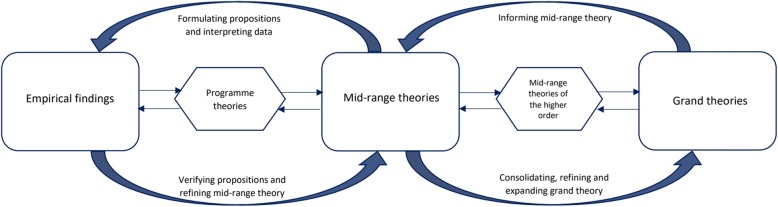
Theories occupy different positions in the scientific circle of enquiry as they vary in scope, abstraction, and complexity. Mid-range theories play a crucial bridging role between raw empirical observations and all-encompassing grand-theoretical schemes. A shift of perspective from ‘theories’ as products to ‘theorising’ as a process can enable empirical researchers to capitalise on the two-way relationships between empirical data and different levels of theory and contribute to the advancement of knowledge. This can be facilitated by embracing theoretically informative (in addition to merely theoretically informed) research, developing mechanism-based explanations, and broadening the repertoire of grand-theoretical orientations.
Overview
The claims and statistics of this paper haven’t been checked yet.
Free: it reads the open-access text and checks the first 5 claims that cite a source we can check. Create a free account to check every claim.
Integrity signals
Registry
Cites
Statistics
Figures
Verification
Claims the paper makes
The claims and statistics of this paper haven’t been checked yet.
Free: it reads the open-access text and checks the first 5 claims that cite a source we can check. Create a free account to check every claim.
Claims other papers make about this one
Each is checked against this paper’s own text: does it say what the citing paper says it does?
The cited source says what the claim attributes to it.
In the citing paper
“Implementation scientists have been called to engage in “theory-building” science where theory is improved with every application and theorizing becomes “an iterative and recursive process” [16].”
From The updated consolidated framework for implementation research based on user feedback (2022) · cites this paper as [16]
Self-check
Percentages, sums and reported differences re-computed from the paper’s own numbers.
The self-check needs the paper’s full text.
Citations
Cites
Damschroder, L. J., Aron, D. C., Keith, R. E., Kirsh, S. R., Alexander, J. A., & Lowery, J. C. (2009) · Implementation Science · doi:10.1186/1748-5908-4-50 · Cited by 14,496 · cited 1×
“CFIR [Consolidated Framework for Implementation Research] [16] or TDF [Theoretical Domains Framework] [17])”
MethodQualitative research practice: a guide for social science students and researchers
(2003) · Choice Reviews Online · doi:10.5860/choice.41-1319 · Cited by 10,543
Social Theory and Social Structure
Ross, E. J., & Merton, R. K. (1958) · The American Catholic Sociological Review · doi:10.2307/3709394 · Cited by 10,315
Social Theory and Social Structure.
Bock, K. E., & Merton, R. K. (1969) · American Sociological Review · doi:10.2307/2091967 · Cited by 6,660
Making sense of implementation theories, models and frameworks
Nilsen, P. (2015) · Implementation Science · doi:10.1186/s13012-015-0242-0 · Cited by 4,447 · cited 2×
“The gradual maturation of implementation science as a discipline is also reflected in laudable endeavours to systematise and make sense of this theoretical knowledge [3 – 6] as well as to critically reflect on the current state of the field in general [7, 8].”
What Constitutes a Theoretical Contribution?
Whetten, D. A. (1989) · The Academy of Management Review · doi:10.2307/258554 · Cited by 4,129 · cited 1×
“Here, theory is a tool which should be improved with each subsequent application, rather than merely having its utility confirmed [36].”
BackgroundMaking psychological theory useful for implementing evidence based practice: a consensus approach
Michie, S. (2005) · Quality and Safety in Health Care · doi:10.1136/qshc.2004.011155 · Cited by 3,440 · cited 1×
“The evidence-based practice paradigm [48] and the discipline of behaviour change psychology [17] have been particularly influential in this regard, whilst the iterative development of NPT has involved continuous engagement with fundamental theoretical questions debated by several sociological…”
Qualitative Data Analysis for Health Services Research: Developing Taxonomy, Themes, and Theory
Bradley, E. H., Curry, L. A., & Devers, K. J. (2007) · Health Services Research · doi:10.1111/j.1475-6773.2006.00684.x · Cited by 3,437 · cited 1×
“Themes and propositions should evolve from the data that link different determinants, concepts, or factors together, thus reflecting relationships between them [40].”
BackgroundThe SAGE handbook of organizational research methods
Buchanan, D., & Bryman, A. E. (2009) · Cited by 2,559
Theory Construction as Disciplined Imagination
Weick, K. E. (1989) · The Academy of Management Review · doi:10.2307/258556 · Cited by 2,134 · cited 2×
“Mid-range theories are seen as fundamental for all social sciences as they are sufficiently broad to provide practically adequate explanations applicable to a range of contexts, yet focused enough to generate testable propositions and guide empirical enquiry [11, 22].”
Cited by
Items 101–200 of 323
Use of Theories in Health Services Research
Wensing, M., & Ullrich, C. (2023) · Springer eBooks · doi:10.1007/978-3-031-29998-8_3 · Cited by 12
Nicoll, A., Maxwell, M., & Williams, B. (2021) · Implementation Science Communications · doi:10.1186/s43058-021-00159-0 · Cited by 14
“However, TIDieR may be limited in the support it can provide for practice change as it was designed from an innovator/developer rather than an adopter/implementer perspective [3] without taking account of how interventions, implementers and contexts might interact to make practice change more or less possible [4].”
BackgroundHyzak, K. A., Bunger, A. C., Bogner, J. A., Davis, A. K., & Corrigan, J. D. (2022) · Implementation Science Communications · doi:10.1186/s43058-022-00261-x · Cited by 11
Frimpong, S., Sunindijo, R. Y., Wang, C., Boadu, E. F., & Dansoh, A. (2023) · Buildings · doi:10.3390/buildings13041025 · Cited by 11
Williams, C. R., Bogdewic, S., Owen, M. D., Srofenyoh, E. K., & Ramaswamy, R. (2020) · Implementation Science · doi:10.1186/s13012-020-00992-2 · Cited by 10
“practice, but practical guidance to practitioners on how to create or select theories has been limited [17].”
BackgroundUsing AV1 robots to support pupils with physical and emotional health needs
Fletcher, M., Bond, C., & Qualter, P. (2023) · Educational Psychology in Practice · doi:10.1080/02667363.2023.2269082 · Cited by 10
“Kislov et al. (2019) advocates for “theoretically informative implementation research” (p.6), which enables practitioners to remain evidence informed whilst also promoting the concept that evidence bases are not finalised and should be continually tested and adapted.”
BackgroundResultInfluentialWeiner, B. J., Meza, R. D., Klasnja, P., Lengnick‐Hall, R., Buchanan, G. J. R., Lyon, A. R., Mettert, K. D., Boynton, M. H., Powell, B. J., & Lewis, C. C. (2024) · Frontiers in Health Services · doi:10.3389/frhs.2024.1443955 · Cited by 10
Physical activity in kidney disease: evidence and implementation
Young, H. M. L., Billany, R. E., Graham-Brown, M. P. M., Lightfoot, C. J., March, D. S., & Smith, A. C. (2025) · Nature Reviews Nephrology · doi:10.1038/s41581-025-00999-2 · Cited by 10
“More than 140 implementation-science theories, models and frameworks provide strategies for the systematic and effective embedding of interventions into practice and for assessing the success of implementation efforts 121–123 .”
Fusari, G., Gibbs, E., Hoskin, L., Dickens, D., Leis, M., Taylor, E., Jones, F., & Darzi, A. W. (2020) · BMJ Open · doi:10.1136/bmjopen-2019-034936 · Cited by 10
Brocklehurst, P. R., Hoare, Z., Woods, C. W., Williams, L., Brand, A., Shen, J., Breckons, M., Ashley, J., Jenkins, A., Gough, L., et al. (2021) · Health Services and Delivery Research · doi:10.3310/hsdr09030 · Cited by 11
Boaden, R. (2020) · Journal of Health Services Research & Policy · doi:10.1177/1355819620907352 · Cited by 10
“Much implementation research is descriptive, however, with models criticized as ‘rudimentary and implicit forms of theory, often reducing complex relationships to prescriptive checklists or stages’.(9) Increased emphasis on the use of theory in implementation science may well increase its rigour, but may not make it m…”
BackgroundMay, C. R., Albers, B., Desveaux, L., Finch, T. L., Gilbert, A. W., Hillis, A., Girling, M., Kislov, R., MacFarlane, A. E., Mair, F. S., et al. (2022) · NIHR Open Research · doi:10.3310/nihropenres.13269.1 · Cited by 13
Self-citationMody, A., Filiatreau, L. M., Goss, C. W., Powell, B. J., & Geng, E. (2023) · Implementation Science Communications · doi:10.1186/s43058-023-00536-x · Cited by 9
Iguna, S., Getahun, M., Lewis-Kulzer, J., Odhiambo, G., Adhiambo, H. F., Montoya, L., Petersen, M. L., Bukusi, E. A., Odeny, T., Geng, E., et al. (2022) · PLOS Global Public Health · doi:10.1371/journal.pgph.0000204 · Cited by 9
“Codes were queried, coded segment within thematic categories were extracted and revised, and analyzed using thematic analysis, in the domain of interpretivist approaches in qualitative research [33,34].”
MethodKingstone, T., Chew-Graham, C. A., & Nadia Corp (2022) · Health Expectations · doi:10.1111/hex.13594 · Cited by 9
“Appraisal considered relevance—if the source could contribute to the development and/or testing of theory within the review; and rigour—if the source was coherent and trustworthy.(37,38) Articles were rated as ‘high’, ‘moderate’, ‘low’ or ‘exclude’ (see Table 2).”
BackgroundVarieties of improvement expertise: Knowledge and contestation in health‐care improvement
Cribb, A., Entwistle, V. A., & Mitchell, P. (2023) · Sociology of Health & Illness · doi:10.1111/1467-9566.13616 · Cited by 9
“Theorising in this active creative sense can include both reflecting on epistemological and ontological contradictions and helping to rethink and reconstruct frames, concepts and practices (Kislov et al., 2019).”
BackgroundNicosia, F. M., Zamora, K. A., Rizzo, A., Spar, M. J., Silvestrini, M. C., & Brown, R. T. (2023) · PLoS ONE · doi:10.1371/journal.pone.0290741 · Cited by 9
Munn, Z., McArthur, A., Klugar, M., Stannard, D., Cooper, A. S., Enuameh, Y., & Porritt, K. A. (2023) · International Journal of Evidence-Based Healthcare · doi:10.1097/xeb.0000000000000397 · Cited by 10
“…“ become scripted accounts that offer a go-to explanation for any observed social phenomenon, plucked off the shelf without thought or reflection, ” 15(p.3) perhaps a result of those working in evidence implementation in health care having limited training in social sciences and limited exposure…”
BackgroundInfluentialQuality of life in breast cancer survivors: An ambiguous loss perspective
Salafia, C. M., & Adamsons, K. L. (2025) · Journal of Family Theory & Review · doi:10.1111/jftr.12612 · Cited by 9
Gremyr, A., Seid, M., Margolis, P. A., & Ramaswamy, R. (2025) · Learning Health Systems · doi:10.1002/lrh2.70038 · Cited by 8
“In this article, we adapt a model proposed by Kislov 10 and shown in Figure 1, in which the process of theorizing is guided by multiple theory levels.”
Martens, M., Wouters, E., van Olmen, J., Klemenc–Ketiš, Z., Chhim, S., Chham, S., Buffel, V., Danhieux, K., Stojnić, N., Zavrnik, Č., et al. (2022) · BMJ Open · doi:10.1136/bmjopen-2022-062151 · Cited by 8
Brodie, R. J., & Fehrer, J. A. (2022) · Industrial Marketing Management · doi:10.1016/j.indmarman.2022.10.023 · Cited by 8
Madden, M., Morris, S. L., Stewart, D., Atkin, K. M., Gough, B., Mills, T., & McCambridge, J. (2021) · SSM - Qualitative Research in Health · doi:10.1016/j.ssmqr.2021.100012 · Cited by 8
Sandom, F., Hearnshaw, S., Grant, S., Williams, L., & Brocklehurst, P. R. (2022) · BDJ · doi:10.1038/s41415-022-4140-y · Cited by 10
Lost in translation: key lessons from conducting dissemination and implementation science in Zambia
Maritim, P., Munakampe, M. N., Nglazi, M. D., Mweemba, C., Sikombe, K., Mbewe, W., Silumbwe, A., Jacobs, C. N., Zulu, J. M., Herce, M. E., et al. (2024) · Implementation Science Communications · doi:10.1186/s43058-024-00663-z · Cited by 7
Too deductive too soon? Toward an inductive renewal of implementation science
Nilsen, P., Kislov, R., Birken, S. A., & Mittman, B. S. (2026) · Implementation Science · doi:10.1186/s13012-026-01504-4 · Cited by 9
“Moreover, induction without theoretical discipline can devolve into anecdotalism [11].”
InfluentialSelf-citationMartens, M., van Olmen, J., Wouters, E., Boateng, D., Damme, W. V., & Belle, S. V. (2023) · BMJ Global Health · doi:10.1136/bmjgh-2023-012637 · Cited by 7
“…of Antwerp, Belgium, in the period between December 2019 and January 2020) the roadmap (intervention) components, taking a ‘theorising’ approach 40 to reflect on how, from a participatory governance perspective, the development of a strategy or policy plan (roadmap) and stakeholder engagement…”
Bond, C., Evans, V. C., & Humphrey, N. (2024) · Journal of Research in Special Educational Needs · doi:10.1111/1471-3802.12655 · Cited by 7
Evans, C., Clancy, G., Evans, K., Booth, A., Nazmeen, B., Timmons, S., Sunney, C., Clowes, M., Jones, N. W., & Spiby, H. (2024) · Journal of research in nursing · doi:10.1177/17449871241226911 · Cited by 7
“…of potentially relevant mid-range theories – defined as ‘ theories that lie between the working hypotheses that evolve in abundance during day-to-day research and the all-encompassing speculations comprising a master conceptual scheme ’ (Kislov et al., 2019: 4) and conceptual frameworks.”
BackgroundHow context links to best practice use in long-term care homes: a mixed methods study
Duan, Y., Wang, J., Lanham, H. J., Berta, W. B., Chamberlain, S. A., Hoben, M., Choroschun, K., Iaconi, A., Song, Y., Perez, J. S., et al. (2024) · Implementation Science Communications · doi:10.1186/s43058-024-00600-0 · Cited by 7
Integrating Buprenorphine for Opioid Use Disorder into Rural, Primary Care Settings
Wyse, J. J. B., Eckhardt, A. C., Newell, S., Gordon, A. J., Morasco, B. J., Carlson, K. F., Korthuis, P. T., Ono, S. S., & Lovejoy, T. I. (2024) · Journal of General Internal Medicine · doi:10.1007/s11606-024-08898-1 · Cited by 7
Zhao, J., Chen, W., Bai, W., Zhang, X., Hui, R., Chen, S., Fontaine, G., Wei, X., Zhang, N., & Graham, I. D. (2025) · Systematic Reviews · doi:10.1186/s13643-025-02786-3 · Cited by 7
“Notably, the insufficient recognition of its multidisciplinary and interdisciplinary nature has resulted in a lack of diversification in episte-mological assumptions, conceptual lenses, and methodological approaches [39].”
Yakovchenko, V., McCullough, M. B., Smith, J. L., Gabrielian, S. E., Byrne, T. H., Bruzios, K. E., Koosis, E. R., & Smelson, D. A. (2021) · Implementation Research and Practice · doi:10.1177/26334895211049483 · Cited by 7
“The Consolidated Framework for Implementation Research (CFIR) is a multi-level implementation determinant framework that helps structure the consistent study of contextual and intervention factors associated with effective implementation (Damschroder et al., 2009; Kislov et al., 2019).”
Shoobridge, J., Schultz, T., Harvey, G., & Kirby, N. H. (2021) · Journal of Health Organization and Management · doi:10.1108/jhom-12-2020-0510 · Cited by 7
Kletter, M., Norman, G., Dumville, J. C., & Wilson, P. M. (2025) · Trials · doi:10.1186/s13063-025-08910-x · Cited by 6
Self-citationVandrevala, T., Montague, A., Boulton, R., Coxon, K., & Jones, C. E. (2024) · BMC Pregnancy and Childbirth · doi:10.1186/s12884-024-06715-5 · Cited by 6
Hinrichsen, C., Kirk, J. W., & Broholm-Jørgensen, M. (2025) · Evaluation · doi:10.1177/13563890251346772 · Cited by 5
“The cumulative construction of program theories for various implementation strategies sets the stage for developing middle-range theories (Pawson, 2013) for implementation strategies, as has been called for in the implementation science literature (Kislov et al., 2019; Meza et al., 2023).”
Byrne, M., Tan, R. K. J., Ho, D., Marley, G., Ramaswamy, R., Li, K. T., Wang, T., Mu, R., Tang, Q., Sheng, Q., et al. (2024) · SSM - Qualitative Research in Health · doi:10.1016/j.ssmqr.2024.100433 · Cited by 5
Full Comprehension of Theories, Models, and Frameworks Improves Application: A Focus on RE-AIM
Smith, M. L., & Harden, S. M. (2021) · Frontiers in Public Health · doi:10.3389/fpubh.2021.599975 · Cited by 5
Weitzman, E. R., Pierce, S. E., Blakemore, L. M., Murdock, A., Angelidou, A., Dowling, D. J., Levy, O., & Levy, S. (2024) · Vaccine · doi:10.1016/j.vaccine.2024.06.049 · Cited by 5
“…process of theorizing in conjunction with rounds of empirical work may elucidate factors associated with the likely adoption of a novel intervention[19] – in this case, a vaccine to protect against overdose – as may aligning its promotion with underlying beliefs about the nature of a targeted…”
BackgroundAdvancing sexual assault prevention through implementation science.
Orchowski, L. M. (2024) · Psychology of Violence · doi:10.1037/vio0000561 · Cited by 6
Pelt, A. E. V., & Beidas, R. S. (2021) · International Journal of Health Policy and Management · doi:10.34172/ijhpm.2021.173 · Cited by 5
Eastwood, J. G., Mukumbang, F. C., de Souza, D., Liu, H., & Miller, E. (2022) · International Journal of Integrated Care · doi:10.5334/ijic.6421 · Cited by 5
Flowers, P., Leiser, R., Mapp, F., McLeod, J., Stirrup, O., Illingworth, C. J. R., Blackstone, J., & Breuer, J. (2023) · British Journal of Health Psychology · doi:10.1111/bjhp.12666 · Cited by 5
Potential Applications of Realist Methodologies to Implementation Science Research
Mukumbang, F. C., Bullon, A. A., McClelland, R. S., Potthoff, S., Weiner, B. J., & Dalkin, S. M. (2026) · International Journal of Qualitative Methods · doi:10.1177/16094069261432357 · Cited by 5
Devlin, A. M., & Wight, D. (2021) · Drugs Education Prevention and Policy · doi:10.1080/09687637.2021.1991889 · Cited by 4
“In keeping with current debate (Kislov et al., 2019), we attempted to synthesise the relational nature of mechanisms and context in our findings, rather than listing components.”
BackgroundWong, R., & Kitto, S. C. (2023) · Journal of Continuing Education in the Health Professions · doi:10.1097/ceh.0000000000000543 · Cited by 6
“Although frameworks informed by “ mid-range ” theories have been proposed to explain or predict variation in expected outcomes, 54 we suggest that they would not overcome the tendency to reduce complex phenomena to prescriptive checklists.”
BackgroundSchreurs, R. H. P., Joore, M. A., Bruijn‐Geraets, D. P. D., Cate, H. T., & ten Cate‐Hoek, A. J. (2022) · PLoS ONE · doi:10.1371/journal.pone.0272566 · Cited by 5
Widening access to medicine: using mid‐range theory to extend knowledge and understanding
Nicholson, S., Alexander, K., Coyle, M., & Cleland, J. (2022) · Wiley eBooks · doi:10.1002/9781119839446.ch4 · Cited by 4
Theorizing as a pedagogical project: how to teach theorizing in social work doctoral education
Lee, E. (2023) · Social Work Education · doi:10.1080/02615479.2023.2215798 · Cited by 4
Johnson, N. L., Tiem, J. M. V., Balkenende, E., Jones, D., Friberg, J. E., Chasco, E. E., Moeckli, J. K., Steffensmeier, K. S., Steffen, M. J. A., Arora, K., et al. (2024) · Implementation Science · doi:10.1186/s13012-024-01395-3 · Cited by 4
“Previous work that engages the Transaction orientation and points to the benefits of reliable information exchange has paved the way for more exploratory naturalistic methods for studying IS from a Process orientation to communication [3, 14–16].”
BackgroundLearning how and why complex improvement interventions work: insights from implementation science
Wilson, P. M., & Kislov, R. (2023) · BMJ Quality & Safety · doi:10.1136/bmjqs-2023-016008 · Cited by 4
Self-citationSituating Transformative Learning Research
Baldwin, C. K. (2024) · Journal of Transformative Education · doi:10.1177/15413446241238473 · Cited by 4
Yan, C., Hu, J., Kang, J., Xing, X., Tu, S., & Zhou, F. (2024) · Systematic Reviews · doi:10.1186/s13643-024-02713-y · Cited by 3
Ailabouni, N. J., Hanjani, L. S., Weir, K. R., Reeve, E., Abdulla, A., Bohill, R., & Brandt, N. (2025) · Journal of Alzheimer s Disease · doi:10.1177/13872877251406907 · Cited by 3
Hybrid type 1 effectiveness-implementation studies: why and how to do them
Baloh, J., Landes, S. J., Smith, J. L., & Curran, G. M. (2026) · Frontiers in Health Services · doi:10.3389/frhs.2026.1678257 · Cited by 4
Implementation Science: Strategies to Improve Adoption and Adherence to Clinical Practice Guidelines
Jones, L. K., Sarkies, M., Gionfriddo, M. R., Gidding, S. S., & Watts, G. F. (2024) · Contemporary cardiology · doi:10.1007/978-3-031-54960-1_6 · Cited by 5
Pallin, N. D., Browne, J. P., Connolly, R. M., Hegarty, J. M., & McHugh, S. (2024) · BMJ Quality & Safety · doi:10.1136/bmjqs-2024-017561 · Cited by 3
“31 Our study responds to the call for ‘theoretically informative’ improvement research 32 by presenting a framework of contextual factors perceived to influence service level implementation of SMS programmes and generating potentially testable explanations for variation in implementation.”
Semkina, A., Boulton, R., Sevdalis, N., Jones, F., & Markham, S. (2025) · Research Involvement and Engagement · doi:10.1186/s40900-025-00702-6 · Cited by 3
Sutcliffe, K., & Kneale, D. (2025) · International Journal of Nursing Studies · doi:10.1016/j.ijnurstu.2025.105144 · Cited by 3
Abejirinde, I. O., Pleguezuelo, V. C., Beňová, L., Dossou, J., Hanson, C., Metogni, C. B., Meja, S. J., Mkoka, D. A., Namazzi, G., Annerstedt, K. S., et al. (2022) · BMJ Open · doi:10.1136/bmjopen-2021-057414 · Cited by 3
Hoffacker, C. P., Klein, M. R., Becker‐Haimes, E. M., Fishman, J., Schoenwald, S. K., Fugo, P. B., McLeod, B. D., Dorsey, S., Litke, S. G., Shider, L., et al. (2022) · Implementation Research and Practice · doi:10.1177/26334895221114664 · Cited by 3
“…together an established causal theory from social psychology, the TPB, and an established framework from implementation science, the CFIR, consistent with recent calls to grow our understanding of how theories and frameworks operate rather than reifying existing approaches (Kislov et al., 2019).”
BackgroundTelerehabilitation of patients with stroke: Initial program theories for successful implementation
Hasan, M. M., Rafferty, M. R., Roth, E. J., Abunaser, S., Smith, J. D., Hirschhorn, L. R., & Woods, D. M. (2025) · PM&R · doi:10.1002/pmrj.13322 · Cited by 4
“27 For example, the Consolidated Framework for Implementation Research is an MRT. 27,29 Finally, an IPT focuses on the specifics of a single intervention in a specific context, illustrating why it is expected to work.”
How to Implement Digital Clinical Consultations in UK Maternity Care: the ARM@DA Realist Review
Evans, C., Clancy, G., Evans, K., Booth, A., Nazmeen, B., Sunney, C., Clowes, M., Jones, N. W., Timmons, S., & Spiby, H. (2025) · Health and Social Care Delivery Research · doi:10.3310/wqfv7425 · Cited by 3
McGee, R. E., Walker, E. R., McBride, C. M., Nehl, E. J., Rice, W. S., Wise, N. E., Jones-Harrell, C., & Lang, D. L. (2023) · Pedagogy in Health Promotion · doi:10.1177/23733799231186637 · Cited by 3
“…theorize means asking questions and developing logical explanations through an iterative process of review, reflection, and testing (Goodson, 2010; Kislov et al., 2019), including identifying relevant constructs, describing propositions, and designing conceptual models to faciliate testing…”
BackgroundMethodBaumann, A. A. (2020) · Frontiers in Public Health · doi:10.3389/fpubh.2020.00218 · Cited by 3
“However, few empirical studies are informed by them (1), and when informed, few clearly describe how they applied the frameworks in the study (2).”
BackgroundTractenberg, R. E. (2023) · SocArXiv (OSF Preprints) · doi:10.31235/osf.io/f3ujn · Cited by 4
Balayah, Z., Stavropoulou, C., Scarbrough, H., Nigam, A., & Ziemann, A. (2025) · Frontiers in Health Services · doi:10.3389/frhs.2025.1373429 · Cited by 2
Desai, S., Kumar, N., Gram, L., Hazra, A., Sanyal, K. A., Sivaram, S., Nair, N., Ved, R. R., & Prost, A. (2024) · Journal of Global Health · doi:10.7189/jogh.14.04152 · Cited by 2
“Recent work in implementation science has called for greater use of mid-range theorising – a foundational approach to theory construction in sociology – to address the challenge of developing theory out of heterogenous evidence bases [9,10].”
BackgroundBelle, S. V., & Marchal, B. (2025) · Health Policy and Planning · doi:10.1093/heapol/czaf048 · Cited by 2
“This corresponds to the third point raised by Kislov et al .”
InfluentialApplications of social marketing for implementation science: a scoping review
Colquhoun, H. L., Ellen, M., Brehaut, J., Weinreich, N. K., Morvinski, C., Zarshenas, S., Nguyen, T., Presseau, J., McCleary, N., Shepherd, H. A., et al. (2025) · Implementation Science · doi:10.1186/s13012-025-01458-z · Cited by 2
Zhu, E. M., Buljac‐Samardžić, M., Ahaus, K., & Huijsman, R. (2026) · Health Research Policy and Systems · doi:10.1186/s12961-025-01440-7 · Cited by 2
Tabak, R. G., Schwarz, C. D., Haire-Joshu, D. L., Wang, J., Gilbert, A. S., & Steger-May, K. (2026) · Frontiers in Health Services · doi:10.3389/frhs.2026.1637060 · Cited by 2
“Frameworks from implementation science provide constructs that are important in understanding the context in which an intervention is implemented as well as the evaluation of implementation efforts (26–28).”
Hinrichsen, C., Hassing, H. R., Mairey, I. P., & Broholm-Jørgensen, M. (2026) · Arts & Health · doi:10.1080/17533015.2026.2631581 · Cited by 2
Tibane, C. C. (2026) · International Journal of Learning Teaching and Educational Research · doi:10.26803/ijlter.25.3.18 · Cited by 2
Domlyn, A. M., Dodge, J., Pfeiffer, P. N., Robinson, C., Evans, L., Damschroder, L. J., Stewart, M. A., Garlick, B., Sussman, J. B., & Nevedal, A. (2026) · Implementation Science Communications · doi:10.1186/s43058-026-00956-5 · Cited by 3
“Understanding complex relationships and causality between determinants is the purview of existing theories and observational theorizing as a form of analysis [21, 22].”
Subhi, R., Burhin, M., Sogbesan, A., Muramuzi, D., Bakare, A. A., Falade, A. G., Kitutu, F. E., Ssengooba, F., King, C., Dawson-McClaren, B., et al. (2026) · The Lancet Global Health · doi:10.1016/j.langlo.2026.103972 · Cited by 2
Social business theory: a seven-principle framework for sustainable social value
KHASHRU, M. A., Lin, C., & Ferdoues, N. (2026) · Social enterprise journal · doi:10.1108/sej-01-2026-0002 · Cited by 2
A chronicle of the liberation struggle: the career development of Ahmed Kathrada
van Niekerk, R., & Botes, V. (2023) · International Review of Psychiatry · doi:10.1080/09540261.2023.2274344 · Cited by 2
“For example, Kislov et al. (2019) asserted that broad theoretical frameworks tend to employ significant levels of abstract thinking, often without empirical foundations.”
BackgroundSheringham, J., Steed, L., McClatchey, K., Delaney, B., Barat, A., Hammersley, V., Marsh, V., Fulop, N., Taylor, S. J., & Pinnock, H. (2024) · Trials · doi:10.1186/s13063-024-08179-6 · Cited by 3
Coetzer-Liversage, A., Stein, L. A. R., Stephens, M., Jefferis, E. S., Step, M. M., Crowe, A. R., & Sloboda, Z. (2024) · Health Behavior Research · doi:10.4148/2572-1836.1265 · Cited by 2
Duran, A. T., Cumella, R., Mendieta, M., Keener-DeNoia, A., Veneros, D. L., Farris, S. G., Moise, N., & Kronish, I. M. (2024) · JMIR Formative Research · doi:10.2196/55137 · Cited by 2
“…has the potential to aid intervention developers’ understanding of what, how, and why implementation efforts of an intervention succeed or fail [68,69], information that is useful during early and later stages of intervention development and can be applied to interventions as well as…”
The Lived Experience of Patients With Idiopathic Anaphylaxis
Applewhite, T. L. (2025) · The Journal for Nurse Practitioners · doi:10.1016/j.nurpra.2025.105329 · Cited by 2
Tennakoon, M., Chileshe, N., Rameezdeen, R., Ochoa, J. J., & Samaraweera, A. (2025) · International Journal of Construction Management · doi:10.1080/15623599.2025.2515493 · Cited by 4
“Implementation scientists have been called to engage in “theory-building” science, where theory is improved with every application, and theorising becomes “an iterative and recursive process” (Kislov et al. 2019).”
Manuel, K., Block, H., Crotty, M., Harvey, G., Kurrle, S. E., Cameron, I. D., Lockwood, K., Sherrington, C., Pond, D. C., Nguyen, T. A., et al. (2023) · BMJ Open · doi:10.1136/bmjopen-2022-070267 · Cited by 2
The need for retroductive thinking in implementation sciencesPreprint
Mukumbang, F. C. (2020) · Research Square · doi:10.21203/rs.2.24309/v1 · Cited by 3
“[6] proposed that theoretical traditions, theory-driven approaches, and methods should be adopted to (1) approach empirical data in an informative way and (2) establish the dynamic relationships between interventions, contexts, and actors, through mechanism-based explanations.”
BackgroundInfluentialElvey, R., Mathieson, A., & Wilson, P. M. (2024) · Research Square · doi:10.21203/rs.3.rs-4347771/v1 · Cited by 2
Self-citationSheard, L., Reisinger, H. S., Beidas, R. S., & Wilson, P. M. (2026) · Implementation Science · doi:10.1186/s13012-026-01515-1 · Cited by 4
“Kislov et al. [6] have discussed the above points as analogous to a preoccupation with anatomy rather than physiology, specifically in relation to determinant frameworks where reportage can take on the form of assembling a list of disconnected items.”
InfluentialSelf-citationTheorising Practice Development
Radbron, E., Douglas, C., & Atherfold, C. (2021) · Wiley eBooks · doi:10.1002/9781119698463.ch9 · Cited by 1
Breuer, E., Kadi, S., Kahlert, R., Champeix, C., Soler, A., Grbevska, T., Ondas, K., Comas‐Herrera, A., Oliva, S., Diez, S., et al. (2025) · Journal of Long-Term Care · doi:10.31389/jltc.306 · Cited by 2
Xu, G., Mi, Y., & Pan, Z. (2025) · British Journal of Hospital Medicine · doi:10.12968/hmed.2024.0605 · Cited by 1
Baharnah, A. A., Bowie, P., Sattar, A. A., Ferguson, J. A., Alkutbe, R. B., & O’Donnell, C. A. (2025) · Health Open Research · doi:10.12688/healthopenres.13922.1 · Cited by 1
Using the Repertory Grid for Nomothetic Mixed Methods Research: A Theory-Driven Approach
Voss, M., & Winters, N. (2025) · Journal of Mixed Methods Research · doi:10.1177/15586898251395789 · Cited by 1
“As long as working theory is chosen at the right level of abstraction, empirical data can be used to develop mechanism-based explanations and “ broaden the repertoire ” of the grand theoretical orientations that informed the working theory (Kislov et al., 2019).”
Varzeshi, S., Aires, F., Haynes, K., & Fien, J. (2026) · International Journal of Wildland Fire · doi:10.1071/wf25154 · Cited by 1
Ciência da implementação e justiça epistêmica na educação médica brasileira
Caramori, U., da Cunha, A. T. R., Pacheco, R. A., & Bragança, J. F. (2025) · Revista Brasileira de Educação Médica · doi:10.1590/1981-5271v49.4-2025-0125 · Cited by 1
Multilingual communication and the challenge posed across the perinatal journey: a qualitative study
Madell, S. (2026) · British Journal of Midwifery · doi:10.12968/bjom.2025.0080 · Cited by 1
Pagano, L., Hirschhorn, A. D., Arnolda, G., Long, J. C., Francis‐Auton, E., Braithwaite, J., Churruca, K., Ellis, L. A., Hibbert, P. D., Partington, A., et al. (2026) · Implementation Science Communications · doi:10.1186/s43058-026-00876-4 · Cited by 1
Lu, Y., Karanikas, N., & Carroll, J. (2026) · Safety Science · doi:10.1016/j.ssci.2026.107150 · Cited by 1
A study of the antecedents to misconduct in the Ugandan public healthcare facilities
Mutumba, W. W., & Webb, W. N. (2026) · SSM - Qualitative Research in Health · doi:10.1016/j.ssmqr.2026.100750 · Cited by 1
‘What are we doing here?’: Implementation science and the politics of research as context
Claypool, E., & Neiman, A. (2026) · Journal of Critical Public Health · doi:10.55016/0d9ptq41 · Cited by 1
“…ethnography to understand ‘interactions between the ensembles of actors, agencies, interventions, and other contextual variables’ and how such interactions might impact the people IS is meant to serve (Brownson et al. 2022, p. 12, Finley et al. 2018, Kislov et al. 2019, Snell-Rood et al. 2021).”
Metadata
- Authors
- Kislov, R., Pope, C., Martin, G. P., & Wilson, P. M.
- Affiliations
- Manchester Metropolitan University (GB)
- University of Oxford (GB)
- University of Cambridge (GB)
- University of Manchester (GB)
- Corresponding author
- Kislov, Roman
- Venue
- Implementation Science
- Published
- 2019-12-11
- Volume
- 14
- Issue
- 1
- Pages
- 103-103
- ISSN
- 1748-5908 (ISSN-L)
- PMC
- PMC6905028
- OpenAlex
- W2995894510
- Semantic Scholar
- 8c65ab66885d4efe5eace626f966c09708a3a48b
- Cited by
- 289
- References
- 58
- Citations by year
- 2026: 39 · 2025: 39 · 2024: 45 · 2023: 38 · 2022: 51 · 2021: 52 · 2020: 24 · 2019: 1
- FWCI
- 43.63
- Type
- journal article
- Language
- en
- Open access
- gold
- doi.org
- Licence
- cc-by
- creativecommons.org/licenses/by/4.0 (tdm)
- creativecommons.org/licenses/by/4.0 (vor)
- Locations
- Implementation Science (publishedVersion, cc-by)
- PubMed Central (publishedVersion, cc-by)
- PubMed (publishedVersion)
- e-space (Manchester Metropolitan University) (acceptedVersion)
- DOAJ (DOAJ: Directory of Open Access Journals) (submittedVersion, cc-by-sa)
- Figshare (submittedVersion, cc-by)
- Research Explorer (The University of Manchester) (submittedVersion, cc-by)
- Apollo (University of Cambridge) (submittedVersion, cc-by)
- Apollo (cc-by)
- Funders
- National Institute for Health and Care Research
- Topics
- Health Sciences › Health Professions › General Health Professions › Health Policy Implementation Science
- Social Sciences › Education › Qualitative Research Methods and Applications
- Health Sciences › Nursing › Research and Theory › Methodologies in Health Research and Practice
- Keywords
- theorizing, middle-range theory, grand theory, theory development, mechanistic explanation, theoretical orientation
- MeSH terms
- Implementation Science, Health Services Research, Humans
About these checks
Registry, retraction, Cites and statistics results are computed, not judged, with one exception: a printed reference that no index lists is read once by a model before it counts as a citation error. Claims are extracted by a model and kept only when their quote appears verbatim in the text; each cited source is then checked, with a model’s help, for whether it says what the claim relies on. Those verdicts can be wrong — read the claim’s quote and the cited source before relying on one.
Statistics and arithmetic are recomputed, not judged.
Confidence bands are shown only for fields calibrated on our annotated test set. None is calibrated yet, so no band is shown.
What counts as a claim ›How we measure confidence ›How we check this ›
Are you an author, or do you see a problem with this page? Request a review
Data sources
Bibliographic data: Semantic Scholar, OpenAlex, Crossref.
Contains information from the Semantic Scholar Academic Graph Datasets, made available under the ODC Attribution License (ODC-BY 1.0).
Semantic Scholar’s data is described in: Kinney, R., et al. (2023). The Semantic Scholar Open Data Platform. arXiv:2301.10140.
