

The FRAME-IS: a framework for documenting modifications to implementation strategies in healthcare
Open accessThe DOI matches its Crossref record; 60 of the 60 references it cites were found in a registry or an index.
Abstract
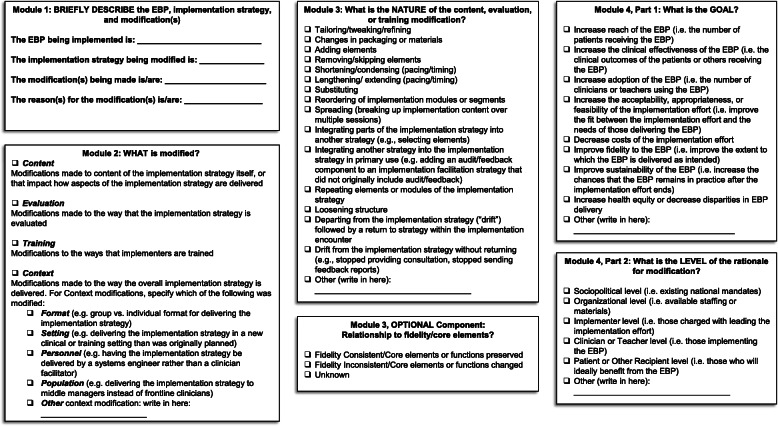
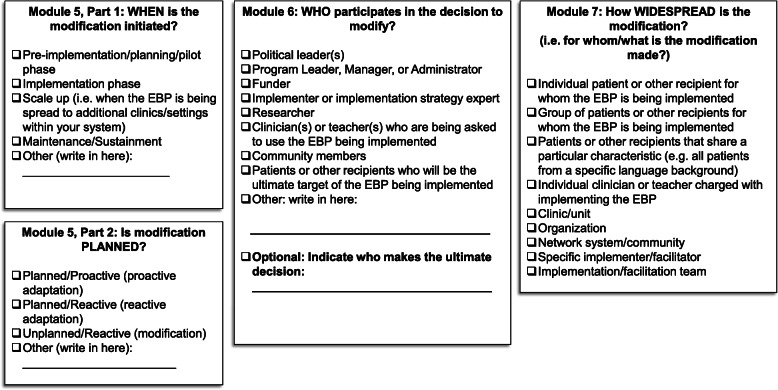
BACKGROUND: Implementation strategies are necessary to ensure that evidence-based practices are successfully incorporated into routine clinical practice. Such strategies, however, are frequently modified to fit local populations, settings, and contexts. While such modifications can be crucial to implementation success, the literature on documenting and evaluating them is virtually nonexistent. In this paper, we therefore describe the development of a new framework for documenting modifications to implementation strategies. DISCUSSION: We employed a multifaceted approach to developing the Framework for Reporting Adaptations and Modifications to Evidence-based Implementation Strategies (FRAME-IS), incorporating multiple stakeholder perspectives. Development steps included presentations of initial versions of the FRAME-IS to solicit structured feedback from individual implementation scientists ("think-aloud" exercises) and larger, international groups of researchers. The FRAME-IS includes core and supplementary modules to document modifications to implementation strategies: what is modified, the nature of the modification (including the relationship to core elements or functions), the primary goal and rationale for the modification, timing of the modification, participants in the modification decision-making process, and how widespread the modification is. We provide an example of application of the FRAME-IS to an implementation project and provide guidance on how it may be used in future work. CONCLUSION: Increasing attention is being given to modifications to evidence-based practices, but little work has investigated modifications to the implementation strategies used to implement such practices. To fill this gap, the FRAME-IS is meant to be a flexible, practical tool for documenting modifications to implementation strategies. Its use may help illuminate the pivotal processes and mechanisms by which implementation strategies exert their effects.
Overview
The claims and statistics of this paper haven’t been checked yet.
Free: it reads the open-access text and checks the first 5 claims that cite a source we can check. Create a free account to check every claim.
Integrity signals
Registry
Cites
Statistics
Figures
Verification
Claims the paper makes
The claims and statistics of this paper haven’t been checked yet.
Free: it reads the open-access text and checks the first 5 claims that cite a source we can check. Create a free account to check every claim.
Claims other papers make about this one
Each is checked against this paper’s own text: does it say what the citing paper says it does?
The source backs part of the claim, not all of it — or backs it for a different population, condition or comparison.
In the citing paper
“Retrospective in nature, this study provides guidance in evaluating the implementation of a newborn care package but is limited in providing more in-depth instruction on systematic detail on modifications and adaptations to tailor interventions for this setting (79–81).”
From Born too soon in a resource-limited setting: A 10-year mixed methods review of a special care baby unit for refugees and migrants on the Myanmar-Thailand border (2023) · cites this paper as [79]
Experimental — accuracy not yet measuredThe cited source says what the claim attributes to it.
In the citing paper
“We will document the nature of any modifications, rationale, timing and the decision-making process.44”
Self-check
Percentages, sums and reported differences re-computed from the paper’s own numbers.
The self-check needs the paper’s full text.
Citations
Cites
The Discovery of Grounded Theory; Strategies for Qualitative Research
Glaser, B. G., Strauss, A. L., & Strutzel, E. (1968) · Nursing Research · doi:10.1097/00006199-196807000-00014 · Cited by 39,449
(1998) · Sage eBooks · Cited by 38,631
The Discovery of Grounded Theory: Strategies for Qualitative Research
Glaser, B. G., & Strauss, A. L. (2017) · Aldine (Routledge reprint) · doi:10.4324/9780203793206 · Cited by 25,789
Proctor, E., Silmere, H., Raghavan, R., Hovmand, P., Aarons, G., Bunger, A., Griffey, R., & Hensley, M. (2011) · Administration and Policy in Mental Health and Mental Health Services Research · doi:10.1007/s10488-010-0319-7 · Cited by 8,721 · cited 1×
“First, regarding the goal of the modification, we have derived answer options in part from the Reach – Effectiveness – Adoption – Implementation – Maintenance ((RE-AIM) Framework [35] and Proctor’s implementation outcomes [15], plus one option related to health equity.”
MethodEvaluating the public health impact of health promotion interventions: the RE-AIM framework.
Glasgow, R. E., Vogt, T. M., & Boles, S. M. (1999) · American Journal of Public Health · doi:10.2105/ajph.89.9.1322 · Cited by 7,217 · cited 8×
“Glasgow RE, Vogt TM, Boles SM. Evaluating the public health impact of health promotion interventions: the RE-AIM framework.”
MethodInfluentialDurlak, J. A., & DuPre, E. P. (2008) · American Journal of Community Psychology · doi:10.1007/s10464-008-9165-0 · Cited by 5,304
Powell, B. J., Waltz, T. J., Chinman, M. J., Damschroder, L. J., Smith, J. L., Matthieu, M. M., Proctor, E. K., & Kirchner, J. E. (2015) · Implementation Science · doi:10.1186/s13012-015-0209-1 · Cited by 4,963 · cited 3×
“The Expert Recommendations for Implementing Change (ERIC) compilation [11] may be useful in describing the”
MethodInfluentialImplementation strategies: recommendations for specifying and reporting
Proctor, E. K., Powell, B. J., & McMillen, J. C. (2013) · Implementation Science · doi:10.1186/1748-5908-8-139 · Cited by 2,585 · cited 3×
“, administrators, frontline clinicians, implementation specialists) agreeing that a given modification is needed in a given setting [16].”
BackgroundMethodInfluentialThe dynamic sustainability framework: addressing the paradox of sustainment amid ongoing change
Chambers, D. A., Glasgow, R. E., & Stange, K. C. (2013) · Implementation Science · doi:10.1186/1748-5908-8-117 · Cited by 1,724 · cited 2×
“It is crucially important to develop a more nuanced understanding of modifications to implementation strategies because of the inherent dynamism and complexity of implementation itself [5].”
BackgroundWiltsey Stirman, S., Baumann, A. A., & Miller, C. J. (2019) · Implementation Science · doi:10.1186/s13012-019-0898-y · Cited by 1,329 · cited 5×
“The FRAME-IS is based on the FRAME, the development of which is described in detail elsewhere [10, 26] Briefly, the FRAME is a framework for tracking modifications to EBPs focused on what to adapt, alongside a related adaptation framework blending the content and processes of adaptation [27, 28].”
BackgroundMethodInfluentialSelf-citationGREENHALGH, T., JACKSON, C., SHAW, S., & JANAMIAN, T. (2016) · The Milbank Quarterly · doi:10.1111/1468-0009.12197 · Cited by 1,288 · cited 1×
“to co-creation models [24], which provide opportunities to generate collaborative knowledge about how modifications to implementation strategies impact clinical and implementation outcomes.”
BackgroundSystematic review of the Exploration, Preparation, Implementation, Sustainment (EPIS) framework
Moullin, J. C., Dickson, K. S., Stadnick, N. A., Rabin, B., & Aarons, G. A. (2019) · Implementation Science · doi:10.1186/s13012-018-0842-6 · Cited by 1,223 · cited 1×
“The timing of modifications is crucial in implementation science, with the pre-implementation, implementation, and sustainment phases featuring distinct pressures, challenges, and goals [37, 41, 42].”
BackgroundWaltz, T. J., Powell, B. J., Fernández, M. E., Abadie, B., & Damschroder, L. J. (2019) · Implementation Science · doi:10.1186/s13012-019-0892-4 · Cited by 1,136 · cited 1×
“Recent work suggests little consensus in the field regarding the selection of specific implementation strategies for a given implementation project, or the mechanisms of action for those strategies [14].”
BackgroundMethods to Improve the Selection and Tailoring of Implementation Strategies
Powell, B. J., Beidas, R. S., Lewis, C. C., Aarons, G. A., McMillen, J. C., Proctor, E. K., & Mandell, D. S. (2017) · The Journal of Behavioral Health Services & Research · doi:10.1007/s11414-015-9475-6 · Cited by 967 · cited 1×
“Concurrently, scholars acknowledge the importance of modifying implementation strategies to fit with the unique characteristics of the EBP, setting, and stakeholders involved in an implementation effort [18].”
BackgroundStirman, S. W., Miller, C. J., Toder, K., & Calloway, A. (2013) · Implementation Science · doi:10.1186/1748-5908-8-65 · Cited by 691 · cited 2×
“The FRAME-IS is based on the FRAME, the development of which is described in detail elsewhere [10, 26] Briefly, the FRAME is a framework for tracking modifications to EBPs focused on what to adapt, alongside a related adaptation framework blending the content and processes of adaptation [27, 28].”
MethodSelf-citationKilbourne, A. M., Neumann, M. S., Pincus, H. A., Bauer, M. S., & Stall, R. (2007) · Implementation Science · doi:10.1186/1748-5908-2-42 · Cited by 653
Jull, J., Giles, A., & Graham, I. D. (2017) · Implementation Science · doi:10.1186/s13012-017-0696-3 · Cited by 651
Chambers, D. A., & Norton, W. E. (2016) · American Journal of Preventive Medicine · doi:10.1016/j.amepre.2016.05.011 · Cited by 581 · cited 1×
“modifications to EBPs [25], we propose that systematic documentation is needed to determine what modifications to implementation strategies are associated with successful versus unsuccessful implementation.”
BackgroundWoodward, E. N., Matthieu, M. M., Uchendu, U. S., Rogal, S., & Kirchner, J. E. (2019) · Implementation Science · doi:10.1186/s13012-019-0861-y · Cited by 470
Reframing implementation science to address inequities in healthcare delivery
Baumann, A. A., & Cabassa, L. J. (2020) · BMC Health Services Research · doi:10.1186/s12913-020-4975-3 · Cited by 461
Self-citationAarons, G. A., Ehrhart, M. G., Farahnak, L. R., & Hurlburt, M. S. (2015) · Implementation Science · doi:10.1186/s13012-014-0192-y · Cited by 435 · cited 1×
“For example, Leadership and Organizational Change for Implementation (LOCI [36]) is a multicomponent implementation strategy that includes coaching calls.”
BackgroundA systematic review of adaptations of evidence-based public health interventions globally
Escoffery, C., Lebow-Skelley, E., Haardoerfer, R., Boing, E., Udelson, H., Wood, R., Hartman, M., Fernandez, M. E., & Mullen, P. D. (2018) · Implementation Science · doi:10.1186/s13012-018-0815-9 · Cited by 386
Pai, M., Lloyd, N. S., Cheng, J., Thabane, L., Spencer, F. A., Cook, D. J., Haynes, R. B., Schünemann, H. J., & Douketis, J. D. (2013) · Implementation Science · doi:10.1186/1748-5908-8-1 · Cited by 376
Audit and feedback and clinical practice guideline adherence: Making feedback actionable
Hysong, S. J., Best, R. G., & Pugh, J. A. (2006) · Implementation Science · doi:10.1186/1748-5908-1-9 · Cited by 371 · cited 1×
“, audit and feedback [12]) to more intensive strategies that include multiple components and may act on more than one level of a health system (e.”
BackgroundParent-Child Interaction Therapy: A Meta-analysis
Thomas, R., Abell, B., Webb, H. J., Avdagic, E., & Zimmer-Gembeck, M. J. (2017) · Pediatrics · doi:10.1542/peds.2017-0352 · Cited by 353 · cited 1×
“PCIT is an evidence-based parenting program for young children with disruptive behavior disorders [49].”
BackgroundDomenech Rodríguez, M. M., Baumann, A. A., & Schwartz, A. L. (2011) · American Journal of Community Psychology · doi:10.1007/s10464-010-9371-4 · Cited by 335
Self-citationPerez Jolles, M., Lengnick-Hall, R., & Mittman, B. S. (2019) · Journal of General Internal Medicine · doi:10.1007/s11606-018-4818-7 · Cited by 325
A scoping study of frameworks for adapting public health evidence-based interventions
Escoffery, C., Lebow-Skelley, E., Udelson, H., Böing, E. A., Wood, R., Fernandez, M. E., & Mullen, P. D. (2019) · Translational Behavioral Medicine · doi:10.1093/tbm/ibx067 · Cited by 307 · cited 1×
“Discussion Recent implementation science work has emphasized the importance of documenting modifications to EBPs [8, 10].”
BackgroundOutcomes of a Partnered Facilitation Strategy to Implement Primary Care–Mental Health
Kirchner, J. E., Ritchie, M. J., Pitcock, J. A., Parker, L. E., Curran, G. M., & Fortney, J. C. (2014) · Journal of General Internal Medicine · doi:10.1007/s11606-014-3027-2 · Cited by 255
Examining Adaptations of Evidence-Based Programs in Natural Contexts
Moore, J. E., Bumbarger, B. K., & Cooper, B. R. (2013) · The Journal of Primary Prevention · doi:10.1007/s10935-013-0303-6 · Cited by 250 · cited 1×
“Regardless of the phase in which modifications to implementation strategies are made, there is a conceptual distinction between those that are made in a planful versus reactive manner [43, 44].”
BackgroundThe think aloud method: a practical approach to modelling cognitive processes
van Someren, M., Barnard, Y. F., & Sandberg, J. A. C. (1994) · UvA-DARE (University of Amsterdam) · Cited by 220
Using Planned Adaptation to Implement Evidence‐Based Programs with New Populations
Lee, S. J., Altschul, I., & Mowbray, C. T. (2008) · American Journal of Community Psychology · doi:10.1007/s10464-008-9160-5 · Cited by 209
Tracking implementation strategies: a description of a practical approach and early findings
Bunger, A. C., Powell, B. J., Robertson, H. A., MacDowell, H., Birken, S. A., & Shea, C. (2017) · Health Research Policy and Systems · doi:10.1186/s12961-017-0175-y · Cited by 208 · cited 1×
“In addition to tracking the specific implementation strategies being used in a given project [19, 20], we advocate for the need to document and evaluate modifications to implementation strategies that have been welldefined and characterized.”
MethodKumar, A., Gautam, A., Dey, A., Saith, R., Uttamacharya, Achyut, P., Gautam, V., Agarwal, D., Chakraverty, A., Mozumdar, A., et al. (2020) · BMC Health Services Research · doi:10.1186/s12913-019-4778-6 · Cited by 205
Barrera, M., Berkel, C., & Castro, F. G. (2017) · Prevention Science · doi:10.1007/s11121-016-0705-9 · Cited by 203
Wiltsey Stirman, S., A Gutner, C., Crits-Christoph, P., Edmunds, J., Evans, A. C., & Beidas, R. S. (2015) · Implementation Science · doi:10.1186/s13012-015-0308-z · Cited by 188 · cited 2×
“Adaptation of an EBP has been defined as the deliberate alteration of its design or delivery to improve its fit in a given context [1, 2].”
BackgroundSelf-citationBarnett, M. L., Lau, A. S., & Miranda, J. (2018) · Annual Review of Clinical Psychology · doi:10.1146/annurev-clinpsy-050817-084825 · Cited by 182
Self-citationVCE Physical Activity Leadership Team, Chambers, D., Simpson, L., Neta, G., Schwarz, U. V. T., Percy-Laurry, A., Aarons, G. A., Neta, G., Brownson, R., Vogel, A., et al. (2017) · Implementation Science · doi:10.1186/s13012-017-0575-y · Cited by 156
Self-citationGama, E., Madan, J., Banda, H., Squire, B., Thomson, R., & Namakhoma, I. (2015) · Implementation Science · doi:10.1186/s13012-014-0195-8 · Cited by 155
Wiltsey Stirman, S., Gamarra, J. M., Bartlett, B. A., Calloway, A., & Gutner, C. A. (2017) · Clinical Psychology: Science and Practice · doi:10.1111/cpsp.12218 · Cited by 138 · cited 1×
“Adaptation of an EBP has been defined as the deliberate alteration of its design or delivery to improve its fit in a given context [1, 2].”
BackgroundSelf-citationMiller, C. J., Wiltsey‐Stirman, S., & Baumann, A. A. (2020) · Journal of Community Psychology · doi:10.1002/jcop.22279 · Cited by 138
Self-citationBoyd, M. R., Powell, B. J., Endicott, D., & Lewis, C. C. (2018) · Behavior Therapy · doi:10.1016/j.beth.2017.11.012 · Cited by 137 · cited 2×
“In addition to tracking the specific implementation strategies being used in a given project [19, 20], we advocate for the need to document and evaluate modifications to implementation strategies that have been welldefined and characterized.”
BackgroundMethodNicholson, E., McDonnell, T., De Brún, A., Barrett, M., Bury, G., Collins, C., Hensey, C., & McAuliffe, E. (2020) · BMC Health Services Research · doi:10.1186/s12913-020-05527-5 · Cited by 107
Rogers, L., Brún, A. D., Birken, S. A., Davies, C., & McAuliffe, É. (2020) · BMC Health Services Research · doi:10.1186/s12913-020-05905-z · Cited by 102
Salloum, R. G., Shenkman, E. A., Louviere, J. J., & Chambers, D. A. (2017) · Implementation Science · doi:10.1186/s13012-017-0675-8 · Cited by 87
Building capacity for dissemination and implementation research: one university’s experience
Brownson, R. C., Proctor, E. K., Luke, D. A., Baumann, A. A., Staub, M., Brown, M. T., & Johnson, M. O. (2017) · Implementation Science · doi:10.1186/s13012-017-0634-4 · Cited by 84
Self-citationAdaptations in a Community-Based Family Intervention: Replication of Two Coding Schemes
Cooper, B. R., Shrestha, G., Hyman, L., & Hill, L. (2016) · The Journal of Primary Prevention · doi:10.1007/s10935-015-0413-4 · Cited by 62 · cited 1×
“Modifications to EBPs may be made in either an ad hoc or planful manner; the latter category of planned modifications may be labeled as adaptations [3, 4].”
BackgroundTowards a heart and soul for co-creative research practice: a systemic approach
Nicholas, G., Foote, J., Kainz, K., Midgley, G., Prager, K., & Zurbriggen, C. (2019) · Evidence & Policy · doi:10.1332/174426419x15578220630571 · Cited by 60
Molina, R. L., Neal, B. J., Bobanski, L., Singh, V. P., Neville, B. A., Delaney, M. M., Lipsitz, S., Karlage, A., Shetye, M., & Semrau, K. E. A. (2020) · Implementation Science · doi:10.1186/s13012-019-0962-7 · Cited by 59
Smith, S. N., Liebrecht, C., Bauer, M. S., & Kilbourne, A. M. (2020) · Health Services Research · doi:10.1111/1475-6773.13583 · Cited by 47
Baumann, A. A., Domenech Rodríguez, M. M., Amador, N. G., Forgatch, M. S., & Parra-Cardona, J. R. (2014) · Clinical Psychology: Science and Practice · doi:10.1111/cpsp.12059 · Cited by 44
Self-citationBarnett, M. L., Miranda, J. M., Kia‐Keating, M., Saldana, L., Landsverk, J. A., & Lau, A. S. (2019) · BMJ Open · doi:10.1136/bmjopen-2019-028988 · Cited by 33
Self-citationRogal, S. S., Yakovchenko, V., Morgan, T. R. M., Bajaj, J. S., Gonzalez, R. I., Park, A., Beste, L. A., Miech, E. J., Lamorte, C., Neely, B., et al. (2020) · Implementation Science · doi:10.1186/s13012-020-01050-7 · Cited by 30
Barnett, M. L., Davis, E., Callejas, L. M., White, J. V., Acevedo-Polakovich, I. D., Niec, L. N., & Jent, J. F. (2016) · Children and Youth Services Review · doi:10.1016/j.childyouth.2016.03.016 · Cited by 29
Self-citationIverson, K. M., Dichter, M. E., Stolzmann, K. L., Adjognon, O. L., Lew, R., Bruce, L. E., Gerber, M. R., Portnoy, G. A., & Miller, C. J. (2020) · Implementation Science · doi:10.1186/s13012-020-0969-0 · Cited by 28
Self-citationEngell, T., Follestad, I. B., Andersen, A., & Hagen, K. A. (2018) · Trials · doi:10.1186/s13063-018-3079-4 · Cited by 27
Morley, K. C., Kranzler, H. R., Luquin, N., Baillie, A., Shanahan, M., Trent, R. J., Teesson, M., & Haber, P. (2018) · Trials · doi:10.1186/s13063-018-2824-z · Cited by 12
Supporting implementation science capacity in a university setting
Beidas, R. S., Bennett, I. M., Fleischer, L., Day, T., & Meisel, Z. F. (2015) · Implementation Science · doi:10.1186/1748-5908-10-s1-a79 · Cited by 5
Smith, S. N., Almirall, D., Bauer, M. S., Liebrecht, C., & Kilbourne, A. M. (2020) · Health Services Research · doi:10.1111/1475-6773.13413 · Cited by 5
Research works printed but not linked: 1
- Smith JL, R.M., Miller CJ, Chinman MJ, Landes S, Kelly PA, Kirchner JE. Getting to fidelity: identifying core components of implementation facilitation strategies. In Innovation to Impact: Research to Advance VA’s Learning Healthcare Community (VA HSR&D / QUERI National Conference). 2019 (October). Washington, DC.
Cited by
The updated consolidated framework for implementation research based on user feedback
Damschroder, L. J., Reardon, C. M., Widerquist, M. A. O., & Lowery, J. (2022) · Implementation Science · doi:10.1186/s13012-022-01245-0 · Cited by 4,452
Revisiting concepts of evidence in implementation science
Brownson, R. C., Shelton, R. C., Geng, E. H., & Glasgow, R. E. (2022) · Implementation Science · doi:10.1186/s13012-022-01201-y · Cited by 201
The Lancet Psychiatry Commission: transforming mental health implementation research
McGinty, E. E., Alegria, M. M., Beidas, R. S., Braithwaite, J., Kola, L., LESLIE, D. L., Moise, N., Mueller, B., Pincus, H. A., Shidhaye, R. R., et al. (2024) · The Lancet Psychiatry · doi:10.1016/s2215-0366(24)00040-3 · Cited by 148
Hurwitz, S., Garman‐McClaine, B., & Carlock, K. (2021) · Autism · doi:10.1177/13623613211035935 · Cited by 132
Advancing healthcare equity through dissemination and implementation science
Baumann, A. A., Shelton, R. C., Kumanyika, S., & Haire-Joshu, D. L. (2023) · Health Services Research · doi:10.1111/1475-6773.14175 · Cited by 116
Self-citation
Metadata
- Authors
- Miller, C. J., Barnett, M. L., Baumann, A. A., Gutner, C. A., & Wiltsey-Stirman, S.
- Affiliations
- Harvard University (US)
- University of California, Santa Barbara (US)
- Washington University in St. Louis (US)
- Boston University (US)
- Corresponding author
- Miller, Christopher J.
- Venue
- Implementation Science
- Published
- 2021-04-07
- Volume
- 16
- Issue
- 1
- Pages
- 36-36
- ISSN
- 1748-5908 (ISSN-L)
- PMC
- PMC8024675
- OpenAlex
- W3150872160
- Cited by
- 490
- References
- 60
- Citations by year
- 2026: 93 · 2025: 88 · 2024: 138 · 2023: 105 · 2022: 60 · 2021: 6
- FWCI
- 88.18
- Type
- journal article
- Language
- en
- Open access
- gold
- doi.org
- Licence
- cc-by
- creativecommons.org/licenses/by/4.0/ (tdm)
- creativecommons.org/licenses/by/4.0/ (vor)
- Locations
- Implementation Science (publishedVersion, cc-by)
- PubMed Central (publishedVersion, cc-by)
- PubMed (publishedVersion)
- DOAJ (DOAJ: Directory of Open Access Journals) (submittedVersion, cc-by-sa)
- Funders
- National Institute of Mental Health (R01 MH 109506, 5R25 MH 08091607)
- Health Services Research and Development (QUERI QUE 15-289)
- Topics
- Health Sciences › Health Professions › General Health Professions › Health Policy Implementation Science
- Health Sciences › Health Professions › General Health Professions › Health Sciences Research and Education
- Health Sciences › Medicine › Public Health, Environmental and Occupational Health › Clinical practice guidelines implementation
- Keywords
- implementation strategies, reporting framework, implementation research, stakeholder feedback, think-aloud, implementation mechanisms
- MeSH terms
- Delivery of Health Care, Health Facilities, Humans, Evidence-Based Practice
About these checks
Registry, retraction, Cites and statistics results are computed, not judged, with one exception: a printed reference that no index lists is read once by a model before it counts as a citation error. Claims are extracted by a model and kept only when their quote appears verbatim in the text; each cited source is then checked, with a model’s help, for whether it says what the claim relies on. Those verdicts can be wrong — read the claim’s quote and the cited source before relying on one.
Statistics and arithmetic are recomputed, not judged.
Confidence bands are shown only for fields calibrated on our annotated test set. None is calibrated yet, so no band is shown.
What counts as a claim ›How we measure confidence ›How we check this ›
Are you an author, or do you see a problem with this page? Request a review
Data sources
Bibliographic data: Semantic Scholar, OpenAlex, Crossref.
Contains information from the Semantic Scholar Academic Graph Datasets, made available under the ODC Attribution License (ODC-BY 1.0).
Semantic Scholar’s data is described in: Kinney, R., et al. (2023). The Semantic Scholar Open Data Platform. arXiv:2301.10140.
