

Endothelial nitric oxide synthase: a potential therapeutic target for cerebrovascular diseases
Open accessThe DOI matches its Crossref record; 72 of the 72 references it cites were found in a registry or an index.
Abstract
Endothelial nitric oxide (NO) is a significant signaling molecule that regulates cerebral blood flow (CBF), playing a pivotal role in the prevention and treatment of cerebrovascular diseases. However, achieving the expected therapeutic efficacy is difficult using direct administration of NO donors. Therefore, endothelial nitric oxide synthase (eNOS) becomes a potential therapeutic target for cerebrovascular diseases. This review summarizes the current evidence supporting the importance of CBF to cerebrovascular function, and the roles of NO and eNOS in CBF regulation.
Overview
The claims and statistics of this paper haven’t been checked yet.
Free: it reads the open-access text and checks the first 5 claims that cite a source we can check. Create a free account to check every claim.
Integrity signals
Registry
Cites
Statistics
Figures
Verification
Claims the paper makes
The claims and statistics of this paper haven’t been checked yet.
Free: it reads the open-access text and checks the first 5 claims that cite a source we can check. Create a free account to check every claim.
Self-check
Percentages, sums and reported differences re-computed from the paper’s own numbers.
The self-check needs the paper’s full text.
Citations
Cites
Activation of nitric oxide synthase in endothelial cells by Akt-dependent phosphorylation
Dimmeler, S., Fleming, I., Fisslthaler, B., Hermann, C., Busse, R., & Zeiher, A. M. (1999) · Nature · doi:10.1038/21224 · Cited by 3,591 · cited 1×
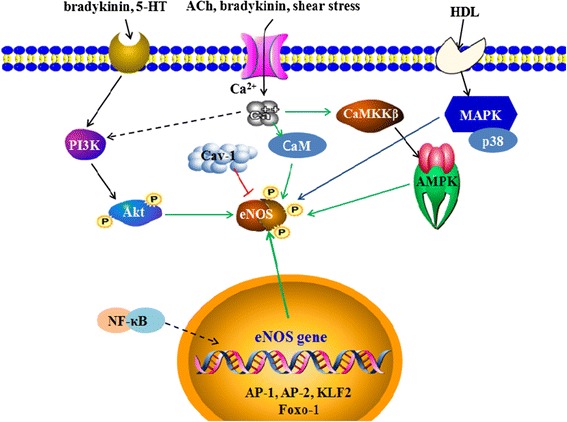
“Furthermore, eNOS can be activated by either shear stress through phosphorylation of Ser1177 via the PI3K/ Akt pathway [50], or by high density lipoprotein (HDL) modification by Akt kinase and mitogen-activated protein kinase (MAPK) [65].”
Regulation of endothelium-derived nitric oxide production by the protein kinase Akt
Fulton, D., Gratton, J.-P., McCabe, T. J., Fontana, J., Fujio, Y., Walsh, K., Franke, T. F., Papapetropoulos, A., & Sessa, W. C. (1999) · Nature · doi:10.1038/21218 · Cited by 2,608 · cited 1×
“The threonine protein kinase (Akt/PKB) is an important determinant of the phosphorylation of the eNOS Ser1177 site, which is involved in the basic activation of eNOS and its agonist activation [52, 53].”
Glial and neuronal control of brain blood flow
Attwell, D., Buchan, A. M., Charpak, S., Lauritzen, M., MacVicar, B. A., & Newman, E. A. (2010) · Nature · doi:10.1038/nature09613 · Cited by 2,511
Landmesser, U., Dikalov, S., Price, S. R., McCann, L., Fukai, T., Holland, S. M., Mitch, W. E., & Harrison, D. G. (2003) · Journal of Clinical Investigation · doi:10.1172/jci200314172 · Cited by 1,660
Landmesser, U., Dikalov, S., Price, S. R., McCann, L. A., Fukai, T., Holland, S. M., Mitch, W. E., & Harrison, D. G. (2003) · Journal of Clinical Investigation · doi:10.1172/jci14172 · Cited by 1,655
Hawley, S. A., Pan, D. A., Mustard, K. J., Ross, L., Bain, J., Edelman, A. M., Frenguelli, B. G., & Hardie, D. G. (2005) · Cell Metabolism · doi:10.1016/j.cmet.2005.05.009 · Cited by 1,589
Superoxide generation by endothelial nitric oxide synthase: The influence of cofactors
Vásquez-Vivar, J., Kalyanaraman, B., Martásek, P., Hogg, N., Masters, B. S. S., Karoui, H., Tordo, P., & Pritchard, K. A. (1998) · Proceedings of the National Academy of Sciences · doi:10.1073/pnas.95.16.9220 · Cited by 1,484
Woods, A., Dickerson, K., Heath, R., Hong, S.-P., Momcilovic, M., Johnstone, S. R., Carlson, M., & Carling, D. (2005) · Cell Metabolism · doi:10.1016/j.cmet.2005.06.005 · Cited by 1,392
Essential role of endothelial nitric oxide synthase for mobilization of stem and progenitor cells
Aicher, A., Heeschen, C., Mildner-Rihm, C., Urbich, C., Ihling, C., Technau-Ihling, K., Zeiher, A. M., & Dimmeler, S. (2003) · Nature Medicine · doi:10.1038/nm948 · Cited by 1,305 · cited 1×
“The impaired neovascularization in mice lacking eNOS is related to a defect in progenitor cell mobilization [30].”
Mammalian nitric oxide synthases
Stuehr, D. J. (1999) · Biochimica et Biophysica Acta (BBA) - Bioenergetics · doi:10.1016/s0005-2728(99)00016-x · Cited by 996 · cited 1×
“To obtain full catalytic activity under physiological conditions, separate N-terminal oxygenase and C-terminal reductase domains of eNOS must be joined together in the presence of heme, BH4 and Ca/CaM complex [7, 34].”
Phosphoinositide 3-kinases: A conserved family of signal transducers
Vanhaesebroeck, B., Leevers, S. J., Panayotou, G., & Waterfield, M. D. (1997) · Trends in Biochemical Sciences · doi:10.1016/s0968-0004(97)01061-x · Cited by 954 · cited 1×
“PI3K recruits Akt to cell membrane and phosphorylates it [55].”
Sessa, W. C., Pritchard, K., Seyedi, N., Wang, J., & Hintze, T. H. (1994) · Circulation Research · doi:10.1161/01.res.74.2.349 · Cited by 934
AMP‐activated protein kinase phosphorylation of endothelial NO synthase
Chen, Z.-P., Mitchelhill, K. I., Michell, B. J., Stapleton, D., Rodriguez-Crespo, I., Witters, L. A., Power, D. A., Ortiz de Montellano, P. R., & Kemp, B. E. (1999) · FEBS Letters · doi:10.1016/s0014-5793(98)01705-0 · Cited by 835
Dissecting the Interaction between Nitric Oxide Synthase (NOS) and Caveolin
Garcı́a-Cardeña, G., Martasek, P., Masters, B. S. S., Skidd, P. M., Couet, J., Li, S., Lisanti, M. P., & Sessa, W. C. (1997) · Journal of Biological Chemistry · doi:10.1074/jbc.272.41.25437 · Cited by 821
Fleming, I., Fisslthaler, B., Dimmeler, S., Kemp, B. E., & Busse, R. (2001) · Circulation Research · doi:10.1161/hh1101.092677 · Cited by 770
Enzymatic function of nitric oxide synthases
Andrew, P. (1999) · Cardiovascular Research · doi:10.1016/s0008-6363(99)00115-7 · Cited by 753 · cited 2×
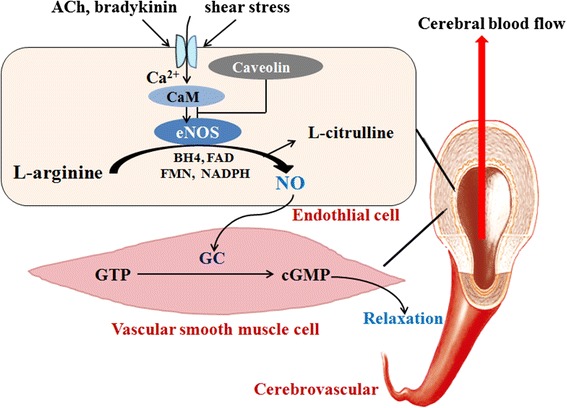
“Studies have shown that the endothelial NO generated in cerebrovascular endothelium is one of the most important signaling molecules of CBF autoregulatory mechanisms [7, 8].”
Nishida, K., Harrison, D. G., Navas, J. P., Fisher, A. A., Dockery, S. P., Uematsu, M., Nerem, R. M., Alexander, R. W., & Murphy, T. J. (1992) · Journal of Clinical Investigation · doi:10.1172/jci116092 · Cited by 735
Huang, Z., Huang, P. L., Ma, J., Meng, W., Ayata, C., Fishman, M. C., & Moskowitz, M. A. (1996) · Journal of Cerebral Blood Flow & Metabolism · doi:10.1097/00004647-199609000-00023 · Cited by 718 · cited 4×
“5-HT: 5-hydroxytryptamine; Ach: acetylcholine; Akt: protein kinase B; Akt/ PKB: threonine protein kinase; AMP: adenosine 5′-monophosphate; AMPK: adenosine 5′-monophosphate (AMP)-activated protein kinase; AP1: activator protein-1; AP-2: activator protein-2; BH4: tetrahydrobiopterin; BMECs: brain microvascular endotheli…”
InfluentialBucci, M., Gratton, J.-P., Rudic, R. D., Acevedo, L., Roviezzo, F., Cirino, G., & Sessa, W. C. (2000) · Nature Medicine · doi:10.1038/82176 · Cited by 572
Platelets at work in primary hemostasis
Broos, K., Feys, H. B., De Meyer, S. F., Vanhoorelbeke, K., & Deckmyn, H. (2011) · Blood Reviews · doi:10.1016/j.blre.2011.03.002 · Cited by 502 · cited 1×
“NO plays a pivotal role in regulating cerebrovascular effects by increasing or decreasing oxygen, and elevating carbon dioxide, carbon monoxide and cerebrovascular autoregulation [9, 10].”
Gao, F., Gao, E., Yue, T.-L., Ohlstein, E. H., Lopez, B. L., Christopher, T. A., & Ma, X.-L. (2002) · Circulation · doi:10.1161/01.cir.0000012529.00367.0f · Cited by 469
Mineo, C., Yuhanna, I. S., Quon, M. J., & Shaul, P. W. (2003) · Journal of Biological Chemistry · doi:10.1074/jbc.m211394200 · Cited by 390 · cited 3×
“5-HT: 5-hydroxytryptamine; Ach: acetylcholine; Akt: protein kinase B; Akt/ PKB: threonine protein kinase; AMP: adenosine 5′-monophosphate; AMPK: adenosine 5′-monophosphate (AMP)-activated protein kinase; AP1: activator protein-1; AP-2: activator protein-2; BH4: tetrahydrobiopterin; BMECs: brain microvascular endotheli…”
McCabe, T. J., Fulton, D., Roman, L. J., & Sessa, W. C. (2000) · Journal of Biological Chemistry · doi:10.1074/jbc.275.9.6123 · Cited by 387
Cerebral Blood Flow Regulation by Nitric Oxide: Recent Advances
Toda, N., Ayajiki, K., & Okamura, T. (2009) · Pharmacological Reviews · doi:10.1124/pr.108.000547 · Cited by 386 · cited 2×
“They also supply new clues for developing novel therapeutic strategies for cerebral dysfunction [9].”
Thomas, S. R., Chen, K., & Keaney, J. F. (2002) · Journal of Biological Chemistry · doi:10.1074/jbc.m109107200 · Cited by 381
Mintun, M. A., Lundstrom, B. N., Snyder, A. Z., Vlassenko, A. G., Shulman, G. L., & Raichle, M. E. (2001) · Proceedings of the National Academy of Sciences · doi:10.1073/pnas.111164398 · Cited by 361 · cited 1×
“It is reported that decreased arterial oxygen supply (hypoxia) increases the CBF baseline in humans [14].”
Pathology and pathogenesis of vascular cognitive impairment—a critical update
Jellinger, K. A. (2013) · Frontiers in Aging Neuroscience · doi:10.3389/fnagi.2013.00017 · Cited by 353
Gallis, B., Corthals, G. L., Goodlett, D. R., Ueba, H., Kim, F., Presnell, S. R., Figeys, D., Harrison, D. G., Berk, B. C., Aebersold, R., et al. (1999) · Journal of Biological Chemistry · doi:10.1074/jbc.274.42.30101 · Cited by 326
Cyclic strain upregulates nitric oxide synthase in cultured bovine aortic endothelial cells.
Awolesi, M. A., Sessa, W. C., & Sumpio, B. E. (1995) · Journal of Clinical Investigation · doi:10.1172/jci118181 · Cited by 326
AMP-activated protein kinase functionally phosphorylates endothelial nitric oxide synthase Ser633
Chen, Z., Peng, I.-C., Sun, W., Su, M.-I., Hsu, P.-H., Fu, Y., Zhu, Y., DeFea, K., Pan, S., Tsai, M.-D., et al. (2009) · Circulation Research · doi:10.1161/circresaha.108.187567 · Cited by 264
Shear stress elevates endothelial cGMP. Role of a potassium channel and G protein coupling.
Ohno, M., Gibbons, G. H., Dzau, V. J., & Cooke, J. P. (1993) · Circulation · doi:10.1161/01.cir.88.1.193 · Cited by 261
Gertz, K., Priller, J., Kronenberg, G., Fink, K. B., Winter, B., Schröck, H., Ji, S., Milosevic, M., Harms, C., Böhm, M., et al. (2006) · Circulation Research · doi:10.1161/01.res.0000250175.14861.77 · Cited by 252 · cited 1×
“This nevertheless enhances neovascularization and CBF by eNOS-dependent mechanisms after brain ischemia [29].”
Bauer, P. M., Fulton, D., Boo, Y. C., Sorescu, G. P., Kemp, B. E., Jo, H., & Sessa, W. C. (2003) · Journal of Biological Chemistry · doi:10.1074/jbc.m211926200 · Cited by 242 · cited 1×
“The threonine protein kinase (Akt/PKB) is an important determinant of the phosphorylation of the eNOS Ser1177 site, which is involved in the basic activation of eNOS and its agonist activation [52, 53].”
Morikawa, E., Moskowitz, M. A., Huang, Z., Yoshida, T., Irikura, K., & Dalkara, T. (1994) · Stroke · doi:10.1161/01.str.25.2.429 · Cited by 229
Endothelial nitric oxide: protector of a healthy mind
Katusic, Z. S., & Austin, S. A. (2014) · European Heart Journal · doi:10.1093/eurheartj/eht544 · Cited by 222 · cited 1×
“More importantly, different risk factors for cerebrovascular diseases including hypertension, hypercholesterolemia, diabetes, aging, smoking, and obesity could all impair contraction and dilation of cerebrovascular endothelium [2].”
Regulation of bovine endothelial constitutive nitric oxide synthase by oxygen.
Liao, J. K., Zulueta, J. J., Yu, F. S., Peng, H. B., Cote, C. G., & Hassoun, P. M. (1995) · Journal of Clinical Investigation · doi:10.1172/jci118332 · Cited by 204
Zimmermann, K., Opitz, N., Dedio, J., Renné, C., Müller-Esterl, W., & Oess, S. (2002) · Proceedings of the National Academy of Sciences · doi:10.1073/pnas.252345399 · Cited by 192
NOSIP, a novel modulator of endothelial nitric oxide synthase activity
DEDIO, J., KÖNIG, P., WOHLFART, P., SCHROEDER, C., KUMMER, W., & MÜLLER-ESTERL, W. (2001) · The FASEB Journal · doi:10.1096/fj.00-0078com · Cited by 191
Willmot, M., Gray, L., Gibson, C., Murphy, S., & Bath, P. M. W. (2005) · Nitric Oxide · doi:10.1016/j.niox.2005.01.003 · Cited by 179
Sabayan, B., Jansen, S., Oleksik, A. M., van Osch, M. J. P., van Buchem, M. A., van Vliet, P., de Craen, A. J. M., & Westendorp, R. G. J. (2012) · Ageing Research Reviews · doi:10.1016/j.arr.2011.12.009 · Cited by 179
The role of neuronal signaling in controlling cerebral blood flow
DRAKE, C., & IADECOLA, C. (2007) · Brain and Language · doi:10.1016/j.bandl.2006.08.002 · Cited by 177 · cited 1×
“Studies have shown that the endothelial NO generated in cerebrovascular endothelium is one of the most important signaling molecules of CBF autoregulatory mechanisms [7, 8].”
Nitric oxide signaling in hypoxia
Ho, J. J. D., Man, H. S. J., & Marsden, P. A. (2012) · Journal of Molecular Medicine · doi:10.1007/s00109-012-0880-5 · Cited by 167 · cited 1×
“Thus, NO plays a significant role in both the signaling event and the CBF response [15].”
Increased Expression of Endothelial Constitutive Nitric Oxide Synthase in Rat Aorta during Pregnancy
Goetz, R. M., Morano, I. L., Calovini, T., Studer, R., & Holtz, J. (1994) · Biochemical and Biophysical Research Communications · doi:10.1006/bbrc.1994.2750 · Cited by 149
Inhibitory Interactions of the Bradykinin B2 Receptor with Endothelial Nitric-oxide Synthase
Ju, H., Venema, V. J., Marrero, M. B., & Venema, R. C. (1998) · Journal of Biological Chemistry · doi:10.1074/jbc.273.37.24025 · Cited by 146
Interaction between Caveolin-1 and the Reductase Domain of Endothelial Nitric-oxide Synthase
Ghosh, S., Gachhui, R., Crooks, C., Wu, C., Lisanti, M. P., & Stuehr, D. J. (1998) · Journal of Biological Chemistry · doi:10.1074/jbc.273.35.22267 · Cited by 146
Endothelial nitric oxide synthase transgenic models of endothelial dysfunction
Atochin, D. N., & Huang, P. L. (2010) · Pflügers Archiv - European Journal of Physiology · doi:10.1007/s00424-010-0867-4 · Cited by 145 · cited 2×
“strategy for the prevention of cerebrovascular diseases [11].”
Vascular protection by tetrahydrobiopterin: progress and therapeutic prospects
Katusic, Z. S., d’Uscio, L. V., & Nath, K. A. (2009) · Trends in Pharmacological Sciences · doi:10.1016/j.tips.2008.10.003 · Cited by 140 · cited 1×
“If the concentration of BH4 becomes suboptimal, the eNOS dimer will uncouple from other eNOS monomers, resulting in reducing the production of endothelial NO and increasing the production of superoxide anions and peroxynitrite [13].”
Tan, X.-L., Xue, Y.-Q., Ma, T., Wang, X., Li, J. J., Lan, L., Malik, K. U., McDonald, M. P., Dopico, A. M., & Liao, F.-F. (2015) · Molecular Neurodegeneration · doi:10.1186/s13024-015-0020-0 · Cited by 129 · cited 4×
“5-HT: 5-hydroxytryptamine; Ach: acetylcholine; Akt: protein kinase B; Akt/ PKB: threonine protein kinase; AMP: adenosine 5′-monophosphate; AMPK: adenosine 5′-monophosphate (AMP)-activated protein kinase; AP1: activator protein-1; AP-2: activator protein-2; BH4: tetrahydrobiopterin; BMECs: brain microvascular endotheli…”
InfluentialSimoncini, T., Genazzani, A. R., & Liao, J. K. (2002) · Circulation · doi:10.1161/hc1102.105267 · Cited by 125
Vellimana, A. K., Milner, E., Azad, T. D., Harries, M. D., Zhou, M.-L., Gidday, J. M., Han, B. H., & Zipfel, G. J. (2011) · Stroke · doi:10.1161/strokeaha.110.607200 · Cited by 106
Gonzalez, E., Kou, R., Lin, A. J., Golan, D. E., & Michel, T. (2002) · Journal of Biological Chemistry · doi:10.1074/jbc.m207299200 · Cited by 96 · cited 1×
“Akt mainly resides in the cytoplasm inactively; translocation to the cell membrane induces its activation and the phosphorylation of eNOS [54].”
Khurana, V. G., Sohni, Y. R., Mangrum, W. I., McClelland, R. L., O’Kane, D. J., Meyer, F. B., & Meissner, I. (2004) · Journal of Cerebral Blood Flow & Metabolism · doi:10.1097/01.wcb.0000110540.96047.c7 · Cited by 92 · cited 2×
“eNOS activity and result in greater risk [19, 20].”
Is targeting eNOS a key mechanistic insight of cardiovascular defensive potentials of statins?
Balakumar, P., Kathuria, S., Taneja, G., Kalra, S., & Mahadevan, N. (2011) · Journal of Molecular and Cellular Cardiology · doi:10.1016/j.yjmcc.2011.09.014 · Cited by 92 · cited 1×
“This is mediated by diverse signaling, such as Rho/ROCK, PI3K/Akt, caveolin, ERK 1/2, and so on [66, 67].”
Schilling, K., Opitz, N., Wiesenthal, A., Oess, S., Tikkanen, R., Müller-Esterl, W., & Icking, A. (2006) · Molecular Biology of the Cell · doi:10.1091/mbc.e05-08-0709 · Cited by 85
Gao, Y.-Z., Zhang, J.-J., Liu, H., Wu, G.-Y., Xiong, L., & Shu, M. (2013) · Current Neurovascular Research · doi:10.2174/156720213804806016 · Cited by 83
The central role of adenosine in statin-induced ERK1/2, Akt, and eNOS phosphorylation
Merla, R., Ye, Y., Lin, Y., Manickavasagam, S., Huang, M.-H., Perez‐Polo, R. J., Uretsky, B. F., & Birnbaum, Y. (2007) · American Journal of Physiology-Heart and Circulatory Physiology · doi:10.1152/ajpheart.00416.2007 · Cited by 80 · cited 1×
“This is mediated by diverse signaling, such as Rho/ROCK, PI3K/Akt, caveolin, ERK 1/2, and so on [66, 67].”
Role of endothelial nitric oxide synthetase in arteriogenesis after stroke in mice
Cui, X., Chopp, M., Zacharek, A., Zhang, C., Roberts, C., & Chen, J. (2009) · Neuroscience · doi:10.1016/j.neuroscience.2008.12.055 · Cited by 79 · cited 1×
“Moreover, eNOS not only promotes vasodilation but also increases the proliferation and migration of VSMCs, thereby enhancing arteriogenesis after stroke [28].”
Salom, J. B., Ortı́, M., Centeno, J. M., Torregrosa, G., & Alborch, E. (2000) · Brain Research · doi:10.1016/s0006-8993(00)02095-3 · Cited by 76
Current Therapeutic Strategies to Mitigate the eNOS Dysfunction in Ischaemic Stroke
Srivastava, K., Bath, P. M., & Bayraktutan, U. (2011) · Cellular and Molecular Neurobiology · doi:10.1007/s10571-011-9777-z · Cited by 70 · cited 1×
“Impairment of eNOS activity by SAH, traumatic brain injury (TBI) and ischemic stroke has been implicated in many cellular mechanisms of neuronal injury [17].”
Perivascular nitric oxide and superoxide in neonatal cerebral hypoxia-ischemia
Fabian, R. H., Perez-Polo, J. R., & Kent, T. A. (2008) · American Journal of Physiology-Heart and Circulatory Physiology · doi:10.1152/ajpheart.00301.2007 · Cited by 65 · cited 1×
“Uncoupled eNOS in the cerebral arteries has been reported to participate in hypoxic-ischemic brain injury by inducing oxidative stress under ischemia [31].”
The endothelium – the body's largest endocrine gland?
Änggård, E. (1990) · Journal of Endocrinology · doi:10.1677/joe.0.1270371 · Cited by 57
Understanding peroxynitrite biochemistry and its potential for treating human diseases
Beckman, J. S. (2009) · Archives of Biochemistry and Biophysics · doi:10.1016/j.abb.2009.03.013 · Cited by 56 · cited 1×
“On one hand, vascular risk factors promote the up-regulation of NADPH-oxidase activity, generation of superoxide anions, chemical inactivation of NO, and generation of a potent oxidant, peroxynitrite [12].”
Ma, Y., Fuzhen, Y., Wang, Y., Du, Z., Liu, D.-H., Guo, H., Shen, J., & Peng, H. (2012) · PLoS ONE · doi:10.1371/journal.pone.0047900 · Cited by 54
Cobbs, C., Fenoy, A. J., Bredt, D. S., & Noble‐Haeusslein, L. J. (1997) · Brain Research · doi:10.1016/s0006-8993(96)01429-1 · Cited by 51 · cited 1×
“has suggested that the immunoreactivity of eNOS is increased in the microvasculature surrounding the area of impact in the first 3 days after experimental trauma [22].”
Robertson, C. S., Gopinath, S. P., Valadka, A. B., Van, M., Swank, P. R., & Goodman, J. C. (2011) · Journal of Neurotrauma · doi:10.1089/neu.2010.1476 · Cited by 51 · cited 1×
“Patients with decreased endogenous eNOS levels have poorer outcomes than patients with alleles that do not affect eNOS levels [21].”
Roberts, B. W., Mitchell, J., Kilgannon, J. H., Chansky, M. E., & Trzeciak, S. (2013) · Shock · doi:10.1097/shk.0b013e31827f565b · Cited by 51
Starke, R. M., Kim, G. H., Komotar, R. J., Hickman, Z. L., Black, E. M., Rosales, M. B., Kellner, C. P., Hahn, D. K., Otten, M. L., Edwards, J. G., et al. (2008) · Journal of Cerebral Blood Flow & Metabolism · doi:10.1038/jcbfm.2008.11 · Cited by 48 · cited 1×
“eNOS activity and result in greater risk [19, 20].”
Hemodynamic and Histological Effects of Traumatic Brain Injury in eNOS-Deficient Mice
Lundblad, C., Grände, P., & Bentzer, P. (2009) · Journal of Neurotrauma · doi:10.1089/neu.2009.0955 · Cited by 35 · cited 1×
“However, eNOS knockout mice have greater reduction in CBF than wildtype variants in the first 2 h after trauma [23].”
Ito, D., Ito, O., Mori, N., Muroya, Y., Cao, P.-Y., Takashima, K., Kanazawa, M., & Kohzuki, M. (2010) · Journal of Hypertension · doi:10.1097/hjh.0b013e32833e0924 · Cited by 32 · cited 1×
“Similarly, atorvastatin and simvastatin could increase eNOS expression by inhibiting Rho-kinase and increasing Ras-mediated activation of the PI3K-Akt and ERK1/2-RSK signaling pathways, respectively [68, 69].”
Cheng, W., Ho, W., Chang, C., Lu, P., Cheng, P., Yeh, T., Hong, L., Sun, G., Hsiao, M., & Tseng, C. (2013) · British Journal of Pharmacology · doi:10.1111/bph.12317 · Cited by 26 · cited 1×
“Similarly, atorvastatin and simvastatin could increase eNOS expression by inhibiting Rho-kinase and increasing Ras-mediated activation of the PI3K-Akt and ERK1/2-RSK signaling pathways, respectively [68, 69].”
Contribution of nitric oxide to cerebral blood flow regulation under hypoxia in rats
Takuwa, H., Matsuura, T., Bakalova, R., Obata, T., & Kanno, I. (2010) · The Journal of Physiological Sciences · doi:10.1007/s12576-010-0108-9 · Cited by 23 · cited 1×
“Conversely, nonselective NOS inhibition abolishes the CBF increase response to hypoxia in rats [16].”
Functional Deterioration of Endothelial Nitric Oxide Synthase after Focal Cerebral Ischemia
Yagita, Y., Kitagawa, K., Oyama, N., Yukami, T., Watanabe, A., Sasaki, T., & Mochizuki, H. (2013) · Journal of Cerebral Blood Flow & Metabolism · doi:10.1038/jcbfm.2013.112 · Cited by 20 · cited 2×
“Because eNOS dysfunction contributes to secondary injury and inhibits tissue repair, dephosphorylation and monomer formation of eNOS may become a potential therapeutic target of cerebral ischemia in the later phases [64].”
Cited by
Physiological roles of hydrogen sulfide in mammalian cells, tissues, and organs
Cirino, G., Szabo, C., & Papapetropoulos, A. (2023) · Physiological Reviews · doi:10.1152/physrev.00028.2021 · Cited by 553
Jurcau, A., & Simion, A. (2021) · International Journal of Molecular Sciences · doi:10.3390/ijms23010014 · Cited by 500
The Janus Face of VEGF in Stroke
Geiseler, S. J., & Morland, C. (2018) · International Journal of Molecular Sciences · doi:10.3390/ijms19051362 · Cited by 176
“pAkt-induced phosphorylation of eNOS at Ser1177, with the subsequent increase in NOS activity, may regulate cerebrovascular functions through several mechanism (for a review of eNOS in cerebrovascular diseases, see [64]).”
BackgroundSalminen, A. (2023) · Journal of Molecular Medicine · doi:10.1007/s00109-023-02289-5 · Cited by 168
Wei, B., Sun, C., Wan, H., Shou, Q., Han, B., Sheng, M., Li, L.-Q., & Kai, G. (2023) · Journal of Ethnopharmacology · doi:10.1016/j.jep.2023.116697 · Cited by 139
Self-citation
Metadata
- Authors
- Zhu, J., Song, W., Li, L., & Fan, X.
- Affiliations
- Tianjin University of Traditional Chinese Medicine (CN)
- Corresponding author
- Fan, Xiang
- Venue
- Molecular Brain
- Published
- 2016-03-22
- Volume
- 9
- Issue
- 1
- Pages
- 30-30
- ISSN
- 1756-6606 (ISSN-L)
- PMC
- PMC4802712
- OpenAlex
- W2309525264
- Cited by
- 96
- References
- 71
- Citations by year
- 2026: 8 · 2025: 10 · 2024: 5 · 2023: 14 · 2022: 10 · 2021: 13 · 2020: 5 · 2019: 4 · 2018: 6 · 2017: 13 · 2016: 8
- FWCI
- 1.25
- Type
- journal article
- Language
- en
- Open access
- gold
- doi.org
- Licence
- cc-by
- Locations
- Molecular Brain (publishedVersion, cc-by)
- Europe PMC (PubMed Central) (publishedVersion, cc-by)
- PubMed Central (publishedVersion, cc-by)
- PubMed (publishedVersion)
- Funders
- National Natural Science Foundation of China (81202653, 81503279)
- Natural Science Foundation of Tianjin City (15JCYBJC54800)
- Topics
- Health Sciences › Medicine › Physiology (medical) › Nitric Oxide and Endothelin Effects
- Life Sciences › Biochemistry, Genetics and Molecular Biology › Molecular Biology › Angiogenesis and VEGF in Cancer
- Health Sciences › Medicine › Clinical Neurology › Acute Ischemic Stroke Management
- Keywords
- endothelial nitric oxide synthase, nitric oxide, cerebral autoregulation, cerebrovascular disease, nitric oxide donors, therapeutic target, cerebral vasculature
- MeSH terms
- Animals, Cerebrovascular Circulation, Cerebrovascular Disorders, Humans, Models, Biological, Nitric Oxide Synthase Type III, Molecular Targeted Therapy
About these checks
Registry, retraction, Cites and statistics results are computed, not judged, with one exception: a printed reference that no index lists is read once by a model before it counts as a citation error. Claims are extracted by a model and kept only when their quote appears verbatim in the text; each cited source is then checked, with a model’s help, for whether it says what the claim relies on. Those verdicts can be wrong — read the claim’s quote and the cited source before relying on one.
Statistics and arithmetic are recomputed, not judged.
Confidence bands are shown only for fields calibrated on our annotated test set. None is calibrated yet, so no band is shown.
What counts as a claim ›How we measure confidence ›How we check this ›
Are you an author, or do you see a problem with this page? Request a review
Data sources
Bibliographic data: Semantic Scholar, OpenAlex, Crossref.
Contains information from the Semantic Scholar Academic Graph Datasets, made available under the ODC Attribution License (ODC-BY 1.0).
Semantic Scholar’s data is described in: Kinney, R., et al. (2023). The Semantic Scholar Open Data Platform. arXiv:2301.10140.
