

DT2216—a Bcl-xL-specific degrader is highly active against Bcl-xL-dependent T cell lymphomas
Open accessThe DOI matches its Crossref record; 43 of the 43 references it cites were found in a registry or an index.
Abstract
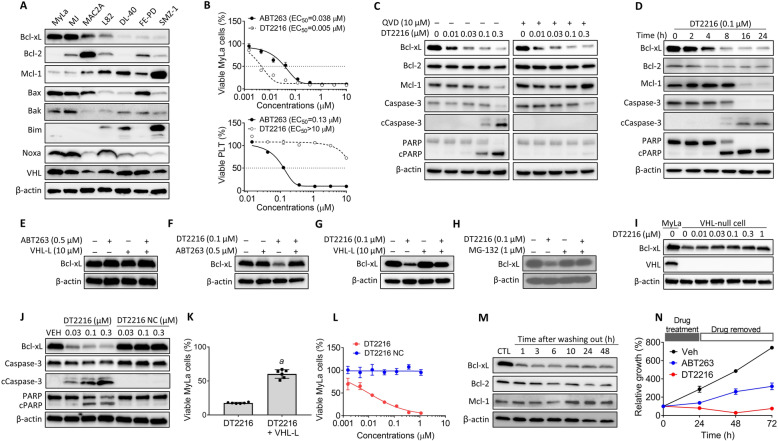
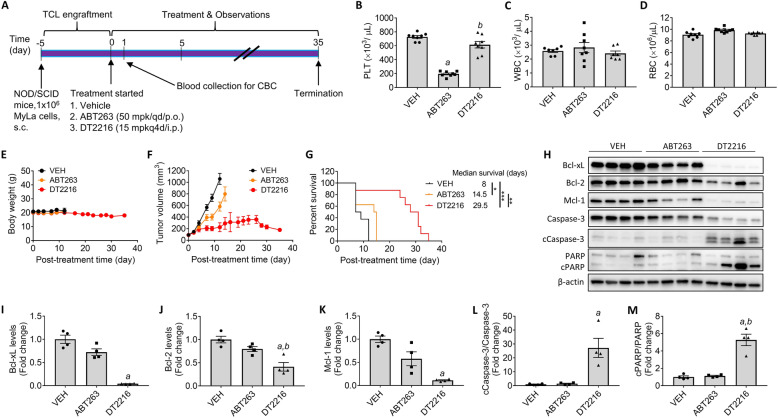
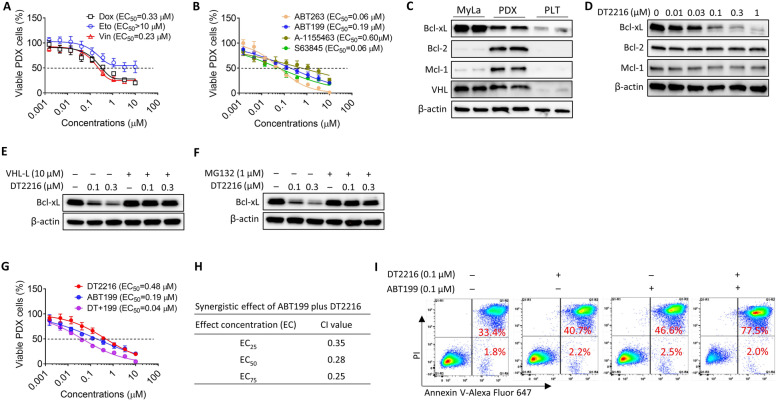
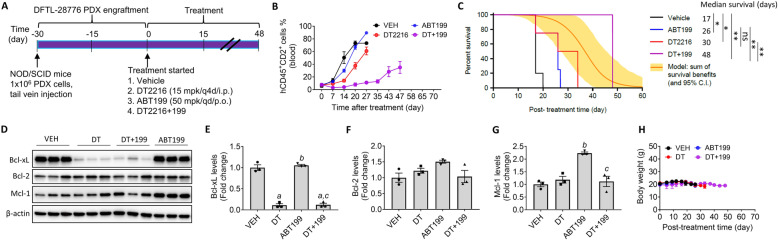
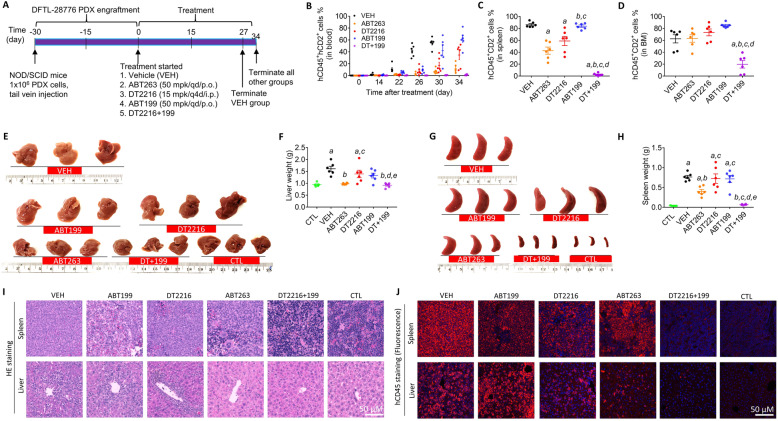
Background: Patients with advanced T cell lymphomas (TCLs) have limited therapeutic options and poor outcomes in part because their TCLs evade apoptosis through upregulation of anti-apoptotic Bcl-2 proteins. Subsets of TCL cell lines, patient-derived xenografts (PDXs), and primary patient samples depend on Bcl-xL for survival. However, small molecule Bcl-xL inhibitors such as ABT263 have failed during clinical development due to on-target and dose-limiting thrombocytopenia. Methods: We have developed DT2216, a proteolysis targeting chimera (PROTAC) targeting Bcl-xL for degradation via Von Hippel-Lindau (VHL) E3 ligase, and shown that it has better anti-tumor activity but is less toxic to platelets compared to ABT263. Here, we examined the therapeutic potential of DT2216 for TCLs via testing its anti-TCL activity in vitro using MTS assay, immunoblotting, and flow cytometry and anti-TCL activity in vivo using TCL cell xenograft and PDX model in mice. Results: The results showed that DT2216 selectively killed various Bcl-xL-dependent TCL cells including MyLa cells in vitro. In vivo, DT2216 alone was highly effective against MyLa TCL xenografts in mice without causing significant thrombocytopenia or other toxicity. Furthermore, DT2216 combined with ABT199 (a selective Bcl-2 inhibitor) synergistically reduced disease burden and improved survival in a TCL PDX mouse model dependent on both Bcl-2 and Bcl-xL. Conclusions: These findings support the clinical testing of DT2216 in patients with Bcl-xL-dependent TCLs, both as a single agent and in rational combinations.
Overview
The claims and statistics of this paper haven’t been checked yet.
Free: it reads the open-access text and checks the first 5 claims that cite a source we can check. Create a free account to check every claim.
Integrity signals
Registry
Cites
Statistics
Figures
Verification
Claims the paper makes
The claims and statistics of this paper haven’t been checked yet.
Free: it reads the open-access text and checks the first 5 claims that cite a source we can check. Create a free account to check every claim.
Claims other papers make about this one
Each is checked against this paper’s own text: does it say what the citing paper says it does?
The source backs part of the claim, not all of it — or backs it for a different population, condition or comparison.
In the citing paper
“DT2216 has shown promising antitumor activities in BCL-XL-dependent hematologic cancers as a single agent therapy and in multiple solid tumors when combined with conventional chemotherapy [8–10].”
From BCL-XL PROTAC degrader DT2216 synergizes with sotorasib in preclinical models of KRASG12C-mutated cancers (2022) · cites this paper as [9]
Experimental — accuracy not yet measuredThe cited source says what the claim attributes to it.
In the citing paper
“Recently, our group has reported platelet-sparing targeting of BCL-XL by proteolysis targeting chimeras (PROTACs) exemplified by DT2216.”
From BCL-XL PROTAC degrader DT2216 synergizes with sotorasib in preclinical models of KRASG12C-mutated cancers (2022) · cites this paper as [9]
In the citing paper
“A notable exception is a BCL-xL degrader known as DT2216 developed by Dialectic Therapeutics that uses VHL as the recruiting ligase77,78, which is in phase I trials (Table 1).”
From PROTAC targeted protein degraders: the past is prologue (2022) · cites this paper as [77]
Self-check
Percentages, sums and reported differences re-computed from the paper’s own numbers.
The self-check needs the paper’s full text.
Citations
Cites
Analysis of Relative Gene Expression Data Using Real-Time Quantitative PCR and the 2−ΔΔCT Method
Livak, K. J., & Schmittgen, T. D. (2001) · Methods · doi:10.1006/meth.2001.1262 · Cited by 180,860
Mutation of the mouse klotho gene leads to a syndrome resembling ageing
Kuro-o, M., Matsumura, Y., Aizawa, H., Kawaguchi, H., Suga, T., Utsugi, T., Ohyama, Y., Kurabayashi, M., Kaname, T., Kume, E., et al. (1997) · Nature · doi:10.1038/36285 · Cited by 3,837
THE TOXICITY OF POISONS APPLIED JOINTLY1
BLISS, C. I. (1939) · Annals of Applied Biology · doi:10.1111/j.1744-7348.1939.tb06990.x · Cited by 2,419
Regulation of apoptosis in health and disease: the balancing act of BCL-2 family proteins
Singh, R., Letai, A., & Sarosiek, K. (2019) · Nature Reviews Molecular Cell Biology · doi:10.1038/s41580-018-0089-8 · Cited by 2,111
Death and anti-death: tumour resistance to apoptosis
Igney, F. H., & Krammer, P. H. (2002) · Nature Reviews Cancer · doi:10.1038/nrc776 · Cited by 2,075
ABT-263: A Potent and Orally Bioavailable Bcl-2 Family Inhibitor
Tse, C., Shoemaker, A. R., Adickes, J., Anderson, M. G., Chen, J., Jin, S., Johnson, E. F., Marsh, K. C., Mitten, M. J., Nimmer, P., et al. (2008) · Cancer Research · doi:10.1158/0008-5472.can-07-5836 · Cited by 1,992
Phthalimide conjugation as a strategy for in vivo target protein degradation
Winter, G. E., Buckley, D. L., Paulk, J., Roberts, J. M., Souza, A., Dhe-Paganon, S., & Bradner, J. E. (2015) · Science · doi:10.1126/science.aab1433 · Cited by 1,760
Induced protein degradation: an emerging drug discovery paradigm
Lai, A. C., & Crews, C. M. (2017) · Nature Reviews Drug Discovery · doi:10.1038/nrd.2016.211 · Cited by 1,486
Catalytic in vivo protein knockdown by small-molecule PROTACs
Bondeson, D. P., Mares, A., Smith, I. E. D., Ko, E., Campos, S., Miah, A. H., Mulholland, K. E., Routly, N., Buckley, D. L., Gustafson, J. L., et al. (2015) · Nature Chemical Biology · doi:10.1038/nchembio.1858 · Cited by 1,356
Hijacking the E3 Ubiquitin Ligase Cereblon to Efficiently Target BRD4
Lu, J., Qian, Y., Altieri, M., Dong, H., Wang, J., Raina, K., Hines, J., Winkler, J. D., Crew, A. P., Coleman, K., et al. (2015) · Chemistry & Biology · doi:10.1016/j.chembiol.2015.05.009 · Cited by 1,140
Selective Small Molecule Induced Degradation of the BET Bromodomain Protein BRD4
Zengerle, M., Chan, K.-H., & Ciulli, A. (2015) · ACS Chemical Biology · doi:10.1021/acschembio.5b00216 · Cited by 1,056
Programmed Anuclear Cell Death Delimits Platelet Life Span
Mason, K. D., Carpinelli, M. R., Fletcher, J. I., Collinge, J. E., Hilton, A. A., Ellis, S., Kelly, P. N., Ekert, P. G., Metcalf, D., Roberts, A. W., et al. (2007) · Cell · doi:10.1016/j.cell.2007.01.037 · Cited by 1,031 · cited 2×
“However, these small molecule Bcl-xL inhibitors have failed during clinical development due to on-target and dose-limiting thrombocytopenia [9–11], as platelets are solely dependent on Bcl-xL for survival [9, 12].”
BackgroundPROTAC-induced BET protein degradation as a therapy for castration-resistant prostate cancer
Raina, K., Lu, J., Qian, Y., Altieri, M., Gordon, D., Rossi, A. M. K., Wang, J., Chen, X., Dong, H., Siu, K., et al. (2016) · Proceedings of the National Academy of Sciences · doi:10.1073/pnas.1521738113 · Cited by 852
A selective BCL-XL PROTAC degrader achieves safe and potent antitumor activity
Khan, S., Zhang, X., Lv, D., Zhang, Q., He, Y., Zhang, P., Liu, X., Thummuri, D., Yuan, Y., Wiegand, J. S., et al. (2019) · Nature Medicine · doi:10.1038/s41591-019-0668-z · Cited by 688
Self-citationModular PROTAC design for the degradation of oncogenic BCR-ABL
Lai, A. C., Toure, M., Hellerschmied, D., Salami, J., Jaime‐Figueroa, S., Ko, E., Hines, J., & Crews, C. M. (2016) · Angewandte Chemie International Edition · doi:10.1002/anie.201507634 · Cited by 618
O'Connor, O. A., Horwitz, S., Masszi, T., Van Hoof, A., Brown, P., Doorduijn, J., Hess, G., Jurczak, W., Knoblauch, P., Chawla, S., et al. (2015) · Journal of Clinical Oncology · doi:10.1200/jco.2014.59.2782 · Cited by 555
Leverson, J. D., Phillips, D. C., Mitten, M. J., Boghaert, E. R., Diaz, D., Tahir, S. K., Belmont, L. D., Nimmer, P., Xiao, Y., Ma, X. M., et al. (2015) · Science Translational Medicine · doi:10.1126/scitranslmed.aaa4642 · Cited by 541
Protac-Induced Protein Degradation in Drug Discovery: Breaking the Rules or Just Making New Ones?
Churcher, I. (2018) · Journal of Medicinal Chemistry · doi:10.1021/acs.jmedchem.7b01272 · Cited by 491
Mak, V., Hamm, J., Chhanabhai, M., Shenkier, T., Klasa, R., Sehn, L. H., Villa, D., Gascoyne, R. D., Connors, J. M., & Savage, K. J. (2013) · Journal of Clinical Oncology · doi:10.1200/jco.2012.44.7524 · Cited by 437
A Chemoproteomic Approach to Query the Degradable Kinome Using a Multi-kinase Degrader
Huang, H.-T., Dobrovolsky, D., Paulk, J., Yang, G., Weisberg, E. L., Doctor, Z. M., Buckley, D. L., Cho, J.-H., Ko, E., Jang, J., et al. (2018) · Cell Chemical Biology · doi:10.1016/j.chembiol.2017.10.005 · Cited by 437
Bcl-2 family proteins are essential for platelet survival
Zhang, H., Nimmer, P. M., Tahir, S. K., Chen, J., Fryer, R. M., Hahn, K. R., Iciek, L. A., Morgan, S. J., Nasarre, M. C., Nelson, R., et al. (2007) · Cell Death & Differentiation · doi:10.1038/sj.cdd.4402081 · Cited by 427
Schoenwaelder, S. M., Jarman, K. E., Gardiner, E. E., Hua, M., Qiao, J., White, M. J., Josefsson, E. C., Alwis, I., Ono, A., Willcox, A., et al. (2011) · Blood · doi:10.1182/blood-2011-04-347849 · Cited by 351
Discovery of a Potent and Selective BCL-X L Inhibitor with in Vivo Activity
Tao, Z.-F., Hasvold, L., Wang, L., Wang, X., Petros, A. M., Park, C. H., Boghaert, E. R., Catron, N. D., Chen, J., Colman, P. M., et al. (2014) · ACS Medicinal Chemistry Letters · doi:10.1021/ml5001867 · Cited by 309
Pathways and mechanisms of venetoclax resistance
Bose, P., Gandhi, V., & Konopleva, M. (2017) · Leukemia & Lymphoma · doi:10.1080/10428194.2017.1283032 · Cited by 302
He, Y., Zhang, X., Chang, J., Kim, H.-N., Zhang, P., Wang, Y., Khan, S., Liu, X., Zhang, X., Lv, D., et al. (2020) · Nature Communications · doi:10.1038/s41467-020-15838-0 · Cited by 280 · cited 2×
“The lack of efficient degradation of Bcl-2 by DT2216 may be attributed to the significant reduction of its binding affinity to Bcl-2 [14], lack of the lysine for ubiquitination, and inability of DT2216 to form ternary complex with VHL and Bcl-2 in cells [13].”
BackgroundSelf-citationHomolog-Selective Degradation as a Strategy to Probe the Function of CDK6 in AML
Brand, M., Jiang, B., Bauer, S., Donovan, K. A., Liang, Y., Wang, E. S., Nowak, R. P., Yuan, J. C., Zhang, T., Kwiatkowski, N., et al. (2019) · Cell Chemical Biology · doi:10.1016/j.chembiol.2018.11.006 · Cited by 258 · cited 1×
“Similar phenomena have been reported previously [35, 36].”
Weng, C., Li, Y., Xu, D., Shi, Y., & Tang, H. (2005) · Journal of Biological Chemistry · doi:10.1074/jbc.m412819200 · Cited by 254
Perry, A. M., Diebold, J., Nathwani, B. N., MacLennan, K. A., Muller-Hermelink, H. K., Bast, M., Boilesen, E., Armitage, J. O., & Weisenburger, D. D. (2016) · Haematologica · doi:10.3324/haematol.2016.148809 · Cited by 191
Saenz, D. T., Fiskus, W., Qian, Y., Manshouri, T., Rajapakshe, K., Raina, K., Coleman, K. G., Crew, A. P., Shen, A., Mill, C. P., et al. (2017) · Leukemia · doi:10.1038/leu.2016.393 · Cited by 185
How I treat the peripheral T-cell lymphomas
Moskowitz, A. J., Lunning, M. A., & Horwitz, S. M. (2014) · Blood · doi:10.1182/blood-2013-12-516245 · Cited by 164
The curcumin analog EF24 is a novel senolytic agent
Li, W., He, Y., Zhang, R., Zheng, G., & Zhou, D. (2019) · Aging · doi:10.18632/aging.101787 · Cited by 164
Self-citationDeshaies, R. J. (2015) · Nature Chemical Biology · doi:10.1038/nchembio.1887 · Cited by 162
Kaefer, A., Yang, J., Noertersheuser, P., Mensing, S., Humerickhouse, R., Awni, W., & Xiong, H. (2014) · Cancer Chemotherapy and Pharmacology · doi:10.1007/s00280-014-2530-9 · Cited by 161
Targetable vulnerabilities in T- and NK-cell lymphomas identified through preclinical models
Ng, S. Y., Yoshida, N., Christie, A. L., Ghandi, M., Dharia, N. V., Dempster, J., Murakami, M., Shigemori, K., Morrow, S. N., Van Scoyk, A., et al. (2018) · Nature Communications · doi:10.1038/s41467-018-04356-9 · Cited by 113
Self-citationGuo, Y. P., Strickland, S. A., Mohan, S. R., Li, S., Bosompem, A., Vickers, K. C., Zhao, S., Sheng, Q., & Kim, A. S. (2017) · Leukemia & lymphoma/Leukemia and lymphoma · doi:10.1080/10428194.2016.1272680 · Cited by 71
Biomarker-driven strategy for MCL1 inhibition in T-cell lymphomas
Koch, R., Christie, A. L., Crombie, J. L., Palmer, A. C., Plana, D., Shigemori, K., Morrow, S. N., Van Scoyk, A., Wu, W., Brem, E. A., et al. (2019) · Blood · doi:10.1182/blood-2018-07-865527 · Cited by 61
Self-citationProtein Knockdown Technology: Application of Ubiquitin Ligase to Cancer Therapy
Ohoka, N., Shibata, N., Hattori, T., & Naito, M. (2016) · Current Cancer Drug Targets · doi:10.2174/1568009616666151112122502 · Cited by 54
Microenvironmental cues for T‐cell acute lymphoblastic leukemia development
Passaro, D., Quang, C. T., & Ghysdael, J. (2016) · Immunological Reviews · doi:10.1111/imr.12402 · Cited by 52
Current treatment options in prolymphocytic leukemia.
Robak, T., & Robak, P. J. (2007) · PubMed · Cited by 35
Chemical genetics approaches for selective intervention in epigenetics
Runcie, A. C., Chan, K.-H., Zengerle, M., & Ciulli, A. (2016) · Current Opinion in Chemical Biology · doi:10.1016/j.cbpa.2016.06.031 · Cited by 27
Barwe, S. P., Quagliano, A., & Gopalakrishnapillai, A. (2017) · Seminars in Oncology · doi:10.1053/j.seminoncol.2017.06.005 · Cited by 18
Grant, S. (2017) · Leukemia & lymphoma/Leukemia and lymphoma · doi:10.1080/10428194.2017.1366999 · Cited by 13
Challenges and implications of genomics for T-cell lymphomas
Jacobsen, E. D., & Weinstock, D. M. (2018) · Hematology · doi:10.1182/asheducation-2018.1.63 · Cited by 12
Self-citation
Cited by
PROTAC targeted protein degraders: the past is prologue
Békés, M., Langley, D. R., & Crews, C. M. (2022) · Nature Reviews Drug Discovery · doi:10.1038/s41573-021-00371-6 · Cited by 3,395
Protein degraders enter the clinic — a new approach to cancer therapy
Chirnomas, D., Hornberger, K. R., & Crews, C. M. (2023) · Nature Reviews Clinical Oncology · doi:10.1038/s41571-023-00736-3 · Cited by 658
The BCL2 family: from apoptosis mechanisms to new advances in targeted therapy
Vogler, M., Braun, Y., Smith, V. M., Westhoff, M.-A., Pereira, R. S., Pieper, N. M., Anders, M., Callens, M., Vervliet, T., Abbas, M., et al. (2025) · Signal Transduction and Targeted Therapy · doi:10.1038/s41392-025-02176-0 · Cited by 462
The manipulation of apoptosis for cancer therapy using BH3-mimetic drugs
Diepstraten, S. T., Anderson, M. A., Czabotar, P. E., Lessene, G., Strasser, A., & Kelly, G. L. (2022) · Nature Reviews Cancer · doi:10.1038/s41568-021-00407-4 · Cited by 346
An overview of PROTACs: a promising drug discovery paradigm
Liu, Z., Hu, M., Yang, Y., Du, C., Zhou, H., Liu, C., Chen, Y., Fan, L., Ma, H., Gong, Y., et al. (2022) · Molecular Biomedicine · doi:10.1186/s43556-022-00112-0 · Cited by 344
Metadata
- Authors
- He, Y., Koch, R., Budamagunta, V., Zhang, P., Zhang, X., Khan, S., Thummuri, D., Ortiz, Y. T., Zhang, X., Lv, D., Wiegand, J. S., Li, W., Palmer, A. C., Zheng, G., Weinstock, D. M., & Zhou, D.
- Affiliations
- University of Florida (US)
- Universitätsmedizin Göttingen (DE)
- University of North Carolina at Chapel Hill (US)
- Harvard University (US)
- Corresponding author
- Weinstock, David M.
- Zhou, Daohong
- ORCID
- Venue
- Journal of Hematology & Oncology
- Published
- 2020-07-16
- Volume
- 13
- Issue
- 1
- Pages
- 95-95
- ISSN
- 1756-8722 (ISSN-L)
- PMC
- PMC7364785
- OpenAlex
- W3043399847
- Cited by
- 139
- References
- 43
- Citations by year
- 2026: 24 · 2025: 28 · 2024: 22 · 2023: 21 · 2022: 23 · 2021: 21
- FWCI
- 5.43
- Type
- journal article
- Language
- en
- Open access
- gold
- doi.org
- Licence
- cc-by
- creativecommons.org/licenses/by/4.0 (tdm)
- creativecommons.org/licenses/by/4.0 (vor)
- Locations
- Journal of Hematology & Oncology (publishedVersion, cc-by)
- PubMed Central (publishedVersion, cc-by)
- PubMed (publishedVersion)
- DOAJ (DOAJ: Directory of Open Access Journals) (submittedVersion, cc-by-sa)
- GoeScholar The Publication Server of the Georg-August-Universität Göttingen (Georg-August-Universität Göttingen) (submittedVersion, cc-by)
- Funders
- National Institutes of Health (R01CA211963, R01CA219836, R01CA242003, R21CA223371, R35CA239158, R01CA241191)
- Deutsche Forschungsgemeinschaft (KO 4627/2-1)
- Leukemia and Lymphoma Society (#7011-16)
- Topics
- Life Sciences › Biochemistry, Genetics and Molecular Biology › Molecular Biology › Protein Degradation and Inhibitors
- Life Sciences › Biochemistry, Genetics and Molecular Biology › Molecular Biology › Cell death mechanisms and regulation
- Health Sciences › Medicine › Pathology and Forensic Medicine › Lymphoma Diagnosis and Treatment
- Keywords
- Bcl-xL, PROTACs, T-cell lymphoma, Bcl-2, navitoclax, thrombocytopenia, apoptosis evasion, combination therapy, patient-derived xenografts
- MeSH terms
- Aniline Compounds, Animals, Antineoplastic Agents, Antineoplastic Combined Chemotherapy Protocols, Blood Platelets, Drug Screening Assays, Antitumor, Drug Synergism, Female, Graft Survival, Humans, Liver, Neoplasm Proteins, Neoplasm Transplantation, Piperazines, Random Allocation, Spleen, Sulfonamides, Drug Design, Lymphoma, T-Cell, Mice, SCID, Mice, Inbred NOD, Bridged Bicyclo Compounds, Heterocyclic, Proto-Oncogene Proteins c-bcl-2, Xenograft Model Antitumor Assays, Ubiquitin-Protein Ligases, Cell Line, Tumor, bcl-X Protein, Mice
About these checks
Registry, retraction, Cites and statistics results are computed, not judged, with one exception: a printed reference that no index lists is read once by a model before it counts as a citation error. Claims are extracted by a model and kept only when their quote appears verbatim in the text; each cited source is then checked, with a model’s help, for whether it says what the claim relies on. Those verdicts can be wrong — read the claim’s quote and the cited source before relying on one.
Statistics and arithmetic are recomputed, not judged.
Confidence bands are shown only for fields calibrated on our annotated test set. None is calibrated yet, so no band is shown.
What counts as a claim ›How we measure confidence ›How we check this ›
Are you an author, or do you see a problem with this page? Request a review
Data sources
Bibliographic data: Semantic Scholar, OpenAlex, Crossref.
Contains information from the Semantic Scholar Academic Graph Datasets, made available under the ODC Attribution License (ODC-BY 1.0).
Semantic Scholar’s data is described in: Kinney, R., et al. (2023). The Semantic Scholar Open Data Platform. arXiv:2301.10140.
