

The DOI matches its Crossref record; 50 of the 51 references it cites were found in a registry or an index.
Robustness and applicability of transcription factor and pathway analysis tools on single-cell RNA-seq data
Open accessPublished version of a preprint
Abstract
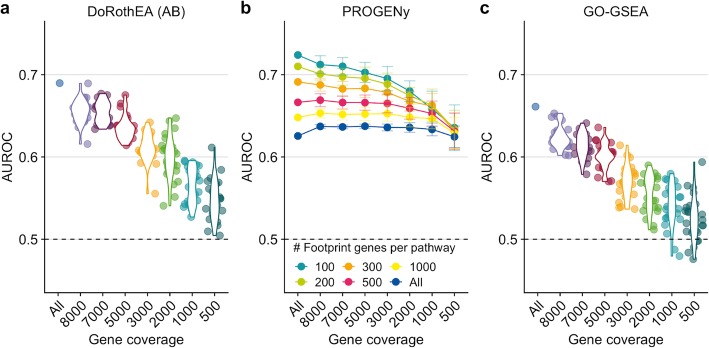
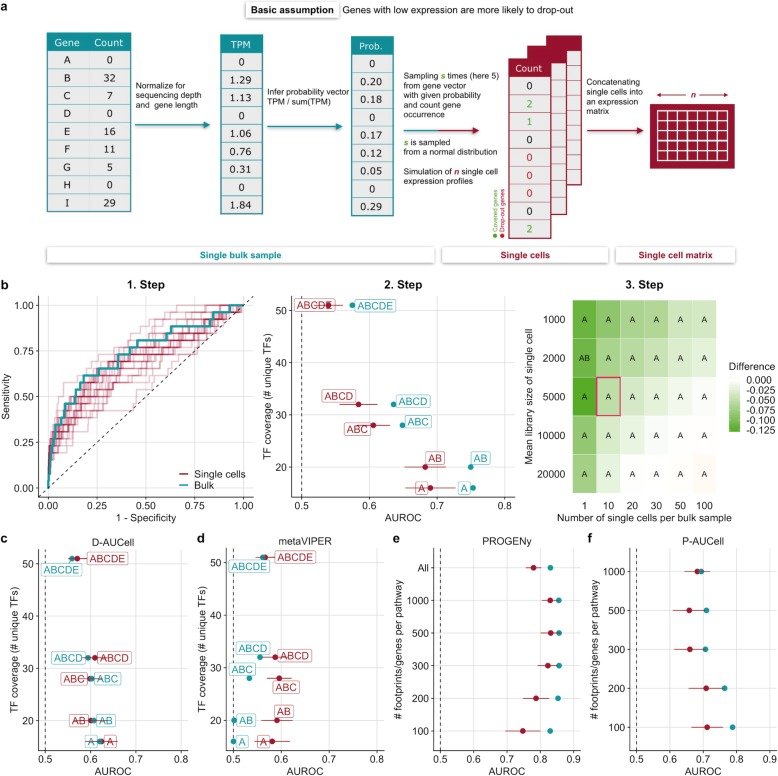
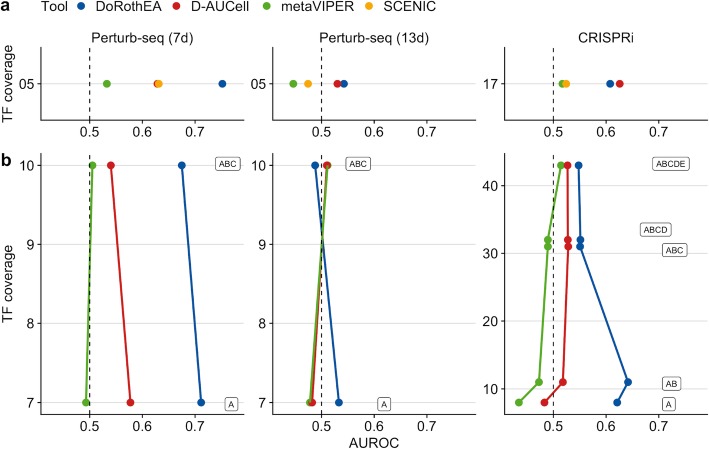
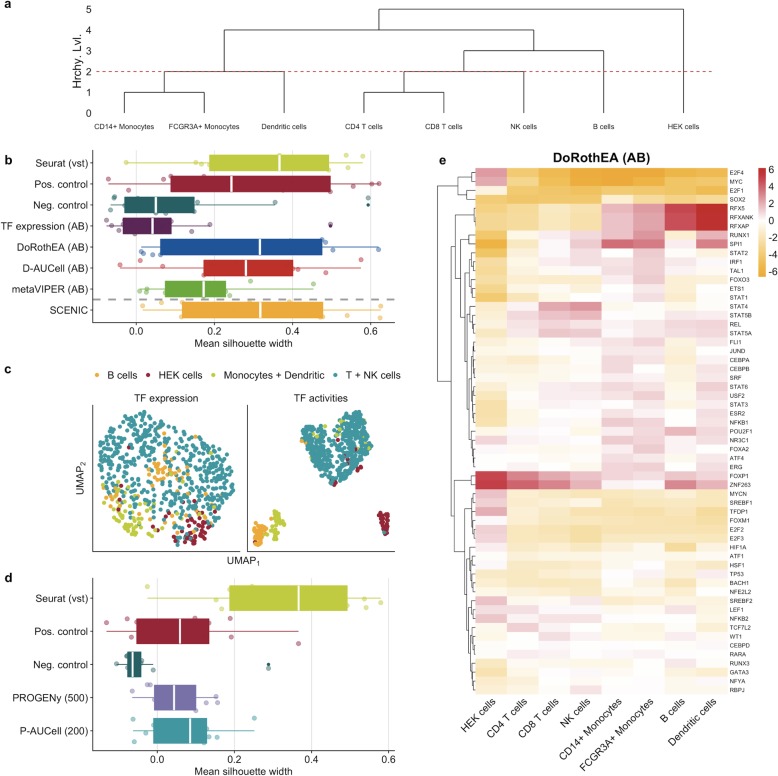
Background: Many functional analysis tools have been developed to extract functional and mechanistic insight from bulk transcriptome data. With the advent of single-cell RNA sequencing (scRNA-seq), it is in principle possible to do such an analysis for single cells. However, scRNA-seq data has characteristics such as drop-out events and low library sizes. It is thus not clear if functional TF and pathway analysis tools established for bulk sequencing can be applied to scRNA-seq in a meaningful way. Results: To address this question, we perform benchmark studies on simulated and real scRNA-seq data. We include the bulk-RNA tools PROGENy, GO enrichment, and DoRothEA that estimate pathway and transcription factor (TF) activities, respectively, and compare them against the tools SCENIC/AUCell and metaVIPER, designed for scRNA-seq. For the in silico study, we simulate single cells from TF/pathway perturbation bulk RNA-seq experiments. We complement the simulated data with real scRNA-seq data upon CRISPR-mediated knock-out. Our benchmarks on simulated and real data reveal comparable performance to the original bulk data. Additionally, we show that the TF and pathway activities preserve cell type-specific variability by analyzing a mixture sample sequenced with 13 scRNA-seq protocols. We also provide the benchmark data for further use by the community. Conclusions: Our analyses suggest that bulk-based functional analysis tools that use manually curated footprint gene sets can be applied to scRNA-seq data, partially outperforming dedicated single-cell tools. Furthermore, we find that the performance of functional analysis tools is more sensitive to the gene sets than to the statistic used.
Overview
The claims and statistics of this paper haven’t been checked yet.
Run the check — free, no account needed. It reads the open-access text and checks the sources it cites.
Integrity signals
Registry
Cites
Statistics
Figures
Verification
Claims the paper makes
The claims and statistics of this paper haven’t been checked yet.
Run the check — free, no account needed. It reads the open-access text and checks the sources it cites.
Claims other papers make about this one
Each is checked against this paper’s own text: does it say what the citing paper says it does?
In the citing paper
“Enrichment methods developed for bulk transcriptomics can be applied to scRNA-seq102”
From Best practices for single-cell analysis across modalities (2023) · cites this paper as [102]
In the citing paper
“Gene set enrichment analysis was found to be more sensitive to the choice of gene sets rather than statistical methods102”
From Best practices for single-cell analysis across modalities (2023) · cites this paper as [102]
Self-check
Percentages, sums and reported differences re-computed from the paper’s own numbers.
The self-check needs the paper’s full text.
Citations
Cites
R: A Language and Environment for Statistical Computing
R Core Team (2000) · doi:10.32614/r.manuals · Cited by 355,893
Subramanian, A., Tamayo, P., Mootha, V. K., Mukherjee, S., Ebert, B. L., Gillette, M. A., Paulovich, A., Pomeroy, S. L., Golub, T. R., Lander, E. S., et al. (2005) · Proceedings of the National Academy of Sciences · doi:10.1073/pnas.0506580102 · Cited by 53,625
Gene Ontology: tool for the unification of biology
Ashburner, M., Ball, C. A., Blake, J. A., Botstein, D., Butler, H., Cherry, J. M., Davis, A. P., Dolinski, K., Dwight, S. S., Eppig, J. T., et al. (2000) · Nature Genetics · doi:10.1038/75556 · Cited by 43,206
Robinson, M. D., McCarthy, D. J., & Smyth, G. K. (2010) · Bioinformatics · doi:10.1093/bioinformatics/btp616 · Cited by 41,364
limma powers differential expression analyses for RNA-sequencing and microarray studies
Ritchie, M. E., Phipson, B., Wu, D., Hu, Y., Law, C. W., Shi, W., & Smyth, G. K. (2015) · Nucleic Acids Research · doi:10.1093/nar/gkv007 · Cited by 40,458
Wickham, H., Averick, M., Bryan, J., Chang, W., McGowan, L., François, R., Grolemund, G., Hayes, A., Henry, L., Hester, J., et al. (2019) · Journal of Open Source Software · doi:10.21105/joss.01686 · Cited by 22,138
Silhouettes: A graphical aid to the interpretation and validation of cluster analysis
Rousseeuw, P. J. (1987) · Journal of Computational and Applied Mathematics · doi:10.1016/0377-0427(87)90125-7 · Cited by 21,392
The Molecular Signatures Database Hallmark Gene Set Collection
Liberzon, A., Birger, C., Thorvaldsdóttir, H., Ghandi, M., Mesirov, J. P., & Tamayo, P. (2015) · Cell Systems · doi:10.1016/j.cels.2015.12.004 · Cited by 13,807
Gene Expression Omnibus: NCBI gene expression and hybridization array data repository
Edgar, R. (2002) · Nucleic Acids Research · doi:10.1093/nar/30.1.207 · Cited by 13,288
Integrating single-cell transcriptomic data across different conditions, technologies, and species
Butler, A., Hoffman, P., Smibert, P., Papalexi, E., & Satija, R. (2018) · Nature Biotechnology · doi:10.1038/nbt.4096 · Cited by 13,174
Research works printed but not linked: 1
- Sergushichev A. An algorithm for fast preranked gene set enrichment analysis using cumulative statistic calculation. bioRxiv. 2016:060012 [cited 2018 Jul 17]. Available from: https://www.biorxiv.org/content/early/2016/06/20/060012.abstract.
Cited by
Sorted by citations
Items 301–327 of 327
Tanevski, J., Flores, R. O. R., Gábor, A., Schapiro, D., & Sáez-Rodríguez, J. (2022) · Figshare · doi:10.6084/m9.figshare.19603464
Self-citationHosseini-Gerami, L., Higgins, I. A., Collier, D. A., Laing, E., Evans, D., Broughton, H. B., & Bender, A. (2024) · Figshare · doi:10.6084/m9.figshare.26583069
DIS3 ribonuclease regulates Sertoli cell development to support spermatogenesis in mice
Wang, X., Li, N., Li, H., & Wang, Z. (2026) · Development · doi:10.1242/dev.205166
Tong, Y. E., Triana, S., Russo, D. D., Reiné, J., Rylance, J., Jochems, S. P., Akeju, O., Sabeti, P. C., Shalek, A. K., Ferreira, D. M., et al. (2026) · medRxiv · doi:10.64898/2026.02.05.26345662
Zhou, X., Parisi, L., Liu, S., Cheng, Z., Liang, H., Youseffi, M., Javid, F. A., & Ma, R. (2026) · Bioinformatics Advances · doi:10.1093/bioadv/vbag059
Nintedanib and Pirfenidone Affect Growth and Differentiation of Human Alveolar Type 2 CellsPreprint
Bazarov, A. V., Serra-Marques, A., Protti, G., Yang, M. M., Naikawadi, R. P., Green, G. A., Lee, S., Kukreja, J., Matthay, M. A., Wax, M., et al. (2026) · bioRxiv (Cold Spring Harbor Laboratory) · doi:10.64898/2026.03.02.708135
Mahemuti, M., Cheng, Y., Li, M., & Yilihamu, A. (2026) · Frontiers in Molecular Biosciences · doi:10.3389/fmolb.2026.1740876
Zhou, Y., Yi, M., Yan, J., Chen, H., & Yang, J. (2026) · Pharmacology · doi:10.1159/000550967
Forouzandehmehr, A. (2026) · bioRxiv (Cold Spring Harbor Laboratory) · doi:10.64898/2026.04.30.721824
Nguyen, Q., Zhang, Z., Le, D., Chen, J. Y., Ku, W., Chen, H., & Yue, Z. (2026) · bioRxiv (Cold Spring Harbor Laboratory) · doi:10.64898/2026.06.02.729674
PCSK5 promotes angiogenesis and cardiac repair after myocardial infarction
Guo, J., Ma, S., Ma, J., Liu, M., Ge, F., Wang, X., Lin, J. I. N. Y. I., Jiang, N., Lin, X., Lian, Z., et al. (2026) · Nature Communications · doi:10.1038/s41467-026-72148-7
Single‐Cell and Multiomics Characterization of p21 in Cancer Progression and Therapeutic Sensitivity
Zhang, W., Ma, Q., Zhao, H., Li, W., Feng, Z., Zhong, L., Ren, Y., Chang, L., Li, Y., & Shi, L. (2026) · Human Mutation · doi:10.1155/humu/5598948
Sheng, Q., Wu, Q., Fan, J., Sangaraju, V. K., Manavalan, B., & He, X. (2026) · Briefings in Bioinformatics · doi:10.1093/bib/bbag386
Yang, X., Yang, T., Wang, Y., Xie, P., Li, X., Yuan, J., & Yang, Y. (2026) · Molecular Cancer · doi:10.1186/s12943-026-02741-3
Alakwaa, F., Elbaz, A., Azzam, S. A., & Alshebani, T. (2026) · BMC Bioinformatics · doi:10.1186/s12859-026-06632-8
den Berge, K. V., Bickel, P. J., & Dudoit, S. (2026) · Biostatistics · doi:10.1093/biostatistics/kxag029
Chen, F., Ma, Z., & Ma, W. (2026) · Research Square · doi:10.21203/rs.3.rs-10616998/v1
Zhu, Y., Han, D., & Wang, Z. (2026) · Briefings in Bioinformatics · doi:10.1093/bib/bbag513
Chen, C., Xing, R., Wen, Y., Li, M., & Hu, M. (2026) · Frontiers in Oncology · doi:10.3389/fonc.2026.1963032
Pham, H. M. Q., Chen, C., Feng, P., Lee, K.-Y., HUNG, Y.-P., & Lin, C.-F. (2026) · Frontiers in Immunology · doi:10.3389/fimmu.2026.1908216
Biase, F. H., Morozyuk, M., & Ezepha, C. (2026) · Scientific Reports · doi:10.1038/s41598-026-74656-4
GSNetAct: Task-aware network weighting for single-cell gene-set activity scoring
Garan, Z., & Kaymaz, Y. (2026) · Current Genomics · doi:10.1016/j.curgen.2026.10.004
+A CAR T cell-amplified suppressive B cell circuit in AMLPreprint
Gottschlich, A., Kavaka, V., Janert, T. A., Igl, V., Carlini, E., Rohrbacher, L., den Hartog, W., Harwood, J., Trefny, M. P., Sogukcelik, S., et al. (2026) · bioRxiv (Cold Spring Harbor Laboratory) · doi:10.64898/2026.10.12.758644
Shahid, S. (2024) · International journal of medical and health research. · doi:10.61424/ijmhr.v2i1.1106
Metadata
- Authors
- Holland, C. H., Tanevski, J., Perales-Patón, J., Gleixner, J., Kumar, M. P., Mereu, E., Joughin, B. A., Stegle, O., Lauffenburger, D. A., Heyn, H., Szalai, B., & Saez-Rodriguez, J.
- Affiliations
- Heidelberg University (DE)
- German Cancer Research Center (DE)
- Barcelona Institute of Science and Technology (ES)
- Koch Institute for Integrative Cancer Research At MIT (US)
- European Bioinformatics Institute (GB)
- Massachusetts Institute of Technology (US)
- Universitat Pompeu Fabra (ES)
- Semmelweis University (HU)
- ORCID
- Venue
- Genome Biology
- Published
- 2020-02-12
- Volume
- 21
- Issue
- 1
- Pages
- 36-36
- ISSN
- 1465-6906 (ISSN-L)
- 1474-760X
- PMC
- PMC7017576
- OpenAlex
- W3007199577
- Cited by
- 323
- References
- 51
- Citations by year
- 2026: 37 · 2025: 39 · 2024: 67 · 2023: 60 · 2022: 61 · 2021: 38 · 2020: 18
- FWCI
- 14.34
- Type
- journal article
- Language
- en
- Open access
- gold
- doi.org
- Locations
- Genome biology (publishedVersion, cc-by)
- bioRxiv (Cold Spring Harbor Laboratory) (acceptedVersion, cc-by)
- PubMed Central (publishedVersion, cc-by)
- PubMed (publishedVersion)
- Repositori digital de la UPF (Universitat Pompeu Fabra) (publishedVersion, cc-by-nc)
- DOAJ (DOAJ: Directory of Open Access Journals) (submittedVersion, cc-by-sa)
- DSpace@MIT (Massachusetts Institute of Technology) (submittedVersion, cc-by-nc)
- Semmelweis University Repository (Semmelweis University) (submittedVersion)
- Funders
- Bundesministerium für Bildung und Forschung (FKZ: 031L0049)
- National Institutes of Health (U54-CA217377)
- Ministry of Science, Innovation and Universities (SAF2017-89109-P)
- Topics
- Life Sciences › Biochemistry, Genetics and Molecular Biology › Molecular Biology › Single-cell and spatial transcriptomics
- Life Sciences › Biochemistry, Genetics and Molecular Biology › Molecular Biology › Bioinformatics and Genomic Networks
- Life Sciences › Biochemistry, Genetics and Molecular Biology › Molecular Biology › Genomics and Phylogenetic Studies
- Keywords
- single-cell RNA sequencing, transcription factor activity, pathway activity, benchmarking, offspring, SCENIC, AUCell, Dorothea, gene ontology enrichment, simulated data
- MeSH terms
- RNA-Seq, Animals, Humans, Software, Transcription Factors, Benchmarking, Gene Regulatory Networks, Single-Cell Analysis, Transcriptome
About these checks
Registry, retraction, Cites and statistics results are computed, not judged, with one exception: a printed reference that no index lists is read once by a model before it counts as a citation error. Claims are extracted by a model and kept only when their quote appears verbatim in the text; each cited source is then checked, with a model’s help, for whether it says what the claim relies on. Those verdicts can be wrong — read the claim’s quote and the cited source before relying on one.
Statistics and arithmetic are recomputed, not judged.
Confidence bands are shown only for fields calibrated on our annotated test set. None is calibrated yet, so no band is shown.
What counts as a claim ›How we measure confidence ›How we check this ›
Are you an author, or do you see a problem with this page? Request a review
