

Comparative analysis of antibody- and lipid-based multiplexing methods for single-cell RNA-seq
Open accessPublished version of a preprint
The DOI matches its Crossref record; 33 of the 33 references it cites were found in a registry or an index.
Abstract
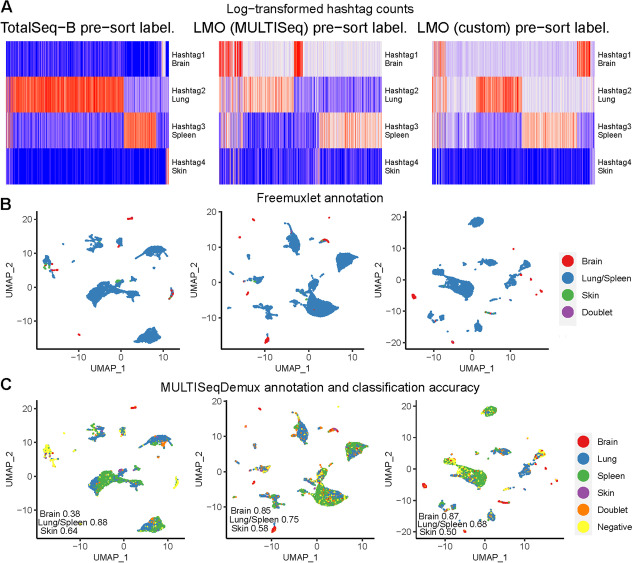
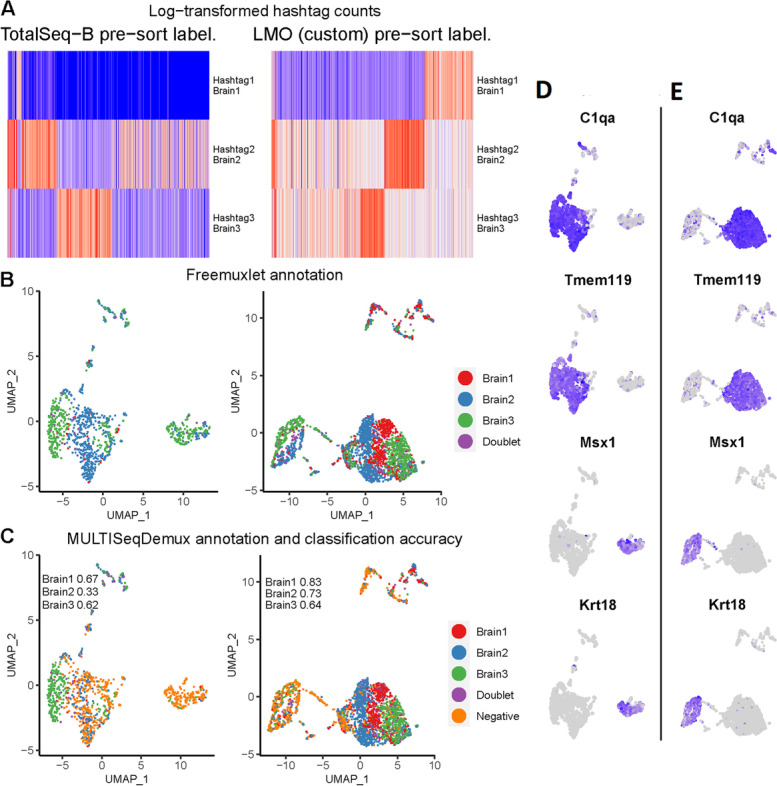
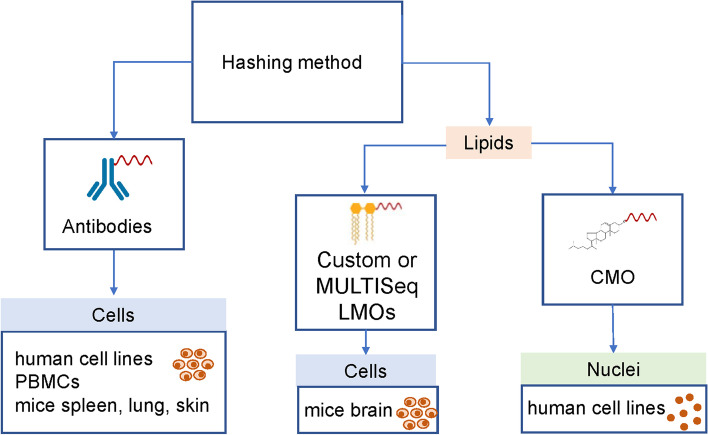
Background: Multiplexing of samples in single-cell RNA-seq studies allows a significant reduction of the experimental costs, straightforward identification of doublets, increased cell throughput, and reduction of sample-specific batch effects. Recently published multiplexing techniques using oligo-conjugated antibodies or -lipids allow barcoding sample-specific cells, a process called “hashing.” Results: Here, we compare the hashing performance of TotalSeq-A and -C antibodies, custom synthesized lipids and MULTI-seq lipid hashes in four cell lines, both for single-cell RNA-seq and single-nucleus RNA-seq. We also compare TotalSeq-B antibodies with CellPlex reagents (10x Genomics) on human PBMCs and TotalSeq-B with different lipids on primary mouse tissues. Hashing efficiency was evaluated using the intrinsic genetic variation of the cell lines and mouse strains. Antibody hashing was further evaluated on clinical samples using PBMCs from healthy and SARS-CoV-2 infected patients, where we demonstrate a more affordable approach for large single-cell sequencing clinical studies, while simultaneously reducing batch effects. Conclusions: Benchmarking of different hashing strategies and computational pipelines indicates that correct demultiplexing can be achieved with both lipid- and antibody-hashed human cells and nuclei, with MULTISeqDemux as the preferred demultiplexing function and antibody-based hashing as the most efficient protocol on cells. On nuclei datasets, lipid hashing delivers the best results. Lipid hashing also outperforms antibodies on cells isolated from mouse brain. However, antibodies demonstrate better results on tissues like spleen or lung.
Overview
The claims and statistics of this paper haven’t been checked yet.
Free: it reads the open-access text and checks the first 5 claims that cite a source we can check. Create a free account to check every claim.
Integrity signals
Registry
Cites
Statistics
Figures
Verification
Claims the paper makes
The claims and statistics of this paper haven’t been checked yet.
Free: it reads the open-access text and checks the first 5 claims that cite a source we can check. Create a free account to check every claim.
Claims other papers make about this one
Each is checked against this paper’s own text: does it say what the citing paper says it does?
The source backs part of the claim, not all of it — or backs it for a different population, condition or comparison.
In the citing paper
“These findings are in line with other claims that SNP-based demultiplexers are unable to separate samples within the same mouse strain (Mylka et al, 2022).”
From Evaluation of genetic demultiplexing of single-cell sequencing data from model species (2023) · cites this paper as Mylka et al, 2022
Experimental — accuracy not yet measuredThe source backs part of the claim, not all of it — or backs it for a different population, condition or comparison.
In the citing paper
“accuracy is lower on nuclei isolated from archived/frozen samples (snRNA-Seq) [15, 19, 20].”
From Benchmarking of computational demultiplexing methods for single-nucleus RNA sequencing data (2025) · cites this paper as [19]
Experimental — accuracy not yet measuredThe cited source says what the claim attributes to it.
In the citing paper
“Outside of human samples, SNP-based demultiplexing has been applied to demultiplex other species: plasmodium samples, and across mouse strains (Heaton et al, 2020; Mylka et al, 2022).”
From Evaluation of genetic demultiplexing of single-cell sequencing data from model species (2023) · cites this paper as Mylka et al, 2022
The cited source says what the claim attributes to it.
In the citing paper
“Although the vast majority of murine work is performed on a single strain, pooling different strains reportedly does allow for SNP-based demultiplexing (Mylka et al, 2022).”
From Evaluation of genetic demultiplexing of single-cell sequencing data from model species (2023) · cites this paper as Mylka et al, 2022
The cited source says what the claim attributes to it.
In the citing paper
“although when applied to live cells these methods can achieve >90% demultiplexing accuracy (defined as the number of all matching singlets plus the number of matching non-singlets divided by the total number of cells), accuracy is lower on nuclei isolated from archived/frozen samples (snRNA-Seq) [15, 19, 20].”
From Benchmarking of computational demultiplexing methods for single-nucleus RNA sequencing data (2025) · cites this paper as [19]
Self-check
Percentages, sums and reported differences re-computed from the paper’s own numbers.
The self-check needs the paper’s full text.
Citations
Cites
A global reference for human genetic variation
The 1000 Genomes Project Consortium, authors, C., Auton, A., Abecasis, G. R., Steering committee, Altshuler, D. M., Durbin, R. M., Abecasis, G. R., Bentley, D. R., Chakravarti, A., et al. (2015) · Nature · doi:10.1038/nature15393 · Cited by 18,247 · cited 1×
“The reference vcf file was assembled from the 1000 Genomes Project GRCh38 genetic variants data (Auton et al. 2015) adapted to the index used for mapping and the variant allele frequency > 0.9 and <0.1. were discarded.”
MethodInfluentialComprehensive Integration of Single-Cell Data
Stuart, T., Butler, A., Hoffman, P., Hafemeister, C., Papalexi, E., Mauck, W. M., Hao, Y., Stoeckius, M., Smibert, P., & Satija, R. (2019) · Cell · doi:10.1016/j.cell.2019.05.031 · Cited by 15,453
Integrating single-cell transcriptomic data across different conditions, technologies, and species
Butler, A., Hoffman, P., Smibert, P., Papalexi, E., & Satija, R. (2018) · Nature Biotechnology · doi:10.1038/nbt.4096 · Cited by 13,174 · cited 1×
“Sample demultiplexing and clustering To assign hashing tags for each cell two strategies implemented in Seurat 3.1.4 package (Butler et al. 2018; Stuart et al. 2019) in R version 3.6.0 were evaluated on the filtered feature-barcode matrix generated by CellRanger: i) HTODemux function with default…”
MethodInfluentialMcGinnis, C. S., Murrow, L. M., & Gartner, Z. J. (2019) · Cell Systems · doi:10.1016/j.cels.2019.03.003 · Cited by 4,521
Simultaneous epitope and transcriptome measurement in single cells
Stoeckius, M., Hafemeister, C., Stephenson, W., Houck-Loomis, B., Chattopadhyay, P. K., Swerdlow, H., Satija, R., & Smibert, P. (2017) · Nature Methods · doi:10.1038/nmeth.4380 · Cited by 3,098 · cited 5×
“After the thawing as described in the PBMC sample preparation protocol from 10x Genomics (CG00039, Rev C) cells were labelled according to the adapted CITE-seq protocol (Stoeckius et al. 2017).”
MethodInfluentialSingle-cell transcriptomics of 20 mouse organs creates a Tabula Muris
The Tabula Muris Consortium, coordination, O., coordination, L., processing, O. C. A., sequencing, L. P. A., analysis, C. D., annotation, C. T., Writing group, Supplemental text writing group, & Principal investigators (2018) · Nature · doi:10.1038/s41586-018-0590-4 · Cited by 2,842 · cited 1×
“Current scRNA-seq experiments make it possible to routinely assay many thousands of cells at once, with recent datasets reporting hundreds of thousands to millions of cells [2, 6, 7].”
BackgroundScrublet: computational identification of cell doublets in single-cell transcriptomic data
Wolock, S. L., Lopez, R., & Klein, A. M. (2018) · doi:10.1101/357368 · Cited by 2,758 · cited 2×
“We also noticed that “doublet vs singlet” classification by freemuxlet was not always consistent with the annotation by DoubletFinder [23] or Scrublet, the commonly used tools for computational doublet prediction [24].”
MethodScrublet: computational identification of cell doublets in single-cell transcriptomic data
Wolock, S. L., Lopez, R., & Klein, A. M. (2019) · Cell Systems · doi:10.1016/j.cels.2018.11.005 · Cited by 2,758
Mapping the Mouse Cell Atlas by Microwell-Seq
Han, X., Wang, R., Zhou, Y., Fei, L., Sun, H., Lai, S., Saadatpour, A., Zhou, Z., Chen, H., Ye, F., et al. (2018) · Cell · doi:10.1016/j.cell.2018.02.001 · Cited by 1,597 · cited 1×
“Recent advances in single-cell and single-nucleus RNA sequencing (scRNA-seq and snRNA-seq) have had an unprecedented impact on our understanding of heterogenous cell populations (Aizarani et al. 2019; Davie et al. 2018; Han et al. 2018; Van et al. Hove 2019; Lake et al. 2016; Schaum et al. 2018).”
BackgroundA human liver cell atlas reveals heterogeneity and epithelial progenitors
Aizarani, N., Saviano, A., Sagar, Mailly, L., Durand, S., Herman, J. S., Pessaux, P., Baumert, T. F., & Grün, D. (2019) · Nature · doi:10.1038/s41586-019-1373-2 · Cited by 1,147 · cited 1×
“Recent advances in single-cell and single-nucleus RNA sequencing (scRNA-seq and snRNA-seq) have had an unprecedented impact on our understanding of heterogenous cell populations (Aizarani et al. 2019; Davie et al. 2018; Han et al. 2018; Van et al. Hove 2019; Lake et al. 2016; Schaum et al. 2018).”
BackgroundMultiplexed droplet single-cell RNA-sequencing using natural genetic variation
Kang, H. M., Subramaniam, M., Targ, S., Nguyen, M., Maliskova, L., McCarthy, E., Wan, E., Wong, S., Byrnes, L., Lanata, C. M., et al. (2018) · Nature Biotechnology · doi:10.1038/nbt.4042 · Cited by 1,101
FUNDAMENTALS OF PLANARIAN REGENERATION
Reddien, P. W., & Alvarado, A. S. (2004) · Annual Review of Cell and Developmental Biology · doi:10.1146/annurev.cellbio.20.010403.095114 · Cited by 1,101
Van Hove, H., Martens, L., Scheyltjens, I., De Vlaminck, K., Pombo Antunes, A. R., De Prijck, S., Vandamme, N., De Schepper, S., Van Isterdael, G., Scott, C. L., et al. (2019) · Nature Neuroscience · doi:10.1038/s41593-019-0393-4 · Cited by 1,074
Self-citationMassively parallel single-nucleus RNA-seq with DroNc-seq
Habib, N., Avraham-Davidi, I., Basu, A., Burks, T., Shekhar, K., Hofree, M., Choudhury, S. R., Aguet, F., Gelfand, E., Ardlie, K., et al. (2017) · Nature Methods · doi:10.1038/nmeth.4407 · Cited by 1,069 · cited 2×
“To overcome these limitations, single-nuclei can be extracted and analysed similarly to a standard single-cell workflow (Habib et al. 2017).”
MethodStoeckius, M., Zheng, S., Houck-Loomis, B., Hao, S., Yeung, B. Z., Mauck, W. M., Smibert, P., & Satija, R. (2018) · Genome Biology · doi:10.1186/s13059-018-1603-1 · Cited by 1,046 · cited 4×
“Recently, several approaches for multiplexing have been described, including the use of preexisting genetic diversity [8] or by introducing sample-specific barcodes using oligolabeled antibodies [9], oligo-labeled lipid anchors [10], chemical labeling with oligos [11], or genetic cell labeling [12].”
BackgroundMethodInfluentialNeuronal subtypes and diversity revealed by single-nucleus RNA sequencing of the human brain
Lake, B. B., Ai, R., Kaeser, G. E., Salathia, N. S., Yung, Y. C., Liu, R., Wildberg, A., Gao, D., Fung, H.-L., Chen, S., et al. (2016) · Science · doi:10.1126/science.aaf1204 · Cited by 957 · cited 2×
“Recent advances in single-cell and single-nucleus RNA sequencing (scRNA-seq and snRNA-seq) have had an unprecedented impact on our understanding of heterogenous cell populations (Aizarani et al. 2019; Davie et al. 2018; Han et al. 2018; Van et al. Hove 2019; Lake et al. 2016; Schaum et al. 2018).”
BackgroundCD45: A Critical Regulator of Signaling Thresholds in Immune Cells
Hermiston, M. L., Xu, Z., & Weiss, A. (2003) · Annual Review of Immunology · doi:10.1146/annurev.immunol.21.120601.140946 · Cited by 946 · cited 2×
“The success of using antibodies for hashing depends on the ubiquitous expression of these target antigens, which can be problematic for some samples or species (Federico Garrido 2019; Hermiston, Xu, and Weiss 2003), limiting the sample-agnostic, universal application of this method.”
BackgroundA Single-Cell Transcriptome Atlas of the Aging Drosophila Brain
Davie, K., Janssens, J., Koldere, D., De Waegeneer, M., Pech, U., Kreft, Ł., Aibar, S., Makhzami, S., Christiaens, V., Bravo González-Blas, C., et al. (2018) · Cell · doi:10.1016/j.cell.2018.05.057 · Cited by 840 · cited 2×
“Recent advances in single-cell and single-nucleus RNA sequencing (scRNA-seq and snRNA-seq) have had an unprecedented impact on our understanding of heterogenous cell populations (Aizarani et al. 2019; Davie et al. 2018; Han et al. 2018; Van et al. Hove 2019; Lake et al. 2016; Schaum et al. 2018).”
BackgroundSelf-citationMultiplexed quantification of proteins and transcripts in single cells
Peterson, V. M., Zhang, K. X., Kumar, N., Wong, J., Li, L., Wilson, D. C., Moore, R., McClanahan, T. K., Sadekova, S., & Klappenbach, J. A. (2017) · Nature Biotechnology · doi:10.1038/nbt.3973 · Cited by 832 · cited 2×
“The development of oligo-labeled antibodies directed against cell surface proteins for sample multiplexing, is a direct evolution from the Abseq [13], REAP-seq [14], and CITE-seq [15] protocols.”
MethodA cell atlas of human thymic development defines T cell repertoire formation
Park, J.-E., Botting, R. A., Domínguez Conde, C., Popescu, D.-M., Lavaert, M., Kunz, D. J., Goh, I., Stephenson, E., Ragazzini, R., Tuck, E., et al. (2020) · Science · doi:10.1126/science.aay3224 · Cited by 739 · cited 2×
“Current scRNA-seq experiments make it possible to routinely assay many thousands of cells at once, with recent datasets reporting hundreds of thousands to millions of cells [2, 6, 7].”
BackgroundSelf-citationMULTI-seq: sample multiplexing for single-cell RNA sequencing using lipid-tagged indices
McGinnis, C. S., Patterson, D. M., Winkler, J., Conrad, D. N., Hein, M. Y., Srivastava, V., Hu, J. L., Murrow, L. M., Weissman, J. S., Werb, Z., et al. (2019) · Nature Methods · doi:10.1038/s41592-019-0433-8 · Cited by 643 · cited 22×
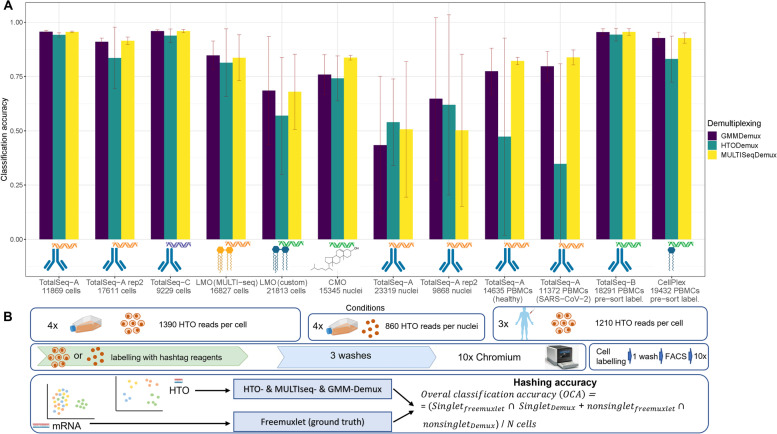
“In this work we have evaluated and compared the performance of commercially available oligos (custom LMOs purchased from Integrated DNA Technologies) with the LMOs used in the MULTI-seq work (McGinnis et al. 2019).”
BackgroundMethodInfluentialDiv-Seq: Single-nucleus RNA-Seq reveals dynamics of rare adult newborn neurons
Habib, N., Li, Y., Heidenreich, M., Swiech, L., Avraham-Davidi, I., Trombetta, J. J., Hession, C., Zhang, F., & Regev, A. (2016) · Science · doi:10.1126/science.aad7038 · Cited by 601
RNA-sequencing from single nuclei
Grindberg, R. V., Yee-Greenbaum, J. L., McConnell, M. J., Novotny, M., O’Shaughnessy, A. L., Lambert, G. M., Araúzo-Bravo, M. J., Lee, J., Fishman, M., Robbins, G. E., et al. (2013) · Proceedings of the National Academy of Sciences · doi:10.1073/pnas.1319700110 · Cited by 422 · cited 2×
“Single-cell suspensions are most commonly prepared from fresh tissues, which is a major roadblock for analysing clinical samples, archived materials and tissues such as the brain, for which cells cannot be readily extracted [5, 18, 19].”
BackgroundAbseq: Ultrahigh-throughput single cell protein profiling with droplet microfluidic barcoding
Shahi, P., Kim, S. C., Haliburton, J. R., Gartner, Z. J., & Abate, A. R. (2017) · Scientific Reports · doi:10.1038/srep44447 · Cited by 259 · cited 2×
“The development of oligo-labeled antibodies directed against cell surface proteins for sample multiplexing, is a direct evolution from the Abseq [13], REAP-seq [14], and CITE-seq [15] protocols.”
MethodDoubletDecon: Deconvoluting Doublets from Single-Cell RNA-Sequencing Data
DePasquale, E. A. K., Schnell, D. J., Van Camp, P.-J., Valiente-Alandí, Í., Blaxall, B. C., Grimes, H. L., Singh, H., & Salomonis, N. (2019) · Cell Reports · doi:10.1016/j.celrep.2019.09.082 · Cited by 207
Nuclei multiplexing with barcoded antibodies for single-nucleus genomics
Gaublomme, J. T., Li, B., McCabe, C., Knecht, A., Yang, Y., Drokhlyansky, E., Van Wittenberghe, N., Waldman, J., Dionne, D., Nguyen, L., et al. (2019) · Nature Communications · doi:10.1038/s41467-019-10756-2 · Cited by 199 · cited 2×
“02% Tween-20, 10mM Tris, 146mM NaCl, 1mM CaCl2, and 21mM MgCl2 [27].”
InfluentialHighly multiplexed single-cell RNA-seq by DNA oligonucleotide tagging of cellular proteins
Gehring, J., Hwee Park, J., Chen, S., Thomson, M., & Pachter, L. (2020) · Nature Biotechnology · doi:10.1038/s41587-019-0372-z · Cited by 122
CellTag Indexing: genetic barcode-based sample multiplexing for single-cell genomics
Guo, C., Kong, W., Kamimoto, K., Rivera-Gonzalez, G. C., Yang, X., Kirita, Y., & Morris, S. A. (2019) · Genome Biology · doi:10.1186/s13059-019-1699-y · Cited by 97
Xin, H., Lian, Q., Jiang, Y., Luo, J., Wang, X., Erb, C., Xu, Z., Zhang, X., Heidrich-O’Hare, E., Yan, Q., et al. (2020) · Genome Biology · doi:10.1186/s13059-020-02084-2 · Cited by 72 · cited 1×
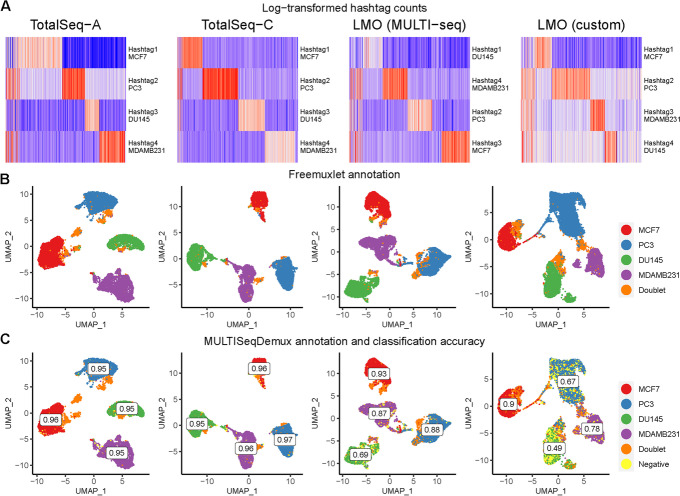
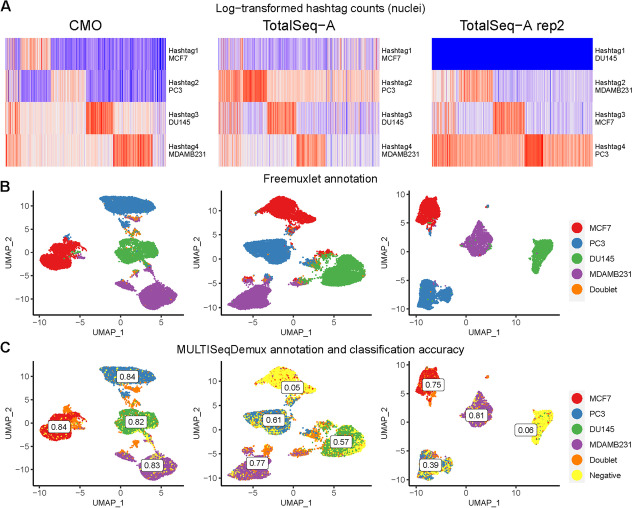
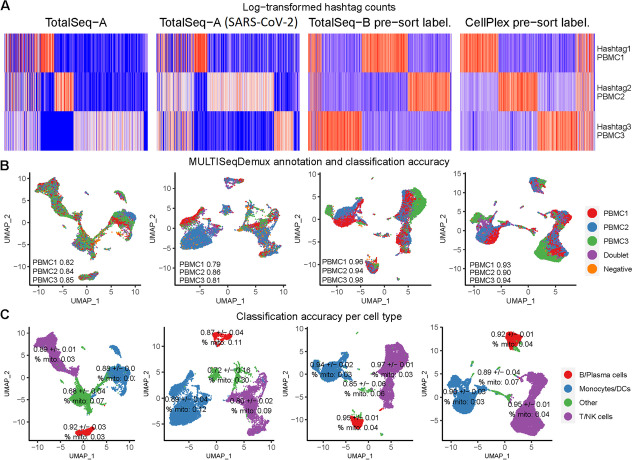
“The hashing accuracy or Overall Classification Accuracy (OCA) was calculated as the overlap between cell line annotation using Seurat (MULTISeqDemux and HTODemux functions) or GMM-Demux [21], and freemuxlet as a reference annotation as follows: the OCA equals the number of all matching singlets (e.”
MethodImproving oligo-conjugated antibody signal in multimodal single-cell analysis
Buus, T. B., Herrera, A., Ivanova, E., Mimitou, E., Cheng, A., Herati, R. S., Papagiannakopoulos, T., Smibert, P., Odum, N., & Koralov, S. B. (2021) · eLife · doi:10.7554/elife.61973 · Cited by 53 · cited 1×
“An important parameter “signal-to-noise ratio” [22] was kept in this comparison on the same level by labeling equal number of cells with the same quantity of hashing antibodies.”
BackgroundIsolation of Murine Skin Resident and Migratory Dendritic Cells via Enzymatic Digestion
Kashem, S. W., & Kaplan, D. H. (2018) · Current Protocols in Immunology · doi:10.1002/cpim.45 · Cited by 31
Nuclei multiplexing with barcoded antibodies for single-nucleus genomics
Gaublomme, J. T., Li, B., McCabe, C., Knecht, A., Drokhlyansky, E., Wittenberghe, N. V., Waldman, J., Dionne, D., Nguyen, L., Jager, P. D., et al. (2018) · bioRxiv (Cold Spring Harbor Laboratory) · doi:10.1101/476036 · Cited by 25
MHC Class-I Loss and Cancer Immune Escape
Garrido, F. (2019) · Advances in experimental medicine and biology · doi:10.1007/978-3-030-17864-2 · Cited by 20 · cited 1×
“The success of using antibodies for hashing depends on the ubiquitous expression of these target antigens, which can be problematic for some samples or species (Federico Garrido 2019; Hermiston, Xu, and Weiss 2003), limiting the sample-agnostic, universal application of this method.”
Background
Research works printed but not linked: 1
- Gehring J Park JH Chen S Thomson M Pachter L Highly multiplexed single-cell RNA-seq for defining cell population and transcriptional spaces jase bioRxiv. 2018 23 10 11
Cited by
Browaeys, R., Gilis, J., Sang-Aram, C., De Bleser, P., Hoste, L., Tavernier, S., Lambrechts, D., Seurinck, R., & Saeys, Y. (2023) · bioRxiv (Cold Spring Harbor Laboratory) · doi:10.1101/2023.06.13.544751 · Cited by 133
Self-citationSample-multiplexing approaches for single-cell sequencing
Zhang, Y., Xu, S., Wen, Z., Gao, J., Li, S., Weissman, S. M., & Pan, X. (2022) · Cellular and Molecular Life Sciences · doi:10.1007/s00018-022-04482-0 · Cited by 40
“compared antibody- and lipid-based multiplexing methods for singlecell RNA-seq, and drew a conclusion that antibody-based hashing is a more efficient protocol on human cell lines and PBMCs, while lipid hashing delivers a better result on nuclei [90].”
BackgroundApplication of single-cell RNA sequencing on human testicular samples: a comprehensive review
Dong, F., Ping, P., Ma, Y., & Chen, X. (2023) · International Journal of Biological Sciences · doi:10.7150/ijbs.82191 · Cited by 39
“, cell capturing/sequencing/barcoding) [44, 57-59] and the dry-lab parts (e.”
BackgroundKlein, H. (2023) · Bioinformatics · doi:10.1093/bioinformatics/btad481 · Cited by 32
Morris, J. A., Sun, J. S., & Sanjana, N. E. (2023) · Trends in Genetics · doi:10.1016/j.tig.2023.10.012 · Cited by 37
Metadata
- Authors
- Mylka, V., Matetovici, I., Poovathingal, S., Aerts, J., Vandamme, N., Seurinck, R., Verstaen, K., Hulselmans, G., Van den Hoecke, S., Scheyltjens, I., Movahedi, K., Wils, H., Reumers, J., Van Houdt, J., Aerts, S., & Saeys, Y.
- Affiliations
- Vlaams Instituut voor Biotechnologie (BE)
- VIB-KU Leuven Center for Brain & Disease Research (BE)
- Ghent University (BE)
- Vrije Universiteit Brussel (BE)
- Janssen (Belgium) (BE)
- Corresponding author
- Aerts, Stein
- Saeys, Yvan
- ORCID
- Venue
- Genome Biology
- Published
- 2022-02-16
- Volume
- 23
- Issue
- 1
- Pages
- 55-55
- ISSN
- 1465-6906 (ISSN-L)
- 1474-760X
- PMC
- PMC8851857
- OpenAlex
- W4213286472
- Cited by
- 53
- References
- 31
- Citations by year
- 2026: 7 · 2025: 12 · 2024: 16 · 2023: 13 · 2022: 3
- FWCI
- 3.67
- Type
- journal article
- Language
- en
- Open access
- gold
- doi.org
- Licence
- cc-by
- creativecommons.org/licenses/by/4.0 (tdm)
- creativecommons.org/licenses/by/4.0 (vor)
- Locations
- Genome biology (publishedVersion, cc-by)
- bioRxiv (Cold Spring Harbor Laboratory) (acceptedVersion)
- PubMed Central (publishedVersion, cc-by)
- PubMed (publishedVersion)
- Lirias (acceptedVersion, other-oa)
- Ghent University Academic Bibliography (Ghent University) (submittedVersion, cc-by)
- Lirias (submittedVersion, other-oa)
- DOAJ (DOAJ: Directory of Open Access Journals) (submittedVersion, cc-by-sa)
- VUBIR (Vrije Universiteit Brussel) (submittedVersion)
- Funders
- University of California, San Francisco
- Topics
- Life Sciences › Biochemistry, Genetics and Molecular Biology › Molecular Biology › Single-cell and spatial transcriptomics
- Life Sciences › Biochemistry, Genetics and Molecular Biology › Molecular Biology › Genomics and Phylogenetic Studies
- Life Sciences › Biochemistry, Genetics and Molecular Biology › Molecular Biology › Gene expression and cancer classification
- Keywords
- single-cell RNA sequencing, multiplexing, hashing, demultiplexing, single-nucleus RNA sequencing, batch effects, SARS-CoV-2, peripheral blood mononuclear cells, mouse tissues
- MeSH terms
- COVID-19, Animals, Antibodies, Cell Nucleus, Humans, Lipids, Mice, Inbred BALB C, Mice, Inbred C57BL, Neutrophils, Case-Control Studies, Sequence Analysis, RNA, Cell Line, Tumor, Mice, Single-Cell Analysis
About these checks
Registry, retraction, Cites and statistics results are computed, not judged, with one exception: a printed reference that no index lists is read once by a model before it counts as a citation error. Claims are extracted by a model and kept only when their quote appears verbatim in the text; each cited source is then checked, with a model’s help, for whether it says what the claim relies on. Those verdicts can be wrong — read the claim’s quote and the cited source before relying on one.
Statistics and arithmetic are recomputed, not judged.
Confidence bands are shown only for fields calibrated on our annotated test set. None is calibrated yet, so no band is shown.
What counts as a claim ›How we measure confidence ›How we check this ›
Are you an author, or do you see a problem with this page? Request a review
Data sources
Bibliographic data: Semantic Scholar, OpenAlex, Crossref.
Contains information from the Semantic Scholar Academic Graph Datasets, made available under the ODC Attribution License (ODC-BY 1.0).
Semantic Scholar’s data is described in: Kinney, R., et al. (2023). The Semantic Scholar Open Data Platform. arXiv:2301.10140.
