

The BrainACT study: acceptance and commitment therapy for depressive and anxiety symptoms following acquired brain injury: study protocol for a randomized controlled trial.
Open accessThe DOI matches its Crossref record; 49 of the 52 references it cites were found in a registry or an index; 17 of the 56 sources its claims cite were checked for support.
Abstract
Background: Following an acquired brain injury, individuals frequently experience anxiety and/or depressive symptoms. However, current treatments for these symptoms are not very effective. A promising treatment is acceptance and commitment therapy (ACT), which is a third-wave behavioural therapy. The primary goal of this therapy is not to reduce symptoms, but to improve psychological flexibility and general well-being, which may be accompanied by a reduction in symptom severity. The aim of this study is to investigate the effectiveness of an adapted ACT intervention (BrainACT) in people with acquired brain injury who experience anxiety and/or depressive symptoms.Methods: The study is a multicenter, randomized, controlled, two-arm parallel trial. In total, 94 patients who survive a stroke or traumatic brain injury will be randomized into an ACT or control (i.e. psycho-education and relaxation) intervention. The primary outcome measures are the Hospital Anxiety and Depression Scale and the Depression Anxiety Stress Scale. Outcomes will be assessed by trained assessors, blinded to treatment condition, pre-treatment, during treatment, post-treatment, and at 7 and 12 months.Discussion: This study will contribute to the existing knowledge on how to treat psychological distress following acquired brain injury. If effective, BrainACT could be implemented in clinical practice and potentially help a large number of patients with acquired brain injury.Trial Registration: Dutch Trial Register, NL691, NTR 7111. Registered on 26 March 2018. https://www.trialregister.nl/trial/6916.
Overview
CoChat Summary
## TL;DR
This is a study protocol for a multicenter randomized controlled trial testing an adapted acceptance and commitment therapy (BrainACT) versus psycho-education plus relaxation in 94 adults with acquired brain injury and anxiety/depressive symptoms. The trial will assess whether BrainACT reduces distress and improves psychological flexibility, participation, health status, and cost-effectiveness.
## Key findings
- Not stated in the paper.
- The planned sample is 94 participants with stroke or traumatic brain injury (TBI), randomized 1:1 to ACT or active control.
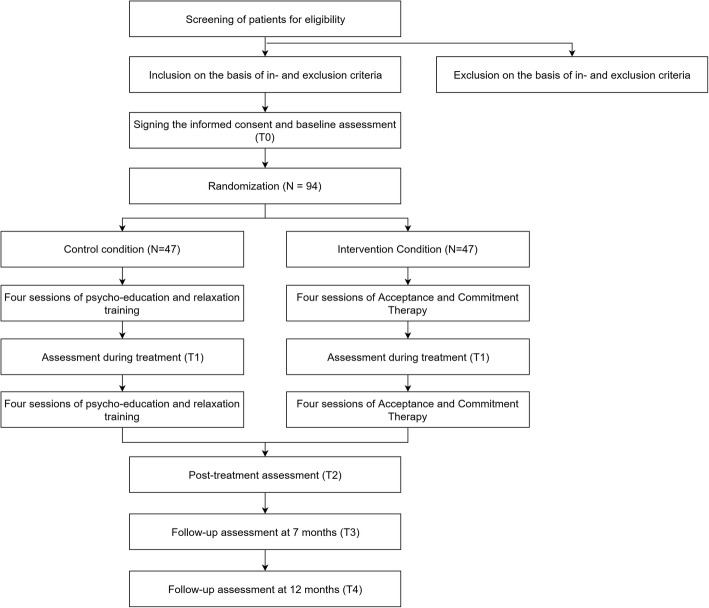
- The intervention is an 8-week ACT program with eight weekly individual sessions of 60 min over 3.5 months; the control is eight sessions of psycho-education plus relaxation training.
- The paper reports that earlier ACT studies in ABI showed promising results, including a randomized trial in stroke survivors with significant reduction in depression and a pilot RCT in severe TBI with significantly decreased anxiety and depression, but this protocol itself reports no trial results.
## Methods
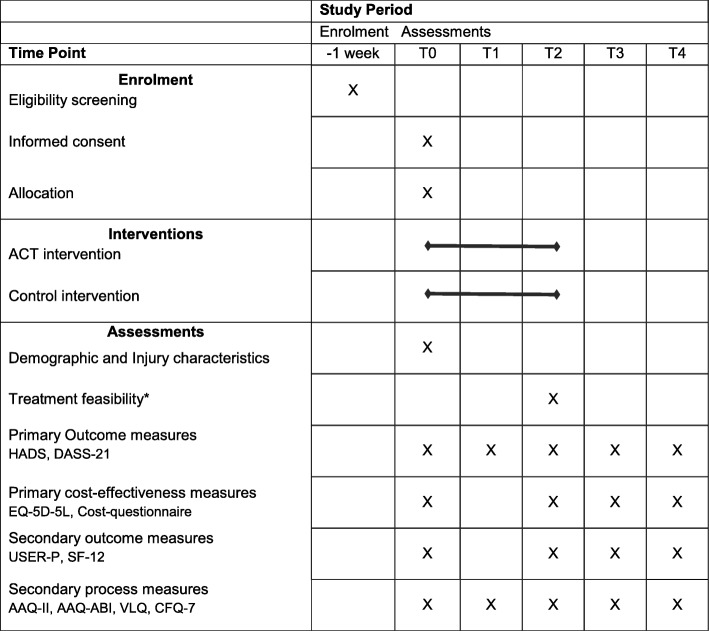
- Design: Multicenter, randomized, controlled, two-arm parallel trial; assessments at T0 baseline, T1 after 1 month, T2 after 3 months, T3 at 7 months, and T4 at 12 months.
- Sample/data: 94 Dutch adults recruited from hospitals and rehabilitation centers; inclusion required stroke or TBI, HADS depression and/or anxiety subscale > 7, age 18+, stable psychotropic medication, Dutch fluency, computer/internet access, and informed consent.
- Analysis: Intention-to-treat analyses using linear mixed models for repeated measures; baseline comparisons with chi-square tests and independent-samples t tests; alpha set at 0.05; trial-based economic evaluation includes cost-effectiveness and cost-utility analyses.
## Limitations
- The paper states that participants and therapists cannot be blinded because of the clinical nature of the intervention; only outcome assessors are blinded.
- The authors note that participant recruitment and loss to follow-up are known to be problematic in ABI studies.
- Evident from the text: this is a protocol, so no efficacy or cost-effectiveness results are reported yet.
Model-written summary. Check it against the paper before relying on it.
Integrity signals
Registry
Cites
Statistics
Figures
Verification
Claims the paper makes
14 Valid · 0 Not valid · 21 Not checked · 31 Own results and interpretations
The cited sources support only part of this claim — read each source’s verdict below.
In the paper
“A recent type of therapy that has been proven to be effective over a wide range of clinical populations is acceptance and commitment therapy (ACT) [16–19].”
§ The BrainACT study: acceptance and commitment therapy for depressive and anxiety symptoms following acquired brain injury: study protocol for a randomized controlled trial > Introduction
What the sources say
- Not checked — no full text of the sourcecites [16] Powers MB Zum Vorde Sive Vording MB Emmelkamp PM Acceptance and commitment therapy: a meta-analytic review Psychother Psychosom 2009 78 2 73 80 10.1159/000190790 19142046 source
- Supportedcites [17] A-Tjak JGL Davis ML Morina N Powers MB Smits JAJ Emmelkamp PMG A meta-analysis of the efficacy of acceptance and commitment therapy for clinically relevant Mental and physical health problems Psychother Psychosom 2015 84 1 30 36 10.1159/000365764 25547522 source
The Discussion reports that a meta-analysis of 39 randomized trials found ACT outperformed control conditions, and says the findings support its use for anxiety disorders, depression, addiction, and somatic health problems. This supports effectiveness across a range of clinical populations, though the paper notes that more research is needed for some specific disorders. Page numbers were not available in our copy. (LLM, conf=0.88)
- Not checked — no full text of the sourcecites [18] Ost LG The efficacy of acceptance and commitment therapy: an updated systematic review and meta-analysis Behav Res Ther 2014 61 105 121 10.1016/j.brat.2014.07.018 25193001 source
- Partly supportedcites [19] Swain J Hancock K Hainsworth C Bowman J Acceptance and commitment therapy in the treatment of anxiety: a systematic review Clin Psychol Rev 2013 33 8 965 978 10.1016/j.cpr.2013.07.002 23999201 sourceExperimental — accuracy not yet measured
The abstract (p. 1) says ACT has a growing evidence base for an array of problems, and the Discussion (p. 11) reports improvement across a spectrum of anxiety disorders. But the review calls its findings preliminary and notes methodological limitations; it does not establish that ACT has been proven effective across a wide range of clinical populations. (LLM, conf=0.88)
boostedstates a cause- Asserted: passes — The authors put it forward as true.
- Checkable: passes — It can be checked against evidence.
- Load-bearing: passes — The paper’s conclusions depend on it.
- Based: passes — The paper gives a reason why it holds.
The cited sources support only part of this claim — read each source’s verdict below.
In the paper
“Whiting, Deane, McLeod, Ciarrochi and Simpson [31] performed a pilot RCT comparing an ACT group intervention with befriending therapy in patients with severe TBI. Their results show that ACT decreased the levels of anxiety and depression significantly compared to the befriending treatment.”
§ The BrainACT study: acceptance and commitment therapy for depressive and anxiety symptoms following acquired brain injury: study protocol for a randomized controlled trial > Introduction
What the sources say
- Partly supportedcites [31] Whiting D, Deane F, McLeod H, Ciarrochi J, Simpson G. Can acceptance and commitment therapy facilitate psychological adjustment after a severe traumatic brain injury? A pilot randomized controlled trial. Neuropsychol Rehabil. 2019;1–24. 10.1080/09602011.2019.1583582. 30789059 sourceExperimental — accuracy not yet measured
The Results (Hypothesis 2: Secondary outcome measures; page not provided) report a significantly greater decrease in depression with ACT-Adjust than with Befriending. They report a significant difference for stress, but no significant effect for the other secondary outcomes, so the claimed significant reduction in anxiety is not supported. The Discussion adds that the depression and stress differences were not maintained at one-month follow-up. (LLM, conf=0.93)
plainstates a cause- Asserted: passes — The authors put it forward as true.
- Checkable: passes — It can be checked against evidence.
- Load-bearing: passes — The paper’s conclusions depend on it.
- Based: passes — The paper gives a reason why it holds.
- Partly supported
Every source the paper cites for this claim was checked and supports it.
In the paper
“Furthermore, antidepressants have not been shown to be more beneficial than placebo when treating depression following TBI [9].”
§ The BrainACT study: acceptance and commitment therapy for depressive and anxiety symptoms following acquired brain injury: study protocol for a randomized controlled trial > Introduction
What the sources say
- Supportedcites [9] Kreitzer Natalie Ancona Rachel McCullumsmith Cheryl Kurowski Brad G. Foreman Brandon Ngwenya Laura B. Adeoye Opeolu The Effect of Antidepressants on Depression After Traumatic Brain Injury Journal of Head Trauma Rehabilitation 2019 34 3 E47 E54 10.1097/HTR.0000000000000439 30169440 PMC8730802 source
The Conclusions state that the meta-analysis found no benefit of antidepressants over placebo for major depressive disorder following TBI. The Discussion likewise reports no significant difference in depression severity across five placebo-controlled trials, while noting bias and heterogeneity in the evidence. (LLM, conf=0.94)
plain- Asserted: passes — The authors put it forward as true.
- Checkable: passes — It can be checked against evidence.
- Load-bearing: passes — The paper’s conclusions depend on it.
- Based: passes — The paper gives a reason why it holds.
- Supported
The cited sources support only part of this claim — read each source’s verdict below.
In the paper
“Currently, there is some evidence that people who developed depressive or anxiety symptoms after ABI can benefit from ACT.”
- Also stated in: § Introduction · hedged
“These studies provide preliminary support for the hypothesis that ACT can be effective in treating psychological distress following ABI.”
- Also stated in: § Discussion · hedged
“However, earlier studies have shown promising results [29–31].”
§ The BrainACT study: acceptance and commitment therapy for depressive and anxiety symptoms following acquired brain injury: study protocol for a randomized controlled trial > Introduction
What the sources say
- Partly supportedcites [29] Majumdar S Morris R Brief group-based acceptance and commitment therapy for stroke survivors Br J Clin Psychol 2019 58 1 70 90 10.1111/bjc.12198 29999185 sourceExperimental — accuracy not yet measured
The Discussion reports that ACT reduced depressive symptoms compared with controls among stroke survivors. It also reports no significant group difference in anxiety and says further research is needed to determine whether ACT helps post-stroke anxiety. The study therefore offers preliminary support for depression after stroke, but not for anxiety or acquired brain injury more broadly. (LLM, conf=0.88)
- Not checked — no full text of the sourcecites [30] Graham CD Gillanders D Stuart S Gouick J An acceptance and commitment therapy (ACT)–based intervention for an adult experiencing post-stroke anxiety and medically unexplained symptoms Clin Case Stud 2015 14 2 83 97 10.1177/1534650114539386 source
- Partly supportedcites [31] Whiting D, Deane F, McLeod H, Ciarrochi J, Simpson G. Can acceptance and commitment therapy facilitate psychological adjustment after a severe traumatic brain injury? A pilot randomized controlled trial. Neuropsychol Rehabil. 2019;1–24. 10.1080/09602011.2019.1583582. 30789059 sourceExperimental — accuracy not yet measured
The Results (Hypothesis 2: Secondary outcome measures; page unavailable) report greater post-treatment reductions in depression and stress with ACT than with befriending, supporting preliminary benefit for psychological distress. They report no significant effect on the other secondary measures, including anxiety, and the depression and stress differences were not maintained at one month (Hypothesis 3). The trial also studied severe traumatic brain injury, rather than acquired brain injury generally. (LLM, conf=0.88)
hedgedstates a possible cause- Asserted: passes — The authors put it forward as true.
- Checkable: passes — It can be checked against evidence.
- Load-bearing: passes — The paper’s conclusions depend on it.
- Based: passes — The paper gives a reason why it holds.
- Also stated in: § Introduction · hedged
The cited sources support only part of this claim — read each source’s verdict below.
In the paper
“Fourth, the ACT treatment protocol was adapted to the needs and possible cognitive deficits of patients with brain injury. These adaptations were based on suggestions made in previous literature and knowledge gained in clinical practice.”
§ The BrainACT study: acceptance and commitment therapy for depressive and anxiety symptoms following acquired brain injury: study protocol for a randomized controlled trial > Discussion
What the sources say
- Partly supportedcites [24] Kangas M McDonald S Is it time to act? The potential of acceptance and commitment therapy for psychological problems following acquired brain injury Neuropsychol Rehabil 2011 21 2 250 276 10.1080/09602011.2010.540920 21246445 PMC3877858 sourceExperimental — accuracy not yet measured
In “Future Directions: Clinical and Research Implications” (page unavailable), the paper recommends modifying ACT-based treatment programmes for people with cognitive impairments after acquired brain injury, drawing on the literature. It offers guidance rather than reporting that a treatment protocol was actually adapted, and it does not identify knowledge gained in clinical practice as the basis for adaptations. (LLM, conf=0.86)
- Not checked — no full text of the sourcecites [46] Broomfield NM Laidlaw K Hickabottom E Murray MF Pendrey R Whittick JE Post-stroke depression: the case for augmented, individually tailored cognitive behavioural therapy Clin Psychol Psychother 2011 18 3 202 217 10.1002/cpp.711 20632301 source
plain- Asserted: passes — The authors put it forward as true.
- Checkable: passes — It can be checked against evidence.
- Load-bearing: unclear — It is unclear whether the paper’s conclusions depend on it.
- Based: passes — The paper gives a reason why it holds.
- Partly supported
12 more claims
Create a free account to see all 66 claims and to verify the 1 reference still open.
- It may state two separate claims as one. 27
- Probably not a substantial claim. 37
Claims other papers make about this one
Each is checked against this paper’s own text: does it say what the citing paper says it does?
The cited source says what the claim attributes to it.
In the citing paper
“Although treating these symptoms remains a challenge, evidence suggests that Acceptance and Commitment Therapy (ACT) can be an effective treatment for ABI-related anxiety and depressive symptoms (10–13).”
From Trial-based economic evaluation of the BrainACT study: acceptance and commitment therapy for anxiety and/or depressive symptoms after acquired brain injury. (2025) · cites this paper as [12]
The cited source says what the claim attributes to it.
In the citing paper
“This is currently being investigated in a multicentre randomised controlled trial with a one-year follow-up period 17 in which the BrainACT intervention is compared to a combined psycho-education and relaxation treatment.”
From Acceptance and commitment therapy for people with acquired brain injury: Rationale and description of the BrainACT treatment. (2023) · cites this paper as [17]
The cited source says what the claim attributes to it.
In the citing paper
“There were several deviations from the original study protocol [16].”
Citations
Cites
Jacobson, N. S., & Truax, P. (1991) · Journal of Consulting and Clinical Psychology · doi:10.1037/0022-006x.59.1.12 · Cited by 7,770
Acceptance and commitment therapy: model, processes and outcomes
Hayes, S. C., Luoma, J. B., Bond, F. W., Masuda, A., & Lillis, J. (2006) · Behaviour Research and Therapy · doi:10.1016/j.brat.2005.06.006 · Cited by 6,587 · cited 3×
“Psychological flexibility is described as “the ability to contact the present moment more fully as a conscious human being, and to change or persist in behaviour when doing so serves valued ends” [21], p.”
BackgroundInfluentialBond, F. W., Hayes, S. C., Baer, R. A., Carpenter, K. M., Guenole, N., Orcutt, H. K., Waltz, T., & Zettle, R. D. (2011) · Behavior Therapy · doi:10.1016/j.beth.2011.03.007 · Cited by 3,950
Hayes, S. C. (2004) · Behavior Therapy · doi:10.1016/s0005-7894(04)80013-3 · Cited by 2,493 · cited 2×
“Instead of applying cognitive restructuring techniques as used in traditional cognitive therapy, ACT focusses on learning to accept both the negative and positive thoughts and feelings related to those circumstances that cannot be changed or controlled [25].”
BackgroundMethodPost-Stroke Fatigue: Epidemiology, Clinical Characteristics and Treatment
Acciarresi, M., Bogousslavsky, J., & Paciaroni, M. (2014) · European Neurology · doi:10.1159/000363763 · Cited by 1,417
A-Tjak, J. G. L., Davis, M. L., Morina, N., Powers, M. B., Smits, J. A. J., & Emmelkamp, P. M. G. (2015) · Psychotherapy and Psychosomatics · doi:10.1159/000365764 · Cited by 1,031
A Practical Guide to Acceptance and Commitment Therapy
(2004) · doi:10.1007/978-0-387-23369-7 · Cited by 875 · cited 1×
“ACT is a third-wave cognitive behavioural therapy, which uses commitment and behaviour change strategies to increase psychological flexibility [20].”
BackgroundThe development and initial validation of the cognitive fusion questionnaire
Gillanders, D. T., Bolderston, H., Bond, F. W., Dempster, M., Flaxman, P. E., Campbell, L., Kerr, S., Tansey, L., Noel, P., Ferenbach, C., et al. (2014) · Behavior Therapy · doi:10.1016/j.beth.2013.09.001 · Cited by 837 · cited 2×
“Earlier research has shown that the CFQ has good factor structure, validity, reliability, and stability over time [42].”
BackgroundMethodHayes, S. C. (2016) · Behavior Therapy · doi:10.1016/j.beth.2016.11.006 · Cited by 785
Acceptance and commitment therapy: A meta-analytic review
Powers, M. B., Zum Vörde Sive Vörding, M. B., & Emmelkamp, P. M. G. (2009) · Psychotherapy and Psychosomatics · doi:10.1159/000190790 · Cited by 619
The valued living questionnaire: defining and measuring valued action within a behavioral framework
Wilson, K. G., Sandoz, E. K., Kitchens, J., & Roberts, M. (2010) · The Psychological Record · doi:10.1007/bf03395706 · Cited by 518
The efficacy of Acceptance and Commitment Therapy: An updated systematic review and meta-analysis
Öst, L.-G. (2014) · Behaviour Research and Therapy · doi:10.1016/j.brat.2014.07.018 · Cited by 476 · cited 2×
“We have taken into account recommendations made by Ost [18], to enhance the quality of studies”
MethodKreutzer, J. S., Seel, R. T., & Gourley, E. (2001) · Brain Injury · doi:10.1080/02699050010009108 · Cited by 417
Psychiatric Disorders Following Traumatic Brain Injury: Their Nature and Frequency
Whelan-Goodinson, R., Ponsford, J., Johnston, L., & Grant, F. (2009) · Journal of Head Trauma Rehabilitation · doi:10.1097/htr.0b013e3181a712aa · Cited by 310
Validity of the Utrecht Scale for Evaluation of Rehabilitation-Participation
Post, M. W. M., van der Zee, C. H., Hennink, J., Schafrat, C. G., Visser-Meily, J. M. A., & van Berlekom, S. B. (2012) · Disability and Rehabilitation · doi:10.3109/09638288.2011.608148 · Cited by 268
Wicksell, R. K., Olsson, G. L., & Hayes, S. C. (2010) · European Journal of Pain · doi:10.1016/j.ejpain.2010.05.001 · Cited by 259 · cited 2×
“Second, when psychological flexibility increases, a decrease is often observed in psychological distress [22, 23].”
BackgroundWhelan-Goodinson, R., Ponsford, J., & Schönberger, M. (2009) · Journal of Affective Disorders · doi:10.1016/j.jad.2008.06.007 · Cited by 245 · cited 13×
“To our knowledge, no large RCTs have been conducted investigating the effectiveness of ACT for anxiety and depressive symptoms following TBI or stroke.”
MethodInfluentialCognitive Behavioral Psychotherapy for Depression Following Stroke: A Randomized Controlled Trial
Lincoln, N. B., & Flannaghan, T. (2003) · Stroke · doi:10.1161/01.str.0000044167.44670.55 · Cited by 232
Acceptance and Commitment Therapy in the treatment of anxiety: A systematic review
Swain, J., Hancock, K., Hainsworth, C., & Bowman, J. (2013) · Clinical Psychology Review · doi:10.1016/j.cpr.2013.07.002 · Cited by 207
McCallie, M. S., Blum, C. M., & Hood, C. J. (2006) · Journal of Human Behavior in the Social Environment · doi:10.1300/j137v13n03_04 · Cited by 204
Findler, M., Cantor, J., Haddad, L., Gordon, W., & Ashman, T. (2001) · Brain Injury · doi:10.1080/02699050010013941 · Cited by 204 · cited 1×
“The SF-12 has been validated for use in TBI research [38].”
MethodChamelian, L., & Feinstein, A. (2006) · The Journal of Neuropsychiatry and Clinical Neurosciences · doi:10.1176/jnp.18.1.33 · Cited by 174 · cited 1×
“Moreover, anxiety and depressive symptoms have a negative influence on patient rehabilitation [5] and they increase the severity and number of reported health problems such as fatigue, memory, headaches, and concentration problems [6, 7].”
BackgroundPonsford, J., Lee, N. K., Wong, D., McKay, A., Haines, K., Alway, Y., Downing, M., Furtado, C., & O'Donnell, M. L. (2016) · Psychological Medicine · doi:10.1017/s0033291715002640 · Cited by 173
Fann, J. R., Bombardier, C. H., Vannoy, S., Dyer, J., Ludman, E., Dikmen, S., Marshall, K., Barber, J., & Temkin, N. (2015) · Journal of Neurotrauma · doi:10.1089/neu.2014.3423 · Cited by 147
Kangas, M., & McDonald, S. (2011) · Neuropsychological Rehabilitation · doi:10.1080/09602011.2010.540920 · Cited by 133
Fledderus, M., Bohlmeijer, E. T., Fox, J.-P., Schreurs, K. M. G., & Spinhoven, P. (2013) · Behaviour Research and Therapy · doi:10.1016/j.brat.2012.11.007 · Cited by 133 · cited 2×
“Second, when psychological flexibility increases, a decrease is often observed in psychological distress [22, 23].”
BackgroundEffect of mood symptoms on recovery one year after stroke
Donnellan, C., Hickey, A., Hevey, D., & O'Neill, D. (2010) · International Journal of Geriatric Psychiatry · doi:10.1002/gps.2482 · Cited by 132
Resource-Use Measurement Based on Patient Recall: Issues and Challenges for Economic Evaluation
Thorn, J. C., Coast, J., Cohen, D. R., Hollingworth, W., Knapp, M. R. J., Noble, S., Ridyard, C. H., Wordsworth, S., & Hughes, D. A. (2013) · Applied Health Economics and Health Policy · doi:10.1007/s40258-013-0022-4 · Cited by 112
Brief group‐based acceptance and commitment therapy for stroke survivors.
Majumdar, S., & Morris, R. (2019) · British Journal of Clinical Psychology · doi:10.1111/bjc.12198 · Cited by 107 · cited 1×
“Majumdar and Morris [29] performed a randomized controlled trial (RCT) in which an ACT group-intervention of four weekly didactic PowerPoint sessions was compared to treatment as usual in stroke survivors.”
MethodJuengst, S. B., Kumar, R. G., & Wagner, A. K. (2017) · Psychology Research and Behavior Management · doi:10.2147/prbm.s113264 · Cited by 102 · cited 1×
“It leads to more hospitalizations, less societal participation, reduces the return-to-work rates, places a greater burden on caregivers, affects social relationships, and has a vast impact on general quality of life [4].”
BackgroundPost‐stroke depression: the case for augmented, individually tailored cognitive behavioural therapy
Broomfield, N. M., Laidlaw, K., Hickabottom, E., Murray, M. F., Pendrey, R., Whittick, J. E., & Gillespie, D. C. (2011) · Clinical Psychology & Psychotherapy · doi:10.1002/cpp.711 · Cited by 99
Waldron, B., Casserly, L. M., & O'Sullivan, C. (2013) · Neuropsychological Rehabilitation · doi:10.1080/09602011.2012.724196 · Cited by 93
Cochrane review: information provision for stroke patients and their caregivers
Smith, J., Forster, A., Young, J., & On behalf of the Cochrane Group for information provision after stroke (2009) · Clinical Rehabilitation · doi:10.1177/0269215508092820 · Cited by 93 · cited 1×
“A Cochrane review concluded that active information provision is able to reduce depression and anxiety after brain injury [47].”
BackgroundTownend, E., Tinson, D., Kwan, J., & Sharpe, M. (2010) · Clinical Rehabilitation · doi:10.1177/0269215509358934 · Cited by 90
Ashman, T., Cantor, J. B., Tsaousides, T., Spielman, L., & Gordon, W. (2014) · Journal of Head Trauma Rehabilitation · doi:10.1097/htr.0000000000000098 · Cited by 83
Randall, D., Thomas, M., Whiting, D., & McGrath, A. (2017) · Journal of Head Trauma Rehabilitation · doi:10.1097/htr.0000000000000250 · Cited by 80
McCracken, L. M., DaSilva, P., Skillicorn, B., & Doherty, R. (2014) · The Clinical Journal of Pain · doi:10.1097/ajp.0000000000000047 · Cited by 75 · cited 1×
“The questionnaire has been validated in healthy individuals and in patients [42, 43].”
BackgroundWhiting, D., Deane, F., McLeod, H., Ciarrochi, J., & Simpson, G. (2020) · Neuropsychological Rehabilitation · doi:10.1080/09602011.2019.1583582 · Cited by 71 · cited 2×
“Whiting, Deane, McLeod, Ciarrochi and Simpson [31] performed a pilot RCT comparing an”
BackgroundPsychological Factors Determine Depressive Symptomatology After Stroke
van Mierlo, M. L., van Heugten, C. M., Post, M. W., de Kort, P. L., & Visser-Meily, J. M. (2015) · Archives of Physical Medicine and Rehabilitation · doi:10.1016/j.apmr.2015.01.022 · Cited by 56 · cited 1×
“After surviving a stroke, a quarter of the patients experience depressive symptoms at 6 months post-stroke [2]; almost half of the patients who experienced a traumatic brain injury (TBI) suffer from a major depressive disorder and 38% suffer from anxiety symptoms [3].”
BackgroundThe Effect of Antidepressants on Depression After Traumatic Brain Injury: A Meta-analysis
Kreitzer, N., Ancona, R., McCullumsmith, C., Kurowski, B. G., Foreman, B., Ngwenya, L. B., & Adeoye, O. (2019) · Journal of Head Trauma Rehabilitation · doi:10.1097/htr.0000000000000439 · Cited by 56
Ayis, S. A., Ayerbe, L., Ashworth, M., & DA Wolfe, C. (2018) · Journal of Affective Disorders · doi:10.1016/j.jad.2017.11.037 · Cited by 55
Kootker, J. A., Rasquin, S. M. C., Lem, F. C., van Heugten, C. M., Fasotti, L., & Geurts, A. C. H. (2017) · Archives of Physical Medicine and Rehabilitation · doi:10.1016/j.apmr.2016.10.013 · Cited by 53
Validating measures of psychological flexibility in a population with acquired brain injury
Whiting, D. L., Deane, F. P., Ciarrochi, J., McLeod, H. J., & Simpson, G. K. (2015) · Psychological Assessment · doi:10.1037/pas0000050 · Cited by 45 · cited 1×
“Furthermore, the questionnaire has been validated in a sample of patients with ABI [40].”
MethodGraham, C. D., Gillanders, D., Stuart, S., & Gouick, J. (2015) · Clinical Case Studies · doi:10.1177/1534650114539386 · Cited by 43 · cited 2×
“Graham, Gillanders, Stuart, and Gouick [30] described a case study in which a stroke patient no longer experienced chest pain, had a decrease in anxiety and depressive symptoms, and improved illness perception and psychological flexibility following an ACT intervention.”
BackgroundRelaxation training after stroke: potential to reduce anxiety
Kneebone, I., Walker-Samuel, N., Swanston, J., & Otto, E. (2014) · Disability and Rehabilitation · doi:10.3109/09638288.2013.808275 · Cited by 36
Role of valued living and associations with functional outcome following traumatic brain injury
Pais (Hons.), C., Ponsford, J. L., Gould (Clin. Neuro), K. R., & Wong, D. (2019) · Neuropsychological Rehabilitation · doi:10.1080/09602011.2017.1313745 · Cited by 33
Wilz, G. (2007) · Brain Injury · doi:10.1080/02699050601121996 · Cited by 27
Emerging strategies in the treatment of poststroke depression and psychiatric distress in patients
Capaldi II, V. F., & Wynn (2010) · Psychology Research and Behavior Management · doi:10.2147/prbm.s10035 · Cited by 25
Crowley, D., & Andrews, L. (2018) · Aging & Mental Health · doi:10.1080/13607863.2017.1348478 · Cited by 19
Niet rennen maar plannen, een poliklinisch cognitief behandelprogramma.
Baars-Elsinga, A., Geusgens, C. A. V., Heugten, C. M. V., et al. (2013) · Research Publications (Maastricht University) · Cited by 5
Self-citation
Research works printed but not linked: 3
- Jansen G Batink T Time to ACT! Het basisboek voor professionals 2014 Zaltbommel Thema
- Schultz JH, Thomas K. Übungsheft für das autogene training: konzentrative Selbstentspannung: TRIAS Thieme Hippokrates Enke; 1989.
- Corp I IBM SPSS statistics for Windows, Version 25.0 2017 Armonk IBM Corp
Cited by
Management of Psychological Complications Following Mild Traumatic Brain Injury
Silverberg, N. D., & Mikolić, A. (2023) · Current Neurology and Neuroscience Reports · doi:10.1007/s11910-023-01251-9 · Cited by 39
Liu, Y.-E., Lv, J., Sun, F., Liang, J., Zhang, Y., Chen, J., & Jiang, W. (2023) · Brain and Behavior · doi:10.1002/brb3.3260 · Cited by 29
Novel Synthetic and Natural Therapies for Traumatic Brain Injury
Battaglini, D., Siwicka-Gieroba, D., Rocco, P. R. M., Cruz, F. F., Silva, P. L., Dąbrowski, W., Brunetti, I., Patroniti, N. A., Pelosi, P. P., & Robba, C. (2021) · Current Neuropharmacology · doi:10.2174/1570159x19666210225145957 · Cited by 22
Rauwenhoff, J. C., Bol, Y., van Heugten, C. M., Batink, T., Geusgens, C. A., van den Hout, A. J., Smits, P., Verwegen, C. R., Visser, A., & Peeters, F. (2023) · Clinical Rehabilitation · doi:10.1177/02692155231154124 · Cited by 19
“Currently, the BrainACT intervention is further being evaluated in a multicentre randomised controlled trial.(17) In this article, we present the rationale and description of the BrainACT intervention using the Template for Intervention Description and Replication framework and illustrate it with a case description.”
MethodSelf-citationPsychotherapeutic Intervention for Adults With Acquired Brain Injury: A Case Study Using BackUp
Thøgersen, C. M. S., Glintborg, C., Hansen, T. G. B., & Trettvik, J. (2022) · Frontiers in Rehabilitation Sciences · doi:10.3389/fresc.2022.771416 · Cited by 13
Metadata
- Authors
- Rauwenhoff, J., Peeters, F., Bol, Y., & Van Heugten, C.
- Affiliations
- Maastricht University Medical Centre (NL)
- Maastricht University (NL)
- Zuyderland Medisch Centrum (NL)
- Venue
- Trials
- Published
- 2019-12
- Volume
- 20
- Issue
- 1
- Pages
- 773-773
- ISSN
- 1745-6215 (ISSN-L)
- PMC
- PMC6935100
- OpenAlex
- W2996941602
- Cited by
- 22
- References
- 52
- Citations by year
- 2026: 1 · 2025: 2 · 2024: 2 · 2023: 5 · 2022: 5 · 2021: 3 · 2020: 4
- FWCI
- 3.50
- Type
- journal article
- Language
- en
- Open access
- gold
- doi.org
- Licence
- cc-by
- creativecommons.org/licenses/by/4.0/ (tdm)
- creativecommons.org/licenses/by/4.0/ (vor, 26 d)
- Locations
- Trials (publishedVersion, cc-by)
- PubMed Central (publishedVersion, cc-by)
- PubMed (publishedVersion)
- Research Publications (Maastricht University) (submittedVersion, cc-by)
- DOAJ (DOAJ: Directory of Open Access Journals) (submittedVersion)
- Research Publications (Maastricht University) (submittedVersion, other-oa)
- Funders
- ZonMW (63631 0003)
- Topics
- Social Sciences › Psychology › Clinical Psychology › Mindfulness and Compassion Interventions
- Social Sciences › Psychology › Experimental and Cognitive Psychology › Anxiety, Depression, Psychometrics, Treatment, Cognitive Processes
- Health Sciences › Medicine › Clinical Neurology › Traumatic Brain Injury Research
- Keywords
- acceptance and commitment therapy, acquired brain injury, depressive symptoms, anxiety symptoms, psychological distress, stroke, traumatic brain injury, psychological flexibility, psychoeducation, relaxation
- MeSH terms
- Psychological Distress, Adult, Anxiety, Brain Injuries, Depression, Humans, Psychiatric Status Rating Scales, Research Design, Multicenter Studies as Topic, Randomized Controlled Trials as Topic, Treatment Outcome, Acceptance and Commitment Therapy
About these checks
Registry, retraction, Cites and statistics results are computed, not judged, with one exception: a printed reference that no index lists is read once by a model before it counts as a citation error. Claims are extracted by a model and kept only when their quote appears verbatim in the text; each cited source is then checked, with a model’s help, for whether it says what the claim relies on. Those verdicts can be wrong — read the claim’s quote and the cited source before relying on one.
The claim verdicts this report counts are experimental: their accuracy is not yet measured.
A language model drew the claims from the paper on 2026-10-11, under version 3 of the claim definition (model deepseek-v4.1-flash, prompt extract-v3).
A second model labelled each claim on 2026-10-11 (model jev-1.13-20260917, definition revision gold-guideline-v0.2).
Cited sources are checked with a language model’s help (gpt-6-sol).
Statistics and arithmetic are recomputed, not judged.
Confidence bands are shown only for fields calibrated on our annotated test set. None is calibrated yet, so no band is shown.
What counts as a claim ›How we measure confidence ›How we check this ›
Are you an author, or do you see a problem with this page? Request a review
Data sources
Bibliographic data: Semantic Scholar, OpenAlex, Crossref.
Contains information from the Semantic Scholar Academic Graph Datasets, made available under the ODC Attribution License (ODC-BY 1.0).
Semantic Scholar’s data is described in: Kinney, R., et al. (2023). The Semantic Scholar Open Data Platform. arXiv:2301.10140.
