

The DOI matches its Crossref record; 50 of the 51 references it cites were found in a registry or an index.
Co-production of biodiesel and bioethanol using psychrophilic microalga Chlamydomonas sp. KNM0029C isolated from Arctic sea ice
Open accessAbstract
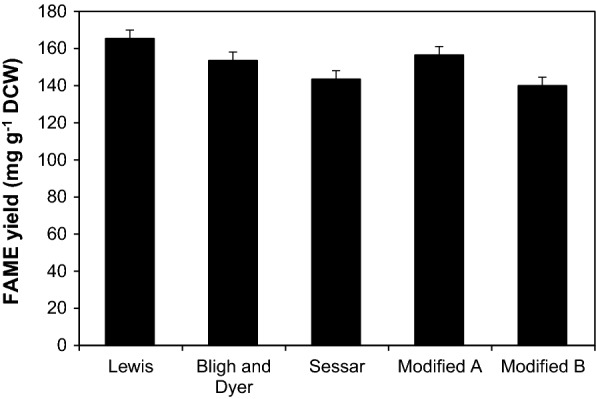
Background: Biofuels, generated using microalgae as sustainable energy, have received a lot of attention. Microalgae can be cultivated at low cost with CO 2 and solar energy without competition from edible crops. Psychrophilic microalgae can be a suitable feedstock to produce biofuels without the environmental constraints of low temperatures, because they can grow below 10 °C. However, there is a lack of efficient strategies using psychrophilic microalgae to produce biodiesel and bioethanol. Therefore, the current study aimed to optimize the production of biodiesel and bioethanol from Arctic Chlamydomonas sp. KNM0029C at low temperatures. Results: After incubation in a 20-L photobioreactor, fatty acid methyl ester (FAME) was extracted using modified FAME extraction methods, producing a maximum yield of 0.16-g FAME/g KNM0029C. Residual biomass was pretreated for bioethanol production, and the yields from different methods were compared. The highest bioethanol yield (0.22-g/g residual biomass) was obtained by pretreatment with enzyme (amyloglucosidase) after sonication. Approximately 300-mg biofuel was obtained, including 156-mg FAME biodiesel and 144-mg bioethanol per g dried cells, representing the highest recorded yield from psychrophilic microalgae. Conclusions: This is the first to attempt at utilizing biomass from psychrophilic Arctic microalga Chlamydomonas sp. KNM0029C for the co-production of bioethanol and biodiesel, and it yielded the highest values among reported studies using psychrophilic organisms. These results can be used as a source for the efficient biofuel production using polar microalgae.
Overview
The claims and statistics of this paper haven’t been checked yet.
Run the check — free, no account needed. It reads the open-access text and checks the sources it cites.
Integrity signals
Registry
Cites
Statistics
Figures
Verification
Claims the paper makes
The claims and statistics of this paper haven’t been checked yet.
Run the check — free, no account needed. It reads the open-access text and checks the sources it cites.
Claims other papers make about this one
Each is checked against this paper’s own text: does it say what the citing paper says it does?
The cited source says what the claim attributes to it.
In the citing paper
“Despite corn and sugarcane being the main sources of bioethanol, reports show the feasibility of producing it from algal biomass, particularly lipid-extracted biomass, which can be converted into simple sugars through saccharification and fermented to produce ethanol [77–79].”
From A Holistic Approach to Circular Bioeconomy Through the Sustainable Utilization of Microalgal Biomass for Biofuel and Other Value-Added Products (2024) · cites this paper as [79]
Self-check
Percentages, sums and reported differences re-computed from the paper’s own numbers.
The self-check needs the paper’s full text.
Citations
Cites
Bradford, M. M. (1976) · Analytical Biochemistry · doi:10.1016/0003-2697(76)90527-3 · Cited by 255,302
A RAPID METHOD OF TOTAL LIPID EXTRACTION AND PURIFICATION
Bligh, E. G., & Dyer, W. J. (1959) · Canadian Journal of Biochemistry and Physiology · doi:10.1139/o59-099 · Cited by 54,751
Chisti, Y. (2007) · Biotechnology Advances · doi:10.1016/j.biotechadv.2007.02.001 · Cited by 9,524
Identification of bacteria by gas chromatography of cellular fatty acids
Sasser, M. (1990) · Medical Entomology and Zoology · Cited by 6,161
Brennan, L., & Owende, P. (2010) · Renewable and Sustainable Energy Reviews · doi:10.1016/j.rser.2009.10.009 · Cited by 4,894
Commercial Applications of Microalgae
Spolaore, P., Joannis-Cassan, C., Duran, E., & Isambert, A. (2006) · Journal of Bioscience and Bioengineering · doi:10.1263/jbb.101.87 · Cited by 4,285
Production of liquid biofuels from renewable resources
Nigam, P. S., & Singh, A. (2011) · Progress in Energy and Combustion Science · doi:10.1016/j.pecs.2010.01.003 · Cited by 2,156
Life-Cycle Assessment of Biodiesel Production from Microalgae
Lardon, L., Hélias, A., Sialve, B., Steyer, J.-P., & Bernard, O. (2009) · Environmental Science & Technology · doi:10.1021/es900705j · Cited by 1,528
Ho, S., Chen, C., & Chang, J. (2011) · Bioresource Technology · doi:10.1016/j.biortech.2011.11.133 · Cited by 798
Nascimento, I. A., Marques, S. S. I., Cabanelas, I. T. D., Pereira, S. A., Druzian, J. I., de Souza, C. O., Vich, D. V., de Carvalho, G. C., & Nascimento, M. A. (2013) · BioEnergy Research · doi:10.1007/s12155-012-9222-2 · Cited by 517
Wahidin, S., Idris, A., & Shaleh, S. R. M. (2012) · Bioresource Technology · doi:10.1016/j.biortech.2012.11.032 · Cited by 473
Evaluation of extraction methods for recovery of fatty acids from lipid-producing microheterotrophs
Lewis, T. E., Nichols, P. D., & McMeekin, T. A. (2000) · Journal of Microbiological Methods · doi:10.1016/s0167-7012(00)00217-7 · Cited by 425
Enzymatic pretreatment of Chlamydomonas reinhardtii biomass for ethanol production
Choi, S. P., Nguyen, M. T., & Sim, S. J. (2010) · Bioresource Technology · doi:10.1016/j.biortech.2010.02.026 · Cited by 408
Recent advances in liquid biofuel production from algal feedstocks
Daroch, M., Geng, S., & Wang, G. (2012) · Applied Energy · doi:10.1016/j.apenergy.2012.07.031 · Cited by 393
Sforza, E., Simionato, D., Giacometti, G. M., Bertucco, A., & Morosinotto, T. (2012) · PLoS ONE · doi:10.1371/journal.pone.0038975 · Cited by 313
Pre-treatment optimization of Scenedesmus obliquus microalga for bioethanol production
Miranda, J. R., Passarinho, P. C., & Gouveia, L. (2011) · Bioresource Technology · doi:10.1016/j.biortech.2011.10.059 · Cited by 307
Hirano, A., Ueda, R., Hirayama, S., & Ogushi, Y. (1997) · Energy · doi:10.1016/s0360-5442(96)00123-5 · Cited by 284
Molino, A., Iovine, A., Casella, P., Mehariya, S., Chianese, S., Cerbone, A., Rimauro, J., & Musmarra, D. (2018) · International Journal of Environmental Research and Public Health · doi:10.3390/ijerph15112436 · Cited by 263
Hydrothermal Acid Pretreatment of Chlamydomonas reinhardtii Biomass for Ethanol Production
Sim, S. J. (2009) · Journal of Microbiology and Biotechnology · doi:10.4014/jmb.0810.578 · Cited by 257
The vitamin content of microalgae used in aquaculture
Brown, M. R., Mular, M., Miller, I., Farmer, C., & Trenerry, C. (1999) · Journal of Applied Phycology · doi:10.1023/a:1008075903578 · Cited by 227
Enzymatic hydrolysis of microalgal biomass for bioethanol production
Harun, R., & Danquah, M. K. (2011) · Chemical Engineering Journal · doi:10.1016/j.cej.2011.01.088 · Cited by 207
Kim, M. G., Baek, J., YUN, Y., JUNSIM, S., PARK, S., & Kim, S. S. (2005) · International Journal of Hydrogen Energy · doi:10.1016/j.ijhydene.2005.06.009 · Cited by 203
Self-citationWastewater-leachate treatment by microalgae: Biomass, carbohydrate and lipid production
Hernández-García, A., Velasquez‐Orta, S. B., Novelo, E., Yáñez-Noguez, I., Ramírez, I. M., & Ledesma, M. T. O. (2019) · Ecotoxicology and Environmental Safety · doi:10.1016/j.ecoenv.2019.02.052 · Cited by 188
Teoh, M., Chu, W.-L., Marchant, H. J., & Phang, S. (2004) · Journal of Applied Phycology · doi:10.1007/s10811-004-5502-3 · Cited by 181
Lee, O. K., Kim, A. L., Seong, D. H., Lee, C., Jung, Y. T., Lee, J. W., & Lee, E. Y. (2013) · Bioresource Technology · doi:10.1016/j.biortech.2013.01.007 · Cited by 161
Two‐stage Hydrolysis of Invasive Algal Feedstock for Ethanol FermentationF
Wang, X., Liu, X., & Wang, G. (2010) · Journal of Integrative Plant Biology · doi:10.1111/j.1744-7909.2010.01024.x · Cited by 155
Zou, S., Wu, Y., Yang, M., Li, C., & Tong, J. (2009) · Energy & Fuels · doi:10.1021/ef9000105 · Cited by 150
Phwan, C. K., Chew, K. W., Sebayang, A. H., Ong, H. C., Ling, T. C., Malek, M. A., Ho, Y.-C., & Show, P. L. (2019) · Biotechnology for Biofuels · doi:10.1186/s13068-019-1533-5 · Cited by 143
Waltz, E. (2009) · Nature Biotechnology · doi:10.1038/nbt0109-15 · Cited by 133
Cavonius, L. R., Carlsson, N., & Undeland, I. (2014) · Analytical and Bioanalytical Chemistry · doi:10.1007/s00216-014-8155-3 · Cited by 133
Impact of temperature and light intensity on triacylglycerol accumulation in marine microalgae
Kurpan Nogueira, D. P., Silva, A. F., Araújo, O. Q. F., & Chaloub, R. M. (2015) · Biomass and Bioenergy · doi:10.1016/j.biombioe.2014.10.017 · Cited by 122
Lee, O. K., Oh, Y., & Lee, E. Y. (2015) · Bioresource Technology · doi:10.1016/j.biortech.2015.07.040 · Cited by 121
Lee, S., Oh, Y., Kim, D., Kwon, D., Lee, C., & Lee, J. (2011) · Applied Biochemistry and Biotechnology · doi:10.1007/s12010-011-9181-7 · Cited by 120
Tommasi, E., Cravotto, G., Galletti, P., Grillo, G., Mazzotti, M., Sacchetti, G., Samorì, C., Tabasso, S., Tacchini, M., & Tagliavini, E. (2017) · ACS Sustainable Chemistry & Engineering · doi:10.1021/acssuschemeng.7b02074 · Cited by 110
Evaluation of Fatty Acid Extraction Methods for Thraustochytrium sp. ONC-T18
Burja, A. M., Armenta, R. E., Radianingtyas, H., & Barrow, C. J. (2007) · Journal of Agricultural and Food Chemistry · doi:10.1021/jf070412s · Cited by 106
Musa, M., Ayoko, G. A., Ward, A., Rösch, C., Brown, R. J., & Rainey, T. J. (2019) · Cells · doi:10.3390/cells8080851 · Cited by 97
Difusa, A., Talukdar, J., Kalita, M. C., Mohanty, K., & Goud, V. V. (2015) · Biofuels · doi:10.1080/17597269.2015.1045274 · Cited by 89
Ike, A., Toda, N., Tsuji, N., Hirata, K., & Miyamoto, K. (1997) · Journal of Fermentation and Bioengineering · doi:10.1016/s0922-338x(97)81921-6 · Cited by 59
Della-Bianca, B. E., de Hulster, E. A. F., Pronk, J. T., van Maris, A. J. A., & Gombert, A. K. (2014) · FEMS Yeast Research · doi:10.1111/1567-1364.12217 · Cited by 56
SMITH, R. E. H., Stapleford, L. C., & Ridings, R. S. (1994) · Journal of Phycology · doi:10.1111/j.0022-3646.1994.00008.x · Cited by 46
Sheikh, R. A., Al-Bar, O. A. M., & Ahmed, Y. M. (2016) · Biotechnology & Biotechnological Equipment · doi:10.1080/13102818.2016.1159527 · Cited by 40
Light Intensity Modulates the Response of Two Antarctic Diatom Species to Ocean Acidification
Heiden, J. P., Bischof, K., & Trimborn, S. (2016) · Frontiers in Marine Science · doi:10.3389/fmars.2016.00260 · Cited by 37
Jung, W., Gwak, Y., Davies, P. L., Kim, H. J., & Jin, E. (2014) · Marine Biotechnology · doi:10.1007/s10126-014-9567-y · Cited by 31
Effect of Chemical Pre-treatments on Bioethanol Production from Chlorella minutissima
Sert, B. Ş., İnan, B., & Özçimen, D. B. (2018) · Acta chimica slovenica · doi:10.17344/acsi.2017.3728 · Cited by 29
Do, H., Lee, J. H., Lee, S. G., & Kim, H. J. (2012) · Acta Crystallographica Section F Structural Biology and Crystallization Communications · doi:10.1107/s1744309112020465 · Cited by 27
Microalgae wet extraction using N-ethyl butylamine for fatty acid production
Du, Y., Schuur, B., Kersten, S. R. A., & Brilman, D. W. F. (2016) · Green Energy & Environment · doi:10.1016/j.gee.2016.07.001 · Cited by 24
Martins, A. P., Yokoya, N. S., & Colepicolo, P. (2012) · Revista Brasileira de Farmacognosia · doi:10.1590/s0102-695x2012005000088 · Cited by 19
Growth and lipid content at low temperature of Arctic alga Chlamydomonas sp. KNM0029C
Kim, E. J., Jung, W., Lim, S., Kim, S., Han, S. J., & Choi, H. (2015) · Bioprocess and Biosystems Engineering · doi:10.1007/s00449-015-1499-z · Cited by 14
Self-citationAdela, B. N., & Loh, S. K. (2015) · Malaysian Journal of Microbiology · doi:10.21161/mjm.12814 · Cited by 7
Kim, E. J., Jung, W., Kim, S., Choi, H., & Han, S. J. (2019) · KSBB Journal · doi:10.7841/ksbbj.2019.34.3.173 · Cited by 2
Self-citation
Research works printed but not linked: 1
- Eshaq FS, Ali MN, Mohd MK. Spirogyra biomass a renewable source for biofuel (bioethanol) production. Int J Eng Sci Technol. 2010;2(12):7045–54.
Cited by
Sorted by citations
Siddiki, S. Y. A., Mofijur, M., Kumar, P. S., Ahmed, S. F., Inayat, A., Kusumo, F., Badruddin, I. A., Khan, T. M. Y., Nghiem, L. D., Ong, H. C., et al. (2021) · Fuel · doi:10.1016/j.fuel.2021.121782 · Cited by 489
Microalgae-based biorefineries for sustainable resource recovery from wastewater
Goswami, R. K., Mehariya, S., Verma, P., Lavecchia, R., & Zuorro, A. (2020) · Journal of Water Process Engineering · doi:10.1016/j.jwpe.2020.101747 · Cited by 304
Bhatia, S. K., Bhatia, R. K., Jeon, J.-M., Pugazhendhi, A., Awasthi, M. K., Kumar, D., Kumar, G., Yoon, J., & Yang, Y. (2020) · Fuel · doi:10.1016/j.fuel.2020.119117 · Cited by 257
Meléndez, J. R., Mátyás, B., Hena, S., Löwy, D. A., & Salous, A. E. (2022) · Renewable and Sustainable Energy Reviews · doi:10.1016/j.rser.2022.112260 · Cited by 150
Karpagam, R., Jawaharraj, K., & Gnanam, R. (2021) · Science of The Total Environment · doi:10.1016/j.scitotenv.2020.144236 · Cited by 146
Metadata
- Authors
- Kim, E. J., Kim, S., Choi, H.-G., & Han, S. J.
- Affiliations
- Korea Polar Research Institute (KR)
- Corresponding author
- Han, Se Jong
- Venue
- Biotechnology for Biofuels
- Published
- 2020-02-01
- Volume
- 13
- Issue
- 1
- Pages
- 20-20
- ISSN
- 1754-6834 (ISSN-L)
- PMC
- PMC6995180
- OpenAlex
- W3010865578
- Cited by
- 113
- References
- 51
- Citations by year
- 2026: 10 · 2025: 20 · 2024: 8 · 2023: 19 · 2022: 19 · 2021: 25 · 2020: 12
- FWCI
- 3.71
- Type
- journal article
- Language
- en
- Open access
- gold
- doi.org
- Locations
- Biotechnology for Biofuels (publishedVersion, cc-by)
- PubMed Central (publishedVersion, cc-by)
- PubMed (publishedVersion)
- DOAJ (DOAJ: Directory of Open Access Journals) (submittedVersion)
- Funders
- Korea Polar Research Institute (PE19180, PE20150)
- Topics
- Physical Sciences › Energy › Renewable Energy, Sustainability and the Environment › Algal biology and biofuel production
- Physical Sciences › Engineering › Biomedical Engineering › Biofuel production and bioconversion
- Life Sciences › Biochemistry, Genetics and Molecular Biology › Molecular Biology › Microbial Metabolic Engineering and Bioproduction
- Keywords
- Arctic sea ice, biodiesel, bioethanol, co-production, fatty acid methyl esters, glucoamylase, sonication, low-temperature cultivation, photobioreactors, biofuel yield
About these checks
Registry, retraction, Cites and statistics results are computed, not judged, with one exception: a printed reference that no index lists is read once by a model before it counts as a citation error. Claims are extracted by a model and kept only when their quote appears verbatim in the text; each cited source is then checked, with a model’s help, for whether it says what the claim relies on. Those verdicts can be wrong — read the claim’s quote and the cited source before relying on one.
Statistics and arithmetic are recomputed, not judged.
Confidence bands are shown only for fields calibrated on our annotated test set. None is calibrated yet, so no band is shown.
What counts as a claim ›How we measure confidence ›How we check this ›
Are you an author, or do you see a problem with this page? Request a review
