

The DOI matches its Crossref record; 53 of the 53 references it cites were found in a registry or an index.
Development of Dirofilaria immitis within the mosquito Aedes (Finlaya) koreicus, a new invasive species for Europe
Open accessAbstract
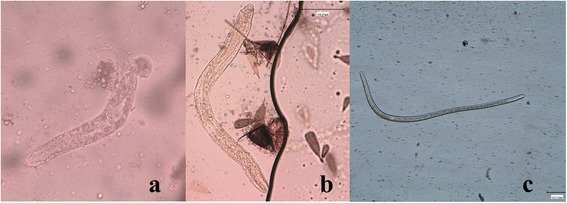
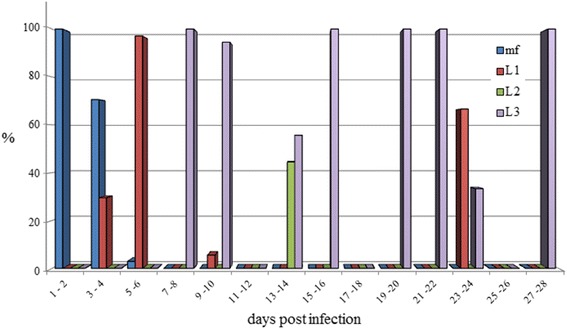
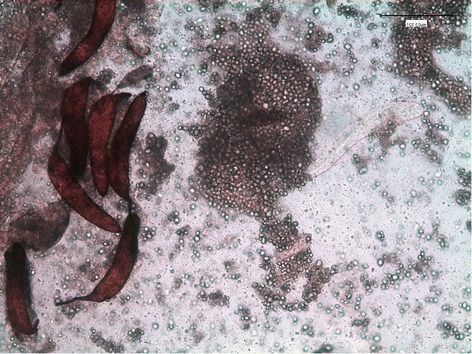
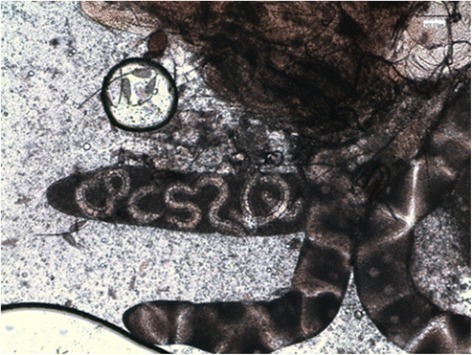
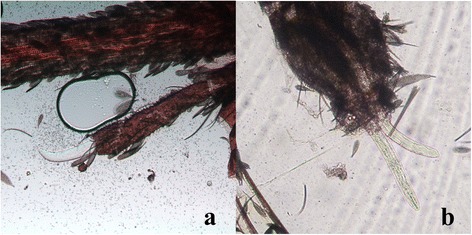
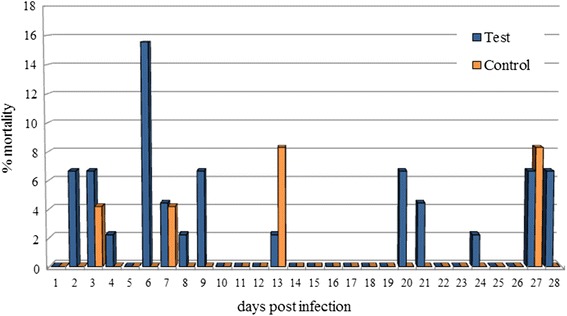
BACKGROUND: Over the recent decades, container-breeding mosquito species belonging to the genus Aedes have frequently been recorded far from their place of origin. Aedes koreicus was first reported in north-eastern Italy in 2011, in a region endemic for Dirofilaria immitis, the agent of canine heartworm disease. The vector competence of Ae. koreicus for D. immitis was here tested under laboratory conditions, by infecting mosquitoes with a local strain of D. immitis. METHODS: Blood containing 3000 microfilariae/ml was offered to 54 mosquitoes (T group) while 29 were left as a control (C group). Mosquitoes killed at scheduled days post infection (dpi) and naturally dead were divided in head, thorax and abdomen and examined for D. immitis larval stages by dissection under a microscope and molecularly. RESULTS: Of the 45 engorged mosquitoes in T, 32 (71.1%) scored positive for D. immitis larval stages. L3 were found as early as 8 dpi in the Malpighian tubules and then in the thorax, salivary glands, palp and proboscis. At the end of the study a total of 18 mosquitoes developed L3 giving an estimated infection rate at 12 dpi of 68.2% and a vector efficiency index of 25.2%. The rate of mortality in T group within the first 9 days post infection was significantly higher in T group (47.6%) than in C group (8.3%) (p < 0.01). The concordance between microscopy and PCR was high (0.8-0.9), however, a positivity for D. immitis in the head was found molecularly at 13 dpi, three days before microscopy. CONCLUSIONS: Aedes koreicus, a new invasive species for Europe, is most likely a competent vector of D. immitis being of potential relevance in the natural cycle of the parasite. This poses a new threat for animal and human health in endemic areas for dirofilariosis and enhances the risk of spreading the infection in previously non-endemic areas. These results stress the importance of active surveillance and control strategies to minimize the risk of introduction of invasive alien species.
Overview
The claims and statistics of this paper haven’t been checked yet.
Run the check — free, no account needed. It reads the open-access text and checks the sources it cites.
Integrity signals
Registry
Cites
Statistics
Figures
Verification
Claims the paper makes
The claims and statistics of this paper haven’t been checked yet.
Run the check — free, no account needed. It reads the open-access text and checks the sources it cites.
Claims other papers make about this one
Each is checked against this paper’s own text: does it say what the citing paper says it does?
In the citing paper
“Moreover, a new vector was detected in Europe, Ae. koreicus, which was identified in the Province of Belluno, north-eastern Italy, and in Chiasso, in the Swiss–Italian border region [152,153].”
From What has happened to heartworm disease in Europe in the last 10 years? (2022) · cites this paper as [152]
In the citing paper
“D. immitis has spread in the last years in Europe due to climate change, the spreading of mosquito Aedes albopictus and the introduction of new vector Aedes koreicus [29].”
From Dirofilaria immitis and Angiostrongylus vasorum: the contemporaneous detection in kennels (2015) · cites this paper as [29]
In the citing paper
“Despite the large natural infestation of European mosquitoes from endemic areas [5–22], only a few species have been experimentally confirmed as competent for Dirofilaria spp. (e.g., Cx. pipiens s.l., Ae. albopictus, Aedes aegypti, Aedes japonicus, Aedes geniculatus and Aedes koreicus) [47–50].”
From Dirofilaria immitis and Dirofilaria repens in mosquitoes from Corsica Island, France (2021) · cites this paper as [48]
Self-check
Percentages, sums and reported differences re-computed from the paper’s own numbers.
The self-check needs the paper’s full text.
Citations
Cites
A Review of the Invasive Mosquitoes in Europe: Ecology, Public Health Risks, and Control Options
Medlock, J. M., Hansford, K. M., Schaffner, F., Versteirt, V., Hendrickx, G., Zeller, H. G., & Bortel, W. V. (2012) · Vector-Borne and Zoonotic Diseases · doi:10.1089/vbz.2011.0814 · Cited by 700
Genetics of Mosquito Vector Competence
Beerntsen, B. T., James, A. A., & Christensen, B. M. (2000) · Microbiology and Molecular Biology Reviews · doi:10.1128/mmbr.64.1.115-137.2000 · Cited by 433
Manual for mosquito rearing and experimental techniques.
Gerberg, E. J., Barnard, D. R., & Ward, R. A. (1994) · Cited by 403
Public health significance of invasive mosquitoes in Europe
Schaffner, F., Medlock, J. M., & Bortel, W. V. (2013) · Clinical Microbiology and Infection · doi:10.1111/1469-0691.12189 · Cited by 317
An outbreak of chikungunya fever in the province of Ravenna, Italy
Angelini, P., Finarelli, A. C., Angelini, P., Po, C., Petropulacos, K., Macini, P., Fiorentini, C., Fortuna, C., Venturi, G., Romi, R., et al. (2007) · Weekly releases (1997–2007) · doi:10.2807/esw.12.36.03260-en · Cited by 234
Is heartworm disease really spreading in Europe?
Genchi, C., Rinaldi, L., Cascone, C., Mortarino, M., & Cringoli, G. (2005) · Veterinary Parasitology · doi:10.1016/j.vetpar.2005.04.009 · Cited by 222
Dirofilarial Infections in Europe
Genchi, C., Kramer, L. H., & Rivasi, F. (2011) · Vector-Borne and Zoonotic Diseases · doi:10.1089/vbz.2010.0247 · Cited by 214
Mosquito-borne viruses in western Europe: a review.
Lundström, J. O. (1999) · PubMed · Cited by 206
Aedes albopictus is a natural vector of Dirofilaria immitis in Italy
Cancrini, G., Frangipane di Regalbono, A., Ricci, I., Tessarin, C., Gabrielli, S., & Pietrobelli, M. (2003) · Veterinary Parasitology · doi:10.1016/j.vetpar.2003.10.011 · Cited by 206
Otranto, D., Capelli, G., & Genchi, C. (2009) · Parasites & Vectors · doi:10.1186/1756-3305-2-s1-s2 · Cited by 177
Self-citation
Research works printed but not linked: 4
- Miyagi I. Notes on the Aedes (Finlaya) chrysolineatus subgroup in Japan and Korea (Diptera: Culicidae). Tropical Med. 1971;13(3):141–51.
- Tiawsirisup S, Kaewthamasorn M. The potential for Aedes albopictus (Skuse) (Diptera: Culicidae) to be a competent vector for canine heartworm, Dirofilaria immitis (Leidy). Southeast Asian J Trop Med Public Health. 2007;38 Suppl 1:208–14.
- Gander E. ZurHistochemie und Histologie des Mitteldarnies von Aedes aegypti und Anopheles stephensi in Znsammenhang mit der Bintverdannng. Acta Trop. 1968;25(2):131–75.
- Cazzin S, Ciocchetta S, Ravagnan S, Drago A, Carlin S, Capelli G, Montarsi F. Host preference of the invasive mosquito Aedes koreicus [Hulecoeteomyia koreica]. In Proceedings of XXVIII National Congress SOIPA, 2014: 156, available online at: http://www.soipa.it/images/documenti/attisoipa2014.pdf
Cited by
Sorted by citations
The prevalence of Dirofilaria immitis and D. repens in the Old World
Genchi, C., & Kramer, L. H. (2020) · Veterinary Parasitology · doi:10.1016/j.vetpar.2019.108995 · Cited by 187
Subcutaneous dirofilariosis (Dirofilaria repens): an infection spreading throughout the old world
Genchi, C., & Kramer, L. (2017) · Parasites & Vectors · doi:10.1186/s13071-017-2434-8 · Cited by 159
Parasite Ecology of Invasive Species: Conceptual Framework and New Hypotheses
Chalkowski, K., Lepczyk, C. A., & Zohdy, S. (2018) · Trends in Parasitology · doi:10.1016/j.pt.2018.05.008 · Cited by 125
Heartworm disease – Overview, intervention, and industry perspective
Noack, S., Harrington, J. L., Carithers, D. S., Kaminsky, R., & Selzer, P. M. (2021) · International Journal for Parasitology Drugs and Drug Resistance · doi:10.1016/j.ijpddr.2021.03.004 · Cited by 145
Blocking transmission of vector-borne diseases
Schorderet-Weber, S., Noack, S., Selzer, P. M., & Kaminsky, R. (2017) · International Journal for Parasitology Drugs and Drug Resistance · doi:10.1016/j.ijpddr.2017.01.004 · Cited by 86
Metadata
- Authors
- Montarsi, F., Ciocchetta, S., Devine, G., Ravagnan, S., Mutinelli, F., Frangipane di Regalbono, A., Otranto, D., & Capelli, G.
- Affiliations
- Istituto Zooprofilattico Sperimentale delle Venezie (IT)
- Queensland University of Technology (AU)
- QIMR Berghofer Medical Research Institute (AU)
- University of Bari Aldo Moro (IT)
- Corresponding author
- Capelli, Gioia
- ORCID
- Venue
- Parasites & Vectors
- Published
- 2015-03-23
- Volume
- 8
- Issue
- 1
- Pages
- 177-177
- ISSN
- 1756-3305 (ISSN-L)
- PMC
- PMC4382832
- OpenAlex
- W2126586237
- Cited by
- 101
- References
- 53
- Citations by year
- 2026: 6 · 2025: 3 · 2024: 4 · 2023: 8 · 2022: 22 · 2021: 12 · 2020: 8 · 2019: 8 · 2018: 8 · 2017: 12 · 2016: 6 · 2015: 4
- FWCI
- 7.80
- Type
- journal article
- Language
- en
- Open access
- gold
- doi.org
- Locations
- Parasites & Vectors (publishedVersion, cc-by)
- Europe PMC (PubMed Central) (publishedVersion, cc-by)
- PubMed Central (publishedVersion, cc-by)
- PubMed (publishedVersion)
- QUT ePrints (Queensland University of Technology) (submittedVersion, cc-by)
- DOAJ (DOAJ: Directory of Open Access Journals) (submittedVersion)
- CINECA IRIS Institutional Research Information System (University of Bari Aldo Moro) (submittedVersion, other-oa)
- Padua Research Archive (University of Padova) (submittedVersion, cc-by)
- Funders
- Bayer HealthCare
- Ministero della Salute
- Regione del Veneto
- Topics
- Health Sciences › Medicine › Infectious Diseases › Parasitic Diseases Research and Treatment
- Health Sciences › Medicine › Public Health, Environmental and Occupational Health › Mosquito-borne diseases and control
- Life Sciences › Immunology and Microbiology › Parasitology › Vector-borne infectious diseases
- Keywords
- Dirofilaria immitis, Aedes koreicus, vector competence, canine heartworm disease, invasive mosquito species, mosquito mortality, Malpighian tubules, salivary glands, dirofilariasis, invasive species, Europe
- MeSH terms
- Aedes, Animals, Dirofilaria immitis, Dirofilariasis, Dog Diseases, Dogs, Europe, Humans, Insect Vectors, Italy, Larva, Introduced Species
About these checks
Registry, retraction, Cites and statistics results are computed, not judged, with one exception: a printed reference that no index lists is read once by a model before it counts as a citation error. Claims are extracted by a model and kept only when their quote appears verbatim in the text; each cited source is then checked, with a model’s help, for whether it says what the claim relies on. Those verdicts can be wrong — read the claim’s quote and the cited source before relying on one.
Statistics and arithmetic are recomputed, not judged.
Confidence bands are shown only for fields calibrated on our annotated test set. None is calibrated yet, so no band is shown.
What counts as a claim ›How we measure confidence ›How we check this ›
Are you an author, or do you see a problem with this page? Request a review
