

Enabling multiplexed testing of pooled donor cells through whole-genome sequencing
Open accessThe DOI matches its Crossref record; 31 of the 31 references it cites were found in a registry or an index.
Abstract
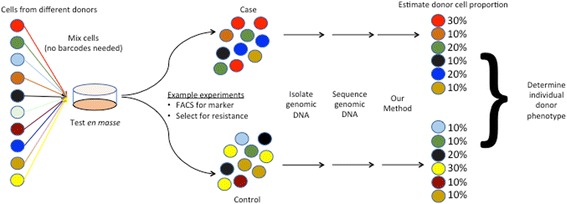
We describe a method that enables the multiplex screening of a pool of many different donor cell lines. Our method accurately predicts each donor proportion from the pool without requiring the use of unique DNA barcodes as markers of donor identity. Instead, we take advantage of common single nucleotide polymorphisms, whole-genome sequencing, and an algorithm to calculate the proportions from the sequencing data. By testing using simulated and real data, we showed that our method robustly predicts the individual proportions from a mixed-pool of numerous donors, thus enabling the multiplexed testing of diverse donor cells en masse.More information is available at https://pgpresearch.med.harvard.edu/poolseq/.
Overview
The claims and statistics of this paper haven’t been checked yet.
Free: it reads the open-access text and checks the first 5 claims that cite a source we can check. Create a free account to check every claim.
Integrity signals
Registry
Cites
Statistics
Figures
Verification
Claims the paper makes
The claims and statistics of this paper haven’t been checked yet.
Free: it reads the open-access text and checks the first 5 claims that cite a source we can check. Create a free account to check every claim.
Claims other papers make about this one
Each is checked against this paper’s own text: does it say what the citing paper says it does?
The source backs part of the claim, not all of it — or backs it for a different population, condition or comparison.
In the citing paper
“Consequently, the pooled population may not reflect a true average physiological state and may instead be skewed toward the phenotype of one or a few dominant donors unless donor-specific contributions are monitored (Chan et al. 2018;Kukaj et al. 2025).”
From Primary cell cultures versus immortalized cell lines: critical comparative insights into biological fidelity and translational applications (2026) · cites this paper as Chan et al. 2018
Experimental — accuracy not yet measuredThe source backs part of the claim, not all of it — or backs it for a different population, condition or comparison.
In the citing paper
“Because pooling averages biological variation across donors, it may reduce the detection of rare, extreme, or clinically relevant donor-specific phenotypes, including differences in proliferation, differentiation potential, marker expression, senescence responses, metabolic activity, or immunomodulatory capacity (Chan et al. 2018;Kukaj et al. 2025;Mebarki et al. 2025;Ya and Bayraktutan 2025).”
From Primary cell cultures versus immortalized cell lines: critical comparative insights into biological fidelity and translational applications (2026) · cites this paper as Chan et al. 2018
Experimental — accuracy not yet measuredThe source backs part of the claim, not all of it — or backs it for a different population, condition or comparison.
In the citing paper
“It is possible that differences in donors’ age, sex, genetics and health status may play a key role in these differences [13,14].”
From Donor Variability Alters the Characteristics of Human Brain Microvascular Endothelial Cells (2025) · cites this paper as [13]
Experimental — accuracy not yet measured
Self-check
Percentages, sums and reported differences re-computed from the paper’s own numbers.
The self-check needs the paper’s full text.
Citations
Cites
Maximum Likelihood from Incomplete Data Via the EM Algorithm
Dempster, A. P., Laird, N. M., & Rubin, D. B. (1977) · Journal of the Royal Statistical Society Series B: Statistical Methodology · doi:10.1111/j.2517-6161.1977.tb01600.x · Cited by 50,444
An integrated map of genetic variation from 1,092 human genomes
The 1000 Genomes Project Consortium (2012) · Nature · doi:10.1038/nature11632 · Cited by 7,711
Aligning sequence reads, clone sequences and assembly contigs with BWA-MEM
Li, H. (2013) · DROPS (Schloss Dagstuhl – Leibniz Center for Informatics) · doi:10.48550/arxiv.1303.3997 · Cited by 5,159
Aligning sequence reads, clone sequences and assembly con*gs with BWA-MEM
Li, H. (2014) · arXiv (Cornell University) · doi:10.6084/m9.figshare.963153.v1 · Cited by 4,932
Genetic studies of body mass index yield new insights for obesity biology
Study, T. L. C., Locke, A. E., The ADIPOGen Consortium, The AGEN-BMI Working Group, The CARDIOGRAMplusC4D Consortium, The CKDGen Consortium, The, G. L. G. C., The, I. C. B. P., The MAGIC Investigators, The MuTHER Consortium, et al. (2015) · Nature · doi:10.1038/nature14177 · Cited by 4,534
Accurate whole human genome sequencing using reversible terminator chemistry
Bentley, D. R., Balasubramanian, S., Swerdlow, H. P., Smith, G. P., Milton, J., Brown, C. G., Hall, K. P., Evers, D. J., Barnes, C. L., Bignell, H. R., et al. (2008) · Nature · doi:10.1038/nature07517 · Cited by 3,684
Reducing the Effects of PCR Amplification and Sequencing Artifacts on 16S rRNA-Based Studies
Schloss, P. D., Gevers, D., & Westcott, S. L. (2011) · PLoS ONE · doi:10.1371/journal.pone.0027310 · Cited by 2,112
The Electronic Medical Records and Genomics (eMERGE) Consortium, Wood, A. R., The MIGen Consortium, The PAGE Consortium, Study, T. L. C., Esko, T., Yang, J., Vedantam, S., Pers, T. H., Gustafsson, S., et al. (2014) · Nature Genetics · doi:10.1038/ng.3097 · Cited by 1,853
Bias in template-to-product ratios in multitemplate PCR
Polz, M. F., & Cavanaugh, C. M. (1998) · Applied and Environmental Microbiology · doi:10.1128/aem.64.10.3724-3730.1998 · Cited by 1,484
Sequencing pools of individuals — mining genome-wide polymorphism data without big funding
Schlötterer, C., Tobler, R., Kofler, R., & Nolte, V. (2014) · Nature Reviews Genetics · doi:10.1038/nrg3803 · Cited by 784
Genetic Ancestry and Natural Selection Drive Population Differences in Immune Responses to Pathogens
Nédélec, Y., Sanz, J., Baharian, G., Szpiech, Z. A., Pacis, A., Dumaine, A., Grenier, J.-C., Freiman, A., Sams, A. J., Hebert, S., et al. (2016) · Cell · doi:10.1016/j.cell.2016.09.025 · Cited by 512 · cited 1×
“Other groups measured the transcriptional response to pathogenic stimulus in primary monocytes obtained from many African and European individuals [5, 6].”
BackgroundGenetic adaptation and Neandertal admixture shaped the immune system of human populations
Quach, H., Rotival, M., Pothlichet, J., Loh, Y.-H. E., Dannemann, M., Zidane, N., Laval, G., Patin, E., Harmant, C., Lopez, M., et al. (2016) · Cell · doi:10.1016/j.cell.2016.09.024 · Cited by 475 · cited 1×
“Other groups measured the transcriptional response to pathogenic stimulus in primary monocytes obtained from many African and European individuals [5, 6].”
BackgroundCheung, H. W., Cowley, G. S., Weir, B. A., Boehm, J. S., Rusin, S., Scott, J. A., East, A., Ali, L. D., Lizotte, P. H., Wong, T. C., et al. (2011) · Proceedings of the National Academy of Sciences · doi:10.1073/pnas.1109363108 · Cited by 423
Cowley, G. S., Weir, B. A., Vazquez, F., Tamayo, P., Scott, J. A., Rusin, S., East-Seletsky, A., Ali, L. D., Gerath, W. F., Pantel, S. E., et al. (2014) · Scientific Data · doi:10.1038/sdata.2014.35 · Cited by 387
Generation of stem cell-derived β-cells from patients with type 1 diabetes
Millman, J. R., Xie, C., Van Dervort, A., Gürtler, M., Pagliuca, F. W., & Melton, D. A. (2016) · Nature Communications · doi:10.1038/ncomms11463 · Cited by 377
Yu, C., Mannan, A. M., Yvone, G. M., Ross, K. N., Zhang, Y.-L., Marton, M. A., Taylor, B. R., Crenshaw, A., Gould, J. Z., Tamayo, P., et al. (2016) · Nature Biotechnology · doi:10.1038/nbt.3460 · Cited by 362
Essential Gene Profiles in Breast, Pancreatic, and Ovarian Cancer Cells
Marcotte, R., Brown, K. R., Suarez, F., Sayad, A., Karamboulas, K., Krzyzanowski, P. M., Sircoulomb, F., Medrano, M., Fedyshyn, Y., Koh, J. L. Y., et al. (2012) · Cancer Discovery · doi:10.1158/2159-8290.cd-11-0224 · Cited by 303
A cellular model for sporadic ALS using patient-derived induced pluripotent stem cells
Burkhardt, M. F., Martinez, F. J., Wright, S., Ramos, C., Volfson, D., Mason, M., Garnes, J., Dang, V., Lievers, J., Shoukat-Mumtaz, U., et al. (2013) · Molecular and Cellular Neuroscience · doi:10.1016/j.mcn.2013.07.007 · Cited by 300
Rates, distribution and implications of postzygotic mosaic mutations in autism spectrum disorder
Lim, E. T., Uddin, M., De Rubeis, S., Chan, Y., Kamumbu, A. S., Zhang, X., D'Gama, A. M., Kim, S. N., Hill, R. S., Goldberg, A. P., et al. (2017) · Nature Neuroscience · doi:10.1038/nn.4598 · Cited by 299
Self-citationQuantitative phenotyping via deep barcode sequencing
Smith, A. M., Heisler, L. E., Mellor, J., Kaper, F., Thompson, M. J., Chee, M., Roth, F. P., Giaever, G., & Nislow, C. (2009) · Genome Research · doi:10.1101/gr.093955.109 · Cited by 298
Lim, E. T., Raychaudhuri, S., Sanders, S. J., Stevens, C., Sabo, A., MacArthur, D. G., Neale, B. M., Kirby, A., Ruderfer, D. M., Fromer, M., et al. (2013) · Neuron · doi:10.1016/j.neuron.2012.12.029 · Cited by 266
Self-citationBiased 16S rDNA PCR amplification caused by interference from DNA flanking the template region
Hansen, M. (1998) · FEMS Microbiology Ecology · doi:10.1016/s0168-6496(98)00031-2 · Cited by 234
A public resource facilitating clinical use of genomes
Ball, M. P., Thakuria, J. V., Zaranek, A. W., Clegg, T., Rosenbaum, A. M., Wu, X., Angrist, M., Bhak, J., Bobe, J., Callow, M. J., et al. (2012) · Proceedings of the National Academy of Sciences · doi:10.1073/pnas.1201904109 · Cited by 221
Genome-wide analysis of barcoded Saccharomyces cerevisiae gene-deletion mutants in pooled cultures
Pierce, S. E., Davis, R. W., Nislow, C., & Giaever, G. (2007) · Nature Protocols · doi:10.1038/nprot.2007.427 · Cited by 211
Inter-individual variability and genetic influences on cytokine responses to bacteria and fungi
Li, Y., Oosting, M., Deelen, P., Ricaño-Ponce, I., Smeekens, S., Jaeger, M., Matzaraki, V., Swertz, M. A., Xavier, R. J., Franke, L., et al. (2016) · Nature Medicine · doi:10.1038/nm.4139 · Cited by 188
Multi-template polymerase chain reaction
Kalle, E., Kubista, M., & Rensing, C. (2014) · Biomolecular Detection and Quantification · doi:10.1016/j.bdq.2014.11.002 · Cited by 119
Harvard Personal Genome Project: lessons from participatory public research
Ball, M. P., Bobe, J. R., Chou, M. F., Clegg, T., Estep, P. W., Lunshof, J. E., Vandewege, W., Zaranek, A. W., & Church, G. M. (2014) · Genome Medicine · doi:10.1186/gm527 · Cited by 103
Self-citationChan, Y., Salem, R. M., Hsu, Y.-H. H., McMahon, G., Pers, T. H., Vedantam, S., Esko, T., Guo, M. H., Lim, E. T., Franke, L., et al. (2015) · The American Journal of Human Genetics · doi:10.1016/j.ajhg.2015.02.018 · Cited by 91
Lim, E. T., Liu, Y. P., Chan, Y., Tuomi, T., Käräjämäki, A., Madsen, E. C., Altshuler, D., Raychaudhuri, S., Groop, L., Flannick, J. A., et al. (2014) · The American Journal of Human Genetics · doi:10.1016/j.ajhg.2014.09.015 · Cited by 36
Middelkamp, S., van Heesch, S., Braat, A. K., de Ligt, J., van Iterson, M., Simonis, M., van Roosmalen, M. J., Kelder, M. J. E., Kruisselbrink, E., Hochstenbach, R., et al. (2017) · Genome Medicine · doi:10.1186/s13073-017-0399-z · Cited by 33
An unbiased index to quantify participant’s phenotypic contribution to an open-access cohort
Chan, Y., Tung, M., Garruss, A. S., Zaranek, S. W., Chan, Y., Lunshof, J. E., Zaranek, A. W., Ball, M. P., Chou, M. F., Lim, E. T., et al. (2017) · Scientific Reports · doi:10.1038/srep46148 · Cited by 8
Cited by
Lim, E. T., Chan, Y., Dawes, P., Guo, X., Erdin, S., Tai, D. J. C., Liu, S., Reichert, J. M., Burns, M. J., Chan, Y., et al. (2022) · Nature Communications · doi:10.1038/s41467-022-30968-3 · Cited by 35
Natural Barcodes for Longitudinal Single Cell Tracking of Leukemic and Immune Cell Dynamics
Penter, L., Gohil, S. H., & Wu, C. J. (2022) · Frontiers in Immunology · doi:10.3389/fimmu.2021.788891 · Cited by 21
Huang, X., Wang, L., Meng, M., Zhang, S., Pham, T. T. H., Jiang, L., Chen, L., Li, Y., Zhou, X., Qin, L., et al. (2019) · Biomedicine & Pharmacotherapy · doi:10.1016/j.biopha.2019.109516 · Cited by 17
Leveraging the Genetic Diversity of Human Stem Cells in Therapeutic Approaches
Tegtmeyer, M., & Nehme, R. (2021) · Journal of Molecular Biology · doi:10.1016/j.jmb.2021.167221 · Cited by 13
Sundstrom, J., Vanderleeden, E., Barton, N., Redick, S. D., Dawes, P., Murray, L. F., Olson, M. N., Tran, K. V., Chigas, S. M., Orszulak, A. R., et al. (2024) · Cells · doi:10.3390/cells13231978 · Cited by 13
Metadata
- Authors
- Chan, Y., Chan, Y. K., Goodman, D. B., Guo, X., Chavez, A., Lim, E. T., & Church, G. M.
- Affiliations
- Harvard University (US)
- Columbia University (US)
- Corresponding author
- Chan, Yingleong
- Church, George M.
- ORCID
- Venue
- Genome Medicine
- Published
- 2018-04-19
- Volume
- 10
- Issue
- 1
- Pages
- 31-31
- ISSN
- 1756-994X (ISSN-L)
- PMC
- PMC5909281
- OpenAlex
- W2799288691
- Cited by
- 17
- References
- 31
- Citations by year
- 2026: 4 · 2025: 1 · 2024: 2 · 2023: 1 · 2022: 3 · 2021: 2 · 2020: 1 · 2019: 1 · 2018: 2
- FWCI
- 0.53
- Type
- journal article
- Language
- en
- Open access
- gold
- doi.org
- Licence
- cc-by
- creativecommons.org/licenses/by/4.0/ (tdm)
- Locations
- Genome Medicine (publishedVersion, cc-by)
- Europe PMC (PubMed Central) (publishedVersion, other-oa)
- PubMed Central (publishedVersion, cc-by)
- PubMed (publishedVersion)
- Digital Access to Scholarship at Harvard (DASH) (Harvard University) (submittedVersion, cc-by)
- DOAJ (DOAJ: Directory of Open Access Journals) (submittedVersion, cc-by-sa)
- Funders
- National Human Genome Research Institute (RM1HG008525)
- Robert Wood Johnson Foundation (74178)
- Burroughs Wellcome Fund
- Topics
- Life Sciences › Biochemistry, Genetics and Molecular Biology › Molecular Biology › Single-cell and spatial transcriptomics
- Life Sciences › Biochemistry, Genetics and Molecular Biology › Molecular Biology › Genomics and Phylogenetic Studies
- Life Sciences › Biochemistry, Genetics and Molecular Biology › Cancer Research › Cancer Genomics and Diagnostics
- Keywords
- single nucleotide polymorphisms, whole genome sequencing, cell line screening
- MeSH terms
- Whole Genome Sequencing, Algorithms, B-Lymphocytes, Computer Simulation, Humans, Tissue Donors, Genome, Human, Sample Size, Polymorphism, Single Nucleotide, High-Throughput Nucleotide Sequencing
About these checks
Registry, retraction, Cites and statistics results are computed, not judged, with one exception: a printed reference that no index lists is read once by a model before it counts as a citation error. Claims are extracted by a model and kept only when their quote appears verbatim in the text; each cited source is then checked, with a model’s help, for whether it says what the claim relies on. Those verdicts can be wrong — read the claim’s quote and the cited source before relying on one.
Statistics and arithmetic are recomputed, not judged.
Confidence bands are shown only for fields calibrated on our annotated test set. None is calibrated yet, so no band is shown.
What counts as a claim ›How we measure confidence ›How we check this ›
Are you an author, or do you see a problem with this page? Request a review
Data sources
Bibliographic data: Semantic Scholar, OpenAlex, Crossref.
Contains information from the Semantic Scholar Academic Graph Datasets, made available under the ODC Attribution License (ODC-BY 1.0).
Semantic Scholar’s data is described in: Kinney, R., et al. (2023). The Semantic Scholar Open Data Platform. arXiv:2301.10140.
