

NAFLD as a continuum: from obesity to metabolic syndrome and diabetes
Open accessThe DOI matches its Crossref record; 176 of the 176 references it cites were found in a registry or an index.
Abstract
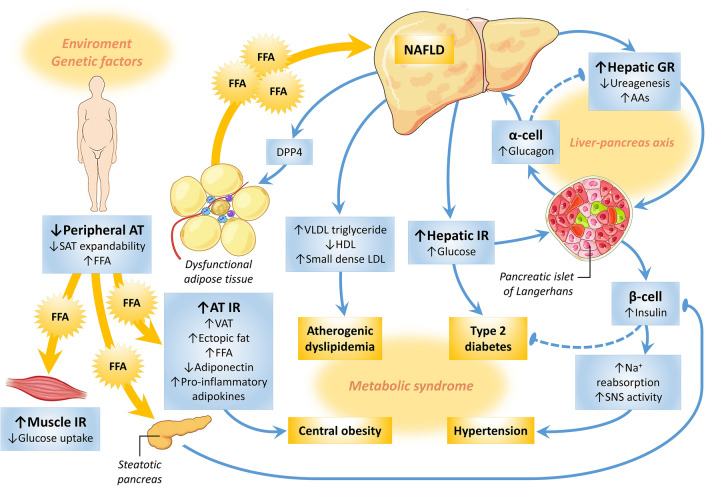
Background: The prevalence of non-alcoholic fatty liver disease (NAFLD) has been increasing rapidly. It is nowadays recognized as the most frequent liver disease, affecting a quarter of global population and regularly coexisting with metabolic disorders such as type 2 diabetes, hypertension, obesity, and cardiovascular disease. In a more simplistic view, NAFLD could be defined as an increase in liver fat content, in the absence of secondary cause of steatosis. In fact, the clinical onset of the disease is a much more complex process, closely related to insulin resistance, limited expandability and dysfunctionality of adipose tissue. A fatty liver is a main driver for a new recognized liver-pancreatic α-cell axis and increased glucagon, contributing to diabetes pathophysiology. Main text: This review will focus on the clinical and pathophysiological connections between NAFLD, insulin resistance and type 2 diabetes. We reviewed non-invasive methods and several scoring systems for estimative of steatosis and fibrosis, proposing a multistep process for NAFLD evaluation. We will also discuss treatment options with a more comprehensive view, focusing on the current available therapies for obesity and/or type 2 diabetes that impact each stage of NAFLD. Conclusion: The proper understanding of NAFLD spectrum—as a continuum from obesity to metabolic syndrome and diabetes—may contribute to the early identification and for establishment of targeted treatment.
Overview
The claims and statistics of this paper haven’t been checked yet.
Free: it reads the open-access text and checks the first 5 claims that cite a source we can check. Create a free account to check every claim.
Integrity signals
Registry
Cites
Statistics
Figures
Verification
Claims the paper makes
The claims and statistics of this paper haven’t been checked yet.
Free: it reads the open-access text and checks the first 5 claims that cite a source we can check. Create a free account to check every claim.
Self-check
Percentages, sums and reported differences re-computed from the paper’s own numbers.
The self-check needs the paper’s full text.
Citations
Cites
International Diabetes Federation 2017
Carracher, A. M., Marathe, P. H., & Close, K. L. (2018) · Journal of Diabetes · doi:10.1111/1753-0407.12644 · Cited by 13,418
Grundy, S. M., Cleeman, J. I., Daniels, S. R., Donato, K. A., Eckel, R. H., Franklin, B. A., Gordon, D. J., Krauss, R. M., Savage, P. J., Smith, S. C., et al. (2005) · Circulation · doi:10.1161/circulationaha.105.169404 · Cited by 11,961
Design and validation of a histological scoring system for nonalcoholic fatty liver disease†
Kleiner, D. E., Brunt, E. M., Van Natta, M., Behling, C., Contos, M. J., Cummings, O. W., Ferrell, L. D., Liu, Y., Torbenson, M. S., Unalp‐Arida, A., et al. (2005) · Hepatology · doi:10.1002/hep.20701 · Cited by 10,791 · cited 2×
“Despite the limitations of liver biopsy, we highlight it is the gold-standard method for NASH and fibrosis evaluation, and may be considered in selected cases, such as suspicion of other liver disease [56, 57].”
MethodYounossi, Z. M., Koenig, A. B., Abdelatif, D., Fazel, Y., Henry, L., & Wymer, M. (2016) · Hepatology · doi:10.1002/hep.28431 · Cited by 10,781 · cited 4×
“Epidemiology Although epidemiological data involving more than 8 million people estimated a global prevalence of NAFLD around 25% [2], it certainly varies greatly depending on how it is diagnosed and on the region of the world considered.”
BackgroundInfluentialThe metabolic syndrome—a new worldwide definition
Alberti, K. G. M., Zimmet, P., & Shaw, J. (2005) · The Lancet · doi:10.1016/s0140-6736(05)67402-8 · Cited by 9,352
The metabolic phenotype in obesity: Fat mass, body fat distribution, and adipose tissue function
Goossens, G. H. (2017) · Obesity Facts · doi:10.1159/000471488 · Cited by 8,481
Chalasani, N., Younossi, Z., Lavine, J. E., Charlton, M., Cusi, K., Rinella, M., Harrison, S. A., Brunt, E. M., & Sanyal, A. J. (2018) · Hepatology · doi:10.1002/hep.29367 · Cited by 7,239 · cited 12×
“Patients with obesity and/or MetS, with or without T2D, might be targeted promptly for ruling out NAFL/ NASH and fibrosis [3, 5, 6].”
BackgroundInfluentialEckel, R. H., Alberti, K., Grundy, S. M., & Zimmet, P. Z. (2010) · The Lancet · doi:10.1016/s0140-6736(09)61794-3 · Cited by 6,295
Eckel, R. H., Grundy, S. M., & Zimmet, P. Z. (2005) · The Lancet · doi:10.1016/s0140-6736(05)66378-7 · Cited by 5,550
Global burden of NAFLD and NASH: trends, predictions, risk factors and prevention
Younossi, Z., Anstee, Q. M., Marietti, M., Hardy, T., Henry, L., Eslam, M., George, J., & Bugianesi, E. (2018) · Nature Reviews Gastroenterology & Hepatology · doi:10.1038/nrgastro.2017.109 · Cited by 5,249 · cited 2×
“Genetic predisposition Genome-wide association (GWA) studies found several genetic variants associated with NAFLD, which implies in variability on individual susceptibility to the disease [39].”
Background
Research works printed but not linked: 1
- Stein DT Szczepaniak L Garg A Malloy C McGarry JD Intramuscular lipid is increased in subjects with congenital generalized lipodystrophy (Abstract) Diabetes 1997 46 Suppl. 1 242A
Cited by
Items 201–300 of 674
Ppp1r3b is a metabolic switch that shifts hepatic energy storage from lipid to glycogen
Creasy, K. T., Mehta, M. B., Schneider, C. V., Park, J., Zhang, D., Shewale, S. V., Millar, J. S., Vujković, M., Hand, N. J., Titchenell, P. M., et al. (2025) · Science Advances · doi:10.1126/sciadv.ado3440 · Cited by 17
“MASLD is highly prevalent among patients with obesity (60 to 95 % ), T2D (55 to 70 % ), and metabolic syndrome (43 to 67 % ), and is also highly heritable ( 2 , 3 ).”
Ahmed, N. R., Kulkarni, V. V., Pokhrel, S., Akram, H., Abdelgadir, A., Chatterjee, A., & Khan, S. (2022) · Cureus · doi:10.7759/cureus.24829 · Cited by 17
“According to multiple studies, among patients with NAFLD, approximately 51% are obese and up to 80% have dyslipidemia [33,34].”
Dietary phytochemical and metabolic disease prevention: Focus on plant proteins
Yang, S., Tao, G., Liu, Y., Wu, X., Liu, J., Dagher, F., Ou, S., Song, Y., & Huang, J. (2023) · Frontiers in Nutrition · doi:10.3389/fnut.2023.1089487 · Cited by 20
Large-scale metabolomic profiling and incident non-alcoholic fatty liver disease
Gagnon, É., Manikpurage, H. D., Mitchell, P. L., Girard, A. S., Gobeil, É., Bourgault, J., Bégin, F., Marette, A., Thériault, S., & Arsenault, B. J. (2023) · iScience · doi:10.1016/j.isci.2023.107127 · Cited by 17
“It is associated with abdominal adiposity and disturbances in hepatocyte lipid handling.(4) Therapeutic options are often limited to lifestyle changes, and effective and specific drug treatment for NAFLD is still an important unmet medical need.”
BackgroundYoshioka, H., Wu, S., Moriishi, T., Tsukiboshi, Y., Yokota, S., Miura, N., Yoshikawa, M., Inagaki, N., Matsushita, Y., & Nakao, M. (2023) · Traditional & Kampo Medicine · doi:10.1002/tkm2.1385 · Cited by 19
“NAFLD is often associated with obesity, type 2 diabetes, insulin resistance, hyperlipidemia, and hypertension [3].”
BackgroundЛазебник, Л. Б., & Туркина, С. В. (2021) · Экспериментальная и клиническая гастроэнтерология · doi:10.31146/1682-8658-ecg-194-10-5-13 · Cited by 16
Yamazaki, M., Okito, M., Harada, A., Miyake, K., Tamiya, T., & Nakamura, T. (2022) · Molecular Nutrition & Food Research · doi:10.1002/mnfr.202200748 · Cited by 14
Identification of High-Risk Patients With Nonalcoholic Fatty Liver Disease in Endocrinology Clinics
Younossi, Z. M., Henry, L. L., Isaacs, S. D., & Cusi, K. J. (2023) · Endocrine Practice · doi:10.1016/j.eprac.2023.06.012 · Cited by 15
Tsou, S., Lin, S., Chen, W., Hung, H., Liao, C., Kornelius, E., Huang, C., Lin, C., & Yang, Y. (2024) · Biomedicines · doi:10.3390/biomedicines12071444 · Cited by 15
“Pathologically, MASLD is defined by the accumulation of 5–10% of body weight in liver fat or the identification of vacuolar degeneration in the cytoplasm of more than 10% of liver tissue sections [2].”
BackgroundBernecker, M., Lin, A., Feuchtinger, A., Molenaar, A., Schriever, S. C., & Pfluger, P. T. (2025) · Journal of Translational Medicine · doi:10.1186/s12967-024-06039-0 · Cited by 15
“With its prevalence rising, this complex metabolic disorder poses a significant challenge to global health systems and increases the risk of associated diseases such as type 2 diabetes, non-alcoholic fatty liver disease (NAFLD), and metabolic syndrome [2].”
Forst, T. M., Block, C. E. M. D., Prato, S. D., Frías, J. P., Lautenbach, A., Ludvik, B. H., Marinez, M., Mathieu, C., Müller, T. D., & Schnell, O. (2025) · Diabetes Obesity and Metabolism · doi:10.1111/dom.16247 · Cited by 15
“53 59 – 61 4 | AMYLIN Amylin is a 37-amino acid peptide co-secreted with insulin from beta cells.”
Nonalcoholic fatty liver disease and the risk of insulin-requiring gestational diabetes
You, S. Y., Han, K., Lee, S.-H., & Kim, M. K. (2021) · Diabetology & Metabolic Syndrome · doi:10.1186/s13098-021-00710-y · Cited by 14
“Introduction Nonalcoholic fatty liver disease (NAFLD) is defined as an increase in liver fat content, in the absence of any secondary cause of steatosis [1, 2].”
BackgroundObesity and Nonalcoholic Fatty Liver Disease
Chaney, A. J. (2021) · Nursing Clinics of North America · doi:10.1016/j.cnur.2021.07.009 · Cited by 16
Nwakiban, A. P. A., Shivashankara, S. T., Piazza, S., Tchamgoue, A. D., Beretta, G., Dell’Agli, M., Magni, P., Agbor, G. A., Kuiate, J., & Manjappara, U. V. (2022) · ACS Omega · doi:10.1021/acsomega.2c00050 · Cited by 14
Siafi, E. P., Andrikou, I., Thomopoulos, C., Konstantinidis, D., Kakouri, N., Tatakis, F., Kariori, M. G., Filippou, C. D., Zamanis, I., Manta, E., et al. (2022) · Hypertension Research · doi:10.1038/s41440-022-01015-x · Cited by 14
“differential propensity of FLI to predict cardiovascular outcomes, at least partly because the features of metabolic syndrome and NAFLD are highly interrelated [18].”
BackgroundRome, F. I., Shobert, G. L., Voigt, W. C., Stagg, D. B., Puchalska, P., Burgess, S. C., Crawford, P. A., & Hughey, C. C. (2022) · American Journal of Physiology-Endocrinology and Metabolism · doi:10.1152/ajpendo.00222.2022 · Cited by 15
Zani, S. C. D. C., Wang, R., Veida-Silva, H., Clugston, R. D., Yue, J. T. Y., Mori, M. A. S., Wu, J., & Chan, C. B. (2023) · Metabolites · doi:10.3390/metabo13020174 · Cited by 14
“In NAFLD, progression to NASH is characterized by increased LD size, hepatocyte hypertrophy and inflammation [2,5].”
BackgroundCho, W., Choi, S. W., Oh, H., El‐Aty, A. M. A., Hacımüftüoğlu, A., Jeong, J. H., Song, J.-H., Shin, Y. K., & Jung, T. W. (2023) · Biochemical and Biophysical Research Communications · doi:10.1016/j.bbrc.2023.01.090 · Cited by 14
Gheorghe, L., Nemțeanu, R., Clim, A., Botnariu, G. E., Costache, I. I., & Pleşa, A. (2023) · Life · doi:10.3390/life13040857 · Cited by 17
Beyazal Polat, H., Beyazal, M., Arpa, M., Kızılkaya, B., Ayaz, T., Gündoğdu, Ö. L., Konur, K., Polat, Z., Beyazal Çeliker, F., & Atasoy, H. (2025) · Journal of Clinical Medicine · doi:10.3390/jcm14103513 · Cited by 13
Arruda, V. M., Azevedo, G. T., Granato, M. J. M. G., Matos, A. C. P., Araújo, T. G., & Guerra, J. F. D. C. (2024) · International Journal of Molecular Sciences · doi:10.3390/ijms25179591 · Cited by 13
“ROS can initiate lipid peroxidation by targeting polyunsaturated fatty acids, resulting in the formation of highly reactive aldehyde products such as 4-hydroxy-2-nonenal (4-HNE) and malondialdehyde (MDA) [5–7].”
BackgroundFriuli, M., Sepe, C., Panza, E., Travelli, C., Paterniti, I., & Romano, A. (2024) · Frontiers in Pharmacology · doi:10.3389/fphar.2024.1407336 · Cited by 14
From diabetes to diverse domains: the multifaceted roles of GLP-1 receptor agonists
Dave, B. P., Chorawala, M. R., Shah, I., Shah, N. N., Bhagat, S. U., Prajapati, B. G., & Thakkar, P. C. (2024) · Molecular Biology Reports · doi:10.1007/s11033-024-09793-y · Cited by 17
“In recent years, GLP-1RA has emerged as a promising avenue of research and treatment in the context of NAFLD [102].”
Al-Baiaty, F. D. R., Ishak, S., Zaki, F. M., Masra, F., Aziz, D. A. A., Zin, W. N. W. M., Hing, E. Y., Zaman, A., Wahab, N. A., Nawawi, K. N. M., et al. (2024) · BMC Pediatrics · doi:10.1186/s12887-024-04993-8 · Cited by 16
“Imbalances between the production of reactive oxygen species [34] and the body’s antioxidant defense capacity can disrupt normal lipid metabolism, contributing to the onset and progression of NAFLD [40].”
BackgroundMeroni, M., Dongiovanni, P., Tiano, F., Piciotti, R., Alisi, A., & Panera, N. (2024) · Biomedicine & Pharmacotherapy · doi:10.1016/j.biopha.2024.117608 · Cited by 17
Feng, Q., Izzi‐Engbeaya, C. N., Manousou, P., & Woodward, M. (2025) · BMC Gastroenterology · doi:10.1186/s12876-025-04079-4 · Cited by 15
“These conditions have been previously linked to MASLD [24, 25, 27].”
Estimates of the prevalence of occult HBV infection in Asia: a systematic review and meta-analysis
Xie, W. Y., Sun, C., He, H., Deng, C., & Sheng, Y. (2022) · Scandinavian Journal of Infectious Diseases · doi:10.1080/23744235.2022.2115126 · Cited by 13
“The incidence of non-alcoholic fatty liver disease is high in patients with hyperlipidaemia and diabetes [87].”
BackgroundChoi, J. W., Yoo, J., Kim, S. G., & Kim, Y. S. (2022) · Healthcare · doi:10.3390/healthcare10112268 · Cited by 13
“NAFLD is strongly associated with obesity and metabolic syndrome, and thus early diagnosis of fatty liver and lifestyle corrections in accordance with treatment measures have become important health issues [6,7].”
Ardekani, A., Tabrizi, R., Maleki, E., Lankarani, K. B., Heydari, S. T., Moradinazar, M., & Akbari, M. (2023) · Food Science & Nutrition · doi:10.1002/fsn3.3315 · Cited by 16
Oh, K., Yoon, S. J., Lee, S.-B., Lee, S. Y., Gupta, H., Ganesan, R., Sharma, S. P., Won, S., Jeong, J., Kim, D. J., et al. (2023) · Journal of Translational Medicine · doi:10.1186/s12967-023-04122-6 · Cited by 14
“Also, NAFLD is associated with diverse metabolic disorders: obesity, diabetes mellitus, hypertension, and cardiovascular diseases [3].”
BackgroundTutunchi, H., Ebrahimi‐Mameghani, M., Hosseinzadeh‐Attar, M. J., Roshanravan, N., Mobasseri, M., Najafipour, F., Naeini, F., Naghshi, S., Asghari, S., Akbarzadeh, M., et al. (2023) · Clinical Nutrition ESPEN · doi:10.1016/j.clnesp.2023.10.013 · Cited by 15
Shea, S., Lionis, C. D., Atkinson, L., Kite, C., Lagojda, L., Chaggar, S. S., Kyrou, I., & Randeva, H. S. (2022) · Livers · doi:10.3390/livers3010001 · Cited by 16
Çupi, B., Šarac, I., Jovanović, J., Jovanović, S., Petrović-Oggiano, G., Debeljak-Martačić, J., & Jovanović, J. (2023) · Archives of Industrial Hygiene and Toxicology · doi:10.2478/aiht-2023-74-3754 · Cited by 20
Björnsdóttir, S., Ulfsdottir, H., Gudmundsson, E. F., Sveinsdottir, K., Ísberg, A. P., Dobies, B., Magnusdottir, G. E. A., Gunnarsdottir, T., Karlsdottir, T., Björnsdóttir, G., et al. (2024) · JMIR Cardio · doi:10.2196/52576 · Cited by 16
“Growing evidence supports a common pathophysiological mechanism between metabolic syndrome and NAFLD and NASH, which often involves insulin resistance and dysfunctional adipose tissue [11].”
BackgroundCardiometabolic risk factors in MASLD patients with HCC: the other side of the coin
Meroni, M., Longo, M., & Dongiovanni, P. (2024) · Frontiers in Endocrinology · doi:10.3389/fendo.2024.1411706 · Cited by 17
“As abovementioned, it is now widely acknowledged that obesity, hypertension, glucose intolerance and T2D frequently co-occur with hepatic steatosis, contribute to its progression and have been associated with both cardiovascular and HCC risk in MASLD patients (111).”
BackgroundJúnior, W. S. D. S., Sposito, A. C., & Godoy‐Matos, A. F. (2024) · Journal of Hepatology · doi:10.1016/j.jhep.2024.06.034 · Cited by 16
Self-citationWang, X., Wang, Z., Du, W., Ma, X., Ma, J., Chen, Z., Gao, C., & Chen, X. (2024) · Journal of Clinical Medicine · doi:10.3390/jcm13237423 · Cited by 12
Taylor, L. C., Arthur, G., Cruz, M. D. C., Stec, D. E., & Badmus, O. O. (2024) · International Journal of Translational Medicine · doi:10.3390/ijtm4040052 · Cited by 17
Chou, Y.-T., Sun, Z., Shen, W.-C., Yang, Y., Lu, F.-H., Chang, C., Li, C., & Wu, J. (2022) · Frontiers in Nutrition · doi:10.3389/fnut.2022.765206 · Cited by 12
“In addition, NAFLD, which was considered as continuum, or precursor of MetS (28, 29), was found to be associated with liver fibrosis in betel quid chewer in one recent study (15).”
BackgroundFicolin-2 Plasma Level Assesses Liver Fibrosis in Non-Alcoholic Fatty Liver Disease
Giraudi, P. J., Salvoza, N. C., Bonazza, D., Saitta, C., Lombardo, D., Casagranda, B., de Manzini, N., Pollicino, T., Raimondo, G., Tiribelli, C., et al. (2022) · International Journal of Molecular Sciences · doi:10.3390/ijms23052813 · Cited by 12
“In obese populations, NAFLD prevalence varies from 60% to 95% [16].”
BackgroundSchmid, A., Arians, M., Karrasch, T., Pons‐Kühnemann, J., Schäffler, A., Roderfeld, M., & Roeb, E. (2022) · Journal of Clinical Medicine · doi:10.3390/jcm11071756 · Cited by 13
“Non-alcoholic fatty liver disease (NAFLD) [4] is an important representative of metabolic morbidities [5,6] frequently accompanied by obesity and T2D [7].”
BackgroundFinelli, C. (2023) · Gastrointestinal Disorders · doi:10.3390/gidisord5020020 · Cited by 13
Evolving role of semaglutide in NAFLD: in combination, weekly and oral administration
Koureta, E., & Cholongitas, Ε. (2024) · Frontiers in Pharmacology · doi:10.3389/fphar.2024.1343587 · Cited by 15
Fadhilah, J., Zariyah, H., Pramono, A., Purnomo, H. D., Syauqy, A., Afifah, D. N., Fadhillah, F. S., & Purwanti, R. A. (2024) · Clinical Nutrition Open Science · doi:10.1016/j.nutos.2024.05.014 · Cited by 12
Beetz, N., Kalsch, B., Forst, T. M., Schmid, B., Schultz, A., & Hennige, A. M. (2024) · Diabetes Obesity and Metabolism · doi:10.1111/dom.15984 · Cited by 12
Coleman, M. J., Espino, L. M., Lebensohn, H., Zimkute, M. V., Yaghooti, N., Ling, C. L., Gross, J., Listwan, N., Cano, S., Garcia, V., et al. (2022) · Metabolites · doi:10.3390/metabo12050431 · Cited by 14
“Although NAFLD is clinically less ambiguous to diagnose than metabolic syndrome, a biopsy is currently required to diagnose NAFLD and NASH.”
BackgroundInfluentialChoi, S. W., Oh, H., Park, S. Y., Cho, W., El‐Aty, A. M. A., Hacımüftüoğlu, A., Jeong, J. H., & Jung, T. W. (2023) · Journal of Cellular Physiology · doi:10.1002/jcp.30982 · Cited by 11
Sarkar, S., Ghosh, S., & Biswas, M. (2025) · Toxicology Reports · doi:10.1016/j.toxrep.2025.102062 · Cited by 12
“Additionally, NAFLD and obesity are inter-linked and gives rise to abnormal lipid metabolism that subsequently promotes hyperlipidemia [38].”
Malik, A., Amjad, W., Inayat, F., Nadeem, M., Weissman, S. I., Malik, M. I., Jajja, A. A., Khan, A., & Tabibian, J. H. (2022) · Gastroenterology Review · doi:10.5114/pg.2022.112775 · Cited by 11
“There is a strong association between NASH and metabolic syndromes, particularly obesity and type 2 diabetes [2].”
BackgroundTocotrienol in the Management of Nonalcoholic Fatty Liver Disease: A Systematic Review
Chin, K., Ekeuku, S. O., Chew, D. C. H., & Trias, A. (2023) · Nutrients · doi:10.3390/nu15040834 · Cited by 12
Alomari, M., Rashid, M. U., Chadalavada, P. N., Ragheb, J. G., Zafar, H., Suarez, Z. K., Khazaaleh, S., Gonzalez, A. J., & Castro, F. (2023) · World Journal of Hepatology · doi:10.4254/wjh.v15.i4.477 · Cited by 13
Zohara, Z., Adelekun, A., Seffah, K. D., Salib, K., Dardari, L., Taha, M., Dahat, P., Toriola, S. L., Satnarine, T., & Franchini, A. P. A. (2023) · Cureus · doi:10.7759/cureus.41959 · Cited by 15
“This selection has been briefly summarized in Table 2 [29-43].”
BackgroundInfluentialLela, L., Russo, D., Biasio, F. D., Gorgoglione, D., Ostuni, A., Ponticelli, M., & Milella, L. (2023) · Plants · doi:10.3390/plants12152859 · Cited by 11
An Update on Semaglutide Research: A Bibliometric Analysis and a Literature Review
Dagli, N., Kumar, S., Ahmad, R., Narwaria, M., & Haque, M. (2023) · Cureus · doi:10.7759/cureus.46510 · Cited by 17
“, 2020 [35] NAFLD as a continuum: From obesity to metabolic syndrome and diabetes Diabetology & Metabolic Syndrome 209 This review focuses on the clinical and pathophysiological connections between NAFLD, insulin resistance, and type 2 diabetes.”
BackgroundPilling, D., Karhadkar, T. R., & Gomer, R. H. (2020) · PLoS ONE · doi:10.1371/journal.pone.0244762 · Cited by 12
Sapwarobol, S., Tangkijvanich, P., Avihingsanon, A., Kongruttanachok, N., Jantarapakde, J., & Jiamjarasrangsi, W. (2022) · PLoS ONE · doi:10.1371/journal.pone.0263826 · Cited by 11
“In NAFLD, excessive fat accumulation in the liver increases the mobilization of free fatty acids (FFAs) and consequently promotes insulin resistance [39].”
BackgroundDoustmohammadian, A., Saeidlou, S. N., Esfandyari, S., Gholizadeh, E., Maadi, M., Motamed, N., Ajdarkosh, H., Khoonsari, M., Clark, C. C. T., & Zamani, F. (2022) · Frontiers in Nutrition · doi:10.3389/fnut.2022.921415 · Cited by 12
“2), and NAFLD patients are also at higher risk for developing MeS (78, 79) (Hypothesis 7).”
BackgroundShea, S., Lionis, C. D., Kite, C., Atkinson, L., Lagojda, L., Chaggar, S. S., Kyrou, I., & Randeva, H. S. (2023) · Livers · doi:10.3390/livers3030031 · Cited by 11
Huang, H. Y. R., Badar, S. M., Said, M. T., Shah, S., Bharadwaj, H. R., Ramamoorthy, K., Alrawashdeh, M. M., Haroon, F., Basit, J., Saeed, S., et al. (2024) · Molecular Biology Reports · doi:10.1007/s11033-024-09457-x · Cited by 12
“A multi-hit hypothesis suggests that fat accumulation in the liver could trigger inflammation and fibrosis by promoting insulin resistance, a process that facilitates lipolysis in hepatocytes [75].”
Yoyo Dieting, Post-Obesity Weight Loss, and Their Relationship with Gut Health
Phuong-Nguyen, K., McGee, S. L., Aston‐Mourney, K., McNeill, B. A., Mahmood, M. Q., & Rivera, L. R. (2024) · Nutrients · doi:10.3390/nu16183170 · Cited by 11
Li, J., Kou, C., Chai, Y., Li, Y., Liu, X., Zhang, L., & Zhang, H. (2025) · Frontiers in Nutrition · doi:10.3389/fnut.2025.1508106 · Cited by 11
“The global prevalence of metabolic dysfunction-associated steatotic liver disease (MASLD) has risen in recent years, paralleling the increasing incidence of metabolic disorders (1, 2).”
Diuretics: a review of the pharmacology and effects on glucose homeostasis
Fulvio, M. D., Rathod, Y. D., & Khader, S. T. S. A. (2025) · Frontiers in Pharmacology · doi:10.3389/fphar.2025.1513125 · Cited by 11
Júnior, W. S. D. S. (2025) · Diabetes Technology and Obesity Medicine · doi:10.1089/dtom.2025.0015 · Cited by 13
“Adapted from Godoy-Matos et al. 35 Importantly, the advances in the categorization of clinical obesity will allow the selection of therapeutic interventions for obesity that aim to promote bene fi ts beyond simply reducing adiposity.”
Chen, Y., Pan, S., Chin, W., Wu, C., & Guo, Y. L. (2025) · International Journal of Epidemiology · doi:10.1093/ije/dyaf101 · Cited by 13
“Given that NAFLD typically coexists with metabolic disorders [10, 11, 41], metabolic indicators, including abdominal obesity, hypertension, elevated fasting glucose, hypertriglyceridemia, low HDL-C, and high LDL-C, were adjusted for.”
Nishikawa, H., Yoh, K., Enomoto, H., Nishiguchi, S., & Iijima, H. (2021) · Diagnostics · doi:10.3390/diagnostics11071262 · Cited by 11
“Patients with Met-S have increased visceral fat and are more prone to cardiovascular diseases, which can be associated with adverse clinical outcomes [13].”
BackgroundPeriyasamy, T., Uddandrao, V. V. S., Ponnusamy, C., Saravanan, G., Pudhupalayam, S. P., Sengottuvelu, S., Ponnusamy, P., Jagadeesan, R., Aiyasamy, K., & Vadivukkarasi, S. (2023) · Revista Brasileira de Farmacognosia · doi:10.1007/s43450-023-00395-6 · Cited by 11
“In addition, inflammation, dysfunctional lipid metabolism, apoptosis, and fibrosis are some of the main pathogenic processes connected to the development of NAFLD (Godoy-Matos et al. 2020).”
BackgroundVillamil, F. G., Barbero, M., Massenzio, N. E., Giani, S. M., Kozima, S., Cairo, F. M., Belloni, R., Mariani, J. A., Gazari, M. R., Coisson, P., et al. (2023) · Annals of Hepatology · doi:10.1016/j.aohep.2023.101111 · Cited by 11
Maleki, E., Sadeghpour, A., Taherifard, E., Izadi, B., Pasalar, M., & Akbari, M. (2023) · Clinical Nutrition ESPEN · doi:10.1016/j.clnesp.2023.04.025 · Cited by 11
Fibrosis severity scoring on Sirius red histology with multiple-instance deep learning
Naik, S. N., Forlano, R., Manousou, P., Goldin, R. D., & Angelini, E. D. (2023) · Biological Imaging · doi:10.1017/s2633903x23000144 · Cited by 10
“Non-alcoholic fatty liver disease (NAFLD) is currently the leading cause of chronic liver disease worldwide and is typically associated with obesity, insulin resistance, and diabetes (1) .”
BackgroundAtteia, H. H., AlFaris, N. A., Alshammari, G. M., Alamri, E. S., Ahmed, S. F., Albalwi, R. A., & Abdel-Sattar, S. A.-L. (2023) · Foods · doi:10.3390/foods12234214 · Cited by 10
Chandrasekaran, P., & Weiskirchen, R. (2023) · Livers · doi:10.3390/livers4010001 · Cited by 12
“Adipose tissue dysfunction is the key contributor to NAFLD in patients with lipodystrophy by increasing the hepatic/peripheral insulin resistance and promoting hepatic inflammation (Figure 3) [8,30].”
Investigating the Role of Non-Coding RNA in Non-Alcoholic Fatty Liver Disease
Zailaie, S. A., Khoja, B. B., Siddiqui, J. J., Mawardi, M., Heaphy, E. L. G., Aljagthmi, A. A., & Sergi, C. M. (2024) · Non-Coding RNA · doi:10.3390/ncrna10010010 · Cited by 18
“Obesity is linked to impaired blood glucose tolerance as well as to hyperinsulinemia, which increases the risk of developing diabetes and hyperlipidemia [135].”
BackgroundLi, R., Li, M., Fly, A. D., Bidulescu, A., & Luo, J. (2024) · Journal of Human Nutrition and Dietetics · doi:10.1111/jhn.13290 · Cited by 12
Associations of serum carotenoids with all-cause and cardiovascular mortality in adults with MAFLD
Lin, B., Liu, Z., Li, D., Zhang, T., & Yu, C. (2024) · Nutrition Metabolism and Cardiovascular Diseases · doi:10.1016/j.numecd.2024.06.001 · Cited by 13
Kim, J., Jeong, J.-S., Kim, J., Chung, E.-H., Kim, C.-Y., Lee, D., Choi, B., Lim, J.-H., Ko, J., & Kim, T. (2024) · Frontiers in Pharmacology · doi:10.3389/fphar.2024.1415670 · Cited by 13
Vasarri, M., Barletta, E., & Degl’Innocenti, D. (2021) · Pharmaceuticals · doi:10.3390/ph14100969 · Cited by 11
“NAFLD is the most common liver disease in Western countries and is defined as evidence of hepatic steatosis without any cause of secondary hepatic fat accumulation, such as alcohol abuse, use of steatogenic drugs, or inherited disorders [14].”
BackgroundÁlvarez, C. S., Rivera‐Andrade, A., Kroker-Lobos, M. F., Florio, A. A., Smith, J. W., Egner, P. A., Freedman, N. D., Lazo, M., Güallar, E., Dean, M. C., et al. (2022) · Health Science Reports · doi:10.1002/hsr2.495 · Cited by 11
“Although obesity seems to be the main driver of most metabolic conditions, there are several other factors that could explain their rising global prevalence.(9) Aflatoxins are naturally occurring mycotoxins produced by fungi of the Aspergillus species, predominantly, A.”
BackgroundJung, T. W., Jeong, J.-C., Park, S. Y., Cho, W., Oh, H., Lee, H. J., Hacımüftüoğlu, A., El‐Aty, A. M. A., Bang, J. S., & Jeong, J. H. (2022) · Biochemical and Biophysical Research Communications · doi:10.1016/j.bbrc.2022.04.010 · Cited by 10
Recent research advances in metabolism, clinical and experimental
Boutari, C., Kokkorakis, M., Stefanakis, K., Valenzuela-Vallejo, L., Axarloglou, E., Volčanšek, Š., Chakhtoura, M., & Mantzoros, C. S. (2023) · Metabolism · doi:10.1016/j.metabol.2023.155722 · Cited by 9
Andani, F. M., Talebi-Garakani, E., Ashabi, G., Ganbarirad, M., Hashemnia, M., Sharifi, M., & Ghasemi, M. (2024) · Molecular Biology Reports · doi:10.1007/s11033-024-09844-4 · Cited by 9
“NAFLD is significantly asso - ciated with a hepatic manifestation of metabolic syndrome and increased susceptibility to type 2 diabetes, dyslipid-emia, and hypertension [3].”
Gavril, O. I., Adam, C. A., Stamate, T.-C., Gavril, R. S., Zota, I. M., Jigoranu, A. R., Drugescu, A., Costache, A. D., Eşanu, I., Arhire, L. I., et al. (2025) · Biomedicines · doi:10.3390/biomedicines13092098 · Cited by 12
Aghaei, F., Arabzadeh, E., Hosseini, H. M., & Shirvani, H. (2022) · Probiotics and Antimicrobial Proteins · doi:10.1007/s12602-022-09994-6 · Cited by 10
Seeberg, K. A., Hofsø, D., Borgeraas, H., Grimnes, J. O., Fatima, F., Seeberg, L. T., Kvan, N. P., Svanevik, M., Hertel, J. K., & Hjelmesaeth, J. S. (2022) · BMC Gastroenterology · doi:10.1186/s12876-022-02550-0 · Cited by 10
“Discussion The clinical and pathophysiological connections between NAFLD, insulin resistance, obesity and T2DM have been widely explored [30].”
BackgroundElevated serum hepatic transaminases in apical periodontitis individuals
Bordagaray, M. J., Pellegrini, E., Garrido, M., Hernández‐Ríos, P., Villalobos, T., Fernández, A., V, & Hernández, M. (2024) · International Endodontic Journal · doi:10.1111/iej.14109 · Cited by 9
Rabehl, M., Wei, Z., Leineweber, C. G., Enssle, J., Rothe, M., Jung, A., Schmöcker, C., Elbelt, U., Weylandt, K. H., & Pietzner, A. (2024) · Frontiers in Nutrition · doi:10.3389/fnut.2024.1356986 · Cited by 9
Mechanisms of Non-alcoholic Fatty Liver Disease and Beneficial Effects of Semaglutide: A Review
Alfawaz, S. A., Burzangi, A. S., & Esmat, A. (2024) · Cureus · doi:10.7759/cureus.67080 · Cited by 16
“Consequently, the focus is on managing associated or coexisting conditions (such as diabetes, obesity, and NAFLD) to regulate the patient’s glycemic levels, hepatic function, and lipid profile [83].”
BackgroundPérez-Díaz-del-Campo, N., Martínez‐Urbistondo, D., Bugianesi, E., & Martínez, J. A. (2022) · Current Opinion in Clinical Nutrition & Metabolic Care · doi:10.1097/mco.0000000000000849 · Cited by 12
“In particular, extra-hepatic complications such as insulin resistance and type 2 diabetes mellitus, metabolic and cardiovascular disorders, especially obesity, or chronic kidney disease, have been strongly associated with NAFLD [14,15].”
BackgroundLoss of Slc12a2 specifically in pancreatic β-cells drives metabolic syndrome in mice
Abdelgawad, R., Rathod, Y. D., Alshammari, M. A. S., Kelly, L., Hübner, C. A., Aguilar‐Bryan, L., & Fulvio, M. D. (2022) · PLoS ONE · doi:10.1371/journal.pone.0279560 · Cited by 10
“together with obesity is considered the primary cause of non-alcoholic fatty liver disease (NAFLD) and its complications [5].”
BackgroundAljahdali, B. A., Bajaber, A. S., Al-Nouri, D. M., Alkhalifah, A., Arzoo, S., & Alasmari, A. A. (2023) · Life · doi:10.3390/life13061336 · Cited by 9
“NAFLD patients have MS in 42% of cases, diabetes in 22% of cases, hypertension in 39% of cases, obesity in 51% of cases, and hyperlipidemia in 69% of cases [4].”
BackgroundŠarac, I., Debeljak-Martačić, J., Takić, M. M., Stevanović, V. B., Milešević, J. P., Zeković, M., Popović, T. B., Jovanović, J., & Kardum, N. (2023) · Frontiers in Nutrition · doi:10.3389/fnut.2023.1065578 · Cited by 9
“Metabolic syndrome is characterized by abdominal and visceral adiposity, insulin resistance, hyperinsulinemia, hyperglycemia, dyslipidemia [increased triacylglycerols (TAG) and decreased high-density lipoproteins - cholesterol (HDL-C) levels], hypertension, non-alcoholic fatty liver disease (NAFLD) and proinflammatory…”
BackgroundJadani, J. M. A., Albadr, N. A., Alshammari, G. M., Almasri, S. A., Alfayez, F. F., & Yahya, M. A. (2023) · Nutrients · doi:10.3390/nu15224755 · Cited by 9
Li, J., Lai, J., Xu, X., Lu, Y., Gu, K., Chen, S., Xu, L., & Liu, K. (2024) · Diabetes Obesity and Metabolism · doi:10.1111/dom.15902 · Cited by 183
“11 The results showed that children with MAFLD had significantly higher HOMA-IR (Figure 3A), indicating more severe insulin resistance, than those without MAFLD.”
Oncohepatology: Navigating liver injury in the era of modern cancer therapy
Li, S.-F., Ouyang, X., Feng, S., Wan, M.-Z., Zhou, K.-N., Wen, B.-Y., Yin, Y.-Z., Yi, H., & Chen, X. (2025) · World Journal of Hepatology · doi:10.4254/wjh.v17.i6.106932 · Cited by 14
Torralbo, A., Davitte, J., Croteau‐Chonka, D. C., Ytsma, C. R., Tomlinson, C., Fitzpatrick, N. K., Chung, S., Fatemifar, G., Cortés, A., Richardson, T. G., et al. (2025) · Scientific Reports · doi:10.1038/s41598-025-05838-9 · Cited by 12
Расимовна, Х. А., Andreev, D. N., Maev, I. V., Zaborovsky, A. V., Kucheryavyy, Y. A., Beliy, P. A., & Sokolov, F. S. (2026) · Frontiers in Medicine · doi:10.3389/fmed.2026.1771830 · Cited by 9
Effects of Monacolin K in Nondiabetic Patients with NAFLD: A Pilot Study
Porto, A. D., Donnini, D., Vanin, F., Romanin, A., Antonello, M., Toritto, P., Varisco, E., Brosolo, G., Catena, C., Sechi, L. A., et al. (2023) · Nutrients · doi:10.3390/nu15081887 · Cited by 8
Wu, Z., Huang, K., Bao, S., Zhang, X., Li, J., Kong, W., Shi, Y., & Xie, Y. (2024) · Scandinavian Journal of Gastroenterology · doi:10.1080/00365521.2024.2305268 · Cited by 9
“Currently, researchers have gradually adopted the use of MAFLD as a more explanatory medical diagnosis to define this disease, since metabolic factors have key effects in NAFLD, which can effectively reflect the current understanding of NAFLD and related metabolic dysfunction [40].”
BackgroundIqbal, S., Sebhaoui, J., Ashraf, S., Özcan, M., Kim, W., Belmen, B., Yeşilyurt, G., HANASHALSHAHABY, E. H. A., Zhang, C., Uhlén, M., et al. (2024) · Bioorganic Chemistry · doi:10.1016/j.bioorg.2024.107425 · Cited by 8
Phytonanotherapy for the Treatment of Metabolic Dysfunction-Associated Steatotic Liver Disease
Nendouvhada, L. P., Sibuyi, N. R. S., Fadaka, A. O., Meyer, S., Madiehe, A. M., Meyer, M., & Gabuza, K. (2024) · International Journal of Molecular Sciences · doi:10.3390/ijms25115571 · Cited by 8
“Adapted with permission from BMC [25].”
BackgroundBarr, B., & Gollahon, L. (2024) · Nutrients · doi:10.3390/nu16162787 · Cited by 10
Metadata
- Authors
- Godoy-Matos, A. F., Silva Júnior, W. S., & Valerio, C. M.
- Venue
- Diabetology & Metabolic Syndrome
- Published
- 2020-07-14
- Volume
- 12
- Issue
- 1
- Pages
- 60-60
- ISSN
- 1758-5996 (ISSN-L)
- PMC
- PMC7359287
- OpenAlex
- W3043179056
- Semantic Scholar
- a44e7a8165ddce09396d4fa212182af3fa0f97b0
- Cited by
- 643
- References
- 175
- Citations by year
- 2026: 56 · 2025: 111 · 2024: 148 · 2023: 142 · 2022: 109 · 2021: 72 · 2020: 4
- FWCI
- 11.95
- Type
- journal article
- Language
- en
- Open access
- gold
- doi.org
- Licence
- cc-by
- creativecommons.org/licenses/by/4.0 (tdm)
- creativecommons.org/licenses/by/4.0 (vor)
- Locations
- Diabetology & Metabolic Syndrome (publishedVersion, cc-by)
- PubMed Central (publishedVersion, cc-by)
- PubMed (publishedVersion)
- DOAJ (DOAJ: Directory of Open Access Journals) (submittedVersion, cc-by-sa)
- Topics
- Health Sciences › Medicine › Hepatology › Liver Disease Diagnosis and Treatment
- Health Sciences › Medicine › Endocrinology, Diabetes and Metabolism › Diabetes, Cardiovascular Risks, and Lipoproteins
- Health Sciences › Medicine › Endocrinology, Diabetes and Metabolism › Diet, Metabolism, and Disease
- Keywords
- non-alcoholic fatty liver disease, obesity, metabolic syndrome, type 2 diabetes, insulin resistance, hepatic steatosis, liver fibrosis, adipose tissue dysfunction, glucagon, NAFLD treatment, disease continuum
About these checks
Registry, retraction, Cites and statistics results are computed, not judged, with one exception: a printed reference that no index lists is read once by a model before it counts as a citation error. Claims are extracted by a model and kept only when their quote appears verbatim in the text; each cited source is then checked, with a model’s help, for whether it says what the claim relies on. Those verdicts can be wrong — read the claim’s quote and the cited source before relying on one.
Statistics and arithmetic are recomputed, not judged.
Confidence bands are shown only for fields calibrated on our annotated test set. None is calibrated yet, so no band is shown.
What counts as a claim ›How we measure confidence ›How we check this ›
Are you an author, or do you see a problem with this page? Request a review
Data sources
Bibliographic data: Semantic Scholar, OpenAlex, Crossref.
Contains information from the Semantic Scholar Academic Graph Datasets, made available under the ODC Attribution License (ODC-BY 1.0).
Semantic Scholar’s data is described in: Kinney, R., et al. (2023). The Semantic Scholar Open Data Platform. arXiv:2301.10140.
