

NAFLD as a continuum: from obesity to metabolic syndrome and diabetes
Open accessThe DOI matches its Crossref record; 176 of the 176 references it cites were found in a registry or an index.
Abstract
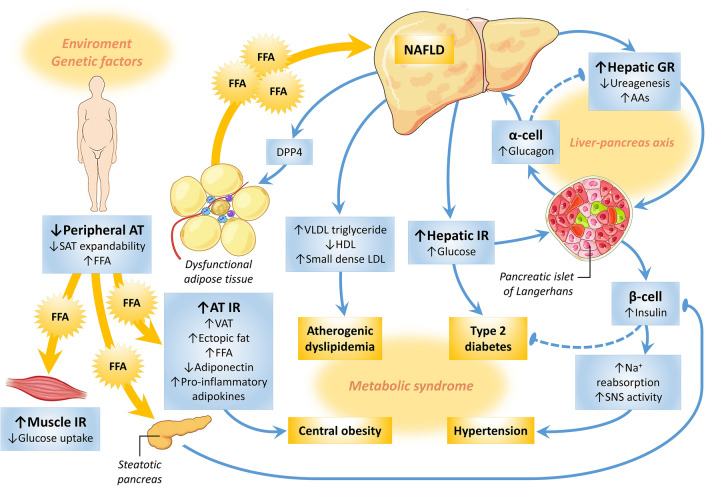
Background: The prevalence of non-alcoholic fatty liver disease (NAFLD) has been increasing rapidly. It is nowadays recognized as the most frequent liver disease, affecting a quarter of global population and regularly coexisting with metabolic disorders such as type 2 diabetes, hypertension, obesity, and cardiovascular disease. In a more simplistic view, NAFLD could be defined as an increase in liver fat content, in the absence of secondary cause of steatosis. In fact, the clinical onset of the disease is a much more complex process, closely related to insulin resistance, limited expandability and dysfunctionality of adipose tissue. A fatty liver is a main driver for a new recognized liver-pancreatic α-cell axis and increased glucagon, contributing to diabetes pathophysiology. Main text: This review will focus on the clinical and pathophysiological connections between NAFLD, insulin resistance and type 2 diabetes. We reviewed non-invasive methods and several scoring systems for estimative of steatosis and fibrosis, proposing a multistep process for NAFLD evaluation. We will also discuss treatment options with a more comprehensive view, focusing on the current available therapies for obesity and/or type 2 diabetes that impact each stage of NAFLD. Conclusion: The proper understanding of NAFLD spectrum—as a continuum from obesity to metabolic syndrome and diabetes—may contribute to the early identification and for establishment of targeted treatment.
Overview
The claims and statistics of this paper haven’t been checked yet.
Free: it reads the open-access text and checks the first 5 claims that cite a source we can check. Create a free account to check every claim.
Integrity signals
Registry
Cites
Statistics
Figures
Verification
Claims the paper makes
The claims and statistics of this paper haven’t been checked yet.
Free: it reads the open-access text and checks the first 5 claims that cite a source we can check. Create a free account to check every claim.
Self-check
Percentages, sums and reported differences re-computed from the paper’s own numbers.
The self-check needs the paper’s full text.
Citations
Cites
International Diabetes Federation 2017
Carracher, A. M., Marathe, P. H., & Close, K. L. (2018) · Journal of Diabetes · doi:10.1111/1753-0407.12644 · Cited by 13,418
Grundy, S. M., Cleeman, J. I., Daniels, S. R., Donato, K. A., Eckel, R. H., Franklin, B. A., Gordon, D. J., Krauss, R. M., Savage, P. J., Smith, S. C., et al. (2005) · Circulation · doi:10.1161/circulationaha.105.169404 · Cited by 11,961
Design and validation of a histological scoring system for nonalcoholic fatty liver disease†
Kleiner, D. E., Brunt, E. M., Van Natta, M., Behling, C., Contos, M. J., Cummings, O. W., Ferrell, L. D., Liu, Y., Torbenson, M. S., Unalp‐Arida, A., et al. (2005) · Hepatology · doi:10.1002/hep.20701 · Cited by 10,791 · cited 2×
“Despite the limitations of liver biopsy, we highlight it is the gold-standard method for NASH and fibrosis evaluation, and may be considered in selected cases, such as suspicion of other liver disease [56, 57].”
MethodYounossi, Z. M., Koenig, A. B., Abdelatif, D., Fazel, Y., Henry, L., & Wymer, M. (2016) · Hepatology · doi:10.1002/hep.28431 · Cited by 10,781 · cited 4×
“Epidemiology Although epidemiological data involving more than 8 million people estimated a global prevalence of NAFLD around 25% [2], it certainly varies greatly depending on how it is diagnosed and on the region of the world considered.”
BackgroundInfluentialThe metabolic syndrome—a new worldwide definition
Alberti, K. G. M., Zimmet, P., & Shaw, J. (2005) · The Lancet · doi:10.1016/s0140-6736(05)67402-8 · Cited by 9,352
The metabolic phenotype in obesity: Fat mass, body fat distribution, and adipose tissue function
Goossens, G. H. (2017) · Obesity Facts · doi:10.1159/000471488 · Cited by 8,481
Chalasani, N., Younossi, Z., Lavine, J. E., Charlton, M., Cusi, K., Rinella, M., Harrison, S. A., Brunt, E. M., & Sanyal, A. J. (2018) · Hepatology · doi:10.1002/hep.29367 · Cited by 7,239 · cited 12×
“Patients with obesity and/or MetS, with or without T2D, might be targeted promptly for ruling out NAFL/ NASH and fibrosis [3, 5, 6].”
BackgroundInfluentialEckel, R. H., Alberti, K., Grundy, S. M., & Zimmet, P. Z. (2010) · The Lancet · doi:10.1016/s0140-6736(09)61794-3 · Cited by 6,295
Eckel, R. H., Grundy, S. M., & Zimmet, P. Z. (2005) · The Lancet · doi:10.1016/s0140-6736(05)66378-7 · Cited by 5,550
Global burden of NAFLD and NASH: trends, predictions, risk factors and prevention
Younossi, Z., Anstee, Q. M., Marietti, M., Hardy, T., Henry, L., Eslam, M., George, J., & Bugianesi, E. (2018) · Nature Reviews Gastroenterology & Hepatology · doi:10.1038/nrgastro.2017.109 · Cited by 5,249 · cited 2×
“Genetic predisposition Genome-wide association (GWA) studies found several genetic variants associated with NAFLD, which implies in variability on individual susceptibility to the disease [39].”
Background
Research works printed but not linked: 1
- Stein DT Szczepaniak L Garg A Malloy C McGarry JD Intramuscular lipid is increased in subjects with congenital generalized lipodystrophy (Abstract) Diabetes 1997 46 Suppl. 1 242A
Cited by
Items 301–400 of 674
Dietary Pattern’s Role in Hepatic Epigenetic and Dietary Recommendations for the Prevention of NAFLD
Martin, J., & Bars‐Cortina, D. (2024) · Nutrients · doi:10.3390/nu16172956 · Cited by 11
Effect of ketogenic diets on lipid metabolism in adults: protocol for a systematic review
Hilary, S., Östlundh, L., Platat, C., Al‐Rifai, R. H., Almehairbi, O., Alshamsi, F., Ali, H. I., Dhaheri, A. S. A., Ismail, L. C., & Stojanovska, L. (2024) · BMJ Open · doi:10.1136/bmjopen-2023-076938 · Cited by 9
Kołota, A., & Głąbska, D. (2021) · Applied Sciences · doi:10.3390/app11135836 · Cited by 11
“Moreover, for patients with metabolic syndrome, as NAFLD individuals commonly are [10,23], with a specific pharmacotherapy associated with their condition [24], using various dietary supplements may be potentially harmful due to the high risk of excessive supply of active components; thus, it may be especially benefic…”
BackgroundMicó, V., San-Cristóbal, R., Martín, R., Martínez‐González, M. Á., Salas‐Salvadó, J., Corella, D., Fitó, M., Alonso‐Gómez, Á. M., Wärnberǵ, J., Vioqué, J., et al. (2022) · Frontiers in Endocrinology · doi:10.3389/fendo.2022.936956 · Cited by 8
Siqueira, J. S., Palacio, T. L. N., Vieira, T. A., Nakandakare-Maia, E. T., Grandini, N. A., Ferron, A. J. T., Francisqueti‐Ferron, F. V., & Corrêa, C. R. (2023) · Nutrire · doi:10.1186/s41110-023-00206-x · Cited by 8
Huang, X., Ji, Q., She, C.-Y., Cheng, Y., Zhou, J., & Wu, Q. (2023) · Experimental and Therapeutic Medicine · doi:10.3892/etm.2023.12116 · Cited by 10
“The disease is closely associated with metabolic disorders, such as obesity, dyslipidemia, IR and T2DM (31).”
Impact of tofogliflozin on hepatic outcomes: a systematic review
Pathak, M., Parveen, R., Khan, P. M., Saha, N., & Agarwal, N. B. (2023) · European Journal of Clinical Pharmacology · doi:10.1007/s00228-023-03537-w · Cited by 8
“As a consequence of obesity, which is a global epidemic, there is an increased number of NAFLD in T2DM patients [41].”
BackgroundChhimwal, J., Anand, P., Mehta, P., Swarnkar, M. K., Patial, V., Pandey, R., & Padwad, Y. S. (2023) · Frontiers in Microbiology · doi:10.3389/fmicb.2023.1210517 · Cited by 8
“Findings of the study suggested that mice subjected to WD for an extended period exhibited a broad range of metabolic and histological alterations typical with NASH, including extensive lipid accumulation in the liver, ballooning of hepatocytes, and steatohepatitic foci (Godoy-Matos et al., 2020).”
BackgroundYendewa, G. A., Khazan, A., & Jacobson, J. M. (2024) · Open Forum Infectious Diseases · doi:10.1093/ofid/ofae014 · Cited by 10
Cardiovascular implications of MASLD: overview of the evidence
Ismail, B., Nabilou, P., Gluud, L. L., & Møller, S. (2025) · Scandinavian Journal of Gastroenterology · doi:10.1080/00365521.2025.2536585 · Cited by 7
Yang, Y., & Huang, Y. (2025) · European Journal of Pharmacology · doi:10.1016/j.ejphar.2025.178107 · Cited by 10
Rao, N. K., Ghodous, S., Gurram, A., Khorasani, M., Ponnala, M., Habibi, A., Agyeman, K. B., Saberian, P., Biswas, P., Letafatkar, N., et al. (2025) · Inflammatory Bowel Diseases · doi:10.1093/ibd/izaf226 · Cited by 9
miRNAs, lncRNAs, circRNAs and piRNAs in Nonalcoholic Fatty Liver Disease: Past, Present and Future
Lucaciu, R. L., Orasan, O. H., Hangan, A. C., Iancu, M., Cozma, A., Coste, S. C., Gog-Bogdan, S., Sevastre, B., & Procopciuc, L. M. (2025) · International Journal of Molecular Sciences · doi:10.3390/ijms262110402 · Cited by 9
“Obesity is closely related to impaired blood glucose tolerance and with hyperinsulinemia, which increases the risk of developing diabetes and hyperlipidemia [162].”
Feng, Q., Manousou, P., Izzi‐Engbeaya, C. N., Loomba, R. S., Thursz, M. R., & Woodward, M. (2025) · Liver International · doi:10.1111/liv.70485 · Cited by 10
Ou, H., Kawaguchi, S., Sonomura, K., Kawaguchi, T., Kitada, S., Yoshiji, S., Brial, F., Gauguier, D., Xia, J., & Matsuda, F. (2023) · Scientific Reports · doi:10.1038/s41598-023-40697-2 · Cited by 8
“In addition, NAFLD is a risk factor for CKD 18 , and insulin resistance is a hallmark in the pathogenesis of NAFLD, T2DM and MetS 19 .”
Pramono, A., Gunawan, W. B., Nurkolis, F., Alisaputra, D., Limen, G. A., Alfaqih, M. S., & Ardiaria, M. (2024) · Pharmacia · doi:10.3897/pharmacia.71.e116794 · Cited by 7
“Sustaining a metabolically healthy condition in obesity may also decrease the risk of diabetes, NAFLD, and metabolic syndrome (Godoy-Matos et al. 2020).”
BackgroundPourseyedi, N., Arefhosseini, S., Tutunchi, H., & Ebrahimi‐Mameghani, M. (2025) · BMC Endocrine Disorders · doi:10.1186/s12902-025-01977-2 · Cited by 9
“Obesity is widely recognized as a major contributor to hepatic steatosis, and its prevalence is directly associated with higher BMI [64–66].”
Ramadhin, J., Silva‐Moraes, V., Nagy, T., Norberg, T., & Harn, D. A. (2021) · Frontiers in Immunology · doi:10.3389/fimmu.2021.668217 · Cited by 8
Nagy, E. N., Ibrahim, F. M., Jouda, A., & Elsayed, M. M. (2021) · Journal of lasers in medical sciences · doi:10.34172/jlms.2021.39 · Cited by 7
The Influence of the FFAR4 Agonist TUG-891 on Liver Steatosis in ApoE-Knockout Mice
Kiepura, A., Suski, M., Stachyra, K., Kuś, K., Czepiel, K., Wiśniewska, A., Ulatowska-Białas, M., & Olszanecki, R. (2023) · Cardiovascular Drugs and Therapy · doi:10.1007/s10557-023-07430-7 · Cited by 7
“Therefore, the presence of liver steatosis is associated with a constellation of alterations in glucose, fatty acid, and lipoprotein metabolism, as well as mitochondrial dysfunction, which has been shown to aggravate the development of NAFLD [4].”
BackgroundRana, M., Saini, M., Das, R., Gupta, S., Joshi, T., & Mehta, D. K. (2023) · MicroRNA · doi:10.2174/2211536612666230330083146 · Cited by 8
Kim, S.-H., Lee, S.-J., & Yu, S.-M. (2021) · Chemistry and Physics of Lipids · doi:10.1016/j.chemphyslip.2021.105164 · Cited by 7
Sugihara, N., Kamiya, K., Kado, S., Kishimoto, M., Kuwahara, A., Sugai, J., Iwami, D., Mieno, M., Komine, M., & Ohtsuki, M. (2023) · The Journal of Dermatology · doi:10.1111/1346-8138.16843 · Cited by 7
Sherif, K., Coborn, J., Hoovler, A., & Gill, L. A. (2022) · Postgraduate Medicine · doi:10.1080/00325481.2022.2140511 · Cited by 9
“NAFLD is another adiposity-based chronic disease associated with metabolic syndrome [29].”
BackgroundIridoids in gardenia fruit: key components in liver disease therapy
Cao, Q., Du, X., Liu, A. A., Li, Q. H., Luo, Q., Chen, Y., Wang, R., & Meng, L. (2025) · Frontiers in Nutrition · doi:10.3389/fnut.2025.1667863 · Cited by 8
Mallmann, M. M., Strobel, R., Ivantes, C. A. P., Sakamoto, D. G., Duarte, M. L., & Pedroso, M. L. A. (2023) · Archives of Endocrinology and Metabolism · doi:10.20945/2359-4292-2022-0138 · Cited by 6
“Furthermore, patients with NAFLD have increasingly been found to present with IR (13,14).”
BackgroundZhu, J. F., Zhang, M., Yue, Y., Zhu, J., Li, D., Sun, G., Chen, X., & Zhang, H. (2024) · Chemosphere · doi:10.1016/j.chemosphere.2024.143555 · Cited by 6
Immunology and treatments of fatty liver disease
Tang, S., Wu, S., Zhang, W., Ma, L., Zuo, L., & Wang, H. (2024) · Archives of Toxicology · doi:10.1007/s00204-024-03920-1 · Cited by 6
“In contrast, low carbohydrate diets may help reduce the risk of fatty liver (Godoy-Matos et al. 2020; Kang et al. 2022; Yki-Järvinen et al. 2021).”
Effects of Tinospora cordifolia (giloy) on metabolic syndrome components: a mechanistic review
Mansouri, M., Imenshahidi, M., Rameshrad, M., & Hosseinzadeh, H. (2024) · Naunyn-Schmiedeberg s Archives of Pharmacology · doi:10.1007/s00210-024-03642-2 · Cited by 8
“1) (Godoy-Matos et al. 2020).”
Cardiometabolic diseases in patients with inflammatory bowel disease: An evidence-based review
Dutt, K., Vasudevan, A., Hodge, A. D., Nguyen, T. L., & Srinivasan, A. R. (2025) · World Journal of Gastroenterology · doi:10.3748/wjg.v31.i24.107661 · Cited by 6
Feng, Q., Izzi‐Engbeaya, C. N., Beaney, T. E., Smith, A., Manousou, P., & Woodward, M. (2025) · BMC Medicine · doi:10.1186/s12916-025-04288-4 · Cited by 6
“SLD is closely linked to excess alcohol consumption and/or cardiometabolic risk factors, such as obesity, hypertension, diabetes and dyslipidaemia [4].”
Alkhouri, N., Edwards, K. L., Berman, M. A., Finn, H., Escandon, R. D., Lupinacci, P. J., Guthrie, N. L., Coste, A., Topete, J., & Noureddin, M. (2023) · Gastro Hep Advances · doi:10.1016/j.gastha.2023.08.019 · Cited by 8
“1,2 The condition currently affects an estimated 25% – 30% of US adults, 3,4 including approximately 70% of those with type 2 diabetes.”
Kim, H. J. (2023) · Pediatric Gastroenterology Hepatology & Nutrition · doi:10.5223/pghn.2023.26.6.312 · Cited by 6
“Non-alcoholic fatty liver disease (NAFLD) is a spectrum of hepatic diseases that has been increasing rapidly and is associated with metabolic disorders such as obesity, dyslipidemia, and insulin resistance (IR) [1].”
BackgroundZani, S. C. D. C., Berg, E. V., Jiang, X., Knox, A., Ackroyd, E., Getachew, A., Wu, J., & Chan, C. B. (2023) · Journal of Functional Foods · doi:10.1016/j.jff.2023.105976 · Cited by 6
Sakurai, A., Sakurai, T., Ho, H., Chiba, H., & Hui, S. (2024) · Nutrients · doi:10.3390/nu16040508 · Cited by 8
“The prevalence of NAFLD is rapidly increasing alongside the global increase in the incidence of metabolic syndrome, diabetes, and obesity [3].”
BackgroundXu, G., Wu, Y., Chen, J., Xiang, D., & Li, D. (2024) · Frontiers in Medicine · doi:10.3389/fmed.2024.1384366 · Cited by 7
Hernández, M. A. G., Verschuren, L., Caspers, M. P. M., Morrison, M. C., Venhorst, J., van den Berg, J. T., Coornaert, B., Hanemaaijer, R., & van Westen, G. J. P. (2024) · Scientific Reports · doi:10.1038/s41598-024-74098-w · Cited by 7
Ali, B. M., Elbaz, E. M., Al‐Mokaddem, A. K., El‐Emam, S. Z., & Awny, M. M. (2024) · BioFactors · doi:10.1002/biof.2133 · Cited by 7
Rebollo‐Hernanz, M., Aguilera, Y., Martin-Cabrejas, M. A., & de Mejía, E. G. (2020) · International Electronic Conference on Nutrients (IECN) · doi:10.3390/iecn2020-06996 · Cited by 6
“NAFLD is characterized by a dysregulated hepatic metabolism conducting to insulin resistance, lipid accumulation, and further inflammation and oxidative stress [18].”
BackgroundSusceptibility to Metabolic Diseases in COVID-19: To be or Not to be an Issue
Kaviani, M., Keshtkar, S., Soleimanian, S., Sarvestani, F. S., Azarpira, N., & Pakbaz, S. (2022) · Frontiers in Molecular Biosciences · doi:10.3389/fmolb.2022.803314 · Cited by 9
Chambergo‐Michilot, D., Rodrigo-Gallardo, P. K., Huamán, M. R., Vasquez-Chavesta, A. Z., Salinas-Sedo, G., & Toro-Huamanchumo, C. J. (2023) · Clinical and Experimental Gastroenterology · doi:10.2147/ceg.s402498 · Cited by 7
“Obesity coexists with other chronic diseases, including non-alcoholic fatty liver disease (NAFLD).(3) NAFLD has a worldwide prevalence of 25%; it is higher in the Middle East (32%) and South America (31%).”
BackgroundZhu, X., Nima, Q., Zhang, N., Tang, D., Hu, Y., Xie, X., Zhao, X., Meng, Q., Chen, L., Jiang, X., et al. (2023) · Journal of Health Population and Nutrition · doi:10.1186/s41043-023-00485-0 · Cited by 6
“It has been well recognized that obesity is a vital contributor to MAFLD, several researches have studied the relationship between obesity and MAFLD [30, 31], and most studies concluded that obesity was positively associated with MAFLD.”
BackgroundEmerging Perspectives on the Set of Conditions That Lead to the Emergence of Metabolic Syndrome
Tarcău, B.-M., Vicaș, L. G., Filip, L. A., Maghiar, F., Şandor, M. I., Pallag, A., Jurca, T., Muresan, M. E., & Marian, E. (2023) · Journal of Personalized Medicine · doi:10.3390/jpm14010032 · Cited by 7
“Having a comprehensive understanding of the entire range of NAFLD, which includes conditions from obesity through metabolic syndrome and diabetes, might be beneficial in identifying it early and applying personalized treatment [65].”
Bulur, A., & Sivritepe, R. (2023) · Healthcare · doi:10.3390/healthcare11020243 · Cited by 6
“The interaction between the liver, muscle, and adipose tissue, in which insulin resistance is critical, plays a vital role in developing NAFLD [16].”
BackgroundThe HepG2 Cell Line as a Model for Studying Metabolic Dysfunction-Associated Steatotic Liver Disease
Kotlyarova, A., Iskrina, A., & Kotlyarov, S. (2026) · International journal of molecular sciences · doi:10.3390/ijms27083399 · Cited by 10
Tang, F., Li, R.-H., & Huang, J. (2023) · Nutrients · doi:10.3390/nu15224765 · Cited by 6
ALSHAWAF, E. M. M., Marafie, S. K., Abu‐Farha, M., Albatineh, A. N., Alramah, T., Albuhairi, A., Qassar, Y. A., Zinoun, R., Shalabi, R., Behbehani, S., et al. (2025) · Biomedicines · doi:10.3390/biomedicines13010101 · Cited by 10
Sun, Y.-D., Zhang, H., Gong, X.-L., Li, Y., Han, R., Zhou, C., & Han, J. (2025) · Scientific Reports · doi:10.1038/s41598-025-07557-7 · Cited by 9
Augustin, R., Oldenburger, A., Baader-Pagler, T., Zimmermann, T., Borghardt, J. M., Hecksher‐Sørensen, J., Baljuls, A., Reindl, W., Krawczyk, B., Martel, E., et al. (2025) · Molecular Metabolism · doi:10.1016/j.molmet.2025.102205 · Cited by 6
Barbhuiya, P. A., Talukdar, S., Mondal, N. S., Kumari, P., Ahmed, M., & Pathak, M. P. (2025) · Current Topics in Medicinal Chemistry · doi:10.2174/0115680266370869250630062043 · Cited by 6
Semeya, A. A., Hafez, R. S. A. A., Ewais, S. H. M., Mostafa, S. M., Eldeeb, A. A., Elgamal, R., & Othman, A. A. A. (2025) · BMC Gastroenterology · doi:10.1186/s12876-025-03844-9 · Cited by 5
“Even modest increases in BMI have been demonstrated to increase the risk of MAFLD [47], while the role of visceral adiposity in driving the continuum from obesity to MAFLD and metabolic dysfunction has also been emphasized [48].”
Cetiner, S. (2026) · Diabetes Metabolic Syndrome and Obesity · doi:10.2147/dmso.s594898 · Cited by 7
“27,28 In the present cohort, more than two-thirds of participants exhibited ultrasonographic evidence of hepatic steatosis at baseline, consistent with previous epidemiological data.”
Implementation of Cardiometabolic Centers and Training Programs
Taha, M. B., Rao, N., Vaduganathan, M., Cainzos‐Achirica, M., Nasir, K., & Patel, K. V. (2022) · Current Diabetes Reports · doi:10.1007/s11892-022-01459-y · Cited by 5
Cross-talk between gut microbiota and liver steatosis: Complications and therapeutic target
Yao, Y., & Shen, Y. (2023) · Open Life Sciences · doi:10.1515/biol-2022-0699 · Cited by 5
“With cirrhosis, CVD is the main cause of death in NASH [54].”
BackgroundInfluentialEvolutive Models, Algorithms and Predictive Parameters for the Progression of Hepatic Steatosis
Tudor, M. S., Gheorman, V., Simeanu, G.-M. C., Dobrinescu, A., Pădureanu, V., Dinescu, V. C., & Forțofoiu, M.-C. (2024) · Metabolites · doi:10.3390/metabo14040198 · Cited by 6
“The co-occurrence of these conditions can exacerbate the overall disease burden on healthcare systems and contribute to increased healthcare costs [5,9].”
BackgroundCasagrande, D. S., Waib, F. F., Elías, J., & Júnior, A. A. J. (2024) · Obesities · doi:10.3390/obesities4020011 · Cited by 6
“It may or may not be associated with necro-inflammatory changes and fibrosis, which may progress to cirrhosis and hepatocellular carcinoma [8].”
BackgroundVieira, A. C. A., Ferreira, F. D. S., de Araújo, J. M. D., Dutra, L. M. G., Batista, K. S., Cordeiro, Â. M. T. D. M., & Aquino, J. D. S. (2024) · Livers · doi:10.3390/livers4020021 · Cited by 5
“Furthermore, both obesity and diabetes can induce a state of chronic inflammation and changes in liver enzyme levels, contributing to the development of MASLD [47].”
BackgroundZhang, M., Zhao, W., Zhang, Z., He, M., Zhang, Y., Song, B., Liu, J., & Zhang, H. (2024) · BMC Endocrine Disorders · doi:10.1186/s12902-024-01705-2 · Cited by 6
“NAFLD is one of the most important complications in T2DM patients with obesity and dyslipidemia [11].”
BackgroundLee, Y.-J., Tassey, J., Sarkar, A., Levi, J. N., Lee, S., Liu, N. Q., Drake, A. C., Nguyen, F., Magallanes, J., Stevic, U., et al. (2024) · Scientific Reports · doi:10.1038/s41598-024-82414-7 · Cited by 5
Kim, B. S., Kim, H., Jeon, S. W., Kim, K., Kim, D. W., & Shin, J. (2025) · Heliyon · doi:10.1016/j.heliyon.2025.e43073 · Cited by 6
Ashraf, H., Anushiravani, A., Rayatpisheh, M., Alamdari, D. H., Hossieni, A., & Kazeminezhad, B. (2025) · Frontiers in Medicine · doi:10.3389/fmed.2025.1539605 · Cited by 7
“Advancing age, central obesity, and components of metabolic syndrome, such as dyslipidemia and hyperglycemia, are risk factors for NAFLD and fibrosis progression (8).”
Antitumor Effects and Mechanisms of Metabolic Syndrome Medications on Hepatocellular Carcinoma
Oura, K., Morishita, A., Tani, J., & Masaki, T. (2022) · Journal of Hepatocellular Carcinoma · doi:10.2147/jhc.s392051 · Cited by 6
“The pathophysiology of NAFLD can lead to HCC development not caused by the hepatitis virus, on the continuum to metabolic syndrome, including hypertension, diabetes, dyslipidemia, and obesity is shown in Figure 1.(34) NAFLD progresses to NASH characterized by hepatocyte ballooning, apoptosis, accumulation of Mallory–D…”
BackgroundChen, H., Durand, S., Bawa, O., Bourgin, M., Montégut, L., Lambertucci, F., Motiño, O., Li, S., Nogueira-Recalde, U., Anagnostopoulos, G., et al. (2024) · Methods in molecular biology · doi:10.1007/978-1-0716-3694-7_15 · Cited by 5
Soundharrajan, I., Muthusamy, K., Jung, J.-S., Lee, K.-D., Lee, J., Ramesh, T., Kim, D., & Choi, K. (2022) · International Journal of Molecular Sciences · doi:10.3390/ijms23126750 · Cited by 5
“Human diseases such as cardiovascular diseases, insulin resistance, diabetes mellitus, and nonalcoholic fatty liver disease (NAFLD) are closely linked to fat deposition and metabolism [1].”
BackgroundAnzar, C. A., Joseph, M. V., Sundaram, R., Vadiraj, G. B., Prasad, C. P., Eranimose, B., & Jagadeesh, S. (2023) · medRxiv · doi:10.1101/2023.09.22.23295947 · Cited by 5
Shea, S., Lionis, C., Kite, C., Atkinson, L., Chaggar, S. S., Randeva, H. S., & Kyrou, I. (2021) · Biomedicines · doi:10.3390/biomedicines9111697 · Cited by 4
“, insulin resistance and obesity) [3,6,11,12].”
Matboli, M., Hamady, S., Saad, M., Khaled, R., Khaled, A., Barakat, E., Sayed, S. A., Agwa, S. H. A., & Youssef, I. (2024) · Non-coding RNA Research · doi:10.1016/j.ncrna.2024.10.002 · Cited by 5
“Non-alcoholic fatty liver disease (NAFLD) has emerged as one of the prevalent chronic liver conditions, exhibiting a rising global incidence, primarily attributed to its strong correlation with obesity and type 2 diabetes (T2D) [1].”
Fattiny, S. Z. A., Binobead, M. A., Yagoub, A. E. A., Alshammari, G. M., Saleh, A. Y., & Yahya, M. A. (2025) · Frontiers in Pharmacology · doi:10.3389/fphar.2025.1595323 · Cited by 4
Kumar, S., Lahooti, A., Hajifathalian, K., Critelli, B., Hassan, A., Johnson, K. E., Baig, M. R., Akagbosu, C., Canakis, A., Hassan, K., et al. (2025) · Digestive Diseases and Sciences · doi:10.1007/s10620-025-09218-1 · Cited by 4
“Estimates suggest the prevalence of MASLD is between 60 and 95% in those with obesity [3].”
Jeong, Y., Oh, A., Jung, Y. H., Jung, K. H., Lee, S., Carrer, M., Lee, S. B., Valenti, L. V. C., Pajvani, U. B., & Kim, K. (2025) · Experimental & Molecular Medicine · doi:10.1038/s12276-025-01499-w · Cited by 8
Novel concept of cardiovascular-renal-hepatic-metabolic syndrome: what did the experts think about
Shlyakhto, E. V., Nedogoda, S. V., Babenko, A. Y., Arutyunov, G. P., Drapkina, O. M., Kobalava, Z. D., Конради, А. О., Lopatin, Y. M., Вадимовна, В. С., Звартау, Н. Э., et al. (2025) · Russian Journal of Cardiology · doi:10.15829/1560-4071-2025-6534 · Cited by 4
Matcha Green Tea Improves Cafeteria-Diet-Induced NAFLD by Modulating the Gut Microbiota in Rats
Chong, H.-C., Tang, S. X., Tseng, Y.-C., Yang, S., Watanabe, Y., Yamada, S., Yang, Y. S. H., & Chen, Y. (2025) · Nutrients · doi:10.3390/nu17193051 · Cited by 4
Milanovic, S. M., Lew, R., Xiong, K., Casavant, E., Galluppi, G. R., Chen, Y., Lai, Y., Chakravarthy, M. V., Dehn, C., Jackson, E., et al. (2025) · Diabetes Obesity and Metabolism · doi:10.1111/dom.70110 · Cited by 4
“21 Our study cohort was enriched for prediabetes, which could be a contributing factor to the observed higher incidence of MASLD.”
Basurto, L., Basurto-Acevedo, N. E., Oviedo, N., Cruz-Galicia, E. S., Rodríguez-Martínez, A. I., Tesoro-Cruz, E., Murillo, C. M., García-Estrada, A. G., Meneses, A. C. N., & Apolinar, L. M. (2025) · Metabolites · doi:10.3390/metabo15120764 · Cited by 5
Albai, O., Braha, A., Timar, R. Z., Lazăr, S., Popescu, S. D., & Timar, B. (2026) · Diabetes Metabolic Syndrome and Obesity · doi:10.2147/dmso.s577797 · Cited by 5
Arshad, F., Chinnappan, R., Broering, D. C., Raptis, D. A., Mir, T. A., Khan, M. I., & Yaqinuddin, A. (2026) · Frontiers in Bioengineering and Biotechnology · doi:10.3389/fbioe.2026.1748835 · Cited by 4
Doença hepática gordurosa metabólica (DHGM)
Godoy‐Matos, A. F., Valério, C. M., Júnior, W. S. D. S., de Araújo-Neto, J. M., Giacaglia, L. R., & Bertoluci, M. C. (2022) · Conectando Pessoas eBooks · doi:10.29327/557753.2022-21 · Cited by 4
Self-citationGDF11 : An emerging therapeutic target for liver diseases and fibrosis
Habibi, P., Falamarzi, K., Ebrahimi, N. D., Zarei, M., Malekpour, M., & Azarpira, N. (2024) · Journal of Cellular and Molecular Medicine · doi:10.1111/jcmm.18140 · Cited by 4
“58 To attribute metabolic dysregulation to someone, at least two metabolic abnormalities are required, including increased waist circumference, prediabetes, abnormal plasma triglycerides (TG), high-density lipoprotein cholesterol (HDL), blood pressure, high-sensitivity C-reactive protein (hs-CRP),…”
BackgroundInfluentialThe Impact of Yoyo Dieting and Resistant Starch on Weight Loss and Gut Microbiome in C57Bl/6 Mice
Phuong-Nguyen, K., O’Hely, M., Kowalski, G. M., McGee, S. L., Aston‐Mourney, K., Connor, T., Mahmood, M. Q., & Rivera, L. R. (2024) · Nutrients · doi:10.3390/nu16183138 · Cited by 4
Crommen, S., Rheinwalt, K. P., Plamper, A., Rösler, D., Weinhold, L., Metzner, C., & Egert, S. (2024) · Nutrients · doi:10.3390/nu16183210 · Cited by 4
Cooper, K. M., Patel, A. K., Zammitti, C. A., Murchie, E., Colletta, A., & Devuni, D. (2024) · Journal of Clinical and Experimental Hepatology · doi:10.1016/j.jceh.2024.102427 · Cited by 4
Impact of Nonalcoholic Fatty Liver Disease on the Survival of People Living With HIV
Macías, J., Frías, M., Pineda, J. A., Corona‐Mata, D., Corma‐Gómez, A., Rivero‐Juárez, A., Santos, M. L., Deltoro, M. G., Rivero, A., Ricart-Olmos, C., et al. (2024) · Alimentary Pharmacology & Therapeutics · doi:10.1111/apt.18413 · Cited by 4
“The more the body weight reduction, the greater the histological impact [30].”
Mahmoud, M. R., Ibrahim, S., Shahien, M. M., Alshammari, A. D., Alenazi, F., Alreshidi, F. S., Aljadani, A., Khalik, A. A., Elhaj, A. H., Khalifa, A. M., et al. (2025) · Healthcare · doi:10.3390/healthcare13040376 · Cited by 5
Wang, X., Tan, Q., Zhang, D., Cao, H., Deng, S., & Zhang, Y. (2025) · International Journal of Molecular Sciences · doi:10.3390/ijms26125860 · Cited by 5
Deciphering the Role of Oroxylin A in Liver Fibrosis
Wang, S., Wu, J., Sun, J., Chen, W., Tian, Z., Huang, S., & Wang, M. (2025) · Drug Design Development and Therapy · doi:10.2147/dddt.s530387 · Cited by 4
“NAFLD, a prevalent condition among overweight and obese individuals and those with metabolic syndrome, 109 involves oxidative stress and ferroptosis, which exacerbate hepatic inflammation and fibrosis, driving disease progression.”
Maimaitiyiming, M., Maihemuti, S., Aierken, T., Abulimiti, G., Aibaidula, T., Guan, Y., Simayi, A., Aimaiti, M., Wang, X., Abuduaini, A., et al. (2025) · Frontiers in Microbiology · doi:10.3389/fmicb.2025.1666110 · Cited by 4
Kasem, H. E., AbdElAtty, E., Yahia, A. M. M., & Abdalla, E. M. (2023) · Egyptian Liver Journal · doi:10.1186/s43066-023-00297-1 · Cited by 4
“Evidence revealed that fat distribution is a main pathophysiological mechanism for metabolic disease, and abdominal obesity differs from a more equal fat distribution [27].”
BackgroundSepehrinia, M., & Pourmontaseri, H. (2024) · Scandinavian Journal of Gastroenterology · doi:10.1080/00365521.2024.2323513 · Cited by 4
“As obesity plays a role in the pathophysiology of NAFLd and the prevalence of NAFLd is higher in obese people [4], evaluating the role of BMi in the association of dii and NAFLd is important.”
BackgroundMetformin: Beyond Type 2 Diabetes Mellitus
Ahmad, R., & Haque, M. (2024) · Cureus · doi:10.7759/cureus.71730 · Cited by 6
“…when fatty degeneration is detected through histopathological examination over 5% of hepatic cells and concurrently presence of metabolic syndrome precepting features (predominantly T2DM and obesity), disregard of excessive regular alcohol drinking or other long-lasting liver diseases [63-65].”
VanderVeen, B. N., Cardaci, T. D., Bullard, B. M., Unger, C. A., Freeman, J. C., Enos, R. T., Shtutman, M. S., Wyatt, M. D., Fan, D., & Murphy, E. A. (2024) · American Journal of Physiology-Cell Physiology · doi:10.1152/ajpcell.00687.2024 · Cited by 5
Lee, H. L., Kim, J. M., Go, M. J., Lee, H. S., Kim, J. H., Kim, I. Y., Seong, G.-S., & Heo, H. J. (2025) · Journal of Microbiology and Biotechnology · doi:10.4014/jmb.2409.09025 · Cited by 5
“Obesity and diabetes are closely related, and fat accumulation causes diabetes by interfering with the action of insulin [3, 4].”
InfluentialHidden Hunger: A Forgotten Comorbidity of Metabolic‐Syndrome‐Associated Fatty Liver Disease
Agu, P. C., & Lu, J. (2025) · Molecular Nutrition & Food Research · doi:10.1002/mnfr.70134 · Cited by 6
“The comorbidity of M/NAFLD and hidden hunger can create a vicious cycle, where micronutrient deficiencies contribute to liver dysfunction, further exacerbating metabolic imbalances and nutritional deficiencies, as highlighted by Godoy-Matos et al. [15].”
Nonalcoholic fatty liver and left ventricular remodelling: now the prospective evidence
Sechi, L. A., Soardo, G., & Catena, C. (2021) · Journal of Hypertension · doi:10.1097/hjh.0000000000002750 · Cited by 4
Non-alcoholic fatty liver disease - opportunities for personalized treatment and drug development
Kemas, A. M., Youhanna, S. C., & Lauschke, V. M. (2022) · Expert Review of Precision Medicine and Drug Development · doi:10.1080/23808993.2022.2053285 · Cited by 5
“NAFLD is strongly associated with a cluster of metabolic conditions including obesity, hypertension, hypertriglyceridemia, and hyperglycemia [42], which in turn are strongly linked to dietary, environmental and genetic factors.”
BackgroundNogueira, S., Garcez, F., Sá, S., Moutinho, L. C., Cardoso, A., Soares, R. A., Fonseca, B. M., & Leal, S. M. (2022) · Histochemistry and Cell Biology · doi:10.1007/s00418-022-02092-2 · Cited by 6
“In addition, OS activates inflammatory kinases, triggering vascular dysfunction in response to metabolic changes and vice versa, changes that can be aggravated leading to metabolic diseases such as diabetes and NAFLD (Könner and Brüning 2012; Porras et al.”
BackgroundInfluentialZhang, Z., Placa, D. L., Gugiu, G. B., Thunen, A., Le, K., & Shively, J. E. (2022) · Obesity · doi:10.1002/oby.23457 · Cited by 5
“NAFLD is associated with obesity (3) and metabolic syndrome (4), including insulin resistance in the liver (5).”
BackgroundSu, C., & Yang, Q. (2022) · Frontiers in Pharmacology · doi:10.3389/fphar.2022.1032789 · Cited by 4
“As a metabolic stress-induced liver injury, Non-alcoholic fatty liver disease (NAFLD) not only directly leads to liver damage or death, but also increases the risk of metabolic syndrome (Godoy-Matos et al., 2020), cardiovascular disease (Miptah et al.”
BackgroundChang, W., & Chang, Y.-P. (2022) · International Journal of Environmental Research and Public Health · doi:10.3390/ijerph192316294 · Cited by 4
“The best way to break this vicious cycle would be to control the weight, fasting blood glucose, triglycerides, and HDL-C of nurses [34].”
BackgroundYe, J., Lin, Y., Shao, C., Sun, Y., Feng, S., & Zhong, B. (2023) · Annals of Nutrition and Metabolism · doi:10.1159/000530531 · Cited by 4
Liver Fibrosis as an Independent Cardiovascular Risk Factor in Non-alcoholic Fatty Liver Disease
Garbuzenko, D. V. (2024) · Journal of Translational Gastroenterology · doi:10.14218/jtg.2023.00071 · Cited by 3
Metadata
- Authors
- Godoy-Matos, A. F., Silva Júnior, W. S., & Valerio, C. M.
- Venue
- Diabetology & Metabolic Syndrome
- Published
- 2020-07-14
- Volume
- 12
- Issue
- 1
- Pages
- 60-60
- ISSN
- 1758-5996 (ISSN-L)
- PMC
- PMC7359287
- OpenAlex
- W3043179056
- Semantic Scholar
- a44e7a8165ddce09396d4fa212182af3fa0f97b0
- Cited by
- 643
- References
- 175
- Citations by year
- 2026: 56 · 2025: 111 · 2024: 148 · 2023: 142 · 2022: 109 · 2021: 72 · 2020: 4
- FWCI
- 11.95
- Type
- journal article
- Language
- en
- Open access
- gold
- doi.org
- Licence
- cc-by
- creativecommons.org/licenses/by/4.0 (tdm)
- creativecommons.org/licenses/by/4.0 (vor)
- Locations
- Diabetology & Metabolic Syndrome (publishedVersion, cc-by)
- PubMed Central (publishedVersion, cc-by)
- PubMed (publishedVersion)
- DOAJ (DOAJ: Directory of Open Access Journals) (submittedVersion, cc-by-sa)
- Topics
- Health Sciences › Medicine › Hepatology › Liver Disease Diagnosis and Treatment
- Health Sciences › Medicine › Endocrinology, Diabetes and Metabolism › Diabetes, Cardiovascular Risks, and Lipoproteins
- Health Sciences › Medicine › Endocrinology, Diabetes and Metabolism › Diet, Metabolism, and Disease
- Keywords
- non-alcoholic fatty liver disease, obesity, metabolic syndrome, type 2 diabetes, insulin resistance, hepatic steatosis, liver fibrosis, adipose tissue dysfunction, glucagon, NAFLD treatment, disease continuum
About these checks
Registry, retraction, Cites and statistics results are computed, not judged, with one exception: a printed reference that no index lists is read once by a model before it counts as a citation error. Claims are extracted by a model and kept only when their quote appears verbatim in the text; each cited source is then checked, with a model’s help, for whether it says what the claim relies on. Those verdicts can be wrong — read the claim’s quote and the cited source before relying on one.
Statistics and arithmetic are recomputed, not judged.
Confidence bands are shown only for fields calibrated on our annotated test set. None is calibrated yet, so no band is shown.
What counts as a claim ›How we measure confidence ›How we check this ›
Are you an author, or do you see a problem with this page? Request a review
Data sources
Bibliographic data: Semantic Scholar, OpenAlex, Crossref.
Contains information from the Semantic Scholar Academic Graph Datasets, made available under the ODC Attribution License (ODC-BY 1.0).
Semantic Scholar’s data is described in: Kinney, R., et al. (2023). The Semantic Scholar Open Data Platform. arXiv:2301.10140.
