

NAFLD as a continuum: from obesity to metabolic syndrome and diabetes
Open accessThe DOI matches its Crossref record; 176 of the 176 references it cites were found in a registry or an index.
Abstract
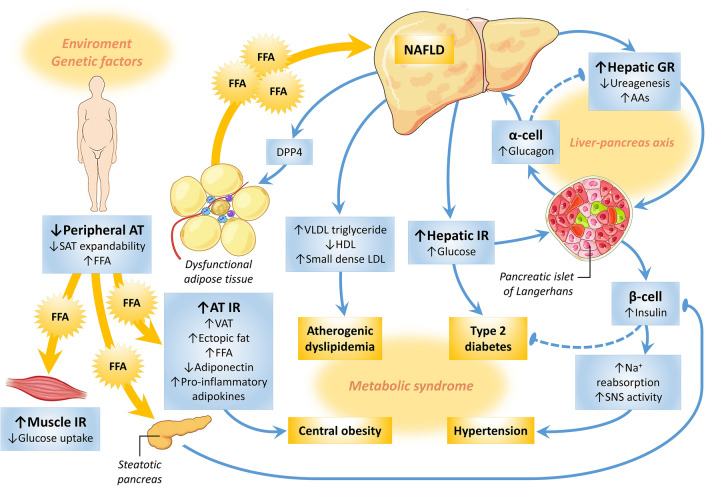
Background: The prevalence of non-alcoholic fatty liver disease (NAFLD) has been increasing rapidly. It is nowadays recognized as the most frequent liver disease, affecting a quarter of global population and regularly coexisting with metabolic disorders such as type 2 diabetes, hypertension, obesity, and cardiovascular disease. In a more simplistic view, NAFLD could be defined as an increase in liver fat content, in the absence of secondary cause of steatosis. In fact, the clinical onset of the disease is a much more complex process, closely related to insulin resistance, limited expandability and dysfunctionality of adipose tissue. A fatty liver is a main driver for a new recognized liver-pancreatic α-cell axis and increased glucagon, contributing to diabetes pathophysiology. Main text: This review will focus on the clinical and pathophysiological connections between NAFLD, insulin resistance and type 2 diabetes. We reviewed non-invasive methods and several scoring systems for estimative of steatosis and fibrosis, proposing a multistep process for NAFLD evaluation. We will also discuss treatment options with a more comprehensive view, focusing on the current available therapies for obesity and/or type 2 diabetes that impact each stage of NAFLD. Conclusion: The proper understanding of NAFLD spectrum—as a continuum from obesity to metabolic syndrome and diabetes—may contribute to the early identification and for establishment of targeted treatment.
Overview
The claims and statistics of this paper haven’t been checked yet.
Free: it reads the open-access text and checks the first 5 claims that cite a source we can check. Create a free account to check every claim.
Integrity signals
Registry
Cites
Statistics
Figures
Verification
Claims the paper makes
The claims and statistics of this paper haven’t been checked yet.
Free: it reads the open-access text and checks the first 5 claims that cite a source we can check. Create a free account to check every claim.
Self-check
Percentages, sums and reported differences re-computed from the paper’s own numbers.
The self-check needs the paper’s full text.
Citations
Cites
International Diabetes Federation 2017
Carracher, A. M., Marathe, P. H., & Close, K. L. (2018) · Journal of Diabetes · doi:10.1111/1753-0407.12644 · Cited by 13,418
Grundy, S. M., Cleeman, J. I., Daniels, S. R., Donato, K. A., Eckel, R. H., Franklin, B. A., Gordon, D. J., Krauss, R. M., Savage, P. J., Smith, S. C., et al. (2005) · Circulation · doi:10.1161/circulationaha.105.169404 · Cited by 11,961
Design and validation of a histological scoring system for nonalcoholic fatty liver disease†
Kleiner, D. E., Brunt, E. M., Van Natta, M., Behling, C., Contos, M. J., Cummings, O. W., Ferrell, L. D., Liu, Y., Torbenson, M. S., Unalp‐Arida, A., et al. (2005) · Hepatology · doi:10.1002/hep.20701 · Cited by 10,791 · cited 2×
“Despite the limitations of liver biopsy, we highlight it is the gold-standard method for NASH and fibrosis evaluation, and may be considered in selected cases, such as suspicion of other liver disease [56, 57].”
MethodYounossi, Z. M., Koenig, A. B., Abdelatif, D., Fazel, Y., Henry, L., & Wymer, M. (2016) · Hepatology · doi:10.1002/hep.28431 · Cited by 10,781 · cited 4×
“Epidemiology Although epidemiological data involving more than 8 million people estimated a global prevalence of NAFLD around 25% [2], it certainly varies greatly depending on how it is diagnosed and on the region of the world considered.”
BackgroundInfluentialThe metabolic syndrome—a new worldwide definition
Alberti, K. G. M., Zimmet, P., & Shaw, J. (2005) · The Lancet · doi:10.1016/s0140-6736(05)67402-8 · Cited by 9,352
The metabolic phenotype in obesity: Fat mass, body fat distribution, and adipose tissue function
Goossens, G. H. (2017) · Obesity Facts · doi:10.1159/000471488 · Cited by 8,481
Chalasani, N., Younossi, Z., Lavine, J. E., Charlton, M., Cusi, K., Rinella, M., Harrison, S. A., Brunt, E. M., & Sanyal, A. J. (2018) · Hepatology · doi:10.1002/hep.29367 · Cited by 7,239 · cited 12×
“Patients with obesity and/or MetS, with or without T2D, might be targeted promptly for ruling out NAFL/ NASH and fibrosis [3, 5, 6].”
BackgroundInfluentialEckel, R. H., Alberti, K., Grundy, S. M., & Zimmet, P. Z. (2010) · The Lancet · doi:10.1016/s0140-6736(09)61794-3 · Cited by 6,295
Eckel, R. H., Grundy, S. M., & Zimmet, P. Z. (2005) · The Lancet · doi:10.1016/s0140-6736(05)66378-7 · Cited by 5,550
Global burden of NAFLD and NASH: trends, predictions, risk factors and prevention
Younossi, Z., Anstee, Q. M., Marietti, M., Hardy, T., Henry, L., Eslam, M., George, J., & Bugianesi, E. (2018) · Nature Reviews Gastroenterology & Hepatology · doi:10.1038/nrgastro.2017.109 · Cited by 5,249 · cited 2×
“Genetic predisposition Genome-wide association (GWA) studies found several genetic variants associated with NAFLD, which implies in variability on individual susceptibility to the disease [39].”
Background
Research works printed but not linked: 1
- Stein DT Szczepaniak L Garg A Malloy C McGarry JD Intramuscular lipid is increased in subjects with congenital generalized lipodystrophy (Abstract) Diabetes 1997 46 Suppl. 1 242A
Cited by
Items 101–200 of 674
Parente, E. B., Dahlström, E. H., Harjutsalo, V., Inkeri, J., Mutter, S., Forsblom, C. M., Sandholm, N., Gordin, D., & Groop, P. (2021) · Diabetes Care · doi:10.2337/dc20-3175 · Cited by 32
Koulaouzidis, G., Charisopoulou, D., Kukla, M., Marlicz, W. M., Rydzewska, G. M., Koulaouzidis, A., & Skonieczna‐Żydecka, K. (2021) · Gastroenterology Review · doi:10.5114/pg.2021.109063 · Cited by 47
“Several mechanisms have been suggested to explain this association [10, 24, 43].”
BackgroundGodoy‐Matos, A. F., Valério, C. M., Júnior, W. S. D. S., Neto, J. M. D. A., & Bertoluci, M. C. (2024) · Diabetology & Metabolic Syndrome · doi:10.1186/s13098-024-01259-2 · Cited by 34
“[2] Adapted from Godoy‑Matos et al.”
BackgroundSelf-citationSangouni, A. A., Hosseinzadeh, M., & Parastouei, K. (2024) · BMC Endocrine Disorders · doi:10.1186/s12902-024-01661-x · Cited by 36
“It has been confirmed that metabolic dysreg-ulations in MetS contributed to the progression of fatty liver disease [5].”
BackgroundCencioni, C., Malatesta, S., Benedetti, V. V., Licursi, V., Perfetto, L., Conte, F., Ranieri, D., Bartolazzi, A., Kunkl, M., Tuosto, L., et al. (2025) · Journal of Experimental & Clinical Cancer Research · doi:10.1186/s13046-024-03263-w · Cited by 32
“The pro-fibrotic role of hyperglycemia and obesity has been already demonstrated in liver and heart [73, 74], but at moment no dedicated scientific reports analysed their involvement in collagen deposition during PDAC stroma development, although a higher malignant stroma has been observed in…”
Zaiou, M., Amrani, R., Rihn, B. H., & Hajri, T. (2021) · Biomedicines · doi:10.3390/biomedicines9091256 · Cited by 30
“sity, type 2 diabetes mellitus (T2DM) or metabolic syndrome (MetS) [11].”
BackgroundUtility of Human Relevant Preclinical Animal Models in Navigating NAFLD to MAFLD Paradigm
Chua, D., Low, Z. S., Cheam, G. X., Ng, A. S., & Tan, N. S. (2022) · International Journal of Molecular Sciences · doi:10.3390/ijms232314762 · Cited by 52
“NAFLD is deeply connected with metabolic disorders, often regarded as the hepatic manifestation of metabolic syndrome, commonly seen in patients with obesity, hypertension, and diabetes [3].”
BackgroundA Review of the Effects of Fucoxanthin on NAFLD
Sayuti, N. H., Nawawi, K. N. M., Goon, J. A., Mokhtar, N. M., Makpol, S., & Tan, J. K. (2023) · Nutrients · doi:10.3390/nu15081954 · Cited by 33
HOMA-IR is an effective biomarker of non-alcoholic fatty liver disease in non-diabetic population
Zeng, P., Cai, X., Yu, X., Huang, L., & Chen, X. (2023) · Journal of International Medical Research · doi:10.1177/03000605231204462 · Cited by 33
sTREM2 is a plasma biomarker for human NASH and promotes hepatocyte lipid accumulation
Kothari, V. M., Savard, C. E., Tang, J., Lee, S. P., Subramanian, S., Wang, S., den Hartigh, L. J., Bornfeldt, K., & Ioannou, G. N. (2023) · Hepatology Communications · doi:10.1097/hc9.0000000000000265 · Cited by 31
Al-Regaiey, K. (2024) · Immunity & Ageing · doi:10.1186/s12979-024-00481-w · Cited by 33
Tang, R., Liu, R., Zha, H., Cheng, Y., Ling, Z., & Li, L. (2023) · Engineering in Life Sciences · doi:10.1002/elsc.202300016 · Cited by 32
“The prevalence of NAFLD is estimated to be between 70% and 90% among patients with metabolic comorbidities [6].”
BackgroundEgea, M. B., Filho, J. G. D. O., & Lemes, A. C. (2023) · International Journal of Molecular Sciences · doi:10.3390/ijms241512015 · Cited by 35
Zamani, M., Zarei, M., Nikbaf-Shandiz, M., Hosseini, S., Shiraseb, F., & Asbaghi, O. (2022) · Frontiers in Nutrition · doi:10.3389/fnut.2022.1013055 · Cited by 28
Bates, E. A., Kipp, Z. A., Lee, W., Martinez, G. J., Weaver, L., Becker, K. N., Pauss, S. N., Creeden, J. F., Anspach, G., Helsley, R. N., et al. (2024) · Journal of Biological Chemistry · doi:10.1016/j.jbc.2024.105691 · Cited by 29
“The rates of NAFLD are rising and are expected to be over 30% of the world ’ s adult population by 2030 (2, 4 – 6).”
BackgroundXie, C., Yuan, Y., Wang, Y., Qi, C., Wang, W., An, C., Aikepaer, A., Zhang, Y., Zhang, G., Feng, X., et al. (2025) · Current Obesity Reports · doi:10.1007/s13679-025-00673-5 · Cited by 32
Jovanović, G. K., Mrakovčić-Šutić, I., Žeželj, S. P., Horvat, I. B., Šuša, L., Rahelić, D., & Majanović, S. K. (2021) · Canadian Journal of Gastroenterology and Hepatology · doi:10.1155/2021/6649142 · Cited by 31
“NAFLD appears to increase the chances of developing nonfatal coronary heart disease, ischemic stroke, or cardiovascular death by more than 50% in patients with T2D [43].”
Hendawy, A. S., El-Lakkany, N. M., Mantawy, E. M., Hammam, O. A., Botros, S. S., & El‐Demerdash, E. (2022) · Life Sciences · doi:10.1016/j.lfs.2022.120695 · Cited by 28
Crosstalk between dietary patterns, obesity and nonalcoholic fatty liver disease
Ristić-Medić, D., Bajerska, J., & Vučić, V. (2022) · World Journal of Gastroenterology · doi:10.3748/wjg.v28.i27.3314 · Cited by 31
From Non-Alcoholic Fatty Liver to Hepatocellular Carcinoma: A Story of (Mal)Adapted Mitochondria
Amorim, R., Magalhães, C. C., Borges, F., Oliveira, P. J., & Teixeira, J. (2023) · Biology · doi:10.3390/biology12040595 · Cited by 36
Rusu, I., Pirlog, R., Chiroi, P., Nutu, A., Puia, V. R., Fetti, A. C., Rusu, D. R., Berindan-Neagoe, I., & Al Hajjar, N. (2022) · International Journal of Molecular Sciences · doi:10.3390/ijms232012370 · Cited by 27
“NAFLD is an underlying disorder in up to 68% of T2DM patients and between 60 and 95% of obese individuals [66,67].”
BackgroundNeuraminidase-1: A Sialidase Involved in the Development of Cancers and Metabolic Diseases
Toussaint, K., Appert-Collin, A., Morjani, H., Albrecht, C., Sartelet, H., Romier, B., Maurice, P., Duca, L., Blaise, S. A., & Bennasroune, A. (2022) · Cancers · doi:10.3390/cancers14194868 · Cited by 31
Zinc finger transcription factor Egf1 promotes non-alcoholic fatty liver disease
Guo, Y., Miao, X., Sun, X., Li, L., Zhou, A., Zhu, X., Xu, Y., Wang, Q., Li, Z., & Fan, Z. (2023) · JHEP Reports · doi:10.1016/j.jhepr.2023.100724 · Cited by 34
“cirrhosis) but also to cardiovascular diseases and diabetes.(3) Despite decades of rigorous research, therapeutic strategies for NAFLD remain elusive.”
Role of Perturbated Hemostasis in MASLD and Its Correlation with Adipokines
Pezzino, S., Luca, T., Castorina, M., Puleo, S., Latteri, S., & Castorina, S. (2024) · Life · doi:10.3390/life14010093 · Cited by 32
“These pathological conditions are frequently correlated with several physiological alterations [7,8] and with obesity or overweight [5,9], both of which are established risk factors for the development of MASLD [10].”
BackgroundAdvancement of Nanoengineered Flavonoids for Chronic Metabolic Diseases
Sharma, H., Anand, A. K., Halagali, P., Inamdar, A., Pathak, R., Taghizadeh‐Hesary, F., & Ashique, S. (2024) · Wiley eBooks · doi:10.1002/9781394238071.ch13 · Cited by 31
Nonalcoholic fatty liver disease from a primary care perspective
Clark, J. M., Cryer, D. R. H., Morton, M., & Shubrook, J. H. (2023) · Diabetes Obesity and Metabolism · doi:10.1111/dom.15016 · Cited by 27
“excess free fatty acids, reactive oxygen species and pro-inflammatory cytokines; ectopic fat deposition occurs, including in the liver, where triglycerides and toxic metabolites induce hepatic insulin-resistance, lipotoxicity and hepatocyte damage.(40,42,43) 1422 CLARK ET AL.”
BackgroundElhoseeny, M. M., Abdulaziz, B. A., Mohamed, M. A., Elsharaby, R. M., Rashad, G. M., & Othman, A. A. A. (2024) · BMC Gastroenterology · doi:10.1186/s12876-024-03310-y · Cited by 29
Dietary pyruvate targets cytosolic phospholipase A2 to mitigate inflammation and obesity in mice
Hasan, S., Ghani, N., Zhao, X., Good, J., Huang, A., Wrona, H. L., Liu, J., & Liu, C.-J. (2024) · Protein & Cell · doi:10.1093/procel/pwae014 · Cited by 25
“NAFLD is characterized by intrahepatic triglyceride fat accumulation in the liver also termed hepatic steatosis (Godoy-Matos et al., 2020).”
Regulation of decorin by ursolic acid protects against non-alcoholic steatohepatitis
Zheng, Y., Huang, C., Zhao, L., Chen, Y., & Liu, F. (2021) · Biomedicine & Pharmacotherapy · doi:10.1016/j.biopha.2021.112166 · Cited by 25
Pezzino, S., Sofia, M., Mazzone, C., Castorina, S., Puleo, S., Barchitta, M., Agodi, A., Gallo, L., Greca, G. L., & Latteri, S. (2023) · Biology · doi:10.3390/biology12050662 · Cited by 30
Pezzino, S., Sofia, M., Mazzone, C., Litrico, G., Greco, L. P., Gallo, L., Greca, G. L., & Latteri, S. (2024) · Heliyon · doi:10.1016/j.heliyon.2024.e35498 · Cited by 26
“The majority of these pathological states are commonly linked with obesity or excessive weight, which are established risk factors for the initiation of NAFLD [15,18,19].”
BackgroundPiya, M. K., Chimoriya, R., Yu, W., Grudzinskas, K., Myint, K. P., Skelsey, K., Kormas, N., & Hay, P. (2021) · Nutrients · doi:10.3390/nu13051425 · Cited by 26
Non-alcoholic fatty liver disease in diabetes: When to refer to the hepatologist?
Khandelwal, R., Dassanayake, A. S., Conjeevaram, H. S., & Singh, S. P. (2021) · World Journal of Diabetes · doi:10.4239/wjd.v12.i9.1479 · Cited by 29
Ferro, Y., Pujia, R., Mazza, E., Lascala, L., Lodari, O., Maurotti, S., Pujia, A., & Montalcini, T. (2022) · Journal of Translational Medicine · doi:10.1186/s12967-022-03579-1 · Cited by 30
The lipid side of unfolded protein response
Białek, W., Hryniewicz‐Jankowska, A., Czechowicz, P., Sławski, J., Collawn, J. F., Czogalla, A., & Bartoszewski, R. (2024) · Biochimica et Biophysica Acta (BBA) - Molecular and Cell Biology of Lipids · doi:10.1016/j.bbalip.2024.159515 · Cited by 36
Ma, J., Ma, Y., Wan, X., Li, J., Zhang, Y., Liu, J., & Gao, Y. (2025) · Frontiers in Endocrinology · doi:10.3389/fendo.2025.1639064 · Cited by 26
“It is closely associated with a range of extrahepatic manifestations, including type 2 diabetes, cardiovascular disease, chronic kidney disease, and certain cancers (6, 7).”
The Homocysteine and Metabolic Syndrome: A Mendelian Randomization Study
Lee, H., In, S., & Park, T. (2021) · Nutrients · doi:10.3390/nu13072440 · Cited by 24
Preclinical mouse models of hepatocellular carcinoma: An overview and update
Gu, C. Y., & Lee, T. K. (2022) · Experimental Cell Research · doi:10.1016/j.yexcr.2022.113042 · Cited by 26
Riezu‐Boj, J. I., Barajas, M. A., Pérez, T., Pajares, M. J., Araña, M., Milagro, F. I., & Urtasun, R. (2022) · Nutrients · doi:10.3390/nu14245212 · Cited by 25
“NAFLD is closely related to metabolic syndrome, insulin resistance, and type 2 diabetes mellitus [4].”
BackgroundEffect of Isoquercitrin on Free Fatty Acid-Induced Lipid Accumulation in HepG2 Cells
Kim, S. H., Yun, C., Kwon, D., Lee, Y., Kwak, J., & Jung, Y. (2023) · Molecules · doi:10.3390/molecules28031476 · Cited by 26
“NAFLD is closely associated with obesity, diabetes, hyperlipidemia, and insulin resistance [4].”
BackgroundYuzbashian, E., Fernando, D. N., Pakseresht, M., Eurich, D. T., & Chan, C. B. (2023) · Nutrition Metabolism and Cardiovascular Diseases · doi:10.1016/j.numecd.2023.04.018 · Cited by 26
Amzolini, A. M., Forțofoiu, M.-C., Abu-Alhija, A. B., Vladu, I. M., Clenciu, D., Mitrea, A., Forţofoiu, M., Matei, D. V., Enăchescu, V., Predescu, O. I., et al. (2022) · Romanian Journal of Morphology and Embryology · doi:10.47162/rjme.62.2.13 · Cited by 28
“Regarding NASH, its prevalence is estimated at 2–7% of the general population, 34–40% in the patients with elevated transaminases levels and in the absence of viral hepatitis markers, reaching 37% in patients with morbid obesity, but not all these data were pathologically confirmed [20].”
BackgroundLi, S., Guo, W. F., Lau, W. W. Y., Zhang, H., Zhan, Z., Wang, X., & Wang, H. (2022) · Critical Reviews in Food Science and Nutrition · doi:10.1080/10408398.2022.2053657 · Cited by 23
“Nonalcoholic fatty liver disease (NAFLD) is consistently associated with features of metabolic syndrome, which is a condition with a high risk of cardiovascular events (Godoy-Matos, Silva Junior, and Valerio 2020).”
BackgroundReinshagen, M., Kabisch, S., Pfeiffer, A. F. H., & Spranger, J. (2023) · Journal of Clinical and Translational Hepatology · doi:10.14218/jcth.2022.00019 · Cited by 34
Alsaqal, S., Hockings, P. D., Ahlström, H. K., Gummesson, A., Hedström, A., Hulthe, J., Johansson, L., Niessen, H. G., Schoelch, C., Schultheis, C., et al. (2021) · Journal of Magnetic Resonance Imaging · doi:10.1002/jmri.28040 · Cited by 26
“NAFLD is associated with metabolic syndrome, obesity, diabetes mellitus, dyslipidemia, and cardiovascular disease.(3,4) Nonalcoholic steatohepatitis (NASH) is a more aggressive form of NAFLD, characterized by the presence of inflammatory features and degenerative hepatocellular changes in addition to steatosis.”
BackgroundBinMowyna, M. N., AlFaris, N. A., AL-SANEA, E. A., ALTAMIMI, J. Z., & Aldayel, T. S. (2022) · Archives of Physiology and Biochemistry · doi:10.1080/13813455.2022.2046106 · Cited by 27
Sabir, U., Irfan, H. M., Alamgeer, Ullah, A., Althobaiti, Y. S., Alshehri, F. S., & Niazi, Z. R. (2022) · Biomedicine & Pharmacotherapy · doi:10.1016/j.biopha.2022.112956 · Cited by 25
Non-Alcoholic Fatty Liver Disease and Extrahepatic Cancers: A Wolf in Sheep’s Clothing?
Mitsala, A., Tsalikidis, C., Romanidis, Κ., & Pitiakoudis, M. S. (2022) · Current Oncology · doi:10.3390/curroncol29070356 · Cited by 23
“drome may contribute to the high prevalence of NAFLD in the general population [6,26].”
BackgroundInfluentialGoodarzi, G., Tehrani, S. S., Panahi, G., Bahramzadeh, A., & Meshkani, R. (2023) · The Journal of Nutritional Biochemistry · doi:10.1016/j.jnutbio.2023.109369 · Cited by 23
Robea, M. A., Balmuș, I.-M., Gîrleanu, I., Huiban, L., Muzica, C. M., Ciobica, A. S., Stanciu, C., Cimpoesu, C. D., & Trifan, A. V. (2023) · Medicina · doi:10.3390/medicina59091614 · Cited by 23
Magnetic Resonance Imaging in Clinical Trials of Diabetic Kidney Disease
Friedli, I., Baid‐Agrawal, S., Unwin, R. J., Morell, A., Johansson, L., & Hockings, P. D. (2023) · Journal of Clinical Medicine · doi:10.3390/jcm12144625 · Cited by 21
Aggarwal, H., Gautam, J., Kumari, D., Gupta, S. K., Bajpai, S., Chaturvedi, K., Kumar, Y., & Dikshit, M. (2023) · Biochimica et Biophysica Acta (BBA) - Molecular Cell Research · doi:10.1016/j.bbamcr.2023.119643 · Cited by 24
Plant Foods, Healthy Plant-Based Diets, and Type 2 Diabetes: A Review of the Evidence
del Carmen Fernández-Fígares Jiménez, M. (2024) · Nutrition Reviews · doi:10.1093/nutrit/nuad099 · Cited by 20
Masi, D., Risi, R., Biagi, F., Vasquez Barahona, D., Watanabe, M., Zilich, R., Gabrielli, G., Santin, P., Mariani, S., Lubrano, C., et al. (2022) · Nutrients · doi:10.3390/nu14020373 · Cited by 20
“In light of this, as recently suggested by Godoy-Matos et al., the proper understanding of NAFLD spectrum—as a continuum from obesity to MS and diabetes—may contribute to the early detection and to the establishment of a targeted treatment [47,51].”
MethodEndocrine Disorders and Metabolic Dysfunction-Associated Steatotic Liver Disease: A Narrative Review
Betlejewska, J., Hubska, J., Roszkowska, Z., Maciejczyk, A., Bachurska, D., Domański, J., Miarka, M., Raszeja‐Wyszomirska, J., Bobrowicz, M., & Ambroziak, U. (2025) · Biomedicines · doi:10.3390/biomedicines13102500 · Cited by 20
“Consequently, obesity emerges as one of the most important modifiable risk factors for the development of MASLD, particularly when accompanied by features of the metabolic syndrome [36,37].”
Chiurazzi, M., Cacciapuoti, N., Lauro, M. D., Nasti, G., Ceparano, M., Salomone, E., Guida, B., & Lonardo, M. S. (2022) · Nutrients · doi:10.3390/nu14224750 · Cited by 25
Pathobiology of Metabolic-Associated Fatty Liver Disease
Fouda, S., Jeeyavudeen, M. S., Pappachan, J. M., & Jayanthi, V. (2023) · Endocrinology and Metabolism Clinics of North America · doi:10.1016/j.ecl.2023.01.001 · Cited by 20
Mastoridou, E. M., GOUSSIA, A. C., Kanavaros, P., & Charchanti, A. V. (2023) · International Journal of Molecular Sciences · doi:10.3390/ijms242115891 · Cited by 20
Barbhuiya, P. A., Sen, S., & Pathak, M. P. (2023) · Phytochemistry Reviews · doi:10.1007/s11101-023-09912-w · Cited by 24
“PPAR-c refers to nuclear regulatory factors that modulate crucial components of glucose and lipid metabolism.”
InfluentialChen, Y., Xie, C., Lei, Y., Ye, D., Wang, L., Xiong, F., Wu, H., He, Q., Zhou, H., Li, L., et al. (2024) · Biomedicine & Pharmacotherapy · doi:10.1016/j.biopha.2024.116582 · Cited by 25
Gad, A. I., Ibrahim, N. F., Almadani, N. A., Mahfouz, R., Nofal, H. A. E., Elrafey, D. S., Ali, H. T., Elhawary, A. T., & Sadek, A. M. E. M. (2024) · Diseases · doi:10.3390/diseases12080186 · Cited by 25
“…promising treatment for the disease [28] Beyond its capacity for inducing weight loss, which correlates with histological improvements in NAFLD patients in a dose-dependent manner [29], semaglutide demonstrates additional liver bene fi ts via anti-in fl ammatory and antioxidative pathways [30,31].”
BackgroundNon-alcoholic fatty liver disease in irritable bowel syndrome: More than a coincidence?
Purssell, H., Whorwell, P. J., Athwal, V. S., & Vasant, D. H. (2021) · World Journal of Hepatology · doi:10.4254/wjh.v13.i12.1816 · Cited by 24
Guo, J., Chen, H.-H., Lee, W., Chen, S., Lee, S., & Chen, C. (2022) · Nutrients · doi:10.3390/nu14030645 · Cited by 23
“NAFLD has been considered as a continuum from obesity to metabolic syndrome and diabetes [42].”
BackgroundMetabolism and Health Effects of Rare Sugars in a CACO-2/HepG2 Coculture Model
van Laar, A., Grootaert, C., Nieuwerburgh, F. V., Deforce, D. L. D., Desmet, T., Beerens, K., & Camp, J. V. (2022) · Nutrients · doi:10.3390/nu14030611 · Cited by 20
Alfadda, A. A., Sherbeeni, S. M., Alqutub, A. N., Aldosary, A. S., Al‐Daghri, N. M., Taylor-Robinson, S. D., Alqahtani, S. A., Gul, R., & Almaghamsi, A. M. (2022) · Saudi Journal of Gastroenterology · doi:10.4103/sjg.sjg_73_22 · Cited by 24
Ng, C. H., Teng, M. L. P., Chew, N., Chan, K. E., Yong, J. N., Quek, J., Tan, D. J. H., Lim, W. H., Lee, G. S. J., Wong, J., et al. (2022) · Expert Review of Gastroenterology & Hepatology · doi:10.1080/17474124.2022.2119128 · Cited by 21
“Nonalcoholic fatty liver disease (NAFLD) has been found to be closely associated with metabolic dysregulation [2].”
BackgroundSila, A., Nucci, S. D., Bonfiglio, C., Stasi, V. D., Cerabino, N., Chito, M. D., Rinaldi, R., Cantalice, P., Shahini, E., Giannuzzi, V., et al. (2024) · Nutrients · doi:10.3390/nu16060874 · Cited by 20
Ganjooei, N. A., Jamialahmadi, T., Nematy, M., Jangjoo, A., Goshayeshi, L., Khadem‐Rezaiyan, M., Reiner, Ž., Alidadi, M., Markin, A. M., & Sahebkar, A. (2021) · Frontiers in Cardiovascular Medicine · doi:10.3389/fcvm.2021.682352 · Cited by 26
Griffiths, A., Wang, J., Song, Q., Iyamu, I. D., Liu, L., Park, J., Jiang, Y., Huang, R., & Song, Z. (2021) · American Journal of Physiology-Cell Physiology · doi:10.1152/ajpcell.00195.2021 · Cited by 19
Plant secondary metabolites for preferential targeting among various stressors of metabolic syndrome
Chaturvedi, S., & Gupta, P. (2021) · Studies in natural products chemistry · doi:10.1016/b978-0-323-91095-8.00012-x · Cited by 29
The advantages of physical exercise as a preventive strategy against NAFLD in postmenopausal women
Molina‐Molina, E., Furtado, G. E., Jones, J. G., Portincasa, P., Pedrosa, A., Teixeira, A. M., Barros, M. P., Bachi, A. L. L., & Sardão, V. A. (2022) · European Journal of Clinical Investigation · doi:10.1111/eci.13731 · Cited by 21
Cardiometabolic Modification of Amyloid Beta in Alzheimer’s Disease Pathology
Hefner, M., Baliga, V., Amphay, K., Ramos, D., & Hegde, V. K. (2021) · Frontiers in Aging Neuroscience · doi:10.3389/fnagi.2021.721858 · Cited by 21
“, 2008), though more recent research suggests that NAFLD can serve as a significant driver of hyperinsulinemia through the pancreas even in the absence of T2D or insulin resistance (Godoy-Matos et al., 2020).”
BackgroundKim, D. K., Han, D., Bae, J., Kim, H., Lee, S., Kim, J.-S., Jeong, Y., Shin, J., & Park, H. (2023) · Biomaterials Research · doi:10.1186/s40824-023-00342-5 · Cited by 19
Scavo, M. P., Lisco, G., Depalo, N., Rizzi, F. R., Volpe, S., Arrè, V., Carrieri, L., Notarnicola, M., Nunzio, V. D., Curri, M. L., et al. (2024) · International Journal of Molecular Sciences · doi:10.3390/ijms25031493 · Cited by 19
“Overweight, obesity, metabolic syndrome, and type 2 diabetes (T2D) are the leading risk factors for MASLD [3–5].”
BackgroundCiobârcă, D., Cătoi, A. F., Gavrilaș, L., Banc, R., Miere, D., & Filip, L. A. (2025) · Pharmaceuticals · doi:10.3390/ph18020279 · Cited by 18
Hattori, S., Nomoto, K., Suzuki, T., & Hayashi, S. (2021) · Diabetology & Metabolic Syndrome · doi:10.1186/s13098-021-00644-5 · Cited by 18
Bima, A. I. H., Eldakhakhny, B. M., Nuwaylati, D. A., Alnami, A., Ajabnoor, M. A., & Elsamanoudy, A. Z. (2021) · Nutrients · doi:10.3390/nu13114127 · Cited by 18
Protein posttranslational modifications in metabolic diseases: basic concepts and targeted therapies
Yang, Y., Wu, J., Zhou, W., Ji, G., & Dang, Y. (2024) · MedComm · doi:10.1002/mco2.752 · Cited by 22
“Globally, the prevalence of NAFLD is approximately 25%, 11,12 with rates exceeding 30% in South America.”
BackgroundYoo, J., Cho, E. J., Chung, G. E., Chang, Y. W., Cho, Y., Park, S. H., Jeong, S., Kim, B., Shin, D. W., Kim, Y. J., et al. (2022) · Journal of Clinical Medicine · doi:10.3390/jcm11040935 · Cited by 21
Corbin, K. D., Dagogo-Jack, S. E., Cannon, C. P., Cherney, D. Z. I., Cosentino, F., Frederich, R. C., Liu, J., Pong, A., Lin, J., Cater, N. B., et al. (2022) · Diabetes Obesity and Metabolism · doi:10.1111/dom.14923 · Cited by 16
“25%).(1) Whilst NAFLD is very common, a smaller proportion of people will develop non-”
BackgroundHassan, M. R. A., Said, R. H. M., Zainuddin, Z., Omar, H., Ali, S. M. M., Aris, S. A., & Chan, H. (2023) · Heliyon · doi:10.1016/j.heliyon.2023.e16652 · Cited by 18
“The prevalence of NAFLD has risen in tandem with obesity and diabetes, given its strong association with insulin resistance and adipose tissue dysfunction [3].”
BackgroundTan, H. C., Shumbayawonda, E., Beyer, C., Cheng, L. T., Low, A. S.-C., Lim, C. H., Eng, A. K. H., Chan, W. H., Lee, P. C., Tay, M. F., et al. (2023) · International Journal of Biomedical Imaging · doi:10.1155/2023/4228321 · Cited by 19
“It affects 30% of the global population and up to 95% of those with morbid obesity [2].”
BackgroundKouvari, M., Mylonakis, S. C., Katsarou, A., Valenzuela‐Vallejo, L., Guatibonza-García, V., Kokkorakis, M., Verrastro, O., Angelini, G., Markakis, G., Eslam, M., et al. (2023) · Diabetes Research and Clinical Practice · doi:10.1016/j.diabres.2023.110870 · Cited by 18
Elseweidy, M. M., Ali, A. A., Hassanin, S. M., & Mahmoud, Y. K. (2023) · Naunyn-Schmiedeberg s Archives of Pharmacology · doi:10.1007/s00210-023-02826-6 · Cited by 17
“…as a main contributor to its pathophysiology and several pharmacological options have been used for its management such as insulin sensitizers and lipid-lowering agents, and both exerted weak effects or long-term side effects that prohibited their use (Gerges et al. 2020, Godoy-Matos et al. 2020).”
BackgroundDas, M., Kumar, D., Sauceda, C., Oberg, A., Ellies, L. G., Zeng, L., Jih, L., Newton, I. G., & Webster, N. J. G. (2024) · Cancers · doi:10.3390/cancers16081513 · Cited by 20
Seedy, G. M. E., El‐Shafey, E. S., & Elsherbiny, E. S. (2021) · Journal of Food Biochemistry · doi:10.1111/jfbc.13849 · Cited by 22
Recent Progress in the Molecular Imaging of Nonalcoholic Fatty Liver Disease
Wegrzyniak, O., Rosestedt, M., & Eriksson, O. (2021) · International Journal of Molecular Sciences · doi:10.3390/ijms22147348 · Cited by 17
“NAFLDs can be subcategorized as NAFL (only evidence of hepatic steatosis on liver histology) or NASH (steatosis, lobular inflammation, and hepatocyte ballooning) [10].”
BackgroundMacrophages in metaflammation – fueling chronic inflammation in metabolic disease
Kardinal, R., & Wachten, D. (2025) · Pflügers Archiv - European Journal of Physiology · doi:10.1007/s00424-025-03141-0 · Cited by 17
Zhang, K., Yuan, Y., Dawa, Z., Liu, F., Yao, Y., Wang, M., Zhu, C., & Lin, C. (2022) · Journal of Ethnopharmacology · doi:10.1016/j.jep.2022.115268 · Cited by 18
Lee, J., Kim, J., Kim, J. O., & Kwon, Y. (2023) · Journal of Translational Medicine · doi:10.1186/s12967-023-04291-4 · Cited by 18
“Maintaining a lower non-HDL cholesterol level is suggested as the best strategy for the management of CVD [7], and thus, it should be a crucial issue whether changes in non-HDL cholesterol with time are significant to predict the incidence of NAFLD.”
BackgroundInfluentialTarantino, G., & Citro, V. (2024) · International Journal of Molecular Sciences · doi:10.3390/ijms25041993 · Cited by 16
Metabolic Syndrome and Insulin Resistance in Romania
Ștefan, A. G., Clenciu, D., Mitrea, A., Vladu, I. M., Timofticiuc, D. C. P., Roşu, M. M., Maria, D. T., Dinu, R., Gheonea, T. C., Vladu, B. E., et al. (2025) · International Journal of Molecular Sciences · doi:10.3390/ijms26062389 · Cited by 18
“MASLD is considered to be the hepatic manifestation of MetS, given the fact that they share numerous cardiometabolic risk factors, such as obesity, IR, HTN, atherogenic dyslipidemia, type 2 DM or prediabetes [7,44,45].”
Catena, C., Brosolo, G., Porto, A. D., Donnini, D., Bulfone, L., Vacca, A., Soardo, G., & Sechi, L. A. (2022) · Frontiers in Cardiovascular Medicine · doi:10.3389/fcvm.2022.1030968 · Cited by 18
“NAFLD is commonly considered the distinctive feature of the liver involvement in the metabolic syndrome (2) and is an independent predictor of coronary heart and cerebrovascular disease (3).”
BackgroundMetabolic-Associated Fatty Liver Disease and Diabetes
Kapoor, N., & Kalra, S. (2023) · Endocrinology and Metabolism Clinics of North America · doi:10.1016/j.ecl.2023.02.006 · Cited by 17
Azizsoltani, A., Niknam, B., Taghizadeh-Teymorloei, M., Ghoodjani, E., Dianat-Moghadam, H., & Alizadeh, E. (2025) · Biomedicine & Pharmacotherapy · doi:10.1016/j.biopha.2025.118249 · Cited by 15
Does Nonalcoholic Pancreatic Steatosis Always Correlate with Nonalcoholic Fatty Liver Disease?
Ulaşoğlu, C., Tekin, Z. N., Akan, K., & Yavuz, A. (2021) · Clinical and Experimental Gastroenterology · doi:10.2147/ceg.s317340 · Cited by 18
Probiotics ameliorate endocrine disorders via modulating inflammatory pathways: a systematic review
Nemati, M., Ebrahimi, B., & Montazeri‐Najafabady, N. (2024) · Genes & Nutrition · doi:10.1186/s12263-024-00743-8 · Cited by 19
“There is a cross-link between NAFLD, obesity, diabetes, and metabolic syndrome, which can cause or exacerbate each other, and lead to many disorders throughout the body [6].”
BackgroundA genetic mouse model of lean-NAFLD unveils sexual dimorphism in the liver-heart axis
Burelle, C., Clapatiuc, V., Deschênes, S., Cuillerier, A., Loof, M. D., Higgins, M., Boël, H., Daneault, C., Chouinard, B., Clavet‐Lanthier, M., et al. (2024) · Communications Biology · doi:10.1038/s42003-024-06035-6 · Cited by 16
“This result was consistent with our previous study 14 as well as with LSFC patients harboring the LRPPRC mutation A354V where a growth delay is well documented 18 – 20 .”
Abildinova, G. Z., Benberin, V. V., Vochshenkova, T. A., Afshar, A., Mussin, N. M., Kaliyev, A. A., Zhussupova, Z., & Tamadon, A. (2024) · Frontiers in Medicine · doi:10.3389/fmed.2024.1452227 · Cited by 18
“NAFLD is characterized by excessive fat accumulation in the liver and is closely linked to obesity and insulin resistance (65, 66).”
BackgroundAcuña-Pilarte, K., Reichert, E. C., Green, Y. S., Halberg, L. M.-T., Golkowski, M. G., Maguire, K. M., Mimche, P. N., Kamdem, S. D., Hu, P.-A., Wright, J., et al. (2024) · Hepatology · doi:10.1097/hep.0000000000001070 · Cited by 18
“…(MASH), the inflammatory component of MASLD, is associated with increased cell death and regeneration that can cause liver injury, fibrosis, and/or cirrhosis that can progress to HCC. [4] However, the molecular mechanisms by which MASH contributes to hepatocarcinogenesis remain poorly understood.”
Metadata
- Authors
- Godoy-Matos, A. F., Silva Júnior, W. S., & Valerio, C. M.
- Venue
- Diabetology & Metabolic Syndrome
- Published
- 2020-07-14
- Volume
- 12
- Issue
- 1
- Pages
- 60-60
- ISSN
- 1758-5996 (ISSN-L)
- PMC
- PMC7359287
- OpenAlex
- W3043179056
- Semantic Scholar
- a44e7a8165ddce09396d4fa212182af3fa0f97b0
- Cited by
- 643
- References
- 175
- Citations by year
- 2026: 56 · 2025: 111 · 2024: 148 · 2023: 142 · 2022: 109 · 2021: 72 · 2020: 4
- FWCI
- 11.95
- Type
- journal article
- Language
- en
- Open access
- gold
- doi.org
- Licence
- cc-by
- creativecommons.org/licenses/by/4.0 (tdm)
- creativecommons.org/licenses/by/4.0 (vor)
- Locations
- Diabetology & Metabolic Syndrome (publishedVersion, cc-by)
- PubMed Central (publishedVersion, cc-by)
- PubMed (publishedVersion)
- DOAJ (DOAJ: Directory of Open Access Journals) (submittedVersion, cc-by-sa)
- Topics
- Health Sciences › Medicine › Hepatology › Liver Disease Diagnosis and Treatment
- Health Sciences › Medicine › Endocrinology, Diabetes and Metabolism › Diabetes, Cardiovascular Risks, and Lipoproteins
- Health Sciences › Medicine › Endocrinology, Diabetes and Metabolism › Diet, Metabolism, and Disease
- Keywords
- non-alcoholic fatty liver disease, obesity, metabolic syndrome, type 2 diabetes, insulin resistance, hepatic steatosis, liver fibrosis, adipose tissue dysfunction, glucagon, NAFLD treatment, disease continuum
About these checks
Registry, retraction, Cites and statistics results are computed, not judged, with one exception: a printed reference that no index lists is read once by a model before it counts as a citation error. Claims are extracted by a model and kept only when their quote appears verbatim in the text; each cited source is then checked, with a model’s help, for whether it says what the claim relies on. Those verdicts can be wrong — read the claim’s quote and the cited source before relying on one.
Statistics and arithmetic are recomputed, not judged.
Confidence bands are shown only for fields calibrated on our annotated test set. None is calibrated yet, so no band is shown.
What counts as a claim ›How we measure confidence ›How we check this ›
Are you an author, or do you see a problem with this page? Request a review
Data sources
Bibliographic data: Semantic Scholar, OpenAlex, Crossref.
Contains information from the Semantic Scholar Academic Graph Datasets, made available under the ODC Attribution License (ODC-BY 1.0).
Semantic Scholar’s data is described in: Kinney, R., et al. (2023). The Semantic Scholar Open Data Platform. arXiv:2301.10140.
