

NAFLD as a continuum: from obesity to metabolic syndrome and diabetes
Open accessThe DOI matches its Crossref record; 176 of the 176 references it cites were found in a registry or an index.
Abstract
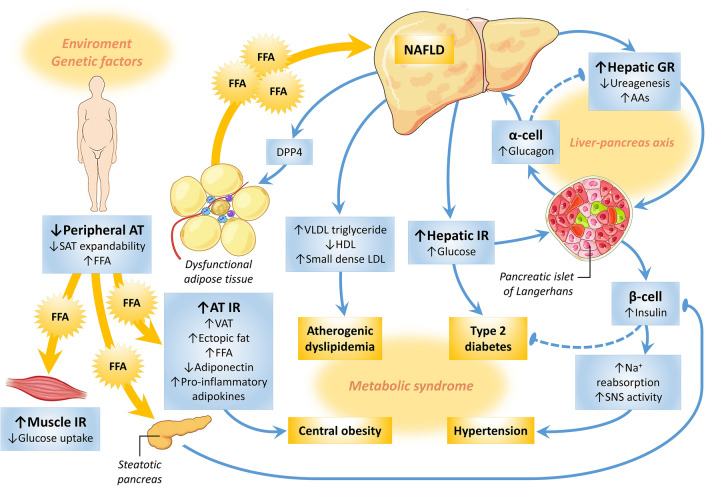
Background: The prevalence of non-alcoholic fatty liver disease (NAFLD) has been increasing rapidly. It is nowadays recognized as the most frequent liver disease, affecting a quarter of global population and regularly coexisting with metabolic disorders such as type 2 diabetes, hypertension, obesity, and cardiovascular disease. In a more simplistic view, NAFLD could be defined as an increase in liver fat content, in the absence of secondary cause of steatosis. In fact, the clinical onset of the disease is a much more complex process, closely related to insulin resistance, limited expandability and dysfunctionality of adipose tissue. A fatty liver is a main driver for a new recognized liver-pancreatic α-cell axis and increased glucagon, contributing to diabetes pathophysiology. Main text: This review will focus on the clinical and pathophysiological connections between NAFLD, insulin resistance and type 2 diabetes. We reviewed non-invasive methods and several scoring systems for estimative of steatosis and fibrosis, proposing a multistep process for NAFLD evaluation. We will also discuss treatment options with a more comprehensive view, focusing on the current available therapies for obesity and/or type 2 diabetes that impact each stage of NAFLD. Conclusion: The proper understanding of NAFLD spectrum—as a continuum from obesity to metabolic syndrome and diabetes—may contribute to the early identification and for establishment of targeted treatment.
Overview
The claims and statistics of this paper haven’t been checked yet.
Free: it reads the open-access text and checks the first 5 claims that cite a source we can check. Create a free account to check every claim.
Integrity signals
Registry
Cites
Statistics
Figures
Verification
Claims the paper makes
The claims and statistics of this paper haven’t been checked yet.
Free: it reads the open-access text and checks the first 5 claims that cite a source we can check. Create a free account to check every claim.
Self-check
Percentages, sums and reported differences re-computed from the paper’s own numbers.
The self-check needs the paper’s full text.
Citations
Cites
International Diabetes Federation 2017
Carracher, A. M., Marathe, P. H., & Close, K. L. (2018) · Journal of Diabetes · doi:10.1111/1753-0407.12644 · Cited by 13,418
Grundy, S. M., Cleeman, J. I., Daniels, S. R., Donato, K. A., Eckel, R. H., Franklin, B. A., Gordon, D. J., Krauss, R. M., Savage, P. J., Smith, S. C., et al. (2005) · Circulation · doi:10.1161/circulationaha.105.169404 · Cited by 11,961
Design and validation of a histological scoring system for nonalcoholic fatty liver disease†
Kleiner, D. E., Brunt, E. M., Van Natta, M., Behling, C., Contos, M. J., Cummings, O. W., Ferrell, L. D., Liu, Y., Torbenson, M. S., Unalp‐Arida, A., et al. (2005) · Hepatology · doi:10.1002/hep.20701 · Cited by 10,791 · cited 2×
“Despite the limitations of liver biopsy, we highlight it is the gold-standard method for NASH and fibrosis evaluation, and may be considered in selected cases, such as suspicion of other liver disease [56, 57].”
MethodYounossi, Z. M., Koenig, A. B., Abdelatif, D., Fazel, Y., Henry, L., & Wymer, M. (2016) · Hepatology · doi:10.1002/hep.28431 · Cited by 10,781 · cited 4×
“Epidemiology Although epidemiological data involving more than 8 million people estimated a global prevalence of NAFLD around 25% [2], it certainly varies greatly depending on how it is diagnosed and on the region of the world considered.”
BackgroundInfluentialThe metabolic syndrome—a new worldwide definition
Alberti, K. G. M., Zimmet, P., & Shaw, J. (2005) · The Lancet · doi:10.1016/s0140-6736(05)67402-8 · Cited by 9,352
The metabolic phenotype in obesity: Fat mass, body fat distribution, and adipose tissue function
Goossens, G. H. (2017) · Obesity Facts · doi:10.1159/000471488 · Cited by 8,481
Chalasani, N., Younossi, Z., Lavine, J. E., Charlton, M., Cusi, K., Rinella, M., Harrison, S. A., Brunt, E. M., & Sanyal, A. J. (2018) · Hepatology · doi:10.1002/hep.29367 · Cited by 7,239 · cited 12×
“Patients with obesity and/or MetS, with or without T2D, might be targeted promptly for ruling out NAFL/ NASH and fibrosis [3, 5, 6].”
BackgroundInfluentialEckel, R. H., Alberti, K., Grundy, S. M., & Zimmet, P. Z. (2010) · The Lancet · doi:10.1016/s0140-6736(09)61794-3 · Cited by 6,295
Eckel, R. H., Grundy, S. M., & Zimmet, P. Z. (2005) · The Lancet · doi:10.1016/s0140-6736(05)66378-7 · Cited by 5,550
Global burden of NAFLD and NASH: trends, predictions, risk factors and prevention
Younossi, Z., Anstee, Q. M., Marietti, M., Hardy, T., Henry, L., Eslam, M., George, J., & Bugianesi, E. (2018) · Nature Reviews Gastroenterology & Hepatology · doi:10.1038/nrgastro.2017.109 · Cited by 5,249 · cited 2×
“Genetic predisposition Genome-wide association (GWA) studies found several genetic variants associated with NAFLD, which implies in variability on individual susceptibility to the disease [39].”
Background
Research works printed but not linked: 1
- Stein DT Szczepaniak L Garg A Malloy C McGarry JD Intramuscular lipid is increased in subjects with congenital generalized lipodystrophy (Abstract) Diabetes 1997 46 Suppl. 1 242A
Cited by
Items 401–500 of 674
Boskabadi, A. R., Khodabandelu, S., Rahimi, Y., Motamedi, A., Asili, P., Ghasempour, A., Keshavarzian, A., Noori, S., & Rahmanian, M. (2025) · Current Clinical Pharmacology · doi:10.2174/0127724328371387250606060831 · Cited by 3
Shah, A., Mohammadi, A., Haq, A., Walji, D., & Zevin, B. (2025) · Obesity Surgery · doi:10.1007/s11695-025-08246-0 · Cited by 5
“[17, 18] MBS has been shown to decrease fibrosis in MASH in approximately 80% of patients, correlating to increased long-term survival.”
Li, X., Liu, S., Zhao, Q., An, M., Hou, C., Hu, S., & Niu, Y. (2025) · HORMONES · doi:10.1007/s42000-025-00721-8 · Cited by 3
Alshamari, M. E., Al‐Harbi, L. N., Alshammari, G. M., Alhussain, M. H., Saleh, A. Y., & Yahya, M. A. (2025) · Scientific Reports · doi:10.1038/s41598-025-19208-y · Cited by 4
“Consequently, lipid accumulation occurs in the liver and muscles, accompanied by increased adipose tissue lipolysis because of IR 4,5 .”
Posicionamento sobre a Saúde Cardiometabólica ao Longo do Ciclo de Vida da Mulher – 2025
de Oliveira, G. M. M., de Almeida, M. C. C., Valério, C. M., Giuffrida, F. M. A., Espíndola, L. N., Izar, M. C. D. O., Marques-Santos, C., Freire, C. M. V., Albuquerque, C. J. D. M., Chagas, A. C. P., et al. (2025) · Arquivos Brasileiros de Cardiologia · doi:10.36660/abc.20250615 · Cited by 5
Magriplis, E., Kotopoulou, S., Kouvari, M., Myrintzou, N., Smiliotopoulos, T., Tsitsou, S., Papakonstandinou, E., Panagopoulou, M.-V., Panagiotakos, D. B., & Zampelas, A. (2026) · Nutrition Research · doi:10.1016/j.nutres.2026.03.006 · Cited by 3
Clínica de Obesidad y envejecimiento, B., & Cubillos-Valencia, G. (2024) · Gaceta Médica de Caracas · doi:10.47307/gmc.2024.132.1.20 · Cited by 3
Galigniana, N. M., Abdelhalim, M., Collas, P., & Sæther, T. (2024) · Nutrients · doi:10.3390/nu16244310 · Cited by 3
Piana, K., Ziomber-Lisiak, A., Ruszczycki, B., Bugajski, A. J., & Szczerbowska‐Boruchowska, M. (2025) · Archives of Biochemistry and Biophysics · doi:10.1016/j.abb.2025.110325 · Cited by 3
Qu, Y.-F., Wang, K., Li, Y., Cheng, Y., Hu, S., & Zhong, M. (2025) · Diabetes Metabolic Syndrome and Obesity · doi:10.2147/dmso.s523771 · Cited by 3
“4,9,10 11–15 Laparoscopic sleeve gastrectomy (LSG) is among the most commonly performed bariatric procedures globally owing to its simplicity, safety, and efficacy.”
Beneficial Effects of Ketogenic Diet on Nonalcoholic Steatohepatitis in Obese Mice Model
Charlot, A., Charles, A., Georg, I., Goupilleau, F., Debrut, L., Pizzimenti, M., Mallard, J., Pagano, A. F., Gény, B., & Zoll, J. (2022) · International Electronic Conference on Nutrients (IECN) · doi:10.3390/iecn2022-12368 · Cited by 3
“Obesity is associated with a high risk of metabolic comorbidities, particularly the development of nonalcoholic fatty liver disease (NAFLD) [3].”
BackgroundChularojmontri, L., Nanna, U., Tingpej, P., Hansakul, P., Jansom, C., Wattanapitayakul, S. K., & Naowaboot, J. (2022) · Preventive Nutrition and Food Science · doi:10.3746/pnf.2022.27.4.399 · Cited by 3
“AMPK and Sirt1 dysfunction may contribute to the development of T2DM and NAFLD by altering lipid homeostasis, inflammation, and insulin resistance and cause mitochondrial dysfunction (Ruderman et al., 2010).”
BackgroundInfluentialNon-Alcoholic Fatty Liver Disease and Metabolic Syndrome: Diagnostic and Laboratory Approach
Mayasari, V. I., & Puspitasari, Y. (2023) · INDONESIAN JOURNAL OF CLINICAL PATHOLOGY AND MEDICAL LABORATORY · doi:10.24293/ijcpml.v29i1.2029 · Cited by 3
Barazesh, M., Jalili, S., Akhzari, M., Faraji, F., & Khorramdin, E. (2023) · Current Drug Therapy · doi:10.2174/1574885518666230417111247 · Cited by 3
Hepatotropc effects of glucose-lowering drugs: non-alcoholic fatty liver disease in focus
Uzhakova, E. V., Zshanko, Z. E., & Smirnova, E. N. (2023) · Экспериментальная и клиническая гастроэнтерология · doi:10.31146/1682-8658-ecg-214-6-121-129 · Cited by 3
Хара, М. Р., Korda, I. V., & Podilska, T. I. (2023) · Pathologia · doi:10.14739/2310-1237.2023.2.282626 · Cited by 3
“The prevalence of NAFLD is increasing in parallel with the increase in the prevalence of obesity, metabolic syndrome, and type 2 diabetes [34].”
BackgroundBarreto, B. C., Asuzu, P., Ebenibo, S., & Dagogo-Jack, S. E. (2024) · Journal of the Endocrine Society · doi:10.1210/jendso/bvae020 · Cited by 4
“High-risk groups for MASLD include people with cardiometabolic disorders, such as obesity, insulin resistance, type 2 diabetes mellitus (T2DM), hypertension, and dyslipidemia [4-9].”
BackgroundChoi, J. W., Lee, C., Kang, B.-K., & Kim, M. (2024) · Scientific Reports · doi:10.1038/s41598-024-77512-5 · Cited by 5
Predicting Nonalcoholic Fatty Liver Disease in Obese Populations with 3D Body Scans
Zheng, Y., Long, Z., Cheng, R., Feng, B., Vaziri, K., Zhang, X., & Hahn, J. K. (2024) · Annual International Conference of the IEEE Engineering in Medicine and Biology Society (EMBC) · doi:10.1109/embc53108.2024.10781798 · Cited by 3
“NAFLD frequently occurs in parallel with obesity, type 2 diabetes, and cardiovascular disease [3], making it a significant public health concern with implications for liver-related morbidity and mortality [4].”
Ye, B. S. (2022) · Clinical and Molecular Hepatology · doi:10.3350/cmh.2022.0097 · Cited by 3
“Although it is well proven that FLI accurately reflects the severity of NAFLD in a general population level,7 the relationship between FLI and NAFLD has not been clearly elucidated in patients with dementia or at-risk population such as mild cognitive impairment (MCI) showing 10-15% annual rate of progression to AD de…”
InfluentialAnsari, N. N., & Kassi, E. N. (2023) · Metabolism Open · doi:10.1016/j.metop.2023.100229 · Cited by 3
“become the most common cause of chronic liver diseases worldwide [3].”
BackgroundDick, S., Wheeler, K., & Keating, S. E. (2024) · Australian and New Zealand Journal of Public Health · doi:10.1016/j.anzjph.2024.100138 · Cited by 2
Hadaegh, P., Abdi, A., Hasheminia, M., Hadaegh, F., Azizi, F., & Tohidi, M. (2025) · Journal of Clinical Laboratory Analysis · doi:10.1002/jcla.70075 · Cited by 2
Loeven, A. M., Brown, A. N., Ebuara, F. U., Jones, K. M., & Fadool, D. A. (2025) · Physiology & Behavior · doi:10.1016/j.physbeh.2025.115062 · Cited by 3
AISI and MASLD: a nonlinear association in U.S. adults (NHANES 2017-2020)
Xiao, X., Li, G., Ma, Y., & Chen, Y. (2025) · BMC Gastroenterology · doi:10.1186/s12876-025-04210-5 · Cited by 2
“While multiple biological pathways contribute to MASLD pathogenesis, systemic inflammation has emerged as a pivotal mechanism linking metabolic dysfunction to liver injury [3, 7, 14].”
Kanagaddi, R., Nannapaneni, S. S., Katari, N. K., Salakolusu, S., & Murty, J. N. S. R. C. (2025) · Microchemical Journal · doi:10.1016/j.microc.2025.115264 · Cited by 2
Archana, P., Kumar, T. D. A., Ganesh, N. V., Mohammed, M., Tavanoji, H. P., Deepikarani, R., & Kumar, B. R. P. (2025) · Bioorganic & Medicinal Chemistry · doi:10.1016/j.bmc.2025.118393 · Cited by 2
Metabolic dysfunction-associated steatotic liver disease in metabolic syndrome
Drapkina, O. M., & Nedogoda, S. V. (2025) · Russian Journal of Cardiology · doi:10.15829/1560-4071-2025-6541 · Cited by 4
Scilletta, S., Welsh, P. I., Pino, A. D., & Sattar, N. A. (2025) · Diabetes Obesity and Metabolism · doi:10.1111/dom.70248 · Cited by 2
“29 The relationship between ectopic fat, prediabetes and type 2 diabetes has previously been studied, 30 though it is in a limited fashion.”
Position Statement on Cardiometabolic Health Across the Woman's Life Course – 2025
de Oliveira, G. M. M., de Almeida, M. C. C., Valério, C. M., Giuffrida, F. M. A., Espíndola, L. N., Izar, M. C. D. O., Marques-Santos, C., Freire, C. M. V., Albuquerque, C. J. D. M., Chagas, A. C. P., et al. (2025) · Revista Brasileira Ginecologia e Obstetrícia · doi:10.61622/rbgo/2025rbgo200 · Cited by 2
Park, H.-Y., & Kim, K. (2025) · Experimental Gerontology · doi:10.1016/j.exger.2025.113017 · Cited by 3
MALINDISA, E. K., Kafumu, I., Rweyendera, A., Mkemangwa, E., Majinge, D. C., Nkandala, I., Manyiri, P. M., & Kilonzo, S. B. (2026) · BMC Endocrine Disorders · doi:10.1186/s12902-026-02179-0 · Cited by 2
“Although we did not collect detailed data on comorbidities, metabolic dysfunction, including obesity, insulin resistance, hypertension, and dyslipidemia, is known to drive both the development and severity of hepatic steatosis [29–31].”
YAP/TAZ signaling in dendritic cells is dispensable for insulin resistance and NAFLD pathogenesis
Lee, M., Schcolnik‐Cabrera, A., Dzierlega, K., Basso, P. J., Strachan, E. R., Zhu, M., Akbari, M., Clemente‐Casares, X., & Tsai, S. J. (2026) · Heliyon · doi:10.1016/j.heliyon.2026.e44680 · Cited by 2
Tapper, E. B., Ryan, T., Lewandowski, D., Winer-Jones, J. P., Bonafede, M., & Kim, Y. (2026) · BMC Gastroenterology · doi:10.1186/s12876-026-04787-5 · Cited by 3
“As the liver manifestation of insulin resistance [7, 8], MASH is commonly comorbid with other metabolic conditions.”
莫启贵, Ghafourian, A., Hamdi, M., Alidadipour, A., Soleimani, M., Davoudi, M., Miao, X., Afrisham, R., & Bagherieh, M. (2026) · Food Science & Nutrition · doi:10.1002/fsn3.71901 · Cited by 2
“…mechanisms of interaction between these two conditions, including the “liver-pancreas axis,” which implicates insulin resistance, and the “multi-hit hypothesis,” which suggests the role of obesity-induced inflammation in the development of non-alcoholic fatty liver (Godoy-Matos et al. 2020).”
Sil, P., Tiwari, R., Garisetti, V., Baskaran, S. P., Dhanaseelan, F. H., Srivastava, S., & Samal, A. (2026) · Computational Biology and Chemistry · doi:10.1016/j.compbiolchem.2026.109194 · Cited by 4
Yang, W., Huang, J., Tang, Z., Chen, C. Y., & Sun, Y. (2026) · Nutrients · doi:10.3390/nu18142251 · Cited by 2
Sánchez-Quevedo, J., Ocampo-Rodríguez, E., Alvarez‐Ayala, E., Rodríguez‐López, A., Duarte‐Vázquez, M. A., Rosado, J. L., & Rodríguez‐Fragoso, L. (2022) · BMC Pharmacology and Toxicology · doi:10.1186/s40360-022-00613-2 · Cited by 2
Hua, X., Zhang, H., Yang, W.-R., Liu, G., Zhang, S., & Wang, Y. (2023) · Frontiers in Endocrinology · doi:10.3389/fendo.2023.1176019 · Cited by 2
Understanding human diet, disease, and insulin resistance: scientific and evolutionary perspectives
Noakes, T. D., Crofts, C. A. P., & Ben‐Dor, M. (2023) · Elsevier eBooks · doi:10.1016/b978-0-12-821617-0.00011-5 · Cited by 2
Serum interleukin-4 is elevated in clinical drug-induced liver injury
Liu, M. N., Au, M., Bishara, M., Worland, T., Con, D., Chew, S., McNiece, A., Grønbæk, H., Sluka, P., & Nicoll, A. (2023) · Scandinavian Journal of Gastroenterology · doi:10.1080/00365521.2023.2237154 · Cited by 2
“24,25 Alcohol, a putative risk factor for VA-DILI due to CYP2E1 induction, also showed a trend towards higher average consumption in VA-DILI cases.”
BackgroundSohrabi, M., Aghapour, S., Khoonsari, M., Ajdarkosh, H., Nobakht, H., Zamani, F., & Nikkhah, M. (2023) · Middle East Journal of Digestive Diseases · doi:10.34172/mejdd.2023.340 · Cited by 2
“3,4 Therefore, the low cost, simplicity of use, non-invasive nature , and wide acceptance by patients make liver markers a suitable method for diagnosing and predicting MetS.”
MethodMathew, C., Patel, A. K., Cholankeril, G. T., Flores, A. G., & Hernáez, R. (2023) · Saudi Journal of Gastroenterology · doi:10.4103/sjg.sjg_263_23 · Cited by 2
“…type, study design, duration, aim, measured outcomes, total patients, cirrhosis etiologies, cardiac comorbidities, mean patient age, concomitant operations, noninvasive risk factor(s) used, risk factor subgroups, mortality or morbidity outcome, and results with statistical significance [ Table 1].”
BackgroundInfluentialDawson, M. A., Hennigar, S. R., Shankaran, M., Kelley, A. M., Anderson, B. J., Nyangau, E., Field, T., Evans, W. J., Hellerstein, M. K., McClung, J. P., et al. (2023) · Physiological Reports · doi:10.14814/phy2.15885 · Cited by 2
“AT dysfunction, in combination with insulin resistance and elevated rates of hepatic DNL and cholesterol synthesis, can contribute to the development of NAFLD (Godoy-Matos et al., 2020; Sanders & Griffin, 2016).”
BackgroundInfluentialBesqueut‐Rougerie, C., Chavanelle, V., Michaux, A., Otero, Y. F., Sirvent, P., King, J. A., & Ennequin, G. (2024) · Physiological Reports · doi:10.14814/phy2.15993 · Cited by 3
“This questions the relevance of this model for mimicking human MASLD, intricately related to the development of obesity and metabolic syndrome (Godoy-Matos et al., 2020).”
BackgroundYang, L.-C., Wang, C., Lee, D., Lin, W., Kuo, S., Juang, S., & Hsieh, M. (2024) · Chemical Biology & Drug Design · doi:10.1111/cbdd.14532 · Cited by 2
“NAFLD often coexists with other conditions, such as diabetes mellitus, hyperinsulinemia, dyslipidemia, and obesity (Deprince et al., 2020; Godoy-Matos et al., 2020).”
BackgroundManagement of hepatorenal syndrome and treatment-related adverse events
Peluso, L., Savi, M., Coppalini, G., Veliaj, D., Villari, N., Albano, G., Petrou, S., Pace, M., & Fiore, M. (2024) · Current Medical Research and Opinion · doi:10.1080/03007995.2024.2358242 · Cited by 1
Increased Level of The Plasminogen Activator Inhibitor Type-1 is Associated with Severity of NAFLD
Indiarso, D., Prasetyo, A. A., Hirlan, H., & Purnomo, H. D. (2023) · Journal of Biomedicine and Translational Research · doi:10.14710/jbtr.v9i2.16293 · Cited by 2
“17 Tilman Kühn examined anthropometric parameters in NAFLD patients with obesity.”
BackgroundIqbal, S., Islam, M. Z., Ashraf, S., Kim, W., AL-Sharabi, A. A., Özcan, M., HANASHALSHAHABY, E. H. A., Zhang, C., Uhlén, M., Borén, J., et al. (2024) · International Journal of Molecular Sciences · doi:10.3390/ijms25147986 · Cited by 2
Alshuweishi, Y., Alfayez, D. I., Almufarrih, A. A., Abudawood, A., Alyami, H. M., Alshuweishi, F. A., Al‐Sheikh, Y. A., & Alfhili, M. A. (2024) · Journal of Clinical Medicine · doi:10.3390/jcm13185650 · Cited by 3
Krönert, N., Moulla, Y., Lange, U. G., Blüher, M., Linder, N., Fuhrmann, A., Busse, H., Linder, A., Karlas, T., Wiegand, J., et al. (2025) · Langenbeck s Archives of Surgery · doi:10.1007/s00423-024-03600-9 · Cited by 2
“Obesity and insulin resistance are main risk factors for metabolic dysfunction-associated steatotic liver disease (MASLD) [1–3].”
Proença, C., Lobo, M. G., Rufino, A. T., de Oliveira, J. M. P. F., Freitas, M., Trepiana, J., Portillo, M. P., Carvalho, F. D., & Fernandes, E. G. R. (2025) · Phytochemistry Reviews · doi:10.1007/s11101-025-10075-z · Cited by 2
“…and despite the high rate of patients with T2D and other diabetes phenotypes that have altered liver metabolism and consequently develop steatosis, fibrosis, and cirrhosis, FLD is still not considered in the daily care routine (Tilg et al. 2017; Godoy-Matos et al. 2020; Rojano-Toimil et al. 2022).”
Gómez-Mendoza, R., Sánchez-Hernández, F., Valentin-Cortez, F. J., & Chávez-Tapia, N. C. (2025) · Metabolism and Target Organ Damage · doi:10.20517/mtod.2024.108 · Cited by 3
Ding, C., & Weng, S. (2025) · Food Science & Nutrition · doi:10.1002/fsn3.70213 · Cited by 2
Feng, Q., Izzi‐Engbeaya, C. N., Manousou, P., & Woodward, M. (2025) · Diabetes Obesity and Metabolism · doi:10.1111/dom.16562 · Cited by 2
Ghalichi, F., Molani‐Gol, R., Ehsani, N., & Khajebishak, Y. (2025) · Food Science & Nutrition · doi:10.1002/fsn3.70404 · Cited by 2
Volniansky, A., Lefebvre, T. L., Kulbay, M., Gilbert, G., Fan, B., Racette, J., Montagnon, E., Olivié, D., Sebastiani, G., Giard, J., et al. (2025) · Journal of Magnetic Resonance Imaging · doi:10.1002/jmri.70192 · Cited by 4
Borsukov, A. V., Venidiktova, D. Y., & Borsukov, S. A. (2022) · International journal of Innovative Medicine · doi:10.33667/2782-4101-2022-2-12-16 · Cited by 2
Fadieienko, G. D., Kushnir, I. Е., Chernova, V. M., Solomentseva, Т. А., Nikiforova, Y. V., & Kurinna, O. G. (2022) · Modern Gastroenterology · doi:10.30978/mg-2022-5-5 · Cited by 2
“Obesity, diabetes, elevated glucose, hyperlipidemia, and insulin resistance are proven risk factors for NAFLD [10].”
BackgroundLee, D. U., Ponder, R. D., Sandlow, S., Yoo, A., Lee, K. J., Chou, H., Fan, G. H., & Urrunaga, N. H. (2023) · Digestive and Liver Disease · doi:10.1016/j.dld.2023.03.018 · Cited by 2
Paniz, G. R., Arroyo-Mercado, F. M. M., Ling, C. L., Choi, E. E., Snow, H. E., Rakov, N. E., & Castillo, E. F. (2021) · medRxiv · doi:10.1101/2021.05.27.21257690 · Cited by 2
Evaluation of fibrosis in patients with nonalcoholic fatty liver disease
Montaño‐Loza, A. J. (2021) · Revista de Gastroenterología de México (English Edition) · doi:10.1016/j.rgmxen.2021.10.004 · Cited by 2
The Effect of Probiotic Supplementation as Alternative Therapy for NAFLD: A Literature Review
Adnan, M. L. (2021) · European Journal of Translational and Clinical Medicine · doi:10.31373/ejtcm/136328 · Cited by 2
“NAFLD is associated with metabolic disorders resulting from worsening metabolic syndrome, e.g. obesity and insulin resistance [14].”
BackgroundDiagnostic Value of Acyl-Ghrelin in Type 2 Diabetic Patients with Non-alcoholic Fatty Liver Disease
Elabd, E. M. Y., El-Beik, D. E.-D. M. S., Bayoumy, E., SALEH, M. D. S. M. M. S. A., Ezzat, W. M., Siddik, R. I., Mohamed, A. E., Sayed, M. M., & Ali, M. O. (2021) · Open Access Macedonian Journal of Medical Sciences · doi:10.3889/oamjms.2021.7548 · Cited by 1
“NAFLD is found to be correlated with a cluster of metabolic disturbances such as, insulin resistance (IR), visceral and subcutaneous fat accumulation, atherogenic dyslipidemia, and type 2 diabetes [1], [2], [3].”
BackgroundAlhujaily, M. M. (2023) · Separations · doi:10.3390/separations10020094 · Cited by 1
Chereliuk, N. I., & Gridnyev, O. (2023) · Modern Gastroenterology · doi:10.30978/mg-2023-1-24 · Cited by 1
Nonalcoholic Fatty Liver Disease and Psoriasis
Huiban, L., Trifan, A. V., & Stanciu, C. (2023) · Springer eBooks · doi:10.1007/978-3-031-33548-8_20 · Cited by 1
Ramzan, F., Sequeira, I. R., Lu, L. W., Mitchell, C. J., D’Souza, R. F., Vickers, M. H., Poppitt, S. D., & Cameron‐Smith, D. (2023) · International Journal of Molecular Sciences · doi:10.3390/ijms241814393 · Cited by 1
“Collectively, the actions of pancreatic steatosis and non-alcoholic fatty liver disease (NAFLD) are major determinants of cardiometabolic disease (CMD) [2].”
Yeyeodu, S. T., Hanafi, D., Webb, K., Laurie, N. A., & Kimbro, K. S. (2024) · Frontiers in Endocrinology · doi:10.3389/fendo.2023.1286979 · Cited by 1
“Clinical de fi nitions of MetS vary depending on which disease(s) are of primary interest (reviewed in 75 – 77 ).”
BackgroundShetty, P., Jayaswamy, P. K., Patil, P., Vijaykrishnaraj, M., Vishwanatha, J. K., & Shetty, S. (2024) · Elsevier eBooks · doi:10.1016/b978-0-323-95469-3.00029-2 · Cited by 1
Shah, A. A., Bakerywala, A., Brahmbhatt, R., Shaikh, H., Bhutak, N. S., & Singh, R. (2025) · Journal of Pharmacy And Bioallied Sciences · doi:10.4103/jpbs.jpbs_2016_24 · Cited by 1
“[5,6] The relationship between type 2 diabetes, insulin resistance, and NAFLD is crucial, as the liver involved in both insulin and glucose metabolism.”
Trends and insights in non-alcoholic fatty liver disease (NAFLD) and cognition research
Rehman, A. R., Kadir, A. A., Zakaria, R., & Hussain, N. H. B. N. (2025) · Journal of University Medical & Dental College · doi:10.37723/jumdc.v16i1.989 · Cited by 1
Öztürk, H. A., & Sümbül, H. E. (2025) · PeerJ · doi:10.7717/peerj.19377 · Cited by 1
Wang, J., Gong, M., Tu, G., Luo, B., Wang, Q., Ding, H., Liang, X., & Chen, J. (2025) · Journal of Nanoparticle Research · doi:10.1007/s11051-025-06323-0 · Cited by 1
Singhai, A., Joshi, R. P., & Khadanga, S. (2025) · Future Health · doi:10.25259/fh_27_2025 · Cited by 1
Ghanem, A. S., Tóth, Á., Takács, P., Ulambayar, B., Móré, M., & Nagy, A. C. (2025) · International Journal of Molecular Sciences · doi:10.3390/ijms26115057 · Cited by 1
Huang, Y.-C., Chiau, J. C., Cheng, M.-L., Lee, H., Chan, W., Chang, S., Chen, Y., Yeung, C., & Jiang, C. (2025) · Pediatrics & Neonatology · doi:10.1016/j.pedneo.2025.01.016 · Cited by 1
Targeting mitochondrial biogenesis: Chandraprabha Vati in the management of metabolic syndrome
Dongre, P., & Majumdar, A. S. (2025) · Phytomedicine Plus · doi:10.1016/j.phyplu.2025.100841 · Cited by 2
Susanto, H., Melani, I. C., Negara, D. R. A. B., Nurfadila, W. A., Azizah, K. R., Zahira, H., & Malek, N. A. N. N. (2025) · BIO Web of Conferences · doi:10.1051/bioconf/202518301008 · Cited by 1
Masroor, M., Haque, Z., Anwar, H., Hanif, F., & Farooqui, W. A. (2025) · Human Gene · doi:10.1016/j.humgen.2025.201453 · Cited by 1
Lefebvre, T. L., Volniansky, A., Petitclerc, L., Montagnon, E., Sebastiani, G., Giard, J., Sylvestre, M., Nguyen, B., Gilbert, G., Cloutier, G., et al. (2025) · British Journal of Radiology · doi:10.1093/bjr/tqaf256 · Cited by 1
Masaeli, A., Goodarzi, M. T., Mohammadalipour, A., Ali‐Asgari, S., Mirzaei, M. R., & Hani, M. (2025) · Scientific Reports · doi:10.1038/s41598-025-19877-9 · Cited by 1
Kim, Y., Zeng, N., Winer-Jones, J. P., Bonafede, M., Lobo, F., O'Donnell, J., & Ryan, T. (2025) · ClinicoEconomics and Outcomes Research · doi:10.2147/ceor.s546841 · Cited by 2
Itsubo, M., Kobayashi, Y., Yamamoto, M., Takayanagi, S., & Akiyama, I. (2025) · Biology · doi:10.3390/biology14111585 · Cited by 1
Bajestani, G. S., Makhloughi, F., Basham, A., Evazi, E., Pour, M. R., Alizadehsani, R., & Razmpour, F. (2025) · Physical and Engineering Sciences in Medicine · doi:10.1007/s13246-025-01659-2
Tinkov, A. A., Korobeinikova, T. V., Zhou, J., Shi, Z., Notova, S. V., Pobilat, A. E., Lu, R., Fang, L., Kirichuk, A. A., & Skalny, A. V. (2025) · Biological Trace Element Research · doi:10.1007/s12011-025-04859-9 · Cited by 1
Cao, Q., Tian, Q., Liu, Y., Cheng, Y., Luo, T., & Zhu, X. (2025) · Diabetes Metabolic Syndrome and Obesity · doi:10.2147/dmso.s568870 · Cited by 3
“…energy metabolism and glucose-lipid homeostasis, unhealthy lifestyle factors—including high-oil and high-fat dietary patterns and insufficient physical activity—can induce conditions such as obesity, 5 T2DM, 6 and metabolic syndrome (MetS), 7 all of which are major risk factors for MASLD.”
Position Statement on Cardiometabolic Health Across the Woman's Life Course – 2025
de Oliveira, G. M. M., de Almeida, M. C. C., Valério, C. M., Giuffrida, F. M. A., Espíndola, L. N., Izar, M. C. D. O., Marques-Santos, C., Freire, C. M. V., Albuquerque, C. J. D. M., Chagas, A. C. P., et al. (2025) · Arquivos Brasileiros de Cardiologia · doi:10.36660/abc.20250615i · Cited by 2
Metabolic phenotypes of frailty and the course of type 2 diabetes mellitus
Александровна, Б. Л., Bulgakova, S. V., Kurmaev, D. P., Treneva, E. V., Косарева, О. В., Merzlova, P. Y., Sharonova, L. A., Dolgikh, Y. A., Pervyshin, N. A., Сергеевич, Б. А., et al. (2025) · Экспериментальная и клиническая гастроэнтерология · doi:10.31146/1682-8658-ecg-235-3-236-244 · Cited by 1
Batacan, R. B., Rao, A., Bajagai, Y. S., Stanley, D., & Briskey, D. R. (2026) · Gut Microbes Reports · doi:10.1080/29933935.2026.2622259 · Cited by 1
“…represents one of the most pressing public health challenges of the 21 st century, affecting nearly 880 million adults worldwide 1 and driving an escalating burden of metabolic comorbidities, including insulin resistance, 2 nonalcoholic fatty liver disease (NAFLD), 3 and cardiovascular disease.”
Theodorou, R.-E., Vrettos, N., & Theodosis‐Nobelos, P. (2026) · Current Issues in Molecular Biology · doi:10.3390/cimb48050465 · Cited by 2
“…disease (NAFLD) appears to be the most common chronic disease of the liver, with its pathology ranging from simple steatosis and lipid accumulation ( ≥ 5%), up to non-alcoholic steatohepatitis (NASH) with fibrosis and cirrhosis, and at more advanced stages, to hepatocellular carcinoma (HCC) [1,2].”
Uti, D. E., Egbung, J. E., Alum, E. U., Bawa, I., Agada, S. A., Ogbu, C. O., & Ugwu, O. P.-C. (2026) · Obesity Medicine · doi:10.1016/j.obmed.2026.100712 · Cited by 3
Apurva, Chaudhary, P., & Bahuguna, S. (2026) · Current Cancer Therapy Reviews · doi:10.2174/0115733947414188251210123952 · Cited by 1
Котлярова, А. А., & Kotlyarov, S. N. (2026) · International Journal of Molecular Sciences · doi:10.3390/ijms27104453 · Cited by 1
Mustika, S., Utami, S., Saputri, N. E. W., Poetri, L. N., Awatara, P. I. D., Rudijanto, A., Purnomo, H. D., Lesmana, C. R. A., & Taufiq, A. (2026) · Biomedicines · doi:10.3390/biomedicines14051147 · Cited by 1
“Simple steatosis is characterized by hepatic fat accumulation with minimal inflammation, whereas MASH involves hepatocyte ballooning, lobular inflammation, apoptosis, and varying degrees of fibrosis [5].”
Lan, D., Sun, G., Dong, Z., Li, K., Li, S., He, X., Zou, R., Yang, W., Wang, J., & Wu, B. (2026) · Biological Procedures Online · doi:10.1186/s12575-026-00340-6 · Cited by 1
Zuo, H., Chen, J., Jiao, Y., Ma, X., Li, X., Xiao, Y., He, J., Jia, Z., & Shi, A. (2026) · Frontiers in Physiology · doi:10.3389/fphys.2026.1803228 · Cited by 1
TCM‐Guided Targeted Therapies Against NLRP3 Inflammasome in NAFLD
Zhang, Y. (2026) · Immunity Inflammation and Disease · doi:10.1002/iid3.70474 · Cited by 1
Figueroa-Guzmán, C., Campos-Morales, M. E., Alcantar, L. M., Hernández-Padilla, L., Sánchez‐Duarte, E., Sánchez‐Briones, L. A., López‐Bucio, J. S., & Campos‐García, J. (2026) · Molecules · doi:10.3390/molecules31142466 · Cited by 1
For Weight Loss: Why Do GLP-1 Agonists Work, and How Can We Make Them Work Better?
Giang, C., Meng, J., Mohammad, M. A., Liu, Z., Wu, X., & Zhu, Y. (2026) · Biology · doi:10.3390/biology15161395 · Cited by 1
Metadata
- Authors
- Godoy-Matos, A. F., Silva Júnior, W. S., & Valerio, C. M.
- Venue
- Diabetology & Metabolic Syndrome
- Published
- 2020-07-14
- Volume
- 12
- Issue
- 1
- Pages
- 60-60
- ISSN
- 1758-5996 (ISSN-L)
- PMC
- PMC7359287
- OpenAlex
- W3043179056
- Semantic Scholar
- a44e7a8165ddce09396d4fa212182af3fa0f97b0
- Cited by
- 643
- References
- 175
- Citations by year
- 2026: 56 · 2025: 111 · 2024: 148 · 2023: 142 · 2022: 109 · 2021: 72 · 2020: 4
- FWCI
- 11.95
- Type
- journal article
- Language
- en
- Open access
- gold
- doi.org
- Licence
- cc-by
- creativecommons.org/licenses/by/4.0 (tdm)
- creativecommons.org/licenses/by/4.0 (vor)
- Locations
- Diabetology & Metabolic Syndrome (publishedVersion, cc-by)
- PubMed Central (publishedVersion, cc-by)
- PubMed (publishedVersion)
- DOAJ (DOAJ: Directory of Open Access Journals) (submittedVersion, cc-by-sa)
- Topics
- Health Sciences › Medicine › Hepatology › Liver Disease Diagnosis and Treatment
- Health Sciences › Medicine › Endocrinology, Diabetes and Metabolism › Diabetes, Cardiovascular Risks, and Lipoproteins
- Health Sciences › Medicine › Endocrinology, Diabetes and Metabolism › Diet, Metabolism, and Disease
- Keywords
- non-alcoholic fatty liver disease, obesity, metabolic syndrome, type 2 diabetes, insulin resistance, hepatic steatosis, liver fibrosis, adipose tissue dysfunction, glucagon, NAFLD treatment, disease continuum
About these checks
Registry, retraction, Cites and statistics results are computed, not judged, with one exception: a printed reference that no index lists is read once by a model before it counts as a citation error. Claims are extracted by a model and kept only when their quote appears verbatim in the text; each cited source is then checked, with a model’s help, for whether it says what the claim relies on. Those verdicts can be wrong — read the claim’s quote and the cited source before relying on one.
Statistics and arithmetic are recomputed, not judged.
Confidence bands are shown only for fields calibrated on our annotated test set. None is calibrated yet, so no band is shown.
What counts as a claim ›How we measure confidence ›How we check this ›
Are you an author, or do you see a problem with this page? Request a review
Data sources
Bibliographic data: Semantic Scholar, OpenAlex, Crossref.
Contains information from the Semantic Scholar Academic Graph Datasets, made available under the ODC Attribution License (ODC-BY 1.0).
Semantic Scholar’s data is described in: Kinney, R., et al. (2023). The Semantic Scholar Open Data Platform. arXiv:2301.10140.
