

Smartphone usage in the 21st century: who is active on WhatsApp?
Open accessThe DOI matches its Crossref record; 20 of the 20 references it cites were found in a registry or an index.
Abstract
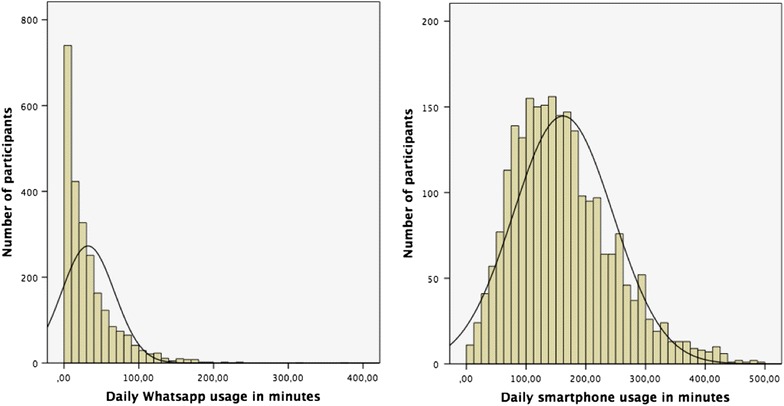
BACKGROUND: Mounting evidence shows that smartphone usage heavily disrupts our work life and social activities. Moreover, it is possible that overuse could resemble addictive tendencies. A key contributing factor to smartphone overuse seems to be usage of the messaging application WhatsApp. Although WhatsApp is one of the most commonly used communication applications on smartphones, research in this area is scarce. Given the huge societal debate on the impact of smartphone usage on our daily lives, the present study undertook a large-scale investigation in order to provide numbers on smartphone usage generally-and use of WhatsApp in particular, with the aim of providing a basis for a scientific debate. METHODS: In a large sample of N = 2,418 users, we recorded WhatsApp behaviour over a 4 week period. RESULTS: Our data show that use of WhatsApp accounted for 19.83% (= 32.11 min) of all smartphone behaviour (compare: Facebook only 9.38% = 15.19 min). The mean of general daily smartphone usage was 161.95 min. Females used WhatsApp for significantly longer periods of time than males and younger age was associated with longer duration of WhatsApp use. While the personality trait Extraversion was positively associated with daily WhatsApp use, Conscientiousness showed an inverse correlation with the length of daily WhatsApp use. CONCLUSIONS: The numbers on smartphone usage in the present study show that the smartphone dominates our daily life. In particular WhatsApp is a driving force, here. Given the length of daily smartphone and WhatsApp usage, more studies need to be conducted to better understand smartphone usage.
Overview
The claims and statistics of this paper haven’t been checked yet.
Free: it reads the open-access text and checks the first 5 claims that cite a source we can check. Create a free account to check every claim.
Integrity signals
Registry
Cites
Statistics
Figures
Verification
Claims the paper makes
The claims and statistics of this paper haven’t been checked yet.
Free: it reads the open-access text and checks the first 5 claims that cite a source we can check. Create a free account to check every claim.
Claims other papers make about this one
Each is checked against this paper’s own text: does it say what the citing paper says it does?
The cited source says what the claim attributes to it.
In the citing paper
“The personality traits were included to serve as covariates, because research has shown that they are related to social media use (Montag et al., 2015; Nowland et al., 2018; Kircaburun et al., 2020).”
From Centennials, FOMO, and loneliness: an investigation of the impact of social networking and messaging/voip apps usage during the initial stage of the coronavirus pandemic (2021) · cites this paper as Montag et al., 2015
In the citing paper
“A large-scale tracking of online behavior showed that the use of WhatApp over the smartphone accounted for nearly 20% of all smartphone behavior, above Facebook use [58].”
From Problematic Use of the Internet and Smartphones in University Students: 2006–2017 (2018) · cites this paper as [58]
Self-check
Percentages, sums and reported differences re-computed from the paper’s own numbers.
The self-check needs the paper’s full text.
Citations
Cites
Rammstedt, B., & John, O. P. (2007) · Journal of Research in Personality · doi:10.1016/j.jrp.2006.02.001 · Cited by 4,244 · cited 2×
“Moreover, the authors of the BFI suggest that “the BFI-10 possesses acceptable psychometric properties” (p. 210, [18]), although the shorter version is accompanied by “substantial losses in comparison to the full-scale BFI”.”
BackgroundMethodThe Smartphone addiction scale: development and validation of a short version for adolescents
Kwon, M., Kim, D.-J., Cho, H., & Yang, S. (2013) · PLoS ONE · doi:10.1371/journal.pone.0083558 · Cited by 2,177 · cited 1×
“It has been suggested that overuse of smartphones may resemble an addiction [2, 3] and overuse is also linked to time distortion, with the result that the smartphone is used for longer than originally intended or perceived [4].”
BackgroundWho interacts on the Web?: The intersection of users’ personality and social media use
Correa, T., Hinsley, A. W., & de Zúñiga, H. G. (2010) · Computers in Human Behavior · doi:10.1016/j.chb.2009.09.003 · Cited by 1,915 · cited 1×
“However, a recent study [21] suggested that high neurotics tend to use Facebook more as it facilitates communication without face-to-face interaction; a hypothesis that may warrant further investigation.”
BackgroundDevelopment and Validation of a Smartphone Addiction Scale (SAS)
Kwon, M., Lee, J.-Y., Won, W.-Y., Park, J.-W., Min, J.-A., Hahn, C., Gu, X., Choi, J.-H., & Kim, D.-J. (2013) · PLoS ONE · doi:10.1371/journal.pone.0056936 · Cited by 1,670 · cited 1×
“It has been suggested that overuse of smartphones may resemble an addiction [2, 3] and overuse is also linked to time distortion, with the result that the smartphone is used for longer than originally intended or perceived [4].”
BackgroundFacebook Use Predicts Declines in Subjective Well-Being in Young Adults
Kross, E., Verduyn, P., Demiralp, E., Park, J., Lee, D. S., Lin, N., Shablack, H., Jonides, J., & Ybarra, O. (2013) · PLoS ONE · doi:10.1371/journal.pone.0069841 · Cited by 1,596 · cited 1×
“In contrast to the small body of literature on WhatsApp, the past few years reflect a focus on social network usage, such as Facebook, when investigating smartphone behaviour or Internet usage (e.g. [11]).”
ResultRyan, T., & Xenos, S. (2011) · Computers in Human Behavior · doi:10.1016/j.chb.2011.02.004 · Cited by 1,260 · cited 1×
“Moreover, it is noteworthy that most previous studies have relied solely on self-report data to measure human–machine interaction [12, 13].”
ResultBeginning the workday yet already depleted? Consequences of late-night smartphone use and sleep
Lanaj, K., Johnson, R. E., & Barnes, C. M. (2014) · Organizational Behavior and Human Decision Processes · doi:10.1016/j.obhdp.2014.01.001 · Cited by 738 · cited 1×
“Moreover, smartphone overuse (in particular evening usage) seems to be associated with poor sleep quality [5] and reduced work engagement [6], which is not surprising, as new numbers show that about 36–40% of smartphone owners use their smartphone in the last 5 min before going to sleep and/ or in…”
BackgroundWhat's up with whatsapp?: comparing mobile instant messaging behaviors with traditional SMS
Church, K., & de Oliveira, R. (2013) · Proceedings of the 15th international conference on Human-computer interaction with mobile devices and services · doi:10.1145/2493190.2493225 · Cited by 565 · cited 1×
“Recent studies yielded the first evidence that What-sApp usage might have an addictive character [9] and of course WhatsApp represents an important communication alternative to classic short message services, which often incur costs (SMS; [10]).”
The influence of personality on Facebook usage, wall postings, and regret
Moore, K., & McElroy, J. C. (2012) · Computers in Human Behavior · doi:10.1016/j.chb.2011.09.009 · Cited by 542 · cited 1×
“Moreover, it is noteworthy that most previous studies have relied solely on self-report data to measure human–machine interaction [12, 13].”
ResultPersonality and self reported mobile phone use
Butt, S., & Phillips, J. G. (2008) · Computers in Human Behavior · doi:10.1016/j.chb.2007.01.019 · Cited by 517 · cited 1×
“In keeping with earlier smart-phone studies on Extraversion and call behaviour (e.g. [16, 20]), extraverts also use WhatsApp for longer durations compared with introverts.”
Background
Cited by
Items 201–300 of 405
A Practical Guide to WhatsApp Data in Social Science Research
Kohne, J., Elhai, J. D., & Montag, C. (2022) · Studies in neuroscience, psychology and behavioral economics · doi:10.1007/978-3-030-98546-2_11 · Cited by 12
Self-citationUse of telemedicine in the postoperative assessment of proctological patients: a case–control study
Gaj, F., Peracchini, M., Passannanti, D., Quaresima, S., Giovanardi, F., & Lai, Q. (2022) · Techniques in Coloproctology · doi:10.1007/s10151-022-02723-9 · Cited by 9
Cuando los instagrammers son los adultos
Torres-Toukoumidis, Á., & Santis-Piras, A. D. (2020) · doi:10.7476/9789978105719 · Cited by 9
Biometrics and Behavior Analysis for Detecting Distractions in e- Learning
Becerra, Á., Irigoyen, J., Daza, R., Cobos, R., Morales, A., Fiérrez, J., & Cukurova, M. (2024) · International Symposium on Computers in Education · doi:10.1109/siie63180.2024.10604582 · Cited by 15
“The mean of general phone usage is approximately 162 minutes of which 32 minutes are spent using WhatsApp [23].”
MethodWinbush, A., McDuff, D., Hernandez, J., Barakat, A., Jiang, A., Heneghan, C., Nelson, B. W., & Allen, N. B. (2025) · Proceedings of the National Academy of Sciences · doi:10.1073/pnas.2427311122 · Cited by 21
“These studies are of relatively small cohorts [N = 187 ( 12 ), N = 50 ( 14 )] or collect data only from specific apps [e.g., WhatsApp OPEN ACCESS data only; ( 13 )] making it difficult to draw conclusions about how the results generalize to the broader population or overall smartphone use.”
Assessment of Application-Driven Postoperative Care in the Pediatric Tonsillectomy Population
Ali, S. A., Kovatch, K. J., Hwang, C. D., Bohm, L. A., Zopf, D. A., & Thorne, M. C. (2019) · JAMA Otolaryngology–Head & Neck Surgery · doi:10.1001/jamaoto.2018.3647 · Cited by 8
Digital Phenotyping - A Case for Cognitive Functions and Dementia?
Montag, C., & Elhai, J. D. (2020) · Digital Psychology · doi:10.24989/dp.v1i1.1810 · Cited by 8
“also between length of daily WhatsApp usage and personality/ age/gender (Montag et al., 2015).”
BackgroundSelf-citationMelo, G. R.-I., Stefany Côrrea, L. I. M. A., Chagas, C. M. D. S., Nakano, E. Y., & Toral, N. (2020) · BMJ Open · doi:10.1136/bmjopen-2020-038896 · Cited by 9
Mobile sensing for studying personality dynamics in daily life
Harari, G. M., Stachl, C., Müller, S. R., & Gosling, S. D. (2021) · Elsevier eBooks · doi:10.1016/b978-0-12-813995-0.00029-7 · Cited by 10
Bientzle, M., Restle, A., & Kimmerle, J. (2021) · JMIR mhealth and uhealth · doi:10.2196/25717 · Cited by 11
WhatsApp Group Sebagai Ruang Percakapan Pastoral di Masa Pandemi Covid-19
Firmanto, A. D. (2021) · Dunamis Jurnal Teologi dan Pendidikan Kristiani · doi:10.30648/dun.v6i2.552 · Cited by 8
Höld, E., Grüblbauer, J., Wiesholzer, M., Wewerka-Kreimel, D., Stieger, S., Kuschei, W., Kisser, P., Gützer, E., Hemetek, U., Ebner-Zarl, A., et al. (2022) · Trials · doi:10.1186/s13063-022-06202-2 · Cited by 10
“Furthermore, IMS users differ in terms of extraversion, neuroticism or conscientiousness [45], which might induce different health benefits related to personality traits.”
BackgroundRozgonjuk, D., Montag, C., & Elhai, J. D. (2022) · Studies in neuroscience, psychology and behavioral economics · doi:10.1007/978-3-031-04772-5_4 · Cited by 12
Self-citationPersonality Trait Recognition Based on Smartphone Typing Characteristics in the Wild
Kovačević, N., Holz, C., Günther, T., Groß, M. H., & Wampfler, R. (2023) · IEEE Transactions on Affective Computing · doi:10.1109/taffc.2023.3253202 · Cited by 10
“For example, several studies have investigated how smartphone usage patterns relate to personality traits [31], [32], [33], [34], leveraging today’s ubiquity of smart-phones as an integral part of our everyday lives, which produce vast amounts of data [35].”
BackgroundMethodInfluentialChatDashboard: A Framework to collect, link, and process donated WhatsApp Chat Log Data
Kohne, J., & Montag, C. (2023) · Behavior Research Methods · doi:10.3758/s13428-023-02276-1 · Cited by 18
Self-citationPLO User Interface based on Telegram Bot
Prastowo, B. N., Putro, N. A. S., & Dhewa, O. A. (2019) · IJCCS (Indonesian Journal of Computing and Cybernetics Systems) · doi:10.22146/ijccs.29089 · Cited by 8
“The biggest contributors to the high smartphone use are instant messaging services and Voice over IP (VoIP) [5], with Whatsapp as the most widely used application [6].”
BackgroundAssessing Refugees’ Integration via Spatio-Temporal Similarities of Mobility and Calling Behaviors
Alfeo, A. L., Cimino, M. G. C. A., Lepri, B., Pentland, A., & Vaglini, G. (2019) · IEEE Transactions on Computational Social Systems · doi:10.1109/tcss.2019.2923216 · Cited by 8
“Nowadays, there are many options for communicating other than calls, such as instant messaging platforms, e.g. WhatsApp [71].”
BackgroundSchwab, J. D., Schobel, J., Werle, S. D., Fürstberger, A., Ikonomi, N., Szekely, R., Thiam, P., Hühne, R., Jahn, N., Schuler, R., et al. (2021) · IEEE Access · doi:10.1109/access.2021.3087315 · Cited by 9
“devices for about 160minutes a day [1].”
BackgroundMo, W., Singh, A., & Holloway, C. (2024) · International ACM SIGACCESS Conference on Computers and Accessibility (ASSETS) · doi:10.1145/3663548.3675609 · Cited by 10
“WhatsApp is reported as the most popular mobile messaging platform on smartphones worldwide [54], and Pew Research has reported that it has dominated social media sites in middle-income countries like Kenya and Nigeria [59].”
Using WhatsApp During the COVID-19 Pandemic and the Emotions and Perceptions of Users
Moawad, R. A. (2022) · Psychology Research and Behavior Management · doi:10.2147/prbm.s367724 · Cited by 9
“WhatsApp is apparently employed more than other messaging applications and social media, such as Facebook.(25) WhatsApp helps deepen friendships; it allows multiple participants to be added to a group, thus supporting a collective experience.”
BackgroundInfluentialWhat's up in WhatsApp research: a comprehensive analysis of 12,947 papers indexed in Dimensions.ai
Verma, M. K., & Yuvaraj, M. (2023) · Library Hi Tech · doi:10.1108/lht-11-2023-0525 · Cited by 12
“Notably, while bibliometric analyses have been applied to platforms such as Facebook (Obreja, 2022; Shiau et al. , 2018), Instagram (Rejeb et al. , 2022), YouTube (Mostafa et al. , 2023), Telegram (Herrero-Solana and Castro-Castro, 2022) and WeChat (Cong et al. , 2022), we have not identified any prior studies utilizi…”
BackgroundA study to Analyze impact of social media on society: WhatsApp in particular
Mangla, M., Ambarkar, S. S., & Akhare, R. (2020) · International Journal of Education and Management Engineering · doi:10.5815/ijeme.2020.01.01 · Cited by 7
“Thus it is evident that WhatsApp heavily disrupts our work life and social activities [10].”
BackgroundCino, D., Gigli, A., & Demozzi, S. (2021) · Studi sulla formazione · doi:10.13128/ssf-12747 · Cited by 13
Branding and Marketing Nigerian Churches on Social Media
Ayeni, O. B. (2021) · Palgrave studies of marketing in emerging economies · doi:10.1007/978-3-030-77204-8_6 · Cited by 7
Lakmali, A. A. I., Abeysekera, N., & Silva, D. A. C. S. (2021) · AAOU Journal/AAOU journal · doi:10.1108/aaouj-08-2021-0093 · Cited by 10
Colledani, D., Anselmi, P., & Robusto, E. (2023) · AI & Society · doi:10.1007/s00146-023-01646-9 · Cited by 10
“Recent studies demonstrated that the use of smartphone and media platforms may have a role in time distortion (Lin et al. 2015; Montag et al. 2015).”
Incorporating Wireless Communication Parameters Into the E-Model Algorithm
Rodríguez, D. Z., Carrillo, D., Ramírez, M. A., Nardelli, P. H. J., & Möller, S. (2021) · IEEE/ACM Transactions on Audio Speech and Language Processing · doi:10.1109/taslp.2021.3057955 · Cited by 7
“6 billion at the end of 2021 [1], [2].”
BackgroundAnderson, E. J., Koss, M. P., Luque, A. L. C., Garcia, D. O., Lopez, E. C., & Ernst, K. C. (2021) · JMIR Formative Research · doi:10.2196/20970 · Cited by 15
“WhatsApp is a free, globally prevalent mobile app that contributes an estimated 20% of the total time spent on smartphones [18] and allows free instant messaging to individuals or social network groups.”
BackgroundWhatsapp. Hábitos de uso y construcción de identidad visual con mensajería móvil
López-Cantos, F. (2017) · Revista ICONO14 · doi:10.7195/ri14.v15i2.996 · Cited by 12
Arnold, R. C. G., Schneider, A., & Hildebrandt, C. (2016) · SSRN Electronic Journal · doi:10.2139/ssrn.2756395 · Cited by 9
Digital generation: the association between daily smartphone app use and well-being
Schenkel, K., Nußbeck, F. W., Kerkhoff, D., Scholz, U., Keller, J., & Radtke, T. (2024) · Behaviour and Information Technology · doi:10.1080/0144929x.2024.2406255 · Cited by 7
“Additionally, most applications in this category can be used to send group messages and to call someone (Montag et al. 2015).”
Mobile phone application for self-assessment of acute stroke patients
Chang, H., Zhao, J., Qiao, Y., Hui, Y., Wang, X., Li, J., & Liu, J. (2018) · Medicine · doi:10.1097/md.0000000000011263 · Cited by 6
Fitriadi, Y., Josef, H. K., & Danawati, C. W. (2021) · Review of Primary Care Practice and Education (Kajian Praktik dan Pendidikan Layanan Primer) · doi:10.22146/rpcpe.65439 · Cited by 8
“In this study the median score and minimum-maximum score before counseling were 10 (4-13).”
BackgroundmHealth Applications: Potentials, Limitations, Current Quality and Future Directions
Meßner, E.-M., Probst, T., O’Rourke, T., Stoyanov, S. R., & Baumeister, H. (2022) · Studies in neuroscience, psychology and behavioral economics · doi:10.1007/978-3-030-98546-2_18 · Cited by 6
Is virtual nutritional counseling efficacious for cancer patients during the COVID-19 pandemic?
Baş, D., Sönmez, Ö., Koç, E. S., Celayir, Ö. M., Hajhamidiasl, L., & Tontaş, E. (2023) · Journal of Telemedicine and Telecare · doi:10.1177/1357633x231158831 · Cited by 6
“27 Instant messaging systems facilitate effective communication among patients, caregivers, and clinicians, providing an enhanced care experience.”
BackgroundA Clinician's Artificial Organ? Instant Messaging Applications in Medical Care
Tazegül, G., Bozoğlan, H., Ogut, T. S., & Balcı, M. K. (2017) · The International Journal of Artificial Organs · doi:10.5301/ijao.5000606 · Cited by 6
“Montag et al (22) studied smartphone usage of 2,418 users over 4 weeks.”
BackgroundParra-Soto, S. L., Ortega, A., Kanter, R., & Kain, J. (2018) · Cogent Social Sciences · doi:10.1080/23311886.2018.1521057 · Cited by 7
“…messages, images, videos and voice recordings using only an Internet connection, which has been available for free since 2013 (Giordano et al., 2017; Montag et al., 2015), is currently an option for the distribution of messages because it is regarded by today’s population as accessible and modern.”
BackgroundDirilenoğlu, F. (2019) · Turkish Journal of Pathology · doi:10.5146/tjpath.2017.01450 · Cited by 6
Development and validation of the WhatsApp Negative Impact scale (WANIS)
Bernal-Ruiz, C., Rosa‐Alcázar, Á., & Calatayud, V. G. (2019) · Anales de Psicología · doi:10.6018/analesps.35.2.356791 · Cited by 13
Bera, B., Bhattacharjee, S., & Sengupta, N. (2021) · Journal of Human Behavior in the Social Environment · doi:10.1080/10911359.2020.1829241 · Cited by 6
“…family members and associates who can provide assistance in several ways and share an emotions of attachment (Braasch, 2018; Deters & Mehl, 2013; Frison & Eggermont, 2015; Meier et al., 2018) whereas at present WhatsApp is another widespread online service all over the world (Montag et al., 2015).”
BackgroundNigg, C., Amrein, M. A., Rackow, P., Scholz, U., & Inauen, J. (2021) · Appetite · doi:10.1016/j.appet.2021.105170 · Cited by 8
Sindermann, C., Lachmann, B., Elhai, J. D., & Montag, C. (2021) · Journal of Individual Differences · doi:10.1027/1614-0001/a000343 · Cited by 12
Self-citationSlavkovik, M., Stachl, C., Pitman, C., & Askonas, J. (2021) · Proceedings of the AAAI/ACM Conference on AI Ethics and Society · doi:10.1145/3461702.3462626 · Cited by 13
“These activities include communication behavior (Harari et al., 2019; Montag et al., 2015), installation and use of apps (Böhmer et al.”
BackgroundA Speech Quality Classifier based on Tree-CNN Algorithm that Considers Network Degradations
Vieira, S. T., Rosa, R. L., & Rodríguez, D. Z. (2020) · Journal of Communications Software and Systems · doi:10.24138/jcomss.v16i2.1032 · Cited by 6
“Speech mobile applications and the number of mobile devices [1] has been increasing in the last years [2], and according to [3] the mobile device number will increase across the world.”
BackgroundOk, C. (2025) · European Journal of Investigation in Health Psychology and Education · doi:10.3390/ejihpe15110221 · Cited by 5
“The widespread integration of smartphones into everyday life has led to increased scholarly attention on how individuals engage with mobile technology (Montag et al., 2015).”
Istiana, T., Raksaka Indra, A., Dharmawan, G. S. B., & Prakoso, B. (2020) · Elektron Jurnal Ilmiah · doi:10.30630/eji.12.1.159 · Cited by 5
“Kontributor terbesar untuk penggunaan telepon pintar yang tinggi adalah layanan pesan instan (instant messaging service) dan Voice over IP (VoIP) [1], dengan whatsapp sebagai aplikasi yang paling banyak digunakan [2].”
BackgroundKotalwar, S., Prakash, A. K., Chatterjee, P., Datta, B., Goyal, P., Tripathy, J. P., Singh, S., Mittal, S. K., Aggrawal, A., & Jaiswal, A. (2020) · Indian Journal of Tuberculosis · doi:10.1016/j.ijtb.2020.07.029 · Cited by 5
WhatsApp! Does Culture Matter to Persuasive System Design and Brand Loyalty?
Faisal, S., Allil, K., Hamid, N. A. A., & Abdullah, N. H. (2021) · Sustainability · doi:10.3390/su13115800 · Cited by 5
Sharma, R., VAIDYA, V., RAJAN, R., ELDHOSE, A. T., RATRE, H., & Lata, H. (2022) · Journal of Integrative Nursing · doi:10.4103/jin.jin_44_21 · Cited by 9
The Impact of WhatsApp as a Health Education Tool in Albinism: Interventional Study
Anaje, C. C., Okpala, C. I., Enechukwu, N. A., Ezejiofor, O. I., Malachy, D. E., & Nwiyi, O. K. (2023) · JMIR Dermatology · doi:10.2196/49950 · Cited by 9
“In contrast to the original text messaging function on mobile phones, WhatsApp allows users to send and receive messages at no cost per message [11].”
BackgroundDo We Really Know What People are Using Their Smartphone for?
Chow, T. C.-L., & Ma, W. W. K. (2017) · International Symposium on Educational Technology · doi:10.1109/iset.2017.16 · Cited by 7
“Study found a major communication app WhatsApp was the most dominating application, which accounted for about 20% daily smartphone use [20].”
BackgroundO USO DE WHATSAPP® NA RELAÇÃO DENTISTA-PACIENTE: UMA REVISÃO DE LITERATURA
Garbín, A. J. Í., Filho, A. C. P., Pacheco, K. T. D. S., & Garbin, C. A. S. (2019) · Revista Brasileira de Odontologia Legal · doi:10.21117/rbol.v6i3.279 · Cited by 8
Afe, T. O., Ogunsemi, O. O., Osalusi, B. S., Adeleye, O., & alé, A. T. (2020) · Annals of Health Research (The Journal of the Medical and Dental Consultants Association of Nigeria OOUTH Sagamu Nigeria) · doi:10.30442/ahr.0601-03-63 · Cited by 7
Bali, P. N., Laksana, I. P. Y., & Boyce, G. P. (2020) · Soshum Jurnal Sosial dan Humaniora · doi:10.31940/soshum.v10i2.1837 · Cited by 5
Sitnik‐Warchulska, K., Izydorczyk, B., & Wajda, Z. (2022) · Routledge eBooks · doi:10.4324/9781003221043 · Cited by 4
Utilización de redes sociales por estudiantes mexicanos
Arredondo, L. R., Rodríguez, L. D. C. R., & Carmona, E. A. (2022) · Acta Universitaria · doi:10.15174/au.2022.3380 · Cited by 5
Adaptive Modelling of Attentiveness to Messaging: A Hybrid Approach
Jain, P., Farzan, R., & Lee, A. J. (2019) · ACM Conference on User Modeling, Adaptation and Personalization (UMAP) · doi:10.1145/3320435.3320461 · Cited by 5
“Messaging behavior in particular, shows high variance across different age and gender groups [29].”
BackgroundThe Avant-Garde Ways to Prevent the WhatsApp Fake News
Indumathi, J., & Gitanjali, J. (2020) · Advances in intelligent systems and computing · doi:10.1007/978-981-15-0135-7_45 · Cited by 5
Braga, A. A., & Carauta, A. A. F. (2020) · Intercom Revista Brasileira de Ciências da Comunicação · doi:10.1590/1809-5844202019 · Cited by 5
WhatsApp, comunicación móvil y participación política: un estudio cuantitativo en Ecuador
Zumárraga-Espinosa, M. (2021) · Contratexto · doi:10.26439/contratexto2021.n035.4839 · Cited by 10
Min, D., Yun, J.-Y., Parslow, C., Jajodia, A., & Han, H.-R. (2025) · Journal of Medical Internet Research · doi:10.2196/55082 · Cited by 4
“With the advent of a digital era, smartphone ownership often equates to connectivity to the world and access to the internet [27].”
Błachnio, A., Przepiórka, A., Gorbaniuk, O., McNeill, M., Bendayan, R., Durak, M., Şenol-Durak, E., Ben‐Ezra, M., Benvenuti, M., Angeluci, A. C. B., et al. (2022) · Frontiers research topics · doi:10.3389/978-2-88974-249-3 · Cited by 4
Jaravaza, D. C., Risiro, J., Mukucha, P., & Jaravaza, N. (2023) · International Journal of Pharmaceutical and Healthcare Marketing · doi:10.1108/ijphm-02-2023-0016 · Cited by 6
Đurić, P., Ćudina, V., Bolić, T., & Tkalić, R. G. (2024) · Journal of European Psychology Students · doi:10.59477/jeps.598 · Cited by 10
“Participants could overestimate or underestimate their time spent using social media (Montag et al., 2015; Verbeij et al., 2021), so their self-reports may be less accurate than objective measures such as applications which track the amount of time one spends using social networks.”
BackgroundChen, I., Pramukti, I., Gan, W. Y., Ruckwongpatr, K., Pham, L. A., Huang, P., Mamun, M. A., Ullah, I., Jahrami, H., Lin, C., et al. (2024) · Brain and Behavior · doi:10.1002/brb3.70133 · Cited by 6
Development of Mobile Application for Pre Order Food and Beverage
Ferdianto, F., Juwitasary, H., Dharma, D. F. S., & Vivien (2021) · International Conference on Information Management and Technology (ICIMTech) · doi:10.1109/icimtech53080.2021.9535046 · Cited by 5
“Nowadays, smartphone represent an important part of human life [12].”
BackgroundAgostinelli, V., Filippis, C. D., Torniai, M., Rocchi, M., Pagliacci, A., Ricci, G., Corsi, R., Luzi, P., Caporossi, M., & Berardi, R. (2022) · Cancer Medicine · doi:10.1002/cam4.4986 · Cited by 4
Almuqairsha, S. A., Aldekhail, M. I., Aldekhail, A. I., Alresaini, M. H., Almarshoud, S. S., Alashqar, S. A., Algosair, I., & Alresaini, H. H. (2022) · Cureus · doi:10.7759/cureus.28101 · Cited by 7
“7 years), which is an expected outcome, as this age group constitutes the majority of social media users [22].”
BackgroundBhatia, S. S., Goyal, S., Ballambat, S. P., Pai, K., & Pai, M. (2023) · Clinical Dermatology Review · doi:10.4103/cdr.cdr_21_22 · Cited by 4
Oliveira, C. D. S., Heck, R. M., Pereira, G. M., Galarça, A. M. S. D. S., Mendieta, M. D. C., Lima, Â. R. A., & Dias, N. D. S. (2023) · Ciência Cuidado e Saúde · doi:10.4025/ciencuidsaude.v22i0.65820 · Cited by 4
Adopting m-Health in Clinical Practice
Ganasegeran, K., & Abdulrahman, S. A. (2019) · Elsevier eBooks · doi:10.1016/b978-0-12-816948-3.00003-9 · Cited by 6
Chérrez-Ojeda, I., Mata, V. L., Vanegas, E., Félix, M., Bernstein, J. A., Jiménez, F., Calderón, J. C., Chedraui, P. A., & Gavilanes, A. W. D. (2020) · International Journal of Telemedicine and Applications · doi:10.1155/2020/2489890 · Cited by 6
Banerjee, I., Robinson, J., Mohabeer, P., Kashyap, A., Shukla, A., & Sathian, B. (2021) · Nepal Journal of Epidemiology · doi:10.3126/nje.v11i2.36951 · Cited by 5
Sylverken, A. A., Owusu‐Dabo, E., Kwarteng, A., Twumasi-Ankrah, S., Owusu, M., Adu-Amoah, L., Dumevi, R. M., Arthur, R. A., Addofoh, N., Dzata, F., et al. (2019) · AAS Open Research · doi:10.12688/aasopenres.12920.1 · Cited by 4
Social Sustainability of Online Instant Messaging Platform—WhatsApp
Gupta, S., & Upadhyay, P. (2019) · Smart innovation, systems and technologies · doi:10.1007/978-981-13-5974-3_41 · Cited by 5
Collaborative filtering content for parental control in mobile application chatting
Razali, M. R. B. M., Ahmad, S., & Diah, N. M. (2019) · Bulletin of Electrical Engineering and Informatics · doi:10.11591/eei.v8i4.1634 · Cited by 4
“Nevertheless, this matter gives negative impact on the education system in a short-term and national preservation in a long term [9-11].”
BackgroundAssessing Refugees’ Integration via Spatio-Temporal Similarities of Mobility and Calling BehaviorsPreprint
Alfeo, A. L., Cimino, M. G. C. A., Lepri, B., Pentland, A., & Vaglini, G. (2019) · DSpace@MIT (Massachusetts Institute of Technology) · Cited by 4
Bilotti, C. C., Oliveira, M. G. B., Tavares, M. F., Macuch, R. D. S., & Bernuci, M. P. (2020) · Revista Família Ciclos de Vida e Saúde no Contexto Social · doi:10.18554/refacs.v8i3.3933 · Cited by 3
Context-based Automated Responses of Unavailability in Mobile Messaging
Jain, P., Farzan, R., & Lee, A. J. (2021) · Computer Supported Cooperative Work (CSCW) · doi:10.1007/s10606-021-09399-z · Cited by 6
“Further, people tend to differ on how they utilize technology (Montag et al. 2015; Andone et al. 2016).”
BackgroundMeßner, E.-M., & Feikes, K. I. (2021) · Psychotherapeut · doi:10.1007/s00278-021-00544-z · Cited by 3
“Im Allgemeinen nutzen Deutsche im Alter zwischen 15 und 35 Jahren ihr Smartphone etwa 160min am Tag und tragen es während des gesamten Tages bei sich (Montag et al. 2015).”
BackgroundAnalyzing CDR/IPDR Data to Find People Network from Encrypted Messaging Services
Joshi, A., Oberoi, M., & Bose, R. (2018) · IEEE International Conference on Collaboration and Internet Computing (CIC) · doi:10.1109/cic.2018.00013 · Cited by 3
Exler, A., Hornberger, T., & Beigl, M. (2020) · Smart innovation, systems and technologies · doi:10.1007/978-981-15-8944-7_14 · Cited by 3
Güzel, A., & Ergün, G. (2020) · Social Work in Public Health · doi:10.1080/19371918.2020.1864557 · Cited by 3
“%) of them said it was Facebook, and 204 (17.1”
BackgroundMethodInfluentialSharper, S., Evans, C. S., Mufalali, S. M., Muduli, R., & Phiri, B. (2021) · Global Journal of Health Science · doi:10.5539/gjhs.v13n12p81 · Cited by 5
“In addition, interventions that focussed only on medication reminders were included (Montag et al., 2015).”
BackgroundRozgonjuk, D., Elhai, J. D., & Hall, B. J. (2022) · Studies in neuroscience, psychology and behavioral economics · doi:10.1007/978-3-030-98546-2_14 · Cited by 6
Analyzing WhatsApp Chat Using Python Libraries
Ranjan, R., Gupta, B., Kapoor, V., & Bansal, D. (2023) · International Conference on Intelligent Systems for Communication, IoT and Security (ICISCoIS) · doi:10.1109/iciscois56541.2023.10100443 · Cited by 3
Mugadza, K., & Mwalemba, G. (2023) · South African Computer Journal · doi:10.18489/sacj.v35i2.17443 · Cited by 5
“Data from a study conducted by Montag et al. (2015) showed that the use of WhatsApp accounted for 19,83% of all smartphone behaviour.”
MethodNeue Medien, neue Störungen? Eine „Smartphone-Chat“-Kasuistik
Wolf, R. C., & Wolf, N. D. (2016) · Nervenheilkunde · doi:10.1055/s-0037-1616389 · Cited by 3
“Eine Deutsche Arbeitsgruppe (21) konnte kürzlich aufzeigen, dass WhatsApp zu den am häufigsten genutzten Apps gehört (ca. 20%), mit vergleichsweise sehr hoher zeitlicher Beanspruchung des Nutzers.”
BackgroundSindermann, C., Elhai, J. D., Moshagen, M., & Montag, C. (2019) · OSF Preprints (OSF Preprints) · doi:10.31219/osf.io/ymvwf · Cited by 3
Self-citationPennini, S. N., Guerra, J. A. D. O., Rebello, P. F. B., Bernardino, M. R. A., Duarte, A., de Queiroz, H. M., Chrusciak-Talhari, A., Guerra, M. D. G. V. B., & Talhari, S. (2025) · Anais Brasileiros de Dermatologia · doi:10.1016/j.abd.2024.08.003 · Cited by 2
Gugushvili, N., Täht, K., Ruiter, R. A. C., & Verduyn, P. (2025) · Behaviour and Information Technology · doi:10.1080/0144929x.2025.2506661 · Cited by 3
“…competent users of technology who enjoy interactions (Bowden-Green, Hinds, and Joinson 2020) and use smartphones and SNS for a variety of seemingly adaptive reasons, including social purposes, communication, and satisfaction of hedonic needs (Harari et al. 2020; Montag et al. 2015; Seidman 2013).”
Design of Information Systems Web-Based Car Parking Place Mall
Ali, M. H., & Kurniawan, D. N. (2019) · IOP Conference Series Materials Science and Engineering · doi:10.1088/1757-899x/662/2/022011 · Cited by 2
“Smartphones represent an important part of modern life, because they enable us to communicate from nearly everywhere (as long a phone signal is available), access the Internet, check e-mails and social networks [13].”
BackgroundPreventing academic burnout and ensuring the wellbeing of teachers returning to academic studies
Hoter, E., & Rutlinger-Reiner, R. (2022) · Journal of Adult and Continuing Education · doi:10.1177/14779714211072304 · Cited by 2
“However academic programs in the past tended to stress the individual’s role in acquiring new knowledge and skills, today learning is considered to take place not only through self-reflection about one’s learning but also interpersonal reflection and building knowledge together through collaboration (Montag et al., 20…”
BackgroundCastilho, J. D. S., Barbosa, R. M. F., Ayupe, K. M. A., Defilipo, É. C., & Chagas, P. S. D. C. (2022) · Physiotherapy Canada · doi:10.3138/ptc-2021-0110 · Cited by 3
Anibueze, A. U., Talabi, O. T., Talabi, F. O., Aderibigbe, A. A., Zannu, P. N., Sanusi, B. O., & Gever, V. C. (2023) · Journal of Integrated Care · doi:10.1108/jica-04-2023-0023 · Cited by 2
Functions, Influences & Effects of WhatsApp Use During the Movement Control Order (MCO) in Malaysia
Karim, M. F. S. A., & Bakar, M. S. A. (2021) · Asian Social Science · doi:10.5539/ass.v17n4p24 · Cited by 2
Wulandari, A., Kurdanti, W., & Setiyobroto, I. (2023) · Jurnal Gizi Klinik Indonesia · doi:10.22146/ijcn.57687 · Cited by 8
“WhatsApp merupakan aplikasi yang digunakan dengan durasi paling lama dalam sehari [6].”
BackgroundNo-reference Speech Quality Assessment of SWB Signal Based on Machine Learning
Wang, R., Liu, Y., Ding, G., Wei, Y., Yang, H., Theories, W., & Lab, T. (2018) · International Symposium on Wireless Communication Systems · doi:10.1109/iswcs.2018.8491197 · Cited by 2
“With the evolution of wireless technologies, the number of voice application users has increased in the past few years [1].”
BackgroundPotential Traffic Savings by Leveraging Proximity of Communication Groups in Mobile Messaging
Seufert, M., Schwind, A., Waigand, M., & Hosfeld, T. (2018) · OPUS (Augsburg University) · Cited by 3
Kunt, M., Demir, L. S., Tunçez, İ. H., & Şahin, T. K. (2020) · Eurasian Journal of Family Medicine · doi:10.33880/ejfm.2020090103 · Cited by 4
“(36) in Germany, 20% of the daily average smartphone use time of the participants was consisted by WhatsApp usage.”
Background
Metadata
- Authors
- Montag, C., Błaszkiewicz, K., Sariyska, R., Lachmann, B., Andone, I., Trendafilov, B., Eibes, M., & Markowetz, A.
- Affiliations
- Universität Ulm (DE)
- University of Bonn (DE)
- Corresponding author
- Montag, Christian
- ORCID
- Venue
- BMC Research Notes
- Published
- 2015-08-04
- Volume
- 8
- Issue
- 1
- Pages
- 331-331
- ISSN
- 1756-0500 (ISSN-L)
- PMC
- PMC4522968
- OpenAlex
- W2170301618
- Semantic Scholar
- adb0257f598c6ffe3d827c7ddf7ac0eece7ee563
- Cited by
- 408
- References
- 20
- Citations by year
- 2026: 16 · 2025: 19 · 2024: 17 · 2023: 36 · 2022: 42 · 2021: 68 · 2020: 64 · 2019: 60 · 2018: 36 · 2017: 31 · 2016: 17 · 2015: 2
- FWCI
- 94.89
- Type
- journal article
- Language
- en
- Open access
- gold
- doi.org
- Licence
- cc-by
- Locations
- BMC Research Notes (publishedVersion, cc-by)
- Europe PMC (PubMed Central) (publishedVersion, cc-by)
- PubMed Central (publishedVersion, cc-by)
- PubMed (publishedVersion)
- Funders
- Deutsche Forschungsgemeinschaft (MO-2363/3-1, 2363/3-1, 2363/2-1, MO 2363/2-1)
- Topics
- Social Sciences › Sociology and Political Science › Impact of Technology on Adolescents
- Social Sciences › Decision Sciences › Information Systems and Management › Personal Information Management and User Behavior
- Social Sciences › Communication › Media and Digital Communication
- Keywords
- smartphone use, WhatsApp, messaging apps, smartphone overuse, daily screen time, gender differences, age differences, personality traits, extraversion, conscientiousness, Facebook
- MeSH terms
- Smartphone, Adolescent, Adult, Communication, Female, Humans, Male, Internet, Young Adult, Text Messaging, Social Networking, Mobile Applications
About these checks
Registry, retraction, Cites and statistics results are computed, not judged, with one exception: a printed reference that no index lists is read once by a model before it counts as a citation error. Claims are extracted by a model and kept only when their quote appears verbatim in the text; each cited source is then checked, with a model’s help, for whether it says what the claim relies on. Those verdicts can be wrong — read the claim’s quote and the cited source before relying on one.
Statistics and arithmetic are recomputed, not judged.
Confidence bands are shown only for fields calibrated on our annotated test set. None is calibrated yet, so no band is shown.
What counts as a claim ›How we measure confidence ›How we check this ›
Are you an author, or do you see a problem with this page? Request a review
Data sources
Bibliographic data: Semantic Scholar, OpenAlex, Crossref.
Contains information from the Semantic Scholar Academic Graph Datasets, made available under the ODC Attribution License (ODC-BY 1.0).
Semantic Scholar’s data is described in: Kinney, R., et al. (2023). The Semantic Scholar Open Data Platform. arXiv:2301.10140.
