

Smartphone usage in the 21st century: who is active on WhatsApp?
Open accessThe DOI matches its Crossref record; 20 of the 20 references it cites were found in a registry or an index.
Abstract
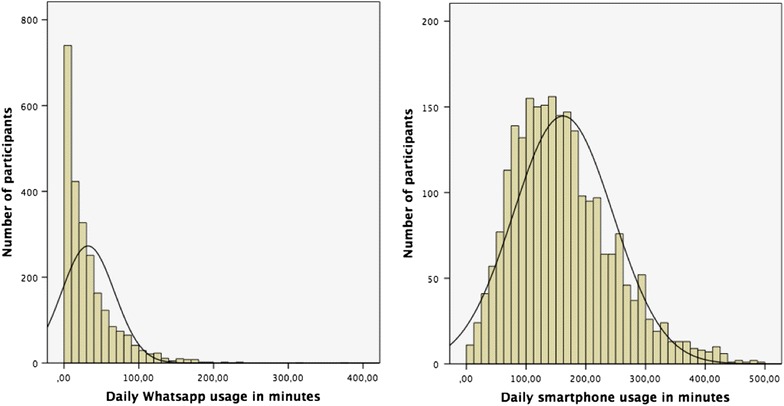
BACKGROUND: Mounting evidence shows that smartphone usage heavily disrupts our work life and social activities. Moreover, it is possible that overuse could resemble addictive tendencies. A key contributing factor to smartphone overuse seems to be usage of the messaging application WhatsApp. Although WhatsApp is one of the most commonly used communication applications on smartphones, research in this area is scarce. Given the huge societal debate on the impact of smartphone usage on our daily lives, the present study undertook a large-scale investigation in order to provide numbers on smartphone usage generally-and use of WhatsApp in particular, with the aim of providing a basis for a scientific debate. METHODS: In a large sample of N = 2,418 users, we recorded WhatsApp behaviour over a 4 week period. RESULTS: Our data show that use of WhatsApp accounted for 19.83% (= 32.11 min) of all smartphone behaviour (compare: Facebook only 9.38% = 15.19 min). The mean of general daily smartphone usage was 161.95 min. Females used WhatsApp for significantly longer periods of time than males and younger age was associated with longer duration of WhatsApp use. While the personality trait Extraversion was positively associated with daily WhatsApp use, Conscientiousness showed an inverse correlation with the length of daily WhatsApp use. CONCLUSIONS: The numbers on smartphone usage in the present study show that the smartphone dominates our daily life. In particular WhatsApp is a driving force, here. Given the length of daily smartphone and WhatsApp usage, more studies need to be conducted to better understand smartphone usage.
Overview
The claims and statistics of this paper haven’t been checked yet.
Free: it reads the open-access text and checks the first 5 claims that cite a source we can check. Create a free account to check every claim.
Integrity signals
Registry
Cites
Statistics
Figures
Verification
Claims the paper makes
The claims and statistics of this paper haven’t been checked yet.
Free: it reads the open-access text and checks the first 5 claims that cite a source we can check. Create a free account to check every claim.
Claims other papers make about this one
Each is checked against this paper’s own text: does it say what the citing paper says it does?
The cited source says what the claim attributes to it.
In the citing paper
“The personality traits were included to serve as covariates, because research has shown that they are related to social media use (Montag et al., 2015; Nowland et al., 2018; Kircaburun et al., 2020).”
From Centennials, FOMO, and loneliness: an investigation of the impact of social networking and messaging/voip apps usage during the initial stage of the coronavirus pandemic (2021) · cites this paper as Montag et al., 2015
In the citing paper
“A large-scale tracking of online behavior showed that the use of WhatApp over the smartphone accounted for nearly 20% of all smartphone behavior, above Facebook use [58].”
From Problematic Use of the Internet and Smartphones in University Students: 2006–2017 (2018) · cites this paper as [58]
Self-check
Percentages, sums and reported differences re-computed from the paper’s own numbers.
The self-check needs the paper’s full text.
Citations
Cites
Rammstedt, B., & John, O. P. (2007) · Journal of Research in Personality · doi:10.1016/j.jrp.2006.02.001 · Cited by 4,244 · cited 2×
“Moreover, the authors of the BFI suggest that “the BFI-10 possesses acceptable psychometric properties” (p. 210, [18]), although the shorter version is accompanied by “substantial losses in comparison to the full-scale BFI”.”
BackgroundMethodThe Smartphone addiction scale: development and validation of a short version for adolescents
Kwon, M., Kim, D.-J., Cho, H., & Yang, S. (2013) · PLoS ONE · doi:10.1371/journal.pone.0083558 · Cited by 2,177 · cited 1×
“It has been suggested that overuse of smartphones may resemble an addiction [2, 3] and overuse is also linked to time distortion, with the result that the smartphone is used for longer than originally intended or perceived [4].”
BackgroundWho interacts on the Web?: The intersection of users’ personality and social media use
Correa, T., Hinsley, A. W., & de Zúñiga, H. G. (2010) · Computers in Human Behavior · doi:10.1016/j.chb.2009.09.003 · Cited by 1,915 · cited 1×
“However, a recent study [21] suggested that high neurotics tend to use Facebook more as it facilitates communication without face-to-face interaction; a hypothesis that may warrant further investigation.”
BackgroundDevelopment and Validation of a Smartphone Addiction Scale (SAS)
Kwon, M., Lee, J.-Y., Won, W.-Y., Park, J.-W., Min, J.-A., Hahn, C., Gu, X., Choi, J.-H., & Kim, D.-J. (2013) · PLoS ONE · doi:10.1371/journal.pone.0056936 · Cited by 1,670 · cited 1×
“It has been suggested that overuse of smartphones may resemble an addiction [2, 3] and overuse is also linked to time distortion, with the result that the smartphone is used for longer than originally intended or perceived [4].”
BackgroundFacebook Use Predicts Declines in Subjective Well-Being in Young Adults
Kross, E., Verduyn, P., Demiralp, E., Park, J., Lee, D. S., Lin, N., Shablack, H., Jonides, J., & Ybarra, O. (2013) · PLoS ONE · doi:10.1371/journal.pone.0069841 · Cited by 1,596 · cited 1×
“In contrast to the small body of literature on WhatsApp, the past few years reflect a focus on social network usage, such as Facebook, when investigating smartphone behaviour or Internet usage (e.g. [11]).”
ResultRyan, T., & Xenos, S. (2011) · Computers in Human Behavior · doi:10.1016/j.chb.2011.02.004 · Cited by 1,260 · cited 1×
“Moreover, it is noteworthy that most previous studies have relied solely on self-report data to measure human–machine interaction [12, 13].”
ResultBeginning the workday yet already depleted? Consequences of late-night smartphone use and sleep
Lanaj, K., Johnson, R. E., & Barnes, C. M. (2014) · Organizational Behavior and Human Decision Processes · doi:10.1016/j.obhdp.2014.01.001 · Cited by 738 · cited 1×
“Moreover, smartphone overuse (in particular evening usage) seems to be associated with poor sleep quality [5] and reduced work engagement [6], which is not surprising, as new numbers show that about 36–40% of smartphone owners use their smartphone in the last 5 min before going to sleep and/ or in…”
BackgroundWhat's up with whatsapp?: comparing mobile instant messaging behaviors with traditional SMS
Church, K., & de Oliveira, R. (2013) · Proceedings of the 15th international conference on Human-computer interaction with mobile devices and services · doi:10.1145/2493190.2493225 · Cited by 565 · cited 1×
“Recent studies yielded the first evidence that What-sApp usage might have an addictive character [9] and of course WhatsApp represents an important communication alternative to classic short message services, which often incur costs (SMS; [10]).”
The influence of personality on Facebook usage, wall postings, and regret
Moore, K., & McElroy, J. C. (2012) · Computers in Human Behavior · doi:10.1016/j.chb.2011.09.009 · Cited by 542 · cited 1×
“Moreover, it is noteworthy that most previous studies have relied solely on self-report data to measure human–machine interaction [12, 13].”
ResultPersonality and self reported mobile phone use
Butt, S., & Phillips, J. G. (2008) · Computers in Human Behavior · doi:10.1016/j.chb.2007.01.019 · Cited by 517 · cited 1×
“In keeping with earlier smart-phone studies on Extraversion and call behaviour (e.g. [16, 20]), extraverts also use WhatsApp for longer durations compared with introverts.”
Background
Cited by
Items 301–400 of 405
A framework for Sudanese Arabic – English Mixed Speech Processing
Elfahal, M. O., Mustafa, M. E., Mustafa, M. E., & Saeed, R. A. (2020) · International Conference on Computing and Information Technology (ICCIT) · doi:10.1109/iccit-144147971.2020.9213816 · Cited by 2
“Additionally, everyone can utilize modern technology, e.g., cell phone, to establish conversation with other people using computer-based speech facilities[2].”
BackgroundSariyska, R., & Montag, C. (2022) · Studies in neuroscience, psychology and behavioral economics · doi:10.1007/978-3-030-98546-2_5 · Cited by 3
Self-citationMAULINA, M., Rahim, T. R., Cortez, A. O., Narciso, S. A. V., & Said, A. (2023) · Decode Jurnal Pendidikan Teknologi Informasi · doi:10.51454/decode.v3i1.144 · Cited by 2
Grau‐Grau, M., Jiménez, G. G., & Otero, L. M. R. (2023) · Adicciones · doi:10.20882/adicciones.1781 · Cited by 5
“First, it examined the problematic use of an application that despite accounting for a fifth of daily online time is still to receive adequate academic attention: WhatsApp (Montag et al., 2015; Tresáncoras, García Oliva & Piqueras Rodríguez, 2017).”
BackgroundInfluentialThe Attitude of Egyptian Patients with Autoimmune and Rheumatic Diseases towards Telemedicine
Tharwat, S., & Gamal, D. (2023) · Medicina · doi:10.3390/medicina59091595 · Cited by 2
“WhatsApp makes up a significant proportion of daily smartphone usage [26].”
BackgroundA Method for Formative Multi-Context Boundary Profiling
Oppl, S., Schuster, P., & Prinz, T. (2019) · Journal of Interaction Science · doi:10.24982/jois.1812019.001 · Cited by 2
“Still, as we focus on mobile communication settings, we provide participants with the three most common pre-specified channels on mobile devices [12, 26, 46]: phone, email and messenger.”
BackgroundSmartphone Usage Frequency and Duration in Relation to Personality Traits
Beierle, F. (2021) · T-labs series in telecommunication services · doi:10.1007/978-3-030-68840-0_5 · Cited by 3
Nudging problematic smartphone use to a lower level
Palokangas, L., & Suomala, J. (2017) · eScholarship (California Digital Library) · Cited by 2
Smith, H. E. (2017) · Louisiana State University · doi:10.31390/gradschool_dissertations.4222 · Cited by 2
Whatsapp Education for Asthma and Allergy Patients: Pros and Cons
Tayeb, M. M. S. (2019) · Global Journal of Otolaryngology · doi:10.19080/gjo.2019.18.555999 · Cited by 1
Arredondo, L. R., Rodríguez, L. D. C. R., Carmona, E. A., & González, A. J. L. (2023) · Revista Colombiana de Ciencias Sociales · doi:10.21501/22161201.3872 · Cited by 1
Herwandito, S., Pawito, P., Utari, P., & Hastjarjo, S. (2024) · Revista de Gestão Social e Ambiental · doi:10.24857/rgsa.v18n10-037 · Cited by 3
“Nowadays, a mobile messenger application becomes our needs, makes us addicted and slowly disrupt our work and our social life too (Dlodlo, 2015; Montag et al., 2015).”
BackgroundGenealogy in social media: navigating time and space
Yosef, D., & Lev‐On, A. (2024) · The History of the Family · doi:10.1080/1081602x.2024.2416942 · Cited by 1
“While Montag et al. (2015) argue that a defining property of social media is the presence of comprehensive user profiles, this perspective may be too narrow.”
Assessing mobile instant messenger networks with donated data
Corten, R., Boeschoten, L., Carrière, T. C., Jongerius, S., Struminskaya, B., Mulder, J., Zahedi, P., Najafabadi, S. N., & Mendrik, A. M. (2025) · Social Network Analysis and Mining · doi:10.1007/s13278-025-01550-8 · Cited by 5
Weingarten, J., Mertens, F., Brickau, D., Kramm, R. J., Margraf, J., Precht, L.-M., Weingarten, A., & Brailovskaia, J. (2026) · Acta Psychologica · doi:10.1016/j.actpsy.2026.106735 · Cited by 1
Exploring the Impact of Digital Behaviours on Mental Health: Tools and Intervention for Gen Z
Kumar, K., & Pathak, V. N. (2026) · Annals of Neurosciences · doi:10.1177/09727531261472987 · Cited by 1
“11 Research from various sources highlights the increasing rates of anxiety, depression and loneliness, often associated with heavy smartphone use and a decline in in-person social interactions.”
Reporting Key Performance Indicator for Driver Using Whatsapp
Sunarto, R. M., Girsang, A. S., & Saragih, M. H. (2021) · International Journal of Emerging Technology and Advanced Engineering · doi:10.46338/ijetae0621_08 · Cited by 1
TYDR: Track Your Daily Routine
Beierle, F. (2021) · T-labs series in telecommunication services · doi:10.1007/978-3-030-68840-0_4 · Cited by 2
Consumer Extraversion, Novelty Seeking, and Use of Mobile Instant Messaging (MIM)
Cruz‐Cárdenas, J., Guadalupe-Lanas, J., Ramos-Galarza, C., Забелина, Е. В., & Deyneka, O. S. (2021) · Lecture notes in networks and systems · doi:10.1007/978-3-030-80876-1_24 · Cited by 1
Loureiro, L. D., Zanin, L., & Flório, F. M. (2021) · ETD - Educação Temática Digital · doi:10.20396/etd.v23i4.8658174 · Cited by 2
Bartenschlager, A., & Nürnberg, V. (2019) · Springer eBooks · doi:10.1007/978-3-658-25577-0_3 · Cited by 1
Yaşlıları Günlük Yaşamlarında Destekleyici Mobil Sağlık Uygulaması Geliştirilmesi
CİSSÉ, I. T., & Yılmaz, Ö. (2022) · European Journal of Science and Technology · doi:10.31590/ejosat.1083647 · Cited by 1
Social Emotional Support on One-on-One and Group Family WhatsApp. Do Gender Differences Exist?
Katzman, B., Dolev, N., & Koslowsky, M. (2021) · American Journal of Medical and Clinical Sciences · doi:10.33425/2832-4226/21012 · Cited by 1
Smolders, K. C. H. J., de Woestijne, G. D.-V., Meijer, K. A., McConchie, H., & de Kort, Y. A. W. (2023) · Journal of Medical Internet Research · doi:10.2196/38066 · Cited by 3
Smartphone Addiction and Self-reported Productivity among Hospital Health Professionals in Beirut
Mezher, G. N., Chahine, C., & Khalaf, C. (2023) · International Journal of Health Sciences and Research · doi:10.52403/ijhsr.20230218 · Cited by 2
Talaue, G. M., & Kalanther, I. (2023) · International Journal of Cyber Behavior Psychology and Learning · doi:10.4018/ijcbpl.324087 · Cited by 2
Using Predict-Observe-Explain (POE) Online Learning Systems During the COVID-19 Pandemic
Febrina, R., Subarkah, C. Z., Helsy, I., & Sukmawardani, Y. (2024) · KnE Social Sciences · doi:10.18502/kss.v9i8.15499 · Cited by 1
“The WhatsApp application is one of the most frequently used applications on smartphones to communicate [5].”
MethodTüm Yönleriyle Sosyal Medyada Dezenformasyon-1
Öksüz, A., Yanar, O., Fidan, M. E., Kurtulmuş, M., Şahin, A., Karaarslan, N., Sözer, M., Devletli, E., Önier, G., Karagül, D., et al. (2024) · Akademisyen Kitabevi eBooks · doi:10.37609/akya.1082 · Cited by 1
Czech, O. M., Podoll, K., & Schneider, F. W. (2017) · Der Nervenarzt · doi:10.1007/s00115-017-0384-1 · Cited by 1
Loconi, C., Alvitres, V., Ortega, B., & Zapirain, I. (2015) · Manglar · doi:10.17268/manglar.2015.018 · Cited by 1
Militani, D. R., Begazo, D. C., Rosa, R. L., & Rodríguez, D. Z. (2019) · International Conference on Software, Telecommunications and Computer Networks (SoftCOM) · doi:10.23919/softcom.2019.8903776 · Cited by 1
“Also, speech mobile applications and the number of mobile devices have been increasing in the last years [1], and according to [2] smartphones”
BackgroundA Quantitative and Qualitative Approach to Analysing Cyberbullying in Classmates’ WhatsApp groups
Aizenkot, D. (2020) · Springer eBooks · doi:10.1007/978-3-030-38577-4_9 · Cited by 1
Razalli, N. H. (2020) · The Journal of Teaching and Learning · Cited by 1
Marques, G. (2021) · Advanced information and knowledge processing · doi:10.1007/978-3-030-14939-0_2 · Cited by 1
The Effect of Using WhatsApp on the Jordanian 5th Grade EFL Students' Speaking Skill
AlAzzam-Khraiwish, A. A., Bataineh, A. M., & Alzyod, A. H. (2021) · International Journal of Linguistics · doi:10.5296/ijl.v13i4.18749 · Cited by 1
Social mobility and gonorrhoea in Germany during 2020
Sulyok, M., & Walker, M. D. (2021) · Sexually Transmitted Infections · doi:10.1136/sextrans-2021-055159 · Cited by 1
¿Qué dice tu smartphone sobre ti?
Lérida, S. V., & Poggio, L. (2021) · Behavior & Law Journal · doi:10.47442/blj.v7.i1.82
Investigation on the Spatio-Temporal Mobility and Smartphone Usage of College Students
Lai, X., Zhao, J., Dong, L., Li, B., & Rau, P. P. (2022) · Lecture notes in computer science · doi:10.1007/978-3-031-06053-3_12 · Cited by 1
La fréquence de l’alternance codique dans les groupes WhatsApp des étudiants libanais
Halawi, A., Messarra, N., & Hardane, J. (2022) · Canadian Journal of Applied Linguistics · doi:10.37213/cjal.2022.32158 · Cited by 1
Social Media and Social Bonding in Students' Decision-Making Regarding Their Study Path
Dirin, A., Nieminen, M., & Alamäki, A. V. (2022) · IGI Global eBooks · doi:10.4018/978-1-6684-7123-4.ch084 · Cited by 1
de Oliveira, R. C., de Oliveira, H. M., Ramalho, R. A., & Viana, L. P. S. (2016) · arXiv (Cornell University) · doi:10.48550/arxiv.1603.01316 · Cited by 2
“cation technologies used for text-based communication between two or more participants usually over the Internet [2], [8]. In particular, IM for mobile phones is becoming a worldwide fever [13], [1], [10]. In performance evaluation of electronic devices is commonplace to build a base for comparison ([4]). Usually this…”
MethodMontag, C., & Walla, P. (2016)
Self-citationLeisure Time: Meaningful or Addiction: A Case of WhatsApp
Nagla, M. (2021) · Quest-The Journal of UGC-HRDC Nainital · doi:10.5958/2249-0035.2021.00007.3
Montag, C. (2018) · PPH · doi:10.1055/a-0646-6293
“[11] Montag C, Błaszkiewicz K, Sariyska R et al.”
BackgroundInfluentialSelf-citationAvaliação da Qualidade da Voz em Serviços de Comunicação usando Deep Learning
Gouveia, D. J. D. S., Rosa, R. L., & Rodríguez, D. Z. (2018) · doi:10.5753/sbrc.2018.2415 · Cited by 2
“Introdução Os usuários de aplicativos de voz cresceram nos últimos anos [Montag et al. 2015], principalmente devido ao aumento do número de dispositivos móveis.”
BackgroundAndroid Application to Convert Speech to Text and Text to Speech
Manish, Y. M., Kavya Prabhu, K., & Vishesh, S. (2019) · IJARCCE · doi:10.17148/ijarcce.2019.8208
Montag, C. (2019) · Springer eBooks · doi:10.1007/978-3-658-22954-2_13 · Cited by 1
Self-citationWang, P. (2020) · Louisiana State University · doi:10.31390/gradschool_theses.5215
“numerous convenient features, including games, internet access social networks, emails, instant messaging, and navigation (Demirci, Akgonul, and Akpinar 2015; Montag et al. 2015).”
BackgroundAdebayo, O. A. (2019) · ResearchSpace (University of KwaZulu-Natal) · Cited by 2
Yuniarti, F. A. (2021) · International Conference on Health and Medical Sciences (AHMS) · doi:10.2991/ahsr.k.210127.034
“WhatsApp is one of the most downloaded chat groups by the public [1,2].”
Backgroundاستخدام الجمهور المصری لتطبیق WhatsApp وعلاقته بالتفاعل الاجتماعی
المُنعم, إ. ع. ع. (2020) · المجلة العلمية لبحوث العلاقات العامة و الإعلان · doi:10.21608/sjocs.2020.154770
Radons, D. L., Visentini, M. S., & Löbler, M. L. (2021) · Sociedade Contabilidade e Gestão · doi:10.21446/scg_ufrj.v0i0.28629 · Cited by 2
Polychronicity & Boundary Management: An exploratory study
Aistleithner, A., & Oppl, S. (2021) · European Conference on Cognitive Ergonomics · doi:10.1145/3452853.3452858
“People are permanently available and reachable, they can be contacted anytime and anywhere [14].”
Backgroundاحمد, ي. (2021) · مجلة جامعة الفيوم للعلوم التربوية والنفسية · doi:10.21608/jfust.2021.59842.1261
Conexión constante y directa: WhatsApp
Álvarez, J. D., & Rivera, G. M. (2020) · doi:10.7476/9789978105719.0005
Czech, O. M., Podoll, K., & Schneider, F. W. (2018) · RWTH Publications (RWTH Aachen)
Machuki, O., & Mutua, J. (2021) · International Journal of Communication and Public Relation · doi:10.47604/ijcpr.1344
“Given the huge societal debate on the impact of mobile phone usage on our daily lives, Montag et al. (2015) undertook a study to investigate mobile phone usage in the 21st century by focusing on WhatsApp.”
BackgroundResultInfluentialSouza, M. L. D. A. (2020) · Digital Library of Theses and Dissertations (Universidade de São Paulo) · doi:10.11606/d.25.2020.tde-22102021-120918
Butt, G., Rana, M., & Uzair, M. (2021) · Our Dermatology Online · doi:10.7241/ourd.20214.7 · Cited by 2
Bordas-Beltrán, J. L., Vota, A. M. A., Flores, D. A. P., & Diéz, M. D. C. G. (2021) · RIDE Revista Iberoamericana para la Investigación y el Desarrollo Educativo · doi:10.23913/ride.v12i23.1060
Höld, E., Grüblbauer, J., Wiesholzer, M., Wewerka-Kreimel, D., Stieger, S., Kuschei, W., Kisser, P., Gützer, E., Hemetek, U., Ebner-Zarl, A., et al. (2021) · Research Square · doi:10.21203/rs.3.rs-942223/v1
عثمان, ن. م. (2022) · بحوث في علم المکتبات والمعلومات · doi:10.21608/sjrc.2022.214890
Beierle, F. (2021) · T-labs series in telecommunication services · doi:10.1007/978-3-030-68840-0_3
Siriwong, W., Frost, E. G., & Wilaiwan, W. (2022) · medRxiv · doi:10.1101/2022.04.26.22274312 · Cited by 1
“Smartphones help people easily communicate via text or voice message between two or more people, or any features that help people stay connected are highlight features of smartphones [7].”
BackgroundAn innovative way of teaching electrocardiograms; EKG of the week
Al‐Akchar, M., Salih, M., Ibrahim, A. M., Labedi, M. R., & Robinson, R. (2021) · Journal of Clinical Images and Medical Case Reports · doi:10.52768/2766-7820/1505
“Another study estimated WhatsApp usage to be around 20% of all smartphone behavior [10].”
BackgroundSindermann, C., Yang, H., Yang, S., Elhai, J. D., & Montag, C. (2021) · OSF Preprints (OSF Preprints) · doi:10.31219/osf.io/96s38
Self-citationCoulibaly, S. (2022) · Queensland University of Technology · doi:10.5204/thesis.eprints.236175 · Cited by 1
Bidrman, L.-K. (2018) · The Work Life Balance Bulletin a DOP Publication · doi:10.53841/bpswlb.2018.2.2.33
Gugushvili, N. (2023) · Research Publications (Maastricht University) · doi:10.26481/dis.20230320ng · Cited by 7
Cuadra, J. (2023) · PsyArXiv (OSF Preprints) · doi:10.31234/osf.io/v34qn · Cited by 2
Tarnoto, T. T., Rosa, E. M., Satriyandari, Y., & Mufdlillah, M. (2022) · Jurnal Kebidanan dan Keperawatan Aisyiyah · doi:10.31101/jkk.876
Elsakkar, W. F., Mostafa, M., & Hashem, S. N. (2023) · Al-Azhar Journal of Dentistry · doi:10.58675/2974-4164.1494
WAZUP! COMMUNICATION TOOLS IN ORGANIZATIONAL DECISION-MAKING
Taib, H. M., & Rahim, N. R. A. (2023) · Perspektif Komunikasi Jurnal Ilmu Komunikasi Politik dan Komunikasi Bisnis · doi:10.24853/pk.7.1.103-114
“The use of mobile technology in Communication has become widely used with its current usage trend, which has been on the rise and cannot be ignored, especially now that it is so pervasive throughout organizations and institutions (Bouhnik & Deshen, 2014; Montag et al., 2015).”
BackgroundPEMANFAATAN APLIKASI WHATSAPP GROUP SEBAGAI MEDIA PEMBELAJARAN DARING PADA MATA KULIAH ULUMUL HADIS
Maula, A. R., Muqowim, M., Aula, S. K. N., & Ridhaeva, H. (2023) · Wawasan Jurnal Kediklatan Balai Diklat Keagamaan Jakarta · doi:10.53800/wawasan.v4i2.250
“Hal tersebut dikarenakan WhatsApp menjadi salah satu aplikasi pada smartphone yang memiliki durasi penggunaan harian tertinggi dibandingkan dengan aplikasi media sosial lainnya (Montag et al., 2015; Zaini et al., 2021).”
BackgroundSzymkowiak, A., Nurse, J. R. C., Brauner, P., Ziefle, M., & Shepherd, L. A. (2024) · Frontiers research topics · doi:10.3389/978-2-8325-4819-6
استخدام الجمهور المصري لشبكات المنصات الاجتماعي وعلاقته بالتفاعل الاجتماعي
المُنعم, إ. ع. ع. (2022) · Buḥūṯ Al-Iʿlām Al-Raqamī · doi:10.21608/jsmd.2022.351948
A Correlation Study on Smartphone Usage Duration with Hand Grip Strength in Young Adults
Rincy, S. A. K. (2024) · International Journal of Science and Research (IJSR) · doi:10.21275/mr24308181048
Residents’ Perspective of the WhatsApp and Videoconference-based Educational Programme
Gupta, M., Bakshi, S. G., Rane, A. D., Shrivastava, A. M., Patole, M. R., Gaikwad, S., & Salunke, B. (2024) · Journal of onco-anaesthesiology and perioperative medicine. · doi:10.4103/joapm.joapm_6_24
Ngigi, K. P., Kinoti, K. F., & Wachira, T. J. (2024) · International Journal of Science and Research (IJSR) · doi:10.21275/sr24622131950
INFLUENCE OF SMARTPHONE ADDICTION ON MENTAL HEALTH: A COMPREHENSIVE REVIEW
(2024) · International Journal of Progressive Research in Engineering Management and Science · doi:10.58257/ijprems32965 · Cited by 1
The Impact of Social Media on Knowledge Sharing among Faculty Members in Saudi Universities
Almousa, N. A. (2024) · University of North Texas Digital Library (University of North Texas) · doi:10.12794/metadc2415961
Animal Emotions: How They Drive Human Behavior
Montag, C., & Davis, K. L. (2020) · Punctum Books · doi:10.21983/p3.0305.1.00 · Cited by 3
Self-citationSalvador, F. G. F., Oliveira, L. F. A., Pimentel, M. I. F., Lyra, M. R., Hasslocher‐Moreno, A. M., de Holanda, M. T., Varela, M. C., Silveira, H., & Valete‐Rosalino, C. M. (2025) · Frontiers in Public Health · doi:10.3389/fpubh.2025.1616368 · Cited by 2
“WhatsApp was chosen as the communication channel for teleconsultation, appointments, and sending the evaluation questionnaire due to its popularity and ease of use (40).”
Hilbert, S., Kraus, E., & Lindl, A. (2025) · Springer eBooks · doi:10.1007/978-3-658-43649-0_1
Reforzamiento diferencial de otras conductas aplicado a un caso de uso problemático del smartphone
Orozco, A. I. M., Ruíz, D. M. R., González, B. V., & Rubio, O. A. C. (2025) · Pensamiento Crítico Revista de Investigación Multidisciplinaria · doi:10.64040/5f3d6j97
DANIELS, J., & Bradford, B. D. (2025) · SSRN Electronic Journal · doi:10.2139/ssrn.5372467
High, C., Teleman, H., Нарвселіус, Е., & Boshi, B. (2025) · Journal of Participatory Research Methods · doi:10.35844/001c.141333 · Cited by 1
“Bar et al., 2016; Montag et al., 2015).”
Shah, A., Almourad, M. B., Ali, S., Alam, A., & Rahman, T. U. (2025) · Human Behavior and Emerging Technologies · doi:10.1155/hbe2/4428860 · Cited by 1
Samad, F. A., & Kahar, A. S. J. (2025) · JURNAL DIVERSITA · doi:10.31289/diversita.v11i2.15443
Finkelsztein, S. (2025) · Economics and Culture · doi:10.2478/jec-2025-0018
“Extensive research highlights both positive and negative effects, with mobile accessibility intensifying their influence (Cao et al., 2024; Beyens et al., 2024; Montag et al., 2015a; Montag et al., 2015b; Olorunsogo et al., 2024; Tao et al., 2024).”
Kohne, J., & Montag, C. (2026) · Computers in Human Behavior Reports · doi:10.1016/j.chbr.2026.100996 · Cited by 1
Self-citationLee, M. H., You, K. H., & Cho, J. (2026) · Methods · doi:10.1016/j.ymeth.2026.03.006
Danacı, M. Ö. (2026) · Journal of Teacher Education and Lifelong Learning · doi:10.51535/tell.1885833
Kannen, C., & Montag, C. (2026) · Telematics and Informatics Reports · doi:10.1016/j.teler.2026.100324 · Cited by 1
Self-citationPachajoa-Londoño, A., Forigua-Parra, J. E., & Anzola, J. (2026) · Discover Psychology · doi:10.1007/s44202-026-00648-0 · Cited by 1
“This value varies depending on the culture of each country, communication coverage, and geographical location [23, 46, 47].”
Suárez, D. S., & Cárdenas, R. A. S. (2026) · TRASCENDERE · doi:10.56219/trascendere.v1i7.5374
Factors Influencing Smartphone Selection For An Indian Consumer Perspective
Walia, K., Goswami, D., Kannojiya, J., Patre, S., Bhattad, A., & Rastogi, S. (2025) · International Conference on Intelligent & Innovative Practices in Engineering & Management (IIPEM) · doi:10.1109/iipem65914.2025.11547958 · Cited by 1
“Growing internet penetration with the introduction of 4G and 5G networks, internet connectivity has rapidly increased, making smartphones even more essential for information access, social media interaction, and online commerce[2].”
Suárez, D. S., & Cárdenas, R. A. S. (2026) · TRASCENDERE · doi:10.56219/trascendere.v2i7.5627
Privacy-Aware Local-First User Modeling from Cross-Device Traces
Simac, A. (2026) · Lecture notes in computer science · doi:10.1007/978-3-032-29372-5_9
Sun, Y., & Hou, Z. (2026) · Frontiers in Public Health · doi:10.3389/fpubh.2026.1830540
“In this context, the rapid diffusion of digital technologies, particularly mobile internet technologies, has profoundly reshaped individuals’ daily lives, social interactions, and health-related behaviors (10–13).”
Metadata
- Authors
- Montag, C., Błaszkiewicz, K., Sariyska, R., Lachmann, B., Andone, I., Trendafilov, B., Eibes, M., & Markowetz, A.
- Affiliations
- Universität Ulm (DE)
- University of Bonn (DE)
- Corresponding author
- Montag, Christian
- ORCID
- Venue
- BMC Research Notes
- Published
- 2015-08-04
- Volume
- 8
- Issue
- 1
- Pages
- 331-331
- ISSN
- 1756-0500 (ISSN-L)
- PMC
- PMC4522968
- OpenAlex
- W2170301618
- Semantic Scholar
- adb0257f598c6ffe3d827c7ddf7ac0eece7ee563
- Cited by
- 408
- References
- 20
- Citations by year
- 2026: 16 · 2025: 19 · 2024: 17 · 2023: 36 · 2022: 42 · 2021: 68 · 2020: 64 · 2019: 60 · 2018: 36 · 2017: 31 · 2016: 17 · 2015: 2
- FWCI
- 94.89
- Type
- journal article
- Language
- en
- Open access
- gold
- doi.org
- Licence
- cc-by
- Locations
- BMC Research Notes (publishedVersion, cc-by)
- Europe PMC (PubMed Central) (publishedVersion, cc-by)
- PubMed Central (publishedVersion, cc-by)
- PubMed (publishedVersion)
- Funders
- Deutsche Forschungsgemeinschaft (MO-2363/3-1, 2363/3-1, 2363/2-1, MO 2363/2-1)
- Topics
- Social Sciences › Sociology and Political Science › Impact of Technology on Adolescents
- Social Sciences › Decision Sciences › Information Systems and Management › Personal Information Management and User Behavior
- Social Sciences › Communication › Media and Digital Communication
- Keywords
- smartphone use, WhatsApp, messaging apps, smartphone overuse, daily screen time, gender differences, age differences, personality traits, extraversion, conscientiousness, Facebook
- MeSH terms
- Smartphone, Adolescent, Adult, Communication, Female, Humans, Male, Internet, Young Adult, Text Messaging, Social Networking, Mobile Applications
About these checks
Registry, retraction, Cites and statistics results are computed, not judged, with one exception: a printed reference that no index lists is read once by a model before it counts as a citation error. Claims are extracted by a model and kept only when their quote appears verbatim in the text; each cited source is then checked, with a model’s help, for whether it says what the claim relies on. Those verdicts can be wrong — read the claim’s quote and the cited source before relying on one.
Statistics and arithmetic are recomputed, not judged.
Confidence bands are shown only for fields calibrated on our annotated test set. None is calibrated yet, so no band is shown.
What counts as a claim ›How we measure confidence ›How we check this ›
Are you an author, or do you see a problem with this page? Request a review
Data sources
Bibliographic data: Semantic Scholar, OpenAlex, Crossref.
Contains information from the Semantic Scholar Academic Graph Datasets, made available under the ODC Attribution License (ODC-BY 1.0).
Semantic Scholar’s data is described in: Kinney, R., et al. (2023). The Semantic Scholar Open Data Platform. arXiv:2301.10140.
