

Smartphone usage in the 21st century: who is active on WhatsApp?
Open accessThe DOI matches its Crossref record; 20 of the 20 references it cites were found in a registry or an index.
Abstract
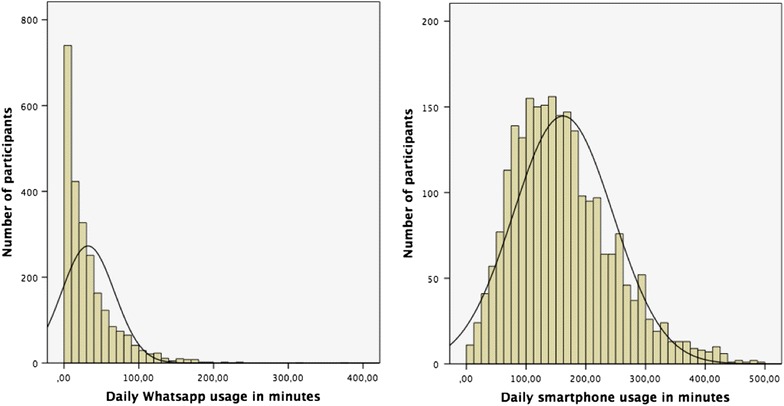
BACKGROUND: Mounting evidence shows that smartphone usage heavily disrupts our work life and social activities. Moreover, it is possible that overuse could resemble addictive tendencies. A key contributing factor to smartphone overuse seems to be usage of the messaging application WhatsApp. Although WhatsApp is one of the most commonly used communication applications on smartphones, research in this area is scarce. Given the huge societal debate on the impact of smartphone usage on our daily lives, the present study undertook a large-scale investigation in order to provide numbers on smartphone usage generally-and use of WhatsApp in particular, with the aim of providing a basis for a scientific debate. METHODS: In a large sample of N = 2,418 users, we recorded WhatsApp behaviour over a 4 week period. RESULTS: Our data show that use of WhatsApp accounted for 19.83% (= 32.11 min) of all smartphone behaviour (compare: Facebook only 9.38% = 15.19 min). The mean of general daily smartphone usage was 161.95 min. Females used WhatsApp for significantly longer periods of time than males and younger age was associated with longer duration of WhatsApp use. While the personality trait Extraversion was positively associated with daily WhatsApp use, Conscientiousness showed an inverse correlation with the length of daily WhatsApp use. CONCLUSIONS: The numbers on smartphone usage in the present study show that the smartphone dominates our daily life. In particular WhatsApp is a driving force, here. Given the length of daily smartphone and WhatsApp usage, more studies need to be conducted to better understand smartphone usage.
Overview
The claims and statistics of this paper haven’t been checked yet.
Free: it reads the open-access text and checks the first 5 claims that cite a source we can check. Create a free account to check every claim.
Integrity signals
Registry
Cites
Statistics
Figures
Verification
Claims the paper makes
The claims and statistics of this paper haven’t been checked yet.
Free: it reads the open-access text and checks the first 5 claims that cite a source we can check. Create a free account to check every claim.
Claims other papers make about this one
Each is checked against this paper’s own text: does it say what the citing paper says it does?
The cited source says what the claim attributes to it.
In the citing paper
“The personality traits were included to serve as covariates, because research has shown that they are related to social media use (Montag et al., 2015; Nowland et al., 2018; Kircaburun et al., 2020).”
From Centennials, FOMO, and loneliness: an investigation of the impact of social networking and messaging/voip apps usage during the initial stage of the coronavirus pandemic (2021) · cites this paper as Montag et al., 2015
In the citing paper
“A large-scale tracking of online behavior showed that the use of WhatApp over the smartphone accounted for nearly 20% of all smartphone behavior, above Facebook use [58].”
From Problematic Use of the Internet and Smartphones in University Students: 2006–2017 (2018) · cites this paper as [58]
Self-check
Percentages, sums and reported differences re-computed from the paper’s own numbers.
The self-check needs the paper’s full text.
Citations
Cites
Rammstedt, B., & John, O. P. (2007) · Journal of Research in Personality · doi:10.1016/j.jrp.2006.02.001 · Cited by 4,244 · cited 2×
“Moreover, the authors of the BFI suggest that “the BFI-10 possesses acceptable psychometric properties” (p. 210, [18]), although the shorter version is accompanied by “substantial losses in comparison to the full-scale BFI”.”
BackgroundMethodThe Smartphone addiction scale: development and validation of a short version for adolescents
Kwon, M., Kim, D.-J., Cho, H., & Yang, S. (2013) · PLoS ONE · doi:10.1371/journal.pone.0083558 · Cited by 2,177 · cited 1×
“It has been suggested that overuse of smartphones may resemble an addiction [2, 3] and overuse is also linked to time distortion, with the result that the smartphone is used for longer than originally intended or perceived [4].”
BackgroundWho interacts on the Web?: The intersection of users’ personality and social media use
Correa, T., Hinsley, A. W., & de Zúñiga, H. G. (2010) · Computers in Human Behavior · doi:10.1016/j.chb.2009.09.003 · Cited by 1,915 · cited 1×
“However, a recent study [21] suggested that high neurotics tend to use Facebook more as it facilitates communication without face-to-face interaction; a hypothesis that may warrant further investigation.”
BackgroundDevelopment and Validation of a Smartphone Addiction Scale (SAS)
Kwon, M., Lee, J.-Y., Won, W.-Y., Park, J.-W., Min, J.-A., Hahn, C., Gu, X., Choi, J.-H., & Kim, D.-J. (2013) · PLoS ONE · doi:10.1371/journal.pone.0056936 · Cited by 1,670 · cited 1×
“It has been suggested that overuse of smartphones may resemble an addiction [2, 3] and overuse is also linked to time distortion, with the result that the smartphone is used for longer than originally intended or perceived [4].”
BackgroundFacebook Use Predicts Declines in Subjective Well-Being in Young Adults
Kross, E., Verduyn, P., Demiralp, E., Park, J., Lee, D. S., Lin, N., Shablack, H., Jonides, J., & Ybarra, O. (2013) · PLoS ONE · doi:10.1371/journal.pone.0069841 · Cited by 1,596 · cited 1×
“In contrast to the small body of literature on WhatsApp, the past few years reflect a focus on social network usage, such as Facebook, when investigating smartphone behaviour or Internet usage (e.g. [11]).”
ResultRyan, T., & Xenos, S. (2011) · Computers in Human Behavior · doi:10.1016/j.chb.2011.02.004 · Cited by 1,260 · cited 1×
“Moreover, it is noteworthy that most previous studies have relied solely on self-report data to measure human–machine interaction [12, 13].”
ResultBeginning the workday yet already depleted? Consequences of late-night smartphone use and sleep
Lanaj, K., Johnson, R. E., & Barnes, C. M. (2014) · Organizational Behavior and Human Decision Processes · doi:10.1016/j.obhdp.2014.01.001 · Cited by 738 · cited 1×
“Moreover, smartphone overuse (in particular evening usage) seems to be associated with poor sleep quality [5] and reduced work engagement [6], which is not surprising, as new numbers show that about 36–40% of smartphone owners use their smartphone in the last 5 min before going to sleep and/ or in…”
BackgroundWhat's up with whatsapp?: comparing mobile instant messaging behaviors with traditional SMS
Church, K., & de Oliveira, R. (2013) · Proceedings of the 15th international conference on Human-computer interaction with mobile devices and services · doi:10.1145/2493190.2493225 · Cited by 565 · cited 1×
“Recent studies yielded the first evidence that What-sApp usage might have an addictive character [9] and of course WhatsApp represents an important communication alternative to classic short message services, which often incur costs (SMS; [10]).”
The influence of personality on Facebook usage, wall postings, and regret
Moore, K., & McElroy, J. C. (2012) · Computers in Human Behavior · doi:10.1016/j.chb.2011.09.009 · Cited by 542 · cited 1×
“Moreover, it is noteworthy that most previous studies have relied solely on self-report data to measure human–machine interaction [12, 13].”
ResultPersonality and self reported mobile phone use
Butt, S., & Phillips, J. G. (2008) · Computers in Human Behavior · doi:10.1016/j.chb.2007.01.019 · Cited by 517 · cited 1×
“In keeping with earlier smart-phone studies on Extraversion and call behaviour (e.g. [16, 20]), extraverts also use WhatsApp for longer durations compared with introverts.”
Background
Cited by
On the psychology of TikTok use: a first glimpse from empirical findings
Montag, C., Yang, H., & Elhai, J. D. (2021) · Frontiers in Public Health · doi:10.3389/fpubh.2021.641673 · Cited by 559
Self-citationSmartphone addiction, daily interruptions and self-reported productivity
Duke, É., & Montag, C. (2017) · Addictive Behaviors Reports · doi:10.1016/j.abrep.2017.07.002 · Cited by 466
Self-citationWegmann, E., Oberst, U., Stodt, B., & Brand, M. (2017) · Addictive Behaviors Reports · doi:10.1016/j.abrep.2017.04.001 · Cited by 458
“This constant access makes it possible to communicate/interact with others at any place and any time and can lead to compulsive checking behaviors and excessive engagement (Choi et al., 2015; Montag et al., 2015).”
BackgroundMontag, C., Wegmann, E., Sariyska, R., Demetrovics, Z., & Brand, M. (2021) · Journal of Behavioral Addictions · doi:10.1556/2006.8.2019.59 · Cited by 441
Self-citationMontag, C., Lachmann, B., Herrlich, M., & Zweig, K. (2019) · International Journal of Environmental Research and Public Health · doi:10.3390/ijerph16142612 · Cited by 387
Self-citationPredicting personality from patterns of behavior collected with smartphones
Stachl, C., Au, Q., Schoedel, R., Gosling, S. D., Harari, G. M., Buschek, D., Völkel, S. T., Schuwerk, T., Oldemeier, M., Ullmann, T., et al. (2020) · Proceedings of the National Academy of Sciences · doi:10.1073/pnas.1920484117 · Cited by 348
Sindermann, C., Sha, P., Zhou, M., Wernicke, J., Schmitt, H. S., Li, M., Sariyska, R., Stavrou, M., Becker, B., & Montag, C. (2021) · KI - Künstliche Intelligenz · doi:10.1007/s13218-020-00689-0 · Cited by 343
Self-citationInstagram and WhatsApp in Health and Healthcare: An Overview
Kamel Boulos, M., Giustini, D., & Wheeler, S. (2016) · Future Internet · doi:10.3390/fi8030037 · Cited by 294
“[60] recorded WhatsApp behaviour over a four-week period.”
BackgroundThe Multipurpose Application WeChat: A Review on Recent Research
Montag, C., Becker, B., & Gan, C. (2018) · Frontiers in Psychology · doi:10.3389/fpsyg.2018.02247 · Cited by 274
Self-citationYildiz Durak, H. (2019) · The Social Science Journal · doi:10.1016/j.soscij.2018.09.003 · Cited by 249
Problematic Use of the Internet and Smartphones in University Students: 2006–2017
Carbonell, X., Chamarro, A., Oberst, U., Rodrigo, B., & Prades, M. (2018) · International Journal of Environmental Research and Public Health · doi:10.3390/ijerph15030475 · Cited by 240
Chen, I.-H., Strong, C., Lin, Y.-C., Tsai, M.-C., Leung, H., Lin, C.-Y., Pakpour, A. H., & Griffiths, M. D. (2020) · Addictive Behaviors · doi:10.1016/j.addbeh.2019.04.018 · Cited by 229
Sha, P., Sariyska, R., Riedl, R., Lachmann, B., & Montag, C. (2019) · Addictive Behaviors Reports · doi:10.1016/j.abrep.2018.100148 · Cited by 222
Self-citationWhatsApp Messenger as an Adjunctive Tool for Telemedicine: An Overview
Giordano, V., Koch, H., Godoy-Santos, A., Dias Belangero, W., Esteves Santos Pires, R., & Labronici, P. (2017) · Interactive Journal of Medical Research · doi:10.2196/ijmr.6214 · Cited by 209
The Role of Empathy and Life Satisfaction in Internet and Smartphone Use Disorder
Lachmann, B., Sindermann, C., Sariyska, R. Y., Luo, R., Melchers, M. C., Becker, B., Cooper, A. J., & Montag, C. (2018) · Frontiers in Psychology · doi:10.3389/fpsyg.2018.00398 · Cited by 181
“Smartphone use is strongly linked to the Internet – Internet access is a prerequisite for many functions of the smartphone (Choi et al., 2015; Montag et al., 2015a,b), particularly those with stronger addictive potential, such as communication with social networks (Montag et al., 2017).”
BackgroundSelf-citationMontag, C., & Walla, P. (2016) · Cogent Psychology · doi:10.1080/23311908.2016.1157281 · Cited by 179
“But a large problem also arises from this call: Internet Gaming Disorder represents a specific form of Internet addiction and is only in part correlated with the more generalized form of Internet addiction (Montag et al., 2015).”
BackgroundInfluentialSelf-citationHarari, G. M., Müller, S. R., Stachl, C., Wang, R., Wang, W., Bühner, M., Rentfrow, P. J., Campbell, A. T., & Gosling, S. D. (2020) · Journal of Personality and Social Psychology · doi:10.1037/pspp0000245 · Cited by 168
Personality Research and Assessment in the Era of Machine Learning
Stachl, C., Pargent, F., Hilbert, S., Harari, G. M., Schoedel, R., Vaid, S. S., Gosling, S. D., & Bühner, M. (2020) · European Journal of Personality · doi:10.1002/per.2257 · Cited by 201
Personality Traits Predict Smartphone Usage
Stachl, C., Hilbert, S., Au, J., Buschek, D., De Luca, A., Bischl, B., Hussmann, H., & Bühner, M. (2017) · European Journal of Personality · doi:10.1002/per.2113 · Cited by 147
Machine learning for the educational sciences
Hilbert, S., Coors, S., Kraus, E., Bischl, B., Lindl, A., Frei, M., Wild, J., Krauß, S., Goretzko, D., & Stachl, C. (2021) · Review of Education · doi:10.1002/rev3.3310 · Cited by 205
Facebook usage on smartphones and gray matter volume of the nucleus accumbens
Montag, C., Markowetz, A., Blaszkiewicz, K., Andone, I., Lachmann, B., Sariyska, R., Trendafilov, B., Eibes, M., Kolb, J., Reuter, M., et al. (2017) · Behavioural Brain Research · doi:10.1016/j.bbr.2017.04.035 · Cited by 135
Self-citationIdentifying Indicators of Smartphone Addiction Through User-App Interaction
Noë, B., Turner, L. D., Linden, D. E. J., Allen, S. M., Winkens, B., & Whitaker, R. M. (2019) · Computers in Human Behavior · doi:10.1016/j.chb.2019.04.023 · Cited by 131
Servidio, R. C. (2019) · Current Psychology · doi:10.1007/s12144-019-00373-z · Cited by 184
Montag, C., & Diefenbach, S. (2018) · Sustainability · doi:10.3390/su10020415 · Cited by 127
Self-citationUsers of the main smartphone operating systems (iOS, Android) differ only little in personality
Götz, F. M., Stieger, S., & Reips, U.-D. (2017) · PLOS ONE · doi:10.1371/journal.pone.0176921 · Cited by 127
Montag, C., Błaszkiewicz, K., Lachmann, B., Sariyska, R., Andone, I., Trendafilov, B., & Markowetz, A. (2015) · Behavioral Sciences · doi:10.3390/bs5040434 · Cited by 122
Self-citationCocoradă, E., Maican, C. I., Cazan, A., & Maican, M. A. (2018) · Children and Youth Services Review · doi:10.1016/j.childyouth.2018.08.006 · Cited by 140
Marques, G., & Pitarma, R. (2019) · Electronics · doi:10.3390/electronics8020170 · Cited by 130
The m-Health revolution: Exploring perceived benefits of WhatsApp use in clinical practice
Ganasegeran, K., Renganathan, P., Rashid, A., & Al‐Dubai, S. A. R. (2016) · International Journal of Medical Informatics · doi:10.1016/j.ijmedinf.2016.10.013 · Cited by 114
A new agenda for personality psychology in the digital age?
Montag, C., & Elhai, J. D. (2019) · Personality and Individual Differences · doi:10.1016/j.paid.2019.03.045 · Cited by 113
Self-citationPeterka-Bonetta, J., Sindermann, C., Elhai, J. D., & Montag, C. (2019) · Frontiers in Public Health · doi:10.3389/fpubh.2019.00127 · Cited by 112
“SUDwasmeasured with the Smartphone Addiction Inventory (41), which consists of 26 items on a 4-point Likert scale ranging from strongly disagree (1) to strongly agree (4) and the SPAI score is a sum of all items, so that the total score ranges between 26 and 104.”
BackgroundMethodSelf-citationYoung, K. S., & Brand, M. (2017) · Frontiers in Psychology · doi:10.3389/fpsyg.2017.01853 · Cited by 109
“…for this could be that in the last 15 years, new Internet applications evolved, for example Facebook, Twitter, and WhatsApp, which make technology a significant part of most people’s everyday life (Montag et al., 2015) and blur the differentiation between addictive and functional Internet use.”
BackgroundMontag, C., Zhao, Z., Sindermann, C., Xu, L., Fu, M., Li, J., Zheng, X., Li, K., Kendrick, K. M., Dai, J., et al. (2018) · Scientific Reports · doi:10.1038/s41598-018-19904-y · Cited by 107
Self-citationTeens’ Motivations to Spread Fake News on WhatsApp
Herrero-Diz, P., Conde-Jiménez, J., & Reyes de Cózar, S. (2020) · Social Media + Society · doi:10.1177/2056305120942879 · Cited by 80
“Martínez-Pastor et al. (2019, p. 263) highlight the results of the research by Montag et al. (2015) who set the time young people in Germany spend on average on WhatsApp at 32.11 min a day.”
BackgroundInfluentialElhai, J. D., Yang, H., & Montag, C. (2019) · Current Addiction Reports · doi:10.1007/s40429-019-00260-4 · Cited by 106
Self-citationLiebherr, M., Schubert, P., Antons, S., Montag, C., & Brand, M. (2020) · Computers in Human Behavior Reports · doi:10.1016/j.chbr.2020.100005 · Cited by 102
Self-citationLachmann, B., Sariyska, R., Kannen, C., Błaszkiewicz, K., Trendafilov, B., Andone, I., Eibes, M., Markowetz, A., Li, M., Kendrick, K. M., et al. (2017) · Behavioral Sciences · doi:10.3390/bs8010001 · Cited by 120
Self-citationWegmann, E., Ostendorf, S., & Brand, M. (2018) · PLOS ONE · doi:10.1371/journal.pone.0195742 · Cited by 99
Toward Psychoinformatics: Computer Science Meets Psychology
Montag, C., Duke, É., & Markowetz, A. (2016) · Computational and Mathematical Methods in Medicine · doi:10.1155/2016/2983685 · Cited by 97
“In addition, low conscientious persons stayed longer on WhatsApp [48].”
BackgroundResultInfluentialSelf-citationAdvancing a NeuroIS research agenda with four areas of societal contributions
Brocke, J. V., Hevner, A. R., Léger, P., Walla, P., & Riedl, R. (2020) · European Journal of Information Systems · doi:10.1080/0960085x.2019.1708218 · Cited by 108
“Not only could our social lives be damaged (Montag et al., 2015), but our productivity could be downsized (Montag & Walla, 2016).”
BackgroundFumagalli, E., Dolmatzian, M. B., & Shrum, L. J. (2021) · Frontiers in Psychology · doi:10.3389/fpsyg.2021.620739 · Cited by 96
Do Not Harm in Private Chat Apps: Ethical Issues for Research on and with WhatsApp
Barbosa, S., & Milan, S. (2019) · Westminster Papers in Communication and Culture · doi:10.16997/wpcc.313 · Cited by 129
An Affective Neuroscience Framework for the Molecular Study of Internet Addiction
Montag, C., Sindermann, C., Becker, B., & Panksepp, J. (2016) · Frontiers in Psychology · doi:10.3389/fpsyg.2016.01906 · Cited by 92
“Finally, we would reflect briefly on some new emerging disorder of the modern electronic communication age— the smartphone addiction (for additional information on smartphone usage and personality, see Montag et al., 2015c).”
BackgroundMethodResultInfluentialSelf-citationHidalgo-Mazzei, D., Reinares, M., Mateu, A., Nikolova, V. L., Bonnín, C. D. M., Samalin, L., García-Estela, A., Pérez-Solá, V., Young, A. H., Strejilevich, S., et al. (2018) · Journal of Affective Disorders · doi:10.1016/j.jad.2018.08.048 · Cited by 92
“This seems contradictory, as smartphone usage and ownership are higher among younger age groups (Andone et al., 2016; Montag et al., 2015; Poushter, 2016).”
BackgroundProblematic smartphone use among Lebanese adults aged 18–65 years using MPPUS-10
Nahas, M., Hlais, S., Saberian, C., & Antoun, J. (2018) · Computers in Human Behavior · doi:10.1016/j.chb.2018.06.009 · Cited by 91
Sindermann, C., Elhai, J. D., & Montag, C. (2020) · Psychiatry Research · doi:10.1016/j.psychres.2020.112793 · Cited by 90
Self-citationJakhar, D., Kaul, S., & Kaur, I. (2020) · Clinical and Experimental Dermatology · doi:10.1111/ced.14227 · Cited by 93
Marques, G., Miranda, N., Bhoi, A. K., García-Zapirain, B., Hamrioui, S., & Díez, I. D. L. T. (2020) · Sensors · doi:10.3390/s20030720 · Cited by 96
“In total, 70% of the Netherlands population and 90% of adolescents have smartphones [121]; 40% of the German population use a smartphone [122], and in the United Kingdom, 51% of adults also have smartphones Furthermore, mobile computing technologies have o ff ered ubiquitous Internet connection…”
BackgroundMontag, C., Sindermann, C., & Baumeister, H. (2020) · Current Opinion in Psychology · doi:10.1016/j.copsyc.2020.03.013 · Cited by 86
Self-citationGroup-based communication in WhatsApp
Seufert, M., Hoßfeld, T., Schwind, A., Burger, V., & Tran‐Gia, P. (2016) · IFIP Networking Conference (IFIP Networking) · doi:10.1109/ifipnetworking.2016.7497256 · Cited by 79
“In that way, 402 messaging histories have been collected.”
BackgroundSindermann, C., Elhai, J. D., Moshagen, M., & Montag, C. (2020) · Heliyon · doi:10.1016/j.heliyon.2020.e03214 · Cited by 78
“Previous literature indicates that Extraversion is higher and Conscientiousness is lower in users of social networking sites/messenger applications than in non-users (Brailovskaia and Margraf, 2016; Eşkisu et al., 2017; Montag et al., 2015; Ryan and Xenos, 2011; Wehrli, 2008).”
BackgroundSelf-citationElhai, J. D., Yang, H., Dempsey, A. E., & Montag, C. (2020) · Psychiatry Research · doi:10.1016/j.psychres.2020.112845 · Cited by 72
Self-citationSmartphone use and study behavior: A Korean and Australian comparison
Winskel, H., Kim, T.-H., Kardash, L., & Belic, I. (2019) · Heliyon · doi:10.1016/j.heliyon.2019.e02158 · Cited by 71
Montag, C., Baumeister, H., Kannen, C., Sariyska, R., Meßner, E.-M., & Brand, M. (2019) · J · doi:10.3390/j2020008 · Cited by 67
“A growing body of studies have been already published in the realm of Psychoinformatics, predicting psychological traits, such as personality from Facebook usage [18,19], Twitter usage [20], WhatsApp usage [21] and also call variables from smartphones [22,23].”
BackgroundSelf-citationDuke, É., & Montag, C. (2017) · Studies in neuroscience, psychology and behavioral economics · doi:10.1007/978-3-319-46276-9_21 · Cited by 94
Self-citationPereira, A. A. C., Destro, J. R., Picinin Bernuci, M., Garcia, L. F., & Rodrigues Lucena, T. F. (2020) · JMIR mHealth and uHealth · doi:10.2196/17430 · Cited by 65
Huang, P., Chen, J., Potenza, M. N., Griffiths, M. D., Pakpour, A. H., Chen, J., Lin, Y.-C., Hung, C., O’Brien, K., & Lin, C. (2022) · Journal of Behavioral Addictions · doi:10.1556/2006.2022.00084 · Cited by 77
Aizenkot, D., & Kashy-Rosenbaum, G. (2021) · Journal of Interpersonal Violence · doi:10.1177/0886260519842860 · Cited by 63
“In recent years, WhatsApp has become one of the most preferred social networking platforms (Cetinkaya, 2017; Montag et al., 2015; Sánchez-Moya & Cruz-Moya, 2015).”
BackgroundChen, X., Sun, M., Wu, D., & Song, X. Y. (2019) · Frontiers in Psychology · doi:10.3389/fpsyg.2019.02540 · Cited by 70
Predictors of Health Information–Seeking Behavior: Systematic Literature Review and Network Analysis
Mirzaei, A., Aslani, P., Luca, E., & Schneider, C. R. (2021) · Journal of Medical Internet Research · doi:10.2196/21680 · Cited by 84
“A smartphone user is estimated to spend a daily average of 2.6 hours on their device [24].”
InfluentialJeong, B., Lee, J. Y., Kim, B. M., Park, E., Kwon, J.-G., Kim, D.-J., Lee, Y., Choi, J.-S., & Lee, D. (2020) · Addictive Behaviors · doi:10.1016/j.addbeh.2020.106485 · Cited by 62
Marengo, D., Sindermann, C., Elhai, J. D., & Montag, C. (2020) · Frontiers in Psychology · doi:10.3389/fpsyg.2020.00936 · Cited by 59
“…studies have aimed at determining personality’s role in explaining individual preferences for social media use, typically focusing on Big Five personality traits (e.g., Ljepava et al., 2013; Montag et al., 2015b; Brailovskaia and Margraf, 2016; Taber and Whittaker, 2018; Sindermann et al., 2020a).”
BackgroundMethodResultSelf-citationSmart Device Use and Perceived Physical and Psychosocial Outcomes among Hong Kong Adolescents
Kwok, S., Lee, P., & Lee, R. (2017) · International Journal of Environmental Research and Public Health · doi:10.3390/ijerph14020205 · Cited by 58
WhatApp Doc? A First Look at WhatsApp Public Group Data
Garimella, K., & Tyson, G. (2018) · Proceedings of the International AAAI Conference on Web and Social Media · doi:10.1609/icwsm.v12i1.14989 · Cited by 56
Aalbers, G., vanden Abeele, M. M. P., Hendrickson, A. T., de Marez, L., & Keijsers, L. (2022) · Mobile Media & Communication · doi:10.1177/2050157921993896 · Cited by 56
“A minority of students were instructed and motivated individually via a telephone call or a WhatsApp conversation.”
BackgroundInfluentialRozgonjuk, D., Pruunsild, P., Jürimäe, K., Schwarz, R.-J., & Aru, J. (2020) · Mobile Media & Communication · doi:10.1177/2050157920910190 · Cited by 56
“Therefore, it is not surprising that smartphone users have reported engaging with SM as one of the main activities when using their smartphone (Kim et al., 2016; Montag et al., 2015, 2017; Rozgonjuk et al., 2016).”
BackgroundInfluentialUnderstanding behaviours in context using mobile sensing
Harari, G. M., & Gosling, S. D. (2023) · Nature Reviews Psychology · doi:10.1038/s44159-023-00235-3 · Cited by 56
“…of data management and analysis; tutorials and other resources will become increasingly valuable for facilitating the analysis of sensing data 51,101 Some statistical methods commonly used for data analysis cannot handle the complexity of multimodal datasets; for example, the accelerometer data…”
BackgroundMethodWang, H., Yuan, X., Wang, J., Sun, C., & Wang, G. (2021) · Primary Health Care Research & Development · doi:10.1017/s1463423621000517 · Cited by 68
To use or not to use? Compulsive behavior and its role in smartphone addiction
Lin, Y.-H., Lin, Y.-C., Lin, S., Lee, Y.-H., Lin, P.-H., Chiang, C.-L., Chang, L.-R., Yang, C. C. H., & Kuo, T. B. J. (2017) · Translational Psychiatry · doi:10.1038/tp.2017.1 · Cited by 59
Developing a shorter version of the Estonian Smartphone Addiction Proneness Scale (E-SAPS18)
Rozgonjuk, D., Rosenvald, V., Janno, S., & Täht, K. (2016) · Cyberpsychology: Journal of Psychosocial Research on Cyberspace · doi:10.5817/cp2016-4-4 · Cited by 53
“Finally, it should be acknowledged that recent advances in technology, especially in terms of computation, provide additional possibilities to measure smartphone use and potential addiction, using specific smartphone applications (Lin et al., 2015; Montag et al., 2015).”
BackgroundPersonality Sensing for Theory Development and Assessment in the Digital Age
Harari, G. M., Vaid, S. S., Müller, S. R., Stachl, C., Marrero, Z., Schoedel, R., Bühner, M., & Gosling, S. D. (2020) · European Journal of Personality · doi:10.1002/per.2273 · Cited by 68
“…Müller, Mishra, et al., 2017; Muller et al., in press), social behaviours (e.g. conversations, calling, texting, and app use; Harari et al., 2020; Montag et al., 2015; Stachl et al., 2017), every-day activities (e.g. sleeping and using one ’ s phone; Schoedel et al., 2020 this issue), and…”
BackgroundThe 2D:4D Marker and Different Forms of Internet Use Disorder
Müller, M., Brand, M., Mies, J., Lachmann, B., Sariyska, R. Y., & Montag, C. (2017) · Frontiers in Psychiatry · doi:10.3389/fpsyt.2017.00213 · Cited by 50
“Whereas online shopping (10) and online social networking channels (11) are more associated with being female, overusage of platforms being related to pornography (12), Internet gaming (13), or online gambling (14) are more a domain of males.”
Self-citationWhatsApp Groups in Social Research: New Opportunities for Fieldwork Communication and Management
Jailobaev, T., Jailobaeva, K., Baialieva, M., Baialieva, G., & Asilbekova, G. (2021) · Bulletin of Sociological Methodology/Bulletin de Méthodologie Sociologique · doi:10.1177/0759106320978337 · Cited by 50
Rosenfeld, A., Sina, S., Sarne, D., Avidov, O., & Kraus, S. (2018) · Demographic Research · doi:10.4054/demres.2018.39.22 · Cited by 124
“To our knowledge, only one other study, performed by Montag et al. (2015), logged WhatsApp usage from nearly 2,500 participants.”
BackgroundMethodKashy‐Rosenbaum, G., & Aizenkot, D. (2019) · Children and Youth Services Review · doi:10.1016/j.childyouth.2019.104614 · Cited by 66
mHealth applications: potentials, limitations, current quality and future directions
Messner, E.-M., Probst, T., O’Rourke, T., Stoyanov, S., & Baumeister, H. (2019) · Studies in neuroscience, psychology and behavioral economics · doi:10.1007/978-3-030-31620-4_15 · Cited by 49
Smartphone Overuse – A Growing Public Health Issue
Ding, D., & Li, J. (2017) · Journal of Psychology & Psychotherapy · doi:10.4172/2161-0487.1000289 · Cited by 49
Brindal, E., Ryan, J. C., Kakoschke, N., Golley, S., Zajac, I. T., & Wiggins, B. (2021) · Journal of Public Health · doi:10.1093/pubmed/fdab040 · Cited by 50
Soraci, P., Demetrovics, Z., Bevan, N., Pisanti, R., Servidio, R. C., Bernardo, C. D., Chini, E., & Griffiths, M. D. (2025) · International Journal of Mental Health and Addiction · doi:10.1007/s11469-024-01432-8 · Cited by 85
“…on the adoption of problematic behaviors associated with social media use and smartphone use (Andreassen et al., 2016a, b; Beyens et al., 2016; Kuss & Griffiths, 2017; Kuss et al., 2013; Montag et al., 2015; Samaha & Hawi, 2016; Satici & Uysal, 2015; Wang et al., 2019; Xanidis & Brignell, 2016).”
Social networks in nursing work processes: an integrative literature review
Garcia, A. C. M., Zamarioli, C. M., Fulquini, F. L., de Carvalho, E. C., & Angerámi, E. L. S. (2017) · Revista da Escola de Enfermagem da USP · doi:10.1590/s1980-220x2016021603219 · Cited by 62
Optimizing Patient Surgical Management Using WhatsApp Application in the Italian Healthcare System
Nardo, B., Cannistrà, M., Diaco, V., Naso, A., Novello, M., Zullo, A., Ruggiero, M., Grande, R., & Sacco, R. (2016) · Telemedicine Journal and e-Health · doi:10.1089/tmj.2015.0219 · Cited by 62
“allows to create chat groups, thereby letting multiple users participate and monitor the conversations.(13) Smartphones may be clinically and academically useful, thanks to the fast access to an overwhelming amount of information(14); despite these advantages, it could adversely affect the privacy of connected users o…”
Promosi kesehatan menggunakan gambar dan teks dalam aplikasi WhatsApp pada kader posbindu
Ekadinata, N., & Widyandana, D. (2017) · Berita Kedokteran Masyarakat · doi:10.22146/bkm.26070 · Cited by 51
Digital Footprints of Sensation Seeking: A Traditional Concept in the Big Data Era
Schoedel, R., Au, Q., Völkel, S. T., Lehmann, F., Becker, D., Bühner, M., Bischl, B., Hußmann, H., & Stachl, C. (2018) · Zeitschrift für Psychologie · doi:10.1027/2151-2604/a000342 · Cited by 51
“Montag et al. ( 2015 ) reported associations of extraversion and conscien-tiousness with daily WhatsApp usage.”
BackgroundWill teledermatology be the silver lining during and after COVID ‐19?
Sharma, A., Jindal, V., Singla, P., Goldust, M., & Mhatre, M. (2020) · Dermatologic Therapy · doi:10.1111/dth.13643 · Cited by 49
“WhatsApp messenger is the commonest platform used for TD, as also cited in other studies by virtue of its ease of use and familiarity.(6) Adequate and appropriate remuneration is a gray area, as brought out in the survey, reflected in a prior study as well.”
MethodSmartphone Use While Driving: An Investigation of Young Novice Driver (YND) Behaviour
Jannusch, T., Shannon, D., Völler, M., Murphy, F., & Mullins, M. (2021) · Transportation Research Part F Traffic Psychology and Behaviour · doi:10.1016/j.trf.2020.12.013 · Cited by 49
Christensen, J. F. (2017) · Proceedings of the Royal Society B Biological Sciences · doi:10.1098/rspb.2016.2837 · Cited by 49
Frequency and Duration of Daily Smartphone Usage in Relation to Personality Traits
Beierle, F., Probst, T., Allemand, M., Zimmermann, J., Pryss, R. C., Neff, P. K. A., Schlee, W., Stieger, S., & Budimir, S. (2020) · Digital Psychology · doi:10.24989/dp.v1i1.1821 · Cited by 47
Toward an integrated framework for examining the addictive use of smartphones among young adults
Tan, C. N.-L. (2023) · Asian Journal of Social Health and Behavior · doi:10.4103/shb.shb_206_23 · Cited by 45
When phones get personal: Predicting Big Five personality traits from application usage
Peltonen, E., Sharmila, P., Asare, K. O., Visuri, A., Lagerspetz, E., & Ferreira, D. (2020) · Pervasive and Mobile Computing · doi:10.1016/j.pmcj.2020.101269 · Cited by 46
EMOTIONAL SELF-PRESENTATION ON WHATSAPP: ANALYSIS OF THE PROFILE STATUS
Maíz-Arévalo, C. (2018) · Russian Journal of Linguistics · doi:10.22363/2312-9182-2018-22-1-144-160 · Cited by 46
“This growing interest has also given rise to methodological concerns on data collection (e.g. Vela Delfa and Cantamutto 2016) and medical consequences related to the overuse of the app (cf. Montag et al. 2015).”
BackgroundElkholy, H. A., ElHabiby, M. M., & Ibrahim, I. (2020) · Frontiers in Psychiatry · doi:10.3389/fpsyt.2020.00304 · Cited by 45
“With the rapid development of smartphones, internet use became easier and more accessible (22).”
BackgroundSindermann, C., Riedl, R., & Montag, C. (2020) · Future Internet · doi:10.3390/fi12070110 · Cited by 44
Self-citationGambo, S., & Özad, B. E. (2020) · Computers in Human Behavior Reports · doi:10.1016/j.chbr.2020.100016 · Cited by 54
A Study of WhatsApp Usage Patterns and Prediction Models without Message ContentPreprint
Rosenfeld, A., Sina, S., Sarne, D., Avidov, O., & Kraus, S. (2018) · arXiv (Cornell University) · doi:10.48550/arxiv.1802.03393 · Cited by 39
“Given the emerging importance of this network it is not surprising that there is a growing interest in researching it, including user studies about people’s WhatsApp use and possible applications [8, 7, 6, 4, 16, 15, 3, 13, 12, 9].”
BackgroundSpeech Quality Assessment Over Lossy Transmission Channels Using Deep Belief Networks
Affonso, E. T., Rosa, R. L., & Rodríguez, D. Z. (2017) · IEEE Signal Processing Letters · doi:10.1109/lsp.2017.2773536 · Cited by 46
“THE number of voice application users has grown in the last years [1], mainly due to an increase in the number of hand-held mobile devices.”
BackgroundSariyska, R., Rathner, E.-M., Baumeister, H., & Montag, C. (2018) · Frontiers in Neuroscience · doi:10.3389/fnins.2018.00945 · Cited by 37
Self-citationThe Psychology of Smartphone: The Development of the Smartphone Impact Scale (SIS)
Pancani, L., Preti, E., & Riva, P. (2019) · Assessment · doi:10.1177/1073191119831788 · Cited by 50
The peril of self-reported adherence in digital interventions: A brief example
Flett, J. A. M., Fletcher, B. D., Riordan, B. C., Patterson, T., Hayne, H., & Conner, T. S. (2019) · Internet Interventions · doi:10.1016/j.invent.2019.100267 · Cited by 37
“Given that young adults spend on average between 2 and 4 h per day on their mobile phones (Montag et al., 2015, sample primarily from Germany; Liao et al., In Review, sample from New Zealand) and more than two-thirds of global internet use in 2017 was completed on mobile devices rather than laptops…”
BackgroundNon-Substance Addiction in Childhood and Adolescence: The Internet, Computer Games and Social Media
Geisel, O., Lipinski, A., & Kaess, M. (2021) · Deutsches Ärzteblatt international · doi:10.3238/arztebl.m2021.0002 · Cited by 50
Khoury, J. M., das Neves, M. D. C. L., Roque, M. A. V., de Freitas, A. A. C., da Costa, M. R., & Garcia, F. D. (2019) · Trends in Psychiatry and Psychotherapy · doi:10.1590/2237-6089-2018-0069 · Cited by 46
Metadata
- Authors
- Montag, C., Błaszkiewicz, K., Sariyska, R., Lachmann, B., Andone, I., Trendafilov, B., Eibes, M., & Markowetz, A.
- Affiliations
- Universität Ulm (DE)
- University of Bonn (DE)
- Corresponding author
- Montag, Christian
- ORCID
- Venue
- BMC Research Notes
- Published
- 2015-08-04
- Volume
- 8
- Issue
- 1
- Pages
- 331-331
- ISSN
- 1756-0500 (ISSN-L)
- PMC
- PMC4522968
- OpenAlex
- W2170301618
- Cited by
- 408
- References
- 20
- Citations by year
- 2026: 16 · 2025: 19 · 2024: 17 · 2023: 36 · 2022: 42 · 2021: 68 · 2020: 64 · 2019: 60 · 2018: 36 · 2017: 31 · 2016: 17 · 2015: 2
- FWCI
- 94.89
- Type
- journal article
- Language
- en
- Open access
- gold
- doi.org
- Licence
- cc-by
- Locations
- BMC Research Notes (publishedVersion, cc-by)
- Europe PMC (PubMed Central) (publishedVersion, cc-by)
- PubMed Central (publishedVersion, cc-by)
- PubMed (publishedVersion)
- Funders
- Deutsche Forschungsgemeinschaft (MO-2363/3-1, 2363/3-1, 2363/2-1, MO 2363/2-1)
- Topics
- Social Sciences › Sociology and Political Science › Impact of Technology on Adolescents
- Social Sciences › Decision Sciences › Information Systems and Management › Personal Information Management and User Behavior
- Social Sciences › Communication › Media and Digital Communication
- Keywords
- smartphone use, WhatsApp, messaging apps, smartphone overuse, daily screen time, gender differences, age differences, personality traits, extraversion, conscientiousness, Facebook
- MeSH terms
- Smartphone, Adolescent, Adult, Communication, Female, Humans, Male, Internet, Young Adult, Text Messaging, Social Networking, Mobile Applications
About these checks
Registry, retraction, Cites and statistics results are computed, not judged, with one exception: a printed reference that no index lists is read once by a model before it counts as a citation error. Claims are extracted by a model and kept only when their quote appears verbatim in the text; each cited source is then checked, with a model’s help, for whether it says what the claim relies on. Those verdicts can be wrong — read the claim’s quote and the cited source before relying on one.
Statistics and arithmetic are recomputed, not judged.
Confidence bands are shown only for fields calibrated on our annotated test set. None is calibrated yet, so no band is shown.
What counts as a claim ›How we measure confidence ›How we check this ›
Are you an author, or do you see a problem with this page? Request a review
Data sources
Bibliographic data: Semantic Scholar, OpenAlex, Crossref.
Contains information from the Semantic Scholar Academic Graph Datasets, made available under the ODC Attribution License (ODC-BY 1.0).
Semantic Scholar’s data is described in: Kinney, R., et al. (2023). The Semantic Scholar Open Data Platform. arXiv:2301.10140.
