

Smartphone usage in the 21st century: who is active on WhatsApp?
Open accessThe DOI matches its Crossref record; 20 of the 20 references it cites were found in a registry or an index.
Abstract
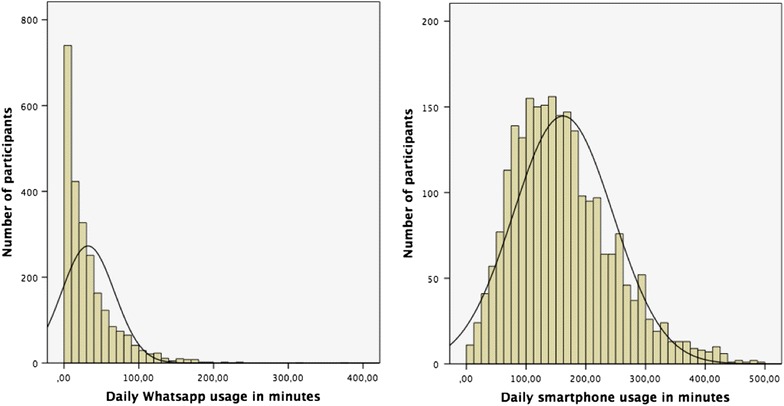
BACKGROUND: Mounting evidence shows that smartphone usage heavily disrupts our work life and social activities. Moreover, it is possible that overuse could resemble addictive tendencies. A key contributing factor to smartphone overuse seems to be usage of the messaging application WhatsApp. Although WhatsApp is one of the most commonly used communication applications on smartphones, research in this area is scarce. Given the huge societal debate on the impact of smartphone usage on our daily lives, the present study undertook a large-scale investigation in order to provide numbers on smartphone usage generally-and use of WhatsApp in particular, with the aim of providing a basis for a scientific debate. METHODS: In a large sample of N = 2,418 users, we recorded WhatsApp behaviour over a 4 week period. RESULTS: Our data show that use of WhatsApp accounted for 19.83% (= 32.11 min) of all smartphone behaviour (compare: Facebook only 9.38% = 15.19 min). The mean of general daily smartphone usage was 161.95 min. Females used WhatsApp for significantly longer periods of time than males and younger age was associated with longer duration of WhatsApp use. While the personality trait Extraversion was positively associated with daily WhatsApp use, Conscientiousness showed an inverse correlation with the length of daily WhatsApp use. CONCLUSIONS: The numbers on smartphone usage in the present study show that the smartphone dominates our daily life. In particular WhatsApp is a driving force, here. Given the length of daily smartphone and WhatsApp usage, more studies need to be conducted to better understand smartphone usage.
Overview
The claims and statistics of this paper haven’t been checked yet.
Free: it reads the open-access text and checks the first 5 claims that cite a source we can check. Create a free account to check every claim.
Integrity signals
Registry
Cites
Statistics
Figures
Verification
Claims the paper makes
The claims and statistics of this paper haven’t been checked yet.
Free: it reads the open-access text and checks the first 5 claims that cite a source we can check. Create a free account to check every claim.
Claims other papers make about this one
Each is checked against this paper’s own text: does it say what the citing paper says it does?
The cited source says what the claim attributes to it.
In the citing paper
“The personality traits were included to serve as covariates, because research has shown that they are related to social media use (Montag et al., 2015; Nowland et al., 2018; Kircaburun et al., 2020).”
From Centennials, FOMO, and loneliness: an investigation of the impact of social networking and messaging/voip apps usage during the initial stage of the coronavirus pandemic (2021) · cites this paper as Montag et al., 2015
In the citing paper
“A large-scale tracking of online behavior showed that the use of WhatApp over the smartphone accounted for nearly 20% of all smartphone behavior, above Facebook use [58].”
From Problematic Use of the Internet and Smartphones in University Students: 2006–2017 (2018) · cites this paper as [58]
Self-check
Percentages, sums and reported differences re-computed from the paper’s own numbers.
The self-check needs the paper’s full text.
Citations
Cites
Rammstedt, B., & John, O. P. (2007) · Journal of Research in Personality · doi:10.1016/j.jrp.2006.02.001 · Cited by 4,244 · cited 2×
“Moreover, the authors of the BFI suggest that “the BFI-10 possesses acceptable psychometric properties” (p. 210, [18]), although the shorter version is accompanied by “substantial losses in comparison to the full-scale BFI”.”
BackgroundMethodThe Smartphone addiction scale: development and validation of a short version for adolescents
Kwon, M., Kim, D.-J., Cho, H., & Yang, S. (2013) · PLoS ONE · doi:10.1371/journal.pone.0083558 · Cited by 2,177 · cited 1×
“It has been suggested that overuse of smartphones may resemble an addiction [2, 3] and overuse is also linked to time distortion, with the result that the smartphone is used for longer than originally intended or perceived [4].”
BackgroundWho interacts on the Web?: The intersection of users’ personality and social media use
Correa, T., Hinsley, A. W., & de Zúñiga, H. G. (2010) · Computers in Human Behavior · doi:10.1016/j.chb.2009.09.003 · Cited by 1,915 · cited 1×
“However, a recent study [21] suggested that high neurotics tend to use Facebook more as it facilitates communication without face-to-face interaction; a hypothesis that may warrant further investigation.”
BackgroundDevelopment and Validation of a Smartphone Addiction Scale (SAS)
Kwon, M., Lee, J.-Y., Won, W.-Y., Park, J.-W., Min, J.-A., Hahn, C., Gu, X., Choi, J.-H., & Kim, D.-J. (2013) · PLoS ONE · doi:10.1371/journal.pone.0056936 · Cited by 1,670 · cited 1×
“It has been suggested that overuse of smartphones may resemble an addiction [2, 3] and overuse is also linked to time distortion, with the result that the smartphone is used for longer than originally intended or perceived [4].”
BackgroundFacebook Use Predicts Declines in Subjective Well-Being in Young Adults
Kross, E., Verduyn, P., Demiralp, E., Park, J., Lee, D. S., Lin, N., Shablack, H., Jonides, J., & Ybarra, O. (2013) · PLoS ONE · doi:10.1371/journal.pone.0069841 · Cited by 1,596 · cited 1×
“In contrast to the small body of literature on WhatsApp, the past few years reflect a focus on social network usage, such as Facebook, when investigating smartphone behaviour or Internet usage (e.g. [11]).”
ResultRyan, T., & Xenos, S. (2011) · Computers in Human Behavior · doi:10.1016/j.chb.2011.02.004 · Cited by 1,260 · cited 1×
“Moreover, it is noteworthy that most previous studies have relied solely on self-report data to measure human–machine interaction [12, 13].”
ResultBeginning the workday yet already depleted? Consequences of late-night smartphone use and sleep
Lanaj, K., Johnson, R. E., & Barnes, C. M. (2014) · Organizational Behavior and Human Decision Processes · doi:10.1016/j.obhdp.2014.01.001 · Cited by 738 · cited 1×
“Moreover, smartphone overuse (in particular evening usage) seems to be associated with poor sleep quality [5] and reduced work engagement [6], which is not surprising, as new numbers show that about 36–40% of smartphone owners use their smartphone in the last 5 min before going to sleep and/ or in…”
BackgroundWhat's up with whatsapp?: comparing mobile instant messaging behaviors with traditional SMS
Church, K., & de Oliveira, R. (2013) · Proceedings of the 15th international conference on Human-computer interaction with mobile devices and services · doi:10.1145/2493190.2493225 · Cited by 565 · cited 1×
“Recent studies yielded the first evidence that What-sApp usage might have an addictive character [9] and of course WhatsApp represents an important communication alternative to classic short message services, which often incur costs (SMS; [10]).”
The influence of personality on Facebook usage, wall postings, and regret
Moore, K., & McElroy, J. C. (2012) · Computers in Human Behavior · doi:10.1016/j.chb.2011.09.009 · Cited by 542 · cited 1×
“Moreover, it is noteworthy that most previous studies have relied solely on self-report data to measure human–machine interaction [12, 13].”
ResultPersonality and self reported mobile phone use
Butt, S., & Phillips, J. G. (2008) · Computers in Human Behavior · doi:10.1016/j.chb.2007.01.019 · Cited by 517 · cited 1×
“In keeping with earlier smart-phone studies on Extraversion and call behaviour (e.g. [16, 20]), extraverts also use WhatsApp for longer durations compared with introverts.”
Background
Cited by
Items 101–200 of 405
How Are Personality States Associated with Smartphone Data?
Rüegger, D., Stieger, M., Nißen, M., Allemand, M., Fleisch, E., & Kowatsch, T. (2020) · European Journal of Personality · doi:10.1002/per.2309 · Cited by 36
“One of the earliest large studies investigated usage patterns of WhatsApp and other mobile applications and found that extraversion was positively associated with the duration of daily WhatsApp use, while conscientiousness was negatively related (Montag et al., 2015).”
BackgroundEvaluation of smartphone addiction and related factors among university students
Zencirci, S. A., Aygar, H., Göktaş, S., Önsüz, M. F., Alaiye, M., & Metintaş, S. (2018) · International Journal of Research in Medical Sciences · doi:10.18203/2320-6012.ijrms20182805 · Cited by 46
“In addition, there are studies demonstrating that an online messaging service named ‘Whatsapp’ consists of 20 % of daily smartphone usage and gaming on smartphones are related with smartphone addiction.(34,35) Including negative relationships of telephone calling, e-mail and news reading with smartphone addiction, it…”
Backgroundde Gruchy, T., Vearey, J., Opiti, C., Mlotshwa, L., Manji, K., & Hanefeld, J. (2021) · Globalization and Health · doi:10.1186/s12992-021-00727-y · Cited by 43
A System for Monitoring Public Political Groups in WhatsApp
Resende, G., Messias, J., Silva, M., Almeida, J. M., Vasconcelos, M., & Benevenuto, F. (2018) · Brazilian Symposium on Multimedia and the Web · doi:10.1145/3243082.3264662 · Cited by 39
“Alguns estudos monitoraram usuários do WhatsApp [6, 8], que vo-luntariamente permitiram a coleta de dados ou estatísticas como tempo médio de uso do aplicativo.”
BackgroundMazzoni, E., Cannata, D., & Baiocco, L. (2016) · Behaviour and Information Technology · doi:10.1080/0144929x.2016.1159249 · Cited by 44
“Further negative relationships have been underlined by Montag and colleagues (Montag, B ł aszkie-wicz, Sariyska, et al. 2015), who described the disruptive effects of online social network-messages on fl ow and concentration.”
BackgroundBalerna, M., & Ghosh, A. (2018) · npj Digital Medicine · doi:10.1038/s41746-017-0011-3 · Cited by 35
Monitoring Health Factors in Indoor Living Environments Using Internet of Things
Marques, G., & Pitarma, R. (2017) · Advances in intelligent systems and computing · doi:10.1007/978-3-319-56538-5_79 · Cited by 37
Tan, W.-K., Hsiao, Y.-J., Tseng, S., & Chan, C. (2017) · Telematics and Informatics · doi:10.1016/j.tele.2017.11.007 · Cited by 41
Dogruel, L., & Schnauber-Stockmann, A. (2020) · Mobile Media & Communication · doi:10.1177/2050157920943926 · Cited by 37
“Furthermore, previous findings showed that users differ greatly in their IM messaging patterns, for instance with regard to the number of messages they send and receive (for the case of WhatsApp, see Montag et al., 2015).”
BackgroundMethodMarengo, D., Elhai, J. D., & Montag, C. (2023) · Journal of Personality · doi:10.1111/jopy.12817 · Cited by 43
“…used different versions of Big Five measures (e.g., TIPI, NEO-FFI, TSDI, etc.) and included different sets of recorded variables (e.g., call activity, social media use, gaming, etc.) from the smartphone to shed light on human personality (e.g., Montag et al., 2015, 2019; Stachl et al., 2017).”
Self-citationCross-generational analysis of information seeking behavior of smartphone users
Zhitomirsky‐Geffet, M., & Blau, M. (2017) · Aslib Journal of Information Management · doi:10.1108/ajim-04-2017-0083 · Cited by 45
“According to the literature (Montag et al., 2015), WhatsApp was a significant factor in social information seeking but only in the Z generation.”
InfluentialPsychopathology of Everyday Life in the 21st Century: Smartphone Addiction
Lin, Y., Lin, S., Yang, C. C. H., & Kuo, T. B. J. (2017) · Studies in neuroscience, psychology and behavioral economics · doi:10.1007/978-3-319-46276-9_20 · Cited by 35
Oehlschläger, D., Glas, A. H., & Eßig, M. (2023) · Industrial Management & Data Systems · doi:10.1108/imds-07-2023-0467 · Cited by 36
Consent and engagement, security, and authentic living using wearable and mobile health technology
Kreitmair, K., Cho, M. K., & Magnus, D. C. (2017) · Nature Biotechnology · doi:10.1038/nbt.3887 · Cited by 35
Covid-19 and Islamic Education in School: Searching for Alternative Learning Media
Zaini, H., oni, A., Hadi, A., Sofyan, F. A., sal, F., rin, P., & Ḥamzah, A. (2021) · Webology · doi:10.14704/web/v18i1/web18080 · Cited by 43
“The use of this application on smartphones was 161.95 minutes a day (Montag et al., 2015).”
InfluentialMangialavori, S., Russo, C., Jiménez, M. V. J., Ricarte, J. J., D’Urso, G., Barni, D., & Cacioppo, M. (2021) · European Journal of Investigation in Health Psychology and Education · doi:10.3390/ejihpe11030075 · Cited by 31
How do consumers perceive mobile self-checkout in fashion retail stores?
Liang, Y., Lee, S., & Workman, J. E. (2021) · International Journal of Retail & Distribution Management · doi:10.1108/ijrdm-08-2020-0299 · Cited by 36
Falcão, R. P. D. Q., Ferreira, J. B., & Filho, M. C. M. D. C. (2019) · Information Technology & Tourism · doi:10.1007/s40558-019-00154-1 · Cited by 31
“…platforms to reduce loneliness and create a sense of belonging (Amichai-Hamburger and Ben-Artzi 2003; Amiel and Sargent 2004; Correa et al. 2010; Montag et al. 2015; Islam et al. 2017), overuse their smartphones (Jenaro et al. 2007; Beranuy et al. 2009; Augner and Hacker 2012; Roberts et al.…”
BackgroundInfluentialSeufert, A., Poignée, F., Hoßfeld, T., & Seufert, M. (2022) · Humanities and Social Sciences Communications · doi:10.1057/s41599-022-01161-0 · Cited by 29
Addiction-Like Mobile Phone Behavior – Validation and Association With Problem Gambling
Fransson, A., Montañés, M. C., & Håkansson, A. (2018) · Frontiers in Psychology · doi:10.3389/fpsyg.2018.00655 · Cited by 31
“…of excessive mobile phone use, and some researchers have even suggested a possible new form of behavioral addiction (Chóliz, 2010; Billieux et al., 2015a; Haug et al., 2015; Montag et al., 2015; Nikhita et al., 2015; World Health Organization, 2015; Long et al., 2016; Sapacz et al., 2016).”
BackgroundSocial Media as a Promotional Tool in the Fashion Industry: A Case Study on Meta Platforms Inc.
Madhura, K., & Panakaje, N. (2022) · International Journal of Case Studies in Business IT and Education · doi:10.47992/ijcsbe.2581.6942.0168 · Cited by 44
“[58] India Social Media Statistics 2022 | Mobile & Internet Statistics.”
BackgroundInfluentialTecnoestrés en población mexicana y su relación con variables sociodemográficas y laborales
Villavicencio-Ayub, E., Aguilar, D. G. I., & Calleja, N. (2020) · psicogente · doi:10.17081/psico.23.44.3473 · Cited by 51
Lupo, R., Zacchino, S., Caldararo, C., Calabrò, A., Carriero, M. C., Santoro, P., Carvello, M., & Conte, L. (2022) · Epidemiology Biostatistics and Public Health · doi:10.2427/13272 · Cited by 30
“Therefore, the majority of the world’s population uses electronical devices to communicate [3] with an estimated of 56% in the United States [4], 72% in Germany [5] and 79% in Switzerland [6].”
BackgroundSindermann, C., Kuss, D. J., Throuvala, M. A., Griffiths, M. D., & Montag, C. (2020) · Frontiers in Psychology · doi:10.3389/fpsyg.2020.01415 · Cited by 31
Self-citationThe Relationship of Smartphone Addiction and Alexithymia
Gündoğmuş, İ., Aydın, M. S., & Algül, A. (2021) · Psychiatry Investigation · doi:10.30773/pi.2021.0072 · Cited by 37
Sindermann, C., Yang, H., Liu, T., Elhai, J. D., & Montag, C. (2021) · Journal of Technology in Behavioral Science · doi:10.1007/s41347-020-00179-y · Cited by 31
Self-citationRozgonjuk, D., Blinka, L., Löchner, N., Faltýnková, A., Husárová, D., & Montag, C. (2023) · Child and Adolescent Psychiatry and Mental Health · doi:10.1186/s13034-023-00620-z · Cited by 33
“On the other hand, the application use may be slightly different, because some social media use (e.g., Instagram, WhatsApp) is optimized for smartphones.”
BackgroundInfluentialSelf-citationKalal, N., Vel, N. S., Angmo, S., Choyal, S., Bishnoi, S., Dhaka, S., Rulaniya, S., & Banswal, S. (2023) · Investigación y Educación en Enfermería · doi:10.17533/udea.iee.v41n2e11 · Cited by 45
Molecular Genetics, Personality, and Internet Addiction Revisited
Montag, C., & Reuter, M. (2017) · Studies in neuroscience, psychology and behavioral economics · doi:10.1007/978-3-319-46276-9_9 · Cited by 33
Self-citationPsychological and neuroscientific advances to understand Internet Use Disorder
Becker, B., & Montag, C. (2019) · e-Neuroforum · doi:10.1515/nf-2018-0026 · Cited by 27
“Application of computer science methods in IUD research and treatment will help paint a more refined picture of actual online usage, which may be a highly relevant means to reflect on one’s own online behavior (Lin et al., 2015; Montag et al., 2015b).”
BackgroundSelf-citationInterprofessional Communication of Physicians Using WhatsApp: Physicians' Perspective
Shaarani, I., El-Kantar, A., Hamzeh, N., Jounblat, M., El-Yaman, T., Habanjar, M., Halawi, N., Itani, A., & Soubra, R. (2020) · Telemedicine Journal and e-Health · doi:10.1089/tmj.2019.0216 · Cited by 29
Aizenkot, D., & Kashy‐Rosenbaum, G. (2020) · The Journal of Early Adolescence · doi:10.1177/0272431620931203 · Cited by 34
“As one such site (Cetinkaya, 2017), WhatsApp enjoys enormous popularity worldwide (Montag et al., 2015; Sánchez-Moya & Cruz-Moya, 2015), and especially in Israel (Bezeq, 2019; Israel National Council for the Child, 2019).”
BackgroundRejón‐Guardia, F. (2024) · British Food Journal · doi:10.1108/bfj-03-2024-0222 · Cited by 32
WhatsApp addiction and borderline personality disorder: A new therapeutic challenge
Faye, A. D., Gawande, S., Tadke, R., Kirpekar, V., & Bhave, S. H. (2016) · Indian Journal of Psychiatry · doi:10.4103/0019-5545.183790 · Cited by 24
Exploring the relationship between personality structure and smartphone usage
Burtăverde, V., Sebastian, V., & Avram, E. (2019) · Current Psychology · doi:10.1007/s12144-019-00521-5 · Cited by 22
Sindermann, C., Yang, H., Yang, S., Elhai, J. D., & Montag, C. (2022) · Acta Psychologica · doi:10.1016/j.actpsy.2021.103462 · Cited by 24
Self-citationTalking about Chat at Work in the Global South: An Ethnographic Study of Chat Use in India and Kenya
McGregor, M., Bidwell, N. J., Sarangapani, V., Appavoo, J., & O’Neill, J. (2019) · CHI Conference on Human Factors in Computing Systems · doi:10.1145/3290605.3300463 · Cited by 26
The interplay between social media use and problematic internet usage: Four behavioral patterns
Chemnad, K., Aziz, M., Belhaouari, S. B., & Ali, R. (2023) · Heliyon · doi:10.1016/j.heliyon.2023.e15745 · Cited by 21
“According to previous studies, individuals spend more than half an hour every day using WhatsApp [25].”
MethodLi, Z.-K., Li-juan, S., & Cai, X. (2022) · Frontiers in Psychology · doi:10.3389/fpsyg.2022.1044190 · Cited by 32
Appetite for distraction? A systematic literature review on customer smartphone distraction
Taylor, A., Hook, M., Carlson, J., Gudergan, S. P., & Falk, T. (2023) · International Journal of Information Management · doi:10.1016/j.ijinfomgt.2023.102722 · Cited by 31
“Environmental cues, such as location-based triggers or contextual information (e.g., being in a coffee shop where smartphone use is common), can be associated with specific behavioral signatures (Montag et al., 2015).”
BackgroundSoftware randomness analysis and evaluation of lightweight ciphers: the prospective for IoT security
Qasaimeh, M., Al‐Qassas, R. S., & Tedmori, S. (2018) · Multimedia Tools and Applications · doi:10.1007/s11042-018-5663-8 · Cited by 26
Do we still need psychological self-report questionnaires in the age of the Internet of Things?
Montag, C., Dagum, P., Hall, B. J., & Elhai, J. D. (2022) · Discover Psychology · doi:10.1007/s44202-021-00012-4 · Cited by 29
Self-citationSarıtepeci, M., Durán, A., & Ermiş, U. F. (2019) · Education and Information Technologies · doi:10.1007/s10639-019-09893-4 · Cited by 34
“At this precise point, this study may contribute to the obvious relation between technology and education which has been clarified by previous research (Aljaad 2017; Allagui 2014; Anglano 2014; Ashiyan and Salehi 2016; Awada 2016; Barhoumi 2015; Bouhnik and Deshen 2014; Boyinbode, Agbonifo & Ogundare, 2017; Cavus and…”
BackgroundResultFactors determining speed management during distracted driving (WhatsApp messaging)
Ortiz‐Peregrina, S., Oviedo-Trespalacios, Ó., Ortíz, C., Casares‐López, M., Salas, C. A., & Anera, R. G. (2020) · Scientific Reports · doi:10.1038/s41598-020-70288-4 · Cited by 20
Views and experiences of dermatologists in Turkey about teledermatology during the COVID‐19 pandemic
Altunışık, N., Türkmen, D., Çalıkoğlu, E. E., & Şener, S. (2020) · Journal of Cosmetic Dermatology · doi:10.1111/jocd.13677 · Cited by 22
Öğretmen-Aile İletişiminde WhatsApp Uygulamasının Kullanımı
Balci, A., & Şahin, F. T. (2018) · Gazi Üniversitesi Gazi Eğitim Fakültesi Dergisi · doi:10.17152/gefad.395223 · Cited by 19
Chronemic urgency in everyday digital communication
Kalman, Y. M., Ballard, D. I., & Aguilar, A. M. (2021) · Time & Society · doi:10.1177/0961463x20987721 · Cited by 26
“Our interpretation of these data is that in the US population, there is a meaningful minority of the users who assign it high urgency, as they communicate with users outside the United States, where WhatsApp fulfills the role of texting (e.g., Karapanos et al., 2016; Montag et al., 2015; Shah and Kaushik, 2015; Treré,…”
BackgroundInfluentialDigital literacy: exploration of social media-based Arabic language learning
Raya, I. P., Ilmiani, A. M., Miolo, M. I., & Gorontolo, I. (2021) · Journal of Applied Studies in Language · doi:10.31940/jasl.v5i2.215-221 · Cited by 19
Sümer, C., & Büttner, O. B. (2022) · Frontiers in Psychology · doi:10.3389/fpsyg.2022.918306 · Cited by 44
Getting acquainted with social networks and apps: WhatsApp-ening with mobile instant messaging?
Anderson, K. E. (2016) · Library Hi Tech News · doi:10.1108/lhtn-07-2016-0032 · Cited by 28
Chow, C. K., Islam, S. M. S., Farmer, A. A., Bobrow, K., Maddision, R., Whittaker, R., Dale, L. P., Lechner, A., Niessen, L. W., Lear, S. A., et al. (2016) · BMJ Open · doi:10.1136/bmjopen-2016-012723 · Cited by 20
Montag, C. (2018) · Lecture notes in information systems and organisation · doi:10.1007/978-3-030-01087-4_32 · Cited by 22
Self-citationSheth, F., Chatter, I., Jasra, M., Kumar, G., & Sharma, R. (2025) · Plant Methods · doi:10.1186/s13007-025-01421-5 · Cited by 23
“Given the wide-spread availability of smartphones, including in remote areas, the application is optimized for mobile use to maximize reach and usability across diverse populations [93].”
Students’ Perception in Learning English through Blended Learning
Maulina, M., Andriyani, A. S., Amin, S., Nasrullah, R., Asdar, A., & Hamsiah, A. (2022) · Journal of Education and Teaching (JET) · doi:10.51454/jet.v3i1.138 · Cited by 59
“Montag et al. (2015) said that WhatsApp had become a driving force that smartphones dominate our daily lives. learning through blended learning in this 21st era will lead students to develop, acquire, comprehend, and produce English language extensively for both male and female students (Maulina,…”
BackgroundRoehrick, K., Vaid, S. S., & Harari, G. M. (2023) · Journal of Personality and Social Psychology · doi:10.1037/pspp0000478 · Cited by 28
Insights: Anwendungsmöglichkeiten von passivem Smartphone-Tracking im therapeutischen Kontext
Meßner, E.-M., Sariyska, R., Mayer, B., Montag, C., Kannen, C., Schwerdtfeger, A. R., & Baumeister, H. (2019) · Verhaltenstherapie · doi:10.1159/000501735 · Cited by 20
“Derzeit besitzen rund 36% weltweit und 81% der Deutschen ein Smartphone, welches von Jugendlichen und jungen Erwachsenen im Schnitt 162 Minuten pro Tag aktiv genutzt wird [Montag et al., 2015].”
BackgroundSelf-citationExploring the Use of WhatsApp for Teaching Speaking to English Language Learners: A Case Study
Albogami, A., & Algethami, G. F. (2022) · Arab World English Journal · doi:10.24093/awej/covid2.12 · Cited by 32
“The facts that it is free and can be easily uploaded on different smartphone types lead to its attractiveness to many users (Montag et al., 2015).”
BackgroundNursing-Related Smartphone Activities in the Italian Nursing Population: A Descriptive Study
Pucciarelli, G., Simeone, S., Virgolesi, M., Madonna, G., Proietti, M. G., Rocco, G., & Stievano, A. (2018) · CIN Computers Informatics Nursing · doi:10.1097/cin.0000000000000474 · Cited by 34
Insights – future implications of passive smartphone sensing in the therapeutic context
Messner, E.-M., Sariyska, R., Mayer, B., Montag, C., Kannen, C., Schwerdtfeger, A., & Baumeister, H. (2022) · Verhaltenstherapie · doi:10.1159/000501951 · Cited by 17
“Secondly, humans are prone to recall biases [Montag et al., 2015; Stone and Shiffman, 2002].”
BackgroundSelf-citationLin, C.-Y., Lin, C.-K., Imani, V., Griffiths, M. D., & Pakpour, A. H. (2020) · International Journal of Mental Health and Addiction · doi:10.1007/s11469-019-00124-y · Cited by 17
“…of well-known social media platforms (e.g., Facebook, Twitter, Instagram), there has been a growing interest of research investigating problematic social media use and social media addiction in the contemporary literature on behavioral addiction (Alimoradi et al. 2019; Montag et al. 2015, 2017).”
BackgroundSheth, F., Mathur, P., Gupta, A. K., & Chaurasia, S. (2025) · Engineering Applications of Artificial Intelligence · doi:10.1016/j.engappai.2025.111425 · Cited by 23
Factors Directing Students to Academic Digital Reading
Keskin, H. K., Baştuğ, M., & Atmaca, T. (2016) · TED EĞİTİM VE BİLİM · doi:10.15390/eb.2016.6655 · Cited by 17
“For example, Montag et al. (2015) states that smart phones are used for 161 minutes on average daily, and WhatsApp is responsible for average 32 minutes and applications such as Facebook are responsible for average 15 minutes of the total duration.”
BackgroundValidación de un cuestionario diseñado para medir frecuencia y amplitud de uso de las TIC
Rodríguez, V. J., Alvarado, J. M., & Pablos, C. L. (2017) · Edutec Revista Electrónica de Tecnología Educativa · doi:10.21556/edutec.2017.61.949 · Cited by 33
Aguirre, P. E. A., Lotto, M., Strieder, A. P., Cruvinel, A. F. P., & Cruvinel, T. (2019) · JMIR Research Protocols · doi:10.2196/13656 · Cited by 22
Dunne, D. M., Lefevre, C. E., Cunniffe, B., Tod, D., Close, G. L., Morton, J. P., & Murphy, R. (2019) · Journal of Sports Sciences · doi:10.1080/02640414.2019.1642052 · Cited by 25
“, (Montag et al., 2015) found that WhatsApp now accounts for an average of 20% of an individuals phone usage, with users averaging approximately 32 minutes a day on the platform.”
BackgroundDAENet: Making Strong Anonymity Scale in a Fully Decentralized Network
Shen, T., Jiang, J., Jiang, Y., Chen, X., Qi, J., Zhao, S., Zhang, F., Luo, X., & Cui, H. (2021) · IEEE Transactions on Dependable and Secure Computing · doi:10.1109/tdsc.2021.3052831 · Cited by 24
Gertz, M., Schütz‐Bosbach, S., & Diefenbach, S. (2021) · Multimodal Technologies and Interaction · doi:10.3390/mti5110067 · Cited by 21
Ceolini, E., Kock, R., Band, G. P. H., Stoet, G., & Ghosh, A. (2022) · iScience · doi:10.1016/j.isci.2022.104791 · Cited by 19
Noise Mapping Through Mobile Crowdsourcing for Enhanced Living Environments
Marques, G., & Pitarma, R. (2019) · Lecture notes in computer science · doi:10.1007/978-3-030-22744-9_52 · Cited by 18
“About 36– 40% of smartphone owners use their smartphone 5 minutes before bed and in the next 5 minutes after wake up [32].”
BackgroundWhatsApp groups: channel for sharing information among LIS professionals in Nigeria
Udem, O. K., Aghoghovwia, D. U., & Baro, E. E. (2020) · The Electronic Library · doi:10.1108/el-12-2019-0289 · Cited by 16
de Mello, L. T. N., Trintin-Rodrigues, V., & Andretta, I. (2019) · Quaderns de Psicologia · doi:10.5565/rev/qpsicologia.1463 · Cited by 27
Li, H., Yue, J., Wang, Y., Zou, F., Zhang, M., & Wu, X. (2021) · Frontiers in Human Neuroscience · doi:10.3389/fnhum.2021.636504 · Cited by 20
Paudel, V. (2022) · JAAD International · doi:10.1016/j.jdin.2022.02.011 · Cited by 15
“10-12 Among the various skin disorders, the diagnosis was straightforward in patients with common diseases such as acne, tinea, alopecia, bacterial infections, eczema, viral infections, and pigmentary disorders.”
Schoedel, R., Oldemeier, M., Bonauer, L., & Sust, L. N. N. (2022) · Journal of Open Psychology Data · doi:10.5334/jopd.59 · Cited by 24
Whatsappsport: Using Whatsapp While Viewing Sports Events
Tamir, I. (2020) · Journal of Sport and Social Issues · doi:10.1177/0193723520907624 · Cited by 22
“Although Whatsapp is one of the most widespread smartphone apps, research on this application remains limited (Montag et al., 2015).”
BackgroundRaz, A. E., Amano, Y., & Timmermans, S. (2018) · New Genetics and Society · doi:10.1080/14636778.2018.1451315 · Cited by 19
“Being cost-free, in addition to its functionality across different smartphone types (Apple, Android, etc.) and its international functionality, explain this app’s growing popularity – more than half billion downloads in 2014 (Montag et al. 2015).”
BackgroundInfluentialWenerda, I. (2022) · International Journal of Communication and Society · doi:10.31763/ijcs.v4i2.252 · Cited by 15
“Until now, approximately 1.5 billion people have downloaded and used WhatsApp [10].”
BackgroundInfluentialNardo, B., Lugaresi, M., Doni, M., Vulcano, I., Piccione, D., Paglione, D., & Stabile, G. (2021) · Minerva Surgery · doi:10.23736/s2724-5691.20.08454-0 · Cited by 17
Peterka‐Bonetta, J., Sindermann, C., Elhai, J. D., & Montag, C. (2021) · Human Behavior and Emerging Technologies · doi:10.1002/hbe2.243 · Cited by 23
Self-citationThe Impact of Psychoinformatics on Internet Addiction Including New Evidence
Montag, C., Reuter, M., & Markowetz, A. (2017) · Studies in neuroscience, psychology and behavioral economics · doi:10.1007/978-3-319-46276-9_13 · Cited by 16
Self-citationDeveloping EFL Writing Skills through WhatsApp Dialogue Journaling
Noyan, E., & Koçoğlu, Z. (2019) · Advances in Language and Literary Studies · doi:10.7575/aiac.alls.v.10n.2p.38 · Cited by 25
Møgelvang, A., & Grassini, S. (2025) · Discover Education · doi:10.1007/s44217-025-00657-6 · Cited by 16
“However, as technology has developed and incorporated a social aspect, e.g., social media, while having been introduced into young peoples’ lives through e.g. smart phones, it has been hypothesized that the gender gap might lessen [62].”
Helmy, M. S., Ebrahim, A. H., Faqeeh, A., Engel, E., Ashraf, F., & Buremoh, A. I. (2024) · Oman Medical Journal · doi:10.5001/omj.2024.50 · Cited by 17
Percepción de actitudes nocivas en el uso de las redes sociales en los jóvenes adolescentes
Romero, C. S., & Berlanga, M. C. L. (2020) · Revista Interuniversitaria de Investigación en Tecnología Educativa · doi:10.6018/riite.401801 · Cited by 18
“También la mensajería instantánea a través de WhatsApp como muestran estudios de Montag et al. (2015) contribuye al uso excesivo de los teléfonos inteligentes en los jóvenes adolescentes.”
BackgroundSariyska, R., & Montag, C. (2019) · Studies in neuroscience, psychology and behavioral economics · doi:10.1007/978-3-030-31620-4_4 · Cited by 13
Self-citationWhatsApp: Kehadiran, Aktivitas Belajar, dan Hasil Belajar
Salam, M. (2020) · Jurnal Pendidikan Matematika · doi:10.36709/jpm.v11i2.11675 · Cited by 12
Interpersonal Communication Motives for Flirting Face to Face and Through Texting
Punyanunt-Carter, N. M., & Wagner, T. R. (2018) · Cyberpsychology Behavior and Social Networking · doi:10.1089/cyber.2017.0608 · Cited by 12
Teens’ Motivations to Spread Fake News on WhatsApp
Herrero-Diz, P., Jiménez, J. C., & de Cózar, S. R. (2020) · Deposito de Investigacion Universidad de Sevilla (University of Seville) · doi:10.25384/sage.c.5106563.v1 · Cited by 12
Studying Psychopathology in Relation to Smartphone Use
Rozgonjuk, D., Elhai, J. D., & Hall, B. J. (2019) · Studies in neuroscience, psychology and behavioral economics · doi:10.1007/978-3-030-31620-4_11 · Cited by 14
WhatsApp? Opportunities and Challenges in the Use of a Messaging App as a Qualitative Research Tool
Bueno-Roldan, R., & Röder, A. (2022) · The Qualitative Report · doi:10.46743/2160-3715/2022.5329 · Cited by 29
Cruz‐Cárdenas, J., Guadalupe-Lanas, J., Забелина, Е. В., Palacio-Fierro, A., Velín-Fárez, M., & Staniewski, M. W. (2019) · Academia Revista Latinoamericana de Administración · doi:10.1108/arla-02-2019-0044 · Cited by 16
An Examination of How Social and Technological Perceptions Predict Social Media News Use on WeChat
Peng, Z., & Miller, S. (2021) · Journalism Practice · doi:10.1080/17512786.2021.1925948 · Cited by 11
“Additionally, media and communication scholars primarily focus on examining the social media behaviors of people from Western countries (Montag et al. 2015).”
BackgroundThe relationship between problematic internet use, WhatsApp and personality
Bernal-Ruiz, C., & Alcázar, A. I. R. (2022) · Europe’s Journal of Psychology · doi:10.5964/ejop.2051 · Cited by 18
“In relation to WhatsApp, statistically significant differences were observed in the problematic use of WhatsApp and in the total score of the WANIS, with the highest average scores corresponding to women in both cases (Montag et al., 2015).”
MethodAhmad, S., Zulfikar, T., & Hardiana, F. (2020) · Humanities & Social Sciences Reviews · doi:10.18510/hssr.2020.8348 · Cited by 11
Hodes, L. N., Oosthuizen, J., Henry, M., & Thomas, K. G. F. (2022) · Development Southern Africa · doi:10.1080/0376835x.2021.2003757 · Cited by 10
“We changed one item on the original version, from MMS to instant messaging, because individuals tend use the latter (e.g. WhatsApp platforms) rather than the outmoded former (Montag et al. 2015).”
MethodSmartphone, menores y vulnerabilidades. Revisión de la literatura
Pastor, E. M., Catalina-García, B., & López, M. C. L. D. A. (2019) · Revista Mediterránea de Comunicación · doi:10.14198/medcom2019.10.2.5 · Cited by 17
Social Media and Social Bonding in Students' Decision-Making Regarding Their Study Path
Dirin, A., Nieminen, M., & Alamäki, A. V. (2020) · International Journal of Information and Communication Technology Education · doi:10.4018/ijicte.2021010106 · Cited by 16
Manning, R., & Brook-Rowland, P. (2023) · International Journal of Human-Computer Interaction · doi:10.1080/10447318.2023.2247557 · Cited by 9
“Participants thereby indicated a broader knowledge about the app and its dominance as a messaging app (Montag et al., 2015; Statista, 2022).”
İnternet Bağımlılığı, Akıllı Telefon Bağımlılığı ve Psikolojik İyi Oluş: Yalnızlığın Aracı Rolü
TOPAL, N., Odacı, H., & ÖZER, Ş. (2023) · Gazi Üniversitesi Gazi Eğitim Fakültesi Dergisi · doi:10.17152/gefad.1140695 · Cited by 13
What Whatsapp Status Enables Reseller to Do as Channel
(2019) · International Journal of Innovative Technology and Exploring Engineering · doi:10.35940/ijitee.i3009.0789s319 · Cited by 9
Metadata
- Authors
- Montag, C., Błaszkiewicz, K., Sariyska, R., Lachmann, B., Andone, I., Trendafilov, B., Eibes, M., & Markowetz, A.
- Affiliations
- Universität Ulm (DE)
- University of Bonn (DE)
- Corresponding author
- Montag, Christian
- ORCID
- Venue
- BMC Research Notes
- Published
- 2015-08-04
- Volume
- 8
- Issue
- 1
- Pages
- 331-331
- ISSN
- 1756-0500 (ISSN-L)
- PMC
- PMC4522968
- OpenAlex
- W2170301618
- Semantic Scholar
- adb0257f598c6ffe3d827c7ddf7ac0eece7ee563
- Cited by
- 408
- References
- 20
- Citations by year
- 2026: 16 · 2025: 19 · 2024: 17 · 2023: 36 · 2022: 42 · 2021: 68 · 2020: 64 · 2019: 60 · 2018: 36 · 2017: 31 · 2016: 17 · 2015: 2
- FWCI
- 94.89
- Type
- journal article
- Language
- en
- Open access
- gold
- doi.org
- Licence
- cc-by
- Locations
- BMC Research Notes (publishedVersion, cc-by)
- Europe PMC (PubMed Central) (publishedVersion, cc-by)
- PubMed Central (publishedVersion, cc-by)
- PubMed (publishedVersion)
- Funders
- Deutsche Forschungsgemeinschaft (MO-2363/3-1, 2363/3-1, 2363/2-1, MO 2363/2-1)
- Topics
- Social Sciences › Sociology and Political Science › Impact of Technology on Adolescents
- Social Sciences › Decision Sciences › Information Systems and Management › Personal Information Management and User Behavior
- Social Sciences › Communication › Media and Digital Communication
- Keywords
- smartphone use, WhatsApp, messaging apps, smartphone overuse, daily screen time, gender differences, age differences, personality traits, extraversion, conscientiousness, Facebook
- MeSH terms
- Smartphone, Adolescent, Adult, Communication, Female, Humans, Male, Internet, Young Adult, Text Messaging, Social Networking, Mobile Applications
About these checks
Registry, retraction, Cites and statistics results are computed, not judged, with one exception: a printed reference that no index lists is read once by a model before it counts as a citation error. Claims are extracted by a model and kept only when their quote appears verbatim in the text; each cited source is then checked, with a model’s help, for whether it says what the claim relies on. Those verdicts can be wrong — read the claim’s quote and the cited source before relying on one.
Statistics and arithmetic are recomputed, not judged.
Confidence bands are shown only for fields calibrated on our annotated test set. None is calibrated yet, so no band is shown.
What counts as a claim ›How we measure confidence ›How we check this ›
Are you an author, or do you see a problem with this page? Request a review
Data sources
Bibliographic data: Semantic Scholar, OpenAlex, Crossref.
Contains information from the Semantic Scholar Academic Graph Datasets, made available under the ODC Attribution License (ODC-BY 1.0).
Semantic Scholar’s data is described in: Kinney, R., et al. (2023). The Semantic Scholar Open Data Platform. arXiv:2301.10140.
